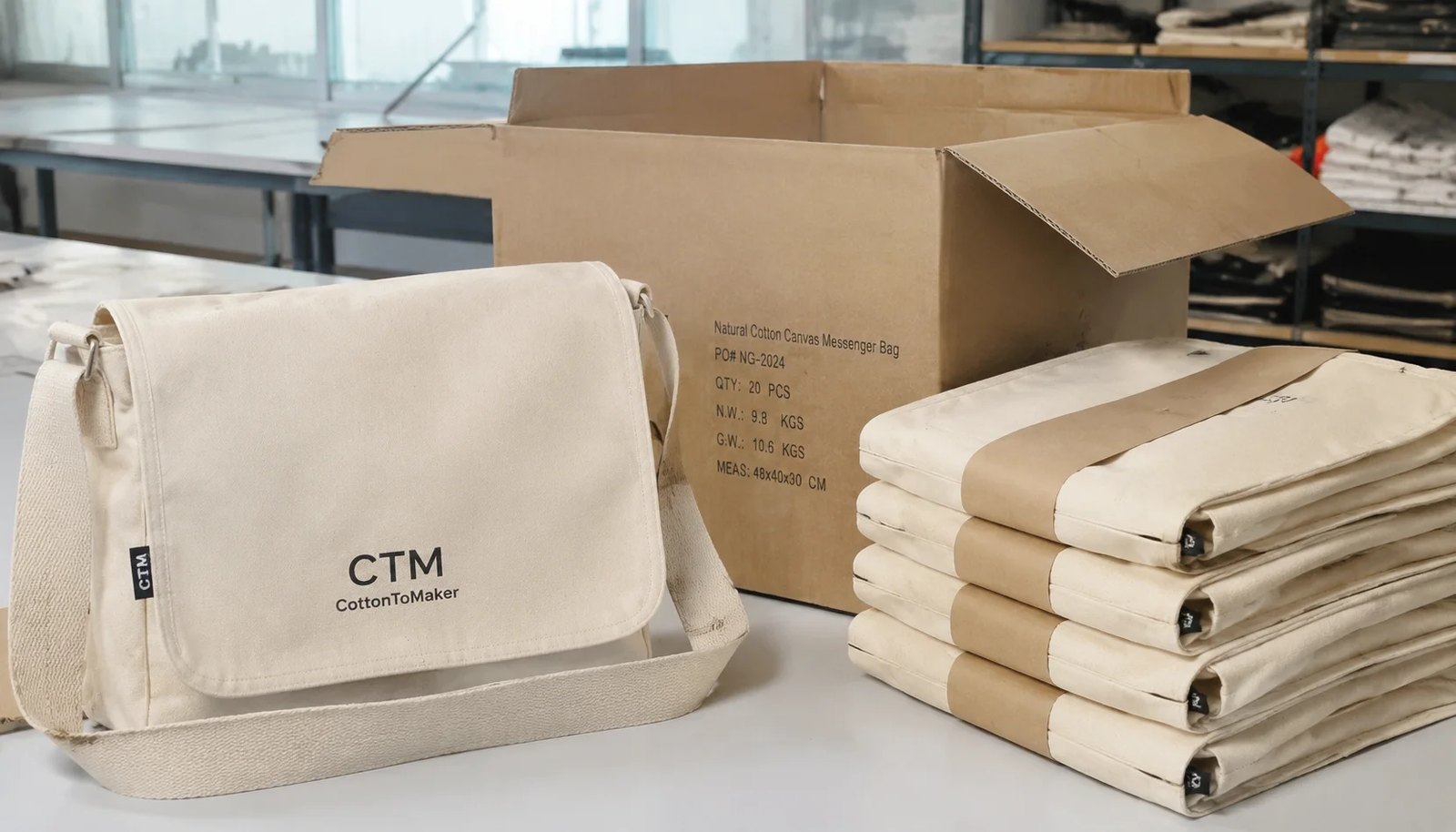
Why carton planning matters for messenger bags in natural grocer programs
Canvas messenger bags are not packed like flat grocery totes. The flap, shoulder strap, pocket layers, and reinforced sewing create bulk in uneven places. If the carton plan is left until the end of production, the factory may simply force more bags into a carton to reduce CBM on paper. That can wrinkle the flap, twist the strap, and make the first retail presentation look lower quality than the approved sample.
Natural grocers also have different handling conditions from fashion boutiques. Bags may ship to a central DC, then split by store, then sit in a backroom near produce boxes, paper goods, or refrigerated receiving areas. A carton plan should protect the bag while also allowing fast count verification and store allocation. The practical target is not the smallest carton; it is a carton that protects the bag, fits pallet or LCL handling, and supports predictable landed cost.
- Main buying problem: avoid carton decisions that reduce quoted freight but create creased, dirty, or hard-to-distribute bags.
- Best timing: define carton quantity and folded packing during sampling, before confirming bulk price.
- Key documents: product specification sheet, artwork file, packing instruction, carton mark layout, and final quote with CBM.
Start with bag construction before calculating carton quantity
The same outside size can produce very different carton volumes depending on construction. A simple 38 x 30 cm messenger bag with one flap and cotton strap can fold nearly flat. Add a bottom gusset, padded laptop panel, metal hardware, zipper pocket, or thick adjustable strap and the carton count drops quickly. For natural grocer programs, buyers often need a practical carry bag rather than a commuter laptop bag, so overbuilding the structure can create avoidable freight cost.
A useful RFQ should describe the body size, flap size, strap type, pockets, closure, and reinforcement method. Do not rely on a reference photo alone. A factory can quote a low price by simplifying the strap, reducing canvas weight, or removing reinforcement that is not visible in the photo. When carton planning is part of the RFQ, those shortcuts become easier to identify because the carton quantity and gross weight will not match the promised construction.
- Common body size range: about 34-40 cm wide and 28-32 cm high for retail promo messenger bags.
- Typical flap: single-layer or double-layer canvas; double-layer improves feel but adds bulk.
- Practical strap: fixed cotton webbing for lower cost; adjustable strap if fit range is important.
- Reinforcement: box-X stitching or bartack at strap tabs is usually more important than decorative hardware.
Fabric weight and GSM drive both perceived value and freight density
For canvas messenger bags, fabric weight is one of the first cost and packing drivers. A 10 oz canvas, roughly 339 GSM, is easier to fold and gives good carton density, but may feel soft if the bag carries books, bottles, or staff materials. A 12 oz canvas, around 407 GSM, is a stronger middle option for natural grocer branding. A 14 oz canvas, around 475 GSM, feels premium but increases cutting weight, sewing difficulty, carton volume, and freight.
Natural canvas is often the most efficient starting point because it avoids dye MOQ and color-lot risk. Dyed canvas can support store colors or private-label branding, but it changes the sourcing calculation. The fabric mill may require a dye lot MOQ, and the factory may need extra lead time for lab dip approval and shade control. If the program is a first launch or multi-store test, natural canvas with a strong print and woven side label is usually easier to control.
- 10 oz / about 339 GSM: cost-efficient, folds well, better for light-duty giveaways.
- 12 oz / about 407 GSM: balanced option for retail-quality messenger bags.
- 14 oz / about 475 GSM: premium handfeel, higher freight and sewing cost, lower carton count.
- Dyed canvas: confirm colorfastness, shade tolerance, dye MOQ, and whether shrinkage changes finished dimensions.
- Washed canvas: softer handfeel but more variable measurement and higher processing cost.
Print method affects drying time, packing risk, and carton claims
Most natural grocer artwork uses one to three solid colors, simple typography, leaf or produce graphics, and a practical brand mark. Water-based screen printing is often the best match because it keeps a softer handfeel on canvas and supports a less plastic-looking finish. Pigment discharge is not normally relevant for natural cotton canvas unless the fabric is dyed. Heat transfer can reproduce detailed artwork, but it may look less aligned with a natural-material message and can crack if the bag is folded through the print area.
Packing risk appears when print coverage is large or production is rushed. If ink is not fully cured before folding, printed flaps can block, pick up marks, or transfer to the bag body. A carton plan should therefore include curing time, stacking method after print, and a basic rub or tape test before packing. For large flap artwork, it is better to fold in a way that avoids hard pressure directly across the printed area.
- Screen print: best for solid logos, lower setup cost for repeat programs, good durability when cured correctly.
- Heat transfer: useful for gradients or small details, but test flexibility on the flap fold.
- Embroidery: premium but adds cost, thread color control, and slight packing pressure around the stitched area.
- Woven label: good for subtle CTM-style side labels or private-label detail, but has its own MOQ and lead time.
- Print acceptance: define color reference, print size, position tolerance, and curing check.
Build the carton plan from folded dimensions, not catalog dimensions
A common quote error is using the finished bag size to guess carton size. Messenger bags are packed after folding the flap, arranging the strap, and stacking layers. The folded dimension may be larger than expected because the strap creates a raised section. If the strap is placed randomly, every carton can have a different height and the top layer may be crushed when sealed.
During sampling, the factory should provide a folded packing photo and a trial carton count. Buyers can then compare three figures: pieces per carton, gross weight per carton, and CBM per piece. The cheapest unit price may not be the cheapest landed cost if the carton contains too much air or if the packing causes rework after arrival. For LCL shipments, carton cube matters. For full container shipments, both cube and carton strength matter because high stacks increase compression.
- Request folded size of one bag, including strap arrangement.
- Define whether straps are tucked inside, wrapped around the body, or laid straight within the stack.
- Set carton count after trial packing, not by estimate from a spreadsheet.
- Record carton dimensions in centimeters and inches if your import system uses both.
- Compare CBM per 1,000 pcs when reviewing supplier quotes.
Carton size, board strength, and warehouse handling limits
A practical export carton for canvas messenger bags often falls near 55 x 40 x 35 cm, but the right size depends on the folded bag and target carton quantity. A larger carton may reduce carton count, but it can become awkward for store or DC staff and may crush more easily. A smaller carton improves handling and count control, but too many cartons can raise origin handling charges and warehouse labor.
Gross weight is an operational issue, not just a shipping number. A carton filled with 14 oz canvas messenger bags can become heavy before it looks full. Procurement teams should align maximum carton weight with their warehouse or 3PL rules. If there is no internal rule, many buyers keep promotional textile cartons in a manageable range rather than pushing maximum weight. The carton board grade, sealing tape, and inner liner should be specified when natural canvas must arrive clean.
- Set a maximum gross weight before the factory locks carton quantity.
- Use stronger double-wall carton for heavy canvas, long transit, or high stacking.
- Specify clean inner liner or kraft paper sheet if avoiding individual polybags.
- Confirm carton marks include PO number, item number, color, quantity, carton number, and gross/net weight.
- Do not allow mixed carton quantities unless the packing list clearly identifies the exception.
MOQ logic: why carton planning changes the real order quantity
MOQ for canvas messenger bags is not only a sewing-line number. The real MOQ comes from canvas procurement, webbing color, printing setup, label production, carton printing, and cutting efficiency. Natural canvas with standard cotton webbing can support lower starting volumes than custom dyed canvas with a matching strap and woven label. If a supplier quotes a low MOQ, the buyer should identify which parts are stock and which are custom.
Carton quantity also affects order rounding. If the approved carton pack is 30 pcs and the buyer orders 1,000 pcs, the last carton will be short. That may be acceptable, but it must be shown on the packing list. Some retailers prefer full master cartons for store allocation, which means the order should be rounded to 990 or 1,020 pcs. For natural grocers distributing to many locations, carton multiples can simplify store splits and reduce repacking labor.
- Separate MOQ by fabric, webbing, printing, label, and finished bag.
- Use carton multiples when the program ships to multiple stores or DCs.
- Clarify whether overruns and underruns are allowed, commonly within a small agreed percentage.
- For mixed artwork by region, confirm whether each print version has its own screen setup and minimum.
- For private-label cartons, confirm minimum carton printing quantity or use neutral cartons with labels.
Sample approval should include a packed-carton review
Many buyers approve the bag sample but never approve how it will be packed. That leaves the factory to decide after bulk sewing, when changes are expensive. A better sample path includes material swatch, print strike-off, pre-production sample, and at least a photo-based carton packing trial. For larger programs, a full packed carton sample can be worth the courier cost because it shows real compression, fold memory, and carton dimensions.
The pre-production sample should be measured after the planned fold is tested. Flap alignment, strap length, print position, and pocket placement should match the approved specification. If the bag has a natural cotton color, the sample should also set the acceptable range for shade, specks, and yarn slubs. Natural canvas is not pure white and should not be judged like synthetic fabric, but stains, oil marks, and dirty handling are defects.
- Approve fabric swatch with weight, color, and handfeel.
- Approve print strike-off with actual ink on actual canvas, not only a digital proof.
- Approve pre-production sample with final stitching, strap, label, and closure.
- Approve folded packing method with photo and carton count.
- Keep one sealed approval sample at factory and one with the buyer or inspection company.
Quote comparison: unit price is not enough for landed-cost control
For importers and distributors, the relevant comparison is cost per usable delivered bag. A supplier with a lower FOB price can be more expensive after freight if carton CBM is high. Another supplier may quote a stronger 12 oz canvas and better carton plan, resulting in fewer damage issues and better retail presentation even if the unit price is slightly higher. Buyers should request enough data to calculate freight per piece before choosing a factory.
A complete factory quote for canvas messenger bags should include finished bag specification, print method, packing method, carton quantity, carton size, gross weight, net weight, total CBM, sample cost policy, production lead time, and payment terms. If any of those fields are missing, the quote is not ready for comparison. The quotation should also identify assumptions, such as natural canvas, one-color print, paper band packing, and neutral export carton.
- Compare FOB unit price plus estimated ocean or air freight per piece.
- Calculate CBM per 1,000 pcs to reveal inefficient packing.
- Review carton gross weight to avoid warehouse handling problems.
- Compare sample and setup charges separately from bulk unit cost.
- Check whether duties are based on material and product classification in your import market.
Lead time risks that affect carton planning and shipment release
Lead time is often quoted as a single number, but messenger bag production has several gates. Fabric booking, cutting, printing, curing, sewing, trimming, inspection, packing, and carton sealing all need time. If the print is on the flap before sewing, the production sequence differs from printing after sewing. If the buyer changes carton quantity after bulk production, the factory may need new cartons and a revised packing list, which can delay shipment even when the bags are finished.
Natural grocer programs often target store openings, seasonal campaigns, or community events. Schedule risk should therefore be handled before the PO is issued. The buyer should define the date for final artwork, approval sample, bulk fabric release, inspection booking, and cargo handover. Carton planning belongs in this timeline because carton procurement and trial packing are not instant. For sea freight, moisture control and final carton storage conditions should also be reviewed before vessel loading.
- Typical sequence: artwork approval, material approval, pre-production sample, bulk cutting, printing, sewing, final inspection, packing, shipment.
- Allow extra time for dyed canvas lab dips, revised artwork, or custom woven labels.
- Do not approve production before print size and placement are final.
- Book inspection after cartons are mostly packed, not when goods are only sewn.
- Require final packing list and carton measurement before cargo pickup.
Specification comparison for buyers
| Spec decision | Recommended option | When it fits | Buyer risk to check |
|---|---|---|---|
| Canvas weight | 12 oz cotton canvas, about 407 GSM, pre-shrunk if washing is required | Good balance for natural grocer retail programs where the bag must feel durable but still fold into cartons efficiently | Too light can collapse under documents or groceries; too heavy increases carton CBM and freight cost before retail value improves |
| Bag structure | Flat messenger body with flap, internal slip pocket, and reinforced strap tabs | Suitable for staff gifts, loyalty programs, local market events, and practical daily carry | Extra gussets, foam, or many pockets reduce carton quantity and can create uneven stacks |
| Print method | Water-based screen print for 1-3 solid colors; heat transfer only for detailed art that cannot be separated | Works well for natural grocer branding, farm-market graphics, and sustainability messages | Heavy ink coverage can stiffen the flap and cause blocking if bags are packed before full curing |
| Strap material | Cotton webbing 3.8 cm to 5 cm wide, box-X stitched at stress points | Comfortable for casual messenger use and aligns with natural-fiber positioning | Polyester webbing may be cheaper but can conflict with brand material claims; narrow straps may trigger complaints |
| Retail packing | Paper band or belly band, carton inner liner, no individual polybag unless requested for barcode or moisture control | Best for buyers reducing plastic and for grocer backroom handling | Unprotected light canvas can pick up carton dust or abrasion if carton strength and inner liner are not specified |
| Carton size | Export carton near 55 x 40 x 35 cm or adjusted to keep gross weight manageable | Practical for warehouse staff, pallet loading, and LCL shipment planning | Oversized cartons may cube out containers and arrive crushed if the board grade is weak |
| Carton quantity | Pack 25-40 pcs per carton depending on canvas weight, flap structure, and folded size | Allows buyers to balance handling weight, store allocation, and freight density | Using only the highest possible quantity per carton can wrinkle flaps, deform straps, and increase reject handling |
| MOQ logic | Start from fabric dye/printing setup and cutting efficiency, usually higher for custom color canvas than natural canvas | Natural canvas or stock-dyed colors suit mixed-store launches and smaller test orders | MOQ quoted only as bag pieces can hide separate MOQ for custom fabric, webbing, labels, cartons, and printing screens |
Buyer checklist before sampling
- Define the packed bag size, folded size, and target carton quantity before final price comparison.
- Specify fabric weight in oz and GSM, not only the word canvas.
- State whether the canvas is natural, bleached, dyed, or washed, because shrinkage and shade control differ.
- Choose print method based on artwork coverage, curing time, and flap flexibility.
- Set maximum carton gross weight for warehouse handling, normally below a limit agreed with your 3PL or retailer.
- Require carton dimensions, carton quantity, gross weight, net weight, and CBM in the quotation.
- Decide whether individual polybags are prohibited, optional, or required for barcode labeling.
- Approve a folded packing photo during sample stage, not only a front-view bag photo.
- Include carton drop-resistance expectations and board strength in the PO or packing instruction.
- Reserve schedule time for print curing, carton trial packing, and pre-shipment carton measurement.
Factory quote questions to send
- What is the exact canvas weight in oz and GSM, and is it natural, dyed, washed, or laminated?
- What folded bag size and carton quantity are used in the quoted CBM calculation?
- What carton dimensions, board grade, gross weight, net weight, and total CBM apply to the quote?
- Will the bags be packed loose, with paper bands, in individual polybags, or in retail-ready inner packs?
- Which print method is quoted, how many colors are included, and what curing or colorfastness standard will be used?
- What is the MOQ for bag production, printed artwork, woven label, strap color, and custom carton mark separately?
- Can the factory provide a carton trial packing photo and carton weight before bulk production is released?
- What sample type is included: material swatch, printed strike-off, pre-production sample, or full packed carton sample?
- What lead time starts after artwork approval, deposit, material approval, or pre-production sample approval?
- How will the factory control flap creasing, strap twisting, carton compression, and moisture during shipment?
Quality-control points to confirm
- Fabric weight tolerance should be defined, for example +/-5% from approved GSM, with handfeel compared to the approved sample.
- Finished bag dimensions should include tolerance for body width, height, flap depth, strap length, and pocket placement.
- Print position should be measured from fixed seam or flap edges, not judged only by visual centering.
- Print adhesion and curing should be checked by rub test after drying, especially on water-based ink with heavy coverage.
- Strap attachment should use reinforced stitching such as box-X or multiple bartacks, with no skipped stitches at stress points.
- Flap shape and fold line should remain consistent after carton packing, without permanent crushing or sharp unintended creases.
- Light natural canvas should be inspected for oil marks, dirty handling, yarn contamination, and carton dust transfer.
- Carton quantity, gross weight, dimensions, shipping marks, and packing method should match the approved packing instruction.
- Moisture control should be reviewed for sea freight, including dry cartons, inner liner if required, and no wet packing area.
- Random carton opening during final inspection should verify both bag quality and packing deformation, not only piece count.