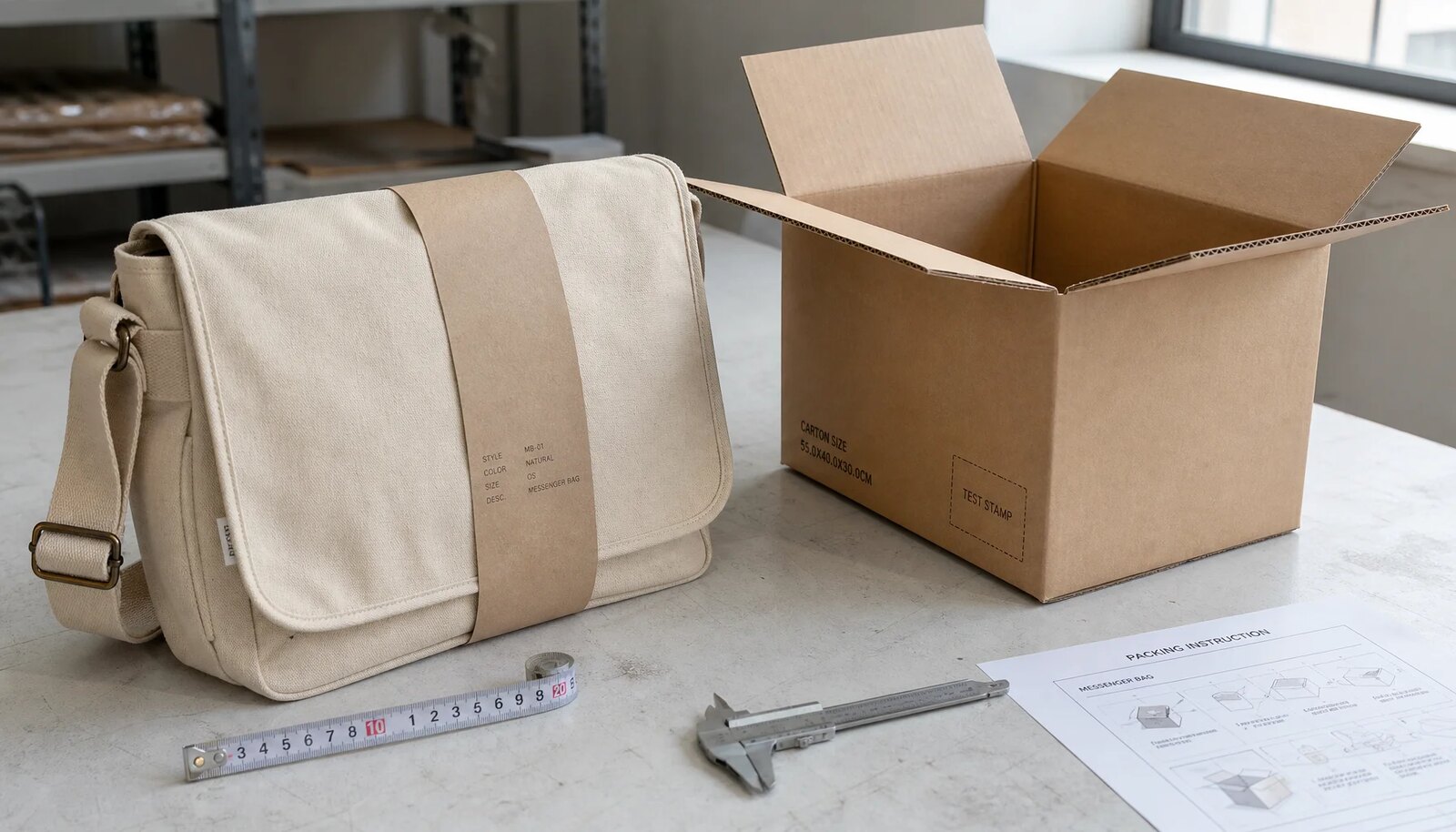
Why carton planning belongs in the product brief, not the last email
Canvas messenger bags are bulky relative to their selling price, which makes carton planning a procurement issue rather than a warehouse afterthought. A bag can pass fit, sewing, and logo approval yet still create avoidable landed-cost problems if the carton is oversized, too weak for stacking, or packed in a way that leaves a crease through the front flap. For eco apparel brands, the carton is also part of the sustainability story: buyers are expected to reduce waste without creating a higher damage rate that causes replacement shipments.
Good carton planning starts before the RFQ is sent. The buyer should tell the supplier whether the order will ship by full container, LCL, air, courier, or domestic truck after import. Each route handles cartons differently. A carton that works in a full-container load may fail when it is handled repeatedly in courier networks. A carton that looks efficient for airfreight may be too tightly packed for a premium retail launch. The carton plan should therefore be tied to the bag construction, route, receiving rules, and packaging claim.
The most useful supplier quote is not a single unit price. It is a quote package that shows bag cost, packaging cost, carton dimensions, pack count, gross weight, carton board specification, pallet pattern, and the assumptions used. Without those details, a buyer cannot compare two offers on the same basis. The lower ex-factory price may become the higher landed cost once cube, damage risk, warehouse repacking, and sustainability documentation are included.
- Treat carton planning as a controlled spec line with revision dates, not as a generic note saying export carton.
- Require measured packed-carton data before booking freight or confirming retail delivery windows.
- Review carton plan, inner packing, and sustainability claims together because changing one often changes carton cube.
- Make the supplier prove the packing method with a carton trial, not only with a drawing or verbal promise.
Map the bag geometry before choosing carton dimensions
Canvas messenger bags do not pack like flat tote bags. The flap, strap, buckles, adjusters, internal pockets, gusset, and any padding create uneven thickness. If the factory simply stacks the bags in the same orientation, buckles may press into printed panels and straps may create high points that bulge the carton. A good carton plan begins with the actual folded footprint of the finished bag, measured after the production fabric, print, hardware, and trims have been confirmed.
Buyers should ask the factory to record three measurements during the carton trial: the folded bag length, folded bag width, and average stack height for a defined quantity. The folded measurements are more important than the open bag dimensions for freight planning. If a bag has a long adjustable strap, the supplier should show where the strap tail sits. If the bag has a front-flap logo, the logo should not be forced across a hard fold unless the buyer has approved that visual effect.
Carton dimensions should be built from the stack, with enough allowance for normal packing variation but not so much empty space that bags shift during transit. Instead of relying on unsourced tolerances, write the method: measure a packed carton from the production trial, photograph it, weigh it, then compare bulk cartons against that approved standard. If the supplier needs to change pack count or carton size later, the buyer should approve the change before freight is booked.
- Ask for folded bag dimensions using production hardware and final strap length, not a simplified sample.
- Identify pressure points: buckles, sliders, zipper pulls, snap buttons, patches, and embroidered areas.
- Protect the logo panel from direct contact with hardware or carton seams.
- Keep one fold method per SKU unless the buyer approves a mixed orientation plan for cube reduction.
- Record whether carton dimensions are inside or outside dimensions; freight usually uses outside dimensions.
Build a carton plan with pack count, stack limit, and pallet fit
Pack count should be selected from a physical test, not copied from a previous order. A slim unlined messenger bag may allow a higher count per carton, while a heavier gusseted bag with pockets and metal hardware may need fewer units to avoid compression marks. The buyer's objective is not to maximize pieces per carton at any cost. It is to find the pack count that protects the bag, keeps carton weight manageable, fits the pallet or container plan, and supports accurate receiving.
A buyer-grade carton plan should include the master carton outside dimensions, pieces per carton, net weight, gross weight, cube per carton, cartons per pallet layer, layers per pallet, and maximum pallet height. If the buyer's 3PL or retailer uses a standard pallet footprint, the supplier should test carton footprints against that requirement. For example, a carton may look efficient alone but waste pallet space because it leaves large gaps on each layer. Another carton may have slightly more cube per carton but create a cleaner pallet pattern and reduce restacking.
Stack limits must also be written into the spec. Cartons of canvas bags can compress slowly under warehouse load, especially in humid conditions. The buyer should define whether cartons can be stacked loose, palletized only, or top-loaded in a container. If the route includes LCL handling, the carton may need stronger board or lower stack height because it may be handled more often and stacked with unrelated cargo. The supplier should not decide this alone; it depends on the freight scenario and receiving rules.
- Request carton cube in cubic meters and cubic feet if different teams use different freight calculators.
- Ask the supplier to show cartons per pallet layer and layers per pallet, not only total cartons.
- Set a maximum gross carton weight based on your warehouse handling policy and local safety rules.
- Avoid carton overhang on pallets; overhang is a common cause of corner crush and label damage.
- If mixed SKUs ship together, define whether cartons may be mixed on one pallet and how they must be labeled.
Freight scenarios: full container, LCL, air, courier, and domestic DC delivery
The same carton is not optimal for every route. Full-container sea freight usually rewards stable cartons that cube well and stack cleanly. Because handling is more controlled than courier movement, the buyer may accept a standard flat-pack carton if compression resistance is suitable. LCL freight is different. Cartons may be consolidated, moved several times, and stacked with other cargo, so board strength, moisture resistance, and label durability become more important.
Airfreight and courier shipments often create a dimensional-weight problem. If the carton is large and light, the buyer pays for space rather than actual weight. In that case, it can be worth testing a lower-cube carton plan, but only if the bag still opens cleanly and the print is not damaged. Tight packing should be validated by unpacking samples after a rest period and checking fold recovery. A few centimeters saved on carton height can matter in airfreight, but not if the result is a retail cosmetic failure.
Domestic distribution after import should not be ignored. A carton may arrive intact at the port but fail a retailer's distribution-center rules because labels are on the wrong side, cartons are too heavy, barcodes are wrinkled, or pallets exceed the height limit. Eco apparel brands that sell through wholesale channels should ask their sales or operations team for retailer routing guides before finalizing carton marks and pallet patterns. The supplier can then build the carton plan to meet the final receiving point, not only the export shipment.
- For FCL sea freight, prioritize stack stability, clean pallet or floor loading, and moisture control.
- For LCL, consider stronger cartons and clearer handling marks because cartons face more touch points.
- For airfreight, compare chargeable weight from carton dimensions against actual gross weight.
- For courier, run drop-style validation because cartons may travel through parcel networks.
- For retail DC delivery, confirm label panel, pallet height, carton weight, and barcode requirements before printing cartons.
Eco packaging decisions that actually change carton planning
The eco apparel angle should be more than a kraft carton photo. Packaging choices affect carton strength, moisture behavior, documentation, and pack count. A recycled-content carton may be appropriate, but recycled fiber content can perform differently depending on board construction and supplier quality. The buyer should specify the performance requirement, such as an edge crush or burst target where needed, and then allow the supplier to meet it with FSC-certified, PEFC-certified, recycled-content, or mixed-source board depending on the brand's policy.
Plastic-reduced packing also changes the carton calculation. Replacing individual polybags with tissue, kraft wraps, or paper belly bands can increase packing labor and may alter stack height. Paper can protect against scuffing but does not provide the same moisture barrier as a sealed bag. If the shipment travels through humid sea lanes, the buyer may still need a carton liner, desiccant, or controlled warehouse conditions. A plastic-free claim should be carefully defined because tape, label liners, desiccant packaging, pallet wrap, and document pouches may still contain plastic.
Ink and adhesive choices deserve attention. If cartons are printed, buyers can ask whether the supplier uses water-based inks and whether heavy ink coverage affects recyclability or drying time. Paper tape may support a plastic-reduction goal, but it must hold under humidity and handling. Labels should remain scannable after transit. Sustainability documentation should be collected before shipment, not after a marketing team asks for it. For procurement, the safest approach is to define the claim, list every packaging component, and request evidence for each component that supports the claim.
- Separate performance requirements from claims: a recycled carton still needs adequate compression and handling strength.
- Ask for FSC, PEFC, recycled-content, or supplier declarations only when those claims will be used commercially.
- List all packaging components: inner wrap, hangtag string, tape, carton, ink, labels, desiccant, pallet wrap, and corner boards.
- Do not claim plastic-free if any required component still contains plastic; use plastic-reduced if that is more accurate.
- Confirm whether paper-based inner packing increases carton height or reduces pieces per carton.
- Check whether uncoated kraft paper can transfer lint, dust, or color to light canvas.
Supplier and carton-plan comparison: what to evaluate beyond unit price
A serious quote comparison should put carton data beside the bag price. Two suppliers can quote the same messenger bag construction but use very different folded dimensions, carton board, inner packing, and pallet patterns. The buyer should request a standard quote template so the differences are visible. If one supplier lists only pieces per carton and another gives dimensions, gross weight, board performance, and palletization, the second quote is more usable even if the unit price is not the lowest.
The comparison table in this article is designed for that decision. It separates standard flat-pack, low-cube, retail-protection, pallet-first, plastic-reduced, and cheapest-carton offers. The right answer depends on the sales channel and shipment route. A DTC brand may care most about unboxing and plastic reduction. A wholesale apparel brand may care more about pallet labels and DC compliance. An importer moving urgent goods by air may temporarily accept a tighter carton plan, while a premium launch may choose lower pack count to protect the front flap.
Buyers should also compare supplier behavior. Does the factory know its carton board specification? Can it explain how straps are tucked? Does it understand pallet patterns? Can it provide photos from a real packed carton, not only a diagram? A supplier that cannot answer these questions may still sew a good bag, but it is not yet managing the logistics risk. Procurement teams should reward suppliers that make freight and receiving costs visible before the purchase order is placed.
- Compare unit price, packing cost, carton cost, cube, gross weight, and pallet efficiency in the same sheet.
- Ask every supplier to quote the same inner packing option so the comparison is fair.
- Mark any quote as incomplete if carton dimensions or gross weight are missing.
- Give preference to suppliers that can perform a carton trial before bulk production.
- Do not let a low-cost carton plan override retailer routing rules or sustainability commitments.
Sample approval: approve the packed carton, not only the bag
For canvas messenger bags, the approved sample should include the packing method. A flat photo of the bag cannot show whether the strap creates a crease, whether the buckle presses into the flap, or whether the bag recovers after being compressed in a carton. Buyers should ask for a pre-production sample packed using the proposed inner wrap, fold direction, carton size, and pack count. If a full packed carton is impractical at the first sample stage, the supplier should still provide a small carton trial or a stack-height test using production-like materials.
The approval file should contain photos of the bag before packing, during folding, inside the carton, after the carton is closed, and after unpacking. The after-unpacking photo matters because it shows whether the product is ready for retail or needs steaming and reshaping. If the buyer expects the warehouse or store team to sell the bag directly from the carton, fold recovery must be part of the acceptance decision. A carton that requires manual reshaping of every unit is not a practical carton plan.
Sample approval should also lock the measurement points. Instead of using general statements such as acceptable tolerance, buyers should define how measurements are taken. Bag width may be measured at the top opening or bottom seam; strap length may be measured fully extended or at a standard adjustment point. Logo placement should be measured from a fixed seam or flap edge. Once these points are defined, the carton trial can show whether packing shifts the bag or distorts the logo area.
- Ask for a photo sequence: unfolded bag, folded bag, strap position, open carton, closed carton, carton label, and unpacked sample.
- Let the packed sample rest before final review so pressure marks and fold recovery can be seen.
- Use production fabric, hardware, and print method for the packing trial whenever possible.
- Approve a packing instruction sheet with diagrams so line workers repeat the method consistently.
- Do not approve bulk cutting if the carton plan is still unresolved for a time-sensitive order.
Transit validation and QC tests buyers should specify
Basic visual inspection is not enough when cartons will move through export freight, warehouses, and retail distribution. Procurement teams should decide which transit checks match the order value and route. Formal laboratory testing may not be needed for every small order, but the buyer should at least understand the available methods and request them when the risk justifies the cost. For packaged products, common references include ISTA packaged-product test procedures and ASTM methods for drop, compression, and environmental conditioning. The exact test level should be chosen with a packaging engineer, lab, or the buyer's QA policy.
Drop testing is useful for courier, LCL, and mixed handling routes because corners and edges take impact. Compression testing is important when cartons will be stacked in containers or warehouses. Humidity exposure matters for canvas because moisture can soften cartons, create odor, encourage mildew, or cause dye transfer. Vibration testing may be considered for long truck routes or parcel networks. The goal is not to add tests for appearance; it is to verify that the selected carton plan survives the real handling scenario.
QC should inspect both the carton and the bag after testing or simulated handling. A carton can look damaged but still protect the bag, or it can look acceptable while the bag inside has buckle marks on the logo. Inspection samples should be drawn from different carton positions: top, middle, bottom, and near pallet edges if palletized. If failures appear, the corrective action may be a stronger carton, lower pack count, different strap nesting, paper interleaf, desiccant, or a revised pallet pattern.
- Use drop testing for parcel, courier, LCL, or routes with many handling points.
- Use compression or stack evaluation when cartons will be palletized or floor-loaded in containers.
- Use humidity conditioning or practical moisture checks for sea freight and humid storage lanes.
- Inspect the bag after unpacking, not only the closed carton.
- Document test method, sample size, route assumption, and pass/fail criteria before testing starts.
- Tie corrective action to the cause: board failure, overpacking, hardware pressure, moisture, or poor palletization.
Cost model: how carton cube can erase a cheap bag price
The landed-cost model for canvas messenger bags should include more than fabric and sewing. Important lines include print setup, logo application, labels, inner packing, master carton, carton printing, pallet materials, inspection, freight, duties where applicable, warehousing, and repacking. Carton cube often becomes the hidden cost because messenger bags have straps and structure that make them less compact than flat apparel. A small difference in carton dimensions can multiply across hundreds of cartons.
Buyers should ask suppliers to quote carton cost and packaging labor separately when possible. This does not mean the buyer must negotiate every component individually; it means the buyer can see whether a lower unit price depends on weak cartons or missing inner protection. If an eco brand requests FSC cartons, paper tape, tissue wrap, and printed kraft belly bands, those items should be priced and documented. Otherwise the final invoice may change after the purchase order is issued.
Freight comparisons should be made using the forwarder's actual charge rules for the lane. Sea freight, airfreight, courier, and truck freight treat weight and volume differently. A carton plan optimized for ocean freight may not be best if the launch later shifts to air because of a schedule delay. For that reason, buyers should request two carton scenarios early. The standard plan becomes the default, while the low-cube plan can be used if urgent air shipment becomes necessary and cosmetic risk is acceptable.
- Calculate landed cost from carton count, carton cube, and gross weight, not only pieces per carton.
- Ask the forwarder to price both the standard carton and the low-cube carton before final approval.
- Show packaging upgrades as separate lines: stronger board, paper wrap, printed carton, palletization, and desiccant.
- Include warehouse receiving cost if cartons require relabeling, rebuilding pallets, or manual reshaping.
- Keep a contingency carton option for schedule changes that force airfreight or courier shipping.
Documentation, timeline control, and purchase-order wording
The best carton plan fails if it is not written into the purchase order and inspection checklist. Procurement should attach a packing specification that includes bag fold diagram, inner packing material, pieces per carton, carton dimensions, carton marks, gross weight target, board specification, pallet pattern if applicable, and sustainability documentation. The supplier should confirm that this is the production version before bulk packing begins. If the carton plan changes, the change should be approved like any other product specification change.
Timeline planning should avoid universal lead-time promises. Actual timing depends on fabric availability, dyeing, print approvals, trim sourcing, carton production, certification paperwork, inspection booking, and freight space. Packaging changes are a common cause of delay because cartons, labels, and paper wraps may come from different suppliers than the sewing factory. To reduce risk, buyers should approve artwork, labels, carton marks, and packing materials at the same time as the pre-production sample, not after sewing is underway.
Eco documentation also has a timeline. If the brand needs FSC invoices, recycled-content declarations, restricted-substance statements, or retailer packaging forms, the supplier must know before ordering materials. Some documents cannot be recreated reliably after shipment. The purchase order should state which claims will be made and which evidence is required. That protects both sides: the buyer avoids unsupported marketing claims, and the supplier avoids last-minute paperwork requests that may not match the materials used.
- Attach the packing specification and carton approval photos to the PO or tech pack.
- State that changes to carton size, pack count, inner packing, or carton marks require written approval.
- Book inspection only after the supplier confirms final packing materials are on site.
- Request sustainability documents before shipment, not after goods arrive.
- Keep carton planning connected to freight booking so actual dimensions match the forwarder's data.
- Use one controlled revision file for bag spec, packaging spec, quote, sample approval, and QC checklist.
Specification comparison for buyers
| Carton plan / supplier offer | Typical configuration to request | Best fit for | Freight and warehouse tradeoff | Sustainability and compliance check |
|---|---|---|---|---|
| Plan A: standard flat-pack export carton | One fold direction, straps tucked inside body, individual paper wrap or recycled-content polybag if required, master carton sized from actual folded bag stack, supplier provides L x W x H, gross weight, and carton board specification | Repeat wholesale orders where appearance, carton consistency, and receiving speed matter more than the absolute lowest carton cube | Usually easiest to palletize and inspect; cube may be slightly higher than compression-style packing but reduces rework at receiving | Ask for FSC, PEFC, or recycled-content carton documentation if claimed; confirm water-based carton ink and no unnecessary laminated coating |
| Plan B: low-cube tight carton | Higher pack density, alternating bag orientation, minimal void space, no rigid inserts, straps nested consistently, carton dimensions optimized after a physical carton trial | Airfreight, courier shipments, or high freight-rate lanes where dimensional weight can dominate landed cost | Can reduce chargeable volume, but cartons may be harder to repack after inspection and more sensitive to bulging, corner crush, and logo pressure marks | Works best with lightweight paper protection; avoid plastic-free claims unless tapes, labels, and inner wrap also match the claim |
| Plan C: retail-protection carton | Lower piece count per master carton, tissue or paper interleaf over printed panels, optional inner kraft sleeve or belly band, stronger board grade specified by test value | Premium eco apparel launches, giftable messenger bags, dark-dyed canvas, embroidery, patches, or large front-flap artwork | More cartons and higher cube, but lower cosmetic rejection risk and easier store allocation if cartons are smaller | Paper-based protection is easier to explain in sustainability documentation; verify recyclability of stickers, inks, and adhesives |
| Plan D: pallet-first carton plan | Carton footprint chosen to fit the buyer's pallet standard, with confirmed cartons per layer, layers per pallet, pallet height limit, and label-facing orientation | Retailers, distributors, and 3PLs with strict inbound rules, carton label positions, or maximum pallet height | May not produce the smallest master carton, but improves truck loading, pallet stability, scan access, and DC receiving | Allows less stretch film if cartons interlock well; ask whether recycled-content corner boards or paper pallet wrap are available in your lane |
| Plan E: plastic-reduced or plastic-free inner packing | Uncoated tissue, kraft paper wrap, paper belly band, paper tape, carton liner only where moisture risk requires it, no individual polybag unless the market requires dust or barcode protection | Eco apparel brands with public packaging commitments, direct-to-consumer unpacking standards, or retailer plastic-reduction policies | Can reduce plastic waste but may increase labor and moisture exposure; paper packing may also add thickness and change carton count | Request material declarations, recycled-content claims, FSC paperwork where applicable, and ink/adhesive information for printed paper components |
| Plan F: supplier-proposed cheapest carton | Factory chooses available carton size, basic fold, lowest-cost inner packing, and pack count based on sewing-line convenience | One-time promotional orders where low unit cost is more important than carton optimization or retail presentation | May look cheaper ex-factory but can increase chargeable volume, carton failure, mixed counts, and receiving labor | Often has limited documentation for carton fiber source, ink, and recyclability; sustainability claims may be unsupported |
Buyer checklist before sampling
- Give the supplier the finished bag dimensions, gusset depth, flap size, strap length range, hardware type, logo position, and whether the logo can be folded or must stay flat.
- Require a physical carton trial before bulk packing: actual folded bag stack height, master carton inside dimensions, outside dimensions, net weight, gross weight, and pieces per carton.
- Ask for carton board performance stated by a recognized method, such as edge crush test, burst strength, or supplier's export-carton specification, instead of accepting vague wording like strong carton.
- Compare at least two carton plans: a standard protection plan and a lower-cube freight plan, with the same bag spec, same inner packing, and same destination assumptions.
- Check palletization early: cartons per layer, layers per pallet, pallet height, gross pallet weight, label-facing side, and whether the plan fits your 3PL or retailer inbound manual.
- Define stack limits in writing: maximum cartons high in warehouse storage, maximum pallet height, whether mixed SKU stacking is allowed, and whether top-load stacking is prohibited.
- Confirm eco packaging scope: recycled or FSC carton, paper tape versus plastic tape, water-based or soy-based carton ink if available, paper wrap or recycled polybag, desiccant requirements, and documentation needed for claims.
- Lock carton markings before production: SKU, PO, color, quantity, country of origin if required, carton number, gross/net weight, dimensions, barcode, and handling marks.
- Request packed-carton photos from top, side, label panel, and open-carton view, plus one photo showing how straps are tucked and how the printed panel is protected.
- Build freight comparison from carton cube and weight, not unit price alone; ask your forwarder to calculate sea, air, courier, and LCL scenarios if order volume is uncertain.
Factory quote questions to send
- What are the finished bag dimensions, folded dimensions, and strap-tucking method used for your carton calculation?
- What exact master carton outside dimensions, inside dimensions, pieces per carton, net weight, gross weight, and CBM per carton are you quoting?
- What carton board specification are you using, and can you state it by edge crush, burst strength, flute type, ply count, or your documented export standard?
- Can you quote two options: one carton plan optimized for protection and one optimized for lower cube, with the cost and CBM difference shown separately?
- How many cartons fit per pallet layer, how many layers are allowed, and what is the estimated pallet height and gross pallet weight?
- Will the bags be individually packed in paper, recycled-content polybag, tissue, belly band, or no inner wrap, and is that cost included in the unit price?
- If we request FSC, recycled-content, or plastic-reduced packaging, what certificates, supplier declarations, invoice wording, or chain-of-custody documents can you provide?
- What tape, carton ink, shipping label, sticker, and desiccant materials are included, and do any of them conflict with a plastic-free or recyclable-packaging claim?
- What drop, compression, humidity, or vibration checks can you perform in-house or through a third-party lab before shipment?
- Can you provide a packed-carton approval sample or a small carton trial using production fabric, production print, and final hardware?
Quality-control points to confirm
- Carton specification: record carton outside dimensions, inside dimensions where relevant, board type, flute construction, and edge crush or burst value if the buyer has set one; avoid relying only on the phrase 5-ply export carton.
- Packed-carton weight: compare actual gross weight against the approved packing list and freight booking; investigate large variation because it may indicate wrong pack count, missing inner packing, or mixed SKU errors.
- Carton compression and stack behavior: for palletized sea freight or warehouse storage, confirm cartons do not bulge, buckle, or crush under the agreed stack height; use a compression test method such as ASTM D642 or an equivalent lab procedure when the order requires formal validation.
- Drop and handling validation: run carton drop testing to an agreed sequence, such as ISTA-style packaged-product handling or ASTM D5276 free-fall drop testing, especially for courier, LCL, or mixed handling routes.
- Humidity exposure: for sea freight or humid lanes, check cartons and bags after controlled high-humidity conditioning or a practical sealed-carton rest test; inspect for odor, mildew risk, dye transfer, softened carton panels, and metal hardware corrosion.
- Print and surface protection: after unpacking, inspect the logo panel for scuffing, pressure marks, ink offset, cracking along fold lines, and abrasion caused by buckles, sliders, or strap edges.
- Fold recovery: open samples from the bottom, middle, and top of a packed carton after at least one full day packed; the flap, logo area, and strap should recover without permanent distortion that affects retail presentation.
- Seam and load-point inspection: examine strap anchors, side seams, flap corners, and pocket openings for skipped stitches, loose thread nests, broken bar tacks, puckering, or stress whitening after packing and unpacking.
- Measurement control: verify finished bag width, height, gusset, flap drop, strap length, and logo placement against the approved tech pack using agreed measurement points; set tolerances in the spec rather than using informal factory assumptions.
- Inner packing verification: confirm whether the order uses tissue, kraft wrap, belly band, recycled polybag, desiccant, or no inner packing, and check that the material matches the approved sustainability claim.