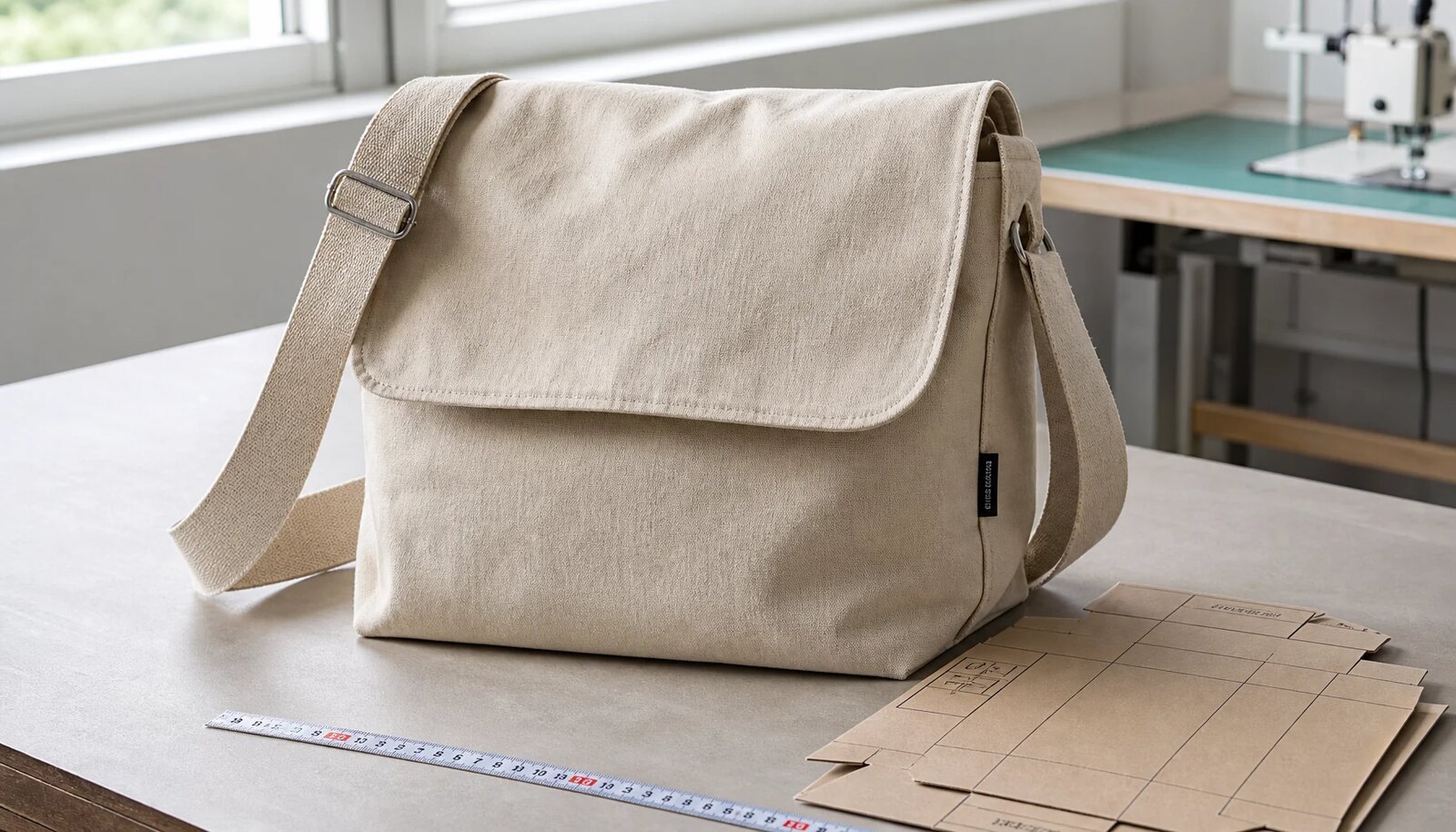
Start with the receiving environment, not only the bag design
Canvas messenger bags are easy to under-spec because the product looks simple: fabric body, strap, closure, logo, carton. Procurement gets harder when the same bag must move through export packing, sea freight, warehouse stacking, retail DC receiving, and possibly e-commerce fulfillment. The carton plan has to support that route from the beginning. A bag that looks good on a sample table can still create margin loss if the straps tangle, cartons bulge, barcodes scan poorly, or the gross weight exceeds the warehouse handling rule.
Before asking a factory for a price, identify the receiving environment. A direct-to-brand warehouse may accept bulk cartons with simple shipping marks. A retailer distribution center may require unit barcodes, carton labels, mixed-SKU rules, pallet height limits, ASN data, and strict carton weight caps. An e-commerce route may need cleaner unit protection because bags will be picked individually. These requirements change cost, labor, carton size, and inspection scope.
For eco apparel brands, sustainability goals also need to be translated into operational choices. Less plastic is a worthy goal, but a dust-stained or abraded bag creates waste too. The buyer’s task is to choose the lowest-impact packing method that still survives the freight lane and receiving process.
- Define destination type: brand warehouse, retailer DC, marketplace fulfillment, event distribution, or direct e-commerce replenishment.
- Record max carton gross weight, pallet height, barcode standard, carton mark format, and mixed-SKU rules before quote comparison.
- Treat unit packing, carton strength, and receiving labels as part of the product specification, not a late logistics add-on.
Build an RFQ that suppliers can price without guessing
A useful RFQ for canvas messenger bags should connect product construction to packed-carton data. If the RFQ only includes artwork and a broad size, suppliers will make different assumptions about fabric finish, lining, stitch density, zipper quality, folding method, carton board, and pack count. The lowest quote may simply be the quote with the most missing assumptions.
The RFQ should have one spec version number and one approval path. Include finished bag size, panel tolerance, canvas weight, fabric finish, lining choice, trim list, logo method, unit packing, master carton target, testing requirements, and shipment terms. If you are still deciding between two constructions, ask suppliers to quote them as separate options rather than blending them into one vague price.
For quote comparability, request both loose unit cost and packed shipment data. The factory should state units per carton, carton outer dimensions, gross weight, net weight, CBM, carton board grade, and packing labor included. That makes it possible to compare cost per shipped unit rather than only FOB unit price.
- Use a quote sheet with separate lines for fabric, trim, decoration, sewing, packing, carton, testing, inspection, and export handling.
- Ask for assumptions in writing: fabric source, shade lot control, sample type, carton grade, and whether palletization is included.
- Require a packed-carton estimate at RFQ stage and a measured packed-carton result after pre-production sampling.
Use realistic MOQ, lead time, and sample decision ranges
MOQ is not a single number for messenger bags. It depends on whether the fabric is stock or custom, whether the color is dyed to order, whether the print requires setup, and whether trim is standard. For early planning, a simple stock-canvas bag with one-color logo may be workable around 300-500 pieces with many suppliers. Custom dyed canvas, custom lining, or special hardware often pushes the practical MOQ toward 500-1000 pieces or more. Very low MOQ can be useful for testing, but it usually carries higher unit price and less flexibility on carton customization.
Lead time should be broken into steps. A typical sourcing calendar may include 5-10 days for swatches or artwork confirmation, 7-15 days for a construction sample, 10-20 days for a pre-production sample after material confirmation, and 25-45 days for bulk production depending on order size and material route. These are planning ranges, not promises; holiday periods, dyeing, washing, testing, and retailer label approval can extend them.
Sample decisions should match order risk. A loose construction sample confirms shape and sewing. A logo strike-off confirms print or label quality. A pre-production sample confirms final material and workmanship. A packed-carton sample confirms fold, carton count, gross weight, and appearance after packing. For a repeat order with no construction change, you may not need every sample stage, but the packed-carton reference should be refreshed when fabric weight, lining, hardware, or unit packing changes.
- Use stock fabric and standard trims when speed and low MOQ matter more than full customization.
- Use custom dyed or washed fabric only when shade, hand feel, or brand positioning justify the extra lead time and MOQ.
- Approve the packed-carton sample before bulk packing, especially when the bag has a zipper, metal hardware, raised logo, or structured flap.
Translate bag construction into carton cube and weight
Carton planning starts with the physical behavior of the finished bag. A 12 oz unlined messenger bag can often be folded flatter than a 14 oz lined version with inner pockets, zipper, flap, and metal hardware. The difference may look small on one sample, but multiplied across 500 or 2000 units it changes carton count, CBM, handling weight, and sometimes freight mode.
Use a simple cube calculation during quote review. CBM equals carton length x width x height in meters. A carton measuring 50 x 40 x 35 cm is 0.070 CBM. If it holds 25 bags, the cube is 0.0028 CBM per bag. If a bulkier design requires a 60 x 40 x 40 cm carton holding 20 bags, the carton is 0.096 CBM, or 0.0048 CBM per bag. That change is a 71 percent increase in cube per unit, before considering pallet inefficiency or container utilization.
Weight planning matters too. Suppose a finished bag weighs 430 g and unit packing adds 25 g. At 30 pieces, product and unit packing weigh about 13.65 kg before the master carton. Add a 1.2-1.8 kg export carton and the gross weight may land around 15-16 kg. If the bag changes to 600 g with heavier lining and hardware, the same 30 pieces could push gross weight past 19 kg. The buyer can either reduce count, strengthen the carton, or accept a higher handling weight if the receiving rules allow it.
- Calculate CBM per bag for each quote, not only carton CBM.
- Set a target gross weight range, often around 12-18 kg unless your carrier or retailer provides a different limit.
- Re-run carton math whenever fabric weight, lining, hardware, or fold method changes.
Choose carton dimensions that work on pallets and in containers
A carton can be strong and still inefficient. Dimensions should be checked against the likely pallet footprint and container plan. For example, a 50 x 40 cm carton footprint can fit neatly on a 1200 x 1000 mm pallet at six cartons per layer, depending on orientation and pallet rules. A 60 x 40 cm footprint can also work in some patterns, but may reduce flexibility. Odd carton sizes can create overhang, voids, or unstable mixed pallets.
Pallet height is another decision point. If a retailer caps pallet height at 150 cm including pallet, and the pallet itself is about 15 cm high, the usable carton stack height may be around 135 cm. With 35 cm cartons, that is only three layers. With 30 cm cartons, four layers may be possible if compression strength and product shape allow it. A lower carton can increase handling count, but it may improve pallet utilization and reduce crush risk.
Container loading is less precise at RFQ stage, but the buyer should still compare cube. Sea freight usually rewards tighter CBM per unit, while air freight and parcel routes may penalize dimensional weight. If the order might ship by air for launch timing, avoid a carton plan that is acceptable for sea freight but punishing under dimensional weight rules.
- Ask the supplier for proposed carton footprint, layer count, pallet count, and estimated total CBM before order release.
- Avoid carton overhang and mixed orientations unless the retailer or forwarder approves them.
- Check whether smaller cartons improve pallet layers enough to offset the extra carton cost.
Specify carton strength with measurable standards
A purchase order that says export carton is too vague. The carton spec should state ply count, board grade or performance value, closure method, carton marks, and any route-specific handling requirement. For messenger bags, 5-ply corrugated is a common export starting point, but the performance still depends on paper quality, flute structure, carton dimensions, humidity, gross weight, and stacking height.
Ask for ECT or burst value when carton performance matters. ECT measures edge crush strength and is useful for stacking performance. Burst strength measures resistance to puncture or rupture. Which value matters more depends on your packaging standard and supplier’s carton system, but the key is to require a measurable value instead of accepting a generic carton description. For many medium-weight export cartons, buyers may reference values such as 44 ECT or 200-275 lb burst, then adjust with the packaging engineer, retailer manual, or freight forwarder.
Carton closure also needs a standard. Define tape width, number of strips, H-tape method if needed, strapping policy, and whether cartons may be stapled. If unit bags have metal hardware, inspect whether pressure points are creating dents in carton walls. A carton that closes only under heavy force is already too full.
- State carton inner dimensions, board type, ECT or burst requirement, tape method, and carton mark placement in the spec.
- Reject cartons that bulge, bow, crush at corners, or show hardware pressure through the wall.
- Request carton supplier evidence or test report for larger orders, retailer shipments, or long sea-freight routes.
Select unit packing based on cleanliness, abrasion, and barcode needs
Unit packing is a cost and sustainability decision. Individual polybags protect against dust, humidity exposure during handling, and abrasion between hardware and fabric. They also add plastic, labor, and cube. Kraft sleeves or paper bands can support a lower-plastic goal, but they may not protect corners, straps, or raised decoration as well. Bulk packing with tissue or interleaving can work for internal warehouse shipments, but it requires cleaner downstream handling.
Barcode requirements often decide the packing method. If each unit must be scanned at a retail DC, the barcode must be visible, flat, durable, and placed consistently. If a kraft sleeve covers the best scan location or a strap crosses the label, receiving slows down. Ask the factory to scan sample barcodes after unit packing and again after packed-carton handling.
The fold sequence should be documented with photos. Show whether the flap is open or closed, where the strap sits, whether zipper sliders face inward or outward, and whether hardware is wrapped or separated. This is especially important when bags are packed by line workers under speed pressure. A clear fold standard reduces carton height variation and keeps the approved appearance repeatable.
- Use polybag when cleanliness, barcode durability, or abrasion risk is high and the retailer allows it.
- Use kraft sleeve or paper band when presentation and reduced plastic matter, but test scuffing and barcode scan before bulk.
- Approve a folding photo guide with strap placement, logo protection, and hardware orientation.
Control decoration risk before carton compression hides it
Decoration defects often become visible after packing, not at the print table. Screen print may feel cured when inspected loose, then transfer under pressure if cartons are packed too soon. Embroidery can pucker the flap, woven patches can lift at edges, and metal labels can mark the bag next to them. The packing method should protect the decoration, and the inspection plan should check the decorated area after the bag has been folded and boxed.
For screen print, request artwork size, print placement, ink type if relevant, curing method, color reference, and rub test expectation. For woven labels or patches, specify stitch density, edge finish, placement tolerance, and thread color. For metal or leather-style branding, check whether the component creates a pressure point in the carton. Eco positioning does not remove the need for performance testing; it just makes material and process choices more deliberate.
Logo placement tolerance should be measurable. A common approach is to set a centerline and allow a small deviation, such as +/- 3 mm for small labels and +/- 5 mm for larger prints, adjusted to bag size and process. The buyer should approve the final tolerance with the supplier because soft fabric panels move during sewing and folding.
- Inspect decoration before and after packed-carton sampling.
- Keep logo placement away from hard fold lines, zipper sliders, snaps, and D-ring pressure points when possible.
- Define pass/fail rules for rub transfer, cracking, puckering, label edge lift, and visible placement drift.
Make QC cover both loose bags and packed cartons
A procurement-grade QC plan should not stop at visual inspection of loose bags. It should include incoming material checks, in-line sewing checks, pre-packing checks, and final packed-carton checks. Many buyers use general inspection level II with AQL examples such as Critical 0, Major 2.5, and Minor 4.0, then tighten or loosen based on retailer rules, order value, and brand risk. The exact AQL should be written on the purchase order and inspection booking.
Timing matters. Inspecting only after every carton is sealed makes rework slower. For new styles, check first output from cutting, first printed panels, first sewn bags, and first packed cartons. The first packed cartons reveal whether the line understands fold method, count, barcode position, carton closure, and mark placement. Correcting those points early is cheaper than reopening hundreds of cartons.
Carton checks should include count verification, assortment verification, gross weight, carton dimensions, barcode scan, carton mark accuracy, tape closure, compression appearance, and packed product condition. For routes with higher handling risk, add a limited carton drop check and stack review. A simple drop expectation might include drops on corner, edge, and face from a height agreed by the buyer, supplier, and packaging standard; the pass condition is no product damage, no carton rupture, and no loss of count integrity.
- Book inspection against a written AQL and defect classification list.
- Require packed-carton sampling, not only loose-bag sampling.
- Hold shipment if barcode data, carton marks, carton count, or gross weight do not match the packing list.
Compare supplier quotes by landed packing performance
The most useful quote is not always the lowest FOB unit price. A supplier offering a cheaper bag may use lighter carton board, fewer units per carton, less controlled folding, or a packing method that creates more claims. Another supplier may quote a higher unit price but deliver better carton density, cleaner barcode compliance, and lower rework risk. Procurement should compare the whole shipped package.
Create a quote comparison grid with unit price, MOQ, sample cost, setup cost, carton size, units per carton, gross weight, CBM per carton, CBM per unit, carton grade, packing included, inspection support, and lead time. Then model a few scenarios. If a 1000-piece order ships in 40 cartons at 0.070 CBM each, total cube is 2.8 CBM. If another construction ships in 50 cartons at 0.096 CBM, total cube is 4.8 CBM. That difference can affect ocean LCL cost, warehouse space, pallet count, and air freight feasibility.
Also compare decision flexibility. A good supplier should be able to explain what happens if you move from polybag to kraft sleeve, from 12 oz to 14 oz canvas, or from 25 to 30 units per carton. The supplier does not need to promise every option; they need to show the cost, risk, and carton impact clearly enough for you to decide.
- Normalize quotes by cost per packed unit, CBM per unit, and carton compliance risk.
- Separate one-time charges from repeat-order costs so reorders are easier to evaluate.
- Ask suppliers to price at least two packing scenarios when carton efficiency is a major cost driver.
Specification comparison for buyers
| Planning decision | Procurement-grade target | Example range or document to request | Buyer risk to control |
|---|---|---|---|
| Fabric weight | 12-14 oz cotton canvas for most retail messenger bags; 16 oz only when structure is more important than cube efficiency | Ask supplier to quote GSM or oz before and after washing; common planning range is about 340-475 GSM depending on finish | Heavier cloth increases fold thickness, carton gross weight, and CBM per unit; confirm shrinkage and packed thickness on the pre-production sample |
| Carton gross weight | Plan cartons around a safe handling range rather than a fixed bag count | Many apparel-accessory buyers target about 12-18 kg gross weight per master carton, with a hard cap set by the retailer, carrier, or warehouse SOP | A carton that is efficient on paper may be rejected or mishandled if it exceeds manual handling limits or retailer receiving rules |
| Master carton size | Use dimensions that balance pack count, carton strength, and pallet footprint | Example starting points: 50 x 40 x 35 cm for 20-30 lighter unlined bags, or 60 x 40 x 40 cm for bulkier lined bags after test packing | Oversized cartons increase dimensional freight, bow under stacking, and may break pallet patterns |
| Carton board strength | Specify export carton strength based on freight mode and stack height | Request 5-ply corrugated with ECT or burst value stated; common buying references include 44 ECT or 200-275 lb burst depending on carton size, weight, and route | A generic 5-ply claim is not enough; poor board quality can pass visual inspection but fail during warehouse stacking |
| Pallet pattern | Confirm carton orientation and count before bulk packing starts | For a 1200 x 1000 mm pallet, a 50 x 40 cm carton often fits 6 cartons per layer; height depends on carton height, pallet limit, and stack strength | Late pallet planning can create mixed overhang, crushed corners, or unexpected container cube |
| Packing format | Choose individual polybag, kraft sleeve, tissue wrap, or bulk pack based on receiving requirement | Retail/DC orders often need barcode-ready unit packing; wholesale or internal brand use may accept bulk cartons with interleaving | Overpacking adds labor and cube; underpacking risks dust, abrasion, strap tangling, and barcode receiving delays |
| Decoration method | Use the logo method that survives folding, rubbing, and carton pressure | One-color screen print or woven label is usually easier to control than raised embroidery, thick patching, or large multi-color print areas | Ink cracking, transfer, puckering, and pressure marks often appear only after packed-carton handling |
| MOQ and sample route | Tie MOQ to fabric booking, color dyeing, print setup, and packing complexity | Typical decision ranges may be 300-500 pcs for stock fabric and simple logo, 500-1000 pcs for custom dyed canvas, and higher when custom hardware or lining is added | A low MOQ can hide higher unit cost, limited material control, or less willingness to run packed-carton validation |
| Inspection level | Use AQL plus carton-specific checks, not only loose bag inspection | For many bag programs, buyers use general inspection level II with AQL examples such as Critical 0, Major 2.5, Minor 4.0, adjusted to brand risk | Without packed-carton sampling, defects in count, barcode, carton marks, compression, and label placement may be missed |
Buyer checklist before sampling
- Finished bag dimensions with tolerances for width, height, gusset depth, flap drop, front pocket position, and strap length.
- Canvas specification in oz or GSM, including whether the fabric is greige, dyed, washed, bio-washed, pre-shrunk, recycled blend, or water-repellent finished.
- Target finished-bag tolerance, such as +/- 5 mm on small panels and +/- 10 mm on overall width or height, adjusted to design complexity.
- Print or label specification covering artwork size, color reference, placement tolerance, rub-resistance expectation, curing method, and approval sample.
- Trim list with zipper type, slider finish, snaps, D-rings, buckles, magnetic closures, webbing width, reinforcement patches, and spare hardware policy.
- Packing method showing fold sequence, strap placement, unit protection, barcode location, carton orientation, carton count, and maximum gross weight.
- Carton specification with inner dimensions, board grade, ECT or burst value, flute type if required, tape method, carton marks, and pallet pattern.
- Quote breakdown separating fabric, cutting, printing, sewing, trim, unit packing, master carton, testing, inspection, and export documentation.
- Sample route covering material swatch, logo strike-off, fit/construction sample, pre-production sample, and packed-carton approval sample.
- Inspection plan naming AQL level, inspection timing, packed-carton sampling quantity, drop or stack test expectation, barcode verification, and photo evidence.
Factory quote questions to send
- What finished bag dimensions, fabric weight, and trim specification are included in this quote, and which items are still assumed?
- What MOQ applies for stock canvas, custom dyed canvas, custom lining, custom hardware, and multi-color logo work?
- What is the quoted sample route: swatch, logo strike-off, construction sample, pre-production sample, and packed-carton sample?
- What master carton inner and outer dimensions do you propose after final folding and unit packing?
- How many units will be packed per carton, and what will the estimated net weight, gross weight, and CBM per carton be?
- What carton board grade are you quoting, including ply count, ECT or burst value, and whether the carton is suitable for sea freight stacking?
- Can you provide a test-packed carton photo showing fold direction, strap placement, carton fill height, carton marks, barcode placement, and carton closure?
- How will you prevent zipper sliders, snaps, D-rings, or buckles from marking the canvas or print area during transit?
- Which costs are included in the unit price, and which are separate lines: print setup, label setup, polybag or kraft sleeve, barcode label, carton, palletization, and export documents?
- What AQL level do you support for final inspection, and can the inspection include packed-carton count, carton compression, barcode scan, and carton drop checks?
Quality-control points to confirm
- Use a written inspection plan, commonly general inspection level II with AQL examples such as Critical 0, Major 2.5, Minor 4.0, unless the buyer or retailer requires a stricter standard.
- Inspect raw material before cutting for fabric weight, shade lot, weave defects, stains, holes, slubs outside the approved character range, and shrinkage after washing if applicable.
- Check finished dimensions against the approved sample and tolerance table, including width, height, gusset, flap position, pocket placement, strap length, and handle drop.
- Verify stitch quality at stress points: no skipped stitches, broken threads, open seams, loose bartacks, weak box-X reinforcement, or seam allowance below the approved minimum.
- Test closure and hardware function across the sample set: zipper must run smoothly, snaps and magnets must hold, buckles must not slip, and D-rings must not deform under normal pull.
- Inspect decoration after curing or application for placement tolerance, color match, edge quality, adhesion, rub transfer, cracking, puckering, and pressure marks from packed hardware.
- Confirm unit packing matches the approved method: fold direction, strap tuck, sleeve or polybag size, desiccant use if specified, barcode visibility, and no trapped dust or loose thread.
- Verify packed-carton count, assortment, carton orientation, gross weight, carton dimensions, carton mark content, barcode scan result, and packing list match.
- Require packed-carton photos from the factory before shipment: open carton top view, side view after closure, carton mark close-up, barcode scan proof, pallet pattern if palletized, and any mixed-SKU label.
- Check carton strength evidence: board grade on purchase spec, ECT or burst value if required, no crushed corners, no bulging, no weak tape closure, and no product pressure against carton walls.