Why carton planning matters more for messenger bags than simple totes
Canvas messenger bags are thicker, more structured, and more hardware-heavy than flat cotton totes. A tote can usually be stacked in a compact bundle with little shape risk. A messenger bag has a flap, strap, gusset, possible lining, metal adjuster, zipper, magnetic snap, buckle, or inner pocket. These parts change how the bag folds, how much pressure it can tolerate, and how quickly booth staff can unpack it for a craft fair table.
The buying problem is not only avoiding damage. Poor carton planning changes the real landed cost. Two suppliers can quote the same FOB unit price, but one packs 25 bags in a compact 5-ply carton while another packs 15 bags loosely in oversized cartons. The second supplier may look competitive until freight, warehouse handling, storage, and event transfer costs are added. For craft fair distribution, carton planning should be part of the product specification, not an afterthought left to the packing room.
- Messenger bags create more CBM because flaps and straps do not compress like flat panels.
- Hardware can mark the canvas if straps are folded carelessly against the printed face.
- A display-ready bag must arrive clean, not only undamaged.
- Carton quantities should match how the buyer allocates stock to booths, stores, or regional teams.
- The RFQ should request carton size, gross weight, packing method, and carton marking format before price comparison.
Set the bag specification before calculating carton quantity
Carton planning starts with the physical bag spec. A 35 x 28 x 9 cm canvas messenger bag with a flap and adjustable webbing strap packs very differently from a slim document-style messenger bag with no gusset. Procurement teams should define finished size, gusset depth, flap style, closure, strap construction, and whether the product must stand with some shape on a display table. Without those details, any carton plan is only a guess.
For craft fair programs, the most common canvas range is 10 oz to 12 oz, roughly 280-360 GSM depending on fabric construction and finishing. This gives enough body for a messenger silhouette while keeping carton weight manageable. A 14 oz or 16 oz canvas can be suitable for a tool bag or premium work bag, but it increases cutting resistance, sewing time, needle wear, carton gross weight, and CBM. If the bag needs lining, inner pockets, or foam reinforcement, the packing quantity per carton may drop more than the buyer expects.
- Typical light retail messenger: 8-10 oz canvas, simple flap, minimal hardware, lower cost but softer shape.
- Balanced craft fair messenger: 10-12 oz canvas, reinforced strap points, screen print on flap or panel.
- Heavy utility messenger: 14-16 oz canvas, stronger webbing and hardware, lower carton quantity and higher freight exposure.
- Finished size should specify body width, body height, gusset depth, flap length, strap width, and strap adjustable range.
- If lining is required, specify cotton lining, polyester lining, or unlined construction because each changes folding thickness.
Use print method and artwork placement to prevent packing damage
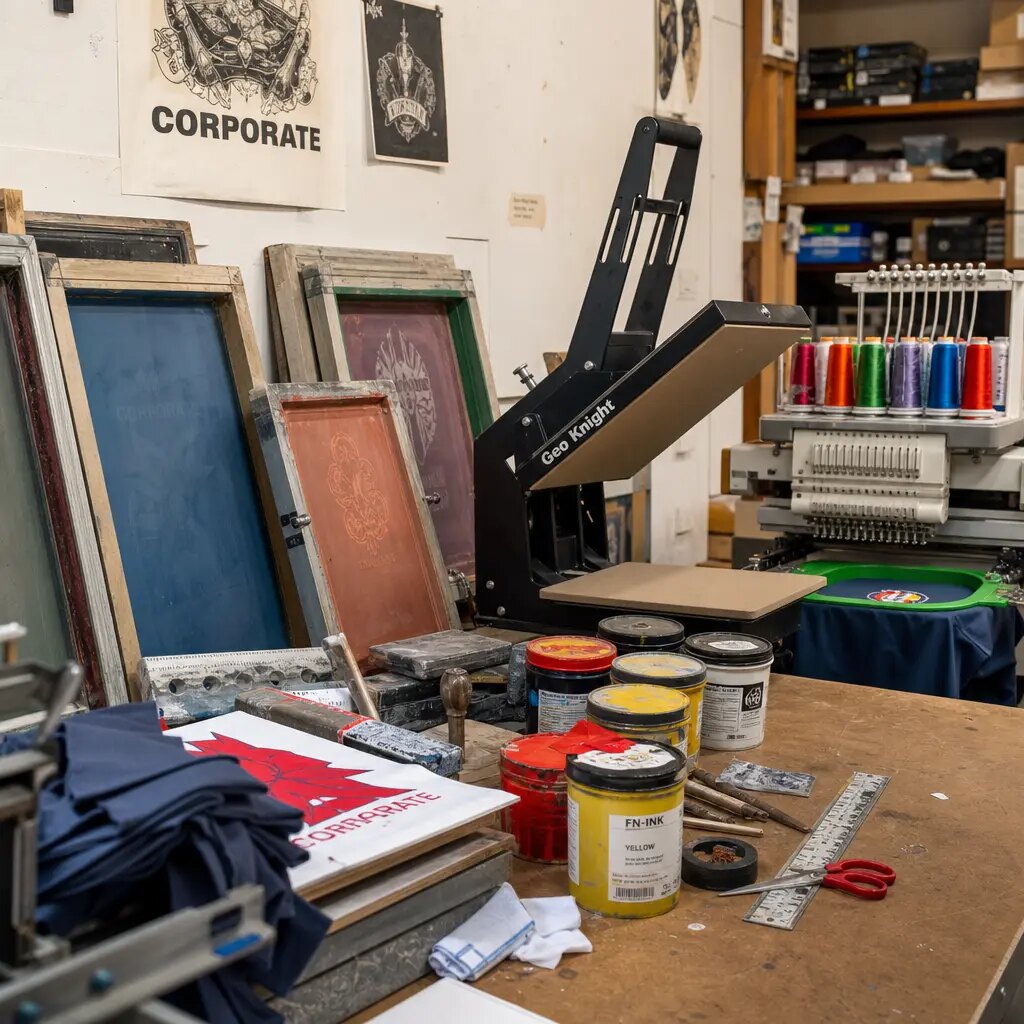
For craft fair sales, the printed flap is often the first part a customer sees. It is also the part most likely to be pressured during packing. Screen printing is normally the most practical method for simple brand marks, event graphics, or one-to-three-color artwork on canvas messenger bags. It offers good cost control and repeatability, but large solid ink areas can stiffen the flap. If printed flaps are folded while ink curing is incomplete, blocking, smudging, or pressure marks can appear after cartons sit in transit.
Embroidery gives a premium look for smaller logos, but it adds thread bulk and can pucker the flap if the fabric weight or backing is not matched. Heat transfer can reproduce complex full-color artwork, but it needs careful film quality and temperature control. Buyers should define the print face and then plan the fold so hardware, straps, or another printed face do not rub directly against the artwork. This is especially important for natural canvas, black canvas, and dark dyed fabrics where abrasion or lint is more visible.
- Best for simple logos: screen print with approved ink color and curing standard.
- Best for small premium marks: embroidery away from thick seams and flap edges.
- Best for complex art: heat transfer with a tested film and wash or rub expectation.
- Print placement tolerance should be stated, such as within plus or minus 5 mm from approved sample position.
- Packed samples should show whether the printed surface touches metal adjusters, zipper teeth, or strap buckles.
Build MOQ logic around variations, not only total order quantity
MOQ discussions often become misleading when buyers only state the total quantity. A total order of 2,000 canvas messenger bags may be easy if all units use the same natural canvas, same print, same strap, and same packing. The same 2,000 pcs split into five fabric colors, ten print designs, two hardware colors, and three carton assortments becomes a different production job. The factory must manage fabric sourcing, cutting markers, print screens, line changeovers, label control, and packing separation.
For craft fair buyers, assortment is commercially useful because different events or maker categories may need different artwork. The risk is that too many small batches push up unit cost and increase sorting mistakes. A practical RFQ should show the order matrix clearly. If the buyer needs 500 pcs per design, say so. If the buyer can accept mixed designs in master cartons, state the required ratio. If each event location needs dedicated cartons, this should be planned before quotation because carton labels, packing lists, and warehouse labor are affected.
- MOQ may apply per dyed fabric color because the fabric mill has its own dye lot requirement.
- MOQ may apply per print design because each artwork needs screen setup, film, registration, and line time.
- MOQ may apply per hardware finish when buckles, snaps, D-rings, or adjusters are custom colored.
- MOQ may apply per label or hangtag version when retail branding changes by region.
- Carton assortment requirements can add handling time even when the sewing specification is identical.
Plan carton quantity by weight, shape, and receiving workflow
The best carton quantity is not automatically the highest number of bags that can be forced into a box. Canvas messenger bags are dense, and a carton that appears space-efficient can become too heavy for craft fair staff, small retailers, or regional distributors to handle safely. A practical gross weight target is often around 12-18 kg per carton, although the exact limit depends on the receiving warehouse and local handling rules. If cartons are courier-shipped, smaller cartons may survive better than very heavy ones.
Packing count also affects counting speed. If one craft fair booth receives 100 units, cartons of 25 pcs or 50 pcs can be easier than cartons of 37 pcs. If the buyer operates several booths, carton quantities should support allocation without opening every box. For example, a PO of 1,200 pcs packed 30 pcs per carton gives 40 cartons, which is easy to divide by event. But if each carton contains mixed designs, the packing list must clearly show the assortment ratio and carton-level breakdown.
- Use flat packing when the bag body and flap can lie cleanly without permanent crease risk.
- Use alternating direction if flaps or buckles create uneven carton height on one side.
- Keep straps folded inside or tied lightly so they do not tangle during unpacking.
- Do not compress metal hardware directly into printed panels.
- Request actual carton measurements after the packed sample, because early estimates often change after bulk sewing.
Choose export cartons that match the route, not just the factory default
A standard 5-ply export carton is usually a safe starting point for canvas messenger bags, but the route matters. Goods moving by ocean freight in palletized cartons face different stress than cartons shipped by courier to multiple craft fair locations. Courier networks involve more manual handling, drops, and sorting belts. Long warehouse storage adds stacking pressure. If the carton board is weak or the carton is overfilled, corners split and dust enters the bags before they ever reach the sales table.
Buyers should make carton strength part of the quote comparison. A cheaper carton can save cents at origin and cost dollars at destination through repacking, damaged retail presentation, or rejected inbound shipments. If cartons are palletized, note pallet dimensions, maximum stack height, and whether edge protectors or stretch wrap are needed. If cartons are not palletized, the carton should be strong enough for direct handling. It is also useful to specify whether carton tape must be plain, reinforced, or buyer-branded.
- Use 5-ply cartons for most wholesale messenger bag shipments.
- Consider stronger board or smaller cartons for courier delivery and repeated event transfers.
- Set maximum gross weight if the receiver has manual handling limits.
- Use moisture control when shipping during humid seasons or to long-storage warehouses.
- Carton labels should remain readable after stacking, wrapping, and local transport.
Approve samples with the packing method, not only the loose product
A loose messenger bag sample can look good on a table and still fail in bulk packing. Sample approval should include construction, print, hardware, and the proposed folding method. The buyer should see how the strap is folded, whether the flap is bent, whether the print touches another surface, and whether individual packaging keeps dust away. One pre-production sample packed as intended is more useful than five beautiful loose samples that never prove the carton plan.
The packed sample stage is also where practical display issues appear. Does the bag need steaming after unpacking? Does the flap keep its shape? Are straps tangled? Does the hangtag sit outside the polybag or inside it? Can staff unpack 30 bags quickly without sorting loose straps and loose tags? For craft fairs, setup speed matters because the receiving team may not have warehouse benches, scanners, or repacking tools at the venue.
- Approve one golden sample for construction, fabric hand feel, print, and hardware.
- Approve one folded sample showing the exact packing method.
- Approve carton quantity after the factory packs a trial carton and measures actual dimensions.
- Review photos of open carton layers before bulk packing continues.
- Keep the approved sample and carton packing photo attached to the PO record for inspection reference.
Calculate quote data that affects landed cost
A serious quote for canvas messenger bags should include more than FOB unit price. Procurement teams need fabric specification, print method, sample charge if any, MOQ by variation, packing method, carton quantity, carton dimensions, gross weight, net weight, and lead time assumptions. Without this data, freight forwarders cannot estimate correctly and buyers cannot compare suppliers fairly. Carton CBM is especially important because canvas bags can move from weight-sensitive to volume-sensitive depending on the final folding method.
A useful comparison is to calculate cost per sellable unit after packing and freight assumptions, not only factory price. For example, one supplier may quote a slightly higher unit cost but pack the bags cleanly at a lower CBM per 1,000 pcs with stronger cartons. Another may quote lower but use oversized cartons and no individual protection. The cheaper quote may create higher landed cost, more repacking labor, and more product cleaning at the event level.
- Required quote data: unit price, fabric weight, print method, packaging included, MOQ, sample time, production time, carton data.
- Required carton data: pcs per carton, carton length, width, height, net weight, gross weight, and total CBM.
- Required variation data: color split, artwork split, label split, and carton assortment plan.
- Required commercial data: Incoterm, payment term, validity period, inspection allowance, and shipment handover point.
- Do not compare quotes until each supplier uses the same packing specification and carton target.
Control lead time risk from fabric, printing, and packing approvals
Lead time for canvas messenger bags is affected by the slowest approved component. Natural canvas is usually faster than custom dyed canvas. Standard black or nickel hardware is faster than custom plated hardware. Screen printing is usually quicker than complex multi-process decoration, but artwork approval can still delay production if Pantone references, print size, or file resolution are unclear. Retail packaging, barcode labels, and carton allocations can also delay packing if supplied late.
A realistic schedule separates sample development, pre-production approval, material purchasing, cutting, printing, sewing, QC, packing, and shipment booking. Buyers often focus only on sewing days, but carton planning needs time too. If the factory waits until the final week to determine carton size, the freight booking may be inaccurate. If carton labels are changed after packing starts, rework can delay dispatch and create allocation errors.
- Sample lead time depends on fabric availability, artwork preparation, hardware sourcing, and label development.
- Bulk production lead time starts after written approval of sample, artwork, packing, and deposit or payment condition.
- Custom dyed fabric can add time for lab dip approval, bulk dyeing, drying, and shade inspection.
- Retail barcodes and event-specific labels should be supplied before bulk packing begins.
- Freight booking should use actual trial carton data, then be updated after final carton measurement if needed.
Set receiving and inspection criteria for craft fair distribution
Craft fair shipments often move through smaller storage areas than normal retail warehouse programs. Cartons may be opened at a venue, in a distributor back room, or by a brand team preparing table displays. The inspection standard should therefore cover presentation issues as well as structural defects. A bag that is technically usable but dusty, crushed, badly creased, or mislabeled can still create real cost because event staff must clean, steam, sort, or relabel it under time pressure.
For incoming inspection, select a sample of cartons across the shipment, not only the cartons placed at the front. Verify carton count, carton labels, unit count, color split, artwork split, and visible bag condition. Then inspect product details: fabric defects, print alignment, seam strength, strap attachment, hardware function, and packaging cleanliness. If defects are found, separate construction problems from packing problems. This helps the supplier correct the right process in the next order.
- Carton-level acceptance: correct label, correct quantity, no burst corners, no water damage, no severe crushing.
- Unit-level acceptance: correct style, color, print, strap, hardware, label, and packaging.
- Visual acceptance: no obvious stains, heavy creases on display face, loose thread clusters, or print smears.
- Functional acceptance: strap adjuster moves, closure works, seams hold under normal pull test.
- Documentation acceptance: packing list matches carton marks and event allocation plan.
Specification comparison for buyers
| Spec decision | Recommended option | When it fits | Buyer risk to check |
|---|---|---|---|
| Fabric weight for craft fair retail display | 10 oz to 12 oz cotton canvas, roughly 280-360 GSM before washing or finishing | Good balance for messenger bags sold as event merchandise, maker kits, school accessories, or brand retail items | Below 10 oz may collapse on display and feel cheap; above 14 oz raises carton weight and may require stronger needles, higher labor, and higher freight cost |
| Bag structure and flap stiffness | Single main compartment with reinforced flap, boxed bottom, and optional light inner lining | Works for craft fairs where bags hang on racks or sit on shelves and must keep a presentable shape | Too much stiffener increases CBM and may crease during compression; no reinforcement can make the flap curl after printing or steaming |
| Printing method on flap or front panel | Screen print for solid logos; heat transfer only for complex full-color art; embroidery for small premium marks | Screen print is usually the most stable option for medium to large fair runs with repeatable brand artwork | Large ink coverage on heavy canvas can feel stiff; embroidery on thick seams may pucker; transfer film may crack if low-grade or overheated |
| Packing unit for retail handling | One bag in a recyclable polybag or paper belly band, then 20-40 bags per master carton depending on size and weight | Useful when craft fair staff need fast counting, clean storage, and simple table replenishment | Individual packaging adds labor and material cost; no inner packing can cause dust marks, strap tangling, and slower booth setup |
| Carton fill method | Flat packing with straps folded inside and flaps aligned, alternating direction every 5-10 pcs if needed | Best for keeping carton height controlled and preventing flap distortion during ocean or courier transit | Random folding creates uneven pressure, crushed corners, and misleading carton measurements that affect freight booking |
| Master carton strength | 5-ply export carton for most orders; consider stronger board for courier, pallet stacking, or long storage | Suitable for mixed distributor shipments, regional craft fair routes, and warehouse replenishment | Thin cartons may burst at corners because canvas messenger bags are dense; overfilled cartons can exceed safe manual handling weight |
| Carton weight target | Keep gross weight commonly around 12-18 kg per carton unless the buyer has a strict warehouse limit | Safer for manual unloading at fairs and easier for distributors to split inventory by event location | A carton that looks efficient on CBM can still be rejected by the receiving team if too heavy or awkward to lift |
| MOQ planning | Set MOQ by fabric color, print artwork, hardware color, and packing style, not only total bag quantity | Helps buyers understand why 1,000 pcs one design is simpler than 1,000 pcs split into many colorways | Too many small variations cause higher setup cost, longer pre-production approval, and carton labeling mistakes |
| Carton label information | Style code, color, artwork version, quantity, carton number, gross/net weight, carton size, and PO number | Needed when goods are delivered to multiple craft fair teams, distributors, or pop-up retail locations | Generic labels slow receiving and increase the chance that the wrong design goes to the wrong event |
Buyer checklist before sampling
- Define the bag size as finished dimensions, including flap length, gusset depth, strap length range, and whether dimensions are measured before or after pressing.
- Select canvas weight by use case: 10-12 oz for most craft fair retail messenger bags, heavier only when the bag must carry books, tools, or premium merchandise.
- Provide artwork with print size, print placement, Pantone or CMYK reference, and tolerance for logo position on the flap or front panel.
- State whether bags need individual polybags, paper bands, hangtags, barcode stickers, silica gel, retail price labels, or no unit packaging.
- Set carton goals before quotation: target pcs per carton, maximum gross weight, maximum carton dimension, pallet requirement, and whether cartons will be courier-shipped.
- Require a pre-production sample packed in the proposed folding method, not only a loose bag sample.
- Approve hardware color, strap webbing width, zipper or magnetic snap quality if used, and reinforcement stitching at shoulder strap connection points.
- Request carton drop or compression expectations when the route includes courier delivery, long storage, or multiple craft fair transfers.
- Confirm carton marks and inner assortment plan, especially when one PO includes several fabric colors, prints, or regional event allocations.
- Compare supplier quotes using the same packing specification; otherwise the lowest unit price may hide higher CBM, weaker cartons, or missing retail packaging.
Factory quote questions to send
- What finished bag dimensions, fabric GSM or ounce weight, strap width, and hardware specification are included in the quoted price?
- Is the canvas fabric greige, dyed, washed, or pre-shrunk, and what shrinkage tolerance should we expect after finishing or steam pressing?
- Which print method is quoted, how many colors are included, and what is the setup cost or screen charge for each artwork version?
- What MOQ applies per fabric color, per print design, per hardware color, and per packing method?
- How many bags are packed per carton, what are the estimated carton dimensions, and what are the estimated net weight, gross weight, and CBM?
- Is individual packaging included, and if yes, what material, size, warning text, barcode sticker, and hangtag application are included?
- Will the factory provide a packed pre-production sample or carton packing photo before bulk packing starts?
- What is the sample lead time, bulk production lead time after sample approval, and additional time required for custom labels, dyed fabric, or special hardware?
- What quality control standard is used for fabric defects, print placement, seam strength, carton weight, and packing accuracy?
- Can the supplier separate cartons by color, design, or craft fair location, and provide a packing list showing carton-level breakdown?
Quality-control points to confirm
- Fabric weight should match the approved specification within a practical tolerance, commonly checked by GSM test or supplier fabric report before cutting.
- Finished bag dimensions should stay within agreed tolerance, for example plus or minus 1 cm for main body size and tighter tolerance for print placement where visible.
- Flap alignment should be centered and cover the main opening evenly; warped flaps are highly visible on retail racks.
- Shoulder strap bar-tacks or box stitches should be clean, dense, and placed at stress points without skipped stitches.
- Print color, opacity, registration, and curing should match the approved sample; perform rub testing on dark canvas and heavy ink coverage.
- Metal or plastic hardware should be the approved color and finish, with no sharp burrs, weak adjusters, or loose rivets.
- Each unit should be free from loose thread, dust marks, oil stains, needle holes outside seam allowance, and obvious fabric slubs on the display face.
- Packing should follow the approved fold direction, strap placement, inner packaging, and carton quantity; random overfilling should be treated as a packing defect.
- Carton markings should match the PO, style, color, quantity, carton number, gross weight, and destination allocation.
- Finished cartons should be weighed and measured before shipment so the freight quote is based on actual carton data, not early estimates.