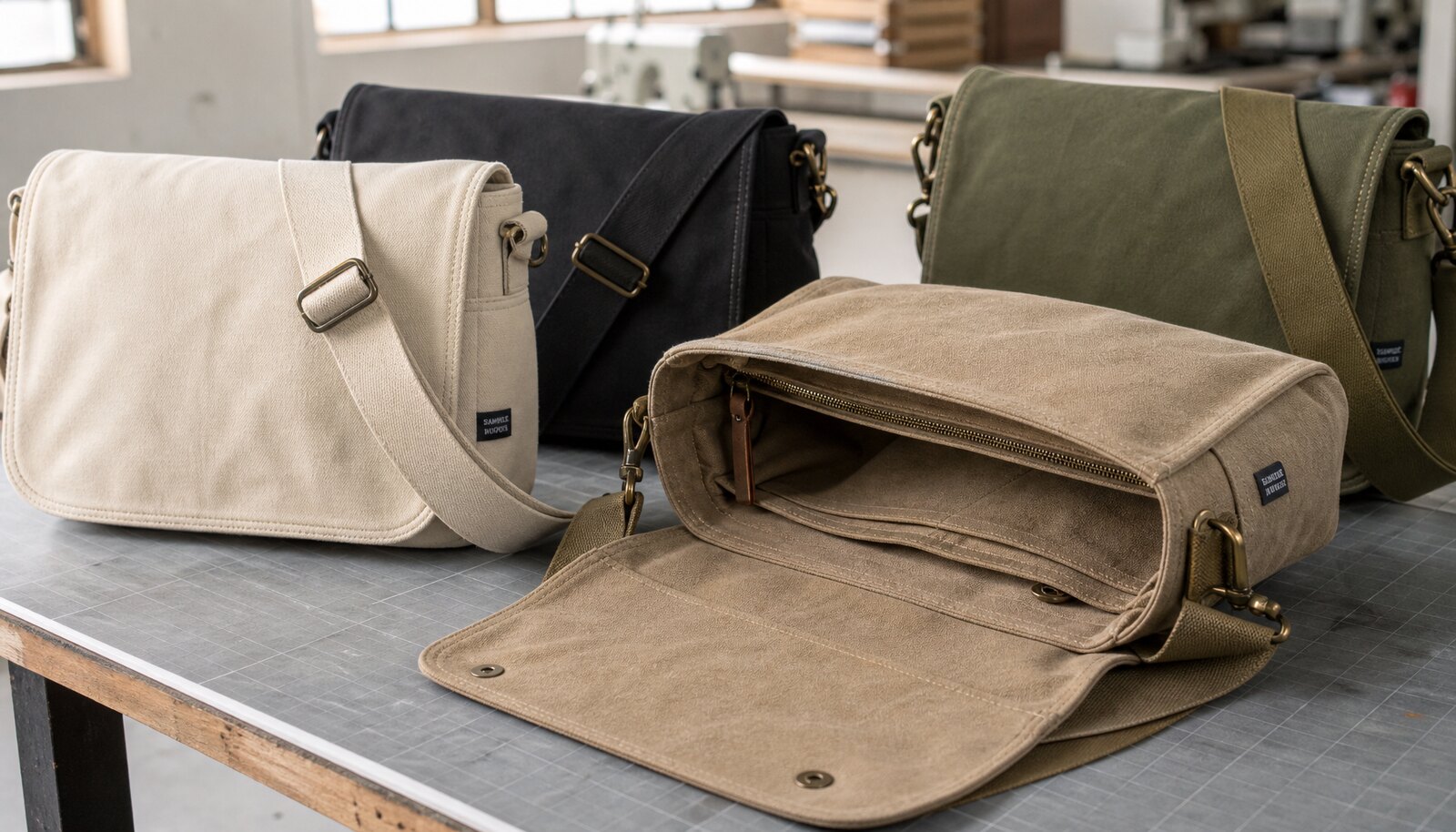
Why a gift-shop RFQ needs more than a line that says “canvas messenger bag”
Gift shop buyers are not sourcing a generic bag. They are buying a retail item that has to fit a target margin, look good on shelf, hold up to daily handling, and still be easy to reorder months later. Canvas messenger bags can be made as soft or structured, unlined or lined, open top or zip top, plain or decorated, stock color or custom dyed. If the RFQ only says “canvas messenger bag, custom logo,” suppliers will quote different constructions and the quotes will not be comparable.
The first procurement risk is spec drift hidden inside a simple product name. A low quote may be lower because the supplier assumed lighter canvas, smaller reinforcement patches, fewer stitching operations, a cheaper closure, or minimal packing. None of those assumptions is visible if the RFQ is vague. The buyer then compares prices that do not represent the same bag.
Gift shop programs also have a reordering problem. If the first order sells well, the product may need to be repeated for museum shops, tourist stores, campus stores, seasonal events, or promotional gifting. That means the RFQ should capture the details that affect repeatability: fabric finish, decoration method, reinforcement points, fold style, packing, and inspection standard. Without those details, the second order can drift away from the first one even if the product photos still look similar.
A useful RFQ does not need to be long. It needs to remove hidden assumptions. Any detail that changes cost, retail appearance, lead time, or claim risk should be written into the request. If a supplier can reasonably make a different choice and still claim the order was filled, the requirement needs to be specified.
For gift shop buyers, the business question is simple: which version of the bag will sell cleanly at the right margin and be repeatable without re-learning the product every season? The RFQ is the tool that turns that question into a stable spec.
- Use one product definition before requesting prices.
- Keep the first RFQ focused on one size and one decoration method.
- Separate retail appearance requirements from functional requirements.
- Treat every uncontrolled assumption as a hidden price difference.
Start with product architecture: size, canvas weight, and how structured the bag should be
The most useful gift-shop messenger bags usually sit in the medium range rather than the oversized commuter range. A practical starting footprint is about 14 to 16 inches wide, 11 to 13 inches high, and 3 to 5 inches deep, with an adjustable strap and a flap or top closure. That size is large enough for books, souvenir items, a small tablet, or daily carry, but still compact enough to merchandise well in a retail setting.
Canvas weight has a direct effect on how the bag looks, feels, and ships. A 12 oz canvas is a common baseline when buyers want a retail-friendly bag that still has some body. A 16 oz canvas gives more structure and a more substantial hand feel, but it can cost more, add shipping weight, and feel too rigid for a casual gift-shop audience. Very light canvas can lower price, but it often collapses when loaded and can look unfinished in a display fixture.
When a supplier quotes in GSM, ask how the weight was measured. Was it before finishing, after washing, or on a finished cloth? This matters because finish can change the apparent weight and hand feel. Also ask whether the canvas is plain weave, treated, washed after sewing, or finished with any coating. Those details affect print sharpness, seam appearance, and dimension stability.
Structure should match the selling channel. Some gift shops want a bag that hangs neatly and looks presentable immediately. Others want a softer, casual silhouette that feels more like a souvenir piece than a work bag. If the bag is too rigid, it may feel technical or heavy. If it is too soft, it may not hold its shape on shelf. Ask the factory to quote the same style in one fabric weight and one construction level first, then decide whether an upgrade is worth the cost.
Dimensions should be written as finished measurements with tolerance, not as marketing language. State the body width, body height, gusset depth, and the usable opening if contents need to fit easily. If the bag will hang on a fixture, note the total hanging height including strap drop. That avoids a situation where the bag looks right in a photo but sits awkwardly on your retail hook.
- Ask for fabric weight in oz or GSM plus the finish state.
- Request a physical swatch or sealed reference sample.
- If the bag must fold flat for display, avoid over-building the structure.
- Define usable opening and internal depth if the bag will carry books or tablets.
Decoration choice should follow retail price point, not just design preference
Decoration has a larger cost effect on canvas messenger bags than many buyers expect. The same artwork can be made as screen print, transfer print, embroidery, woven label, sew-on patch, or a mixed decoration package. Each method changes setup time, labor, reject risk, and shelf presentation. For simple logos and repeat programs, screen print is often the cleanest commercial choice because it can be efficient and predictable on natural canvas.
Embroidery can make the bag feel more premium, but it is not a free upgrade. It adds machine time and can distort softer canvas if the logo is too large or placed too close to an edge. Ask the supplier how they stabilize the panel, whether they add backing, and how they prevent puckering. If the logo is large or detailed, ask for a stitched sample on the exact canvas type rather than assuming a thread chart is enough.
Transfer decoration works better when the artwork needs more color detail or when the run is too small to justify a screen setup. The risk is durability. On rough canvas, transfer can crack, lift at the edges, or show wear after folding and rubbing. If the factory suggests heat transfer, ask for the film type, press conditions, curing or cooling method, and the post-press test they use before bulk approval.
Woven labels and sewn patches are useful for gift-shop items that need a softer branded look. They can keep the front panel cleaner and often look more intentional than a large print. But the placement still matters. A label that sits too close to a seam or is slightly off-center can make the entire product look rushed, even if the stitching quality is otherwise acceptable.
The right decoration method is the one that supports your target price, your artwork complexity, and your acceptable level of production risk. If the bag is meant for tourist shops or impulse-buy displays, simpler decoration often protects margin and keeps reorders easier. If the bag is positioned as a premium souvenir or branded retail item, then embroidery, patch work, or mixed decoration may be justified, but the RFQ should make that choice deliberate rather than accidental.
- Simple logo: screen print or woven label usually gives the best value.
- Premium positioning: consider embroidery or a sewn patch.
- Complex full-color artwork: confirm transfer durability on canvas before bulk approval.
- Ask whether the decoration method changes MOQ or lead time.
Use the comparison table as a sourcing filter, not a style sheet
The comparison table is useful only if it helps you identify hidden differences between quotes. When suppliers price canvas messenger bags, the lowest number often comes from a lighter cloth, fewer reinforcement points, a simpler closure, or minimal packing. That does not mean the supplier is more efficient. It may simply mean they are quoting a different bag.
To compare like for like, every supplier should be asked to quote the same baseline spec before any alternatives are considered. If one quote is based on 12 oz natural canvas, screen print, unlined construction, and polybag packing, then every quote should start from that exact baseline. Only after the baseline is clear should you ask for optional prices for a zipper, a lining, a premium closure, or a heavier canvas.
The table also helps separate price from risk. For example, a fully lined bag can justify a higher price because it improves structure and protects contents, but it also adds sewing complexity and possible misalignment risk. A snap closure may be cheaper and easier to make, but a zipper may better match a security-sensitive retail use. The buyer’s job is to decide which tradeoff matters most for the store environment and target ticket price.
Quote structure matters too. A useful supplier quote lists fabric, sewing labor, decoration, trims, packing, carton, and inland charges separately. A single blended number hides the drivers that matter. If the quote is opaque, ask for a line-item breakdown before you compare suppliers. That will tell you whether the supplier is truly competitive or simply offering fewer operations.
In landed-cost terms, a slightly higher ex-factory price may still be the better buy if the bag arrives with better packing, cleaner finishing, and fewer defects. Gift shops care about presentation and receiving labor, not just unit cost. The table should help you compare the actual retail product, not a theoretical factory sample.
- Compare only like-for-like versions before ranking suppliers.
- Request separate price lines for fabric, labor, decoration, trims, packing, carton, and inland charges.
- Use supplier route as a decision factor, not just a price label.
- Treat lower unit price with caution if the spec is thinner, simpler, or less protected in transit.
What to write into the RFQ so factories quote the same bag
A solid RFQ for canvas messenger bags can stay concise if it covers the fields that actually drive production. Start with finished size, canvas weight, fabric finish, color, closure, lining level, pocket count, strap width, strap length range, decoration method, and hardware finish. Then attach the artwork file, packing instructions, carton requirements, and approval process. That is enough for a factory to quote with discipline instead of guesswork.
Be specific about functional requirements. If the bag must fit books, a tablet, or a souvenir item sold in the same store, state the minimum internal dimensions. If the bag will hang in a retail fixture, note the full hanging height. If the logo must sit a fixed distance from the top edge or seam, include the tolerance. The more you define these points, the less room there is for a supplier to make assumptions that alter cost or appearance.
Artwork information should be complete enough that a production team can work without chasing clarifications. Include the file type, Pantone references if needed, print size, exact placement, and whether decoration is single-sided or double-sided. If the artwork is complex, ask the supplier to confirm whether they will create production art, a strike-off, or a print proof and who will approve it. Poor artwork control is a common cause of sample loops and schedule slips.
The RFQ should also define the approval sequence. For most canvas messenger bag programs, the factory should not move to bulk production until the buyer has approved the swatch or reference sample, the pre-production sample, the print proof or strike-off if relevant, and the packing or carton layout. If the supplier knows exactly what needs sign-off, they are less likely to substitute materials or change the build quietly.
If you are sourcing for more than one store channel, note the variant logic. A museum shop colorway and a tourist shop colorway may use the same base construction with different decoration or color. Ask the supplier to price them on a shared structure so the comparison stays clean. That makes reorders easier later because the spec is already organized around the base bag instead of around one-off sample decisions.
- Finished size with tolerance
- Fabric weight and finish
- Decoration method, size, and placement
- Closure, lining, pocket, and strap details
- Packing method and carton specification
- Approval points before bulk release
Sample approval is where many messenger bag launches fail
A sample should prove more than appearance. It should prove that the exact bag can be made with the final fabric, final trim, final decoration, and final packing method, and that it still works in use. A bag that looks clean on the sample table can still twist under load, pull at the strap anchors, or arrive with a closure that feels weak in the hand.
Use the sample sequence intentionally. A reference sample can show the supplier’s prior capability, but it is not the same as your approved product. Require a pre-production sample built with your actual artwork and approved materials. If the factory changes anything after that, they should flag the change in writing and re-submit the revised version for approval. That matters even more if a trading company is managing the order because material substitutions can be hidden behind “equivalent” language.
Review the sample with a measurement plan, not just a visual scan. Put the bag flat and check width, height, gusset, strap length, and logo position. Open and close the closure several times. Load the bag with a realistic amount of weight and look for top-edge distortion, strap pull, seam shift, or flap ride-up. If there is a pocket, test whether the intended item fits without stretching the panel or causing crooked stitch lines.
Gift shop buyers often have a higher appearance threshold than utility-bag buyers. Thread ends, label alignment, print edge quality, seam puckering, and fold presentation can all affect the retail perception of the bag. Minor workmanship flaws that might be acceptable in a work bag can become shelf issues in a gift shop. Put that standard in writing before the sample review so the factory understands how strict the appearance bar is.
Lock the sample version before bulk approval. Record the sample date, the approved artwork file, the fabric reference, the trim details, and any special packing notes. Keep one physical approved sample and one digital record. If the factory later says it followed the approved sample, you will want a clear version trail to prove which sample was actually approved.
- Measure finished size after the sample is fully formed.
- Check logo placement against seam lines and pocket edges.
- Load the bag and inspect strap comfort and seam strain.
- Keep one signed physical approval sample and one digital approval record.
Packing and carton planning should reduce receiving labor, not add it
Packing is one of the most overlooked cost drivers in this category. Canvas messenger bags do not all fold the same way, and a poor fold plan can leave the front panel creased, the flap warped, or the decoration scuffed. That creates extra work for store staff or warehouse teams before the bags even reach the shelf. A slightly better packing instruction can save more time than a small unit-price discount.
A common retail-friendly pack is one bag per polybag with a barcode sticker or size/color label, then bulk packed into export cartons. If the bag has dark decoration, metal hardware, or a coated finish, use a protective insert or tissue sheet so the face does not rub against other units. If the shipping route is humid or long, ask whether the supplier recommends desiccant. These are small decisions with real damage-control value.
Carton planning should match how your warehouse receives goods. Ask for carton count by SKU and color, not only a total piece count. That way, mixed programs can be received and allocated faster. Request carton dimensions, gross weight, and net weight so your team can plan palletization and handling. A carton that is too heavy can create receiving issues even if it saves on packing cost.
The carton label spec should be written into the RFQ. Include SKU, color, quantity, carton number, destination mark, and any retailer-specific receiving code. If the order is shipping to multiple locations, note whether cartons should be separated by channel or mixed by color. Ask the supplier to confirm the carton grade or compression approach if the boxes will be stacked or shipped long distance. Weak cartons can crush a structured flap or leave creases that are hard to remove.
Fold direction should also be specified. That sounds minor, but it affects how the bag opens on shelf and whether the front panel shows a permanent crease. If the bag will hang, ask whether the strap is tucked inside the bag or left visible in the polybag. A small packing instruction can improve presentation and reduce the amount of post-receipt fixing your team has to do.
- Specify fold direction to reduce permanent front-panel creasing.
- Request carton markings with SKU, color, quantity, and carton number.
- State whether mixed colors may ship in one carton or must be segregated.
- Ask for carton size, gross weight, and net weight before freight booking.
MOQ and lead time are production outcomes, not marketing promises
MOQ rises when the bag requires custom color, custom lining, custom hardware, multiple decoration steps, or a special packing format. On canvas messenger bags, the cleanest way to control MOQ is to keep the first order simple. Use one base fabric, one construction style, one closure type, and one decoration method if you can. Each extra variable adds sourcing work and can push the minimum quantity higher.
Lead time should be measured from pre-production sample approval, not from purchase order date. That distinction matters because the factory cannot safely start bulk work until the materials, artwork, and sample are approved. If your order supports a holiday launch, a store opening, or a trade-show deadline, put that timeline into the RFQ so the supplier sees the real schedule pressure.
Ask for a stage-by-stage timeline rather than a single delivery number. A useful schedule includes fabric procurement, cutting, decoration, sewing, finishing, inspection, packing, and shipment booking. If the supplier cannot identify the bottleneck stage, they may be quoting from spare capacity rather than from a firm plan. That is risky when the order sits in peak season.
For a first run, stock canvas and standard trims are usually the safest path. They reduce quote uncertainty and make approvals faster. Once the product proves itself, you can introduce custom color or more refined finishing on a reorder. That is often better than over-engineering the first launch and missing the timing window.
Also ask what changes will reset the delivery date after order confirmation. If artwork revisions, trim substitutions, or delayed color approval can restart the schedule, that needs to be documented. In soft-goods sourcing, hidden approval assumptions are a common reason launch dates slip. Put the approval path in writing so the factory and buyer are working from the same schedule logic.
- Ask for separate timings for sample, bulk production, inspection, and shipment.
- Clarify whether lead time changes if artwork or trim is not confirmed immediately.
- Use stock fabric and standard trims for the first run to protect MOQ and schedule.
- Write the final approval date into the RFQ when the launch is time-sensitive.
How to compare quote lines and calculate landed cost without missing hidden drivers
The quote that matters is the one that reaches your store at the lowest practical total cost, not the one with the lowest unit price at the factory gate. For canvas messenger bags, landed cost can include freight, import handling, carton handling, warehousing, inspection, and the labor required to re-fold or rework the product on arrival. A cheaper ex-factory quote can become more expensive if the packing is poor or if the bags arrive with more damage or scuffing.
To compare fairly, ask each supplier to price the same item in the same format. At minimum, the quote should show fabric, sewing labor, decoration, trims, packing, carton, and inland charges. If a supplier offers only one all-in number, request a breakdown before you compare. A line-item quote is not just an accounting preference; it is the only way to identify which cost driver is changing the price.
The landed-cost discussion should include quality risk. A bag that arrives with cleaner stitching, better decoration placement, and safer packing may save labor and reduce claims even if it costs more upfront. Gift shops care about shelf appeal, so defects do not only create replacement cost. They can also slow sell-through and create an assortment that looks uneven from one store to the next.
Supply route affects transparency. Factory-direct usually gives the cleanest view of material and labor assumptions, especially when the style will be reordered. A trading company or sourcing agent can still be valuable if you need mixed-category consolidation or help managing communication, but then you should ask who owns the material purchase, who approves the strike-off, and whether the agent can show production photos from the actual line. If those answers are vague, the low price may not be worth the added uncertainty.
A simple comparison matrix helps. Put the product specs side by side, then mark where each supplier differs in fabric, closure, strap reinforcement, decoration, packing, and carton spec. The answer usually becomes obvious once you strip away the marketing language. The best quote is the one that matches the approved bag, not the one that sounds cheapest in isolation.
- Compare ex-factory price and then add freight, handling, and receiving costs to reach landed cost.
- Separate fabric, labor, decoration, trims, packing, carton, and inland charges.
- Treat a cleaner, more consistent bag as part of cost savings if it reduces claims or receiving labor.
- Use a side-by-side matrix to spot material or packing differences hidden inside “similar” quotes.
Factory-direct vs trading company: choose the route that matches your control needs
Factory-direct sourcing usually works best when the spec is stable and you want direct control over cost, material selection, and repeatability. You can discuss canvas weight, reinforcement, print method, and packing directly with the production source, which is helpful if the bag will be reordered across multiple seasons or store programs. Direct sourcing also makes it easier to request production photos, line references, and clear answers about QC flow.
A trading company or export agent can still make sense when the service layer adds real value. If you need mixed-category consolidation, local-language support, or help coordinating smaller accessories with the same shipment, a strong agent can simplify the process. But the buyer should verify whether the quote is backed by an actual factory relationship or by subcontracting layers that reduce visibility. The more layers in the chain, the more important material traceability becomes.
This is not a philosophical decision. It is an operational one. If your team has a stable spec and can review samples and inspections directly, factory-direct usually gives stronger control. If your team needs bundled service or help managing multiple product lines, a trading partner can earn its margin. Either way, the RFQ should still require the same spec lock, approval record, and QC standard.
Ask who buys the canvas, who approves the strike-off, who confirms the strap webbing, and who signs off on the carton mark. Vague answers are a warning sign. Clear answers show that the supplier understands product ownership rather than just purchase-order handling. If the supplier can document its role in material purchase and production approval, either route can work.
For gift shop buyers, the routing choice may change by order stage. A first sample order may be easier through an agent if communication speed matters and the order is small. A repeat bulk order may be better direct with the factory once the spec is stable. The RFQ should support either path by defining the product clearly enough that the route becomes a service choice, not a product-definition choice.
- Choose factory-direct when the spec is stable and you need repeatability.
- Use a trading company only when the service layer adds real value, such as consolidation or communication support.
- Ask who owns material purchase, strike-off approval, and carton marking confirmation.
- Do not let the sourcing route replace spec discipline.
Specification comparison for buyers
| Buyer decision point | What to quote explicitly | Why it changes the quote | Procurement tradeoff to evaluate |
|---|---|---|---|
| Fabric weight and finish | State canvas weight in oz or GSM, and whether the cloth is raw, bleached, dyed, enzyme-washed, garment-washed, or coated | Weight and finish change cutting behavior, print appearance, body, and sewing difficulty; washed or coated fabrics can also alter yield and inspection tolerance | A lighter cloth may reduce cost and carton weight, but it can look soft or collapse when loaded; a heavier cloth gives more structure but can raise cost and make the bag feel less casual |
| Construction level | Specify unlined, partial lining, or full lining; add pocket count, divider needs, gusset depth, flap structure, and whether binding or facing is required | More panels and lining increase sewing minutes, pattern complexity, and defect points | Unlined construction is usually cheaper and faster, while lined construction can protect contents and support a higher shelf price |
| Closure and opening | Ask for magnetic snap, zipper, hook-and-loop, drawstring under flap, or open top with strap closure; define hardware finish and closure placement | Different closures require different hardware, reinforcement, and assembly time | A snap or open-top bag is simpler and lighter; a zipper adds security and perceived value but adds labor and failure points |
| Decoration method | Define screen print, digital transfer, embroidery, woven label, sew-on patch, deboss patch, or mixed decoration; include placement, size, and artwork count | Decoration drives setup cost, rejection risk, and throughput; the same artwork can produce different factory methods and lead times | Screen print is usually strongest for repeat programs; embroidery or patch work can improve retail presentation but may reduce detail or increase quote cost |
| Strap and load points | State strap width, webbing type, adjustability, buckle or slider type, anchor reinforcement, bar-tack count, and hardware color | Strap build affects material usage, labor, and the risk of seam failure under load | A narrow or lightly reinforced strap lowers cost, but it can raise claim risk if the bag carries books, tablets, or daily commute weight |
| Retail packing | Specify polybag or no polybag, barcode placement, insert card, hang tag, tissue, silica gel, and carton label format | Retail-ready packing adds materials and time at the factory | Simple packing keeps cost down, but shelf-ready packing can reduce store labor and improve presentation consistency |
| Color strategy | Identify stock natural canvas, standard dyed colors, Pantone matching, piece-dyed, or panel color blocking | Stock colors are faster and lower risk; custom dyeing or matching needs color approval and may require higher MOQ | Using standard stock color reduces sampling complexity; custom color may fit a gift-shop collection better but needs tighter controls |
| Supply route | Quote whether the supplier is factory-direct, through a trading company, or through an export agent; ask who owns material purchasing and approvals | Supply route affects pricing transparency, speed, traceability, and change control | Factory-direct usually gives cleaner control; a trading company can help with mixed-category consolidation, but traceability must be verified |
| Carton and shipping plan | Request carton dimensions, pieces per carton, gross weight, net weight, master carton marks, and palletization guidance | Carton specs affect freight cost, warehouse handling, and crush risk | Denser cartons may ship cheaper but can crush or crease product; lighter cartons protect appearance but may increase freight volume |
Buyer checklist before sampling
- Define finished width, height, gusset depth, and strap length before asking for price.
- State canvas weight in oz or GSM and note whether the fabric is raw, dyed, washed, coated, or enzyme-finished.
- Lock the decoration method, artwork size, placement, and file format so every supplier quotes the same process.
- Specify closure type, lining level, pocket count, strap width, hardware finish, and reinforcement points.
- Ask for a physical swatch and an approved pre-production sample before bulk starts.
- Request a price breakdown for fabric, sewing labor, decoration, trims, packing, carton, and inland charges.
- Confirm carton count, carton dimensions, gross weight, net weight, and outer label requirements.
- Set measurable tolerances for size, color, print placement, and strap length.
- Confirm lead time from sample approval, not from purchase order date.
- Request production reference photos or a prior QC report if the supplier is new to your program.
Factory quote questions to send
- What canvas weight are you quoting in oz or GSM, and is that measured before or after finishing or washing?
- What fabric finish is included in the quote: raw, bleached, dyed, washed, coated, or enzyme-finished?
- Please break down the unit price into fabric, cut-and-sew labor, decoration, trims, packing, carton, and inland charges.
- Which decoration method is included, and what setup cost, if any, is already in the quote?
- What is the MOQ for this exact spec, and what changes would increase MOQ or lead time?
- What reinforcement do you use at strap anchors, top edge joins, flap corners, and closure points?
- What tolerance do you follow for finished size, strap length, logo position, and color variation?
- Can you show the sample path: reference sample, pre-production sample, and top-of-production sample?
- What carton size, pieces per carton, gross weight, and net weight should we expect for warehouse planning?
- What inspection standard do you use before shipment, and can you share a QC checklist or defect photos?
Quality-control points to confirm
- Measure finished size on a flat table after the sample is fully formed. Check width, height, gusset depth, and strap length against the approved tolerance, not against a catalog photo.
- Confirm the canvas weight against a sealed reference swatch or approved lab note. Do not accept a verbal GSM or oz claim without a sample reference.
- Check stitch density along main seams and strap anchors. Look for skipped stitches, seam wandering, loose tension, and broken thread ends at stress points.
- Inspect bar-tacks or reinforcement patches for even placement, full coverage, and clean thread lock. Anchor points should not separate or distort under a pull test.
- Use a realistic load test on samples and early production pieces. The bag should hold the target load without seam opening, anchor distortion, or hardware pullout.
- Check print or decoration adhesion on the actual canvas texture using rub, tape, or repeated fold testing. Ink, transfer, or patch edges should not crack, peel, or smear.
- Verify logo placement relative to seams, flap edges, pocket openings, and top edge so the decoration does not look off-center or get cut by a seam line.
- Examine hardware for smooth operation, correct finish, secure riveting, and the absence of sharp edges or weak magnetic closure strength.
- Review color under daylight or a standardized light source against the approved sample. This matters most for natural, black, navy, olive, and other deep shades.
- Record defect counts by category using an AQL-based inspection plan. For a bulk order, define acceptable, major, and critical defects before shipment rather than deciding them after goods arrive.