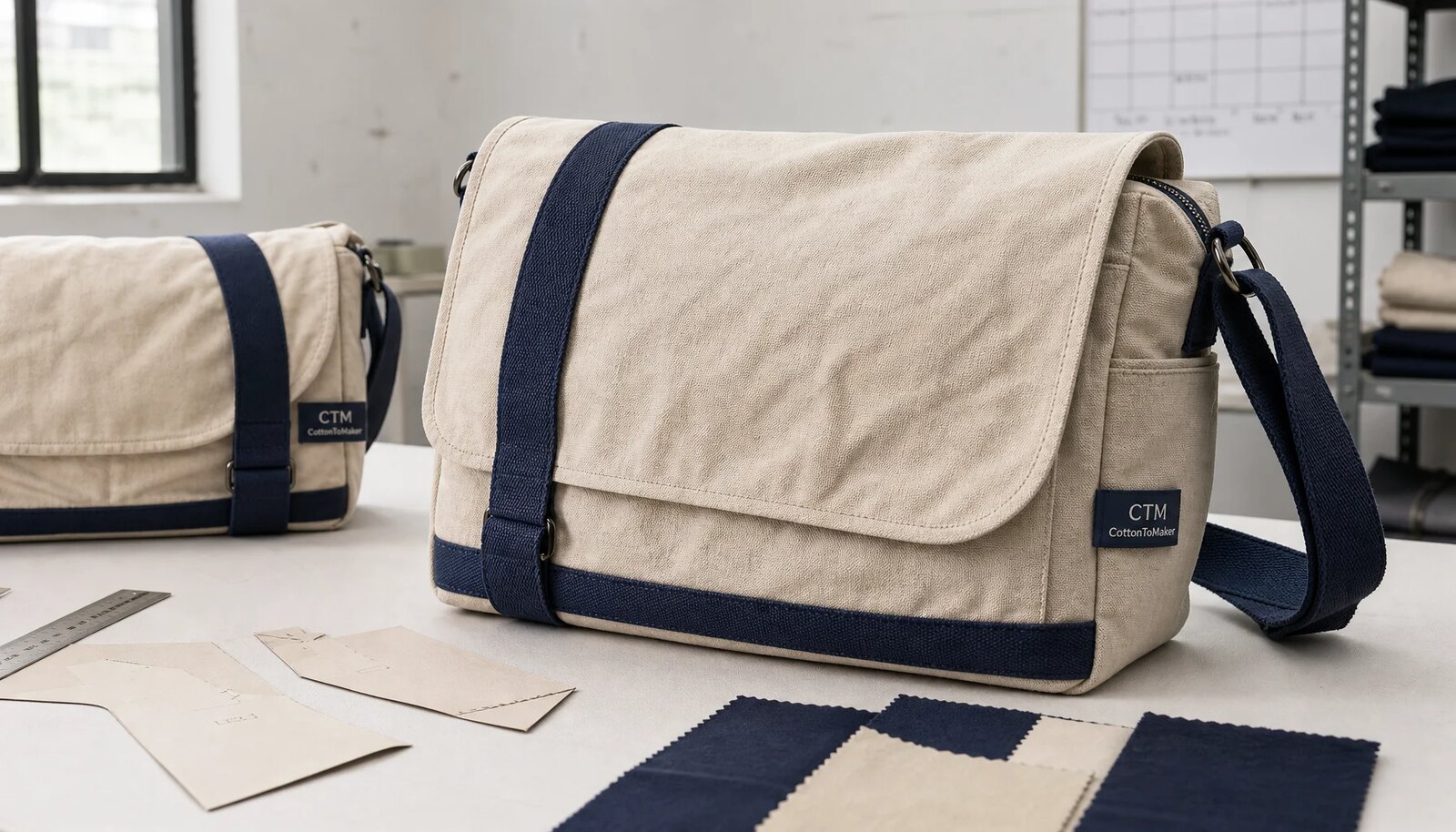
1. Start With the Event Job, Not the Bag Photo
A useful RFQ begins before fabric weight, logo size, or price tiers. It starts with the job the bag must do at the event. Canvas messenger bags may serve as simple attendee giveaways, staff work bags, sponsor kits, VIP gifts, retail resale items, or reusable bags across a multi-city program. Those use cases can look similar in a mood board, but they should not be quoted as the same product.
Tell suppliers who receives the bag, what goes inside it, how it will be distributed, and how long it needs to look presentable. A registration giveaway may carry a notebook, agenda, pen, and sponsor card for one or two days. A staff bag may carry a tablet, charger, badge stock, water bottle, and printed documents through long shifts. A VIP kit may be pre-packed and photographed before delivery, so shape retention and unpacking presentation matter as much as seam strength.
State the event deadline and the operational deadline separately. The event date is not the only date that matters. Kitting teams may need bags two weeks earlier. A venue may accept deliveries only during a short window. A sponsor approval may be tied to sample photos. When suppliers understand the real receiving schedule, they can flag whether custom dyeing, sample revisions, outsourced decoration, or freight mode creates risk. A stronger canvas messenger bags for event planners RFQ template guide connects the product spec to those operational dates from the first page.
- Attendee giveaway: prioritize clean logo execution, dependable canvas, simple closure, and economical carton packing.
- Staff or field bag: prioritize reinforced strap anchors, secure closure, useful pockets, and a sample load test.
- VIP or sponsor kit: prioritize presentation after unpacking, cleaner finishing, controlled folding, and consistent decoration.
- Retail resale item: prioritize tighter size tolerance, durable hardware, hangtag or barcode needs, and preserved master samples for reorders.
2. Turn the Concept Into Measurable Specifications
A supplier cannot quote accurately from a logo file, a reference photo, and the phrase premium canvas messenger bag. The RFQ needs measurable specifications. Include finished width, finished height, gusset depth, flap length, strap width, strap adjustment range, pocket layout, closure type, lining, canvas weight, hardware finish, and decoration placement. Missing fields invite guesswork. One supplier may price an unlined 10 oz bag with a flap. Another may price a lined 12 oz bag with a zipper, metal adjuster, internal pocket, and heavier webbing. The cheaper quote may simply be a different bag.
Use millimeters for finished dimensions and ask suppliers to confirm the measuring method. Soft canvas changes shape depending on whether it is measured flat, lightly filled, or loaded. For comparison, state the condition and practical tolerance. Finished body size can usually allow some variation. Logo placement often needs a tighter window because crooked branding is visible at a glance. Avoid words such as standard, approximate, and premium unless you also define what they mean.
Separate must-have features from priced options. Required fields might include 360 mm width, 280 mm height, 80 mm gusset, adjustable 38 mm cotton webbing strap, flap closure, one internal slip pocket, and one-color screen print. Options might include lining, zipper under the flap, antique brass hardware, woven label, padded laptop sleeve, reinforced base, individual polybag, or barcode label. This lets suppliers show the cost and timing effect of each upgrade instead of burying everything inside one unit price.
- Core size fields: width, height, gusset, flap coverage, pocket dimensions, strap width, and strap adjustment range.
- Material fields: canvas oz, GSM, cotton composition, fabric color, lining material, webbing type, zipper specification, and hardware finish.
- Construction fields: seam type, edge binding, base reinforcement, strap anchor reinforcement, pocket count, closure method, and thread color.
- Tolerance fields: finished dimensions, logo placement, color variation, stitch density, canvas weight, strap length, and carton quantity variance.
3. Specify Canvas Weight, GSM, Shrinkage, and Shade
Canvas terminology can get loose in promotional sourcing. Ask for both ounce weight and GSM where possible. Ounce ratings are common in bag conversations, but suppliers may use them as a trade shorthand or rounded description. GSM is easier to compare in a written RFQ. Ask the supplier to state the actual GSM for the quoted fabric, the expected tolerance, and whether the fabric is greige, bleached, dyed, washed, or finished.
For many event messenger bags, around 10 oz canvas can work for lighter giveaways and small satchels. Around 12 oz is often a practical middle point when buyers want better body, cleaner flap shape, and stronger perceived value without excessive weight. Around 14 oz can suit premium or heavier-use bags, but it can increase material cost, sewing strain, needle marks, fold bulk, and freight weight. Treat these as starting points, not rules. Ask suppliers to quote the same design in more than one canvas weight so the trade-off is visible.
Color needs the same discipline. Natural cotton canvas can vary by batch, especially when undyed. Dyed canvas should reference a Pantone target, lab dip, or physical swatch, while allowing for the reality that textile matching is not identical to paper printing. If shade consistency matters across multiple cities or reorders, ask whether the supplier can reserve fabric, repeat the dye lot, or keep a fabric master. For printed logos, also ask whether the canvas surface has been checked for ink coverage, curing, adhesion, and color visibility.
- Ask for actual GSM, not only 10 oz, 12 oz, or 14 oz wording.
- Confirm whether the canvas is 100% cotton or blended, and whether that affects handfeel, shrinkage, or color.
- Require lab dip or swatch approval for dyed fabric before bulk cutting.
- Ask about shrinkage expectation if fabric is washed, printed, steamed, packed tightly, or exposed to humid transit conditions.
- Keep an approved fabric swatch with the master sample for receiving inspection and reorder comparison.
4. Engineer the Bag Around Stress Points
Messenger bags tend to fail in predictable places: strap anchors, buckle loops, flap corners, zipper ends, pocket corners, and seams that carry weight. A quote that says reinforced stitching is too vague for procurement. Ask exactly how each stress point is reinforced. The answer may involve box-and-cross stitching, bar tacks, extra fabric patches, binding, folded webbing ends, reinforced D-ring loops, or a base panel. The right choice depends on the bag size, intended load, canvas weight, and webbing.
Straps deserve more attention than they usually receive. State the strap width, material, color, adjustability range, and hardware type. A 25 mm strap may be acceptable for a small light bag. A 38 mm or wider strap usually feels more stable for a larger event messenger bag. Ask whether the adjuster holds under load without slipping. For staff use, request a sample load test using either the intended contents or an agreed weight. This is a simple way to catch a strap that looks fine on a table but slides longer during use.
Closures should match the event flow. A flap-only design is simple and economical, but contents may shift if the bag tips over. A zipper under the flap improves security but adds cost, sewing time, and defect points such as lining catch or a wavy zipper line on thick canvas. Snaps, magnetic closures, buckles, and hook-and-loop tape each affect speed, noise, strength, and brand feel. Ask for the supplier's recommendation, then make the sample prove it.
- Strap anchors: require close-up approval photos and consistent reinforcement on both sides.
- Pocket corners: use backtacks or another reinforcement where users will pull repeatedly.
- Flap corners: check for curling, weak edge finish, poor symmetry, and distortion after loading.
- Zipper ends: inspect for secure stops, clean topstitching, smooth action, and no lining catch.
- Hardware: confirm finish, function, corrosion expectations if relevant, and replacement or rework plan for obvious failures.
5. Lock Decoration Before Comparing Prices
Decoration can change the whole quote. A large one-color screen print on the flap is not comparable to embroidery, a woven label, a sewn patch, or a heat transfer. Each method has different setup charges, minimums, durability risks, and production sequencing. The RFQ should name the required method or ask the supplier to recommend one with a clear reason tied to the artwork, order quantity, canvas texture, and event use. Do not let the lowest-cost decoration path become the default if the brand team expects a different finish.
Screen print is often practical for event quantities when artwork is bold, flat, and one to three colors. Ask about ink type, curing control, registration tolerance, and whether panels are printed before sewing or finished bags are printed after assembly. Embroidery can look premium on a smaller mark, but dense stitching may pucker lighter canvas and may not suit large filled artwork. Woven labels and sewn patches work well for repeat programs because they create a durable brand element with controlled dimensions. Heat transfers can support complex art or shorter runs, but buyers should ask about edge lift, cracking, abrasion, and heat behavior on canvas.
Specify placement in millimeters from stable reference points, not only with a screenshot. State logo size, orientation, color reference, location, and acceptable position window. A flap print, for example, might be centered horizontally and placed a fixed distance from the bottom flap edge with an agreed tolerance. Ask for a digital proof before screens, embroidery files, labels, or patches are made, and require a physical strike-off or decorated sample before bulk. That proof prevents quiet changes such as shrinking the logo to reduce print risk or shifting it because the flap pattern was misunderstood.
- Screen print: request print size, ink colors, curing check, registration tolerance, and abrasion expectation.
- Embroidery: request stitch count estimate, backing method, puckering review, thread color approval, and placement tolerance.
- Woven label: request label size, fold type, yarn colors, edge finish, and sewing placement.
- Sewn patch: request patch material, border type, stitch method, corner durability, and color approval.
- Heat transfer: request adhesion test, edge-lift check, temperature risk on canvas, and approved sample before bulk.
6. Build Price Tiers That Reveal MOQ and Setup Costs
A single unit price is thin information. Ask suppliers to quote the same specification at several quantities, such as 500, 1,000, 3,000, and 5,000 pcs. Even when the target quantity is fixed, tiered pricing shows material minimums, setup absorption, labor efficiency, and freight movement. It also helps an internal team decide whether to buy extra units for reorders, regional events, staff replacements, or sponsor overages.
MOQ logic changes by component. The bag body may have one minimum, while custom-dyed canvas, zipper color, webbing color, lining, woven label, patch, or logo version may trigger separate minimums. A 3,000-piece order split across six sponsor logos can be less efficient than one 3,000-piece logo run. Three canvas colors may require separate fabric bookings or dye lots. The RFQ should ask which elements share MOQ and which are treated separately.
Separate one-time costs from recurring unit costs. Pattern development, sample fees, print screens, embroidery digitizing, woven-label setup, patch setup, special carton printing, and testing or inspection support should sit outside the unit price. This lets procurement compare first orders and reorders correctly. A supplier with a higher first-order quote may be more competitive for repeat events if the pattern, artwork settings, and label setup are reusable.
- Request the same Incoterm, currency, destination, artwork, packing, and delivery assumption for every quantity tier.
- Ask for an upgrade table showing the cost impact of lining, zipper, heavier canvas, woven label, patch, extra pocket, reinforced base, or individual packing.
- Clarify whether sample fees are credited after bulk order placement.
- Ask when fabric, labels, zippers, patches, or custom hardware become non-cancelable.
- Require quote validity date, deposit requirement, balance timing, and payment terms so budget approval does not outlast the offer.
7. Make Sampling a Functional Approval Process
A sample is not just a nice-looking object for a meeting table. It is a working test piece. Measure it, load it, wear it, open it, close it, adjust it, and inspect it inside and out. A messenger bag can look right while empty and still fail when filled with event materials. The flap may ride too high, the strap may slip, the front panel may distort, the zipper may bind, or an internal pocket may be too small for the intended item.
Use the real kit contents whenever possible: conference program, tablet, sponsor inserts, bottle, badge kit, merchandise, staff tools, or charger. Check whether the bag closes as intended, whether the strap length works for different users, whether the gusset is deep enough, and whether the logo still presents cleanly after packing. Then inspect construction details such as seam alignment, stitch pitch, backtacks, raw edges, lining attachment, pocket openings, hardware action, and thread trimming.
The approval record should be clear enough for bulk inspection. Photograph the approved sample from the front, back, side, inside, strap anchor, logo close-up, and packed condition. Record measured dimensions, fabric reference, decoration version, hardware color, approved packing method, and any accepted deviations. If another sample round is needed, list every revision and mark which elements are locked. This keeps sample rounds from becoming a long conversation with no inspection standard at the end.
- Measure the sample against the RFQ, including width, height, gusset, flap coverage, pocket size, strap range, and logo position.
- Load the sample with expected contents and check closure, strap comfort, distortion, and hardware function.
- Cycle zippers, snaps, buckles, sliders, and magnetic closures multiple times before approval.
- Inspect interior seams, lining, pocket attachment, reinforcement, raw edges, and trimming, not only the decorated front.
- Keep one approved master sample for factory reference and one for receiving or third-party inspection when possible.
8. Write QC Standards Before Bulk Cutting
Quality requirements need to be agreed before production starts. Once cartons are packed, the buyer has fewer choices and less time. The RFQ should state which defects matter, which measurements will be taken, what tolerances apply, and what evidence the supplier must provide before shipment. Event planners often have no practical rework window. A low-cost order becomes expensive if registration staff must sort bags at the venue.
Use concrete tolerances where the brand or function requires them. Finished dimensions can allow some practical variation because canvas is soft, but the range should still be written. Logo placement needs a clear position window. Strap length range should match the approved sample. Stitching should be secure, with no skipped stitches, loose thread ends, needle damage, weak backtacks, or seam failure at stress points. Decoration defects should be named: bleeding, cracking, misregistration, scorching, missing ink, puckering, label skew, patch lift, or visible adhesive residue.
Stage the inspection. Fabric and component checks before cutting catch shade, odor, weight, zipper, webbing, and hardware problems early. Inline sewing checks catch strap anchors, pockets, flap alignment, and reinforcement before the full order is assembled. Decoration checks confirm color, placement, curing, adhesion, and registration. Final inspection verifies finished measurements, function, cosmetic appearance, packing, carton marks, and quantities. If using AQL inspection, agree on the inspection level and defect classification with the supplier or third-party inspector before production begins.
- Fabric check: GSM, shade, stains, weaving flaws, odor, shrinkage concern, roll consistency, and print compatibility.
- Component check: zipper size, puller, slider, buckle, D-ring, snap, magnetic closure, webbing width, label, and thread color.
- Sewing check: stitch pitch, seam alignment, strap anchors, backtacks, flap symmetry, pocket corners, and loose threads.
- Decoration check: placement, color, registration, curing or adhesion, embroidery puckering, patch stitching, and label alignment.
- Final check: dimensions, loaded function, closure action, carton count, carton marks, folding method, and gross weight.
9. Treat Packing, Cartons, and Receiving as Part of the Product
Packing decisions affect presentation, freight cost, warehouse handling, and event readiness. Canvas messenger bags can arrive with hard flap creases, crushed corners, dirty fabric, print transfer, or distorted pockets if cartons are too dense or folding is uncontrolled. For a simple giveaway, flat or folded bulk packing may be acceptable. For VIP kits, sponsor-facing programs, or resale bags, controlled folding, tissue, light stuffing, or individual protection may be worth the added cost and carton volume.
Choose individual packaging early. Polybags protect against dirt and moisture, but they add material and may conflict with sustainability requirements. Plastic-free packing can work when cartons are clean and handling is controlled, but it needs stronger carton discipline. Hangtags, care labels, barcodes, sponsor inserts, and ship-to labels should be part of the RFQ because they affect labor, packing sequence, and carton reconciliation. Late additions often mean cartons must be opened, handled again, and repacked.
Carton specifications are part of landed cost. Units per carton, carton dimensions, net weight, gross weight, and carton count affect freight quotes, pallet planning, receiving labor, and venue delivery. A carton that is too heavy may be difficult for event staff to move. A carton that is too loose may inflate freight. Ask suppliers to propose a carton plan and provide a packed-carton photo or pilot carton before full packing starts, especially when the bag must look good immediately after unpacking.
- State whether bags are bulk packed, individually bagged, tissue wrapped, lightly stuffed, hangtagged, barcoded, kitted, or plastic-free packed.
- Require carton dimensions, units per carton, gross weight, net weight, carton material, and expected carton count at each quantity tier.
- Define carton marks: PO number, style code, color, logo version, destination, quantity, gross weight, carton number, and country of origin if required.
- Ask whether printed surfaces are protected from transfer, abrasion, and pressure marks during transit.
- Plan receiving needs: pallet pattern, mixed-SKU rules, ship-to labels, carton numbering, appointment windows, and venue delivery restrictions.
10. Compare Suppliers by Landed Cost, Evidence, and Deadline Risk
The cheapest ex-factory unit price is not automatically the best procurement decision. Compare landed cost per usable bag. Include pattern and sample charges, setup fees, unit price, decoration, labels, packing, inspection, freight, duty, destination handling, domestic delivery, and the likely cost of rework or unusable units. A slightly higher unit price may be better if the supplier provides clearer samples, stronger reinforcement, reliable packing, and better shipment documentation.
Normalize Incoterms before comparing quotes. EXW, FOB, CIF, and DDP are different commercial bases. One supplier may appear cheaper because inspection, export handling, ocean or air freight, duty, and destination delivery are excluded. Ask every supplier to state what is included and excluded, the port or delivery address used, currency, quote validity, payment terms, cargo-ready date, and whether carton marks, packing list, and inspection support are included. For DDP quotes, confirm duties, taxes, delivery appointments, accessorial charges, and damage claim terms.
Deadline risk deserves its own score. Ask for a production calendar with approval milestones: artwork lock, sample completion, sample revision deadline, fabric booking, cutting, sewing, decoration, packing, inspection, export handoff, and delivery buffer. Identify the critical path. Custom dyeing, outsourced decoration, delayed artwork approval, failed inspection, late deposit, and freight booking can all threaten the event date. A strong RFQ will not remove every risk, but it will show which decisions carry the most pressure before the purchase order is placed.
- Normalize all quotes to the same spec, quantity, artwork, packing, Incoterm, currency, and destination.
- Compare landed cost per usable bag, not only factory unit price.
- Score supplier evidence: similar product photos, sample quality, reinforcement details, decoration proof, QC checklist, and carton plan.
- Ask what can delay production: artwork changes, fabric booking, dye lot approval, subcontracted decoration, inspection failure, export booking, or payment timing.
- Keep the approved spec, quote, artwork proof, master sample, QC plan, production calendar, and packing plan together for future reorders.
Specification comparison for buyers
| Sourcing route | Best-fit order profile | Quote detail to require | Main procurement risk |
|---|---|---|---|
| Imported stock blank plus local decoration | 250 to 1,000 pcs, simple event logo, short timeline, no custom pocket, strap, lining, or flap requirements | Blank bag brand or style code, confirmed finished size, fabric weight if available, decoration method, setup charges, local proof timing, and delivery date | The decorator may control the print but not the bag construction; fabric, zipper, strap length, shade, and carton quality can vary by blank lot |
| Direct cut-and-sew factory custom build | 1,000 to 10,000 pcs, fixed event specification, repeated program, custom flap, lining, pockets, strap, zipper, or hardware | Full bill of materials, pattern fee, sample fee, unit tiers, fabric booking lead time, decoration process, QC tolerances, production calendar, and Incoterm | A vague RFQ creates re-samples and uneven quotes because suppliers make different assumptions about canvas weight, lining, reinforcement, and packing |
| Factory with in-house sewing and print | Custom messenger bag plus screen print, heat transfer, woven label, or patch managed in one production schedule | Which decoration is in-house, when decoration occurs, placement tolerance, curing or adhesion checks, reject handling, and approval sample timing | Pricing can look bundled and hard to compare unless sewing, decoration, packing, inspection, and freight assumptions are separated |
| Cut-and-sew factory with outsourced decoration | Bag construction is strong, but artwork requires a specialist printer, embroiderer, label maker, patch supplier, or heat-transfer partner | Subcontracted process name, proof sample timing, handoff schedule, who owns decoration defects, and whether decoration happens before or after sewing | Misaligned artwork, color mismatch, late subcontractor delivery, and unclear responsibility for rework can put the event date at risk |
| Mill-direct fabric plus bag factory | Large programs where exact GSM, custom dye, shrinkage control, handfeel, reorder shade, or fabric reservation matters | Fabric composition, weave, GSM tolerance, dye standard, lab dip approval, shrinkage expectation, roll inspection plan, and fabric MOQ | Higher material MOQ and longer booking; a delayed fabric approval can consume the buffer before sewing even starts |
| Regional distributor managing overseas production | Event agency or corporate buyer wants one accountable commercial contact and fewer factory handoffs | FOB, CIF, or DDP basis; factory sample photos; QC plan; carton data; inspection evidence; milestone calendar; and shipment documents | Buyer may have less direct visibility into factory decisions, material substitutions, inspection depth, and the real source of delay |
| DDP landed-cost supplier | Procurement needs one delivered cost per usable bag to a warehouse, office, kitting partner, hotel, or event venue | Delivered address, duty and tax inclusion, carton count, damage claim terms, appointment rules, liftgate or accessorial fees, and excluded charges | DDP can hide freight and duty assumptions; confirm inspection, destination handling, storage, appointment fees, and damage claims before award |
| FOB factory-direct import | Experienced importer controls freight forwarder, customs broker, insurance, port handling, and domestic delivery | FOB port, cargo-ready date, export carton data, packing list format, commercial invoice timing, inspection window, and document responsibility | A low FOB unit price may be offset by freight, duty, inspection, storage, domestic delivery, late booking, or customs document corrections |
| Pilot run before full order | High-visibility launch, retail resale, first-time construction, new decoration method, or tight brand approval path | Pilot quantity, pilot unit cost, sample-to-bulk material match, test method, inspection criteria, and approval deadline before main production | Pilot cost can look high; separate learning cost from repeat production cost before comparing suppliers |
Buyer checklist before sampling
- Define the bag's job: attendee giveaway, staff field bag, VIP gift, sponsor kit, retail resale item, or multi-event reorder program.
- State the intended contents and approximate loaded weight, such as agenda, tablet, water bottle, brochures, badge kit, charger, staff radio, or merchandise bundle.
- Specify finished dimensions in millimeters: body width, body height, gusset depth, flap coverage, pocket openings, and strap length adjustment range.
- Define canvas by oz and GSM where possible; common event ranges are about 10 oz, 12 oz, and 14 oz cotton canvas, but require the supplier's actual GSM for the quoted fabric.
- Request fabric details: cotton composition, weave, dyed or undyed shade, color standard, shrinkage expectation, odor control, and whether bulk fabric will match the approved sample.
- Specify construction: unlined or lined, zipper or open top, flap closure, internal pockets, external pockets, edge binding, base reinforcement, seam allowance, and strap reinforcement method.
- Lock strap and hardware details: strap width, webbing material, adjuster type, D-ring or buckle finish, zipper size, puller style, snap or magnetic closure, and corrosion or finish expectations if relevant.
- Define decoration before pricing: screen print, embroidery, woven label, sewn patch, heat transfer, or mixed method; include artwork version, Pantone references if used, logo size, and placement window.
- Request price tiers at 500, 1,000, 3,000, and 5,000 pcs using the same spec, artwork, packing, Incoterm, currency, and delivery destination.
- Ask suppliers to separate unit price, sample fee, pattern fee, print screens, embroidery digitizing, woven-label setup, patch mold or setup, packaging cost, inspection cost, and freight assumptions.
Factory quote questions to send
- What exact canvas are you quoting by oz and GSM, and what tolerance do you hold for fabric weight across bulk production?
- Can you quote the same finished dimensions, gusset, flap length, strap width, lining, pocket count, closure, and hardware at 500, 1,000, 3,000, and 5,000 pcs?
- What is the price and packed-carton weight impact if we move from 10 oz to 12 oz or from 12 oz to 14 oz canvas using the same bag design?
- Is the decoration screen print, heat transfer, embroidery, woven label, sewn patch, or a combination, and is it applied before panel assembly or after the bag is sewn?
- What is the MOQ for the bag body, and does the MOQ change by canvas color, strap color, lining color, zipper color, hardware finish, or logo version?
- How many sample rounds are included before bulk production, what is charged for each revision, and will the pre-production sample use bulk fabric, bulk hardware, and the final decoration method?
- What tolerances do you hold for finished width, height, gusset, flap coverage, strap length, stitch pitch, logo placement, print registration, and color variation from the approved sample?
- Which stress points are reinforced, and can you show close-up photos of strap anchors, flap corners, pocket corners, zipper ends, and buckle loops from similar messenger bags?
- What load test do you recommend for this use case, and how much weight should the approved sample carry without strap slippage, seam failure, or severe distortion?
- What fabric, sewing, decoration, and final packing inspections will you perform, and can you share the checklist format before production starts?
Quality-control points to confirm
- Canvas weight should be checked against the approved spec in GSM or oz with the supplier's stated tolerance; handfeel, weave density, and body should match the approved master sample.
- Fabric should be inspected before cutting for stains, oil marks, excessive slubs, dye streaks, shade variation, mildew odor, weaving defects, and roll-to-roll inconsistency.
- Shrinkage and colorfastness should be considered when the bag is dyed, washed, printed, or exposed to moisture during transit; ask what test method the supplier uses if the program is high visibility.
- Finished dimensions should be measured flat using an agreed method, including body width, body height, gusset, flap coverage, pocket openings, and strap length adjustment range.
- Stitching should be straight and secure, with consistent stitch pitch, no skipped stitches, loose threads, needle cuts, broken thread ends, seam puckering, or weak backtacks.
- Stress points should be reinforced consistently at strap ends, D-ring loops, buckle loops, zipper ends, pocket corners, flap attachment seams, and any handle or grab point.
- Logo placement should remain within the approved position window, with correct orientation, clean registration, and no bleeding, cracking, scorching, thread pull, adhesive edge lift, or patch misalignment.
- Decoration color should be reviewed against the approved proof, lab dip, strike-off, or Pantone reference under daylight-equivalent lighting, especially on natural cotton or dark canvas.
- Zippers, snaps, magnetic closures, buckles, sliders, hooks, and adjusters must cycle smoothly without catching lining, scraping print, twisting straps, or opening under normal handling.
- Strap adjusters should hold under the agreed loaded weight without gradual slipping; webbing should not twist excessively or fray at cut ends.