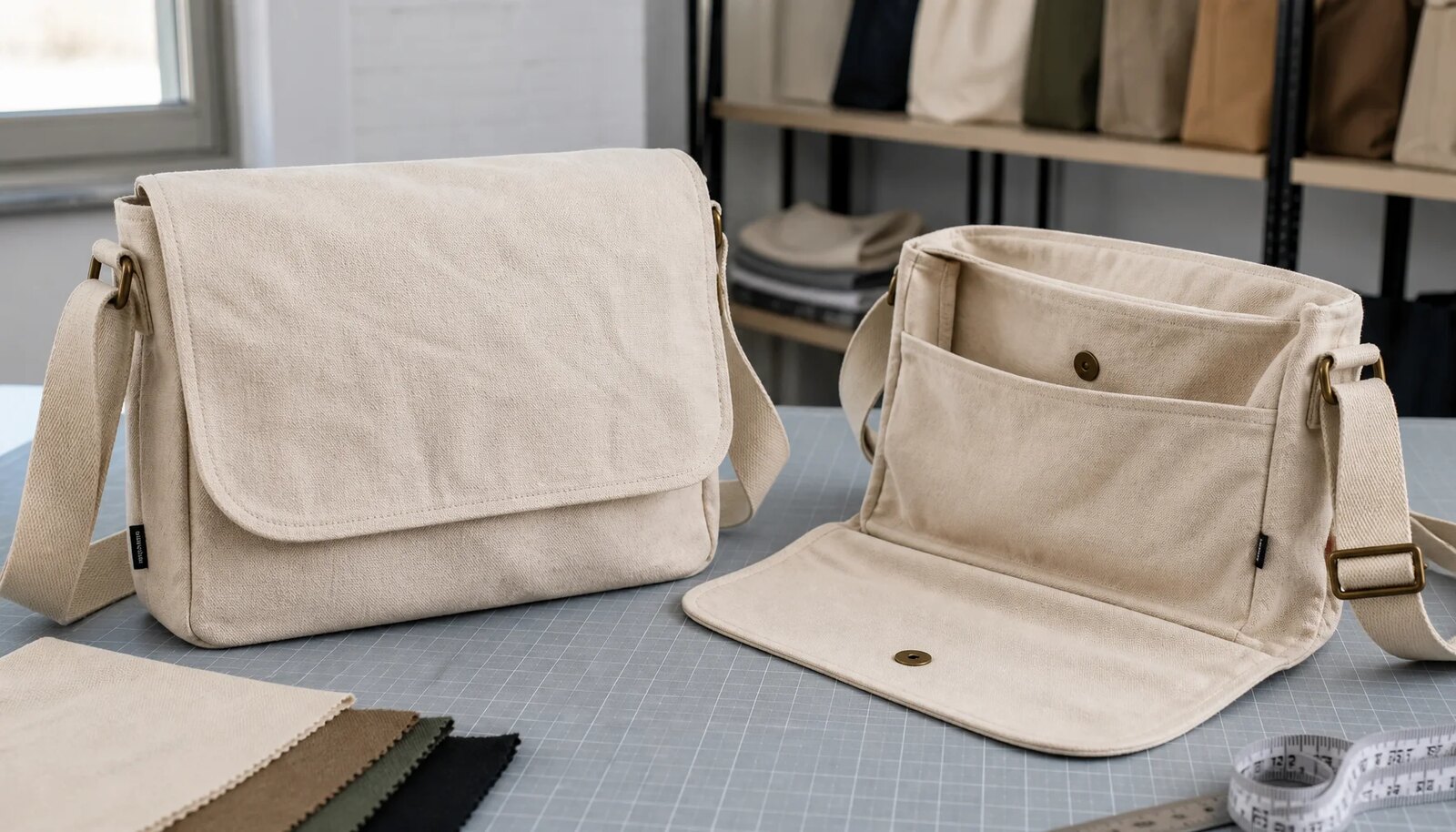
Start With the Craft Fair Use Case
Canvas messenger bags for craft fairs need more definition than a reference photo and quantity. A sponsor giveaway, booth resale item, exhibitor kit, and artist-branded product can all look similar online, but they require different decisions on fabric, branding, packing, and inspection. Procurement should begin by naming the business use case and expected buyer experience. Is the bag meant to be sold at a maker booth, handed out with catalogues, used by staff, or included in a sponsor package?
The use case drives cost. A giveaway can be simpler if the logo is clear and the bag holds light materials. A resale item needs better stitching, cleaner finishing, stronger presentation, and tighter defect standards. An exhibitor kit may need carton sorting by event, booth, or destination. Distributor stock should use stable materials that can be reordered without redesigning every component.
Also define likely contents. Craft fair visitors may carry brochures, notebooks, candles, ceramics, boxed accessories, textile goods, or small framed prints. These loads are uneven and sometimes heavier than conference papers. If the bag must handle dense items, prioritize reinforced strap tabs, secure seams, and realistic load testing before spending budget on decorative extras.
- Resale merchandise: prioritize appearance, flap alignment, labels, hangtags, and individual protection.
- Sponsor giveaway: prioritize logo visibility, cost control, fast packing, and repeatable print placement.
- Exhibitor kit: prioritize carrying strength, carton sorting, clear marks, and distribution efficiency.
- Artist merchandise: prioritize natural canvas character, tactile feel, subtle branding, and craft-appropriate construction.
- Distributor stock: prioritize standard materials, reorder consistency, quote validity, and stable MOQ.
Define Fabric Weight and Finish Clearly
Fabric weight is one of the biggest reasons quotes vary. Suppliers may price 10 oz, 12 oz, 14 oz, or another canvas weight while all calling the item a cotton canvas messenger bag. For many craft fair programs, a midweight canvas around 12 oz, sometimes approximately 380-410 GSM after finishing, is a practical starting example because it balances body, sewability, cost, and freight. It should not be treated as a universal standard; the buyer should set the target based on budget, structure, and expected use.
Ask suppliers to state whether quoted weight is greige, finished, dyed, washed, or softened. Dyeing and washing can change hand-feel, shrinkage, shade, and final measurement. If GSM is used, request the finished GSM target or accepted range. If ounce weight is used, ask how it converts to the supplier's measurement method. This removes ambiguity before samples are made.
Natural unbleached canvas fits craft fair aesthetics because seed flecks, slubs, and yarn variation can feel authentic. But procurement must separate acceptable natural character from defects. Small flecks may be approved; oil marks, mildew, large stains, strong odor, and obvious shade panels should not be accepted. Dyed canvas needs lab dips, shade bands, and bulk shade approval before full cutting.
- 10 oz example: lighter and lower cost, suitable for simple giveaways or light event kits.
- 12 oz example: balanced for many craft fair bags, with enough body for display and reuse.
- 14 oz example: more structured and premium, but heavier to sew, pack, and ship.
- Natural canvas: efficient for many programs, but define acceptable flecks, slubs, and cleanliness.
- Dyed or washed canvas: requires lab dip, shrinkage review, shade tolerance, and measurement confirmation.
Make Construction Comparable Across Quotes
Messenger bag quotes are hard to compare unless construction is locked. One supplier may quote an unlined body with overlocked seams and a fixed strap. Another may include lining, bound seams, reinforced bottom, inner pocket, adjustable hardware, and a closure. Both products can be described as canvas messenger bags, but they are not the same cost or quality level.
A practical base specification for craft fairs can include a front flap, main compartment, one inner slip pocket, adjustable shoulder strap, and reinforced strap tabs. From there, optional upgrades can be priced separately: lining, zipper pocket, shoulder pad, magnetic snap, metal snap, bottom reinforcement, branded woven label, or retail hangtag. This structure lets procurement compare a base price while still understanding upgrade costs.
Strap attachment deserves special attention. Side-seam insertion may work for light contents, but craft fair bags often carry awkward loads. Box stitching, bar tacks, rivets, webbing reinforcement, or layered tabs can improve strength when designed correctly. Ask the supplier to identify the reinforcement method included in the quote and how they verify it during production.
- Size: specify width, height, gusset, flap depth, and whether measurements are taken flat or filled.
- Pockets: identify each pocket by type, size, position, closure, and whether it is lined or unlined.
- Seams: state overlocked, bound, taped, lined, or other finish so factories do not assume differently.
- Strap: specify width, material, adjustment range, slider type, tab method, and reinforcement.
- Closure: select no closure, metal snap, magnetic snap, Velcro, zipper, or other method with alignment expectations.
Match Branding Method to Artwork
Most craft fair messenger bags use visible front-flap branding, so artwork details must be production-ready. Provide vector artwork, Pantone references, print size, print position, number of colors, and a placement drawing. Do not rely on a mockup alone. The supplier should confirm printable area before screens, transfers, embroidery files, or labels are produced.
Screen printing is often the best fit for simple event logos, maker marks, and sponsor graphics with one to three solid colors. It can be cost-effective and visually strong on cotton canvas when opacity and curing are controlled. Heat transfer or digital print can suit gradients and full-color images, but textured canvas may affect smoothness and detail. Embroidery can feel premium for small logos, yet it adds backing, stitch density, and puckering risk.
Placement matters because a messenger flap moves, folds, and may not lie perfectly flat in a carton. Printing too close to edges, snaps, seams, or fold lines increases defect risk. For multiple sponsor or event versions, treat each artwork as a separate production line for setup, inspection, packing, and carton marks.
- Screen print: efficient for simple solid logos and repeatable sponsor artwork.
- Heat transfer: useful for full color, but check cracking, lifting, edge lines, and rub resistance.
- Digital print: useful for complex artwork, but test color density on textured canvas.
- Embroidery: premium for small marks, but control puckering, backing, thread color, and stitch count.
- Woven label: good for subtle branding and reorders, but include label MOQ and lead time.
- Hangtag or belly band: quote paper stock, size, barcode, string, attachment, and packing separately.
Use MOQ Tiers, Not One Price
MOQ is shaped by fabric, dyeing, cutting efficiency, print setup, trim sourcing, labels, hardware, packing materials, and carton requirements. A low MOQ is more realistic when the buyer accepts stock natural canvas, standard straps, standard hardware, one artwork, one print position, and simple packing. Custom dyed fabric, woven labels, multiple artworks, and retail packaging can each create a separate minimum.
Request tiered pricing rather than one unit price. Example tiers such as 500, 1,000, 2,000, and 5,000 pcs help show where setup costs are diluted and where material purchasing becomes more efficient. The right tier depends on the buyer's event calendar, reorder plan, warehouse capacity, and artwork version count.
Very low MOQ is not automatically better. It may mean the supplier is using available trims, leftover fabric, simplified construction, or limited QC support. That can be acceptable for a small one-time event, but it is risky for a brand that expects reorder consistency. Ask what materials are guaranteed for reorder and how long the quotation remains valid.
- Quote MOQ by bag color, artwork version, label type, hardware finish, and packing method.
- Separate setup charges for screens, transfers, embroidery files, labels, hangtags, and barcodes.
- Ask whether stock fabric and trims are reserved after quote approval or only after deposit.
- Compare landed cost, not only FOB unit price, because carton volume and packing affect freight.
- Confirm whether screens, label specs, and approved material standards can be retained for reorders.
Build a Supplier-Ready RFQ Spec Block
A strong RFQ turns a concept into comparable supplier quotes. The goal is not to over-specify every detail, but to remove the assumptions that change price and quality. Provide the target product, artwork files, quantity tiers, packing requirement, trade term, delivery window, and inspection expectation in one controlled document.
If a detail is undecided, mark it as an option instead of leaving it open. For example, ask suppliers to quote a base unlined bag with one inner slip pocket, then add option prices for lining, zipper pocket, magnetic snap, individual polybag, hangtag, and second print position. This prevents each factory from choosing a different configuration while still giving the buyer flexibility.
Version control is important. The RFQ, artwork, sample comments, supplier revisions, and final PO should use the same item number and revision date. If the final order changes fabric, print size, closure, or packing, update the specification before production release.
- Product fields: finished size, gusset, flap, fabric, color, finish, strap, closure, pockets, and seam finish.
- Branding fields: artwork file name, Pantone colors, print method, print size, placement, label, hangtag, and care label.
- Commercial fields: quantity tiers, MOQ, sample fee, setup charge, trade term, port, payment terms, and quote validity.
- Logistics fields: pieces per carton, carton dimensions, gross weight, net weight, CBM estimate, and carton mark format.
- Approval fields: sample type, sample deadline, approval contact, sealed sample rule, and no-substitution statement.
- Inspection fields: tolerance, defect classification, strap test target, print check, AQL if used, and final inspection timing.
Approve Samples With Measurable Gates
Sample approval should not be limited to photos. Canvas is tactile, and buyers need to feel fabric weight, stiffness, hand-feel, print surface, closure force, and strap comfort. A prototype can confirm shape, but the production release sample should use approved or actual bulk fabric, strap, closure, branding method, label, and packing whenever possible.
Create a simple sample report. Measure width, height, gusset, flap depth, pocket size, strap range, print size, print position, and label position. Photograph the front, back, inside, side seams, strap tabs, closure, print, label, and packing. Record any approved deviation clearly so the inspector does not later reject intentional natural canvas character or accepted construction choices.
Test the sample with realistic craft fair contents. Load it with items similar to the intended use: notebooks, catalogues, small boxed goods, candles, textile items, or packaged samples. Check whether the strap slips, the flap still covers the opening, the closure aligns, the body distorts, or the print creases where the bag folds.
- Approve fabric hand-feel, shade, weight, surface character, and odor before bulk cutting.
- Confirm print opacity, placement, curing, rubbing, and whether ink bleeds through the fabric.
- Check closure alignment and strength with the bag empty and loaded.
- Review strap comfort, adjustment range, slider hold, and reinforced tab construction.
- Verify packing fit, hangtag position, barcode readability, and whether folding damages the logo.
- Keep one sealed approved sample with the supplier and one with the buyer or inspector.
Set QC Rules Before Production
Quality problems on canvas messenger bags usually appear in predictable places: dirty canvas, crooked print, twisted flap, loose snap, weak strap attachment, skipped stitches, open seams, shade mismatch, poor trimming, strong odor, and wrong packing. These are easier to prevent when the supplier receives QC expectations before cutting and sewing.
Classify defects by severity. A broken strap, sharp metal edge, wrong artwork, mildew, or serious contamination can be critical. An obvious stain, crooked sponsor logo, open seam, loose label, shade mismatch, or wrong barcode is usually major. Minor thread ends or approved natural flecks may be minor if they do not affect appearance or use. The exact classification should match the buyer's sales channel and tolerance.
Use in-line checks for early production, especially after the first printed and sewn pieces. This catches print placement, flap symmetry, snap setting, strap reinforcement, and stitching before the full order is packed. Final inspection should reference the sealed sample, fabric swatch, artwork, PO, carton mark file, and packing sample.
- Measure width, height, gusset, flap depth, strap range, pocket position, and print placement.
- Check seam security, stitch density consistency, skipped stitches, open seams, and trimming.
- Test strap attachment against the buyer-defined load target and inspect tabs for tearing or distortion.
- Inspect hardware for sharp edges, rust, weak setting, plating issues, slider slipping, and color mismatch.
- Review print for opacity, adhesion, curing, cracking, smearing, off-center placement, and color match.
- Verify carton count, assortment, barcode, hangtag, carton marks, and destination labels before shipment.
Plan Packing for Clean Canvas and Freight Control
Canvas can pick up dirt, lint, moisture, and pressure marks, so packing affects both appearance and landed cost. Event distribution may only need bulk bundles or master polybags if bags are unpacked behind the scenes. Retail resale may require individual polybags, hangtags, barcodes, belly bands, tissue, or insert cards. Quote these as separate elements so the buyer can compare cost and channel value.
Carton planning should happen during quotation, not after production. Request pieces per carton, carton dimensions, gross weight, net weight, and estimated CBM per 1,000 pcs. Overstuffed cartons can crush flaps, bend hardware, and crease logos. Too many small cartons increase handling, labeling, and warehouse cost.
Straps need a packing rule. Adjustable straps can tangle, scratch hardware, or leave pressure marks if they are not folded consistently. Natural and white canvas should not touch dirty floors, damp pallets, or dusty storage areas. If barcodes or hangtags are needed, verify them before cartons are sealed.
- Bulk event packing: use inner bundles or master protection to reduce plastic while keeping bags clean.
- Retail packing: specify individual bag, hangtag, barcode, belly band, insert, warning text, and label position.
- Cartons: define export-grade carton strength, carton marks, quantity, and maximum acceptable deformation.
- Folding: state whether straps go inside, outside, tied, wrapped, or secured with a paper band.
- Warehouse data: require PO number, item number, color, artwork version, quantity, carton count, and destination on marks.
Control Lead Time and Approval Risk
Lead time depends on material status, artwork, sampling, approvals, production, inspection, and logistics. Stock natural canvas with standard trims can move faster than custom dyed fabric, special hardware, woven labels, or retail packaging. Screen printing also needs artwork confirmation, screen making, ink matching, print testing, curing, and bulk print time.
Break the schedule into gates. Approve artwork before sample making. Approve fabric, strap, closure, label, and packing before production release. If dyed fabric is used, approve lab dips and bulk shade before sewing. If there are multiple artwork versions, confirm each version and carton mark before packing starts.
Fixed craft fair dates leave little room for rework. Schedule final inspection after packing but before cargo handover, with time for sorting or correction. Decide in advance whether partial shipment, split delivery, or air shipment for urgent samples is acceptable if timing becomes tight.
- Sample gate: artwork confirmation, first sample, written comments, revision if needed, and sealed approval sample.
- Material gate: fabric swatch, shade, strap, hardware, label, print standard, and packing sample approval.
- Production gate: first-off photos or in-line samples for print, flap, strap, closure, and stitching checks.
- Inspection gate: final inspection before shipment handover, with PO, sample, artwork, and packing references.
- Schedule risk: include buffer for courier time, approval delays, peak season, customs, and local distribution.
Specification comparison for buyers
| Sourcing decision | Practical buyer target | Best fit | Risk to control |
|---|---|---|---|
| Canvas weight | Buyer-defined finished weight, often around 10-14 oz depending on budget and use | Giveaways, resale merchandise, sponsor bags, and exhibitor kits | Confirm whether weight is before or after dyeing, washing, or finishing |
| Canvas color | Stock natural canvas for speed; dyed canvas only with lab dip and shade approval | Natural craft positioning or brand-specific color programs | Natural flecks must be defined; dyed lots need shade tolerance |
| Construction | Front flap, main compartment, inner slip pocket, reinforced strap tabs, adjustable strap | General craft fair shopping, catalogues, small boxed goods, and daily reuse | Unclear construction leads to cheaper seams, weak tabs, or missing pockets |
| Branding method | Screen print for simple solid logos; transfer, digital, embroidery, or label when artwork requires it | Event logos, sponsor marks, maker branding, retail presentation | Test opacity, curing, rubbing, puckering, placement, and edge lifting |
| Closure | No closure, metal snap, magnetic snap, Velcro, or zipper based on channel | Giveaway, retail, or higher-value merchandise versions | Check alignment, pull force, sharp edges, rust, and magnet shipment questions |
| MOQ logic | Quote tiers such as 500, 1,000, 2,000, and 5,000 pcs as examples, with MOQ by color and artwork | Trial programs, distributor stock, seasonal fair campaigns | Low MOQ may rely on stock trims, fewer options, or higher unit cost |
| Sample gate | Pre-production sample using approved or actual bulk fabric, trims, branding, and packing | Any order sold, sponsored, or distributed publicly | Photo approval misses hand-feel, load, odor, print quality, and flap shape |
| Packing | Bulk bundles for event handling; individual packing, barcode, hangtag, or belly band for retail | Warehouse distribution, booth resale, sponsor kits | Poor packing causes dirty canvas, crushed flaps, tangled straps, and relabeling |
| QC focus | Measurement, fabric, sewing, strap, closure, print, hardware, odor, packing, and carton marks | Orders with multiple destinations, artworks, or event deadlines | Inspection must reference the sealed sample, artwork, PO, and packing file |
Buyer checklist before sampling
- Define the channel first: resale merchandise, sponsor giveaway, exhibitor kit, artist-branded product, distributor stock, staff bag, or retail gift item.
- State finished bag size as width x height x gusset, plus flap depth, strap length range, pocket dimensions, and measurement tolerance.
- Specify fabric as a finished target, including oz, approximate GSM if used, color, finish, hand-feel, and acceptable natural canvas character.
- Separate required construction from optional upgrades such as lining, zipper pocket, shoulder pad, bottom reinforcement, hangtag, or individual polybag.
- Confirm strap width, material, adjustment range, hardware finish, reinforcement method, and buyer-defined load expectation for intended contents.
- Send vector artwork with Pantone references, print size, print position, number of colors, and any restrictions around seams, folds, snaps, or labels.
- Ask for quote tiers at practical volumes, including MOQ per bag color, print design, label type, hardware color, and packing style.
- Require a pre-production sample before bulk cutting, printing, sewing, or final packing, with all substitutions disclosed in writing.
- Define QC checks for fabric shade, finished size, stitching, strap attachment, closure, print adhesion, hardware, odor, cleanliness, and carton marks.
- Confirm export packing: pieces per carton, carton dimensions, gross weight, net weight, CBM estimate, bundle method, barcode rules, and carton label format.
Factory quote questions to send
- What finished fabric weight are you quoting in oz and GSM, and is that measured before or after dyeing, washing, softening, or other finishing?
- Which stock canvas colors, strap colors, hardware finishes, and closures are available now, and which options require custom sourcing or longer lead time?
- What is the MOQ by finished bag color, artwork version, label type, hardware finish, and packing method?
- How does the price change at 500, 1,000, 2,000, and 5,000 pcs, and which setup charges or sample charges are separate?
- Which construction details are included in the base price: inner pocket, lining, seam binding, reinforced tabs, adjustable slider, closure, bottom reinforcement, and hangtag?
- Which branding method are you quoting, what ink or transfer type will be used, and what is the cost impact for extra colors or a second print position?
- Will the pre-production sample use actual bulk fabric, strap, closure, print, label, and packing, or will any sample components be substitutes?
- What are the sample lead time, revision lead time, material preparation time, sewing time, packing time, and earliest shipment-ready date after written approval?
- What carton size, pieces per carton, gross weight, net weight, and estimated CBM per 1,000 pcs do you recommend for this specification?
- Which in-line and final checks do you perform for shade, weight, seam strength, strap pull, print adhesion, hardware setting, flap alignment, odor, and packing accuracy?
Quality-control points to confirm
- Finished size should follow the buyer-approved tolerance; +/- 1 cm is a common soft-goods example when no tighter retail fit is required.
- Finished fabric weight should match the approved sample and agreed range, with no fabric substitution unless the buyer approves it in writing.
- Fabric shade should be checked against the approved swatch or shade band, especially for dyed canvas, washed canvas, split shipments, or repeat orders.
- Strap attachment should meet the buyer-defined load expectation; 10-15 kg static pull is only an example target for many light promotional or event uses.
- Flap alignment should be centered, with no obvious twisting, puckering, uneven topstitching, or closure misplacement on the front view.
- Print adhesion should be checked by an agreed method such as tape test, dry rub, wash/rub simulation, or supplier standard approved before production.
- Print position should be measured from fixed reference points; visibly crooked, off-center, or smeared sponsor logos should be treated as major defects.
- Hardware should be checked for loose setting, sharp edges, rust, plating defects, color mismatch, weak snaps, slider slipping, and zipper failure where applicable.
- Canvas surface should be clean for retail handling, with no oil marks, mildew, large stains, strong odor, or unapproved shade patches.
- Packing inspection should verify assortment, quantity, barcode, hangtag, carton mark, carton strength, strap control, and protection from dirt or compression.