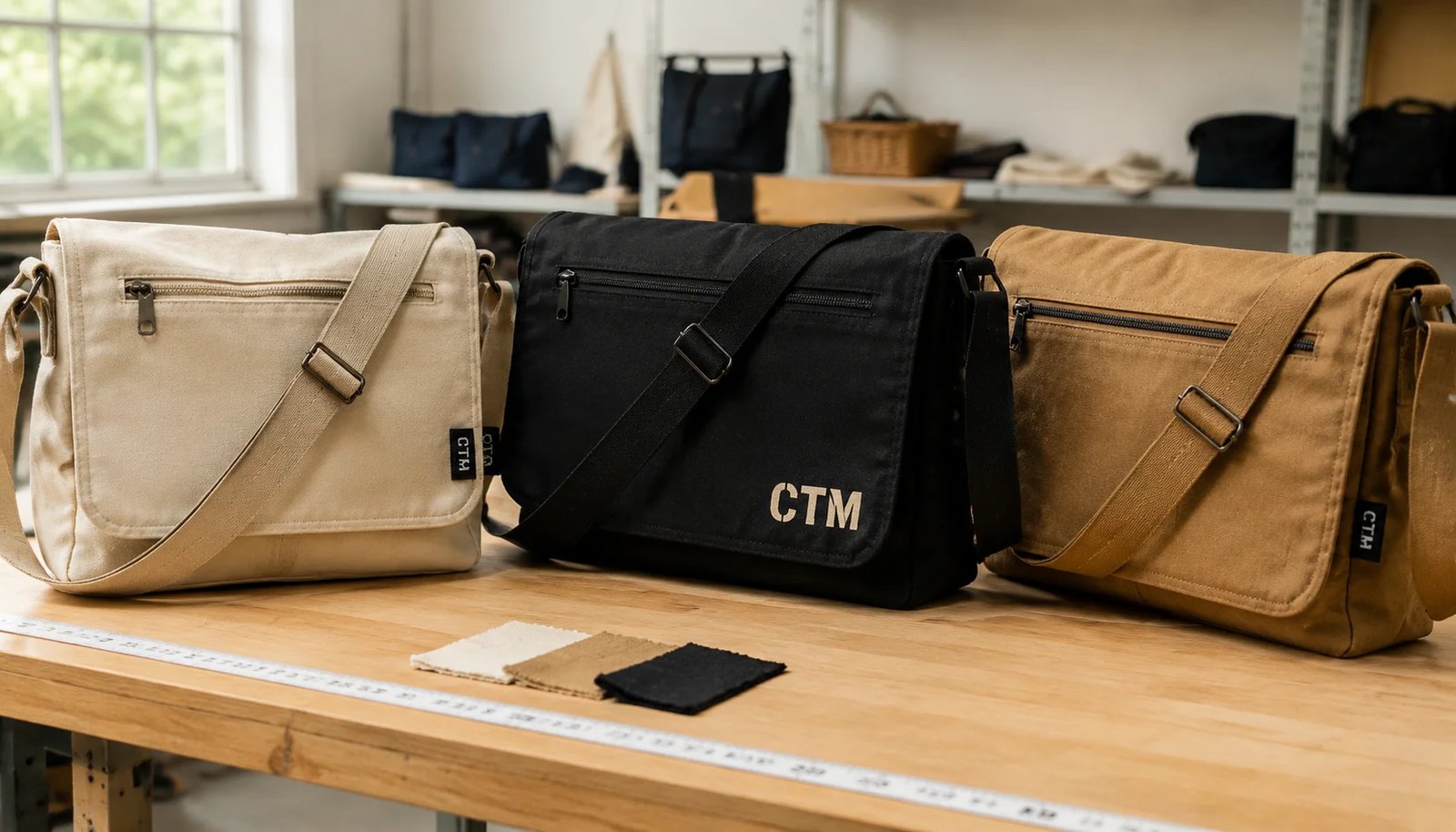
Why liquor retail buyers need a tighter RFQ for canvas messenger bags
Canvas messenger bags for liquor retail are rarely just generic promotional bags. They often carry heavy glass bottles, tasting kits, printed inserts, or seasonal gift bundles, so a vague RFQ creates expensive quote gaps. One supplier prices a soft 10 oz canvas body with a light strap, another prices a structured 14 oz bag with a reinforced base, and both appear to be quoting the same item until the sample stage exposes the difference.
For procurement teams, the core buying problem is not finding a bag factory. It is making sure every quote is built on the same real specification so cost, durability, packing, and lead time can be compared cleanly. A better RFQ reduces back-and-forth, avoids hidden downgrades, and prevents the common issue where a visually acceptable sample turns into a weak bulk shipment once bottle weight and retail handling start.
- Liquor retail use increases stress at bottom seams, side panels, and strap joins
- Giftable appearance matters, but structure and hardware grade matter more than in ordinary tote programs
- Packaging requirements are often stricter because bags may move through retail DCs, promotional kitting lines, and store displays
- Holiday launch windows are unforgiving, so unclear specs often become schedule problems later
Start the RFQ with the actual carry use, not only bag dimensions
Many buyers open with length, width, and logo size. That is not enough for this category. A canvas messenger bag intended to hold one 750 ml bottle and printed tasting notes needs a different body shape and base support than a two-bottle holiday set or a staff event bag carrying catalogs and branded accessories. If the supplier does not know the practical load, they will quote to a cosmetic standard instead of a functional one.
Put the intended use case at the top of the RFQ in plain commercial language. State the expected bottle count, bottle height range, whether there is an internal divider, and whether the bag must stand up reasonably well when loaded. This single step improves supplier engineering decisions on canvas weight, gusset depth, bottom reinforcement, and strap construction.
- Define contents: one bottle, two bottles, or mixed merchandise
- State approximate total carry weight in kilograms
- Note whether the bag is for point-of-sale resale, gift-with-purchase, staff use, or event distribution
- Include if inserts are needed: divider, base board, foam pad, or document sleeve
Choose fabric weight and construction around load, not only price
For most liquor retail messenger bag programs, 12 oz to 14 oz canvas, roughly 340 to 400 GSM, is the practical range. It gives enough body for cleaner shape retention and better printing without moving into unnecessarily heavy fabric that increases freight and sewing difficulty. Lighter fabric can still work for low-load event use, but it should not be treated as equivalent when comparing supplier quotes for bottle-carrying retail programs.
Fabric composition also changes the buying decision. A pure cotton canvas usually aligns better with natural retail positioning and gives a more expected handfeel for branded gift packaging. Cotton-poly blends may reduce cost or wrinkle visibility, but they can change print appearance and undermine a pure cotton claim in your sales material. If your marketing team plans to call out cotton or eco messaging, the RFQ must lock the composition clearly.
- Typical working range: 340 to 400 GSM for structured retail messenger bags
- Use lighter canvas only when the bag is mainly promotional and not carrying heavy glass consistently
- Request fabric swatches before proto sampling if shade and handfeel are important
- If natural canvas is used, state whether seed specks or minor slub texture are acceptable
Print method, hardware, and trim choices change both durability and quote logic
Screen printing is usually the strongest value choice for custom liquor retail messenger bags. It handles bold branding, holds up well on medium to heavy canvas, and remains cost-efficient once quantities rise. Heat transfer can work for short runs or multicolor detail, but it may crack earlier on fold zones or feel too synthetic on a natural canvas program. Embroidery can elevate perceived value, but on lighter panels it may pucker the fabric, especially under a flap where multiple layers already create thickness.
Trim decisions deserve equal attention. Magnetic snaps, zipper grade, metal adjusters, and webbing width can shift a quote significantly. Buyers often compare unit prices without noticing that one supplier is quoting lightweight iron hardware with basic plating while another has included better anti-rust fittings. In liquor retail, where the bag may be reused repeatedly and occasionally exposed to moisture, trim quality deserves a line-item review.
- Screen print is usually the baseline method for medium and large custom runs
- Specify logo position in millimeters from edges, not only a visual reference
- Use 38 mm webbing or similar for better comfort on heavier loads
- State hardware finish expectations: matte black, nickel, antique brass, or painted coating
- If using magnets, include corrosion and holding strength expectations
Build MOQ and pricing expectations around production reality
MOQ for canvas messenger bags is not driven by sewing alone. It comes from fabric booking, print setup, trim sourcing, and carton efficiency. A straightforward style in stock canvas with a one-color print may be workable at a lower MOQ than a custom-dyed bag with special hardware and inner dividers. Procurement teams that treat all custom bags as having the same MOQ often get quotes that look acceptable initially but become revised once real material planning starts.
To compare quotes properly, ask suppliers to break out costs rather than sending one flat number. Fabric weight, print method, bottom support insert, hardware grade, and individual packing can each move the unit price. A slightly higher quote may be the better buy if it includes stronger strap reinforcement, lower defect risk, and more freight-efficient carton planning. Without this breakdown, price comparison is mostly guesswork.
- Factory direct often makes sense from around 500 pieces upward for one style and one main color
- Mixed styles or low-volume assortment orders may fit a consolidator better than a single factory
- Custom-dyed canvas usually raises MOQ because mills need minimum yardage
- Ask for cost breakout by fabric, print, trims, packing, and any testing charges
- Treat unusually low quotes as a signal to verify GSM, hardware, and packing density
Use a sample approval path that catches stress and fit issues early
A good-looking photo sample is not enough for this category. Buyers should review a material swatch first, then a proto sample with real bottle dimensions, then a pre-production sample in approved fabric and print, and finally a packing sample if retail presentation matters. This sequence avoids the common failure where the final bag looks correct flat on a table but does not carry the intended bottle load cleanly or creases badly in export packing.
Sample evaluation should be practical. Put the target bottle inside. Measure flap coverage, check whether the base stays reasonably flat, and test whether the strap twists under load. If there is an internal divider or sleeve, use the actual bottle diameter rather than relying on nominal dimensions. These are small actions, but they prevent expensive bulk corrections after material is already booked.
- Approve fabric swatch before logo strike-off if exact handfeel matters
- Use real bottle samples during fit review, not only paper dimensions
- Review print after curing for rub resistance and edge sharpness
- Confirm strap adjustability range suits expected users and retail use case
- Approve packing sample if bags must arrive retail-ready without heavy steaming or reshaping
Set quality thresholds that match commercial use, not luxury fashion standards
Canvas messenger bags for liquor retail should be inspected to practical acceptance criteria. The main defects that matter are not minor organic fabric character or tiny weave variation on natural canvas. The real commercial failures are weak seam reinforcement, off-position prints, misaligned flaps, distorted gussets, rust-prone hardware, and cartons packed so tightly that the bags arrive crushed. Your QC plan should focus there.
If your business uses third-party inspection, provide the inspector with clear style-specific points rather than generic bag wording. AQL may still be used, but the pass or fail decision should give extra attention to load-bearing construction and print placement on visible retail panels. Procurement teams often over-focus on cosmetic lint or small natural slubs while under-specifying critical stress areas.
- Dimension tolerance should be defined for body, gusset, flap, and strap length
- Print position tolerance should be written, especially for centered flap logos
- Reinforcement stitch pattern at strap joins should match the approved sample exactly
- Hardware should operate smoothly without plating flakes, burrs, or visible rust
- Carton compression damage should be treated as a quality issue, not only a logistics issue
Packing details matter more than most buyers expect
Packing is one of the easiest places for a supplier to reduce cost and one of the fastest ways to damage a decent product. Messenger bags with flaps, bottom boards, or thicker print panels can be permanently creased if cartons are overfilled. This is especially important for liquor retail programs where the bag may be sold as a gift item and appearance at unboxing matters. A low-cost packing plan can quietly erase the value of a well-made bag.
The RFQ should state whether individual polybags are needed, whether silica gel is required in humid season, and what the maximum outer carton weight can be for your warehouse handling rules. Also define how bags should be folded. A bag folded across a printed flap or over a rigid insert may arrive with visible marks that create unnecessary store-level rejection.
- State units per carton and maximum gross weight per carton
- If retail presentation matters, require folding method approval with photos or a physical packing sample
- Request export cartons strong enough for stacked storage during peak season
- If using natural cotton canvas, note whether dust marks from carton handling are acceptable
- Avoid over-compression on bags with stiff prints, piping, or inserted base support
Lead time risk usually sits in materials and approvals, not only sewing capacity
Buyers often focus on the factory's stated production days, but messenger bag schedules slip earlier than that. The real delays usually come from waiting for final artwork, fabric dye approval, hardware sourcing, or repeated sample changes after the marketing team adjusts branding. For liquor retail programs tied to launch dates, tasting events, or year-end gifting, these approval stages need to be planned backward from the in-store date, not from the ex-factory target alone.
An RFQ should therefore request a lead-time split. Ask for separate timing on material sourcing, sample development, approval turnaround, bulk sewing, and packing. This gives procurement a way to identify which suppliers are actually booking fabric and trims in a disciplined manner and which are simply promising a short total lead time without explaining how they will achieve it.
- Custom-dyed canvas and special hardware usually add more risk than standard sewing time
- Artwork sign-off delays can hold print plate or screen preparation
- Holiday liquor retail periods may overlap with factory peak load, so capacity confirmation matters
- Ask whether material booking begins before or after deposit and final sample approval
Compare landed cost, not just FOB unit price
For a bulky sewn product like a canvas messenger bag, freight efficiency and carton design can materially affect the final landed cost. A cheaper FOB quote may end up more expensive if the supplier packs inefficiently, uses oversized cartons, or includes a rigid insert that adds cubic volume without commercial benefit. Retail buyers managing distribution costs should model freight against the packing plan before choosing the lowest factory quote.
This is also where durability interacts with cost. If a stronger 14 oz canvas bag with proper base support reduces returns or store complaints compared with a lighter bag, the lower-risk option may be the better commercial decision even at a higher ex-factory price. Procurement should evaluate total use cost: unit price, freight, compliance documentation, inspection, and likely defect exposure.
- Request carton dimensions and gross weight in the quotation stage
- Compare freight impact of flat-packed versus lightly shaped packing if both are possible
- Include sample costs, testing fees, and inspection charges in the sourcing comparison
- Consider returns, markdown risk, or store rejection when comparing low-cost offers
Specification comparison for buyers
| Spec decision | Recommended option | When it fits | Buyer risk to check |
|---|---|---|---|
| Canvas weight | 12 oz to 14 oz canvas, about 340 to 400 GSM | Best for liquor gift sets, bottle carriers with documents, and retail programs needing structure without excessive weight | Below about 300 GSM the bag can collapse under bottle weight and corners may show stress at side seams |
| Fabric composition | 100% cotton canvas for natural positioning; cotton-poly canvas only if price and wrinkle resistance matter more than pure cotton claims | Use cotton canvas for eco-forward retail branding and easier print positioning | If supplier mixes fiber content, print handfeel, shrinkage, and compliance documentation may not match the approved sample |
| Inner support | Add 2 mm to 3 mm bottom board or removable base insert | Useful when the bag will carry one or two wine or spirits bottles plus promotional materials | Without base support, bottle load can distort the bag shape and increase return complaints even if seam strength passes factory tests |
| Closure style | Flap with magnetic snap plus interior zipper pocket | Good for giftable retail programs where appearance matters but contents still need basic organization | Low-grade magnets can rust or weaken; zipper quality varies widely and can become the first failure point |
| Strap construction | 38 mm webbing with box-x reinforcement at stress points | Suitable for daily carry and heavier bottle loads during events or seasonal promotions | Unreinforced strap joins can fail before body seams, especially when bags are overfilled with glass bottles |
| Print method | Screen print for bold logos; heat transfer only for short runs with fine color detail; embroidery only on heavier panels away from bottle stress areas | Screen print is usually the best cost-to-durability choice for medium and large orders | Large dark prints on natural canvas may need underbase or strike-through control; embroidery can pucker lighter canvas panels |
| MOQ route | Factory direct for 500 pieces and up; trading company or consolidator for mixed styles below factory MOQ | Factory direct gives better control on fabric, print, and packing when the order is large enough | Small runs through multiple intermediaries often create spec drift between approved sample and bulk production |
| Packing format | Individual polybag only if retail hygiene or transit scuff control is needed; otherwise bulk pack in export carton with shape-preserving stacking | Bulk packed works well for most promotional and retail replenishment orders | Over-compressed cartons can crease flaps, distort shape, and crack stiff print areas before goods reach the DC |
| Quote basis | FOB with separate breakout for fabric, print, trims, sampling, and carton count | Makes supplier comparison practical and exposes hidden cost drivers | Lump-sum quotes hide where quality has been reduced, especially in canvas GSM, hardware grade, or packing density |
Buyer checklist before sampling
- State target use clearly: one bottle, two bottles, or mixed bottle plus printed collateral load
- Specify finished bag size with tolerance, including gusset depth, flap drop, and strap length range
- Define canvas weight in GSM or oz and state whether tolerance is allowed after washing or finishing
- Name the exact print method, print size, print location, and acceptable color variance standard
- List all hardware: buckle, magnetic snap, zipper brand or grade, adjuster finish, and corrosion expectation
- Require reinforcement details for strap attachments, bottom seam, and bottle-load stress points
- Set sample approval stages: material swatch, pre-production sample, print strike-off, and packing sample
- State carton packing quantity, maximum carton weight, and whether inner dividers or shape inserts are needed
- Request compliance documents relevant to your market for dyes, restricted substances, and packaging materials
- Ask for quote validity, production lead time, and capacity during peak holiday liquor retail season
Factory quote questions to send
- What is the actual canvas construction in GSM, yarn count if available, and finished fabric tolerance after cutting and sewing?
- Is the quoted fabric stock color-dyed, piece-dyed, or printed after sewing, and how does that affect shade consistency across lots?
- What seam construction is used at strap joints and bottom corners: single stitch, double stitch, binding, or box-x reinforcement?
- What bottle load has the sample been designed around, and can you provide an internal recommendation for safe carrying weight?
- What print method is included in the quote, how many colors, and is there an extra charge for underbase on dark canvas?
- Are metal fittings standard iron, zinc alloy, stainless, or coated hardware, and what rust-prevention treatment is used?
- Does the quote include a base board, foam, cardboard insert, or PE support panel, and is it removable or sewn in?
- How many pieces per export carton, what are the carton dimensions, and what is the estimated gross weight per carton?
- What sample fees apply for custom size, custom print, and revised proto rounds, and which fees are refundable against bulk order?
- What is the lead time split between material booking, sample approval, bulk production, and ex-factory date?
Quality-control points to confirm
- Canvas weight should stay within the agreed tolerance and match approved handfeel and thickness
- Finished dimensions should meet agreed tolerance for width, height, gusset, flap coverage, and strap length
- Logo print placement must be centered to approved artwork position and free from pinholes, smudging, or weak adhesion
- Color shade on dyed canvas should be commercially consistent across panels and across cartons from the same lot
- Strap attachment points must show clean box-x or specified reinforcement with no skipped stitches or loose thread buildup
- Bottom corners and side seams must remain even and secure under practical load simulation for bottle weight
- Magnetic snaps, zippers, and adjusters must function smoothly and show no rust, sharp edges, or plating loss
- Inside pockets, dividers, or inserts must match approved dimensions so bottles fit as intended without distortion
- Cartons must not be overpacked to the point that flap shape, piping, or printed panels are visibly crushed
- Barcode labels, carton marks, and assortment counts must match the PO and outer carton packing list exactly