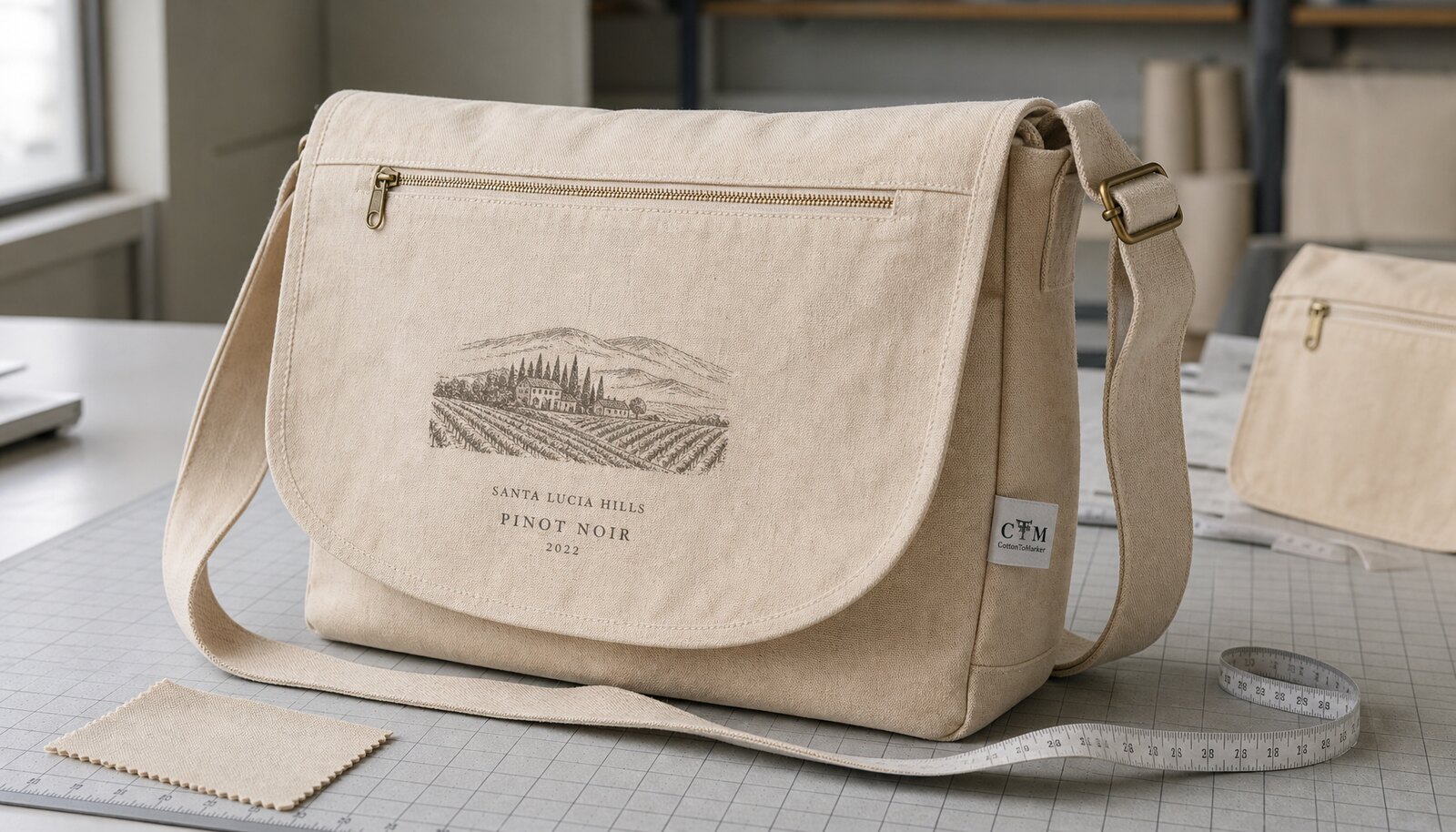
Why boutique wineries need a stricter standard
Canvas messenger bags for boutique wineries are not ordinary promo items. They sit close to the brand, often next to higher-margin retail goods, and are handed to customers who notice presentation immediately. A crooked logo, rough seam, or uneven fold does more than create a defect count. It weakens the product story at the exact point where the winery is trying to signal care, consistency, and value.
That is why a canvas messenger bags quality inspection checklist for boutique wineries has to cover more than fabric and price. Buyers need one view of the whole item: cloth, stitch behavior, decoration, closures, pack-out, and carton presentation. A bag can be usable and still fail the buying standard if it looks unfinished on a tasting-room shelf. For this category, visual control is part of functional control.
- Treat the bag as a branded retail product, not as a disposable giveaway.
- Inspect appearance at arm's length and at close range; both matter.
- Assume every visible flaw will be noticed faster than it would on a generic utility bag.
Start with the use case, not the fabric
The right spec begins with how the winery will use the bag. A single-bottle carrier, a membership gift, and a tasting-room merch item do not need the same construction. If the supplier does not know the use case, it will guess on closure type, pocket depth, strap length, and the amount of structure needed to keep the bag upright on a shelf.
That matters because the bag may need to do more than hold an item. It may need to sit flat in retail display, fold neatly for carton packing, or carry a bottle without tipping and deforming the silhouette. The buyer should define the job first, then the structure around it. That makes later inspection objective instead of subjective.
- State whether the bag is for one bottle, two bottles, or mixed gift use.
- Define the shelf behavior: stand, fold flat, or hang neatly.
- List any contents that must fit inside, such as tasting notes, corkscrews, or vouchers.
- If the bag is part of a set, define the outer package size it must fit into.
Use the spec comparison before you ask for price
A useful RFQ starts with a comparison of spec choices, not a request for a generic quote. Canvas weight, closure type, decoration method, structure, carry format, and packing all change the bag's performance and cost. If these are not separated early, the buyer may compare two quotes that look similar on paper but describe different products.
For procurement teams, the important point is not only which option is cheaper. It is which option best fits the channel. An open-top bag can work for a short event campaign, but a retail gift program usually benefits from a closure and a more structured front panel. The comparison table should help the team choose the right build before the supplier starts pricing setup fees, hardware, or packaging changes.
- Compare specs before comparing unit price.
- Write down which options are acceptable and which are not.
- Keep the first quote round tied to one locked spec so the supplier cannot quietly substitute materials.
Lock the tech pack before sampling starts
The tech pack should remove guesswork. At a minimum, it needs finished dimensions, seam allowances, strap width, strap drop, pocket measurements, logo placement, closure details, and the packing method. If the buyer wants the bag to match a retail shelf aesthetic, add a simple front and back drawing with measurements so the supplier cannot reinterpret proportions from memory.
Measurement tolerances should also be written down. Many teams only inspect the finished sample visually, then discover later that the bulk run has drifted. A practical approach is to set a tolerance for visible dimensions and artwork placement, then keep the bulk production against the sealed gold sample. If the supplier proposes a spec change later, treat it as a formal revision, not a casual production adjustment.
- Use a dimensioned drawing, not a free-form email description.
- Record the approved sample number and revision history.
- Ask the supplier to confirm every dimension back in writing before cutting begins.
- Keep artwork position and closure placement fixed unless the buyer approves a revision.
Sample approval should include a real use test
The first sample is where buyers should uncover process risk. Review it in two passes. First, look at the bag from customer distance and ask whether it feels clean, balanced, and ready for retail. Then inspect it closely for stitch density, seam margin consistency, thread trimming, logo position, and fabric shading. If the sample already looks off, the bulk run usually magnifies the problem instead of correcting it.
Then test the bag with the intended contents. A bag that carries a bottle should hold shape without slumping, twisting, or leaning enough to distort the profile. A bag meant for a gift set should still close cleanly when the contents are inside. This is the moment to confirm that the sample matches the business use, not just the drawing.
- Measure body size, strap drop, pocket placement, and closure position against the drawing.
- Test the bag with the actual items it will carry in sales or gifting.
- Check corners and inside seams for loose thread nests, skipped stitches, or raw edges.
- Approve only if the same fabric, decoration method, and hardware can be repeated in bulk.
Fabric and sewing checks need measurable thresholds
Canvas quality is not just the number on the quote. Weight matters, but so do weave consistency, finish, and how the fabric behaves when it is cut and sewn. Two rolls can both be labeled 12 oz canvas and still perform differently if one is coarse, one is washed heavily, or one carries a shade shift across the roll. For winery retail use, a clean and stable surface usually performs better than a rough cloth that looks inconsistent from panel to panel.
Sewing needs equal discipline. A supplier may keep the bag shape correct while silently lowering stitch quality or reducing reinforcement at load points. Buyers should lock the approved stitch standard and inspect against it. On many canvas programs, a common starting point is 7 to 10 stitches per inch on visible seams, with reinforcement at stress points, but the exact figure should be tied to the approved sample and the intended load. The key is repeatability, not a generic number.
- Hold bulk production to the approved fabric weight, finish, and shade.
- Reject rolls with stains, holes, oil marks, warped weave, or visible shading changes.
- Require reinforcement at strap joins and handle stress points.
- Ask the factory to state its stitch standard in measurable terms and record it in the approval file.
Decoration quality is where retail value is won or lost
Decoration is often the most visible gap between a good quote and a good product. Screen print can be the cleanest choice for simple winery logos because it is repeatable and usually cost-efficient once setup is absorbed. Embroidery can feel more premium, but it can also distort lighter canvas or cause puckering if the stitch density is too aggressive. Heat transfer can work for shorter runs or multiple art versions, but buyers should be cautious about edge lift, gloss mismatch, and rub resistance.
The right method is the one that matches the bag's use and the winery's tolerance for wear. For a retail item that will be handled often, the logo should stay legible after normal folding, carrying, and packing. Placement also matters. Marks should stay away from seam intersections and hard-fold zones so the decoration does not crack, wrinkle, or shift out of position. A woven label or side label can be a better choice when the brand wants a quieter premium look and lower risk on textured canvas.
- Screen print is usually best for simple logos and repeat runs.
- Embroidery should be checked for puckering, stitch pull, and panel distortion.
- Heat transfer needs close inspection for cracking, lifting, and gloss mismatch.
- Keep artwork away from stress points, folds, and hardware pressure zones.
Closures, hardware, and carry behavior deserve their own check
A canvas messenger bag for a winery should carry predictably. Open-top bags can work for low-cost event use, but they usually present less cleanly for retail gifting because they leave the contents exposed and can look unfinished. Magnetic snaps often fit premium presentation if the alignment is clean and the top edge remains flat. Zippers give better containment, but only if the tape, pull, and stitching are consistent and the pull does not snag the canvas.
Hardware is a common quality blind spot. Rivets can be sharp, snaps can misalign, and plated parts can show rust or poor finish if storage is sloppy. For a branded gift program, that is not a minor cosmetic flaw. Ask the supplier how hardware is stored, when it is installed, and how it is checked before packing. If the bag is supposed to feel premium, the closure has to work smoothly and look intentional.
- Use open top only when the bag is meant for low-cost distribution.
- Use magnetic snap or zipper when the bag must hold contents securely and present cleanly.
- Check metal parts for sharp edges, poor alignment, rust, and inconsistent plating.
- Cycle the closure several times on the sample to make sure the top line stays flat.
Hidden cost drivers often sit outside the unit price
Two quotes can look similar while describing different products. The real cost driver list includes fabric, dye or wash process, decoration setup, hardware, lining, interfacing, packing, and carton configuration. If a supplier is quoting one combined number without separating those variables, the buyer may not be comparing the same bag at all. This is where procurement teams often lose visibility and later discover why the reorder price is higher than expected.
Tooling and sampling also deserve attention. Screens, embroidery files, plates, custom labels, and revision rounds all affect landed cost. So do special packing rules, carton marks, and retailer-ready inserts. Buyers should ask what changes trigger a setup fee versus a simple unit-price adjustment. That makes seasonal artwork, alternate colorways, and closure changes easier to budget. It also prevents surprises when the first sample approval turns into three extra rounds of paid revisions.
- Ask for a structured quote that separates fabric, decoration, hardware, packing, and carton cost.
- Ask which changes trigger new setup fees and which only change the unit price.
- Ask whether mixed artwork, mixed colorways, or mixed closures change MOQ.
- Ask whether the supplier can hold the same price on reorder if the spec does not change.
- Ask what happens if a material is unavailable and the factory wants to substitute it.
Set an AQL-based inspection rule before bulk production
A useful inspection plan starts with a simple principle: critical defects get zero acceptance, major defects use a defined AQL, and minor defects are capped at a lower but nonzero threshold. A common procurement baseline is AQL 2.5 for major defects and AQL 4.0 for minor defects, with critical defects rejected outright unless your internal standard is stricter. The exact plan should align with the order size and your internal quality policy, but it should never be improvised after the shipment arrives.
Use a standard sampling method such as ANSI/ASQ Z1.4 or your company's equivalent, then define the defect matrix in plain terms. Critical defects are the ones that make the bag unsafe or unusable, such as a failed strap attachment, broken closure, or severe contamination. Major defects affect function or retail acceptance, such as incorrect size, visible logo shift, or seam opening. Minor defects are appearance issues that do not affect use but still matter on shelf, such as a small thread tail or slight wrinkle outside the logo area. The important step is to define these categories before inspection begins.
- Set critical defects to zero acceptance unless your internal policy says otherwise.
- Use a fixed AQL target for major and minor defects instead of negotiating after the fact.
- Choose the sampling plan before mass production so both sides know the pass/fail rule.
- Write the defect matrix into the PO or quality annex so there is no ambiguity at shipment time.
Specification comparison for buyers
| Spec decision | Option that usually fits boutique wineries | Why buyers choose it | What to write into the RFQ |
|---|---|---|---|
| Canvas weight | 12 to 16 oz for most retail and gift programs | Gives enough body for shelf presentation without becoming overly stiff or bulky | State the exact oz or GSM target, acceptable tolerance, and whether washed or raw canvas is required |
| Closure | Open top for low-cost events, magnetic snap or zipper for retail gifts | A closure helps the bag hold shape and present better on a tasting-room shelf | Define closure type, alignment tolerance, and whether the closure must survive repeated opening and closing without distortion |
| Decoration | Screen print for simple logos, embroidery or woven patch for a more premium look | Different methods change cost, durability, and how clean the logo looks on textured canvas | Name the method, number of colors, placement zone, and any rub or wash expectation |
| Structure | Light interfacing or lining when the bag must stand neatly | Improves presentation and helps the bag keep a clean silhouette when filled | Specify whether the bag is unlined, partially lined, or fully lined, and where interfacing is allowed |
| Carry format | Messenger profile with shoulder strap and optional front pocket | Works for tasting notes, retail inserts, and small gifts without looking generic | Lock the finished dimensions, strap drop, pocket size, and load expectation |
| Packing | Individual protection with carton marks and SKU labels | Reduces warehouse handling time and keeps the bag retail-ready on arrival | Define unit pack, master carton count, label format, and whether barcodes are required |
Buyer checklist before sampling
- Define the use case first: tasting-room retail, wine club gift, event merch, or bottle-and-accessory packaging. A bag built for shelf display needs tighter appearance control than one meant for a one-day giveaway.
- Freeze a dimensioned drawing before requesting pricing. Include body width, body height, gusset depth, strap drop, pocket size, closure position, and logo placement zone.
- Specify the canvas in measurable terms, not just as canvas. Use oz or GSM, weave type, finish, and whether the cloth is washed, raw, or pre-shrunk.
- Request a physical preproduction sample and one sealed gold sample. Record measurements, stitch observations, artwork placement, and revision number together in one approval file.
- Choose the decoration method before pricing is finalized. If the artwork can be printed, embroidered, woven, or patched, ask the supplier to price each method separately instead of blending them into one quote.
- Set the pack-out standard before bulk starts. Decide on polybag or no polybag, tissue or no tissue, carton count, barcode placement, and carton mark format.
- Write the defect rules into the purchase order. Separate cosmetic issues from functional issues and define what is auto-reject, what can be reworked, and what needs buyer approval.
- Ask for a production timeline that breaks out sample approval, material booking, printing setup, cutting, sewing, packing, final QC, and export booking. A single-line lead time is too vague to manage.
- Require the supplier to identify any outsourced step. Fabric dyeing, printing, hardware finishing, and packing are common places where quality drifts if subcontracting is hidden.
- Confirm reorder behavior before you place the first order. Ask what happens if the factory changes fabric lot, hardware source, or packing method on the next run.
Factory quote questions to send
- Who is the actual manufacturer, and which steps are done in-house versus outsourced for fabric, printing, hardware, and packing?
- What exact canvas weight do you quote, what tolerance do you allow from roll to roll, and can you share a swatch from the same lot?
- Which decoration method is included in the price, how many colors are covered, and what setup fees apply for screens, embroidery files, or plates?
- What is the MOQ by colorway, artwork version, closure option, and lining option, and how does MOQ change if we mix branding?
- What seam standard do you build to at the handles, pocket edges, and stress points, and do you use bar-tacks, box-x reinforcement, or both?
- What measurement tolerances do you quote for body size, strap drop, pocket placement, and logo position?
- What sample stages are included in the development process, and how many revision rounds are covered before bulk starts?
- What is your in-line inspection method, final inspection method, and carton sampling method, and can you share a blank inspection report?
- What packing is included in the quote, what are the carton dimensions and gross weight, and do you provide carton marks and SKU labels for warehouse receiving?
- What happens if the bulk run shows print drift, shade variation, missing pieces, or seam failure: rework, replacement, credit, or shipment hold?
Quality-control points to confirm
- Canvas weight, hand feel, and shade match the approved sample or approved swatch lot. Reject any roll that looks limp, overly coarse, oily, or visibly different under neutral light.
- Panels are cut square and assembled without twist. The front, back, pocket, and gusset should sit flat and align cleanly, with no skew that makes the bag look off-center.
- Main seams and pocket seams show even stitch density, no skipped stitches, no loose thread nests, and no seam opening when the bag is flexed by hand.
- Load-bearing points use reinforcement exactly where the approved sample shows it. Strap and handle joins should not rely on a single weak seam.
- Logo placement stays within the agreed tolerance, commonly within 2 to 3 mm on visible surfaces if the design is highly centered. The mark should not be cropped by a seam or edge.
- Print matches the approved color reference in normal daylight, with no bleeding into the weave, no obvious misregistration, and no cracking at first handling.
- Embroidery, if used, sits flat without puckering, thread pull, broken stitches, or exposed backing that changes the look of the bag.
- Closures and hardware operate smoothly and are free from sharp edges, loose rivets, rust, or poor alignment. A snap should close cleanly without warping the top edge.
- The bag passes a practical carry test with the intended contents, such as a bottle, tasting notes, or a small retail gift set, without strap pull, distortion, or tipping.
- Finished bags are clean inside and out, with no dust, oil marks, marker lines, glue residue, fabric lint, or leftover thread tails visible when the bag is opened.