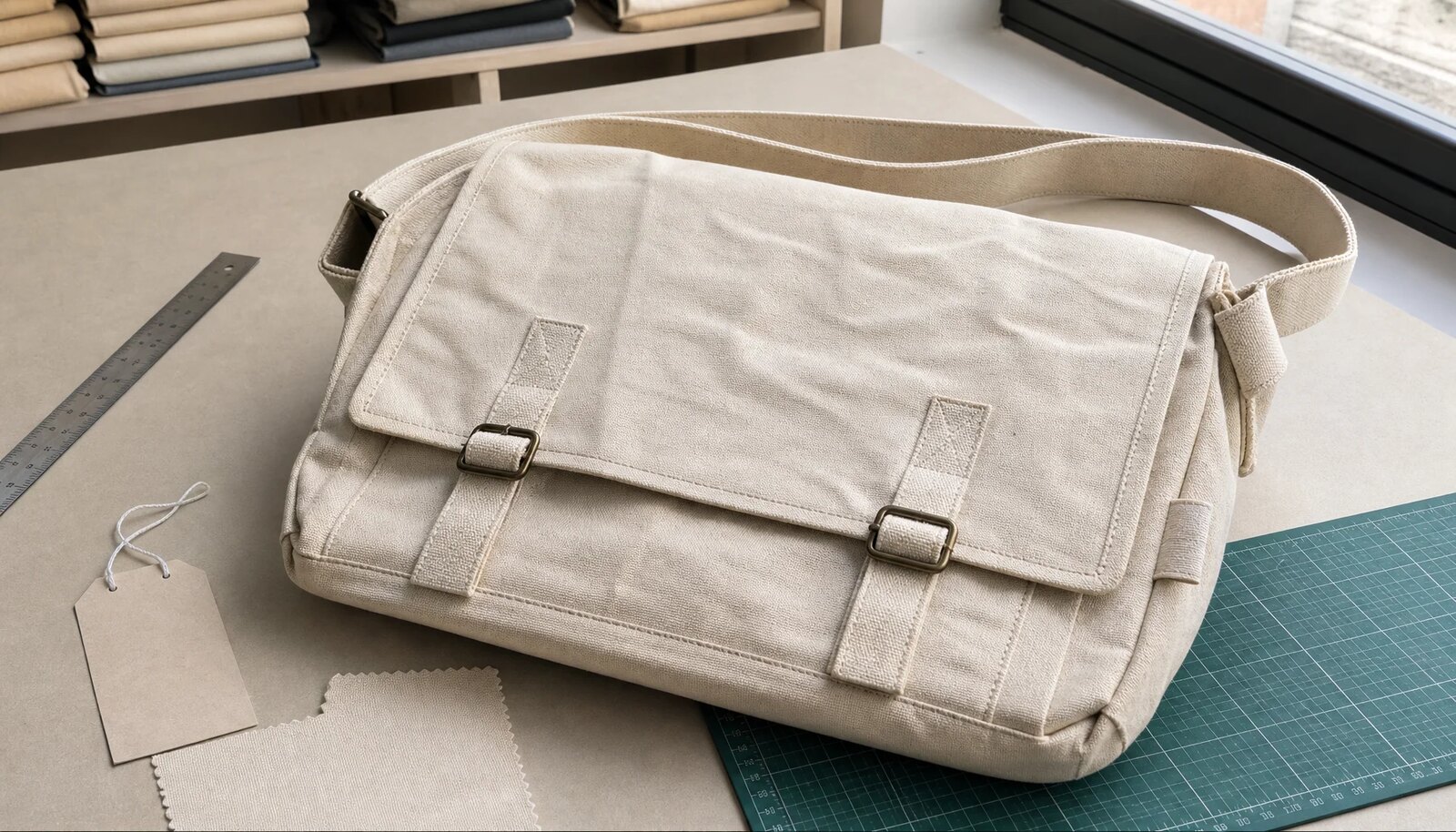
1. Define the bag’s job before requesting a quote
Canvas messenger bags are often quoted as if they are a single product, but procurement risk starts with the use case. A lightweight event bag, a boutique retail accessory, and a daily commuter bag need different canvas weights, strap construction, closures, and packing. Before comparing prices, define what the bag must carry, how long it should last, and how it will be presented to the customer.
For an eco apparel brand, the product also has to match the brand story without creating unsupported sustainability claims. A natural cotton canvas messenger bag may suit a low-impact retail program, while a recycled cotton blend may be preferred for a capsule collection. Those choices affect fabric availability, color consistency, certification paperwork, MOQ, and lead time.
A good RFQ starts with practical language: expected contents, target load, retail channel, packaging preference, and whether the bag needs to hold shape on shelf. Once those points are clear, the factory can recommend fabric weight, reinforcement, and hardware instead of guessing.
- State the channel: wholesale retail, e-commerce, event, employee kit, or commuter product.
- List expected contents: folded apparel, catalog, laptop sleeve, tablet, notebook, bottle, or daily carry items.
- Set a target load and service level: occasional use, regular retail use, or heavier daily use.
- Decide whether the bag must stand neatly on shelf or can ship and store flat.
2. Turn canvas and construction into measurable specifications
Avoid vague descriptions such as “heavy canvas,” “eco cotton,” or “premium hardware.” The spec should state finished fabric weight, fiber content, dye or finish, lining, closure, strap width, and reinforcement details. Finished fabric weight matters because washing, dyeing, coating, and shrinkage can change the final hand-feel and dimensions.
For many branded canvas messenger bags, 12 oz to 16 oz cotton canvas is the practical range. As buyer-defined examples, 12 oz can work for lighter programs, 14 oz is a common middle ground for structure and cost, and 16 oz gives a sturdier premium feel. These are not universal rules; they are starting points that should be confirmed by sample, load expectations, and any lab performance requirements.
Construction must follow the material choice. Lighter canvas needs careful reinforcement at stress points. Heavier canvas may require stronger needles, better seam control, and more attention to bulk at folded edges. If the bag is lined, inspect lining twist, pocket opening, and seam finish inside the bag, not just the front panel.
- Specify finished fabric weight in both oz and gsm.
- State fiber content and whether recycled, organic, conventional, or blended material is acceptable.
- Define lining: none, partial facing, full cotton lining, recycled polyester lining, or other material.
- Call out reinforcement patches at strap anchors, flap corners, pocket ends, and handle points.
- Record stitch density, thread color, seam allowance, bartack length, and webbing width in the tech pack.
3. Strengthen eco-claim controls before sampling
Eco apparel buyers should treat sustainability claims as controlled product specifications, not marketing copy. If a supplier says the canvas is organic, recycled, or certified, the claim needs documentation that applies to the actual material used in the order. A certificate logo on a product deck is not enough; check scope, validity dates, material type, transaction documents if applicable, and whether the named company matches the supplier or fabric source.
Traceability is especially important when several materials are used. A bag may have organic cotton canvas, conventional cotton webbing, polyester thread, metal hardware, synthetic zipper tape, and plastic packaging. Decide which parts of the product must meet your eco requirements and which are acceptable as conventional components. This prevents an overbroad product claim that the documents cannot support.
Dyeing and finishing also deserve attention. Natural, undyed canvas may reduce processing but can show seed flecks, shade variation, and stains more easily. Dark dyed canvas needs stronger rub testing because color transfer can damage apparel in the same shipment or rub onto clothing during use. For restricted-substance needs, define the test standard required by your market rather than asking generally for “safe materials.”
- Match sustainability documents to the material lot, not only to the supplier profile.
- Confirm whether claims cover canvas only or also webbing, lining, labels, thread, and packaging.
- Request dye, finishing, and restricted-substance information before bulk production.
- Approve acceptable natural-canvas variation, including flecks, shade bands, and slubs.
- Specify packaging preference: recycled polybag, kraft sleeve, FSC paper insert, master-bag packing, or no individual polybag where feasible.
4. Verify the supplier’s role and production control
The words “factory direct” and “manufacturer” do not prove control. A direct factory may be ideal when the order requires custom sewing and repeat production, while a trading company can be useful if it manages multiple components or categories. The important question is who controls cutting, sewing, printing, inspection, and packing for your actual order.
Before paying a deposit, match the supplier’s business license, legal name, factory address, pro forma invoice, and bank account. Request recent photos or a short video of similar messenger bags being cut, sewn, inspected, and packed. If a certification, social audit, or material claim is presented, check the document’s company name, scope, and expiry date.
Inspection access is a strong signal. A supplier that accepts third-party inspection, provides production status honestly, and identifies the actual production site is easier to manage. If the factory identity is hidden or the supplier refuses inspection before shipment, factor that risk into the sourcing decision.
- Confirm legal entity, bank account name, and factory address before deposit.
- Request recent production evidence for similar canvas bags, not unrelated tote bags only.
- Check whether printing, embroidery, washing, and packing are in-house or subcontracted.
- Ask for audit or certificate documents only if they are current and within scope.
- Include inspection access in the PO or quality agreement.
5. Compare quotes by full scope, not headline unit price
The cheapest quote often excludes something important: lining, barcode stickers, stronger cartons, print setup, sample revisions, hangtags, or higher-grade hardware. For canvas messenger bags, small spec differences can materially change price and quality. A 12 oz unlined bag with a heat transfer logo should not be compared directly with a 14 oz lined bag with a woven patch and metal buckle.
Use a quote sheet that separates fabric, webbing, lining, hardware, print, label, packaging, carton, sample charges, tooling, and testing. Then ask how price changes when the order is split across colors or artwork versions. Eco apparel brands often run smaller seasonal assortments, so MOQ by component matters more than a single minimum order number.
Landed risk should be part of quote comparison. A slightly higher quote that includes stable sampling, inspection access, and documented materials may be the better buy if it prevents rework, late shipment, or brand-claim problems.
- Normalize all quotes to the same fabric weight, dimensions, lining, logo method, and packing.
- Request MOQ by fabric color, print version, hardware finish, lining color, and label type.
- Clarify whether sample fees, setup charges, and testing costs are included or separate.
- Ask whether bulk price changes after sample corrections.
- Confirm carton quantity and gross weight because packing can affect freight cost.
6. Approve samples with dimensions, photos, and tolerances
A signed sample is useful only if it is tied to measurable requirements. Record body height, width, gusset depth, flap overlap, strap length, strap width, pocket dimensions, label position, and logo placement. Keep a dated photo set showing front, back, inside, strap anchors, closures, seam intersections, and packing method.
Tolerances should be buyer-defined and agreed before bulk production. As practical examples, many buyers use +/- 5 mm for height and width on standard bags, +/- 8 mm for larger bodies, +/- 5 mm for gusset depth, and +/- 10 mm for strap length. Logo placement is usually tighter, often +/- 3 mm for small marks and +/- 5 mm for larger graphics. If your product requires a different tolerance, write that into the spec.
Watch for sample drift. If each sample round changes unrelated details, the pattern or production communication is unstable. The final pre-production sample should freeze materials, dimensions, construction, artwork, label placement, hardware, and packing. Bulk cutting should not start until that reference is approved.
- Keep one physical reference sample or a signed photo-and-measurement sheet.
- Measure the bag after final pressing and in the same condition expected at inspection.
- Approve fabric shade, print color, hardware finish, label, and packing together.
- Do not allow material, hardware, or construction substitutions without written approval.
- Use the approved sample as the inspection reference, not the factory’s memory of the discussion.
7. Define durability checks for fabric, print, seams, and hardware
Durability targets should be stated as buyer requirements or linked to recognized test methods when lab evidence is needed. For abrasion, buyers may request ISO 12947 or ASTM D4966 testing. Example internal targets might be 10,000 Martindale cycles for standard retail use and 20,000 cycles for heavier commuter positioning, but those figures should be confirmed against the brand’s actual performance expectation and price point.
For dyed and printed canvas, rub resistance is critical. Dark colors and large prints should be checked for dry and wet rubbing, commonly by ISO 105-X12 or an agreed equivalent. A target such as grade 4 or better is often used for visible areas, but the PO should define the required grade and what counts as failure. At minimum, the sample should not visibly transfer color to a clean white cloth during a controlled handling check.
Mechanical strength is where messenger bags often fail. Strap anchors, bartacks, rivets, buckles, and flap closures take repeated stress. A buyer-defined pull test, such as 20 kg for 60 seconds for standard retail bags or 25 kg for heavier programs, helps expose weak construction. During inspection, also cycle zippers, magnets, buckles, and adjusters to catch binding, burrs, rust, loose rivets, or plating defects.
- Request abrasion testing where durability is a selling point or return risk is high.
- Check dry and wet rub on dyed canvas and printed artwork.
- Pull-test strap anchors and inspect for seam opening, stitch rupture, and hardware deformation.
- Cycle-test closures and inspect for sharp edges, rust spots, and loose setting.
- Flex stress points after testing to see whether bartacks or reinforcement patches break out.
8. Build the inspection plan around real defect risk
AQL is only useful when defect definitions are clear. For canvas messenger bags, critical defects include wrong artwork, missing strap attachment, open structural seam, sharp hardware, missing closure, or a size error that makes the bag unusable. Major defects affect function or saleability: crooked flap, failed zipper, severe print misregistration, visible stains, broken stitching, weak bartack, or badly twisted lining. Minor defects are small cosmetic issues within the agreed tolerance.
A common buyer-defined starting point is AQL 2.5 for major defects and AQL 4.0 for minor defects, with zero tolerance for critical defects. Sampling can follow ANSI/ASQ Z1.4 or ISO 2859-1, often general inspection level II for normal shipments. Tighten the plan for new suppliers, urgent launches, high-value orders, or prior quality failures.
Use inspection gates, not just one final check. Pre-production review confirms approved materials and artwork before cutting. Inline inspection at roughly 20 to 30 percent completion catches systematic sewing, shade, or print issues while rework is still possible. Final random inspection should happen before balance payment or shipment release.
- Classify defects before inspection starts: critical, major, and minor.
- Use AQL 2.5 major / 4.0 minor as a practical default only if it fits the order risk.
- Reject critical defects rather than negotiating them down to major defects.
- Inspect stress points, not only front-panel appearance.
- State who pays for sorting, rework, replacement, or reinspection if the lot fails.
9. Control packing, lead time, MOQ, and remedies in the PO
Packing can turn a good bag into an unsellable one. Flat packing saves carton space but can crease the flap or print. Light stuffing or paper inserts improve shape but increase volume and cost. Write the packing method into the spec, including inner packaging material, hangtag placement, carton quantity, carton marks, and whether mixed SKUs are allowed.
Carton strength should match the shipping route. For lighter shipments, a standard export carton may be enough; dense packing, heavy hardware, or long ocean transit may require stronger cartons and moisture protection. Before bulk release, check a sample-packed carton for crushed corners, split seams, print transfer, warped gussets, and unreadable labels. If needed, run a buyer-defined drop check or compression check, or request lab testing for larger orders.
Lead time should be broken into sample development, material booking, bulk sewing, inspection, and packing. Standard custom programs may sample in 7 to 14 days and produce in 30 to 45 days after approval, but custom fabric, certified materials, special dyeing, embroidery patches, or nonstandard hardware can extend the schedule. Put milestones and remedies in the PO so delays and nonconforming goods are handled commercially, not emotionally.
- Specify flat pack, light stuffing, paper insert, sleeve, polybag, or master-bag packing.
- Include carton dimensions, quantity per carton, gross weight target, and carton mark format.
- Check packed cartons for flap creasing, print transfer, moisture, and crushed gussets.
- Separate lead time for sampling, material booking, bulk production, inspection, and shipment.
- Write remedies for nonconforming bulk: rework, replacement, partial rejection, chargeback, or reinspection.
Specification comparison for buyers
| Decision area | Common options | Best fit | Inspection risk |
|---|---|---|---|
| Canvas fabric | 12 oz / approx. 340 gsm, 14 oz / approx. 400 gsm, 16 oz / approx. 450 gsm | 12 oz for light retail or events; 14 oz for most branded programs; 16 oz for premium commuter positioning | Confirm finished gsm after dyeing, washing, or finishing; verify shrinkage and panel-to-panel shade consistency |
| Construction | Unlined, partial facing, full lining | Unlined for simple promotions; facing for stress areas; lining for higher perceived value and cleaner interiors | Check fraying, seam allowance, pocket ends, lining twisting, and whether reinforcement matches the approved sample |
| Closure | Magnet, buckle, tuck flap, zipper | Magnet for fast access; buckle for classic styling; zipper for content retention | Cycle-test closures; check magnet alignment, buckle pull strength, zipper smoothness, and sharp hardware edges |
| Branding | Screen print, embroidery, woven patch, heat transfer | Screen print for simple logos; patch or embroidery for premium look; transfer for small complex artwork | Check rub resistance, registration, color match, puckering, edge lift, and logo placement tolerance |
| MOQ drivers | Fabric color, print version, hardware finish, lining, label, packing | Useful when planning seasonal drops or multiple SKUs | Do not accept one headline MOQ; request MOQ and price impact by component |
| Inspection gate | Pre-production sample, inline check, final random inspection | Required for custom specs, new suppliers, or sustainability claims | Bulk may drift from sample unless material lot, artwork, construction, and packing are checked before shipment |
Buyer checklist before sampling
- Define the use case: retail sale, event giveaway, employee kit, or daily commuter bag.
- State expected contents and load target, such as notebook, tablet, bottle, catalog, or folded apparel.
- Specify finished dimensions, gusset depth, flap overlap, strap length, pocket depth, and logo placement.
- List fabric weight in oz and gsm, and clarify whether the figure is measured before or after finishing.
- Confirm material claim requirements: organic cotton, recycled cotton, blended recycled content, undyed canvas, low-impact dye, or conventional canvas with reduced packaging.
- Lock print method, artwork size, color reference, label position, and acceptable registration tolerance.
- Define strap width, webbing material, attachment method, bartack count, and reinforcement patch size.
- Request one approved pre-production sample with measurement sheet and close-up photos of stress points.
- Set AQL level, critical defect rules, rework rights, and final inspection timing before paying the deposit.
- Confirm packing method, inner packaging material, carton marks, carton strength, and mixed-carton rules.
Factory quote questions to send
- What is the finished canvas weight in gsm and oz, and is it measured after dyeing, washing, coating, or other finishing?
- Can you quote the same bag in 12 oz, 14 oz, and 16 oz canvas so we can compare cost, structure, and carton weight?
- Please break down the unit price by fabric, lining, webbing, hardware, print, label, hangtag, inner packing, and export carton.
- What is the MOQ by fabric color, print version, hardware finish, lining color, label type, and packaging format?
- Which factory will sew the bags, and can you share recent production photos for a similar canvas messenger bag?
- Can you provide the business license, factory address, and bank account name so we can match the legal entity before deposit?
- If recycled, organic, or certified material is claimed, what certificate applies to the actual material, and how is the lot traced to our order?
- What dyeing or finishing options are available for lower-impact programs, and can you confirm whether azo, formaldehyde, or restricted-substance testing is available if required?
- How many sample rounds are included, what changes trigger a new sample charge, and what is the timeline for each revision?
- Do you accept third-party inspection under ANSI/ASQ Z1.4 or ISO 2859-1 sampling, and what AQL levels are acceptable before shipment?
Quality-control points to confirm
- Use buyer-defined AQL targets such as 2.5 for major defects and 4.0 for minor defects, with zero tolerance for critical defects including wrong artwork, missing strap attachment, open seams, sharp hardware, or unusable size error.
- Measure finished height and width against the approved sample; common buyer tolerances are +/- 5 mm for standard bags and +/- 8 mm for larger formats unless a different tolerance is agreed.
- Check gusset depth within a buyer-agreed tolerance such as +/- 5 mm, and confirm the empty bag does not twist, collapse unevenly, or expose the interior when the flap is closed.
- Measure strap length within a practical tolerance such as +/- 10 mm, and confirm strap width, webbing hand-feel, and adjustment range match the signed sample.
- Inspect seam allowance, stitch density, and thread tension at visible seams; reject skipped stitches, broken thread, loose seam ends, wavy panel edges, and stitch holes from rework.
- Check bartacks at strap anchors, flap stress points, pocket ends, and webbing loops for centered placement, full webbing coverage, and no stitch breakout after flexing.
- Use buyer-defined strap pull targets, for example 20 kg static pull for 60 seconds on standard retail bags or 25 kg for heavier commuter programs, with no seam opening or hardware deformation.
- Request abrasion testing to ISO 12947, ASTM D4966, or another agreed lab method; example buyer targets may be 10,000 Martindale cycles for standard retail use and 20,000 cycles for heavier-use programs, subject to the brand’s performance requirement.
- Check dry and wet rubbing by ISO 105-X12 or an agreed equivalent; many buyers target grade 4 or better for visible printed or dyed surfaces, especially on dark colors.
- Cycle-test hardware at least 50 open-close operations during inspection; check zippers, magnets, buckles, snaps, rivets, and adjusters for binding, rust, burrs, plating blistering, and loose setting.