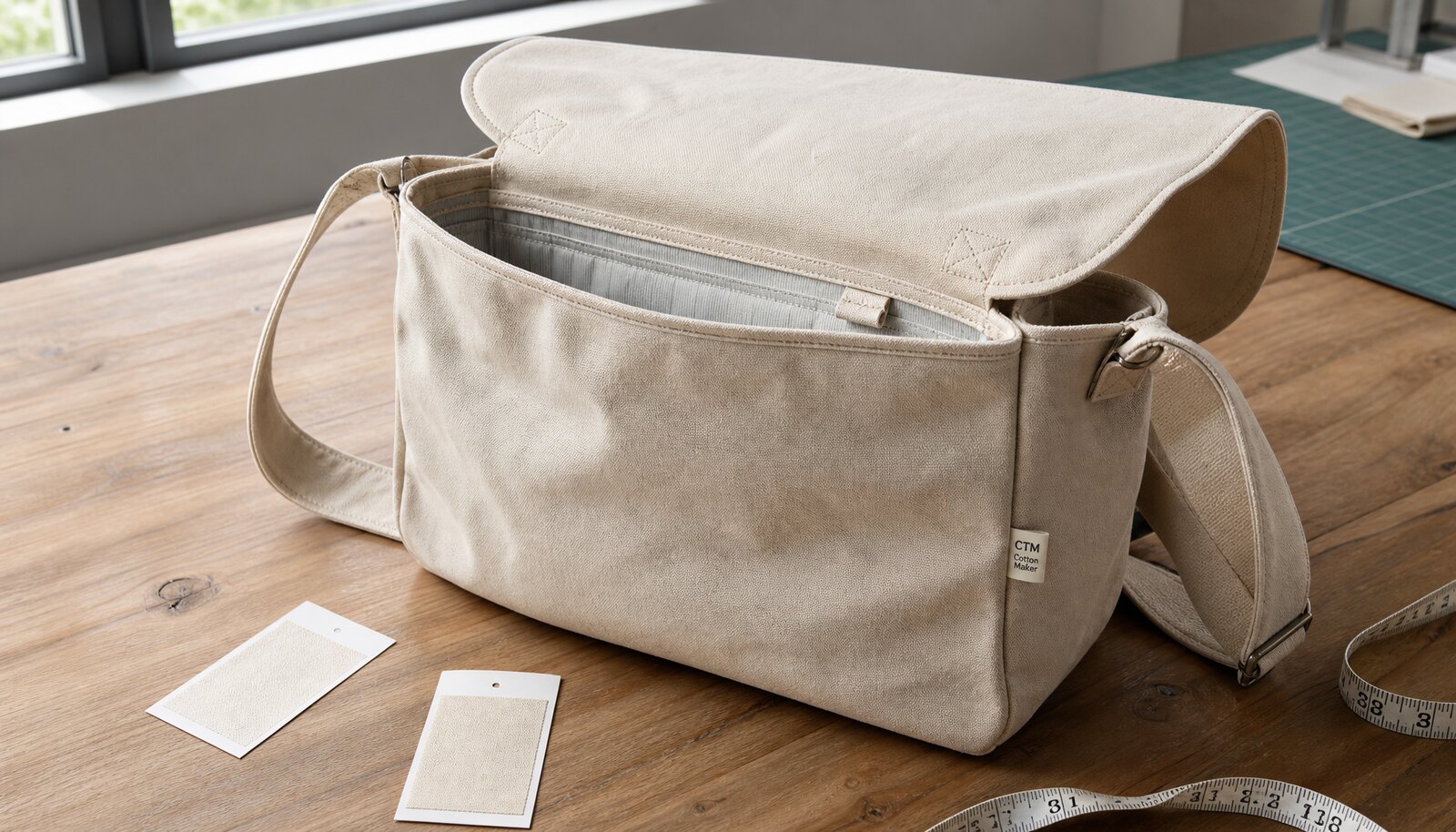
Start With The Carrying Job
Canvas messenger bags are not one product. A document bag for a conference, a commuter bag for daily carry, a school bag, and a retail laptop messenger all need different structure, reinforcement, and branding treatment. If the brief says only canvas messenger bag, the supplier will fill in the gaps with its own standard build, and quote comparisons will become meaningless. Procurement works better when the use case is defined before anyone talks about price.
Write the job in one sentence before sending an RFQ. State what the bag must carry, whether it is promotional or retail, whether it needs to look structured or soft, and whether the customer will see the inside lining. That single sentence drives the fabric weight, closure style, pocket layout, and packing format. A lightweight event bag and a premium everyday messenger can share the same silhouette while requiring very different manufacturing control.
- Document carry: lighter build, flatter profile, and simpler branding
- Retail or commuter use: lined construction, stronger strap, and cleaner interior finish
- Laptop or heavier-load use: reinforced strap points, load target, and clearer stitch requirements
Turn The Concept Into A Spec Sheet
A quote is only useful if every supplier is pricing the same bag. Put finished dimensions, gusset depth, strap width, strap drop, flap overlap, pocket count, lining type, and closure method into one spec sheet. Use millimeters or centimeters and say whether the numbers are finished size or cut size. Soft goods are easy to misread when one factory measures flat and another measures with slight stretch or stuffing.
The spec should also tell the factory where the tolerances matter most. For example, the body width and strap drop usually affect usability more than a cosmetic stitch line, so those should be tighter. If the bag will be shelf-displayed, the flap shape and front panel alignment matter more than an internal pocket that is hidden from the buyer. A short spec sheet with precise tolerances is easier to quote and easier to inspect than a long verbal brief.
- Body size, gusset, and flap measurements with tolerance bands
- Strap width, strap drop, and any adjustment range
- Pocket count, lining type, and closure method
- Artwork placement, print size, and logo color count
- Packing format and carton count
Choose Canvas Weight By Use Case
Fabric weight is one of the fastest ways to align cost with performance. For light promotional use, 8 to 10 oz canvas, roughly 240 to 340 gsm, can work if the load is low and the build is simple. For a more structured retail messenger bag, 12 oz canvas, roughly 340 to 410 gsm, is usually a safer starting point. If the bag needs to carry heavier items or hold shape better on shelf, 14 oz or heavier canvas may be justified, especially when the brand wants a premium hand feel.
Do not look at GSM in isolation. The weave, finish, and pre-treatment matter too. Washed canvas will feel softer and may drape better, but it can change the final dimensions slightly. Coated canvas can add body and improve soil resistance, but coating can affect print adhesion or fold behavior. If the supplier recommends interlining or a board insert, ask why. That recommendation may be a sign that the chosen fabric alone will not hold the intended structure.
- 8 to 10 oz: promotion, events, low-load carry
- 12 oz: general retail use, everyday carry, balanced cost and durability
- 14 oz and above: heavier load, more structure, premium hand feel
- Check whether the canvas is washed, dyed, coated, or left natural
Specify Construction Details That Control Failure
Canvas messenger bags usually fail at the same points: strap ends, flap corners, pocket mouths, and zipper terminations. That is why stitch planning matters as much as the fabric choice. Ask for the seam type on each stress point, not just a generic promise of good quality. A load-bearing strap should not rely on a single row of stitching if the bag is meant to be used daily. Bartacks, double rows, and X-box reinforcement are all small details that change how the bag survives use.
Visible finishing also affects the buyer's perception. Topstitch consistency, seam allowance control, and interior thread cleanup matter on retail bags because customers notice the underside of the flap and the interior pocket edges. If the bag is promotional, the finish can be simpler, but the load points still need proper reinforcement. Use the spec to separate cosmetic choices from structural choices so the factory does not overbuild one area and underbuild another.
- Use bartacks or X-box reinforcement at strap attachment points
- Set a minimum stitch density on load-bearing seams and a separate target for topstitching
- Require clean edge finishing inside the bag where the customer can see the seam
- Confirm closure alignment on flap, zipper, buckle, or hook-and-loop components
Compare Supplier Routes With Real Tradeoffs
The right supplier route depends on how much control the program needs. A direct cut-and-sew factory gives the most visibility into pattern making, sewing, print, and packing, but only if it truly owns those steps. A trading company can simplify communication when one team is managing artwork, samples, and shipping documents, yet the buyer still needs to know where production actually happens. Stock wholesalers and local decorators are fast, but they only make sense when the body can stay standard and the branding change is simple.
For a new program, the key is to compare risk, not just piece price. Ask each supplier who controls the pattern, who approves the sample, and who performs the final inspection. If those answers are vague, the quote is not fully comparable. For canvas messenger bags, process ownership matters because a small change in fabric weight or reinforcement can change both appearance and durability. The supplier that can explain its workflow clearly usually gives you fewer surprises later.
- Direct factory: best for custom dimensions and repeatability
- Trading company: useful when one coordinator is needed, but only if the factory is named
- Stock plus decoration: fastest route when the body can stay standard
- Domestic converter: strongest option for quick revisions and launch testing
Write An RFQ That Produces Comparable Quotes
A useful RFQ should read like a manufacturing brief, not a shopping request. Send the finished size, target GSM, artwork file, decoration method, carton requirement, and shipment window in one package. If the supplier only receives a photo and quantity, it will quote its closest standard model, which often hides the cost of custom dimensions or reinforcement changes. That is how a low quote becomes a higher final price once sampling starts.
Ask for line-item pricing so the real cost structure is visible. Separate the bag body, decoration, sample fee, setup fee, packing, special labels, and any testing or carton upgrade. If you need a second sample round, ask whether it is included. If the supplier gives you one lump sum without explaining what is inside it, you lose the ability to compare sourcing routes or remove unnecessary features. Clear pricing is not only a negotiation tool; it is a spec control tool.
- One reference image or sketch with front, back, and interior views
- Finished dimensions and tolerance bands
- Canvas GSM, finish, and color
- Decoration method, size, and placement
- Packing method, carton count, and barcode requirement
- Delivery term, target ship window, and destination
Approve Samples In Stages
Sampling should move through separate approval gates. A development sample can validate shape and overall proportion. The pre-production sample should use the final fabric, final trim, final print method, and final packing format. If the supplier sends a sample built from substitute materials, treat it as a visual reference only. The sample you accept should become the standard for bulk production and the first reference point for any dispute.
The approval note should be short and measurable. If you approve a sample with no written tolerance band, no print placement reference, and no reinforcement callout, the factory will assume the visual sample is enough. That creates avoidable debate later. For canvas messenger bags, the sample should answer three questions: does it carry the required load, does it look like the approved art, and does it pack the way the buyer expects?
- Development sample for shape and proportion
- Pre-production sample for final fabric, trim, print, and packing
- Golden sample for bulk comparison and inspection reference
- Written approval note with dimensions, reinforcement, and decoration details
Lock QC To Measurable Criteria
QC is where many sourcing guides stay too generic. For canvas messenger bags, you need measurable acceptance criteria, not only a reminder to inspect carefully. Start with dimensions, fabric weight, seam quality, print placement, and closure function. Then define the defect threshold. Many buyers use ANSI/ASQ Z1.4 or ISO 2859-1 as the sampling basis and start around AQL 2.5 for major defects and 4.0 for minor defects, then tighten the plan for retail programs or lower-volume launches. The exact numbers should match your channel and risk level, but the point is to make the rule explicit before inspection begins.
Load-bearing checks need special attention. A strap that looks fine in a photo can still fail if the reinforcement is too short or the bartack is inconsistent. Ask for a load test that reflects real use, even if it is simple. For a light promo bag, that may be a lower weight and a short hold. For a commuter bag, the target should be higher and the hold longer. If the bag has a print across a fold line, add a rub or flex check so the logo does not crack after carton packing or normal use.
- Set a dimensional tolerance for width, height, gusset, and strap drop
- Use a clear defect threshold with AQL targets or your own acceptance rule
- Require reinforcement at strap joins, flap corners, and pocket mouths
- Check print placement, color density, and rub resistance on fold areas
- Verify closure action, zipper travel, and pocket stitching on every sample lot
- Inspect carton marks, barcode legibility, and pack count before release
Treat Packing And Freight As Part Of The Product
Packing can change both the selling condition and the landed cost. A retail program may need individual polybags, hangtags, barcode labels, and a fixed case pack. A bulk program may not need presentation packaging, but it still needs protection from dirt, pressure marks, and excess creasing. With soft canvas bags, overly tight packing can leave a permanent fold line or flatten the flap in a way that hurts shelf appeal. If the product is e-commerce bound, the inner pack needs to survive both warehouse handling and customer unboxing.
Landed cost is the only number that should govern supplier comparison once the spec is stable. A quote that looks cheaper on FOB can become more expensive once packing, inland freight, inspection, carton upgrades, and ocean or air freight are added. For example, a bag quoted at $3.20 FOB can move well above $4.00 after packing material, labels, inland transport, and freight allocation are added, before duty or warehouse receiving. The exact number depends on the lane, but the lesson is constant: compare the full cost chain, not the unit price alone.
- Confirm whether each bag ships in a polybag, bulk fold, or retail-ready pack
- Agree on carton count, carton dimensions, and carton weight limit
- Include label, barcode, and insert requirements in the quote
- Add freight, inspection, and receiving costs to the supplier comparison
Choose The Quote That Reduces Rework
The lowest quote is not always the lowest-risk quote. For canvas messenger bags, the better supplier is usually the one that shows the spec back to you clearly, names the fabric and trim, explains the sample path, and gives a line-item quote without ambiguity. If two quotes are close, favor the one that is easier to inspect and easier to reorder. A supplier that communicates clearly at the quote stage usually has fewer surprises during production, and that matters more than saving a small amount per unit.
For launch orders, prioritize sample fidelity and process clarity. For repeat programs, prioritize stability in cloth, print method, and packing. If you plan to reorder, ask whether the supplier can hold the same material and the same carton format on the next run. If you need speed, choose the route with the strongest sample turnaround and revision handling. If you need scale, choose the route with the best process ownership. The right quote is the one that fits the program rather than the one that looks cheapest in isolation.
- Favor the quote with named materials and line-item pricing
- Favor the supplier that has similar canvas messenger bag examples
- Favor the route that matches your timeline and reorder plan
- Reject any quote that does not explain where the hidden costs sit
Specification comparison for buyers
| Sourcing route | Best fit | Main advantage | Main tradeoff to check |
|---|---|---|---|
| Direct cut-and-sew factory | Custom dimensions, pocket layout, lining, and reinforcement | Best control over pattern, stitching, and final packing | Confirm the factory actually owns cutting, sewing, and QC rather than only export paperwork |
| Trading company with named factory | Programs that need one coordinator for sampling and shipping | Simpler communication when artwork, packing, and documents need coordination | Handoff risk rises if the trading company will not identify the real production site and process owner |
| Specialist canvas bag factory | Repeat canvas messenger bag programs with stable specs | Usually better at fabric choice, reinforcement, and bag-specific details than a general sewing shop | Ask for comparable messenger bag examples, not only tote or pouch references |
| Stock wholesaler plus local decorator | Fast-turn promotions or events with limited customization | Quickest route when the base bag can stay standard and only branding changes | Base body quality, dimensions, and trim may not match your retail standard |
| Domestic converter | Short runs, launch tests, and fast revision cycles | Faster sampling and easier in-person problem solving | Unit cost is higher, so make sure the quoted trim and stitch quality match the approved sample |
| Low-cost offshore factory | Stable repeat orders with a fixed spec and reorder plan | Usually the lowest piece price at scale | Lead time, communication, and hidden packing or testing costs can erase the apparent savings |
| Split supply chain | When one vendor is clearly better at the body and another at decoration | Can improve print or label quality if each specialist is strong | Complexity grows quickly, so assign defect responsibility before production starts |
| Imported blanks plus local finishing | Simple brand programs where body design does not need to change | Useful when speed matters and the bag structure can remain standard | Decoration cannot fix weak seams, poor proportions, or thin fabric |
Buyer checklist before sampling
- Finished dimensions with tolerance bands for width, height, gusset, flap overlap, and strap drop
- Target canvas GSM, weave type, finish, and whether the fabric is dyed, washed, coated, or garment-washed
- Lining material, pocket count, pocket size, closure type, and any board, foam, or interlining requirement
- Stitch spec for load-bearing seams, including whether the factory will use bartacks, X-box reinforcement, or double rows
- Artwork file, print method, print placement, color count, and acceptable color deviation for the logo
- Sample sequence with clear approval gates: development sample, pre-production sample, and golden sample
- Target order quantity by color and by SKU, plus the reorder assumption if the program repeats
- Packing method, polybag standard, carton count, carton mark format, and barcode or hangtag requirement
- Required test standard or inspection level if your channel needs one, such as AQL targets or rub-test criteria
- Target ship window, destination, Incoterm, and whether you want the quote to include freight or only factory pricing
Factory quote questions to send
- What canvas GSM do you recommend for this use case, and is the fabric greige, dyed, washed, or coated?
- Can you confirm the finished size tolerance you can hold on width, height, gusset, and strap drop?
- What is the stitch plan for the load-bearing seams, and will strap ends be reinforced with bartacks or an X-box?
- What is your MOQ by color, print method, and hardware finish, and what changes it the most?
- Can you break the quote into bag body, decoration, packing, sample fee, setup fee, and any testing charge?
- Which steps are in-house, and which steps are outsourced to another shop or subcontractor?
- What sample stages do you include, and which one uses the final fabric, final trim, and final packing format?
- What packing format and carton count do you recommend for retail, warehouse, or bulk delivery?
- Can you share photos of similar canvas messenger bag production, reinforcement, and packing work?
- What inspection records, in-line photos, or pre-ship photos can you provide before dispatch?
Quality-control points to confirm
- Measure the finished bag against the approved sample, not only the sales drawing. Use the same lay-flat method every time.
- Set a dimensional tolerance before production starts. Many buyers use a tighter band on width and height than on strap drop because soft bags vary more at the strap.
- Confirm the fabric matches the approved GSM and finish. A lighter substitute may pass visually but fail the hand-feel or load requirement.
- Inspect seam construction at the highest-stress points: strap joins, flap corners, pocket mouths, zipper ends, and base corners.
- Require bartacks, double rows, or X-box reinforcement at all load-bearing joins if the bag is expected to carry more than promotional weight.
- Use a simple inspection framework such as ANSI/ASQ Z1.4 or ISO 2859-1 with an agreed AQL, often starting around 2.5 for major defects and 4.0 for minor defects on commercial programs.
- Set critical defects to zero tolerance if they affect safety, function, or branding, such as broken straps, open seams, missing closures, or wrong logo placement.
- For print quality, check placement, edge sharpness, and color density against the approved sample. If the logo crosses a fold line, inspect for cracking after flexing.
- For rub resistance, ask the supplier to follow your channel requirement or an agreed standard such as ISO 105-X12 or AATCC 8 if color transfer matters to your buyers.
- For light exposure-sensitive programs, ask whether a lightfastness requirement applies and request the relevant test basis before approval.