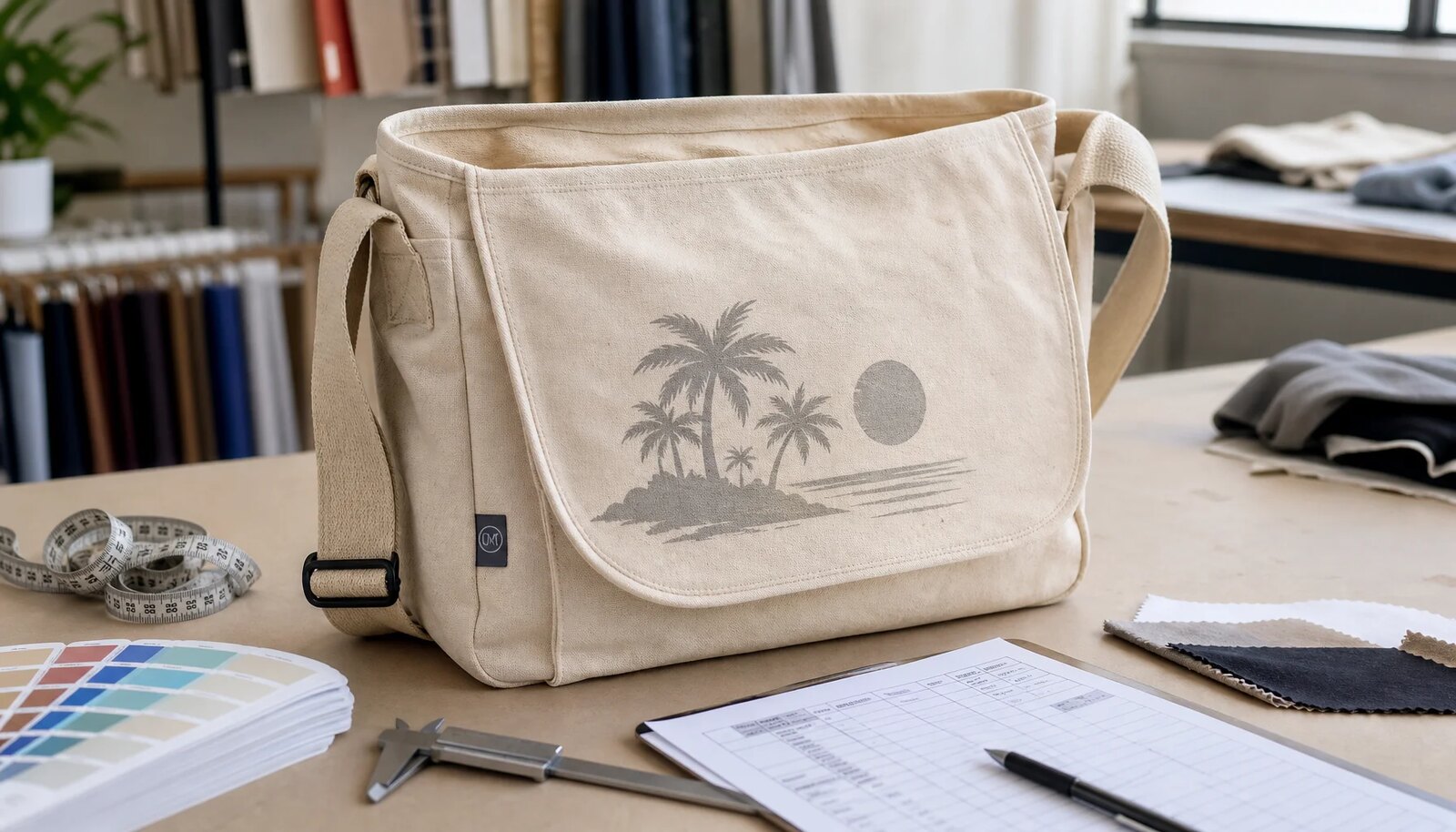
Why Print Proofing Matters in Hotel Retail
A canvas messenger bag sold in a hotel shop is judged before a guest ever uses it. It sits beside apparel, postcards, spa products, local foods, and branded souvenirs. The buyer has only a few seconds to communicate quality. If the flap twists, the logo sits low, the print looks thin, or the natural canvas shows an oil mark, the bag may still be functional but no longer feels retail-ready.
Print proofing is where a design file becomes a production standard. For hotel retail canvas messenger bags, the proof should not stop at a pretty mockup. It should lock the canvas weight, approved shade, print process, print size, placement tolerance, flap construction, hardware position, label placement, packing method, and inspection criteria. Those details decide whether the factory can repeat the result across hundreds or thousands of units.
This matters even more for hotel groups using one bag body across several properties. A beach resort may choose a one-color screen print, a city hotel may prefer a small woven patch, and a destination property may want a full-color illustrated map. To a brand team, these may feel like artwork variants. To a factory, they can mean different screens, transfers, setup time, sorting rules, packaging labels, and QC risks.
The safest procurement process ties the RFQ, sample approval, purchase order, and final inspection to the same measured proof. That prevents vague disputes such as 'the logo looked centered on the rendering' or 'we thought 12 oz canvas meant this hand feel.' Buyers should ask for numbers, physical references, and signed approval records before bulk fabric purchase, printing, or cutting begins.
- Treat the proof as a production control document, not only a design preview.
- Approve artwork on the actual canvas weight and flap construction whenever possible.
- Measure from sewn flap edges because sewing, pressing, snap setting, and flap curve shift the visible center.
- Record tolerances for logo placement, print size, print color, finished dimensions, and packing before deposit.
- Keep the signed sample, proof sheet, and packing photos available for inspection and reorders.
Define the Retail Program Before the RFQ
A paid gift-shop product should not be specified the same way as a guest-room amenity or conference giveaway. Retail programs usually need cleaner fabric, stronger shelf presence, tighter logo alignment, better packing, and construction that survives guest handling. Amenity and event programs may be more cost-sensitive, but the bag still carries the hotel brand. A weak print on a low-control item can still create a brand problem.
Start the RFQ with the commercial use. Is the bag a resort souvenir, boutique merchandise item, staff sale item, loyalty welcome gift, conference gift, co-branded local attraction product, or guest amenity? That answer affects canvas weight, lining, pocket layout, strap width, hardware finish, barcode requirements, hangtag design, carton sorting, and inspection level.
Then define how the bag will be displayed and handled. A peg-hook display may need a hang loop, a reinforced hangtag hole, or strap presentation instructions. A flat boutique shelf needs a clean front flap with no hard crease through the logo. A multi-property rollout may require cartons marked by logo version, SKU, property code, and purchase order. A guest-room placement may not need a retail barcode, but it may need compact packing for housekeeping carts or luggage inserts.
Finally, describe what the bag must carry. If it needs to hold a tablet, room literature, folded map, guidebook, water bottle, or conference papers, specify the gusset, closure, strap anchor, and internal seam construction before sampling. If it is mainly a souvenir, the structure can be simpler, but the printed flap still deserves tight control.
- For paid hotel retail, prioritize clean canvas, aligned branding, shelf-ready packing, and guest-handling durability.
- For boutique programs, consider lining, internal pocketing, woven labels, hangtags, barcodes, and upgraded hardware.
- For guest amenities, prioritize lead-time certainty, simple branding, efficient packing, and controlled unit cost.
- For event gifts, confirm date-critical delivery, document capacity, strap comfort, and property logo rules.
- For multi-property programs, standardize the base bag and change only print, label, hangtag, or barcode where practical.
Specify Canvas Weight, Finish, and Shade
The fabric line in the RFQ should include both ounce weight and GSM. Canvas messenger bags commonly sit around 10-16 oz, roughly 300-540 GSM depending on weave, finishing, and supplier terminology. A 12 oz canvas, typically around 380-420 GSM, is a practical middle range for many hotel retail programs. It gives the bag enough body for shelf presentation without making the flap overly stiff or the carton unnecessarily heavy.
Do not buy by ounce description alone. Mills, suppliers, and finishing processes may use weight names differently. A quoted 12 oz fabric from one supplier can feel different from another if the weave, yarn, washing, or softening is different. Ask for actual GSM tolerance, fabric construction information when available, and a physical swatch before approving the pre-production sample.
Lighter 10 oz canvas, around 300-340 GSM, can work for budget programs, event gifts, or short campaigns. It may also reduce carton weight. The tradeoff is a softer body, more visible seam bulk, and a front flap that may collapse on shelf. Heavier 14-16 oz canvas, around 450-540 GSM, can support a premium feel, but it adds freight weight, stronger fold memory, and more difficulty at thick seams. It can also affect print coverage across the weave.
Color control needs equal attention. Natural canvas is not one universal shade. It can shift from cream to beige depending on yarn, finishing, and lot. If natural canvas is acceptable, approve a swatch range rather than a single photo. If the hotel brand requires dyed fabric, ask for lab dips and define bulk shade tolerance before production. Custom dyeing can add fabric MOQ, extra lead time, and shade drift risk between batches.
- Use both oz and GSM in the RFQ, and ask the supplier to state the GSM tolerance they can hold.
- Confirm whether the canvas is greige, natural, dyed, washed, softened, pre-shrunk, or stock inventory.
- Approve natural canvas with a physical shade range, not only a supplier photo.
- Use lab dips for custom dyed canvas and allow time for correction before sampling.
- Check whether washed or softened finishing changes print sharpness, flap drape, and finished dimensions.
- Record fabric lot, swatch reference, and approved sample photos for reorder comparison.
Choose the Branding Method Early
Many proofing problems begin when artwork is approved before the decoration method is fixed. Screen print, heat transfer, digital transfer, embroidery, woven patch, leather patch, PU patch, and side labels all behave differently on cotton canvas. Each method changes cost, lead time, placement tolerance, reject sorting, and perceived value.
Screen printing is usually a strong choice for one to four solid spot colors, clean hotel wordmarks, and repeat programs. It requires screen setup, ink mixing, registration control, and opacity testing on the final canvas shade. Pale inks can look muted on natural canvas because the base fabric shows through. Dark dyed canvas may need a white underbase or extra passes. Fine lines and small serif text should be physically tested because canvas ridges can fill in details.
Heat transfer and digital transfer can solve other problems. They suit gradients, full-color illustrations, seasonal artwork, and smaller mixed-logo runs. They also introduce different risks: adhesive outline, gloss mismatch, scorch marks, edge curling, lifting, cracking after flap flexing, and a hand feel that may seem too plastic for boutique retail. If the artwork crosses a bend line, the sample should be flexed before approval.
Embroidery and patches can look premium, but they still need proofing discipline. Embroidery may pucker the flap or blur small text. Woven patches add edge quality, backing, and sewing alignment checks. Leather and PU patches need deboss clarity, color consistency, clean edges, and strong attachment. If a patch is selected, include its width, height, stitch line, backing, placement, and tolerance on the proof sheet.
- Screen print fits 1-4 spot color logos, repeat orders, and clean wordmarks when opacity is tested.
- Heat transfer fits gradients and mixed-logo runs but needs cracking, lifting, gloss, and edge checks.
- Digital transfer fits detailed destination artwork but should be tested for hand feel and flap flexing.
- Embroidery adds texture but can pucker canvas and is weak for tiny text or dense fill areas.
- Woven patches support multi-color logos but add patch edge, backing, and sewing-placement variables.
- Leather or PU patches require deboss clarity, material color standard, edge finishing, and attachment review.
Build a Measured Artwork Proof Sheet
A procurement-ready proof sheet should be clear enough for sampling, production, and inspection. It should show logo width and height in millimeters, placement from the sewn top edge of the flap, placement from both sewn side edges, distance from snap or hardware, Pantone or target color, print method, print color count, and printable area limits. Avoid instructions such as 'centered,' 'large logo,' 'same as photo,' or 'match mockup.' They may help conversation, but they do not work as inspection criteria.
For visible front-flap branding, many buyers use a working placement tolerance of about +/-3 mm from sewn flap edges if the construction can support it. Print size tolerance may be around +/-2 mm for smaller logos and +/-3 mm for larger flap artwork. These are not automatic rules. The factory should confirm what it can hold on the selected canvas weight, flap shape, and print process before bulk production.
Be careful with visual center. A logo printed in the mathematical center of a cut panel may not appear centered after sewing, turning, pressing, snap setting, and flap drape. If the design should be visually centered on the finished bag, mark that directly on the proof and include a centerline reference or measuring template. Inspection should measure from sewn edges, not guess by eye.
Minimum text size is another common failure point. Property names, dates, destination taglines, and co-branding lines may look fine in a PDF but disappear into canvas weave. Ask the supplier to confirm minimum readable text height for the selected process. For screen print on canvas, very fine strokes and reversed-out text deserve a physical strike-off before bulk approval.
Color should also be approved physically when the brand is sensitive. Pantone references are useful, but cotton canvas is absorbent and uneven compared with coated paper. Natural canvas changes the perceived color of white, cream, pale gray, beige, and gold. For strict brand control, define the target as the approved physical sample plus a tolerance statement, not only a digital number.
- Provide AI, EPS, SVG, or editable PDF artwork with fonts outlined or font files supplied.
- State print width, print height, color count, minimum text height, and stroke-risk areas.
- Measure placement from sewn flap edges, not only from cut-panel edges.
- Keep artwork away from flap folds, seams, snaps, rivets, buckles, and heavy crease lines.
- Use +/-3 mm placement tolerance only when the design and construction can realistically support it.
- Require supplier acknowledgement of the final proof sheet before bulk printing.
Approve the Pre-Production Sample Like an Inspector
A photo sample can help early design discussion. It should not be the final approval for hotel retail production. The pre-production sample should use bulk or production-equivalent canvas, final webbing strap, final hardware, final lining or seam finish, final label, final branding method, and proposed packing. If substitute materials are unavoidable, list them clearly and require follow-up approval for anything that affects appearance, strength, or shelf presentation.
Review the sample with a measuring tape, not only a camera. Check body width, body height, gusset, flap depth, strap width, adjustable strap range, print size, print position, pocket position, zipper length, snap position, label position, and packed size. Compare each point against the RFQ, quote, and artwork proof. If the approved sample includes a change, update the production record immediately.
Handle the sample the way a guest would. Load it with a realistic weight, wear it over the shoulder, open and close the flap, adjust the strap, bend the printed area, and see whether the flap still sits flat. If the bag will be packed flat, fold and unpack it to check whether the print creases or the hardware marks the canvas. If it will hang in a store, suspend it and check how the front logo presents.
Photo records prevent long arguments later. Take clear images of the approved sample from the front, back, side, bottom, interior, print close-up, hardware close-up, label view, and packed view. Include a ruler in placement photos. Attach these images to the purchase order or approval record so the inspection team is not relying on a separate design file.
- Measure finished dimensions, flap depth, gusset, strap width, strap range, print size, and print placement.
- Check print color, opacity, edge sharpness, and hand feel on the final canvas surface.
- Bend the flap repeatedly to review cracking, lifting, adhesive outline, gloss change, or ink stress.
- Load the bag to review strap comfort, strap anchor reinforcement, snap alignment, and flap closure.
- Approve hangtag, barcode, woven label, care label, and country-of-origin label positions if included.
- Approve the packed sample or packing photos before releasing bulk shipment.
Compare Quotes Without Missing Hidden Costs
MOQ for canvas messenger bags is rarely driven by total quantity alone. It may be tied to fabric purchase, custom dyeing, cutting yield, print screens, ink changes, hardware finish, webbing color, woven label MOQ, hangtag printing, barcode labeling, and carton sorting. A supplier may accept a low MOQ for stock natural canvas with a one-color screen print, then require higher minimums for custom dyed canvas, antique brass hardware, or multiple property logos.
Separate unit price from one-time charges and variable surcharges. One factory may include screen charges and sample making; another may list them separately. One may quote master carton packing only; another may include retail polybags, hangtags, barcode stickers, and property-level carton marks. Procurement should compare landed cost per sellable unit, not just ex-factory unit price.
For hotel groups, it often helps to separate the standard bag body from property-specific branding. Ask whether cutting and sewing can be combined for one body style while screens, transfers, labels, hangtags, barcodes, and cartons are controlled by property or logo version. This shows which volume can be aggregated and which costs remain design-specific. It also makes reorders easier.
Lead time should be broken into milestones. Ask for timing on artwork proof, fabric swatch or lab dip, pre-production sample, courier transit, bulk material preparation, printing, cutting, sewing, finishing, inspection, packing, export documents, and shipment handover. Custom dyed canvas, multi-color artwork corrections, late barcode data, and delayed packaging approvals are common schedule risks.
- Request MOQ by fabric color, print design, print color count, hardware finish, strap color, label, hangtag, barcode, and carton configuration.
- Separate screen charges, lab dips, sample fees, courier fees, artwork cleanup, mold fees, label setup, and carton mark changes from unit price.
- Ask for price breaks at initial order quantity, reorder quantity, single-property replenishment, and mixed-logo program volume.
- Confirm whether overruns or underruns are allowed, and set acceptance limits in the purchase order.
- Compare carton size, pieces per carton, gross weight, and packing method because freight can change landed cost.
- Require quote validity, payment terms, sampling lead time, bulk lead time, and latest artwork approval date.
Control Packing for Shelf-Ready Arrival
Packing is part of print proofing. A correct logo can still arrive unsellable if a hard fold runs through the printed flap. Messenger bags are often folded to reduce carton volume, but folds through screen print, heat transfer, embroidery, or patches can cause cracking, pressure marks, or poor shelf presentation. For hotel retail, controlled flat packing is often safer, especially on natural canvas that shows dust, pressure lines, and oil marks easily.
The packing specification should state whether bags are individually polybagged, packed in recyclable polybags, wrapped in tissue, shipped with a paper band, packed without individual bags, or placed in inner cartons. Some hotel buyers prefer reduced plastic. That can be a good choice, but it must be balanced against dust protection, warehouse handling, and store labor. If units arrive dusty or crushed, the shop team may need to steam, wipe, or re-fold every bag.
Retail accessories need the same attention as the bag. Hangtags, barcode stickers, spare straps, silica gel, paper inserts, and country-of-origin labels should not press into the logo during transit. If hangtags are attached, specify the attachment point and orientation. If barcodes are required, confirm the barcode type, SKU, property code, and whether labels go on the product, polybag, hangtag, inner carton, or master carton.
Carton data belongs in the quote and approval package. Request pieces per carton, carton dimensions, gross weight, net weight, inner pack quantity, carton marks, and property-level sorting plan. For multi-property hotel groups, carton marks should clearly identify logo version, SKU, color, quantity, and purchase order number to reduce receiving errors.
- Avoid folds or pressure points through the printed front flap.
- Use tissue, paper inserts, or controlled flat packing when shelf presentation is important.
- Confirm whether individual polybags are required for dust protection, barcode control, or warehouse handling.
- Approve hangtag, barcode, and label placement so they do not mark the logo.
- Request packing photos, carton dimensions, pieces per carton, gross weight, and net weight before shipment.
- Include carton marks and property-level sorting instructions in the purchase order.
Inspect Print, Sewing, Hardware, and Labels Separately
Final inspection should separate logo defects from general sewing defects. A bag can have strong stitching and still fail retail approval if the hotel logo is off-center, printed too small, or creased through the flap. Inspection criteria should cover print, fabric, construction, hardware, labeling, and packing as separate checkpoints. Inspectors should compare bulk units against the approved physical sample, signed proof sheet, and approved packing photo.
Many buyers use AQL sampling for soft goods, but the defect classes should be agreed before production. Wrong logo, wrong property name, mold, unsafe hardware, missing legally required label, or severe contamination may be treated as critical defects. Off-center print beyond tolerance, wrong print size, visible ink smear, broken strap-anchor stitch, wrong packing method, failed snap, or flap crease through the logo may be major defects. Small trimmed thread ends or minor internal irregularities may be minor defects if they do not affect retail appearance or function.
The inspection method should include tools. Use a ruler, template, or marked gauge to check logo placement from sewn edges. Open cartons from different packing sequences or production batches to catch shade drift, print drift, and compression marks. Bend selected printed flaps to check cracking or lifting. Review strap anchor reinforcement against the approved construction. Check hardware for rust, burrs, weak magnetic closure, plating defects, sharp edges, and staining against natural canvas.
When defects appear, corrective action should be specific. Sorting should identify saleable, repairable, and reject units. Rework instructions should include photos and limits, such as maximum allowed ink mark size, acceptable thread trimming method, or whether heat-transfer edge lifting is not repairable. Do not average away visible logo problems under a broad overall pass if the brand presentation fails.
- Set critical, major, and minor defect definitions before production starts.
- Use AQL or another agreed sampling plan, but define logo defects separately from sewing defects.
- Measure print placement, print size, bag dimensions, strap length, and hardware position during inspection.
- Open cartons from different batches to find shade variation, print drift, and packing compression damage.
- Photograph defect examples with a ruler or reference point for sorting and rework.
- Do not release shipment until barcode, labeling, carton marks, and property sorting match the purchase order.
Manage Approval Flow and Lead-Time Risk
A realistic schedule includes artwork proofing, swatch or lab dip approval, pre-production sample making, courier transit, buyer review, sample correction, bulk material sourcing, printing, cutting, sewing, trimming, factory QC, third-party inspection if required, packing, export paperwork, and shipment handover. Hotel retail dates often connect to openings, peak travel seasons, conferences, holiday shop resets, or campaign launches. Missing one approval window can mean missing the selling season.
The most common schedule risks are custom dyed canvas, late artwork changes, multi-color print corrections, unavailable hardware finish, delayed labels, missing barcode data, and unclear property-level packing. Buyers can reduce risk by freezing the base bag construction early and treating logo versions as separate print approvals. For multi-property programs, approve one master construction sample first, then approve print proofs or strike-offs for each logo version.
Approval authority should be named in writing. The supplier needs to know who can approve artwork, who can approve sample construction, who can approve packaging, and who can release shipment after inspection. If brand, legal, procurement, retail operations, and property managers all need input, build that review time into the schedule. Do not let bulk cutting, screen making, transfer printing, or label production begin from a sample still under internal review.
The purchase order should list approval gates. Typical gates include fabric swatch or lab dip, artwork proof sheet, pre-production sample, packing method, bulk production start, inline check if required, final inspection, and shipment release. Each gate should have an owner and date. Silence should not be treated as approval unless the buyer has explicitly written that rule into the process.
- Build the schedule backward from in-store date, not factory completion date.
- Add time for lab dips if canvas color is custom or brand-sensitive.
- Freeze construction before releasing multiple property logo proofs.
- Do not start bulk cutting before fabric, flap dimensions, print placement, and hardware position are approved.
- Reserve time for one corrected sample if the first proof has color, placement, or packing issues.
- Name the approver for artwork, construction, packaging, inspection release, and shipment booking.
Specification comparison for buyers
| Spec decision | Recommended option | When it fits | Buyer risk to check |
|---|---|---|---|
| Fabric weight for hotel retail | 12 oz canvas, typically around 380-420 GSM; request actual supplier GSM tolerance and finished fabric test data | Hotel gift shops, resort boutiques, staff merchandise, destination retail, and mid-range amenity programs that need structure without excessive stiffness | Too light can collapse on shelf; too heavy increases freight, creates bulky flap folds, and can distort print registration |
| Fabric weight alternatives | 10 oz canvas around 300-340 GSM for budget programs; 14-16 oz canvas around 450-540 GSM for premium programs | 10 oz suits event giveaways or short-term campaigns; 14-16 oz suits higher ticket retail where weight supports perceived value | Weight naming varies by mill and finish; verify GSM, not only ounce description, and approve hand feel on a physical swatch |
| Canvas color approval | Stock natural canvas with approved shade range, or custom dyed canvas with lab dip and bulk shade tolerance | Natural works for coastal, eco, heritage, and destination retail; custom dyed canvas fits strict hotel brand palettes | Natural canvas can vary cream to beige by lot; custom dyeing adds lead time, fabric MOQ, and risk of shade drift across batches |
| Front flap print method | Screen print for 1-4 solid spot colors; heat transfer or digital transfer for gradients, full-color artwork, or small mixed-logo runs | Screen print fits clean hotel wordmarks and repeat orders; transfers fit illustrated resort maps, seasonal artwork, and multi-property designs | Check opacity, edge sharpness, registration, gloss, cracking after flexing, adhesive outline, and ink pickup on cotton weave |
| Logo placement tolerance | Measured layout with +/-3 mm tolerance from sewn flap edges for visible front branding; use wider tolerance only if artwork is forgiving | Hotel retail shelves, hanging displays, and boutique merchandising where alignment is visible to guests | A print centered on a cut panel may shift after sewing, turning, pressing, snap setting, or flap curvature |
| Print size tolerance | State width and height in millimeters with typical tolerance of +/-2 mm for small logos or +/-3 mm for larger flap artwork | Useful when several properties use the same bag body but different logo sizes or lockups | A supplier may scale artwork to fit equipment or avoid seams unless final print size is locked in writing |
| Proof format | Vector artwork plus measured proof sheet showing print method, Pantone or target color, dimensions, placement, and printable area limits | Procurement teams comparing factories, agencies, and multi-property hotel programs | Digital renderings can hide canvas absorption, fine-line fill-in, low opacity, flap drape, and visual-center problems |
| Pre-production sample | One physical pre-production sample using bulk canvas, final strap, final hardware, final lining or seam finish, final label, final print process, and proposed packing | Hotel retail programs where brand appearance, shelf presentation, and guest handling matter | A salesman sample with substitute fabric, wrong hardware, or photo-only print approval can create bulk disputes |
| MOQ structure | Quote MOQ by fabric color, print design, hardware finish, webbing color, custom label, hangtag, and packing configuration | Hotel groups ordering one body style for several property logos, resort colorways, or staggered replenishment | A low total MOQ can hide separate screen charges, dyeing MOQ, label MOQ, barcode setup, and carton sorting fees |
Buyer checklist before sampling
- Define the final commercial use: paid hotel shop merchandise, resort boutique item, guest amenity, staff merchandise, event gift, loyalty welcome item, or co-branded destination retail product.
- Specify finished dimensions in millimeters: body width, body height, gusset depth, flap depth, strap width, adjustable strap range, pocket size, and whether the bag must fit a tablet, folded map, room key envelope, or retail display hook.
- State canvas weight in both oz and GSM, including acceptable GSM tolerance, weave style, finishing, shrinkage expectation, and whether fabric is stock natural, stock dyed, custom dyed, washed, softened, or pre-shrunk.
- Define fabric color approval: supplier swatch for natural canvas, Pantone target or lab dip for dyed fabric, bulk shade tolerance, and whether shade variation within one order is acceptable.
- Provide vector artwork with outlined fonts, Pantone or target color references, print size in millimeters, minimum text height, number of colors, and placement from sewn flap edges.
- Select branding before sampling: screen print, heat transfer, digital transfer, embroidery, woven patch, leather patch, PU patch, side label, hangtag, or combined branding.
- Confirm whether printing is done on cut panels before sewing or on the assembled flap, and require the supplier to state how that affects placement tolerance and reject sorting.
- Approve one physical pre-production sample made with bulk canvas, final webbing strap, final hardware, final lining or seam finish, final label, final print process, and proposed packing method.
- Set written tolerances for logo placement, print size, print color, bag dimensions, flap symmetry, stitch density, seam allowance, strap length, hardware placement, and acceptable print defects.
- Confirm retail handling requirements: shelf stacking, peg hooks, hangtags, barcode labels, gift boxes, guest-room placement, luggage packing, property-level sorting, or visual-merchandising displays.
Factory quote questions to send
- What canvas weight in oz and GSM is included in the unit price, what GSM tolerance do you control, and is the fabric greige, natural, dyed, washed, softened, pre-shrunk, or stock inventory?
- Can you provide fabric swatches or lab dips before sampling, and what bulk shade tolerance do you normally apply for natural canvas and dyed canvas?
- Which print method is quoted, how many colors are included, what ink or transfer type is used, and what is the maximum printable area on the messenger flap before seams, folds, snaps, or hardware interfere?
- Will the logo be printed on cut panels before sewing or on the assembled flap, and how does that choice affect logo placement tolerance, visual centering, and reject sorting?
- What logo placement tolerance, print-size tolerance, and print color tolerance can your factory hold in normal bulk production on this canvas weight and flap construction?
- Are screen charges, artwork adjustment, sample cost, sample courier cost, custom woven labels, hangtags, barcode labels, carton marks, lab dips, and inspection support included or quoted separately?
- What MOQ applies per fabric color, print design, print color count, hardware finish, strap color, custom label, hangtag, barcode configuration, and shipping carton configuration?
- Can the pre-production sample use bulk fabric and bulk accessories, or will the first sample use substitute materials that require later confirmation before production?
- What reinforcement is included at strap anchors, flap corners, zipper ends, magnetic snap points, internal pocket stress points, side seams, and webbing attachment points?
- What stitch density, thread type, seam allowance, and edge finishing are included for the quoted construction: lining, binding, overlock, turned seam, bias tape, or raw interior?
Quality-control points to confirm
- Print color should match the approved physical sample or agreed Pantone target under consistent lighting, ideally D65 daylight or a controlled light box; note canvas base shade because it changes perceived color.
- Logo placement should stay within the written tolerance from sewn flap top edge, side edges, bottom edge, snap center, and visual center line; inspectors should measure with a ruler or template, not judge by eye only.
- Print size should match the approved proof sheet, including width, height, stroke weight, minimum text height, spacing between logo elements, and clearance from seams, folds, snaps, rivets, or buckles.
- Ink coverage should be even across canvas ridges with no pinholes, weak edges, ghosting, smudging, unexpected shine, ink bleed, registration shift, lint trapped in ink, or visible screen marks.
- Heat transfer and digital transfer prints should show no lifting, bubbling, cracking, adhesive outline, scorch mark, edge curling, gloss mismatch, or delamination after controlled flap bending.
- Embroidery, woven patch, leather patch, or PU patch branding should not pucker the flap, twist the canvas, expose loose backing, show uneven stitch tension, or sit outside the approved placement tolerance.
- Canvas shade, hand feel, surface slubs, and finishing should match the approved range; reject stains, oil marks, mildew odor, excessive lint, yellowing, dye streaks, needle rust marks, or foreign fibers visible at retail distance.
- Finished dimensions, flap symmetry, gusset width, strap length, strap adjuster function, pocket position, lining fit, zipper operation, and magnetic snap alignment should match the approved sample and tolerance sheet.
- Strap anchors should show agreed reinforcement such as box stitch, bartack, rivet plus stitch, or reinforced seam tape, with no skipped stitches, broken thread, loose webbing, or seam tearing under normal load review.
- Hardware should be free of rust, burrs, sharp edges, plating defects, weak magnetic closure, loose rivets, mismatched finish, or staining against natural canvas.