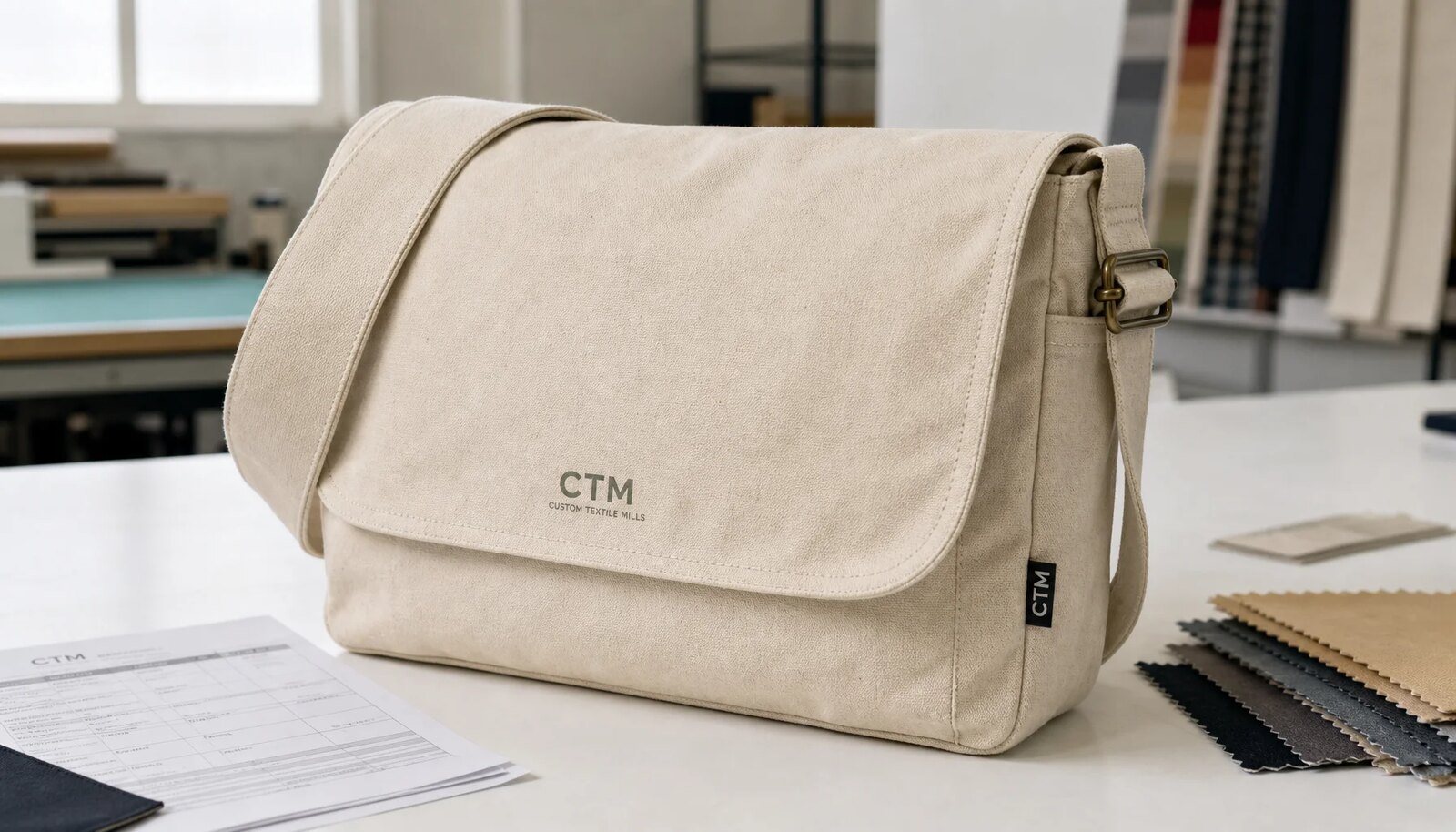
Start with the risk buyers actually face
Canvas messenger bags look straightforward on a PDF proof. That is the trap. A flat mockup does not show the flap curve, gusset pull, seam allowance, pocket thickness, strap anchors, snaps, magnetic closures, zipper teeth, bartacks, or fold lines. Once the bag is sewn, the print surface is no longer a clean rectangle. A mark that appears centered on screen can sit too low after the flap closes, look tilted because the flap edge is slightly uneven, or become crowded when the bag is lightly filled.
For event planners and procurement teams, proofing is not a nice design step. It is the document that connects artwork, product specification, decoration method, packing, and inspection. A useful canvas messenger bags print proofing checklist for event planners should let the buyer, supplier, decorator, and inspector answer the same practical questions: what exact bag is being made, what exact artwork is being applied, where does it go, what variation is acceptable, and what happens if production does not match the approved standard.
Review the bag as a real object. Look at the logo with the flap open and closed. Check the bag flat and lightly filled. If the order will be packed folded, inspect the fold path before approving bulk. If the bags will be handed out at registration or used in sponsor kits, review how they look stacked, carried, and worn crossbody. Event merchandise gets handled quickly and photographed often, so small proofing errors can become highly visible.
- Approve the mark on the sewn bag geometry, not only on a front-view mockup.
- Show placement references such as seam, flap edge, pocket edge, snap center, zipper line, or centerline on the proof.
- Check the logo with the flap closed, flap open, bag lightly filled, and bag folded for packing.
- Keep one signed proof sheet as the shared standard for production, inspection, receiving, and dispute resolution.
Freeze the bag before approving the art
A print proof is only useful when the product underneath it is fixed. A 10 oz unlined canvas messenger bag, a 12 oz promotional messenger bag, and a 16 oz lined retail-style bag can carry the same logo but behave differently under ink, heat, pressure, and folding. Heavier canvas may feel more substantial, yet create seam bulk that changes the flap shape. Lighter canvas can print smoothly, but a large decoration may pucker or distort the panel. Natural canvas may show flecks through thin ink. Dyed canvas may need an under-base or a different ink system.
Procurement should lock the physical specification before comparing supplier quotes. State finished dimensions in millimeters: bag width, height, gusset depth, flap width, flap height, strap width, adjustable strap range, handle drop if used, pocket sizes, lining material, closure type, hardware finish, and reinforcement method. For fabric, ask for oz/yd2 and GSM where possible. As a rough reference, 10 oz canvas is about 339 GSM and 12 oz is about 407 GSM, but supplier targets can vary. The quote should state the supplier's measured target and allowed tolerance. In production buying, '+/-5% fabric weight tolerance' is clearer than 'heavy canvas'.
Construction details change the safe print zone. A magnetic snap can create a pressure point under a flap print. Hook-and-loop tape can leave a rectangular ridge. A front pocket seam may interrupt a sponsor lockup. A zipper line can limit printable height. These are not final-inspection discoveries. Ask the supplier to mark the maximum safe print area on the actual pattern or pre-production sample after the bag construction is confirmed.
- Specify finished width, height, gusset, flap size, strap range, pocket layout, lining, closure, hardware, and reinforcement.
- State canvas weight in oz/yd2 and GSM, with color, weave, finish, dye method, and tolerance.
- Confirm whether the proof sample uses production fabric or a substitute fabric with the same specification.
- Do not approve final artwork placement until flap shape, pocket seams, closures, and hardware positions are fixed.
Match decoration to artwork and timeline
Decoration choice should follow artwork, fabric, quantity, and schedule. Screen print is often a strong fit for simple logos, solid sponsor marks, and medium-to-large quantities because setup cost can be spread across the run and production checks are repeatable once the screen and fixture are approved. It also gives inspectors clear points to review: edge sharpness, opacity, registration, color, cure, and placement. For dyed canvas or dark fabric, ask whether an under-base is needed, whether the ink is water-based, plastisol, or another system, and how cure is controlled.
Digital transfer, heat transfer, and DTF can make sense for gradients, full-color sponsor groups, short runs, or artwork with too many colors for practical screen printing. The tradeoff is surface feel and bonding risk. Transfers may show a film edge, look glossier than the canvas, crack at flap folds, lift at corners, or leave heat press marks if the time, temperature, pressure, fabric, or placement is wrong. A digital proof cannot answer those questions. Require a physical sample on the actual canvas and fold the decorated panel the way it will be folded in packing and use.
Embroidery, woven patches, printed patches, and sewn labels sit in a different lane. They can feel durable and premium, but they are not simple substitutes for a large printed graphic. Embroidery may pucker thin canvas or lose small text. A patch adds thickness, needle holes, and carton bulk. A woven side label works beautifully as a brand detail but may be too small for sponsor obligations. If a supplier recommends changing method after reviewing the artwork, treat it as a new approval path with revised pricing, lead time, sample type, and QC criteria.
- Use screen print for simple solid-color artwork, repeat event programs, and quantities where setup cost is reasonable.
- Use transfer or DTF only after checking film edge, gloss, adhesion, heat marks, rub behavior, and fold cracking.
- Use embroidery, patches, or woven labels for smaller marks where texture and durability matter more than large print coverage.
- Require the quote to name the method, print location, number of colors, setup basis, artwork handling, and sample type.
Build a proof package production can follow
A strong proof package turns design intent into factory instruction. It should include the final artwork file, print-size callout in millimeters, placement drawing, color references, approved bag specification, decoration method, packing requirement, and revision number. If the supplier has to search through email threads to know whether the logo is 90 mm or 110 mm wide, the job is not controlled enough for bulk production.
Artwork should be supplied as vector files when possible. Fonts should be outlined, and placed images should be embedded or clearly linked. The file should state whether colors are Pantone targets, CMYK builds, HEX references, or brand approximations. For B2B buying, priority order matters. A Pantone reference may control screen ink better than a HEX value, while CMYK may be more relevant for a digital transfer. If brand standards give several values, tell the supplier which one governs the order.
The proof should also say whether the supplier may scale the artwork to fit the safe print zone. Some buyers allow small proportional scaling; others need exact sponsor logo size. If scaling is not allowed, write that directly on the proof. Digital proofs are useful for layout approval, but they do not show fabric texture, absorbency, print opacity, edge sharpness, heat marks, flap distortion, or actual position on a sewn bag. For custom or sponsor-sensitive orders, release bulk only after a strike-off on production fabric or a full pre-production sample.
- Create one proof sheet with artwork revision, print size, placement references, color target, decoration method, approval date, and approver name.
- Use millimeters for print size and placement, with a separate note for any allowed scaling.
- Treat a digital proof as layout approval; use a physical strike-off or pre-production sample for production release.
- Store approved sample photos, signed proof, artwork files, quote revision, and accepted deviations together.
Use measurable tolerances, not friendly adjectives
Vague approval language creates expensive arguments. 'Looks good' may be enough for one sample, but it does not tell an inspector how to judge 1,000 pieces across multiple cartons. Before bulk starts, write down the tolerances that matter: bag dimensions, fabric weight, logo size, logo placement, color, registration, print edge quality, stitching, hardware function, and packing count.
Reasonable tolerances depend on the exact product and method, so the buyer should confirm them with the supplier instead of copying numbers blindly. For many sewn canvas promotional bags, finished dimension tolerances are often discussed around +/-5 mm to +/-10 mm depending on size and construction. Logo placement can often be tighter, such as +/-3 mm to +/-5 mm from a defined seam, flap edge, closure center, or centerline when the panel and print fixture are stable. Multi-color screen registration may need a tolerance such as +/-1 mm to +/-2 mm depending on artwork detail. These are practical discussion points, not universal guarantees.
Color needs a physical control. Phone photos, monitor screenshots, and compressed proof images are unreliable. Use a physical Pantone guide, approved strike-off, retained sample, or agreed color standard where possible, and compare under neutral light. Natural canvas affects perceived color because flecks and weave show through some inks. Dyed canvas may need extra opacity control. Decide what is acceptable before production, because exact color matching on textured fabric is harder than on coated paper.
- Write placement tolerance in millimeters from defined physical reference points, not as 'centered' or 'approximately'.
- Confirm dimension tolerance, logo size tolerance, color reference, registration tolerance, and allowable cosmetic defects before release.
- Use a retained physical sample or strike-off as the highest-priority color and finish reference.
- State how out-of-tolerance goods will be sorted, reworked, replaced, discounted, or rejected.
Ask quote questions that expose assumptions
A comparable RFQ must force suppliers to quote the same product. 'Printed canvas messenger bag' can hide major differences in canvas weight, lining, flap shape, strap width, hardware, decoration size, packing, inspection, and delivery term. One supplier may quote an 8 oz stock blank with one-color print and bulk packing. Another may quote a 12 oz custom bag with lining, reinforced strap points, and individual polybags. The lower unit price may simply be a different bag.
Ask suppliers to separate the unit price from setup charges, sample costs, artwork cleanup, screen or plate fees, patch tooling, packing upgrades, inspection, inland freight, and export documentation. For event buyers, the total landed and ready-to-distribute cost is more useful than the lowest ex-works unit price. Packing can change carton volume, and carton volume changes freight. Individual bagging, board inserts, tissue, hangtags, barcode labels, or kitting labels all add labor and material cost.
The quote should also disclose production assumptions. Does the MOQ come from fabric roll minimum, stock blank availability, trim MOQ, screen setup, transfer material, or sewing efficiency? Are overruns or underruns allowed, and by what percentage? Some promotional orders allow a small quantity variance, but events often need a tight count for registration, sponsors, or kits. If exact quantity matters, state that in the RFQ and ask whether it affects price or lead time.
- Request itemized quote lines for bag, decoration, setup, sample, packing, inspection, freight, and delivery terms.
- Ask what drives MOQ for the exact specification: fabric, trim, hardware, decoration setup, blank availability, or packing labor.
- Confirm overrun and underrun terms, especially when attendee counts or sponsor commitments require exact quantities.
- Require suppliers to list assumptions and exclusions in the quote instead of leaving them in informal emails.
Make sampling a control gate
Sampling should answer specific procurement questions. A fabric swatch confirms cloth weight, color, finish, and hand feel. A print strike-off confirms how ink or transfer behaves on canvas. A blank bag sample confirms construction, size, pocket layout, strap, closure, and hardware. A pre-production sample confirms the full finished product before bulk release. These are different sample types. Approving one does not automatically approve the others.
For event planners, the highest-value sample is often the decorated pre-production sample made as close as possible to bulk conditions. It should use the approved fabric specification, actual pattern, correct trim, production decoration method, final artwork size, intended placement, and proposed packing fold. If production fabric is not yet available, the supplier should state what is substituted and what still requires confirmation. A convenient sample should not become the assumed bulk standard unless the quote and approval record say so.
Sample approval needs a written decision. Mark the sample with date, revision, supplier, order number, and any accepted deviations. If the sample is approved with comments, convert those comments into measurable corrections and ask the supplier to confirm whether another sample is required. 'Move logo up slightly' is risky. 'Move logo centerline 6 mm upward from approved proof version 2' is usable.
- Use fabric swatches, print strike-offs, blank bag samples, and pre-production samples for different decisions.
- Require the pre-production sample to show final artwork, final placement, final decoration method, and proposed packing fold.
- Record accepted deviations clearly so they do not become accidental bulk defects.
- If a sample is approved with corrections, issue a revised proof with exact measurements and revision control.
Inspect decoration and sewing together
The attendee receives one finished bag, so inspection should not separate decoration quality from construction quality. A clean print on a weak strap attachment is still a bad bag. A well-sewn bag with a crooked sponsor logo is still a problem. The inspection plan should cover incoming materials, first-article production, during-production checks, final inspection, and packing verification when quantity and schedule justify the work.
For bulk orders, buyers often reference AQL sampling rather than inspecting every unit, unless the quantity is small or the risk is high. A typical consumer goods inspection may use general inspection level II with AQL limits such as 2.5 for major defects and 4.0 for minor defects, but the right level should be agreed with the supplier or inspection company based on event risk. Critical defects should be zero tolerance. Examples include unsafe sharp hardware, broken strap attachments, severe stains, wrong artwork, wrong logo color, missing closure, or cartons labeled for the wrong destination.
Decoration checks should include placement, size, color, registration, print edge quality, opacity, cure, transfer adhesion, embroidery security, and patch stitching. Construction checks should include finished dimensions, seam strength, skipped stitches, bartack placement, strap security, closure alignment, zipper function, loose threads, stains, odor, and hardware finish. Packing checks should include count, fold direction, individual bagging, carton labels, SKU or event labels, and carton condition. The approved proof and physical sample should travel with the inspector's checklist.
- Define critical, major, and minor defects before inspection starts.
- Use the approved physical sample and signed proof sheet as inspection standards.
- Check print placement and bag construction in the same inspection, not in separate workflows.
- Include carton count, carton marks, labels, packing fold, and packaging condition in final inspection scope.
Approve packing for event operations
Packing is part of proofing because it affects print appearance, freight cost, and event labor. A messenger bag printed on the flap can be damaged by a sharp fold through the logo. A transfer can crack if the decorated panel is folded before it cools or if carton pressure pushes hardware into the print. A dark ink can offset onto another panel if it is not fully cured. These risks are manageable, but only when the packing method is approved before bulk packing starts.
Event operations should drive the pack. Registration-table distribution may favor consistent flat folding and easy carton counting. VIP kits may require individual bags, tissue, inserts, hangtags, or barcode labels. Fulfillment centers may need SKU labels, carton numbering, purchase order references, pallet labels, and fixed carton dimensions. Venue deliveries may need carton marks by room, date, sponsor, or attendee group. Put these requirements in the RFQ, not in a late warehouse email.
Ask the supplier to quote packing alternatives with carton size, gross weight, net weight, and CBM. Individual polybags, tissue, board inserts, and retail labels can improve presentation but increase labor, material use, carton volume, and sometimes sustainability concerns. Bulk packing reduces packaging material but may increase sorting time and handling marks. There is no universal best pack. The right pack fits receiving, distribution, freight, budget, and brand presentation.
- Approve fold direction and confirm the fold does not cross or stress the decorated area unless tested.
- Specify units per inner pack, units per carton, carton marks, SKU labels, event labels, and pallet requirements if needed.
- Ask for carton dimensions, gross weight, net weight, and CBM before freight booking.
- Inspect packing against the packing sheet, not only against the product sample.
Build the schedule backward from the event
Supplier lead time usually starts after approval, but event risk starts much earlier. A realistic schedule includes artwork cleanup, supplier proof preparation, sample making, sample freight, buyer review, revision time, fabric booking or blank allocation, cutting, sewing, decoration, curing or cooling, trimming, packing, inspection, dispatch, freight, customs if applicable, inland delivery, receiving, and event setup. A quote that says '25 days after approval' may be accurate for factory production and still incomplete for procurement planning.
Work backward from the date the bags must be ready for use, not the date they arrive at a port or warehouse. If bags are going into event kits, allow time for receiving inspection and kitting. If they are going to a venue, allow for delivery appointments, dock schedules, storage rules, and contingency. If sponsor artwork is still pending, set a firm artwork cutoff. Late logos are one of the easiest ways to turn a controlled proofing process into rushed production.
The schedule should have dated gates: RFQ issue, supplier questions due, artwork freeze, digital proof approval, physical sample completion, sample approval, bulk start, first-article check, decoration completion, final inspection, dispatch, arrival, receiving check, and event distribution. If a supplier proposes skipping a physical sample to save time, document that as a risk decision. For fixed-date events, the quote that protects approval checkpoints is often more useful than the quote that only looks fastest on paper.
- Build backward from the event-ready date, including receiving, kitting, venue delivery, or registration setup.
- Put artwork freeze, sample approval, bulk start, inspection, dispatch, arrival, and distribution on one dated calendar.
- Reserve at least one correction cycle unless the order repeats a retained approved sample without changes.
- Use stock blanks and local decoration when the schedule cannot support full custom proofing safely.
Specification comparison for buyers
| Sourcing route | Best-fit order profile | Proofing control to require | Quote or QC risk to check |
|---|---|---|---|
| Factory-direct bag maker with in-house screen print | Repeat event programs, 500+ units, 1-4 solid print colors, stable bag construction | One approved pre-production sample covering fabric, sewing, print, packing, and carton marks | Confirm canvas oz/GSM tolerance, screen count, ink system, cure method, placement tolerance, AQL level, and rework responsibility |
| Stock blank messenger bags plus local decoration | Tight event dates, smaller quantities, domestic fulfillment, no construction changes | Incoming blank inspection before printing, then one decorated approval sample from the actual blank lot | Check blank size variation, fabric weight, flap symmetry, seam alignment, printable area, and carton-to-carton color consistency |
| Trading company or promotional distributor | Mixed event kits, multi-category purchasing, language support, consolidated invoicing | Written disclosure of sample origin, bag factory, print location, and final inspection owner | Ask whether the quote is based on the final spec or a similar catalogue bag; verify exclusions, setup fees, and inspection scope |
| Low-MOQ digital transfer or DTF supplier | Detailed graphics, gradients, sponsor lockups, short runs, many colors | Physical transfer sample on production canvas, folded across the intended flap or panel position | Test edge feel, gloss level, adhesion, cracking on folds, rub resistance, heat press marks, and color shift on natural or dyed canvas |
| Full custom OEM canvas bag maker | Retail-quality merchandise, custom pockets, lining, trims, hardware, or recurring branded programs | Approved technical spec sheet with retained master sample and controlled trim references | Watch fabric lead time, trim MOQ, hardware finish variation, sample rounds, repeat-order drift, and pattern changes after approval |
| High-volume screen-print specialist | Large event campaigns with standardized blank bags and simple logo placement | First-article print approval plus during-production checks at defined intervals | Confirm registration tolerance, print-table setup, ink cure, pinhole control, color drift checks, and first/last carton comparison |
| Local decorator using imported blanks | Late sponsor artwork, split shipments, regional events, or domestic kitting | 100% count and spot inspection of blanks before decoration starts | Verify every lot matches the approved blank for flap cut, handle strength, strap width, stitch placement, closure position, and flatness for printing |
| Hybrid route: custom-sewn bag plus third-party print | Custom bag construction with final artwork approved close to the event date | Defect ownership matrix covering sewing, transport between vendors, decoration, repacking, and final carton labels | Define who pays for rework if print distortion is caused by panel construction, seam bulk, fabric contamination, or handling damage |
| Patch, label, or embroidery branding | Smaller durable brand marks, premium tactile detail, rough canvas surfaces, or designs unsuitable for flat print | Trim strike-off plus placement sample stitched on the production panel, not loose on a swatch | Check stitch density, backing, edge fray, needle holes, label shrinkage, patch thickness, carton bulk, and placement from seam lines |
Buyer checklist before sampling
- Finished bag dimensions are stated in millimeters, including width, height, gusset depth, flap width and height, strap width, adjustable strap range, handle drop if used, closure position, pocket layout, and printable panel size.
- Canvas weight is stated in both oz/yd2 and GSM where possible, with an agreed production tolerance such as +/-5% unless the supplier proposes another measurable range.
- Fabric color, dye method, weave, finish, hand feel, recycled content claim if any, and whether the sample uses production cloth are confirmed before artwork approval.
- Decoration method is named precisely: screen print, discharge print, pigment print, heat transfer, DTF transfer, embroidery, woven patch, printed patch, woven label, or another defined method.
- Artwork is supplied as vector art when possible, fonts are outlined, placed images are embedded or linked correctly, and the buyer provides Pantone, CMYK, HEX, or brand references with priority order.
- Print size is specified in millimeters by width and height, and the RFQ states whether the supplier may scale the artwork to fit the safe print zone.
- Logo placement is measured from physical references such as flap edge, top seam, pocket seam, side seam, centerline, snap center, zipper line, or closure center, not only from a digital mockup.
- Safe print zone excludes seam allowances, flap bends, gusset turns, zipper teeth, snap backs, magnetic closures, hook-and-loop strips, bartacks, heavy folds, and hardware pressure areas.
- Digital proof is treated as layout approval only; a strike-off or pre-production sample on production fabric is required before bulk release for custom or sponsor-sensitive orders.
- Approved sample photos, marked proof sheet, artwork revision number, color reference, physical sample approval date, buyer sign-off, and accepted deviations are stored together in the job file.
Factory quote questions to send
- What exact canvas are you quoting: oz/yd2, GSM, weave, finish, color, dye method, and production tolerance? Is the sample fabric the same lot or the same specification as bulk?
- What finished dimensions are included in the unit price, and what tolerance do you apply to bag width, height, gusset depth, flap size, strap width, strap length, closure position, and pocket placement?
- Is the decoration price based on one location and one color, or on the complete supplied artwork? What are the charges for additional colors, larger print area, second location, or artwork cleanup?
- Which ink, transfer film, embroidery thread, patch fabric, backing, or label material will be used? Can you provide the material name or internal specification on the quote?
- Will you provide a digital proof only, a fabric strike-off, a decorated blank sample, or a full pre-production sample? Which sample is required before bulk production starts?
- What print placement tolerance do you guarantee in millimeters from the approved reference points, and how many pieces are checked at start-up, during production, and before packing?
- For screen print, what screen mesh, under-base, flash cure, final cure temperature or dwell control, and wash or rub check do you use for this canvas?
- For transfer or DTF, what heat press temperature, pressure, dwell time, peel method, and post-press check do you use, and will the transfer be tested on a flap fold?
- Can you mark the maximum safe print area on the actual pattern or sewn sample, showing seams, closures, fold lines, hardware backs, and any pocket edge that could distort artwork?
- What are the MOQ, price breaks, setup charges, sample charges, screen or plate fees, overrun/underrun terms, packing costs, inspection assumptions, and reorder costs for this exact spec?
Quality-control points to confirm
- Production fabric weight is checked against the approved oz/GSM tolerance, and the fabric surface, weave, color, finish, odor, and hand feel match the approved sample.
- Finished bag dimensions are measured flat using the agreed method; width, height, gusset, flap size, strap width, strap length, pocket placement, closure position, and handle drop if used match the spec sheet.
- Logo size matches the approved proof in millimeters with no unauthorized scaling, stretching, rotation, line-weight change, font substitution, or artwork replacement.
- Logo placement stays within the agreed tolerance from the approved physical reference points, such as flap edge, top seam, side seam, pocket seam, snap center, or centerline.
- Ink, transfer, thread, patch, or label color is compared with the approved physical color reference under neutral light, not only from phone photos or monitor screenshots.
- Screen print edges are clean, with no unacceptable ink bleed, ghosting, scumming, pinholes, visible screen marks, heavy buildup, offset marks, or color-to-color misregistration.
- Transfer decoration is fully bonded, smooth at the edges, correctly aligned, free from bubbles, scorch marks, press boxes, lifting, cracking, and excessive gloss unless approved.
- Embroidery, patches, and labels are correctly placed and secure, with acceptable stitch density, no major puckering, no loose thread ends, no edge fray, and no uncomfortable backing exposure.
- Ink cure, transfer adhesion, or embroidered patch attachment passes the agreed handling check, such as dry rub, tape pull, fold-flex, or fingernail edge lift test.
- Stitching is even and secure at flap seams, pocket seams, side seams, strap attachments, bartacks, reinforcement patches, and stress points, with no skipped stitches or open seams.