Why proofing is a procurement control, not a design courtesy
A canvas messenger bag looks straightforward in a product mockup: one flap, one strap, one logo. In production, that simplicity disappears quickly. The front panel may stretch during sewing, the flap may roll after packing, the strap anchor may pull the body out of square, and the print may sit on a textured surface rather than on a smooth sheet of paper. For eco apparel brands using messenger bags as resale merchandise, staff kits, campus drops, event inventory, or gift-with-purchase items, print proofing is the step that connects brand appearance to manufacturable reality.
The common mistake is approving a digital logo position as if it were a production standard. A PDF can confirm size, layout, and design intent. It cannot confirm ink absorption, transfer adhesion, canvas shade, seam movement, or whether the approved print will crack when the bag is folded into a carton. Messenger bags are less forgiving than flat totes because the artwork often sits on a flap, shaped pocket, or panel interrupted by stitching and hardware.
A strong proofing process creates evidence. The buyer should be able to trace the approved sample back to a revision-controlled specification: fabric, finish, artwork file, print method, placement measurements, construction details, packing method, and inspection rule. If a supplier sends a nice sample but cannot identify the fabric lot, ink type, sample version, or deviations from bulk production, it may be useful for creative review. It is weak as a production control sample.
- Use a physical proof when the supplier, fabric, finish, print method, silhouette, or packing method is new.
- Treat the approved PP sample as a controlled reference, not as a casual photo approval.
- Keep one item code and revision date across artwork, spec sheet, sample label, purchase order, and QC report.
Freeze the bag before judging the logo
Print placement cannot be stable if the base bag is still changing. Before proofing, the supplier should confirm finished bag width, height, gusset or depth, flap shape, flap drop, pocket layout, lining, strap type, adjuster hardware, seam allowance, reinforcement points, and label position. Even a small change to flap drop or pocket mouth height can make a centered logo look too high, too low, or visually crooked.
For many B2B apparel programs, 12 oz to 14 oz cotton canvas is a practical starting range. It has enough body to support a clean print while still being sewable and packable for bulk orders. Lighter canvas can work for budget campaigns, but it usually needs more tolerance for wrinkling and panel movement. Heavier canvas may feel more premium, but it can increase carton weight, sewing difficulty, MOQ, and freight cost. The right choice depends on intended use, not only handfeel.
Clarify how measurements are taken. Some factories discuss cutting dimensions while buyers expect finished dimensions. Others measure the bag flattened, relaxed, or lightly filled. Those differences matter when a logo must sit a fixed distance below the flap edge or above a pocket. Ask for a measurement diagram, not only a size table. The diagram should show where the ruler starts and stops for each dimension.
- Approve logo position only after flap size, pocket placement, strap anchor position, and main body measurements are fixed.
- Set looser tolerance for soft gusset depth than for visually important logo placement when the construction allows it.
- Confirm whether the strap is cotton webbing, self-fabric canvas, recycled webbing, or synthetic webbing because pull and thickness affect panel behavior.
Specify canvas in a way suppliers can actually quote
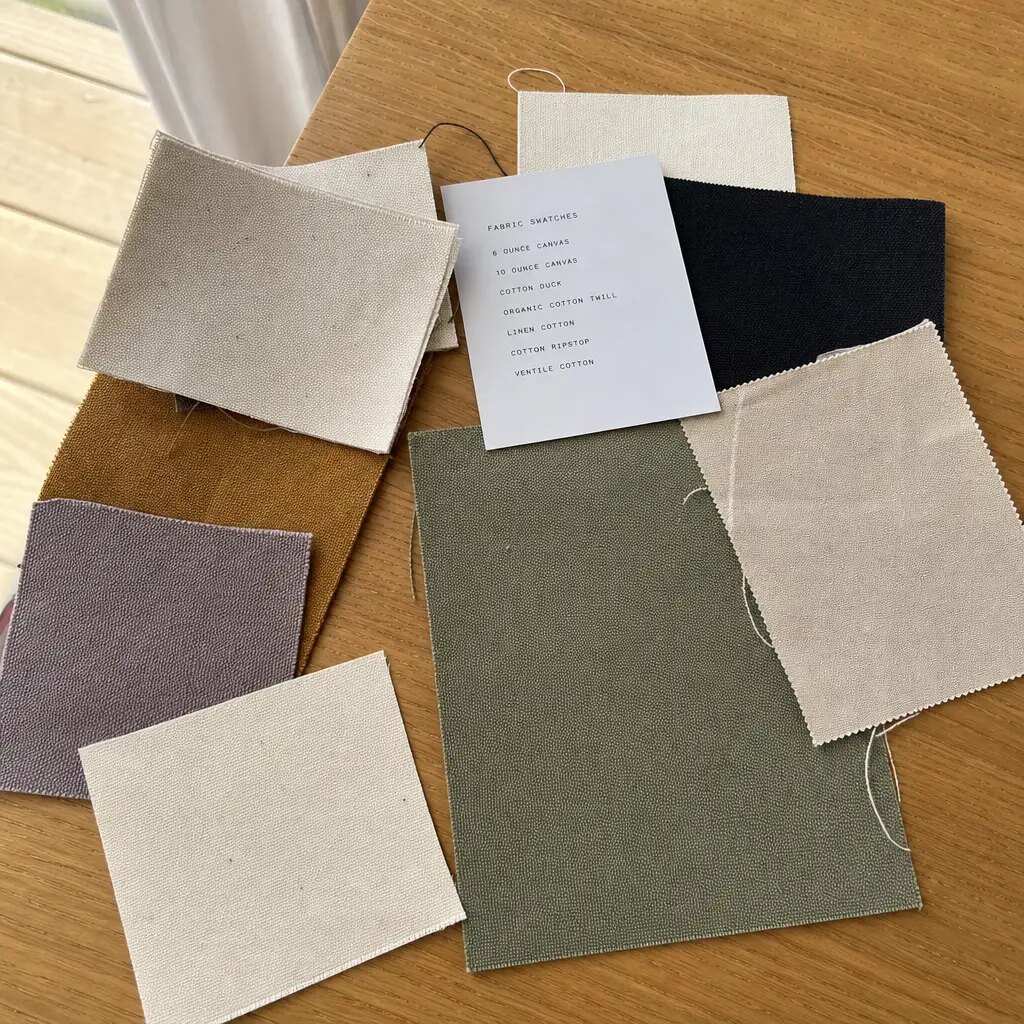
The word canvas is not enough for procurement. A useful specification names fiber composition, weight, weave, finish, shade, shrinkage expectation, and documentation required for sustainability claims. Conventional cotton canvas, organic cotton canvas, recycled cotton blends, undyed cotton canvas, and cotton-poly canvas can look similar in a supplier image but behave differently under ink, washing, sewing tension, and carton pressure.
Finish deserves particular attention. Raw canvas can support a natural look and simpler processing, but it may absorb ink unevenly and vary in shade. Washed or enzyme-washed canvas can feel softer and more retail-ready, but it may introduce size change, puckering, and shade variation. Dyed canvas requires color approval and may need a lab dip or bulk shade band. If a brand plans to describe the bag as organic, recycled, undyed, low-impact, or plastic-reduced, the claim must be backed by documentation that the supplier can provide before marketing copy is written.
Regional sourcing can influence these choices. Suppliers working with stock canvas may offer faster lead times but less shade continuity across reorders. Mills or bag factories producing custom dyed or certified canvas may need higher MOQs and earlier booking. Buyers sourcing from Asia should clarify whether the factory controls fabric procurement directly or buys through local fabric markets. Buyers sourcing closer to market, such as within the EU, UK, Turkey, Mexico, or the United States, may see lower transit risk and easier sample review, but unit cost and material availability can differ. The proofing rule remains the same: approve the print on the actual fabric finish that will be used in bulk.
- Ask whether the quoted weight is before or after finishing, washing, or dyeing.
- Request the specific evidence available for eco claims before using those claims externally.
- Define acceptable natural shade variation and slub level, especially for undyed or recycled-content canvas.
Match the print method to the artwork, not the mockup
Screen printing is often the most efficient method for canvas messenger bags with simple one- to three-color logos. It can be repeatable, scalable, and suitable for solid brand marks. But the buyer should still ask about screen count, setup fees, maximum print area, ink type, proof charges, and whether printing occurs before sewing or after assembly. Printing cut panels can provide a flatter surface, but sewing must be controlled so the logo lands correctly on the finished bag. Printing finished bags can avoid some placement surprises, but seams, pockets, and hardware may limit the printable area.
Water-based ink can offer a softer hand and may align with a lower-plastic brand preference, but opacity on dark or coarse canvas must be tested. Plastisol or heavier ink can improve coverage, though it may feel more raised and may need careful curing. Heat transfer can handle gradients or complex graphics and shorter order structures, but buyers need fold, adhesion, and film-edge checks. DTG can support multicolor artwork, yet textured canvas may reduce detail and saturation. Embroidery, woven patches, rubber patches, and appliqué branding can look premium, but they add thickness and may distort a flap or change how the bag closes.
Supplier-process nuance matters. A factory that outsources printing may have different control points than a vertically integrated bag maker. Ask who prints, where the print happens in the production flow, and how cut panels or finished bags are transported between sewing and printing. Miscommunication between subcontracted printers and sewing lines is a common source of placement drift, wrong ink, or mixed artwork versions.
- For screen print, confirm ink type, cure method, screen setup, color count, print area, and whether screens are stored for reorders.
- For transfers, test edge adhesion and cracking after folding the bag exactly as it will be packed.
- For embroidery or patches, check backing, edge finishing, stitch distortion, thickness, and whether the flap still lies flat.
Translate artwork approval into measurable tolerances
A production-ready artwork proof uses numbers. The artwork file should show final print width and height in millimeters, color references, safe area, minimum spacing, and the fixed construction points used for placement. Instead of approving “centered on flap,” specify the distance from the flap edge, top seam, side seam, pocket opening, zipper line, or strap anchor. If the flap is curved or asymmetric, state whether the logo is centered visually on the shape or geometrically between seam points.
Soft-goods tolerance must be realistic. Canvas bags are cut and sewn items, not molded parts. On a stable flat panel, buyers often target about +/-3 mm to +/-5 mm for print placement. Washed canvas, rounded flaps, raised pockets, bulky seams, or after-assembly printing may require wider tolerance. Decide before production which variations are acceptable, which are major defects, and which are critical failures. That decision is much easier before inventory is produced than after cartons arrive.
Artwork details also need test criteria. Minimum line thickness, minimum text height, edge sharpness, knockout spaces, and registration should be checked on the selected fabric. A thin recycled-content logo mark that looks elegant in vector form may fill in on heavy canvas. A small website line may become unreadable after ink spreads across the weave. If there is uncertainty, ask for a print strip or proof panel containing the smallest text, thinnest line, solid fill, reverse-out detail, and color overlap.
- Use X/Y placement dimensions from fixed seams or edges, not from a floating mockup.
- Define skew by measuring left and right logo height relative to the same seam or flap edge.
- Accept that color on textured natural canvas will not match coated paper exactly; approve against a physical reference under agreed lighting.
Build a sample ladder that reflects production risk
Not every order needs an elaborate sample process, but every new or high-visibility order needs enough proofing to answer the real risks. A practical ladder starts with a digital layout, then a blank construction sample, then a printed prototype, and finally a pre-production sample. The digital layout confirms design intent. The blank sample confirms size, strap, flap, pocket, lining, and construction. The printed prototype tests the selected process. The PP sample should represent bulk fabric, trim, sewing, print method, labels, and packing.
The PP sample is the key reference for B2B procurement. It should not be a hand-built showroom piece made with a different canvas or special sewing unless those deviations are disclosed and accepted. Ask the supplier to label every sample with item code, revision number, date, fabric reference, print method, ink or transfer type, trim description, and packing method. If three versions are sent, select one master approval and archive the others as rejected or superseded.
Review the sample like an inspector. Measure the bag. Check the flap with the bag hanging and lying flat. Pull the strap lightly to see whether the front panel twists. Open and close pockets. Inspect the reverse side of the print. Fold the sample as bulk will be folded and place it under light pressure overnight if timing allows. A proof that only looks good lying open on a sample-room table may not survive packing, warehousing, and final customer handling.
- Do not approve bulk from a substitute-fabric sample unless the substitution and its risks are written down.
- Photograph the approved sample with a ruler, including front, back, inside, folded pack, label, and carton if available.
- Require written approval for any change after PP sign-off, including fabric lot, ink, trim, stitching, label, or packing.
Check sewing because construction changes print perception
On messenger bags, construction and print quality are inseparable. A logo may be printed accurately on a cut panel and still look wrong if the flap is attached unevenly, the seam allowance changes, the pocket mouth tilts, or the strap anchor pulls the body out of square. Buyers tend to judge logo alignment against nearby seams, so those seams become visual reference lines even if they were not part of the artwork file.
Stress points should be checked before the proof is approved. Shoulder strap anchors usually need bartacks, box stitching, or another reinforced method appropriate to the design. Pocket openings should not curl into the print area. Bottom corners may need reinforcement for daily-carry or laptop-adjacent use. If the front print sits near a flap edge, inspect whether the flap naturally rolls, lifts, or twists after folding. That roll can make a centered logo appear off-center in normal use.
Interior finishing also affects acceptance. Unlined bags can support a simpler, lower-material product story, but they expose raw-edge treatment, thread tails, and reverse-side print effects. Lined bags can feel more premium and cleaner, but they introduce puckering, trapped threads, bulk, and different shrinkage behavior. Define what is acceptable inside the bag based on sales channel. A retail resale item usually needs tighter internal finishing than a low-cost event giveaway.
- Inspect strap anchors, bartacks, bottom corners, flap seams, pocket openings, and side seams before judging the print in isolation.
- Check whether seams near the print zone are straight enough to act as visual alignment references.
- Look inside for thread trimming, raw-edge control, lining puckering, backing irritation, and print bleed-through.
Prevent packing from ruining an approved print
Some print problems appear after production, not during printing. Fresh ink or transfer film can scuff, block, crack, or pick up pressure marks during folding and carton packing. Messenger bags are especially vulnerable because straps, buckles, adjusters, flaps, pockets, and layered canvas create uneven pressure points. If hardware presses into the logo face for several weeks in transit, the sample approval may no longer matter.
Packing should be chosen for the sales route. E-commerce generally needs individual packing, barcode accuracy, and a consistent fold for warehouse picking. Retail distribution may require carton labels, SKU counts, inner packs, and shipping marks that match receiving systems. Event programs may accept simpler bulk packing, but the print face still needs protection from hardware and abrasion. Eco apparel brands may prefer paper sleeves, belly bands, recycled polybags, or reduced-plastic packing. Those options are valid only if the proof is tested in the actual pack method.
Carton specification should be part of the proofing conversation. Overfilled cartons can crush flaps and emboss hardware into the print. Underfilled cartons allow bags to move and abrade. Heavy cartons may create compression damage at the bottom of a pallet. Final inspection should open packed cartons and inspect folded bags, not only review loose finished pieces pulled from the production line.
- Approve the fold method with a printed sample, not with a blank bag only.
- Keep buckles, clips, and strap adjusters away from the print face or separate them with tissue, paper, or approved protective material.
- Verify carton count, carton dimensions, gross weight, SKU mix, labels, barcodes, and shipping marks before release.
Normalize quotes before comparing suppliers
Canvas messenger bag quotes often vary because suppliers are not pricing the same product. One quote may include 14 oz washed canvas, water-based screen print, individual paper sleeves, PP sample, and export cartons. Another may assume 10 oz stock canvas, bulk packing, no sample charge, and a smaller print area. A low unit price is not meaningful until the specification is normalized.
Build the RFQ around cost drivers: fabric weight, composition, finish, body color, print method, print size, color count, printing location in the process, lining, webbing, hardware, labels, packing, carton count, inspection requirements, sample charges, and setup charges. Ask suppliers to separate one-time charges from repeat-order unit pricing. If the brand expects reorders, confirm whether screens, artwork files, trim references, and packing specifications will be retained.
MOQ should be broken down by variable. A supplier’s “1,000 piece MOQ” may mean 1,000 per body color, per artwork, per ink color set, or per packing version. Three bag colors and two logo versions can become six production variants, each with separate setup, sorting, QC, and packing risk. Eco specifications may add additional minimums if certified fabric, special trims, custom labels, or paper-based packing are not stock items.
- Request a quote grid by quantity tier, fabric option, print method, artwork version, packing type, and delivery term.
- Clarify whether prices include proofing, PP sample, setup, screens, export carton, inner packing, barcode labels, and carton marks.
- For regional purchasing, compare lead time, freight mode, duty exposure, sampling speed, and reorder flexibility—not unit price alone.
Write inspection rules before bulk begins
Quality control should be agreed before production starts. For canvas messenger bags, the inspection plan should cover finished measurements, print appearance, print placement, sewing, fabric defects, cleanliness, labels, packing, carton marks, and SKU accuracy. If the order uses AQL, define inspection level and defect classifications. If the buyer does not use formal AQL, still define how many pieces will be checked and what triggers rejection, rework, discount negotiation, or management review.
Defect categories should reflect commercial impact. Critical defects may include wrong artwork, wrong body color, wrong barcode, unsafe hardware, missing required label, or upside-down print. Major defects may include visible logo skew beyond tolerance, severe ink cracking, broken strap stitching, heavy stains, incorrect carton assortment, or transfer peeling. Minor defects may include small thread tails or slight natural slubs inside the approved tolerance. This structure prevents every issue from becoming a subjective debate.
Inline checks are useful when the order is large, time-sensitive, or split across multiple variants. Ask the supplier to inspect early printed panels or early finished pieces against the PP sample before completing the full run. For outsourced printing, add a checkpoint when printed panels return to the sewing line. Final QC should include packed-carton review because receiving errors, barcode mistakes, and mixed SKUs can create warehouse costs even when the physical bag looks acceptable.
- Use the approved PP sample as the master reference for print, construction, fabric, label, and packing.
- Measure placement and skew with a ruler and record variance rather than relying only on pass/fail comments.
- Open cartons during final inspection to check fold damage, print abrasion, hardware pressure, labels, SKU mix, and carton count.
Specification comparison for buyers
| Sourcing decision | Practical B2B specification | When it fits | Tolerance or QC risk to confirm |
|---|---|---|---|
| Canvas weight | Specify both oz and GSM, for example 12 oz to 14 oz cotton canvas, approximately 407 to 475 GSM, and state whether the number is greige, finished, washed, or dyed weight. | Retail merch, employee kits, campus programs, and eco apparel add-on products that need more structure than a tote without becoming too heavy. | Finished weight can vary after washing, dyeing, or calendaring. Lighter lots may wrinkle, show print-through, or make the flap look wavy. |
| Fabric composition and claim | Name the exact material: conventional cotton, organic cotton, recycled cotton blend, undyed cotton, cotton-poly canvas, or other blend. List documentation needed for any sustainability claim. | Brands that need substantiated eco language on product pages, packaging, or wholesale line sheets. | Do not accept broad “eco canvas” wording. Confirm certificates, transaction documents, recycled-content statements, or supplier declarations before claims are used. |
| Finish and shade range | Define raw, pre-shrunk, washed, enzyme-washed, pigment dyed, reactive dyed, undyed, or natural finish, with an approved shade range or lab dip where relevant. | Raw natural canvas suits low-processing positioning; washed canvas suits softer retail handfeel; dyed canvas supports brand color matching. | Finish changes shrinkage, ink absorption, shade, and size. A proof on unwashed stock fabric does not prove bulk on washed canvas. |
| Print surface | Request a tight plain-weave face with acceptable slub level and no heavy knots, oil marks, stains, or raised yarns in the print zone. | Logos with small text, QR-adjacent information, thin outlines, and retail-facing artwork. | Loose weave and raised slubs cause pinholes, fuzzy edges, uneven opacity, or ink skips. Inspect the actual panel, not only a loose swatch. |
| Print process | Screen print for clean solid logos; water-based ink for softer hand where opacity allows; transfer for complex graphics; embroidery or patches for dimensional branding. | Screen print is usually efficient for repeat one- to three-color bulk orders. Transfers and DTG help with small runs or gradients. Patches suit premium trims. | Confirm line limits, color count, setup charges, fold resistance, adhesion, and whether the print is applied to cut panels or finished bags. |
| Placement reference | Measure from construction features: flap edge, top seam, side seam, pocket mouth, zipper line, strap anchor, or bartack position. | Needed when logos sit on flaps, raised pockets, or front panels where visual centering affects perceived quality. | Floating mockups create disputes. Set X/Y placement tolerance, commonly around +/-3 mm to +/-5 mm on stable panels, wider where construction requires it. |
| Sewing construction | Define seam allowance, stitch density range, bartack or box-stitch reinforcement, flap attachment, strap anchor method, bottom corner reinforcement, and pocket opening finish. | Daily-carry bags, laptop-adjacent formats, retail resale, and higher-value brand programs. | Uneven sewing can make a correctly printed logo look skewed. Inspect panel symmetry, flap roll, strap pull, and seam straightness together. |
| Lining and interior finish | Specify unlined, bound-seam, partial lining, or full lining; name lining fabric, color, seam finish, label position, and acceptable thread trimming. | Unlined supports simpler eco positioning; lined interiors feel more premium and protect contents. | Unlined bags expose thread tails and reverse-side print issues. Lined bags can pucker, shrink differently, or change finished measurements. |
| Packing method | Approve fold type, print-face protection, individual sleeve or bulk pack, barcode label, carton count, carton dimensions, and shipping marks. | E-commerce, wholesale, event kits, retail DC deliveries, and regional SKU pack-outs. | Hardware, straps, or cartons can scuff the print. Final QC must open packed cartons, not only inspect loose samples. |
Buyer checklist before sampling
- Lock the finished bag measurement chart before approving artwork: width, height, gusset, flap drop, pocket position, strap width, strap length range, and measurement method.
- Specify fabric weight in oz and GSM, including whether it is greige, finished, dyed, washed, or pre-shrunk weight, plus the agreed weight tolerance.
- Define canvas composition, finish, shade standard, slub acceptance, shrinkage expectation, and any organic, recycled, undyed, or reduced-chemical documentation required.
- Supply final vector artwork with outlined fonts, print size in millimeters, Pantone or approved color references, knockout details, and a marked safe area.
- Measure logo placement from fixed construction points such as flap edge, side seam, pocket opening, zipper line, top seam, or strap anchor; avoid approving only from a rendered mockup.
- Ask the supplier to state minimum reliable line thickness, minimum text height, registration tolerance, opacity expectation, and whether canvas pinholes are acceptable.
- Confirm whether printing is done on cut panels before sewing or on finished bags after assembly, and check how that affects placement tolerance and reject criteria.
- Approve a sample ladder appropriate to risk: digital layout, blank construction sample, printed prototype, and PP sample made with intended fabric, trim, ink, sewing, and packing.
- Require every sample to be labeled with item code, revision, date, fabric reference, print method, ink or transfer type, packing method, and any deviation from expected bulk.
- Test the packed proof: fold it as bulk will be folded, keep hardware away from the print face, apply light carton pressure, then inspect for cracking, blocking, scuffing, and creasing.
Factory quote questions to send
- What exact canvas weight are you quoting in oz and GSM, and is that greige fabric weight or finished fabric weight after dyeing, washing, shrinking, or other finishing?
- What is the full fabric composition and finish, and what documentation can you provide if the order uses organic cotton, recycled cotton, undyed cotton, or other sustainability claims?
- Is the quoted fabric stock material, booked greige fabric, or custom woven or dyed fabric, and how does that affect shade repeatability, MOQ, and lead time?
- What finished size tolerances do you guarantee for width, height, gusset, flap drop, strap length, strap width, pocket position, and logo placement?
- Will the print be applied to cut panels before sewing or to finished bags after assembly, and which fixed construction points will your operators use for alignment?
- Which print method are you quoting, and what ink, transfer film, embroidery thread, patch backing, or adhesive system will be used for the actual bulk order?
- For this canvas surface, what minimum line thickness, minimum text height, registration tolerance, and maximum print area do you recommend?
- How many artwork colors, screens, setup charges, proof rounds, strike-offs, and PP samples are included in the price, and what is charged separately?
- What reinforcement is included at strap anchors, flap stress points, pocket openings, bottom corners, and side seams, and can you state stitch density or bartack length?
- What is the MOQ by body color, artwork version, print color count, trim color, lining, packing version, and certification requirement, and are reorder MOQs different?
Quality-control points to confirm
- Measure finished bags against the approved spec sheet, including width, height, gusset, flap drop, pocket position, strap width, strap length, and any handle or hardware dimensions.
- Record print placement from the agreed reference points, including horizontal centering, vertical distance from seam or flap edge, and skew across left and right sides.
- Compare print color and appearance to the approved physical sample under consistent lighting; check opacity, registration, edge sharpness, ink spread, pinholes, bleeding, and contamination.
- For screen print, bend and fold the printed area as packed to check cracking, ink lift, tackiness, blocking, over-curing marks, under-curing rub-off, and pressure marks.
- For transfer print, check edge adhesion, film outline, heat press shine, cracking across fold lines, handfeel, and whether the transfer sticks to packing material.
- Confirm artwork does not unintentionally cross seams, raised pockets, bartacks, flap curves, hardware, or strap attachments unless the placement was approved with those constraints.
- Inspect strap anchors, bottom corners, flap attachment, pocket openings, side seams, and bartacks for skipped stitches, broken thread, loose thread, uneven tension, and insecure reinforcement.
- Check fabric panels for shade variation, stains, oil marks, scorch marks, heavy slubs in the print zone, needle holes, dust, handling marks, and unacceptable wrinkles.
- Inspect the inside of the bag for raw-edge control, thread trimming, lining puckering, reverse-side print bleed, loose labels, backing irritation, and trapped debris.
- Open packed cartons to verify SKU mix, barcode labels, insert placement, fold method, carton count, carton marks, print abrasion, hardware pressure, and consistency with the packing matrix.