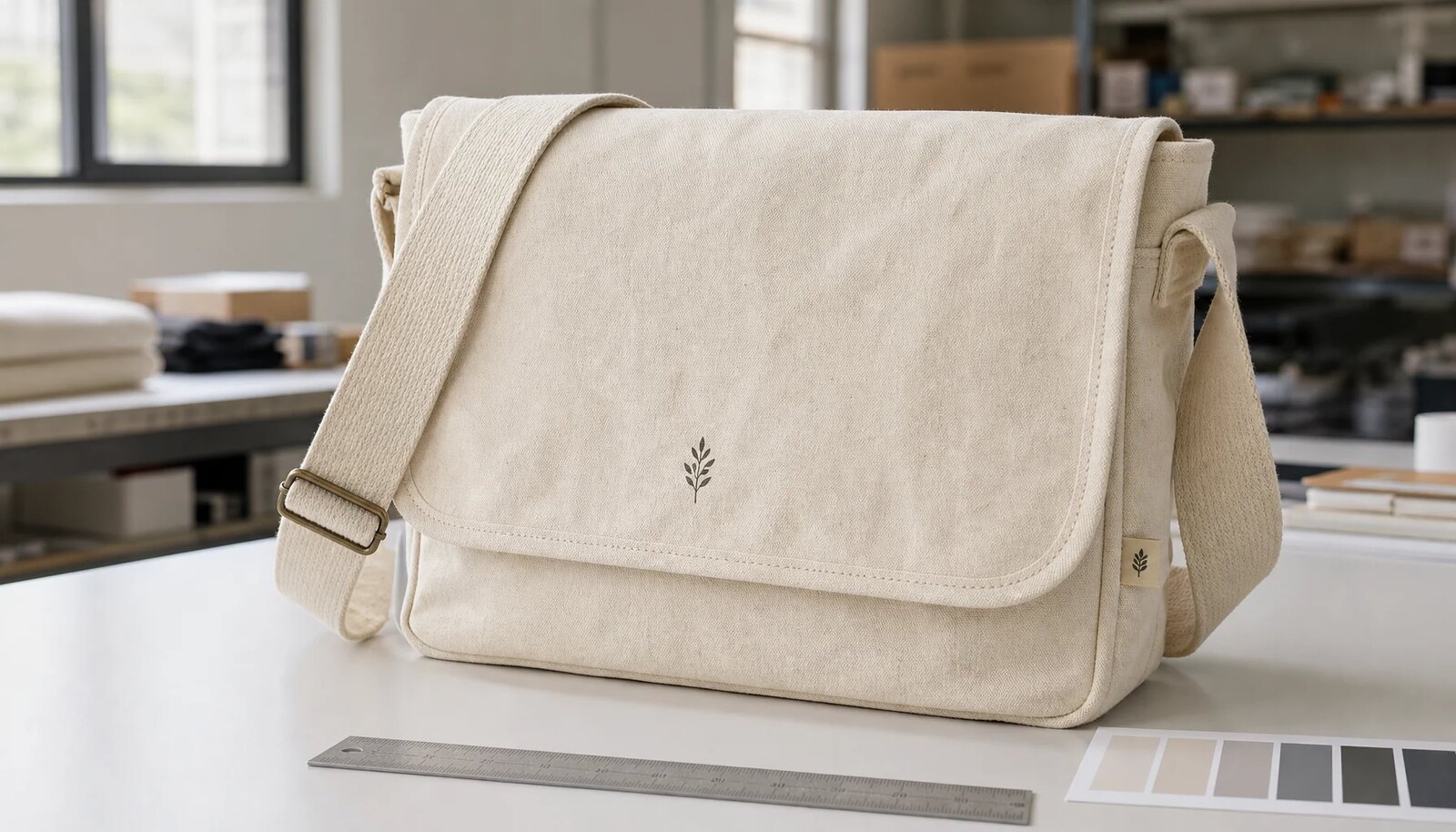
Proof the bag, not just the logo file
Print proofing can go wrong fast when a canvas messenger bag is treated like a flat rectangle. The artwork may be perfect on screen, but the product has a flap, seams, gusset pull, pocket lines, hardware, strap anchors, and fabric texture. Each of those details changes how the finished mark reads. A logo that looks centered in a digital mockup can look low once the flap curves. A clean edge in vector art can look broken on a hairy canvas surface. A print placed too close to a fold may crack or crease after packing.
For eco apparel brands, messenger bags often carry more brand weight than a basic giveaway. They may be sold as an accessory, used as a wholesale account gift, packed with a campaign, issued to staff, or bundled with apparel in a retail program. Buyers who have already specified organic cotton garments, lower-plastic packaging, recycled trims, or carefully restrained branding do not want the bag to feel like an afterthought.
A strong canvas messenger bags for eco apparel brands print proofing checklist turns proof approval into a purchasing control. It should say what fabric is being printed, how the bag is constructed, where the artwork sits, what tolerance is acceptable, how durability will be checked, and how packed goods will be identified. That is the difference between approving an attractive picture and approving something a factory can repeat.
- Approve artwork on the actual bag construction, not only on a flat template.
- Connect artwork approval to canvas weight, finish, decoration method, safe margins, and QC tolerance.
- Use millimeters, file version numbers, dated approvals, and physical samples instead of vague comments such as "centered" or "same as mockup."
- Treat the pre-production sample as the reference for bulk production, inspection, and dispute resolution.
Freeze the canvas specification before judging print quality
Canvas weight should be locked early because it affects almost everything: print sharpness, hand feel, sewing efficiency, carton density, and freight cost. For many retail-grade messenger bags, 12oz to 14oz cotton canvas is a practical range. In GSM terms, that is roughly about 407 to 475 GSM, depending on the supplier's conversion and the fabric construction. It usually gives more structure than a lightweight promotional tote while still being workable for cutting, sewing, folding, and printing.
A 10oz canvas, roughly about 339 GSM, may be suitable for budget programs, event merchandise, or short-use promotional orders. It can also wrinkle more easily and may not hold a structured messenger shape as cleanly. A heavier 16oz canvas, roughly about 542 GSM, can feel substantial, but it may create bulky corners, thick strap anchor areas, harder needle penetration, and higher freight weight. Heavier is not automatically better for a sewn bag with a printed front flap.
Avoid loose specifications such as "heavy canvas," "natural canvas," or "eco canvas." The quote should state oz, GSM, weave, color, finish, shrinkage status, and whether the fabric is stock or custom sourced. If the canvas is dyed, the approval path should be named: lab dip, strike-off, bulk swatch, or cutting swatch. If the canvas is washed, softened, pigment dyed, or pre-shrunk, confirm whether final dimensions are measured before or after that process.
Natural canvas deserves a separate tolerance discussion. Seed flecks, mild slubs, and small shade variation may fit the brand aesthetic. Oil marks, holes, dirt, severe shade bands, and unstable panel-to-panel shade jumps should not be excused as natural character. Decide that line before cutting and printing, while the supplier can still control material selection.
- Write canvas weight in both oz and GSM, with the supplier's accepted tolerance.
- Confirm raw, dyed, pigment dyed, washed, softened, pre-shrunk, or unwashed finish before artwork proofing.
- Define which natural characteristics are acceptable and which fabric defects are rejectable.
- Clarify whether dimensions are measured before wash, after wash, before packing, or after packing recovery.
Build the print area from the construction sheet
The printable area is not an abstract space. It is created by the bag construction. A 140 mm logo may look balanced on a wide flat flap, cramped on a small flap with a buckle, or visually shifted if a strap anchor pulls attention to one side. Before the artwork is approved, procurement needs a construction sheet that shows finished width, height, gusset depth, flap shape, flap coverage, pocket layout, zipper position, strap width, strap length, closure type, binding, labels, and reinforcement points.
Soft canvas bags need realistic dimensional tolerance. They are sewn products, not rigid molded parts. Many buyers use tolerances such as plus or minus 5 mm for smaller features and plus or minus 10 mm for larger soft-bag dimensions, but the exact range should be confirmed with the factory. Strap length may need its own tolerance because it depends on webbing stretch, adjusters, sewing fold-back, and measurement method.
Logo placement tolerance should usually be tighter than overall body tolerance because the eye notices it quickly. A bag body that is 5 mm wider may still pass inspection. A logo that is 5 mm too low on a clean front flap may look obviously wrong. If the construction sheet shows the same landmarks the inspector will use, the factory has fewer ways to interpret the target differently.
Reinforcement is also part of print proofing. Strap anchors, side seams, top hems, pocket openings, zipper tape, flap corners, rivets, buckle tabs, and magnetic snap areas can interrupt or distort the print face. If the artwork is close to any of these features, approve that exact relationship on a sewn sample.
- Create one technical drawing that includes dimensions, flap shape, gusset, pocket openings, closures, labels, and strap anchor positions.
- Set dimension tolerances in millimeters and identify which construction features affect logo placement.
- Keep artwork away from bulky seams, rivets, snaps, buckles, zipper tape, hard fold lines, and high-rub areas unless sampled and approved.
- Check that reinforcement stitching does not run through artwork unless that effect is intentional.
Choose decoration by artwork, quantity, and channel
Screen printing is often the first option for canvas messenger bags because it works well for bold logos, solid colors, and repeat-volume orders. It can offer strong opacity and efficient unit cost once setup is complete. Buyers still need to define ink type, number of colors, print size, screen charge, curing method, and the exact print face. Fine lines, small type, and tight registration may not behave the same on rough canvas as they do in the artwork file.
Heat transfer and digital print can make sense for multicolor graphics, gradients, low-MOQ tests, seasonal artwork, or retailer-specific runs. They can reduce some screen setup limits, but they need different checks. The buyer should review edge feel, transfer shine, cracking, peeling, adhesion, rub resistance, and how the film or ink sits on textured canvas. A glossy transfer on a matte natural canvas may be technically correct and still look wrong for the brand.
Embroidery, woven labels, and cotton labels are useful when the brand wants a smaller identity mark with a more tactile finish. Embroidery can pucker canvas if the stitch count is too high or the backing is not suited to the panel. Large embroidery on a front flap can become stiff, heavy, and expensive. A woven side label may be cleaner for a subtle eco apparel brand mark, but the label location still needs to be included in the placement drawing and QC checklist.
If the program includes sustainability or compliance requirements, separate verified specifications from marketing language. Water-based ink, PVC-free transfer film, organic cotton canvas, recycled polyester thread, nickel-free hardware, azo-free dye, or restricted-substance compliance must be quoted and documented. Words such as sustainable, green, natural, or eco-friendly are not enough for B2B procurement files.
- Use screen print for solid-color logos where opacity, repeatability, and unit cost matter most.
- Use transfer or digital print for short runs, multicolor artwork, gradients, or frequent artwork changes, with durability checks included.
- Use embroidery or woven labels for smaller premium identity marks rather than large stiff graphics.
- Request written material, ink, transfer, thread, dye, and hardware details when the brand or retailer will rely on those claims.
Make placement measurable on the sewn bag
Artwork placement should be approved with a measured drawing of the sewn bag. The drawing should show flap edge, side seams, gusset fold, pocket opening, zipper line, strap attachments, snap or buckle position, labels, and any fold line used in packing. The logo should have a stated width and height, color target, orientation, and reference point. For example: logo 140 mm wide, centered on front flap, baseline 35 mm above flap bottom edge, minimum 25 mm from side seam lines, artwork file CTM-MSG-01-v3.
Visual center and mathematical center may not match on a messenger bag. A curved flap can make a centered logo appear low. A pocket seam under the flap can create a horizontal line that changes the perceived balance. A strap anchor, buckle, snap, or label can pull attention away from the true center. If the design team wants the mark adjusted by eye, that decision should still be converted into measurable distances after the sample is approved.
Safe margins are not just cosmetic. Printing close to seams can cause uneven pressure, broken edges, ink buildup, or transfer lift. Printing across a pocket seam can create registration problems. Printing across a fold line can create cracking, shine changes, or permanent creases. If a design intentionally crosses a seam, fold, or hardware zone, sample it on the final construction and accept the visible variation in writing.
The placement tolerance should define both the reference point and the allowed movement. Measure from the logo center, logo edge, baseline, or full artwork bounding box, but choose one method and use it in production and inspection. Without that detail, one person may measure from the visible printed edge while another measures from the artboard boundary.
- Mark logo size, color target, print face, artwork version, and placement reference on the bag drawing.
- Measure from fixed landmarks such as flap edge, seam line, pocket opening, zipper tape, snap, strap anchor, or gusset fold.
- Set minimum safe margins from seams, folds, hardware, labels, closures, and abrasion zones.
- Confirm whether tolerance is measured from logo edge, logo center, baseline, or full artwork bounding box.
Compare quotes by complete scope, not headline price
Two suppliers can quote the same canvas messenger bag and still mean very different things. One price may include a pre-production sample, one-color screen print, woven label, hangtag, barcode label, individual bag, export carton, and carton marks. Another price may cover only the sewn bag with a basic print. The lower unit price may not stay lower once the missing pieces are added.
Ask each supplier to break out the blank bag cost, canvas upgrade, decoration setup, decoration running charge, label cost, hardware cost, packing cost, carton cost, sample fees, inland freight, export documents, and inspection support. This is not paperwork for its own sake. It shows what will change when the logo gets larger, a second print color is added, a custom dyed canvas is requested, or a retailer needs a different barcode and carton mark.
MOQ rules are often where a clean buying plan gets messy. A quote that says 1,000 pieces may mean 1,000 pieces per order, per fabric color, per artwork, per SKU, per label version, per packing version, or per shipment date. If the brand wants 500 natural canvas bags and 500 black canvas bags, the factory may treat that as two fabric lots. If wholesale and DTC channels need different barcodes, the packing line may split the run again.
A useful RFQ makes suppliers quote the same finished packed product. That means the same canvas weight, same finish, same dimensions, same artwork size, same print method, same label set, same packing, same carton standard, and same approval sequence. Only then does the buyer have a fair view of cost and risk.
- Normalize quotes to the same canvas weight, finish, construction, artwork size, decoration route, label set, packing, and carton standard.
- Ask whether screen, plate, film, embroidery digitizing, label tooling, and carton printing charges are one-time or recurring.
- Confirm MOQ by order, fabric color, artwork, SKU, label version, packing version, and shipment date.
- Compare finished packed unit cost and landed-cost assumptions, not only ex-factory unit price.
Use a sample sequence that answers one question at a time
A strong sampling process does not ask one sample to prove everything. A blank construction sample confirms bag size, flap coverage, pocket access, strap comfort, hardware function, seam bulk, and general hand feel. A print strike-off confirms color, opacity, edge sharpness, curing, rub behavior, and print hand on the chosen canvas. A pre-production sample confirms the full standard: final fabric, final print, final construction, final labels, final hardware, and proposed packing.
This sequence can feel slower at the start, but it reduces expensive rework. If the blank construction is wrong, there is no point debating logo placement. If the print strike-off fails on the selected canvas, the buyer can adjust ink, method, artwork size, or fabric finish before bulk panels are cut. If the pre-production sample is approved with final materials, the factory has a clear target for mass production.
The pre-production sample is also where changes should stop. A new canvas color can change print color. A revised flap shape can invalidate the placement drawing. A washed finish can change dimensions and print edge quality. A different closure can move the safe margin. A new hangtag or barcode can alter packing. The approval record should state which changes require a new proof or sample.
For important programs, keep at least two approved physical references: one with the factory and one with the buyer, buying office, or inspection partner. Record the approval date, sample number, file version, main measurements, and permitted tolerances. Bulk inspection should ask whether production matches that approved reference, not whether it looks generally acceptable.
- Use a blank construction sample when the shape, flap, strap, pocket, or hardware is new.
- Use a print strike-off on the actual canvas before approving color, edge sharpness, opacity, and curing.
- Use a complete pre-production sample before bulk cutting, screen making, label production, or carton printing.
- Freeze fabric, construction, artwork, labels, hardware, packing, and tolerances after pre-production approval.
Write QC tolerances inspectors can actually sort against
Quality control works best when the inspection standard is written before production. Define critical, major, and minor defects in terms the factory and inspector can apply. Critical issues may include wrong artwork, unsafe sharp hardware, broken strap anchors, severe contamination, mixed SKUs, or restricted-substance compliance failure where applicable. Major issues may include logo placement outside tolerance, wrong print color, visible stains, broken zipper, loose rivet, skipped stitches at stress points, or carton quantity errors. Minor issues may include small thread ends or slight natural slubs that fall within the approved fabric standard.
Measurable tolerances keep inspection from becoming a negotiation about taste. A buyer may allow logo placement variation of plus or minus 3 mm to 5 mm for a small front-flap logo if the factory confirms it is achievable. Larger soft-bag body dimensions may need a wider tolerance. Print registration tolerance depends on the artwork, especially for multicolor marks. Stitch density should be stated where it matters, such as strap anchors, top hems, and side seams.
Shade approval needs consistent conditions. Compare bulk goods with the approved swatch or master sample under stable lighting, not mixed warehouse light. For natural canvas, the standard should explain acceptable slubs, flecks, and shade variation. For dyed canvas, the buyer should state whether panel-to-panel shade differences are acceptable and how severe shade bands will be handled.
AQL inspection may be used if the buyer has a formal quality program, but the checklist still matters. Inspectors should measure a representative sample of finished goods, check logo position from fixed seam landmarks, test closures, examine stress points, review labels, and verify carton counts. Photos of defects should include measurements where possible.
- Set logo placement tolerance in millimeters from a defined reference point.
- Set dimension tolerances for body width, height, gusset, flap coverage, pocket depth, strap width, and strap length.
- List rejectable defects such as wrong artwork, severe stains, broken hardware, sharp edges, loose strap anchors, and mixed cartons.
- Inspect printing, sewing, hardware, labeling, packing, and carton count against the same approved sample and written standard.
Include print durability and handling checks
A print proof is not complete just because the logo looks clean on day one. Messenger bags are rubbed by clothing, hands, desks, lockers, cartons, and other bags. The selected decoration method should be checked against the way the product will be used and shipped. Depending on the order, that may mean dry rub, wet rub, light scratch, tape pull, fold handling, or a buyer-specified colorfastness test.
The test level should match the commercial risk. A simple one-color internal staff bag may not need the same testing as a retail accessory sold through wholesale accounts. A dark transfer on a pale canvas may need close review for edge lift and shine. A water-based screen print on a hairy natural canvas may need extra attention to opacity and edge break. A large logo across a fold line should be folded and recovered before approval.
Curing and bonding deserve written confirmation. Screen print ink may look dry before it is fully cured. Transfer film may look attached before edge adhesion has been challenged. Embroidery may look neat before the panel is flexed and checked for puckering. Ask the supplier what checks are included in production, who performs them, and whether results can be shown before bulk packing.
Handling checks also reveal placement problems. Open and close the flap. Adjust the strap. Load the pocket lightly. Fold the bag the way it will be packed. Look at where the print rubs, creases, or disappears. If the logo only works when the bag lies flat on a table, it may not work in real use.
- Ask which durability checks apply: dry rub, wet rub, scratch, tape pull, fold handling, or buyer-required testing.
- Check curing or bonding before bulk goods are packed and sealed.
- Handle the sample as a real bag, including opening, closing, folding, and strap adjustment.
- Review large prints, dark prints, transfers, and fold-line placements with extra care.
Approve packing as part of the proof
Packing can protect the print or damage it. A flat pack may be efficient, but the fold line should not run through the main logo unless the sample proves it recovers cleanly. Tissue, paper dividers, or controlled stacking can reduce abrasion on large graphics, darker prints, or textured transfers. If the bag is folded while the print is not fully cured or cooled, cartons can create pressure marks or surface transfer.
Eco apparel brands often want to reduce plastic, but the packing decision still has to fit the sales channel. Some retailers, distributors, and warehouses require individual polybags, barcode stickers, suffocation warnings, or specific carton labels. DTC programs may need a cleaner unboxing presentation. Wholesale programs may care more about quick receiving and low mixed-SKU risk. The approved packing method should be part of the pre-production sample, not a last-minute warehouse choice.
Carton planning affects receiving accuracy and landed cost. Approve pieces per carton, folded shape, carton size, gross weight, barcode position, inner pack, shipping marks, PO number, SKU, color name, artwork version, and destination. If multiple colorways or artwork versions ship together, cartons need clear separation and packing lists that prevent receiving errors.
Moisture protection may be needed for ocean freight, humid storage, or long inland transit. Cotton canvas can absorb odor and moisture if cartons are poorly controlled. Ask whether desiccants, carton liners, or pallet protection are included when the route requires them, and confirm that any added packing material aligns with the buyer's channel requirements.
- Approve fold direction and confirm that hard creases do not cross the main logo area unless sampled.
- Confirm tissue, divider, individual bag, hangtag, barcode, carton mark, and moisture-protection requirements before packing.
- Check carton labels against PO, SKU, color, artwork version, quantity, destination, and shipment plan.
- Include packing appearance and carton contents in the pre-production sample approval.
Specification comparison for buyers
| Spec decision | Recommended option | When it fits | Buyer risk to check |
|---|---|---|---|
| Canvas body weight | 12oz to 14oz cotton canvas, with both oz and GSM stated on the quote and matched to an approved swatch | Retail-grade messenger bags that need structure, cleaner print definition, and stable shelf or wholesale presentation | Too-light canvas can wrinkle, collapse, and distort the logo; too-heavy canvas adds seam bulk, needle stress, unit cost, and freight weight |
| Canvas tolerance | Written tolerance for fabric weight, shrinkage, shade, and finish before bulk cutting | Programs using custom dyed, washed, softened, or pre-shrunk canvas | If tolerance is missing, bulk fabric may differ from the sample and change final dimensions, print color, or hand feel |
| Canvas finish | Raw natural, dyed, pigment dyed, washed, softened, or pre-shrunk finish approved before artwork proofing | Eco apparel brands matching a natural, colored, washed, or premium tactile story | Surface hairiness, slubs, shade bands, and shrinkage can reduce edge sharpness and alter final measurements |
| Print method | Screen print for bold flat logos; transfer or digital print for multicolor or short runs; embroidery or woven label for small identity marks | Single-color branding, seasonal artwork, low-MOQ tests, retailer-specific graphics, or small premium details | Ink hand feel, rub resistance, edge lift, cracking, registration drift, transfer shine, and distortion near seams |
| Print placement | Measured from fixed seam landmarks on the sewn bag, with safe margins shown in millimeters | Front flap or front panel logos that must look centered and repeatable in bulk | A logo can appear off-center because of flap curve, pocket line, gusset pull, strap anchor, closure position, or sewing variation |
| MOQ structure | MOQ separated by total order, fabric color, artwork, SKU, label set, packing version, and shipment date | Brands testing multiple colorways, wholesale channels, DTC packs, or regional barcode versions | A low headline MOQ may become several smaller production lots with separate setup, label, and packing costs |
| Sample route | Blank construction sample, print strike-off, and pre-production sample using final materials | New supplier, new artwork, new canvas color, new hardware, revised flap shape, or retail launch order | A blank sample cannot confirm print color, curing, rub resistance, placement, label accuracy, barcode position, or packing marks |
| QC standard | Written tolerances for dimensions, print position, registration, stitching, stains, hardware, labels, and carton count | Procurement teams that need objective inspection results and supplier accountability | Vague standards make defect sorting subjective and weaken claims when bulk goods drift from the approved sample |
| Packing method | Flat pack or controlled fold with logo protection, carton count, barcode position, and shipping marks approved | Retail, wholesale, distributor, or DTC programs where receiving accuracy and presentation matter | Poor packing can create dirty panels, crushed corners, print abrasion, fold marks through the logo, moisture issues, or mixed SKUs |
Buyer checklist before sampling
- Final vector artwork file supplied with artwork version number, logo width and height in millimeters, Pantone or approved color target, print method, print face, safe margins, and placement drawing.
- Canvas specification written in oz and GSM, including weave, yarn description if available, color, finish, shrinkage status, dye method if applicable, and whether the fabric is stock or custom sourced.
- Fabric tolerances agreed before cutting, including acceptable weight variance, shade tolerance, shrinkage after washing or finishing, and whether natural slubs are acceptable or rejectable.
- Bag construction sheet covering finished width, height, gusset depth, flap shape, strap length and width, pocket layout, lining, zipper, buckle, snap, binding, edge finish, and reinforcement points.
- Printable-area drawing based on the actual sewn bag, with distances from flap edge, side seams, pocket edge, zipper line, strap anchor, gusset fold, snap, buckle, and any woven label.
- Approved decoration route, including number of colors, ink or transfer type, screen or plate charge, curing requirement, embroidery stitch count if used, transfer film finish if used, and setup ownership.
- MOQ rule confirmed per order, fabric color, artwork, SKU, label version, hangtag, barcode, packing version, carton mark, and shipment date, with split-run surcharges stated before PO.
- Pre-production sample approval record covering fabric hand feel, shade, logo color, edge sharpness, placement, print hand feel, stitching, hardware function, labels, barcode position, carton marks, and packing method.
- Written QC tolerance for finished dimensions, logo position, print registration, shade variation, stitching density, loose threads, stains, broken hardware, sharp edges, carton quantity, and mixed-SKU risk.
- Carton pack-out plan with pieces per carton, folded shape, tissue or divider use, inner polybag requirement, moisture protection, barcode sticker location, carton size, gross weight, and shipping mark format.
Factory quote questions to send
- What is the exact canvas weight in oz and GSM, what tolerance applies, and what weave, yarn, color, and finishing process are included in the quote?
- Is the canvas stock fabric or custom dyed, and will you provide a lab dip, bulk fabric swatch, or cutting approval before production?
- What shrinkage range should we expect after washing or finishing, and are finished bag dimensions measured before or after any wash process?
- Which print method is included, how many colors are covered, what ink or transfer type will be used, and what is the screen, plate, film, or setup charge per artwork?
- Can the selected print method meet the approved artwork size on this exact canvas surface, and what rub, wash, or handling test can you perform if required?
- What is the confirmed printable area on the sewn bag, and can you provide a placement drawing showing millimeter distances from seams, flap edge, pocket edge, zipper line, strap anchor, snap, and gusset fold?
- Does the MOQ apply per order, per fabric color, per artwork, per SKU, per label set, per packing version, or per shipment date, and what changes if we split the run?
- What sample sequence is included: blank construction sample, print strike-off, sales sample, or pre-production sample with final fabric, hardware, labels, and packing?
- What are the written tolerances for bag dimensions, logo placement, print registration, color variation, stitching density, strap length, pocket depth, and carton quantity?
- Which packing method is quoted, and does it include tissue, individual polybag, hangtag, barcode sticker, carton divider, moisture protection, shipping mark, and master carton labeling?
Quality-control points to confirm
- Canvas weight, color, weave, finish, shrinkage status, and hand feel match the approved sample and written specification within the supplier's stated tolerance.
- Fabric panels are cut in consistent direction and shade, with no obvious holes, oil marks, dirt, stains, severe slubs, unacceptable yarn defects, or panel-to-panel shade jumps.
- Finished bag width, height, gusset depth, flap coverage, strap width, strap usable length, pocket depth, and zipper opening are measured against the approved spec sheet.
- Print color matches the approved master sample, Pantone target, or agreed visual standard under consistent lighting, with any natural canvas show-through accepted only if pre-approved.
- Print registration remains within the agreed millimeter tolerance, with no obvious ghosting, double image, broken edge, pinhole clusters, ink bleed, scorch marks, film edge lift, or transfer shine mismatch.
- Print curing or bonding is checked by the agreed method, such as dry rub, light scratch, tape pull, fold handling, or buyer-specified test, before bulk packing is released.
- Artwork placement is measured from fixed seam landmarks rather than judged only by eye, and remains within the approved tolerance across the inspection sample size.
- Logo is not too close to flap edges, pockets, zipper lines, strap anchors, snaps, buckles, folds, gussets, or high-abrasion zones unless that placement was sampled and approved.
- Stitching is even and secure at strap anchors, side seams, top hems, flap edges, pocket openings, zipper tape, binding, and reinforced stress points, with no skipped stitches or unraveling.
- Hardware, zippers, buckles, snaps, adjusters, sliders, rivets, and magnetic closures function smoothly and are aligned without corrosion, sharp edges, broken teeth, loose parts, or tape waviness.