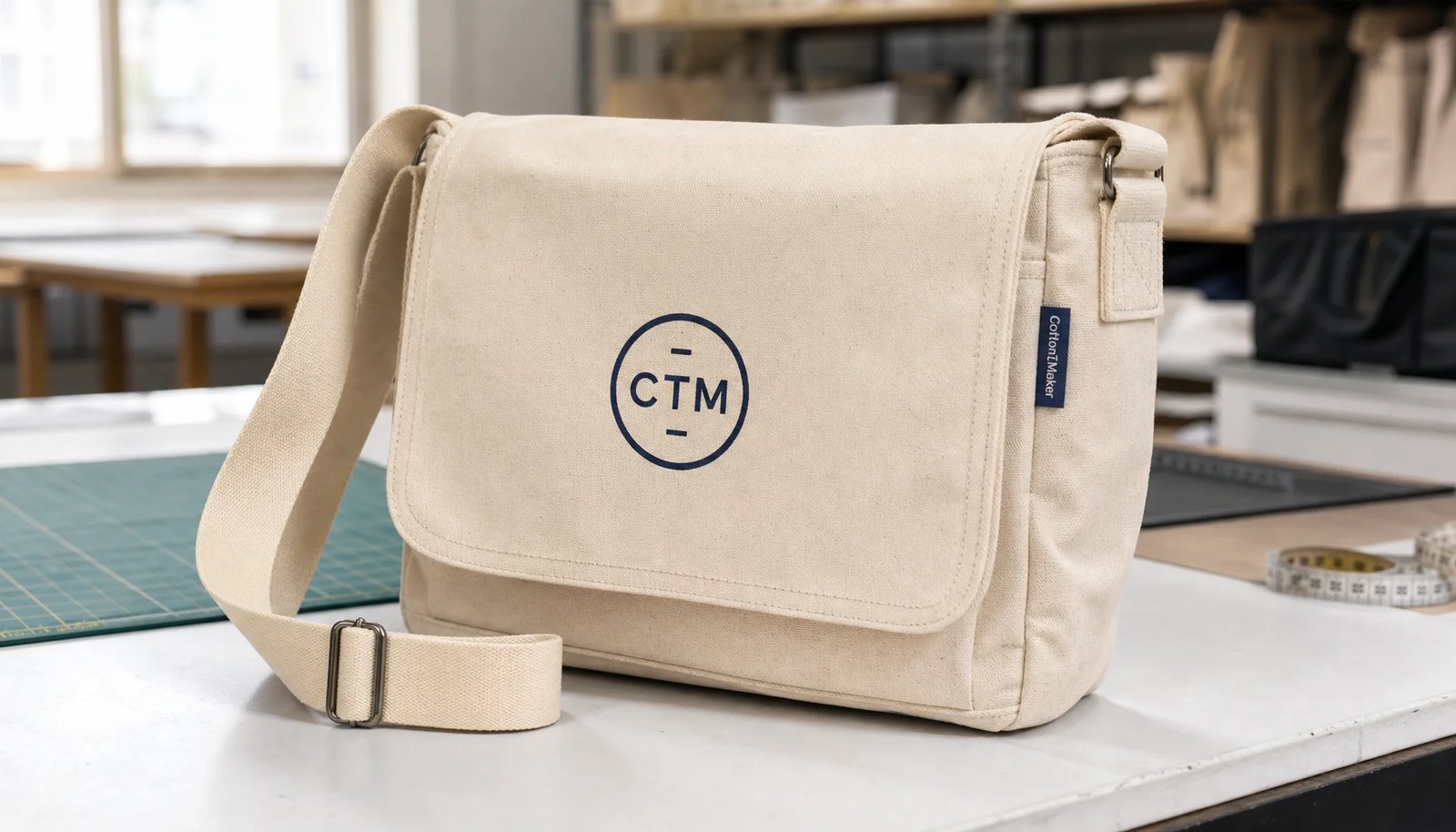
The Proofing Problem Campus Buyers Usually Underestimate
Canvas messenger bags look simple until the bookstore receives cartons with crooked flap prints, weak strap anchors, or logo colors that do not pass university brand review. The expensive mistake is usually not the sewing itself. It is approving artwork on a flat digital drawing while the real print sits on a textured flap that bends, folds, and changes shape after the bag is loaded.
For university bookstores, the bag is often both merchandise and brand item. It may sit beside apparel, notebooks, drinkware, and graduation gifts, so the print must look retail-ready at arm's length. A useful proofing checklist links artwork approval to fabric weight, flap construction, print method, packing, and inspection criteria. Without that link, every supplier quote looks similar on paper but produces a different bag in cartons.
- Treat the proof as a production control document, not a design presentation.
- Approve the print on the same canvas weight and color planned for bulk production.
- View the logo with the flap closed, packed, and lightly loaded, not only on a flat panel.
- Keep written tolerances for placement, color, size, and visible fabric defects.
Start With Bag Construction Before Approving Artwork
The correct artwork size depends on the final messenger bag structure. A 280 mm wide print may look balanced on a large flat front panel, but it can crowd the edges on a compact flap with buckles. Before print proofing, the RFQ should state finished width, height, gusset, flap depth, strap length, strap width, closure type, lining, inside pocket, and whether the bag must hold books, a tablet, or a 13 inch laptop sleeve.
Canvas weight also changes the print result. Natural 10 oz canvas, roughly 300-340 GSM, can work for lightweight promotional messenger bags, but it may feel too soft for bookstore retail. A 12 oz to 16 oz canvas, roughly 380-540 GSM, gives better body and shelf presence. Heavier canvas increases material cost and sewing resistance, but it helps the flap lie flatter and reduces the cheap promotional feel.
- Light campus event bag: 10 oz to 12 oz canvas, simple flap, light contents, lower retail price point.
- Bookstore retail bag: 12 oz to 16 oz canvas, reinforced strap points, clean flap, stable print surface.
- Premium alumni or department bag: 16 oz canvas or lined construction, metal hardware, higher inspection standard.
- Avoid vague terms such as heavy canvas, thick cotton, or premium fabric without oz or GSM data.
Choose the Print Method by Artwork Risk, Not Habit
Most university bookstore messenger bags use spot color screen printing because it gives strong opacity, controlled cost, and good repeatability for logos, mascots, department names, and short slogans. Screen print is usually the safest choice when the design has one to four solid colors and the supplier can hold registration on the flap panel. On coarse canvas, the buyer should expect a slightly textured ink edge, not the razor-smooth edge seen on coated paper.
Heat transfer, digital transfer, embroidery, woven patches, and leather patches each solve different problems. A transfer can handle gradients and small details, but it must be tested for cracking and edge lifting on canvas. Embroidery looks durable but may distort thin flap fabric and can pucker around dense stitch areas. A woven or sewn patch can be excellent for premium campus merchandise, but it adds placement and stitching tolerances.
- Use screen print for solid university marks, bookstore names, and repeat retail orders.
- Use transfer only when artwork complexity justifies the extra durability testing.
- Use embroidery for smaller marks on reinforced panels, not oversized dense flap graphics.
- Use woven patches when a premium look matters more than the lowest unit price.
- Require the proof to show real ink coverage on the actual canvas color.
Define Print Placement With Finished-Bag Measurements
A common proofing failure is measuring the logo on the cut fabric panel instead of the finished bag. During sewing, the flap edge is folded, seams take allowance, and the closure position can visually shift the center line. The buyer should define placement from finished reference points: left and right flap edges, top flap edge, bottom flap edge, buckle center, or magnetic snap center. This gives the sewing and printing teams the same target.
For bookstore retail, the logo normally needs enough breathing room around seams and closures. A practical starting point is 20-30 mm clearance from any stitched edge, snap, buckle, or flap curve. If the bag has two buckles, the artwork should sit between them without looking squeezed. If the flap curves over a loaded gusset, the lowest part of the logo should not fall into the bend zone.
- State print size in width by height, not only as a percentage of the flap.
- Mark the logo center line against the finished flap center line.
- Keep key letters and mascot details away from fold lines and closure hardware.
- Photograph the sample front-on and at a slight retail shelf angle before approval.
- Reject proofs where the supplier cannot provide measurable placement references.
Control University Colors on Absorbent Canvas
University brand colors often look different on natural cotton canvas than on coated paper, polyester fabric, or a screen. Canvas absorbs ink unevenly, and natural yarn color warms light inks. Navy, burgundy, forest green, black, and white are common campus colors, but white ink on dark canvas needs enough opacity, and dark ink on natural canvas can look slightly muted. The proof should be judged against a physical approved sample, not only a Pantone number.
Buyers should separate color approval into three layers: artwork color target, ink strike-off on production fabric, and final sewn bag review. If the canvas is dyed, request lab dip approval before print proofing because a small fabric shade shift can change the perceived logo color. If the bag uses natural canvas, accept that small cotton seed specks and yarn variation may be visible unless a bleached or specially selected canvas is specified.
- Use Pantone references as targets, then approve the real printed canvas sample.
- Define acceptable shade variation between cartons and between repeat orders.
- Request double-hit white ink testing when printing light marks on dark canvas.
- Keep one approved printed fabric swatch and one approved finished bag as control samples.
- Do not approve bulk production from a monitor screenshot or PDF alone.
Understand MOQ and Cost Drivers Before Comparing Quotes
Canvas messenger bag quotes vary because suppliers include different assumptions. One quote may include 12 oz natural canvas, one color screen print, basic cotton webbing, and bulk packing. Another may include 16 oz dyed canvas, metal hardware, lining, individual polybags, hangtags, and multiple logo versions. The unit price alone does not tell the buyer which quote is cheaper after proofing, rework risk, and carton handling are considered.
MOQ is normally driven by fabric purchasing, dyeing, print setup, hardware sourcing, and sewing line efficiency. A single natural canvas color with one logo is easier to quote at a lower MOQ. Multiple campus departments, each with separate artwork, can be handled, but the buyer should expect setup charges or grouped production rules. If the order is split across too many colorways, the factory loses efficiency and the risk of mixed cartons increases.
- Material cost: canvas oz or GSM, dyed versus natural fabric, lining, and reinforcement layers.
- Print cost: number of colors, print area, screens, strike-offs, and transfer films if used.
- Trim cost: buckles, snaps, zippers, sliders, strap webbing, labels, hangtags, and barcodes.
- Labor cost: flap construction, pocket details, lining, bartacks, edge binding, and thread trimming.
- Logistics cost: carton volume, carton weight, retail packing, and mixed-SKU sorting time.
Approve Samples in the Right Sequence
A clean sampling sequence saves time. First, confirm the construction sample without final print if the bag shape, flap, pocket, strap, and hardware are still being adjusted. Second, approve the print strike-off on the actual canvas. Third, approve a pre-production sample that combines final fabric, final construction, final print, final trims, and final packing. Skipping directly to a decorated sample can hide whether the problem is artwork, material, or sewing.
The pre-production sample should be handled like the first piece of bulk production. Load it with realistic weight, close and open the flap repeatedly, rub the print with a dry white cloth, inspect the strap anchors, and place it in the proposed carton fold. For university bookstore merchandise, the sample also needs retail checks: logo visibility on shelf, hangtag readability, barcode position, and whether the flap creases after packing.
- Construction sample approval: size, gusset, flap, strap, hardware, pockets, and carrying comfort.
- Print strike-off approval: color, opacity, edge quality, registration, and ink hand feel.
- Pre-production sample approval: finished bag with final print, trims, labels, and packing.
- Golden sample control: one signed sample at factory, one retained by buyer or importer.
- Bulk release: no cutting, printing, or sewing of production quantity before written approval.
Set QC Thresholds That Match Retail Expectations
The inspection plan should classify defects before production starts. A slight canvas slub outside the logo area may be acceptable on natural cotton, but an oil stain on the flap is not. A tiny ink texture variation may be normal on canvas, but a tilted logo or visible screen smudge should be a major defect for bookstore retail. If the buyer does not define these thresholds, the factory inspector and third-party inspector may judge the same issue differently.
Useful QC points include finished size, print placement, print color, seam strength, strap anchor reinforcement, closure function, hardware finish, thread trimming, odor, stains, and packing accuracy. For load-bearing messenger bags, strap anchors and flap stress points deserve special attention. A sample can look good empty but fail when the customer fills it with books, a tablet, or a water bottle.
- Major print defect: logo tilt visible at normal viewing distance, wrong color, smearing, double image, or missing ink.
- Major sewing defect: open seam, skipped stitch at load point, broken bartack, twisted strap, or sharp hardware edge.
- Minor defect: short loose thread, slight natural canvas slub outside logo area, or small fold mark removable by steaming.
- Critical defect: needle, metal fragment, mold, severe odor, unsafe hardware, or carton contamination.
- Packing defect: wrong barcode, mixed SKU without label, crushed flap, wet carton, or missing hangtag.
Packing Decisions Affect the Print After Approval
A perfect print proof can still arrive damaged if packing is treated as an afterthought. Messenger bag flaps are easy to crease when overpacked, and a heavy carton can flatten buckles into the printed area. The buyer should define the fold direction, whether the strap is tucked inside or wrapped, whether each bag uses a polybag or paper wrap, and whether hangtags are attached before packing.
For campus bookstores, carton labeling matters because receiving teams may be handling many seasonal items at once. Cartons should show item code, color, logo version, quantity, gross weight, net weight, carton number, and destination if the shipment is split by store or department. If the order includes multiple university marks or department logos, mixed cartons should be avoided unless the packing list and carton labels are very clear.
- Limit carton gross weight so cartons can be handled without crushing lower layers.
- Use tissue, paper wrap, or controlled folding when the flap print is vulnerable to pressure marks.
- Keep metal buckles away from direct contact with printed surfaces.
- Confirm barcode label placement for bookstore receiving and point-of-sale workflow.
- Request carton drop test or packing photos when the order ships long distance.
Build a Realistic Lead Time Around Proofing Gates
The lead time for canvas messenger bags is not only sewing time. Artwork cleanup, fabric sourcing, dyeing or washing, print strike-offs, sample shipping, buyer review, production scheduling, bulk printing, sewing, trimming, inspection, and packing all need calendar space. If the bookstore needs goods for orientation, homecoming, graduation, or holiday retail, the approval deadline is more important than the ship date shown on the first quote.
A practical schedule separates controllable factory time from buyer approval time. For example, a supplier may need several working days for artwork proofing, one to two weeks for physical sample making depending on fabric and trims, and additional time for bulk production after sample approval. Air shipping samples can save review time, but it does not solve late artwork, changing logo rules, or delayed color approval.
- Artwork proof: vector file review, print size confirmation, and placement drawing.
- Material approval: canvas weight, color lab dip if dyed, lining, webbing, and hardware.
- Sample approval: construction sample, print strike-off, and final pre-production sample.
- Bulk production: fabric preparation, printing, cutting, sewing, trimming, inspection, and packing.
- Shipping buffer: customs documents, carton labeling, freight booking, and campus receiving schedule.
Specification comparison for buyers
| Spec decision | Recommended option | When it fits | Buyer risk to check |
|---|---|---|---|
| Canvas weight | 12 oz to 16 oz cotton canvas, about 380-540 GSM | Campus bookstores selling reusable daily-carry bags for books, laptops, and merchandise | Below 10 oz may collapse on shelf and show seam strain when loaded with textbooks |
| Print method | Spot color screen print for simple university marks; heat transfer only for complex gradients | Most bookstore logos, club marks, department graphics, and orientation programs | Transfers can crack on textured canvas if temperature, pressure, and wash testing are not controlled |
| Logo placement | Front flap centered with 20-30 mm clearance from seams, buckles, and flap edge | Retail display where the logo must read clearly when the flap is closed | Artwork placed too low may disappear when the flap curves over a full bag |
| Proof format | Physical pre-production sample with actual fabric, actual ink, and final logo size | Bulk orders where brand color, retail shelf appearance, and bookstore approval matter | Digital proofs cannot show canvas texture, ink absorption, strap interference, or flap distortion |
| MOQ logic | One fabric color plus one print setup at 500-1,000 pieces; multiple colors require separate setup review | Bookstore seasonal buys, alumni stores, and campus event programs | Combining too many fabric colors or logo versions can create hidden setup charges and longer sorting time |
| Closure and hardware | Magnetic snaps or side-release buckles tested on the real flap thickness | Messenger bags used for books, tablets, campus retail bundles, or staff kits | Weak magnets, sharp buckles, or untested antique metal finishes can trigger returns |
| Packing method | Individual polybag or paper wrap, hangtag position fixed, 20-40 pieces per export carton by weight | Bookstores receiving mixed SKUs for shelf display or backroom replenishment | Overpacked cartons can crush flaps and create permanent creases before retail unpacking |
| QC acceptance | AQL inspection with print registration, color tolerance, seam strength, and carton drop checks | Importers and distributors managing repeat orders across multiple campus accounts | Approving only the print sample without bag construction standards leaves supplier interpretation too wide |
Buyer checklist before sampling
- Define finished bag size, gusset, flap depth, strap length range, and expected load weight before artwork proofing starts.
- Specify canvas weight in oz and approximate GSM; do not approve a quote that says only cotton canvas without weight.
- Send vector artwork, Pantone references, imprint size, print position, and whether the mark must match licensed university brand rules.
- Require a physical print proof on production canvas, not only a digital mockup or paper color print.
- Measure logo placement from the finished flap edge and side seams after the bag is sewn, not from the flat pattern only.
- Approve ink hand feel, opacity, edge sharpness, and color under daylight and indoor retail lighting.
- Test the sample with realistic contents such as two textbooks or a laptop sleeve to see flap bend, strap pull, and print distortion.
- Confirm whether fabric shrinkage, dye lot variation, and canvas slub are acceptable within written tolerances.
- Lock packing details including folding direction, carton weight limit, hangtag location, barcode label, and mixed-carton rules.
- Keep one signed golden sample at the factory and one with the buyer before mass production begins.
Factory quote questions to send
- What canvas weight, yarn construction, and approximate GSM are included in the quoted price?
- Is the price based on dyed canvas, natural canvas, washed canvas, or laminated canvas?
- Which print method is included, how many colors are covered, and what is the maximum print area?
- Are screen charges, artwork separation, lab dips, strike-offs, and pre-production samples included or listed separately?
- What MOQ applies per fabric color, per logo design, and per print colorway?
- What hardware grade, strap webbing width, lining option, and reinforcement method are included?
- What print color tolerance will be used against Pantone or approved sample?
- How many days are needed for artwork proof, sample making, buyer approval, bulk fabric preparation, printing, sewing, inspection, and packing?
- What export carton size, carton gross weight, and pieces per carton are assumed in the quote?
- What inspection standard, defect classification, and rework procedure will apply if print or sewing defects exceed tolerance?
Quality-control points to confirm
- Finished bag dimensions within agreed tolerance, commonly plus or minus 5 mm for small panels and plus or minus 10 mm for overall width or height.
- Logo centered on the closed flap with no visible tilt, skew, double image, pinhole clusters, or ink smearing.
- Print color matched to approved physical sample within agreed tolerance, with special attention to dark ink on natural canvas and light ink on dyed canvas.
- Canvas panels free from major stains, oil marks, weaving holes, heavy slubs in logo area, and unacceptable shade variation within the same carton.
- Seams, bartacks, strap anchors, and flap corners reinforced where load stress concentrates.
- Hardware opens and closes smoothly without sharp edges, rust spots, plating flakes, or fabric cutting.
- No loose thread tails longer than the agreed limit, commonly 3-5 mm after trimming.
- Cartons packed to avoid flap crushing, moisture exposure, barcode damage, and mixed-SKU confusion.