Buying Problem
Natural grocers often want a reusable bag that feels more durable and more useful than a basic tote, but a canvas messenger bag has more production variables. The flap, strap, hardware, gusset, print placement, and packing method all affect cost and defect risk. A quote that looks attractive on unit price can become weak once the buyer opens the sample and finds thin canvas, twisting straps, uneven flap alignment, or a print that cracks after handling.
For procurement teams sourcing wholesale canvas messenger bags for natural grocers, the main buying problem is not simply finding a factory that can sew a bag. It is building an RFQ that lets suppliers quote the same construction, so price differences reflect real value instead of missing details. This article focuses on the decisions that change production cost, sample quality, and landed performance.
- Use the bag purpose to drive the spec: staff utility bag, member welcome gift, retail resale item, event kit, or distributor sample carrier.
- Avoid generic wording such as 'heavy canvas messenger bag' because one supplier may quote 10 oz canvas while another quotes 16 oz.
- Treat hardware and strap reinforcement as functional details, not decoration, because they are common failure points.
Define The Use Case Before The Size
A natural grocer messenger bag can be used in several different ways. A store staff bag needs comfort, reliable strap hardware, and enough room for daily tools. A member gift bag may prioritize a clean logo area and giftable presentation. A retail resale bag needs better finishing, a barcode or hangtag, and more consistent appearance. These uses should not share the same RFQ unless the buyer accepts compromises.
Size should be set around real contents. If the bag must hold an A4 catalog, a letter-size folder, a tablet, coupons, product samples, or small grocery items, place those items on a table and build the finished dimensions around them. A few centimeters of gusset can matter more than a larger flat body. Flat messenger bags photograph well but can become awkward when packed with boxed goods or produce education kits.
- Common body range: about 32-38 cm wide and 26-32 cm high for document-friendly bags.
- Useful gusset range: 6-10 cm for light grocery or kit capacity without making the bag bulky.
- Flap drop should cover the opening when the gusset is filled, not only when the sample is empty.
- Strap length should suit both shoulder and crossbody wear if the bag is used outside the store.
Canvas Weight And Handfeel
Canvas messenger bags are usually quoted by ounces or GSM, but buyers should not rely on one number alone. A tight 12 oz canvas can feel better than a loose 14 oz canvas with poor body. For export RFQs, ask for GSM and a physical swatch. If the supplier only gives ounces, request the approximate GSM and finished bag weight, then compare it against the approved sample.
For natural grocer programs, unbleached natural cotton canvas is common because it matches an organic or low-waste retail image. The tradeoff is shade variation, cotton seed flecks, and warmer print results. If the brand needs a very clean premium look, bleached or dyed canvas may be better, but it changes cost, lead time, and sometimes MOQ. Recycled cotton blends can also be considered, but the buyer should approve handfeel and color consistency before committing.
- 10 oz canvas can work for budget events, but it may feel underbuilt for a messenger bag with hardware.
- 12 oz to 16 oz canvas is the practical range for many wholesale natural grocery programs.
- 18 oz canvas gives a firmer premium feel, but sewing thickness, freight weight, and price increase.
- Natural canvas should be inspected for odor, stains, large yarn faults, and logo-area imperfections.
Construction Details That Change Cost
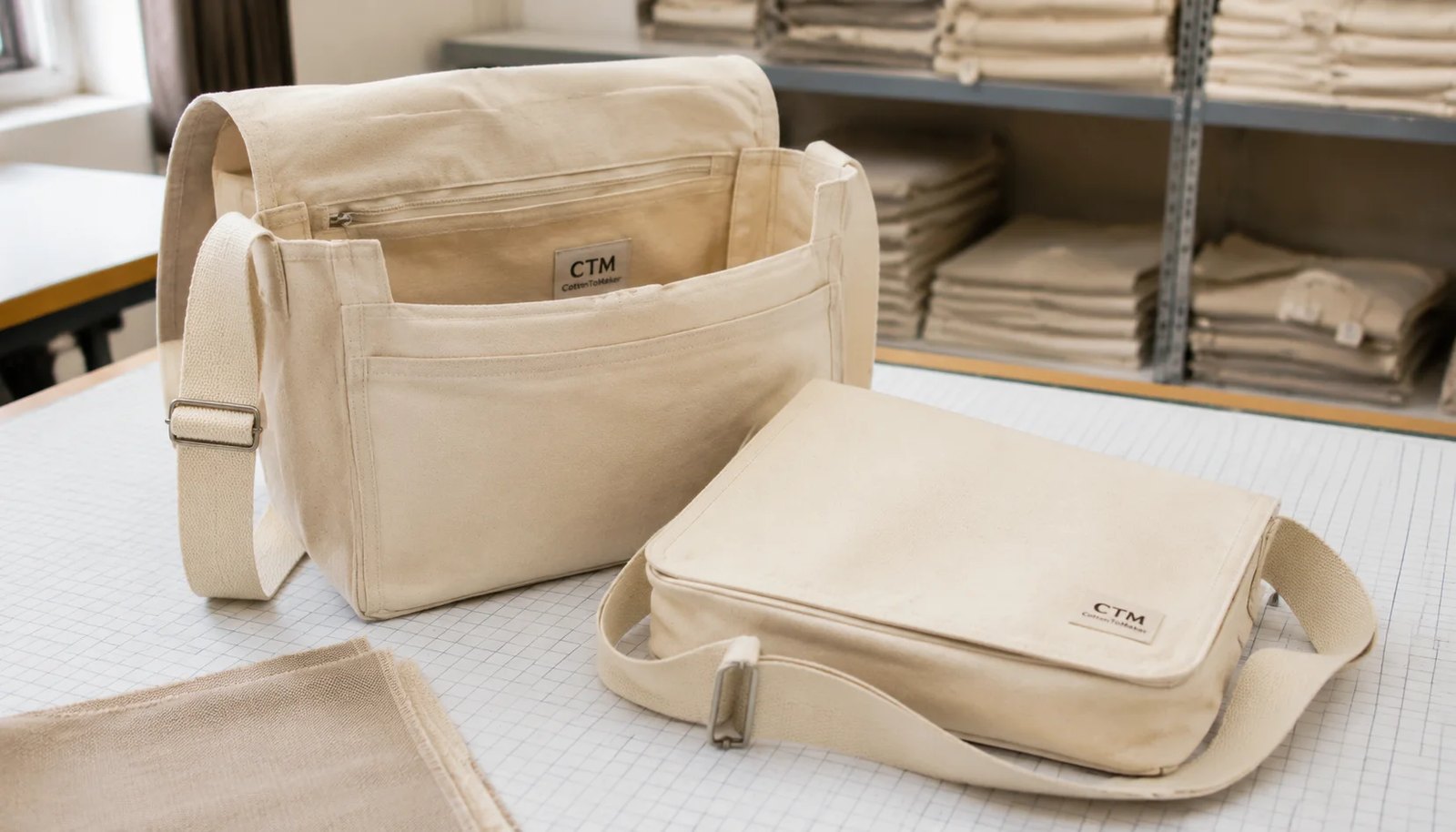
The biggest cost differences often sit in details that are easy to miss on a quote sheet. A full flap uses more fabric than a short flap. A bottom gusset adds cutting and sewing work. An adjustable strap with metal slider costs more than a fixed strap. A zipper pocket, lining, magnetic snaps, and branded woven label all add separate material and labor steps.
Procurement teams should decide which features are necessary and which are only nice to have. For many natural grocers, the best-value construction is an unlined canvas body, reinforced adjustable webbing strap, full flap, and one simple inner slip pocket if needed. Lining and multiple compartments can make the bag feel more finished, but they also increase inspection work and can create more hidden defects.
- Strap joins should be reinforced with box stitch, cross stitch, bartack, or another approved stress stitch.
- Magnetic snaps need backing fabric or reinforcement patches so they do not tear out of the canvas.
- A zipper pocket should have defined zipper length, pocket depth, zipper tape color, and puller style.
- Self-fabric straps may match the bag visually, but cotton webbing usually performs better under repeated use.
Print Method And Logo Placement
Most natural grocer messenger bags use screen printing because it is cost-effective, durable, and suitable for clean brand marks. Water-based ink is often preferred when the buyer wants a softer handfeel, while plastisol may sit more visibly on the fabric. Heat transfer can work for detailed artwork or low-volume logo variations, but it may feel less natural on heavy cotton canvas.
Logo placement deserves more attention than many RFQs give it. A print on the flap is highly visible, but the artwork must be centered after the flap is sewn and closed, not just centered on a flat fabric panel before assembly. A print on the lower body can be partly covered by the flap. Strap printing looks distinctive but adds alignment risk and may wear faster. Approve a print proof on actual canvas because natural fabric changes the color result.
- Send vector artwork and Pantone references, but approve the printed swatch under normal store lighting.
- Define print size in centimeters and distance from flap edge or body seam.
- For multi-color prints, include acceptable registration tolerance and minimum line thickness.
- Avoid very small reversed text on coarse canvas because ink spread can reduce readability.
MOQ Logic And Cost Drivers
MOQ for wholesale canvas messenger bags is driven by fabric procurement, cutting efficiency, hardware purchase quantity, print setup, and sewing line planning. A supplier may accept a lower order if the fabric and hardware are already in stock, but the unit price may rise because setup time is spread across fewer bags. A custom-dyed canvas or custom hardware finish usually requires a higher MOQ and longer lead time.
The most useful quote comparison shows prices at several quantity levels with the same specification. Buyers should compare 500, 1000, and 3000 pieces if those volumes are realistic. A small price gap at 500 pieces may widen at 3000 pieces because one supplier has better fabric sourcing or more efficient sewing. Conversely, a very low starting price may exclude print setup, sample cost, packing, carton marking, or inspection support.
- Cost drivers: canvas GSM, bag size, gusset depth, flap size, strap hardware, pocket count, print color count, and packing format.
- Hidden quote gaps: setup charges, bank fees, sample freight, barcode labels, inner bags, carton strengthening, and store-level carton sorting.
- For mixed store logos, calculate whether each logo version triggers a separate screen charge and minimum print quantity.
- For distributor orders, confirm whether multiple carton marks or SKU splits change packing labor.
Sample Approval Workflow
A sample should prove the production method, not simply show the idea. If the final order will use 14 oz natural canvas, a magnetic snap, a printed flap, and an adjustable metal slider, the pre-production sample should use those same materials. A prototype made from substitute fabric is useful only for shape confirmation. It should not be treated as approval for bulk production.
The sample review should be practical and physical. Pack the sample with the actual documents or goods. Wear it over a coat if the bag will be used in colder regions. Open and close the flap repeatedly. Adjust the strap several times. Look at the logo when the bag is filled, not only when it is flat. Many production mistakes become obvious only when the messenger bag is used as intended.
- Measure width, height, gusset, flap drop, strap width, and strap length range.
- Check whether the flap stays aligned after the bag is filled.
- Rub the print with a dry white cloth after curing and note any transfer.
- Pull strap joins firmly by hand and inspect for thread opening.
- Approve the sample with written comments and photos so the factory can match the approved version.
Quality Thresholds For Bulk Inspection
Messenger bags have more inspection points than simple totes because there are more places for alignment and function to fail. A final inspection should cover fabric condition, measurements, print quality, stitching, hardware, pocket construction, odor, and packing. The buyer should define what counts as a major defect before production starts, especially if a third-party inspection company will be used.
For a natural grocer, appearance defects on the logo area are usually more serious than minor fabric flecks elsewhere because the bag represents the brand in store and in public. Functional defects are more serious still. A strap that pulls loose, a snap that tears the canvas, or a slider that slips under load can create complaints even when the print looks good.
- Major defects: broken stitch at strap join, missing hardware, wrong logo color, severe print skew, mold odor, dirty front panel, or closure misalignment.
- Minor defects: small loose thread, slight natural cotton fleck, tiny slub outside the logo area, or very small crease from packing.
- Useful stitch standard: consistent stitch density with backstitching at pocket ends, flap corners, and stress points.
- Inspection photos should include measurement tape, inside pocket, strap reinforcement, closed flap, print close-up, carton marks, and packed carton view.
Packing And Retail Handling
Packing should match the distribution model. If the bags are shipped to a central warehouse and handed out by stores, bulk packing may be enough. If the bags are sold at retail, individual polybags, paper sleeves, hangtags, barcodes, and cleaner folding may be required. Buyers should decide this before quoting because packing affects labor, materials, carton count, and plastic use.
Canvas is absorbent, so export packing must protect against moisture and odor. Over-compressed cartons can create hard creases across the printed flap. Poorly cured ink can transfer if printed panels rub against each other during transit. For natural grocers that care about reduced packaging, a practical compromise is bulk carton packing with controlled folding, dry cartons, and paper interleaving only when the print or fabric color requires it.
- Define pieces per carton and maximum carton gross weight so warehouse teams can handle the shipment safely.
- Use clear carton marks with PO number, SKU, color, quantity, and destination if store allocation is required.
- Barcode or hangtag placement should be approved on a sample if the bag is sold as merchandise.
- Cartons should be stored dry before shipment, especially during rainy seasons or long port dwell times.
Lead Time And Schedule Risk
A realistic schedule includes artwork proofing, sample making, sample freight, buyer review, material purchasing, cutting, printing, sewing, inline correction, final inspection, packing, and shipment booking. The factory's quoted production lead time often starts after sample approval and deposit, not from the first RFQ email. Buyers who need bags for store openings, Earth Month campaigns, or seasonal promotions should build backward from the in-store date.
The highest schedule risks are custom fabric color, late artwork revision, unavailable hardware, failed print approval, and packing changes after production starts. Natural canvas with stock hardware usually moves faster than dyed canvas with custom metal finish. If the order has multiple store logos or carton splits, the buyer should allow additional time for print screens, sorting, and packing verification.
- Artwork proof: allow time for logo size, placement, and Pantone decisions.
- Sampling: include factory sampling time plus courier transit and buyer review.
- Bulk production: starts only after sample approval, deposit, and final packing instruction.
- Inspection: schedule before the cargo is sealed, not after cartons are already loaded.
- Shipment: compare air, sea, and rail options by delivery need, carton volume, and product margin.
Specification comparison for buyers
| Spec decision | Recommended option | When it fits | Buyer risk to check |
|---|---|---|---|
| Main canvas weight | 12 oz to 16 oz cotton canvas, roughly 380-540 GSM depending on weave | Best for reusable natural grocery programs where the bag must carry catalogs, packaged goods, loyalty kits, or staff materials | Do not compare quotes by ounces only; request GSM, yarn count or fabric construction, and finished bag weight because loose weave canvas can feel lighter in use |
| Bag size and gusset | A4 or letter-friendly body with 6-10 cm bottom gusset | Useful for grocer member kits, produce education folders, tablets, receipt rolls, or small retail purchases | A flat messenger bag may look cheaper in photos but loses real capacity; test with your actual folder, carton, or staff tablet |
| Flap and closure | Full flap with magnetic snaps, metal snaps, or hook-and-loop depending on price point | Good when the bag is used outside the store or as a commuter-style loyalty gift | Magnetic snaps need reinforcement patches; hook-and-loop is economical but can collect lint and feel noisy in a premium natural retail setting |
| Strap construction | 4 cm cotton webbing strap with adjustable metal slider and reinforced cross-stitching | Recommended for bags expected to carry more than light brochures | Thin self-fabric straps reduce cost but twist, stretch, and fail earlier; define strap width, hardware material, and stitch pattern in the RFQ |
| Printing method | Water-based screen print for 1-3 solid colors; heat transfer only for complex artwork or small runs | Screen print suits natural grocer branding where the bag should feel low-plastic and durable | Pantone matching on unbleached canvas shifts warmer; approve a printed fabric swatch instead of judging only digital artwork |
| MOQ structure | Negotiate by fabric availability, print colors, and hardware stock, not only by total bag quantity | Useful for distributors placing mixed seasonal programs or multiple store logos | A low MOQ may hide higher setup, cutting loss, or per-color print charges; compare total landed cost at 500, 1000, and 3000 pieces |
| Inner features | One simple slip pocket or zipper pocket only when the use case needs it | Appropriate for staff bags, market events, or higher-value member welcome gifts | Every pocket adds cutting, sewing, inspection, and defect risk; define pocket size and placement instead of saying 'inside pocket' |
| Packing format | Individual polybag only when retail presentation or moisture control requires it; otherwise master carton bulk pack with paper interleaving if needed | Bulk pack fits wholesale distribution to stores and reduces plastic handling | Natural canvas absorbs moisture and odor; require dry cartons, export carton strength, and carton markings by store or SKU |
Buyer checklist before sampling
- Define the real use case: loyalty gift, staff bag, member kit, event giveaway, or retail resale item.
- Set finished bag dimensions with tolerance, including body width, height, gusset depth, flap drop, and strap length range.
- Choose fabric by GSM, weave density, handfeel, shrinkage risk, and whether natural unbleached color variation is acceptable.
- Specify strap width, strap material, slider material, hardware finish, and reinforcement stitching at load points.
- Provide artwork files with Pantone references, print size, placement from bag edges, and whether print is on flap, body, strap, or label.
- Request a pre-production sample using production fabric, production hardware, and final print method before approving bulk cutting.
- Clarify MOQ by color, logo version, print color count, hardware type, and carton marking requirement.
- Include sample acceptance criteria for size tolerance, print registration, stitch density, seam strength, flap alignment, and odor.
- Decide packing method early: bulk pack, individual polybag, recycled paper sleeve, barcode label, hangtag, or store-level carton split.
- Compare quotes with fabric weight, finished bag weight, print setup, sample charge, carton data, production lead time, and Incoterms in one sheet.
Factory quote questions to send
- What is the exact cotton canvas GSM, fabric width, and available stock color for the quoted price?
- Is the quoted fabric dyed, bleached, unbleached natural, recycled cotton blend, or conventional cotton canvas?
- What is the finished bag weight for the proposed size and construction?
- What is the recommended MOQ for one logo, one fabric color, and one print color, and how does pricing change at higher quantity breaks?
- Which print method is included in the quote, and how many print colors, print positions, and setup charges are included?
- Can the pre-production sample use production fabric, final hardware, and actual printing rather than substitute materials?
- What are the standard tolerances for finished size, strap length, print placement, and fabric color variation?
- What reinforcement is included at strap joins, flap corners, pocket edges, and stress points?
- What packing method and carton quantity are included, and what are the estimated carton dimensions and gross weight?
- What information do you need from us to make the first sample without rework: artwork, Pantone, logo size, bag size, pocket detail, label file, barcode, or packing instruction?
Quality-control points to confirm
- Finished size tolerance should normally be controlled within plus or minus 1 cm for body dimensions and plus or minus 2 cm for adjustable strap range unless the design is oversized.
- Canvas GSM should match the approved swatch, and fabric should not have strong odor, oil stains, mold marks, or severe slub concentration on the logo area.
- Print placement should stay within the approved tolerance from flap or body edges, with no obvious skew when the bag is closed and laid flat.
- Screen print should pass reasonable dry rub and tape-pull checks for the chosen ink system after curing.
- Strap joins should use reinforcement stitching such as box stitch, cross stitch, or dense bartack, with no loose thread at stress points.
- Hardware should open, close, and adjust smoothly without sharp edges, rust spots, cracked coating, or weak magnet attachment.
- Flap should cover the opening evenly, and closures should align without forcing the fabric to twist.
- Inner pocket edges and zipper ends, if used, should be backstitched and free of skipped stitches.
- Cartons should be dry, correctly marked, not over-compressed, and packed so printed panels do not transfer ink or crease heavily.