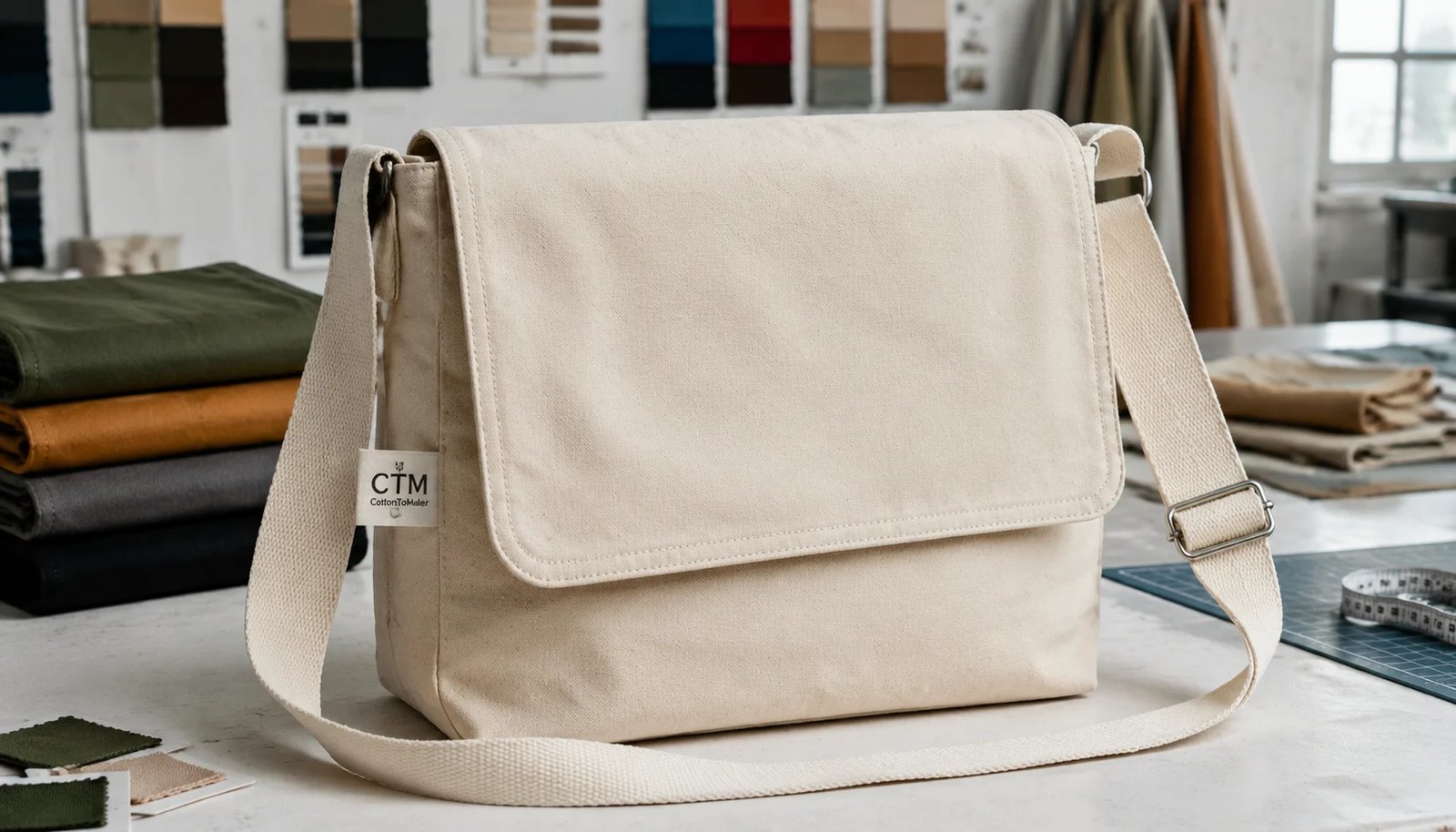
Start with the buying problem, not the bag name
Canvas messenger bags for natural grocers are usually bought for a specific business purpose: staff onboarding, loyalty rewards, wellness kits, local producer promotions, or a paid reusable bag line. The same product name can hide very different cost structures. A simple flap bag for a one-color membership gift is not the same sourcing project as a heavier retail messenger bag with pockets, adjustable hardware, and barcode packaging.
Procurement teams get better quotes when they describe the use case and the expected load first. A natural grocer program may need the bag to carry recipe cards, a water bottle, supplements, notebooks, or small packaged grocery items. If the factory only sees a reference photo, it may quote a lighter construction that looks acceptable in pictures but fails once store teams use it in real life.
- For loyalty gifts, prioritize clean print, controlled cost, and carton efficiency.
- For staff issue bags, prioritize strap strength, dirt resistance, and repeat-use durability.
- For paid retail items, prioritize fabric handfeel, pocket function, shelf presentation, and barcode packing.
- For wellness kits or subscription boxes, design around the packed contents and carton cube.
Choose canvas weight by load, shape, and landed cost
The most common mistake in wholesale canvas messenger bag RFQs is writing only cotton canvas without stating the weight. Canvas weight should be shown in ounces and GSM because suppliers may use different conversion habits. For a basic natural canvas messenger bag, 10 oz is usually light and soft, around 300-340 GSM. A 12 oz canvas, around 380-420 GSM, is a practical middle range. Heavier 14-16 oz canvas can reach roughly 450-540 GSM and gives more body, but it raises fabric cost, sewing difficulty, packed weight, and freight.
Natural grocer buyers often like unbleached canvas because the color fits an organic or low-waste brand position. That is commercially sensible, but natural canvas has shade variation, seed flecks, and occasional slubs. These are normal within limits, but the logo area should not contain large dark knots or oil marks. If a very clean cream color is required, bleached canvas may be more consistent, while dyed canvas needs colorfastness control and a higher MOQ.
- 10 oz canvas: acceptable for light promotional bags, but may feel weak for staff or retail use.
- 12 oz canvas: common choice for wholesale natural grocer programs needing decent structure without excessive freight.
- 14 oz canvas: better for premium or loaded use, but confirm needle size, seam bulk, and carton weight.
- Dyed canvas: useful for brand color programs, but confirm shade tolerance and rubbing fastness.
- Organic or recycled cotton: specify certification expectations early; do not assume it is included in a standard canvas quote.
Define the messenger bag construction before comparing quotes
Two quotes can look close on unit price while the bags are not equivalent. A proper canvas messenger bag spec should include finished width, height, gusset depth, flap length, strap width, strap length range, pocket count, closure type, seam reinforcement, and label positions. Natural grocer buyers should also decide whether the bag is meant to stand with some structure or fold flat as a low-cost giveaway.
The flap is a visible quality area. If the flap edge waves, the logo tilts, or the closure pulls the fabric out of shape, the whole bag looks cheap. A reinforced flap or double-layer flap improves appearance but adds material and sewing time. For many wholesale grocery programs, the best compromise is a simple full flap with neat topstitching, one main compartment, and a small internal slip pocket for coupons, cards, or staff notes.
- State finished dimensions with tolerance, for example plus or minus 1 cm on main body size.
- Use a gusset when the bag must hold boxed samples, bottles, or documents without bulging.
- Choose a 38 mm strap for most adult users; narrow straps reduce cost but feel less durable.
- Add bartacks or box stitching at strap connection points, especially on heavier canvas.
- Limit decorative pockets unless they have a real use; each extra seam creates cost and QC risk.
Print method should match artwork, canvas texture, and quantity
For natural grocers, water-based screen print is often the best-looking and most cost-effective option for a simple logo, slogan, or store mark. It gives a softer matte finish than thick plastisol-style ink and fits the natural fabric look. However, rough canvas texture reduces fine detail. Very thin lines, small ingredient icons, and low-contrast colors may not reproduce cleanly on unbleached canvas.
Heat transfer can handle gradients and complex multi-color graphics, but it changes the handfeel and can look less natural on a canvas messenger bag. Embroidery is durable and premium, but it may pucker lighter canvas and adds stitch-count cost. A woven label sewn on the side seam or flap is a good option when the buyer wants subtle branding and no risk of large print defects.
- For one to three solid colors, screen print is usually the practical wholesale route.
- For photographic artwork, use transfer only after testing adhesion and edge finish on the chosen canvas.
- For premium staff bags, consider embroidery or a woven side label instead of a large front print.
- Approve print size on the actual bag, not just on a flat artwork sheet.
- Require a print strike-off and rub test before bulk printing.
Understand MOQ logic before splitting store versions
MOQ is not just a factory policy; it is tied to fabric booking, dyeing, cutting efficiency, print setup, sewing line changeover, and packing marks. A natural canvas bag with one common logo can often be produced at a lower MOQ than six store-specific logos, three fabric colors, and separate carton marks. Importers and distributors should map the final store allocation before requesting a firm quote.
If a buyer needs multiple regional logos, the factory may still cut the same canvas lot and change only the screen print. That is easier than changing fabric colors. The cost impact comes from screen setup, print washdown, downtime, and small-batch packing. When volumes are small, a shared master carton with inner bundles by design may reduce cost, but retail-ready cartons by store may simplify distribution. The RFQ should make that tradeoff visible.
- Quote natural canvas one-color print as the baseline.
- List every artwork version and expected quantity per version.
- Separate fabric color MOQ from print design MOQ.
- Clarify whether assorted designs can share one production run.
- Include carton mark and barcode variation in the MOQ discussion.
Use the comparison table to prevent false savings
A low quote is not automatically a good quote. Many messenger bag savings come from reducing canvas GSM, narrowing the strap, removing reinforcement, using cheaper hardware, or packing too many bags per carton. Those changes may be acceptable for a short-term promotion, but they should be visible before a purchase order is issued.
The table in this guide is designed for side-by-side quote normalization. Add one column for each supplier and require them to fill the same fields. If a supplier cannot state GSM, strap width, print method, carton cube, and lead time assumptions, the quote is not ready for procurement comparison.
- Normalize all quotes to the same Incoterm, packing method, and artwork count.
- Compare carton cube and gross weight, not only unit price.
- Review whether sample, screen, and test charges are included.
- Treat missing hardware or reinforcement details as an open cost risk.
- Reject vague descriptions such as heavy canvas unless a GSM range is provided.
Sample approval must represent the real production bag
A photo sample or a prototype made from available substitute fabric is useful for early design discussion, but it should not be the final approval standard. The pre-production sample should use the actual canvas weight, final strap, final closure, final print method, and final label or hangtag. This matters because canvas thickness changes seam bulk, flap behavior, print absorption, and folded carton size.
Approval should be written, not informal. Keep one sealed approval sample at the factory and one with the buyer or inspection team. Mark the approved dimensions, print placement, hardware, stitching, and packing method. If the bag is a retail item, include the barcode, hangtag, warning label if needed, and individual packing instructions in the approval.
- Measure body width, height, gusset, flap, strap width, and strap adjustment range.
- Load the sample with realistic contents for at least several minutes to observe strap slip and seam stress.
- Rub the printed logo with a dry and slightly damp white cloth after curing.
- Check flap alignment when the bag is empty and when it is loaded.
- Photograph the approved sample from front, back, inside, strap joint, print close-up, and carton packing view.
Set practical QC thresholds before mass production
Canvas messenger bags have more visible construction points than flat grocery totes. The flap must sit square, the strap must hang correctly, and the bag must not twist when carried. QC should include measurement, fabric surface inspection, sewing inspection, print inspection, hardware function, and packing inspection. If these standards are agreed only after goods are finished, the discussion becomes expensive and emotional.
For natural canvas, buyers should distinguish acceptable natural fabric character from unacceptable defects. Small seed specks and minor slubs are normal. Oil stains, mildew smell, dark marks in the logo area, large holes, and heavy shade mismatch across panels are not acceptable for retail-facing programs. A practical inspection plan defines major defects, minor defects, and measurement tolerances in advance.
- Measurement tolerance: commonly plus or minus 1 cm for main dimensions, but confirm based on construction.
- Print position tolerance: define acceptable shift, such as within 5 mm from approved placement for visible front logos.
- Stitch density: keep consistent with the approved sample; loose long stitches reduce durability.
- Load test: define the test weight and duration according to intended use.
- Odor control: reject mildew, heavy chemical smell, or damp-packed cartons.
- Carton inspection: check burst strength, moisture damage, tape sealing, and correct shipping marks.
Packing decisions affect freight, presentation, and claims
Messenger bags are bulkier than flat totes because of straps, flaps, closures, and gussets. Aggressive compression can reduce carton count, but it may leave permanent creases across the flap or transfer strap marks onto the print. For natural grocer programs where bags are handed directly to shoppers or sold in store, presentation matters. Flat packing with controlled fold lines is usually safer than stuffing bags randomly into cartons.
The packing specification should include pieces per carton, carton dimensions, gross weight, net weight, inner bundle method, polybag requirement, desiccant if needed, and carton marks. Some natural grocers avoid individual polybags for sustainability reasons. That is possible, but then printed surfaces should be protected from rubbing and moisture during transit. A kraft paper band, recyclable master liner, or interleaving sheet may be a better fit than single-use plastic.
- Keep carton gross weight practical for warehouse handling, often below 18-20 kg unless the buyer allows more.
- Avoid direct print-to-print contact if ink surface is large or dark.
- Use export cartons strong enough for stacking and long transit.
- Confirm whether bags are folded, flat packed, or packed with strap tucked inside.
- Provide carton cube data for landed-cost calculation and warehouse planning.
Build lead time around the slowest decision, not the sewing days
Production lead time for canvas messenger bags depends on fabric availability, sample approval speed, print preparation, cutting, sewing, finishing, inspection, packing, and shipping cutoff. Sewing may be only one part of the schedule. Delayed artwork approval, unclear packaging data, or late barcode files can stop production even when fabric is ready.
A realistic project plan separates sample lead time from bulk lead time. For example, a buyer may need a prototype, then a print strike-off, then a pre-production sample, then mass production. If the order involves dyed canvas, custom hardware, certified material, or multiple logo versions, add buffer. Procurement teams should also plan inspection before final payment or shipment booking, not after containers are already scheduled.
- Artwork confirmation should happen before print screens or transfers are made.
- Fabric booking starts only after color, GSM, and material type are confirmed.
- Pre-production sample approval should be a formal milestone before mass cutting.
- Bulk inspection should be scheduled when at least 80 percent of goods are packed, or according to the agreed inspection plan.
- Final carton data should be available before freight quotation and warehouse slot booking.
Specification comparison for buyers
| Spec decision | Recommended option | When it fits | Buyer risk to check |
|---|---|---|---|
| Body fabric weight | 12 oz canvas around 380-420 GSM for standard retail programs; 14-16 oz for heavier staff or subscription use | Good balance of structure, print surface, and carton efficiency for natural grocer campaigns | Low GSM may collapse under catalog samples or glass jars; high GSM raises freight and sewing cost |
| Bag construction | Single main compartment with full flap, reinforced bottom, and inside slip pocket | Suitable for loyalty gifts, staff document bags, wellness kits, and reusable shopping accessories | Too many pockets increase labor time and inspection points; loose flap alignment looks cheap on shelf |
| Strap system | 38 mm cotton webbing shoulder strap with metal or durable acetal adjuster | Works for adult shoppers and store staff carrying light to medium loads | Narrow strap cuts into shoulder; weak adjuster slips during loaded testing |
| Print method | Water-based screen print for simple natural grocer branding; heat transfer only for complex multi-color artwork | Screen print gives a matte look that matches natural canvas and is cost-effective at wholesale quantity | Ink migration, poor curing, and rough canvas texture can reduce logo sharpness |
| Closure | Flap with hidden magnetic snap or simple hook-and-loop depending on retail positioning | Magnetic snap feels cleaner for premium gift programs; hook-and-loop is practical for staff issue bags | Magnet placement must be reinforced; hook-and-loop can catch lint and sound cheap |
| MOQ logic | Base MOQ by fabric color and print setup, usually higher for dyed canvas and custom hardware | Natural canvas with one-color print is the easiest entry spec for distributors and regional grocers | Combining many store logos or colorways can create hidden small-lot surcharges |
| Packing method | Flat pack in export carton with interleaving if printed surfaces touch; avoid over-compression | Keeps freight efficient while protecting flap shape and print face | Overpacked cartons cause flap creases, strap marks, and rejected retail presentation |
| Sample approval | Pre-production sample made in bulk fabric with final print scale and final strap hardware | Best route before issuing purchase order balance or approving mass cutting | Prototype made from substitute fabric may hide shrinkage, color, and sewing behavior |
Buyer checklist before sampling
- Define the bag use before quoting: customer reward, staff bag, paid retail item, wellness kit, or membership gift.
- Specify canvas weight in oz and GSM, not only the word canvas.
- Confirm finished bag size, gusset depth, flap length, strap width, and pocket layout with tolerances.
- Decide whether natural, bleached, dyed, recycled, or organic cotton canvas is required before requesting price.
- Send vector artwork with Pantone references and maximum printable area on the flap or body.
- State print method preference, number of print colors, logo positions, and whether ink should be water-based.
- Require loaded strap and seam testing for the expected carrying weight, not just visual inspection.
- Request MOQ by colorway and artwork version so store-level logo plans do not break the budget.
- Ask for carton dimensions, pieces per carton, gross weight, net weight, and packing style with the quotation.
- Approve a pre-production sample made with final fabric, final hardware, and final printed artwork.
Factory quote questions to send
- What canvas weight in oz and GSM are you quoting, and is it greige, natural, bleached, dyed, recycled, or organic cotton?
- Is the quoted size measured flat or finished after sewing, and what tolerance do you apply to width, height, gusset, flap, and strap length?
- What is the MOQ per fabric color, per print design, and per shipping mark?
- Which print method is included in the quote, how many colors are included, and what is the maximum print area?
- Are screen setup charges, artwork separation, strike-off samples, and pre-production samples included or separate?
- What strap width, strap material, adjuster material, and reinforcement method are included?
- What stitching density, thread type, and seam reinforcement do you use at the strap joint and flap edge?
- How many pieces per export carton, what are carton dimensions, and what are gross and net weights?
- What is the production lead time after sample approval and deposit, and what events can extend it?
- What inspection standard do you use for print defects, sewing defects, stains, odor, measurement tolerance, and carton damage?
Quality-control points to confirm
- Fabric weight verified against approved sample, with acceptable GSM tolerance stated before production.
- Finished dimensions within agreed tolerance after sewing and pressing, including flap length and strap adjustment range.
- Print position centered within agreed tolerance and print color matched to approved strike-off under consistent lighting.
- Ink fully cured with no tackiness, cracking, heavy odor, or transfer when rubbed after drying.
- Strap joints reinforced with box stitch, bartack, or equivalent method according to approved sample.
- Seams free from skipped stitches, loose threads, open seams, puckering, and uneven flap alignment.
- Metal hardware or plastic adjusters free from sharp edges, rust, cracking, and slippage under load.
- Bag passes a practical load test based on intended use, such as repeated hanging with catalog, sample jars, or wellness kit contents.
- Natural canvas surface checked for unacceptable oil marks, mildew spots, large slubs on logo area, and inconsistent bleaching.
- Packing preserves bag shape and print face, with cartons strong enough for export stacking.