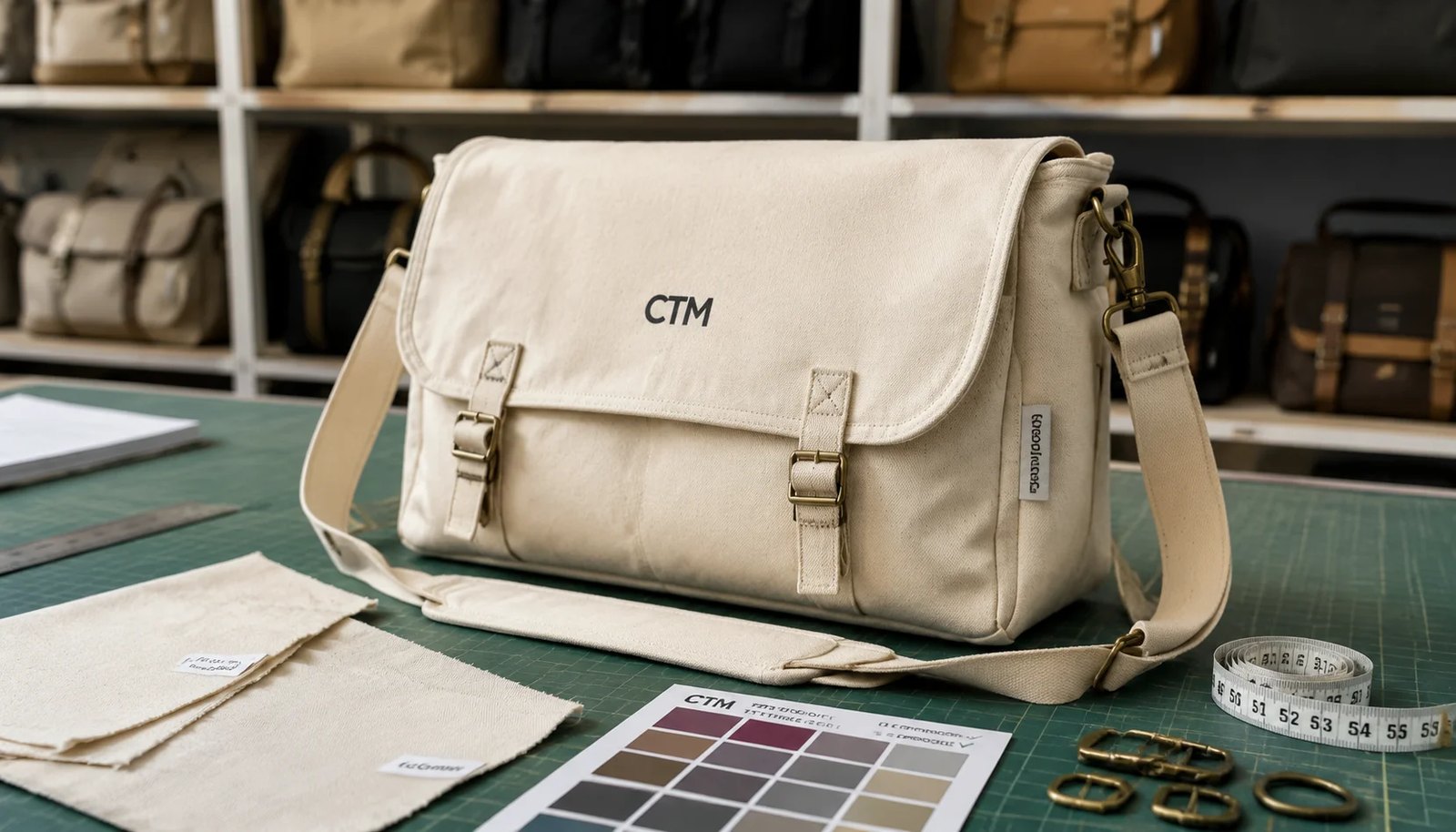
Why MOQ gets difficult on canvas messenger bags for liquor retail programs
MOQ is harder on canvas messenger bags than on simple totes because the bag has more factory steps and more bill-of-materials lines. A tote may be one fabric, one print, and one handle construction. A messenger bag usually adds a flap, strap assembly, buckles or magnets, inside pockets, label placement, reinforcement, and more sewing minutes. For liquor retailers, the problem gets bigger when the same program is split across regional promotions, private labels, store groups, or membership campaigns that each want small artwork changes.
The practical issue is not just the supplier's minimum quantity. It is whether your total order can be combined at the fabric, cutting, printing, and packing stages. If a buyer negotiates only on total pieces without controlling spec variation, the supplier may agree to a low total MOQ but price each SKU like a small run. That creates a false win: the PO gets approved, but unit economics and delivery reliability worsen.
- Most MOQ pressure comes from fabric color changes, hardware changes, and separate print setups
- Messenger bags are more sensitive to labor minutes than plain totes, so low-volume custom features add cost quickly
- Liquor retail campaigns often have seasonal deadlines, making late design changes more expensive than slightly higher MOQ
- The best negotiation target is usually a combined production structure, not just a lower piece count
Start with the end use before you negotiate volume
A messenger bag for resale in a premium wine shop should not be quoted the same way as a gift-with-purchase bag for a holiday spirits promotion. End use affects fabric weight, closure detail, internal organization, perceived value, and how much packaging is acceptable. Buyers who skip this step often overbuild the bag for a promotion or underbuild it for retail resale, then try to fix the mismatch by negotiating MOQ instead of refining the specification.
For liquor retailers, the most common use cases are branded merchandise resale, wine-club membership packs, staff or event bags, and promotional gift bundles. Each use case changes what can be standardized. A resale item may justify 14-16 oz canvas and nicer hardware. A promotional run may work better with 12 oz canvas, one-color print, and minimal inside features. Once the use case is fixed, the supplier can calculate where quantity can be merged and where it cannot.
- Resale item: stronger fabric, neater finishing, and better hardware matter more than the absolute lowest MOQ
- Gift-with-purchase: hold one base color and one closure style to keep MOQ and print setup under control
- Membership program: plan repeatability and reorder dye-lot consistency, not only first-order pricing
- Event bag: freight cube and fast assembly often matter more than heavy internal structure
Fabric weight and construction decisions that influence MOQ and cost
For most liquor retail messenger bag programs, 12 oz to 14 oz canvas, roughly 400-475 GSM finished, is the most workable starting range. It gives enough body for a structured flap and decent print performance while staying manageable on freight. If buyers jump to 16 oz canvas, around 540 GSM, they get a more premium hand-feel and stronger silhouette, but they also reduce stock fabric availability and increase sewing difficulty. That can trigger higher MOQ or a surcharge even when the supplier nominally accepts a small run.
Construction details matter as much as fabric weight. A single-layer body with a reinforced base panel often delivers better value than a fully lined bag when the bag is used for branded retail or promotional resale. Full lining adds cost, sewing time, and MOQ complexity because lining colors and pocket materials may have separate sourcing thresholds. Reinforcement at strap points and flap hinge areas is usually non-negotiable; lining is often negotiable.
- Common buyer spec: 12 oz natural canvas body, reinforced base, 38 mm cotton webbing strap
- Premium buyer spec: 14-16 oz dyed canvas, flap magnetic closure, interior zip pocket, woven label
- Cost-control route: keep one shell fabric across all SKUs and vary only print or hangtag
- If custom dye is needed, request MOQ for dyed fabric separately from cut-and-sew MOQ
Print method choices: where MOQ negotiation really wins or fails
Screen print is usually the best commercial option for canvas messenger bags if the liquor retailer logo is one to three solid colors. It is durable, economical at medium volume, and easier to repeat consistently on flat panels. The catch is that every color and artwork version can create setup cost and practical MOQ pressure. If your team wants the same bag body across several store groups, keep the logo location and print size constant. Changing only the ink artwork is easier to combine than changing the print position, bag color, and closure details all at once.
Heat transfer or digital transfer can make sense for short campaigns with photo-detail art, but buyers should not assume it is always cheaper at low quantities. On messenger bags, flap folds and seam proximity can create durability issues if the transfer sits over a bend area. A nice-looking strike-off is not enough. The supplier should show how the chosen print behaves on the actual canvas weight and where the flap flexes during use.
- Screen print works best on natural or lightly dyed canvas with clear logo zones
- Transfer print is better for complex multi-color art but may be less suitable on fold lines
- Embroidery can look premium but often raises labor time and may pucker lighter canvas
- Woven patch or side label is a useful way to personalize smaller regional runs without resetting the whole print setup
How to negotiate MOQ without letting the supplier hide cost elsewhere
A lower MOQ has to be matched with a clear quote structure. Otherwise the factory may reduce the minimum quantity but recover margin through setup fees, sample charges, hardware surcharges, or inefficient packing. Procurement teams should request a matrix quote rather than one unit price. The matrix should show price by total volume, by number of SKUs, by print color count, and by packaging style. That makes it easier to see whether the factory is genuinely combining production or just averaging numbers.
The most effective MOQ negotiation tactic is simplification, not pressure. Keep one size, one fabric quality, one hardware finish, and one strap construction common across the full order. Then negotiate logo variation and packaging variation inside that framework. If buyers need two store brands, it is usually cheaper to swap flap print art or hangtag text than to change body color or hardware finish. This is especially true for liquor retail buyers who often place campaign-driven mixed orders under one import schedule.
- Request one quote for combined total quantity and another for fully separated SKU production to see the savings gap
- Separate one-time charges from repeat-order charges before approving the first PO
- Do not treat a verbal promise to combine MOQ as final; require a written MOQ logic sheet
- If the supplier offers a low MOQ, ask what specification points must stay fixed to keep that MOQ valid
Sample strategy: the cheapest place to catch expensive messenger bag mistakes
For a first-order messenger bag, a two-stage sample route is safer than a single approval sample. Start with a proto sample to validate dimensions, strap drop, pocket usability, and closure function. This stage does not need final print or final fabric color if the purpose is construction review. Then move to a pre-production sample using the approved fabric, hardware, print method, and packaging notes. This is the sample that should govern mass production.
The reason this matters in MOQ negotiation is simple: lower-volume runs have less room to absorb rework. If the flap print sits too low or the strap length feels awkward, the unit cost impact of correction on a 500-piece order is much higher than on a 5,000-piece order. Buyers often focus on sample charges, but the real financial issue is whether the sample process locks down the details that create production variation.
- Proto sample checks: finished size, flap coverage, strap adjustment range, pocket access, bottle accessory fit
- PPS checks: final print color and placement, hardware finish, stitch density, label placement, packing fold
- Approve samples against a short written tolerance sheet, not just by photos
- If one style will run in several logos, approve one master construction sample and separate print strike-offs
QC thresholds that matter more than generic inspection language
Messenger bag quality problems are often about usability and appearance at the same time. A slightly off-center print on a tote may still be accepted for a promotion. On a flap-front messenger bag, the print becomes the focal point, so placement drift is more visible. Likewise, minor strap length inconsistency can affect customer perception because the bag is worn across the body or shoulder. Generic phrases like 'good workmanship' are not enough for this product.
Buyers should define a few practical acceptance criteria that relate directly to the end use. These include finished dimensions by panel, flap alignment to body, print placement relative to flap edge, stitch reinforcement at strap joins, and tolerance for visible stains on natural canvas. Liquor retail programs often use natural or off-white canvas because it looks premium and sustainable, but those colors show dust, oil marks, and loose dark fibers more easily during sewing and packing.
- Print placement tolerance should be measured from a fixed seam or edge, not judged by eye
- Natural canvas should have a stain standard stated in writing because tiny marks become dispute points later
- Strap reinforcement should note stitch type and count, especially at load-bearing joins
- Hardware should be checked for scratch marks and inconsistent plating if using metal fittings
Packing decisions that affect landed cost and retail presentation
Packing is often ignored until after the unit price is negotiated, but it can erase savings on a bulky product like a messenger bag. Flat packing is usually the best route for importers, but over-compression can create permanent flap creases or distorted straps. If the retail buyer needs a cleaner shelf-ready look, the supplier may use tissue inserts, strap bands, or individual sleeves. Each of those choices changes carton cube, labor time, and waste handling at the destination.
For liquor retailers, the right packing choice depends on channel. If bags are sold as merchandise, better presentation may justify a little extra packing cost. If they are used as promotional carriers or event bags, tighter flat-pack efficiency is usually more important. Carton planning also matters because heavier canvas and metal hardware can push gross weight up quickly even when the bag is not large.
- Request units per carton, gross weight, net weight, and outer carton dimensions in the quote stage
- If bags must stay crease-light, test a packed sample carton before mass production
- Poly-free bundle packing can reduce packaging waste, but fabric cleanliness control must improve
- Barcode sticker placement and assortment packing should be approved if the goods go through a retail DC
Lead time planning: where small custom runs lose schedule control
Low to medium volume custom messenger bags are more vulnerable to schedule drift because the supplier may slot them around larger production runs. Buyers should therefore break lead time into stages rather than accepting one total number. The meaningful milestones are fabric availability, lab dip if dyed fabric is needed, print strike-off, proto sample, PPS approval, bulk cutting, sewing, finishing, inspection, and vessel-ready date. This makes it easier to spot where the schedule can slip if artwork or sample feedback arrives late.
Liquor retail timing is often tied to holiday windows, tasting events, or loyalty launches. If the campaign date is fixed, buyers should protect schedule by simplifying variation early. Holding one stock canvas color and one hardware set can shorten the path materially. A custom dyed body fabric plus custom woven label plus multiple print versions is manageable, but not on a compressed calendar unless all approvals are disciplined.
- Stock natural canvas usually reduces lead time risk compared with custom dyed canvas
- Artwork changes after PPS approval can cause more disruption on printed flaps than on side labels
- A split shipment may help campaign timing, but only if the MOQ and carton plan are agreed upfront
- Request a critical path schedule with approval dates owned by both buyer and factory
Quote analysis: compare landed value, not only the ex-factory unit price
Two suppliers can quote the same messenger bag at similar ex-factory prices and still produce very different landed outcomes. One may be using lighter finished fabric, fewer reinforcement stitches, or more compressed packing that increases crease risk. Another may quote a slightly higher unit price but include cleaner packing, better hardware consistency, and lower carton cube. Procurement teams should normalize the quote line by line before deciding which supplier is truly competitive.
A useful comparison method is to translate the quote into cost drivers: fabric grade, sewing complexity, print setup, trim quality, sample path, packing density, and expected rework risk. For liquor retailers, a failed campaign window or poor retail presentation often costs more than a small unit-price difference. The decision should reflect where the product will be sold and how visible brand details are to the final customer.
- Normalize all quotes to the same GSM, size tolerance, and print area before comparing
- Treat sample charges, screen charges, and custom trim fees separately from repeat production cost
- Compare carton cube and gross weight if freight is significant on your lane
- If one supplier is much cheaper, identify exactly what they removed from construction or packing
Specification comparison for buyers
| Spec decision | Recommended option | When it fits | Buyer risk to check |
|---|---|---|---|
| Canvas weight | 12 oz to 14 oz canvas, about 400-475 GSM | Good balance for retail gift-with-purchase, loyalty packs, or bottle-club carry bags that need structure without excessive freight weight | Some mills quote lower GSM but finish the fabric heavily to feel thicker; request actual finished GSM tolerance and fabric test report if bag shape matters |
| Heavy-duty option | 16 oz canvas, about 540 GSM | Fits premium wine club, higher price-point branded merchandise, or programs carrying catalogs, bottle accessories, and heavier inserts | MOQ often rises because fewer stock colors are available and sewing speed drops; quote should separate fabric surcharge from labor surcharge |
| Body construction | Single-layer body with reinforced base panel | Most liquor retail programs that want stronger carry performance without paying for full lining | Suppliers may omit the reinforcement in production unless base panel dimensions and stitch pattern are listed on PO and artwork/spec sheet |
| Closure style | Flap with magnetic snap or webbing strap and buckle | Works for messenger styling and better perceived value in retail resale items | Magnet strength, buckle finish, and flap alignment can vary; include closure pull test standard and alignment tolerance in approval notes |
| Printing method | Screen print for solid logos; heat transfer only for photo-detail retail graphics | Screen print is usually more economical and durable at medium runs; transfer is useful for multi-color campaign art with lower setup flexibility | Screen print MOQ may be tied to print color count; transfer print can crack on fold areas if artwork sits across flap edge or seam |
| Color assortment strategy | One body color with 2-3 logo versions | Best route when buyers need lower MOQ per SKU but still want regional branding or store-group personalization | If fabric color changes by SKU, MOQ can reset by fabric dye lot; negotiate logo variation on same fabric first |
| Packaging route | Flat-packed 10-20 pcs per inner poly-free bundle, export carton by size and weight limit | Suitable for importers trying to reduce cube and keep DC handling simple | Strap creasing and flap deformation can happen if over-compressed; request packed carton photos and packed dimensions before mass shipment |
| Sampling route | Proto sample, then pre-production sample with final print and hardware | Best for first order or when converting from tote supplier to messenger bag supplier | Skipping PPS often causes strap length, flap drop, and print position disputes; sample cost saved is usually lower than rework cost |
| MOQ negotiation route | Hold one core size and hardware set constant, vary only print and hangtag | Most effective way for liquor retailers to combine volume and still maintain brand differentiation across channels | Suppliers may verbally combine quantities but quote separate setups later; require a written MOQ matrix by SKU, color, print, and packaging type |
Buyer checklist before sampling
- Define whether the bag is a resale item, gift-with-purchase, staff use item, or bottle-club membership bag before negotiating MOQ
- State target finished size, load requirement, and whether the bag must fit A4 catalogs, 750 ml bottle accessories, or boxed gift items
- Specify finished fabric weight in GSM or oz after washing or finishing, not just nominal greige fabric
- List body construction clearly: single layer, lining, reinforced base, padded strap, internal pocket, zipper pocket, bottle divider, or key clip
- Lock one common hardware finish across SKUs if you want the supplier to combine volume effectively
- Indicate whether logo changes are only print art changes or include different bag colors, labels, hangtags, or woven patches
- Request MOQ by bag color, print color count, and packaging style instead of one blended MOQ number
- Approve print position tolerance and seam alignment on the pre-production sample, especially on flap graphics
- Review packed carton dimensions, carton gross weight, and units per carton before final approval to avoid freight surprises
- Confirm production lead time from artwork approval, not from inquiry date or deposit date alone
Factory quote questions to send
- What is your MOQ by size, fabric color, print method, and packaging type for this messenger bag spec?
- If we keep one common fabric color and hardware set, how many logo versions can be combined into one MOQ?
- What finished fabric GSM are you quoting, and what is the tolerance after dyeing, washing, or coating?
- Is the quoted canvas stock color or custom dyed, and what is the dye lot minimum if repeat orders are needed?
- What print method are you quoting for the flap logo, and how does unit price change by print color count and print area?
- What reinforcement is included at strap box stitches, side seams, base panel, and flap hinge area?
- Can you provide a proto sample first and then a pre-production sample with final fabric, hardware, and print?
- What defects would you classify as critical, major, and minor for printing, sewing, hardware finish, and stain marks?
- How many pieces per export carton, what are packed carton dimensions, and what gross weight are you planning?
- What is your standard lead time for lab dip, print strike-off, pre-production sample, bulk production, and vessel-ready packing?
Quality-control points to confirm
- Finished size tolerance should be stated by panel, flap, and strap length rather than only overall bag width and height
- Fabric GSM must be checked on finished fabric; hand-feel alone is not reliable for freight or durability planning
- Print position on flap should be measured from flap edge and centerline, with a practical tolerance noted on sample approval
- Screen print opacity and edge sharpness should be reviewed on natural canvas because slub and weave can affect logo clarity
- Strap attachment needs reinforcement with box stitch or bartack count specified on the approved sample or technical sketch
- Magnetic snaps, buckles, and D-rings should be checked for finish consistency, scratches, and closure function
- Internal pocket size and placement should be measured if catalogs, tablets, or promo inserts must fit
- Carton drop resistance and over-compression risk matter when bags are flat-packed for sea freight
- AQL or internal QC standard should distinguish removable lint from non-removable stains, especially on natural canvas
- Pre-shipment inspection should include packed carton count, barcode accuracy, assortment accuracy, and random load test of strap seams