Start With The Cost Drivers Behind MOQ
MOQ on canvas messenger bags is usually the result of several fixed costs, not one hard rule from the factory. Fabric minimums, dye lots, print setup, trim sourcing, sewing efficiency, packing labor, and inspection scope all push the number up or down. If the buyer asks only for the lowest possible minimum, the supplier often protects itself by removing flexibility elsewhere, which can create a weaker bag, a narrower color choice, or a slower launch.
For eco apparel brands, the commercial question is not whether the bag can be made custom. It is whether the first order is strong enough to sell, repeat, and protect the brand. A clean stock-color bag with a strong logo can be a better launch than a highly customized bag that misses the market window or distorts the landed-cost model. The first order should optimize for sell-through, quality control, and reorderability, not for maximum feature count.
A useful canvas messenger bags for eco apparel brands moq negotiation guide starts by separating two buckets: what must be fixed for launch, and what can wait for reorder. The clearer that split is, the easier it is to get a quote that reflects real production constraints instead of a defensive number padded for uncertainty.
- Treat MOQ as the sum of setup costs, not as a single sticker price from the supplier.
- Use one body size, one fabric color, one logo method, and one packing method as the cleanest pilot order.
- Keep decorative add-ons out of the first-order budget unless they affect channel acceptance or compliance.
Write The RFQ Around The Actual Product Use
A messenger bag sold through retail does not need the same spec as a giveaway bag for a trade show. A wholesale accessory may need to carry a folded garment, notebook, and bottle. An employee kit bag may need reliable packing and carton labels. If the use case is vague, suppliers fill the gap with their own assumptions, and the quotes will not compare cleanly.
Write the RFQ in finished-product terms. Include width, height, gusset, flap drop, strap width, usable strap length range, pocket count, closure type, logo method, label requirements, and packing format. If the bag needs to fit a laptop, say whether that means a sleeved laptop carry or a padded-carry requirement. Padding changes panel count, sewing time, material usage, and QC expectations.
A strong RFQ also identifies what is optional. Mark each feature as required, optional, or quote as an upgrade. That lets the supplier show pricing without forcing every version into the same cost bucket. It also keeps the buyer from comparing a stripped-down promotional bag with a retail-grade construction that only looks similar in the first photo.
- State the channel and use case before asking for price.
- List the contents the bag must carry so the supplier can size it correctly.
- Separate required features from optional upgrades so the quote is readable.
Specify Canvas Weight And Material Claims Carefully
Canvas weight is one of the easiest places for a quote to look better than it is. A 12 oz and a 16 oz messenger bag can share the same title, but they do not feel or perform the same. For a retail or wholesale bag that will be carried daily, a heavier medium-to-heavy canvas is often the safer starting point because it supports structure and reinforcement. A lighter canvas can still work, but it is better suited to lighter promotional use or softer carry loads.
Ask for both oz and GSM, then ask how the weight is measured. Some canvas feels firmer because of starch, washing, or coating rather than yarn density. That matters because the sample-room handfeel can disappear in bulk if the finishing changes. If the supplier cannot explain the finish, the buyer should assume the sample and shipment may not behave the same way.
Material claims should stay factual and supportable. Recycled cotton canvas, organic cotton canvas, undyed canvas, and conventional cotton canvas are different sourcing paths. If the claim will appear on product pages, hangtags, wholesale line sheets, or packaging, the supplier should be able to show what evidence exists before sampling and before copy is locked. The right question is not whether the claim sounds good. It is whether the wording can be backed by the documents the factory actually has.
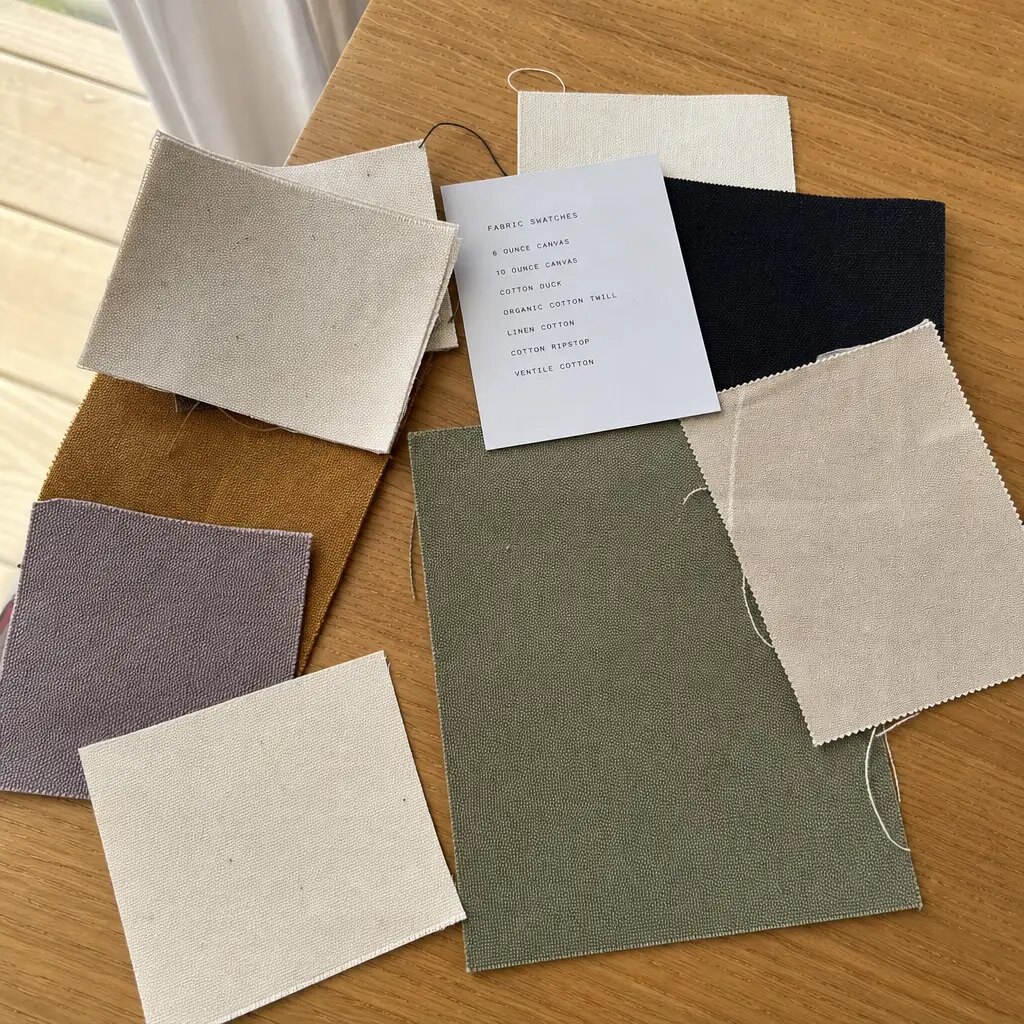
- Request swatches before sample cutting when shade, shrinkage, or handfeel matters.
- Use stock natural, black, or standard dyed canvas when first-order MOQ matters more than custom shade control.
- Avoid vague terms like eco-friendly unless the RFQ also names the material and the supporting evidence.
Use A Comparison Model That Separates Supplier Types
The buyer should not treat every factory as the same kind of vendor. A stock-bag factory, a custom-cut-and-sew factory, a custom-dye factory, a certified-material supplier, and a trim-heavy supplier all behave differently. Some are good at fast development and limited customization. Others are better when the brand needs a specific color, a document trail, or a premium hardware package. The quote format should tell you which business model you are actually buying from.
A stock-bag factory is usually the fastest path to a first order. The price is easier to understand because the body fabric, webbing, and base construction are already in motion. A custom-dye factory often adds lab dips and longer lead time but can solve brand-color requirements. A certified-material supplier may be the right route when material claims need to hold up in wholesale review or packaging copy, but documentation review can slow the process. A trim-heavy supplier can build a stronger premium story, yet it often adds separate minimums and more QC points.
The practical comparison is not about sourcing theory. It is about what changes in the quote, what happens to lead time, and where the risk sits if the first order is delayed or the color is off. Compare supplier routes on the same dimensions every time: MOQ trigger, customization depth, documentation burden, and the point at which lead time starts to stretch.
- Match supplier route to launch strategy instead of asking every factory for the same solution.
- Ask whether MOQ is per SKU, per color, per artwork, or across the total order.
- Use the route that fits the first order, not the one that sounds most flexible in email.
Negotiate MOQ In Scenarios, Not In A Single Generic Ask
The lowest MOQ is not always the best commercial outcome. A buyer can often get a smaller number by accepting stock color, one logo color, bulk packing, and standard hardware. That is usually the right path for a pilot. If the brand insists on custom-dyed canvas, matching webbing, premium hardware, and retail-ready packing, the MOQ should be expected to rise because each choice adds setup or sourcing friction.
A better negotiation is scenario-based. Ask the supplier to price the same bag in three or four versions: stock-color logo-only, stock-color plus woven label, custom dye with one-color print, and custom dye plus upgraded hardware or retail packing. Then compare unit price, lead time, sample fee, and minimums side by side. That shows the actual tradeoff between a faster launch and a more brand-specific product.
This approach also prevents a common mistake. Buyers sometimes push for a lower MOQ on a highly customized bag and then lose money in hidden costs: extra sampling, longer approval cycles, shade rejection, or freight waste from a heavier carton plan. The order may look smaller on paper, but the landed cost per sellable unit can be worse. A good negotiation gives the supplier room to answer in tiers, not in a single guarded line.
- Request separate MOQ and pricing for stock-color, custom dye, certified material, and premium-trim versions.
- Ask whether a larger total PO can be split across colors or artworks without multiplying the setup cost.
- Compare landed cost, not only the ex-factory unit price.
Choose Branding Methods That Fit A First Run
Logo method affects both MOQ and risk. One-color screen print is usually the easiest first-order option because the setup is straightforward and the visual result is predictable on canvas. It works best for bold marks, simple typography, and clear placement. Fine type, very light inks on dark canvas, or art that crosses a seam should be treated as higher risk and reviewed with a strike-off before bulk.
Embroidery can look premium, but it adds thread count, stitch density, backing, and puckering risk. Woven labels and patches suit apparel brands well, but they often come with their own minimums and their own lead times. Heat transfer can carry detail, yet it needs checks for cracking, edge lift, shine, and adhesion after flex. The right answer is not the fanciest method. It is the method that can be produced repeatably at the order size you are negotiating.
For a first order, one strong front mark and one small side label is often enough. If the bag still needs more brand presence, the smarter place to add it may be hangtags or carton branding, because those changes are cheaper to revise later. That keeps the bag focused on construction and fit rather than trying to carry every branding decision at once.
- Use one-color screen print for bold artwork when the goal is lower setup friction.
- Request a strike-off for fine type, multiple colors, dark canvas, or seam-adjacent placement.
- Confirm separate minimums for woven labels, patches, hangtags, or insert cards.
Lock Sample Terms, Payment Terms, And Incoterms Before Deposit
Samples are expensive because they compress decisions into a small run. A simple stock sample may cost a modest amount, while a revised sample that includes custom dye, custom hardware, or repeated artwork changes can move materially higher. Some suppliers credit the fee against bulk; others do not. The important point is not the exact number in isolation. It is whether the sample process is being treated as a paid development step or as part of the first-order commercial package.
Payment terms matter just as much. New buyers often see 30/70 T/T, with 30 percent deposit and 70 percent due before shipment. Smaller orders can be pushed toward 50/50 or even full prepayment if the supplier views the job as higher risk. For larger or repeat programs, more structured terms may be possible, but they usually follow a history of on-time payment and clean inspections. If a supplier asks for 100 percent upfront on a meaningful order, treat that as a risk signal unless there is a clear commercial reason.
Incoterms change what the quote actually means. EXW looks cheaper, but the buyer takes over earlier in the logistics chain. FOB is often easier to compare because the supplier handles export delivery to the port. CIF can simplify the picture but can hide freight variability inside the vendor quote. DDP may look convenient, yet it can blur duty and tax responsibility. Procurement should ask for the same bag priced under the same term, or the comparison is not real.
- Ask whether the sample fee can be credited back against bulk and whether revisions are included.
- Confirm whether 30/70, 50/50, or letter-of-credit terms are available for larger orders.
- Quote the same order under one Incoterm so freight and export handling are comparable.
Set QC Limits That Can Be Measured At Inspection
Quality control should be decided before the order is in production. For canvas messenger bags, the buyer needs tolerances for fabric weight, finished dimensions, logo placement, stitching, hardware function, labels, and packing. If the team does not define these limits, the supplier will use its own standard, and that standard may be acceptable for a promotional bag but too loose for a retail line.
A practical QC plan starts with measurable checks. Fabric weight should sit within the agreed range. Finished dimensions should be measured after sewing and finishing. Logo placement should be checked against the artwork sheet, usually within a few millimeters for a centered mark. Strap anchors need the approved reinforcement pattern, and seams should show no open edges or weak spots at load points. Hardware should cycle smoothly and show no sharp edges, rust, or plating defects.
The defect system should also be clear. Critical defects include unsafe hardware, missing required labels, incorrect origin or material claims, and structural failure. Major defects include out-of-tolerance dimensions, crooked flaps, print smears, or zipper failure. Minor defects can include small thread ends or natural canvas slubs if the approved sample allows them. If your QC partner uses AQL, many buyers start with critical 0, major 2.5, and minor 4.0, then tighten or relax the plan based on risk and channel sensitivity.
- Measure the finished bag, not just the cut pattern.
- Use the approved sample and written tolerances as the inspection standard.
- Ask for in-line photos or top-of-production approval when the order uses new fabric, new artwork, or new hardware.
Plan Packing And Freight Before The Unit Price Looks Final
Packing has a direct effect on landed cost. Bulk packing is efficient for wholesale, employee kits, and distributor shipments. Retail-ready packing adds labor, materials, and carton volume, which can be worth it if the bag needs shelf presentation or barcode control, but it should not be added casually. A messenger bag with metal hardware and a large print can also be damaged by careless folding, so the packing method needs to protect visible surfaces, not only reduce carton count.
Ask the supplier to quote the carton plan with the product. Units per carton, carton dimensions, gross weight, folding method, carton marks, barcode placement, and total CBM should all be visible before final approval. This matters because heavier canvas and custom hardware affect freight differently from light promotional bags. A slightly higher ex-factory price with better packing can still produce a lower landed cost if it reduces damage, chargebacks, or airfreight penalties.
Landed cost should include more than the factory price. Add setup, sample fees, packing, freight method, duty assumptions, inspection, and likely rework. The cheapest quote can become expensive if the supplier hides a trim minimum, adds a new packing charge later, or uses a carton plan that inflates volume. Procurement should know the true cost per sellable bag before saying yes.
- Request carton dimensions, units per carton, gross weight, and total CBM before final supplier selection.
- Choose retail packing only when presentation or fulfillment needs justify the added cost and volume.
- Keep the packing spec aligned with the logo placement so the print is not creased in transit.
Build The Reorder Path While The First Order Is Open
The first order should create a repeatable system, not just a shipment. Keep the approved sample, artwork file, print reference, trim references, carton plan, and tolerance sheet together. When the reorder happens, the supplier should not have to relearn the product from scratch. That saves time, reduces interpretation errors, and makes the second quote more comparable to the first one.
Reorders are where procurement discipline pays off. If the launch order uses stock canvas and a one-color logo, the next run can introduce a new color, a better label, or a more premium closure once the market proves the bag. If the launch order starts too complex, the brand has fewer options to optimize later. A controlled first order gives the team a cleaner path to scale because it isolates the changes that actually matter.
The practical goal is simple: get the first bag right, then preserve the exact decisions that made it work. If the supplier can hold the same fabric, same reinforcement, same print method, and same pack standard on reorder, the brand can spend its time on sales instead of re-approving avoidable details. That is where a good MOQ negotiation turns into a durable supply plan.
- Keep a sealed reference sample and the final spec sheet with the purchase order.
- Record any approved exceptions so they do not disappear on reorder.
- Add new customization only after the first version proves it can sell at the target price.
Specification comparison for buyers
| Supplier route | Typical MOQ trigger | Customization level | Documentation burden | Best fit / commercial tradeoff |
|---|---|---|---|---|
| Stock-bag factory | One body color, one logo method, standard trim set, standard pack format | Low to moderate | Low | Best for pilot launches, wholesale testing, and fast sample-to-bulk cycles. Lowest friction, but the design must fit the factory's existing material and trim setup. |
| Custom-cut and sew factory | New pattern pieces, revised panel count, custom strap construction, or unusual pocket layout | Moderate to high | Moderate | Best when the bag needs a distinct silhouette or function. MOQ rises because cutting efficiency and sewing time change with the pattern. |
| Custom-dye or color-matched factory | Specific body color or strap/webbing color outside stock range | Moderate | Moderate | Best when color consistency matters more than the lowest price. Expect extra approval steps for lab dips or shade matching and a higher risk of color drift between lots. |
| Certified-material supplier | Claims tied to recycled, organic, or other documented fiber streams | Moderate | High | Best when the brand needs claim support for product pages, wholesale review, or packaging. Documentation can slow the quote and reorder path. |
| Trim- or hardware-heavy supplier | Custom buckles, snaps, sliders, labels, or nonstandard closure systems | Moderate to high | Moderate | Best for premium positioning where trim quality is visible to the customer. Separate component minimums can become the real MOQ driver. |
| Trading company or sourcing agent | Order aggregation across multiple buyers or factories | Low to moderate | Variable | Best when language support, factory access, or order consolidation is needed. Useful for small pilots, but the buyer must verify where cost and process control actually sit. |
Buyer checklist before sampling
- Define the commercial channel first: wholesale, retail, employee kit, event merchandise, or gift-with-purchase.
- Write the expected carry load in plain terms, such as tablet, notebook, folded apparel, catalog, bottle, or daily-use items.
- Specify finished width, height, gusset, flap drop, strap width, usable strap range, pocket count, and closure type.
- State the canvas weight in oz and GSM, then note whether the weight is measured before or after finishing, washing, or coating.
- Separate required features from optional upgrades so the supplier can price the bag in clear tiers instead of one bundled number.
- Confirm the base material category: conventional cotton canvas, recycled cotton canvas, organic cotton canvas, undyed canvas, or a blend if applicable.
- Send vector artwork with exact size, placement, Pantone or ink reference, color count, and an acceptable placement tolerance.
- Request line-item pricing for the bag body, logo method, woven label, hardware upgrade, sample fee, setup charge, packing, and bulk unit price.
- Ask the supplier to quote MOQ by driver: fabric color, artwork, print position, trim set, material claim, packing format, and total order quantity.
- Approve one physical sample using the same canvas, webbing, closure, logo process, seam finish, and packing method planned for production.
Factory quote questions to send
- What exact canvas weight are you quoting in oz and GSM, and is that figure measured before or after finishing, washing, starching, or coating?
- Is the MOQ based on one fabric color, one artwork, one print position, one trim set, one packing method, or total units across all variants?
- Which components are stock and which are custom: canvas, webbing, lining, thread, zipper, snap, buckle, slider, label, hangtag, carton mark, insert card, or polybag?
- What is the lowest MOQ for a stock-color canvas messenger bag with one-color logo only?
- What MOQ applies if we request custom dye, certified material, custom webbing, custom hardware, lining, embroidery, or retail-ready packing?
- Can you quote the base bag, print, embroidery if applicable, woven label, hardware upgrade, packing, sample fee, setup charge, and inspection cost as separate lines?
- What is your sample fee, and can it be credited back against the bulk order if the order is placed?
- Will the approval sample use the same bulk canvas, webbing, thread, hardware, logo process, seam finish, and packing method?
- Can you separate EXW, FOB, CIF, or DDP pricing so we can compare landed cost properly?
- What deposit and balance terms do you require for a new buyer, and are 30/70, 50/50, or letter-of-credit terms available for larger orders?
Quality-control points to confirm
- Canvas weight should match the approved specification within the agreed tolerance, often around +/-5% when the buyer and supplier both accept that range.
- Finished dimensions should be measured after sewing and finishing, with a written tolerance such as +/-5 mm for smaller dimensions and +/-10 mm for larger body measurements unless the design calls for tighter control.
- Logo placement should be checked against the artwork sheet, commonly within +/-3 mm to +/-5 mm for a centered mark or flap-aligned placement.
- If the team uses AQL, a common starting point is critical 0, major 2.5, and minor 4.0, then adjust based on risk, lead time, and channel sensitivity.
- Stitch density should be agreed before bulk, for example 7-9 stitches per inch for medium-weight canvas seams where that range fits the construction.
- Strap anchors should use the approved reinforcement pattern, such as box-X stitching or bar tacks, with no skipped stitches, open seams, or loose thread clusters at load points.
- Seams, gusset joins, flap corners, and base corners should fully cover raw edges and show no fraying, exposed seam allowance, or uneven folding that weakens the structure or appearance.
- Prints should show acceptable opacity, edge quality, and curing, with no visible smearing, tackiness, pinholes, cracking, or lift after a light flex and rub check appropriate to the print method.
- Embroidery should be checked for puckering, broken thread, loose backing, distorted lettering, and unreadable small details.
- Zippers, snaps, buckles, sliders, and magnetic closures should align correctly, operate smoothly through repeated manual cycles, and show no sharp edges, rust, weak attachment, or plating defects.