1. Why coffee roasters need a spec-first MOQ negotiation
Coffee roasters usually do not buy canvas messenger bags as throwaway promotional items. The bag is tied to a real commercial moment: a holiday coffee bundle, café opening, subscription welcome kit, staff issue, wholesale partner incentive, loyalty reward, or retail merchandise displayed beside beans and brewing equipment. That means MOQ negotiation has to connect factory realities with the roaster’s sell-through plan. The right quantity is not simply the lowest number a supplier will accept. It is the lowest workable quantity that still produces saleable, repeatable bags at the required quality, price, and launch date.
Canvas messenger bags also carry more brand exposure than many small promo products. Customers may wear them in public. Staff may use them daily. Distributors may judge the roaster’s retail discipline from the finish of the product. A sagging body, weak strap, crooked flap logo, rough inside seam, or crushed packing can make the whole merchandise program feel poorly controlled. For that reason, MOQ should be negotiated together with material, construction, decoration, sample approval, QC tolerance, and carton control.
The common procurement mistake is asking, “What is your lowest MOQ?” before sending a complete specification. That question invites uneven quotes. One supplier may price a 10 oz unlined bag with one-color print and no hardware. Another may include 14 oz canvas, a magnetic snap, inside pocket, woven label, and export carton. Both may call the item a canvas messenger bag, but the MOQ and cost structure are not the same. A stronger process starts with the use case, locks the first specification, and then asks which part of that specification creates the minimum.
- Retail merchandise: prioritize consistent logo placement, clean stitching, shelf-ready packing, and repeatable color for reorders.
- Staff issue: prioritize reinforced strap anchors, comfortable webbing, usable pockets, and closure reliability.
- Gift bundle: prioritize packing presentation, low wrinkle risk, and practical kitting with coffee products.
- Distributor resale: prioritize barcode or carton labeling, stable carton counts, and reorder consistency.
- Event bag: prioritize a short sampling path, controlled unit cost, and a decoration method that can be produced reliably.
2. Turn the coffee-roaster use case into measurable bag specs
Before asking for MOQ, define what the bag must carry. A bag for two 250 g coffee packs and a brew guide can use a simpler construction than a staff bag carrying a notebook, sample bags, café tools, and a tumbler. If the item will be sold online, the bag also needs predictable packing dimensions and a presentation standard that survives warehouse handling. The factory cannot recommend fabric weight, reinforcement, or packing well unless the expected load is clear.
Use finished dimensions rather than general descriptions. A practical RFQ should state body width, body height, gusset depth, flap drop, opening width, strap width, adjustable strap length range, closure type, pocket layout, and decoration position. “Medium messenger bag” is too loose. Finished measurements are also necessary for QC because pattern dimensions and finished dimensions can differ after sewing, washing, pressing, and folding.
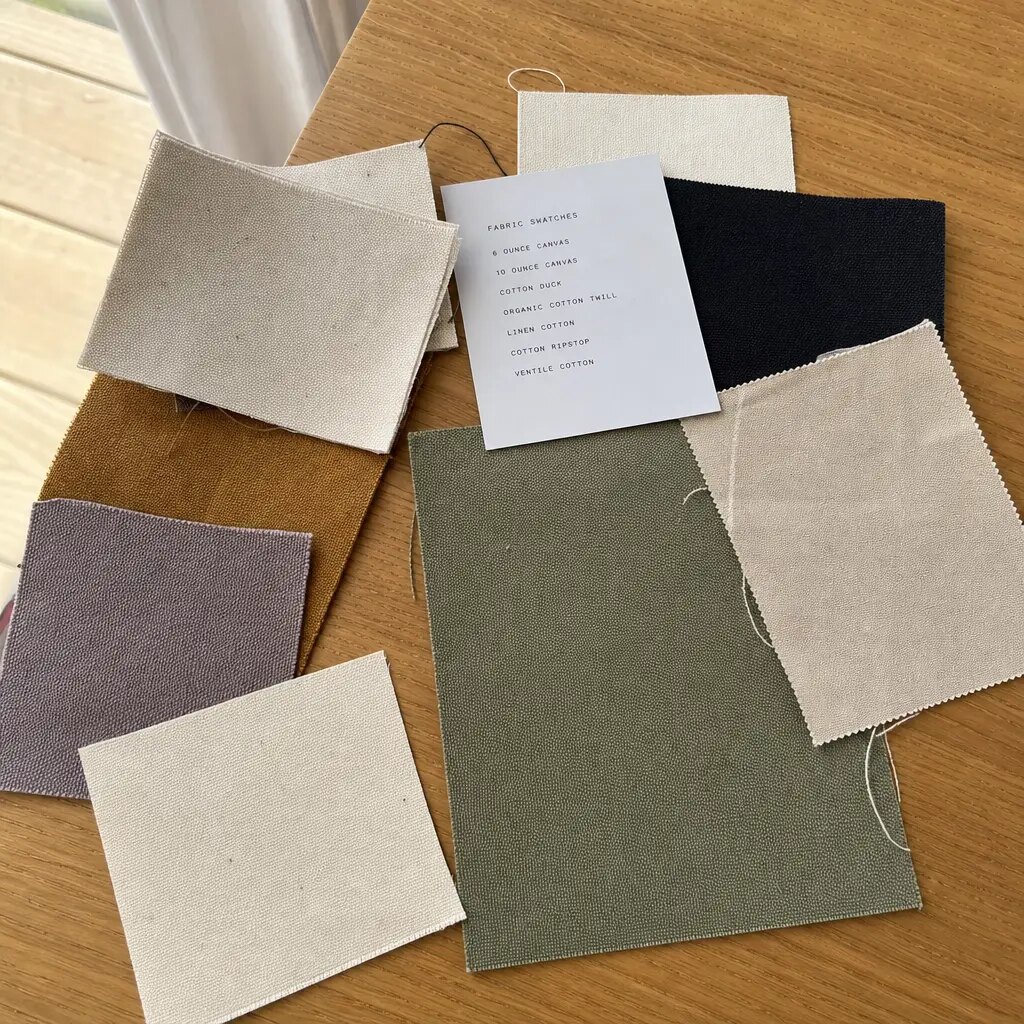
Fabric terminology needs the same precision. In bag sourcing, 12 oz, 14 oz, and 16 oz usually refer to ounces per square yard, not the weight of one finished bag. Approximate equivalents are 12 oz around 407 gsm, 14 oz around 475 gsm, and 16 oz around 542 gsm. Ask whether the supplier is quoting greige fabric weight, finished fabric weight, or washed fabric weight, because finishing can change both hand feel and measurement. If the roaster wants a more structured retail feel, quote 14 oz beside 12 oz instead of assuming the lighter fabric is enough.
- Define target contents: coffee packs, notebook, tablet, tumbler, brew cards, staff tools, retail inserts, or sample kits.
- State expected load in practical terms, such as two or three filled coffee bags plus a notebook, not only “daily use.”
- Write finished dimensions and tolerances into the RFQ before sampling.
- Ask whether shrinkage is relevant if the bag is washed, garment-dyed, or enzyme-washed.
- Use the first order to prove one SKU before adding multiple colorways, pockets, or closure variants.
3. The real MOQ drivers behind canvas messenger bag quotes
A quoted MOQ is rarely just a factory preference. It is usually the result of several minimums inside the supply chain. Fabric is often the first driver. Stock natural canvas may be available by roll and easier to cut for a smaller order. Custom-dyed canvas may require a dye lot, lab dip, strike-off approval, and leftover fabric management. If the supplier must buy more fabric than your order consumes, that cost will show up as a higher MOQ, a higher unit price, or a material surcharge.
Decoration is another major driver. A one-color screen print on a flat flap panel may need one screen and one setup. A two-color print adds registration and more setup time. Embroidery on heavy canvas may require digitizing and backing. A woven side label can look clean and premium, but the label supplier may have its own MOQ that is higher than the bag order. Patches, leather-look badges, and custom hangtags create additional minimums and approval steps.
Construction and accessories also change MOQ. A simple flap-only bag with cotton webbing strap uses fewer components than a lined messenger bag with zipper, magnetic snap, metal buckle, tablet sleeve, and several pockets. Each accessory may have color, size, or finish minimums. Each added pocket creates extra cutting, sewing, measuring, and inspection time. When negotiating MOQ, ask the supplier to name the limiting factor. If fabric drives MOQ, simplify color. If decoration drives MOQ, reduce color count or choose a label. If labor efficiency drives MOQ, keep the first run to one SKU.
- Fabric minimums: canvas weight, roll width, color, dyeing, washing, coating, and leftover material.
- Decoration minimums: screen count, embroidery digitizing, woven labels, patch production, and artwork complexity.
- Hardware minimums: snaps, sliders, buckles, D-rings, zippers, adjusters, and finish color.
- Labor minimums: lining, pocket count, binding, reinforcement, curved flap, and complex strap construction.
- Packing minimums: polybags, hangtags, barcode labels, carton inserts, custom carton marks, and inner packs.
4. Build an RFQ suppliers can price without guessing
A strong RFQ makes the product visible before anyone cuts fabric. Coffee roasters often send a lifestyle photo and ask for a messenger bag with logo. That may start a conversation, but it is not enough for quote comparison. A factory needs a specification sheet, artwork, target quantity, packing requirement, trade term, and timeline. Without those details, suppliers either assume the cheapest construction or protect themselves with a higher MOQ and broad price range.
Ask for the true MOQ and practical price breaks. Instead of only asking for the lowest price, request the supplier’s MOQ at the exact specification. Then ask for price breaks at realistic quantities such as the pilot quantity, 500 pieces, 1,000 pieces, and 3,000 pieces if future replenishment is possible. Those figures are not universal MOQs; they are comparison bands. A roaster planning a small café launch may need a lower pilot quantity, while a distributor program may need a larger first run.
Artwork information should be clear. Send vector files when possible. Specify print size, logo placement, number of colors, Pantone references if required, and any fine text that must remain readable. If the brand can accept a woven label instead of a large print, say so. If a certain mark must be centered on the flap, say so. MOQ negotiation becomes much easier when suppliers know which brand elements are fixed and which are flexible.
- Attach reference photos, but make written specs the quote authority.
- Separate sample cost, pre-production sample cost, bulk unit cost, and setup charges.
- Ask whether setup charges repeat on reorders if artwork and specification remain unchanged.
- Request carton dimensions and gross weight at quote stage, not after production.
- Ask the supplier to confirm excluded costs in writing, including labels, hangtags, polybags, and carton marks.
5. Compare quotes on construction, not headline price
A low unit price is not helpful if the specification is incomplete. Procurement buyers should compare quotes line by line: fabric weight, fabric color, finished dimensions, strap width, strap material, pocket count, lining, closure, logo method, print size, labels, packing, carton count, trade term, lead time, and payment assumptions. If any line is missing, ask before negotiating. Otherwise, the buyer may be comparing different products and different service levels.
Separate one-time charges from repeat unit costs. Screen setup, embroidery digitizing, label artwork, patch tooling, lab dips, and sample fees may not repeat on a reorder if nothing changes. When those charges are hidden in the unit price, a pilot order can look expensive and reorder economics become unclear. Ask for one-time charges to be listed separately where possible, then compare the base unit price at the same specification.
Trade terms and cartons matter for canvas bags. Messenger bags can be bulky if folded poorly, and carton cube may affect landed cost more than expected. An EXW quote may exclude inland pickup and export handling. An FOB quote may be easier to compare if all suppliers quote the same port and packing standard. Ask for units per carton, carton dimensions, gross weight, and packing method before calculating retail margin.
- Compare identical 12 oz or 14 oz fabric, not “canvas” in general.
- Confirm whether the strap is cotton webbing, polyester webbing, or another material.
- Check whether closure hardware and labels are included in the unit price.
- Confirm whether the quote includes final trimming, ironing/pressing, folding, and export cartons.
- Compare lead time after sample approval, not only sample lead time.
6. Practical MOQ negotiation moves that do not cheapen the bag
The best MOQ negotiation is a structured exchange, not pressure for a lower number. Start by asking the supplier what creates the minimum. Then remove complexity that does not improve the buyer’s commercial objective. For coffee roasters, the visible value usually comes from fabric hand feel, clean flap shape, accurate logo placement, comfortable strap, and tidy finishing. Multiple colorways, extra pockets, and special hardware may be less important for a first run.
A pilot SKU is often the cleanest path. Use one stock body color such as natural, black, or navy; one finished size; one strap type; one logo position; and one closure. If MOQ remains high, ask whether a higher unit price can support a smaller batch, whether stock fabric can replace custom dyeing, whether lining can be postponed, or whether a woven side label can replace a multi-color print. Keep construction quality intact. Reducing strap reinforcement, seam quality, or fabric suitability can create returns and brand damage.
If repeat orders are realistic, communicate the plan without making false promises. A supplier may be more willing to support a pilot if the buyer explains that the first run will be evaluated for sell-through and reordered at the approved spec if it performs. You can also ask whether extra labels, patches, or fabric can be held for a future reorder and who pays for that inventory. Inventory ownership should be explicit; otherwise, leftover materials can become a hidden dispute.
- Reduce SKU count before reducing material or sewing quality.
- Use stock fabric colors before custom dyeing.
- Keep one logo method and one position for the pilot run.
- Postpone lining or extra pockets if they are not essential to the commercial use.
- Ask for a lower MOQ with a transparent unit-price adjustment, then recalculate landed cost and retail margin.
- Do not split a small order across many colorways unless each color meets a workable production quantity.
- Document every concession so the next quote does not accidentally change the approved product.
7. Sample approval: prove the bag under real coffee-roaster load
A messenger bag sample must prove function, not only appearance. A bag can look good flat on a table and fail when loaded. The flap may lift. The body may sag. The strap may twist. The print may bend across the wrong part of the flap, or the magnetic snap may miss alignment once the bag is filled. For coffee roasters, sample approval should include realistic contents: coffee bags, brew guides, notebooks, tumblers, or staff tools depending on the intended use.
Start with measurement. Check width, height, gusset, flap drop, opening width, strap width, strap length range, pocket dimensions, and closure position on the finished sample. Then load the bag and hang it by the strap. Look for strap-anchor pulling, uneven flap coverage, side-seam distortion, and base collapse. If the bag includes a zipper, snap, buckle, or slider, test the hardware while the bag is filled because empty-bag alignment can be misleading.
Decoration must be approved on the actual bag panel. A print strike-off is useful for ink color and detail, but it does not prove final placement after sewing and folding. Textured canvas can soften fine lines. Small origin text, café addresses, and detailed illustrations may fill in or lose contrast. Ask the factory to confirm print-placement tolerance and inspect the sample against that tolerance before approving bulk production.
- Measure the finished sample and record approved dimensions and tolerances.
- Load-test with the actual items the customer or staff will carry.
- Check flap coverage when the bag is full, not empty.
- Inspect logo level, center, opacity, registration, and readability.
- Test strap adjustment across likely body sizes and outerwear conditions.
- Open and close snaps, zippers, and buckles repeatedly before approval.
- Keep a sealed approved sample for factory reference and one for buyer-side inspection.
8. QC tolerances and inspection points buyers should write down
Quality control should be specific enough that the factory, buyer, and inspector understand the same standard. Canvas has natural texture, so small yarn variation may be acceptable. Stains, holes, severe slubs, open seams, broken straps, and wrong logos are not. Define critical, major, and minor defects in practical terms. A missing closure, broken strap, wrong artwork, or unsafe hardware is critical. Crooked logo placement, open seam, severe shade mismatch, or visible print failure is major. A small loose thread that can be trimmed may be minor.
Measurement tolerances should be agreed before production. Common practical tolerances for sewn canvas bags may include around ±1 cm for body width, height, and gusset; ±2 cm for adjustable strap length; ±0.5 cm for pocket position; and ±5 mm for simple logo placement if the supplier confirms they can hold it. These are examples, not universal standards. The final tolerance should match the design and factory capability. The important part is to write it down before cutting starts.
Stress points deserve special attention. Strap anchors carry the load and should match the approved reinforcement: bartack, box stitch, X-box stitch, or another agreed method. Pocket corners, flap corners, snap areas, side seams, and D-ring loops also need inspection. If the bag is unlined, inside seam finishing is visible and should not fray excessively. If the bag is lined, inspect twisting, sagging, stains, and whether the lining catches in the closure.
- Inspect fabric weight, shade, stains, holes, panel variation, and severe slubs.
- Measure finished bags from a meaningful sample, not only the first pieces from the line.
- Check stitch security, skipped stitches, broken threads, seam puckering, and loose thread tails.
- Inspect strap anchors and closure mounts as high-risk load points.
- Check print placement, ink opacity, cracking, bleeding, ghosting, and transfer.
- Test hardware function: snap hold, zipper movement, buckle adjustment, slider grip, and D-ring alignment.
- Confirm carton count, SKU separation, barcode accuracy, and carton marks during final inspection.
9. Packing, carton control, and freight-ready presentation
Packing can decide whether canvas messenger bags arrive saleable. If compressed too tightly, the flap can develop deep creases, the logo area can distort, and the bag can look tired before it reaches the café shelf. If packed too loosely, cartons may cube out and increase freight and warehouse handling cost. The packing method should balance protection, presentation, moisture control, counting accuracy, and freight efficiency.
For coffee roasters, carton discipline matters because bags may be distributed to cafés, warehouses, event teams, e-commerce pickers, or gift-kit assembly partners. Mixed cartons with unclear quantities cause receiving delays. Ask for one SKU per carton where possible, carton marks that match the purchase order, and packing lists that show item, color, quantity, carton number, gross weight, and dimensions. If barcode stickers or hangtags are required, confirm whether the factory applies them and where they are placed.
Individual polybags can protect against dust and handling, but they may not match every sustainability policy. If polybags are used, confirm that screen prints are fully cured and bags are dry before packing. If the roaster prefers no individual polybag, specify the alternative: paper band, tissue separator, master polybag, or bulk fold. Any packing element affects labor and sometimes MOQ, so it should be included in the quote, sample approval, and pre-shipment inspection.
- Specify fold method so the flap and logo area are not crushed.
- Confirm units per inner pack, units per carton, carton size, and gross weight before shipment planning.
- Use one color and one SKU per carton where possible.
- Require carton marks that match PO, packing list, and warehouse receiving rules.
- Check print curing before stacking or polybagging.
- Ask for pre-shipment carton photos and packing-list confirmation before final payment.
- Avoid excessive carton compression if bags go directly to retail shelves or gift sets.
10. Reorders: keep MOQ gains from becoming quality drift
The first order should create a repeatable specification, not just a one-time purchase. Coffee roasters often reorder merchandise after a successful café launch, seasonal bundle, or online drop. Reorders become easier when the buyer keeps a complete technical record: approved sample, final artwork, fabric weight, color reference, trim details, closure type, label position, packing method, carton count, and inspection notes. Without that record, every reorder becomes a fresh interpretation.
Quality drift happens when small changes are not documented. A supplier may substitute webbing width, change canvas lot, move a label slightly, alter seam finishing, or use a different snap because the original component is unavailable. Some changes may be acceptable, but they should be approved before production. Ask the supplier to confirm whether any material, hardware, print process, or subcontractor has changed since the previous order.
MOQ negotiation also improves on repeat orders when the specification is stable. Setup charges may not repeat, labels or patches may already be available, and the factory knows the construction. If the roaster plans ongoing merchandise, ask for a reorder price based on the same approved spec and a separate price if any change is requested. This keeps procurement decisions clear and prevents the low-MOQ pilot from turning into an uncontrolled series of similar-but-not-identical bags.
- Store the approved sample and final specification together.
- Record fabric weight, approximate gsm, color reference, trim details, and packing method.
- Ask suppliers to declare any material, hardware, or process substitution before production.
- Use the previous approved sample as the standard for shade, logo placement, and workmanship.
- Separate same-spec reorder pricing from revised-spec pricing.
- Review inspection results after each shipment and update the defect checklist if needed.
Specification comparison for buyers
| Spec decision | Recommended option | When it fits | Buyer risk to check |
|---|---|---|---|
| Base fabric weight | 12 oz cotton canvas, about 407 gsm when the ounce rating means ounces per square yard | Coffee merchandise, tasting-event bags, staff welcome kits, subscription inserts, and moderate-load retail programs | Confirm whether 12 oz refers to greige, finished, or washed fabric; request a fabric-weight tolerance such as ±5% and test sag with the intended contents |
| Premium fabric weight | 14–16 oz canvas, about 475–542 gsm, with reinforcement at strap anchors | Higher-perceived-value retail, corporate gifting, staff field bags, tablet/notebook carry, or bags expected to hold multiple coffee packs | Heavier canvas increases sewing effort, folded bulk, needle-size requirements, and carton volume; check flap behavior, seam puckering, and strap-anchor stitch density |
| Fabric color strategy | Natural, black, navy, or another supplier-stocked color before custom dyeing | Pilot runs, seasonal launches, café merch trials, and programs where MOQ flexibility matters | Custom dyeing may create fabric-lot MOQ, shade variation, lab-dip approval time, strike-off fees, and leftover fabric charges |
| Finished size discipline | One finished size with written tolerance, such as width/height/gusset ±1 cm and strap length ±2 cm | First orders where quote comparison, sample approval, and production inspection must stay clean | Reference photos are not specifications; confirm body width, height, gusset, flap drop, opening width, strap width, strap range, and pocket dimensions on finished bags |
| Logo method | One-color screen print, woven side label, or sewn patch depending on artwork scale | Simple roaster wordmarks, café icons, origin illustrations, and understated retail branding | Fine type can fill in on textured canvas; agree print placement tolerance, often around ±5 mm for simple positions only if the factory confirms capability |
| MOQ strategy | One body color, one size, one print position, one closure type, and one packing method for the pilot SKU | Launches, anniversary merchandise, holiday bundles, staff rollout, distributor testing, or controlled retail trials | Splitting 500 pieces into 5 colorways can behave like five small orders; every SKU adds cutting, setup, inspection, packing, and leftover-material risk |
| Supplier route | Factory or sourcing partner that can document cutting, sewing, decoration coordination, packing, and final QC | B2B buyers needing repeatability, quote transparency, and lower risk across reorders | Verify which operations are in-house versus outsourced; printing, washing, labels, embroidery, and hardware sourcing commonly affect lead time |
| Lining choice | Unlined with bound or overlocked seams for cost control; light polycotton lining for a cleaner interior | Unlined suits promotional and mid-priced retail; lined suits premium gifts, tablet carry, or staff programs | Lining adds pattern pieces, sewing operations, inspection points, possible shade mismatch, and the risk of twisting or catching in zippers/snaps |
| Closure style | Flap-only for simplest merch; magnetic snap for retail convenience; zipper under flap for security | Flap-only fits event giveaways; magnetic snap fits daily use; zipper fits commuter or staff-tool bags | Magnets, zippers, buckles, sliders, and D-rings may carry accessory MOQs and require pull, alignment, corrosion, and function checks |
Buyer checklist before sampling
- Define the commercial use before quoting: retail merchandise, café staff issue, gift-with-purchase, distributor resale, seasonal bundle, online store item, loyalty reward, or corporate gifting.
- Keep the first RFQ disciplined: one finished size, one canvas weight, one body color, one decoration method, one closure type, and one packing method unless the budget truly supports multiple SKUs.
- Specify fabric terminology correctly: ounces per square yard, approximate gsm, finished fabric weight, washed or unwashed condition, and an acceptable fabric-weight tolerance such as ±5%.
- Send finished dimensions, not only reference images: body width, body height, gusset depth, flap drop, strap width, adjustable strap length range, pocket size, opening width, and seam-finish method.
- State realistic contents and target load: one to three 250 g or 12 oz coffee bags, notebooks, cupping cards, retail inserts, tumbler, tablet, grinder accessories, or staff tools.
- Ask the supplier to identify the real MOQ driver: fabric roll purchase, dye lot, screen setup, woven label MOQ, hardware minimum, sewing-line setup, packing material minimum, or carton-mark requirement.
- Request a cost-change grid for 12 oz versus 14 oz canvas, unlined versus lined, flap-only versus magnetic snap, one-color versus two-color print, and stock color versus custom-dyed fabric.
- Require setup charges to be listed separately: screen charge, embroidery digitizing, woven-label setup, patch mold, sample fee, lab dip, printing strike-off, hangtag setup, and barcode sticker cost.
- Confirm whether the quoted price includes canvas, webbing strap, adjuster, thread, closure, labels, hangtags, inner packing, export carton, carton marks, and final inspection.
- Approve a pre-production sample under load using actual coffee packs, notebooks, tumblers, or roastery tools; empty-bag photos are not enough for functional approval.
Factory quote questions to send
- What is the MOQ at this exact specification, and which item is driving the minimum: fabric purchase, custom dyeing, washing, screen setup, woven-label production, hardware MOQ, sewing-line efficiency, or packing material minimum?
- Please quote the same messenger bag in 12 oz and 14 oz cotton canvas, stating whether the weight is finished fabric weight and giving approximate gsm, fabric tolerance, and any change in sewing time or carton volume.
- Is the canvas stock fabric, greige fabric dyed to order, garment-washed, enzyme-washed, coated, water-repellent treated, or untreated, and what shade tolerance or lot-control method will be used?
- What are the exact finished dimensions in the quote: body width, body height, gusset depth, flap drop, opening width, strap width, strap length range, pocket dimensions, and seam allowance or seam finishing?
- Which logo methods are available at this MOQ: screen print, heat transfer, embroidery, woven label, fabric patch, PU patch, leather patch, or printed label, and what are the setup charges and production minimums for each?
- For screen print, what is the maximum print area, number of colors, ink type, curing method, Pantone or color-matching process, print-placement tolerance, and expected performance on textured canvas?
- For woven labels or patches, what is the label/patch MOQ, lead time, edge type, sewing position, placement tolerance, and whether unused labels can be stored for future reorders?
- Are lining, magnetic snap, zipper, buckle, slider, D-ring, cotton webbing, label, hangtag, barcode sticker, individual polybag, carton insert, and export carton included in the unit price or billed separately?
- Which processes are in-house and which are outsourced: cutting, printing, embroidery, woven-label production, washing, sewing, trimming, ironing, packing, and final inspection?
- Can you provide a pre-production sample made from the same fabric weight, same strap, same closure, same decoration process, and same packing method planned for bulk production?
Quality-control points to confirm
- Fabric weight must match the agreed specification, ideally recorded as ounces per square yard and approximate gsm; use a written tolerance such as ±5% where appropriate instead of vague terms like heavy canvas or premium cotton.
- Fabric shade should match the approved swatch or lab dip under consistent light; check panel-to-panel variation, dye streaks, stains, holes, excessive slubs, oil marks, and lot-to-lot differences.
- Finished dimensions must be measured on completed bags, not only on patterns: body width, height, gusset, flap drop, opening width, strap width, strap length range, pocket size, and overall symmetry.
- Agree measurement tolerances before production, for example ±1 cm on body dimensions, ±0.5 cm on pocket position, ±2 cm on strap length, and ±5 mm on simple logo placement if the factory confirms capability.
- Stress points at strap ends, flap corners, pocket edges, side seams, D-rings, buckle loops, and closure mounts should use the approved reinforcement method: bartack, box stitch, X-box stitch, or dense backstitching.
- Stitching should be even and secure with no skipped stitches, broken threads, loose thread tails, puckering, needle cutting, seam cracking, or visible upper/lower thread tension imbalance.
- Stitch density should be agreed on the sample; for many canvas bags, inspectors check consistency rather than a universal number, but obvious long stitches at load-bearing seams should be rejected.
- Print placement must remain centered, level, and square on finished bags; inspect on the actual flap or panel after sewing, because flat-panel strike-offs do not prove final visual alignment.
- Logo color should be checked against the approved artwork, Pantone reference, or physical standard within the limits of the selected process; inspect for bleeding, cracking, pinholes, ghosting, poor opacity, and ink transfer.
- Magnetic snaps, zippers, sliders, buckles, D-rings, and adjusters must be aligned and functional; test repeated opening, closing, strap adjustment, and loaded hanging without slipping or tearing.