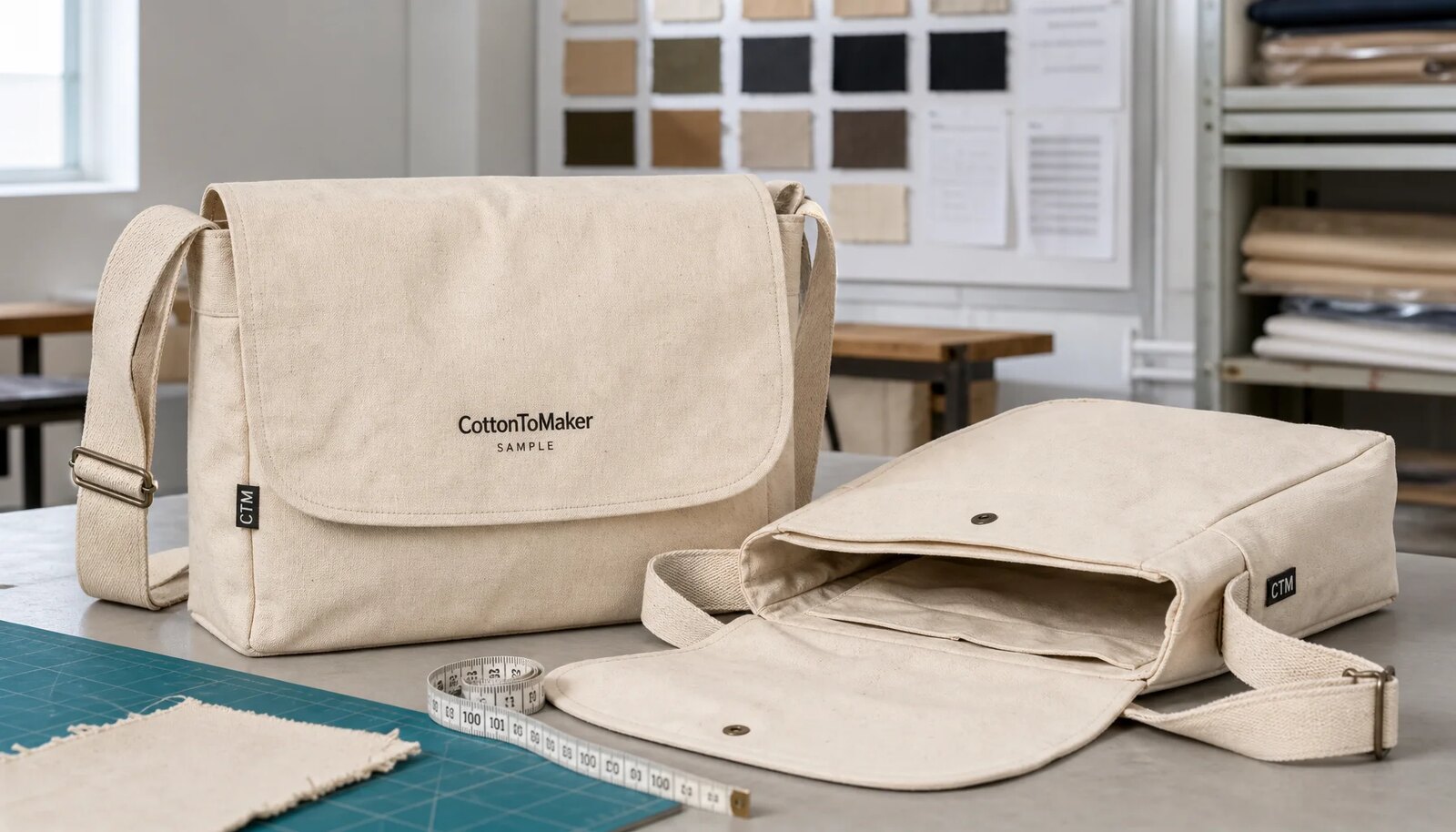
Why MOQ Negotiation Is Different for Craft Fair Messenger Bags
Craft fair canvas messenger bags live in an awkward but important space. They are not throwaway promotional totes, yet they are often ordered in quantities far below a full retail production run. A buyer may need a bag that looks good on a booth table, carries a fair logo or artist graphic, and sells through at a price local customers will accept. That mix makes MOQ negotiation less about pushing for the smallest number and more about finding which part of the order actually creates the minimum.
For this category, the MOQ driver can come from several places. It may be fabric roll size, dye-house minimum, strap webbing color, screen print setup, label production, cutting yield, sewing line setup, packing labor, or carton configuration. A supplier might agree to sew 300 pieces if stock natural canvas is ready in the warehouse. The same bag in custom olive canvas, split across five small artworks, may require a much higher commitment because the fabric and print work no longer behave like one production batch.
Craft fair buyers also sell in a very hands-on environment. Customers pick up the bag, open the flap, adjust the strap, rub the print, and compare it with handmade or small-batch goods nearby. A crooked flap, weak strap joint, thin canvas, messy print edge, or long loose thread is easy to notice. MOQ savings are not useful if the bags feel cheap at the table.
A better buying position is to give the factory a clean plan: one base bag, one fabric route, limited artwork splits, known packing, and written QC criteria. That gives the supplier a real reason to reduce MOQ without recovering the cost through vague setup fees, downgraded trims, rushed sampling, or looser inspection.
- A 300-piece order with one natural canvas body and one print is easier to negotiate than 300 pieces split across six colors and six artworks.
- Stock fabric, standard webbing, common thread, and bulk packing usually support lower MOQ than custom materials and retail packing.
- Custom-dyed fabric, woven labels, embroidery patches, special hardware, and individual polybags can each create separate minimums.
- Craft fair programs should negotiate controlled splits, not unlimited customization.
- Ask the supplier to identify the real MOQ driver before comparing price.
Build the RFQ Around One Base Construction
Start the RFQ with the bag body, not the artwork. A practical craft fair messenger bag might be about 35 cm wide and 28 cm high, with a 6-8 cm gusset, a front flap, an adjustable 38-40 mm cotton webbing shoulder strap, one inner slip pocket, and reinforced strap attachments. The exact measurements can change. The sourcing logic should not: define one base construction first, then price any changes separately.
Many buyers weaken their own MOQ position by packing too many development ideas into one quote request. One version has a zipper. Another has a magnetic snap. A third changes the gusset. A fourth uses a wider strap. To the buyer, it may feel like one 600-piece order. To the factory, it looks like several small production runs, each with its own pattern check, cutting plan, sewing sequence, operator setup, and inspection risk.
A shared construction still leaves room for variety. Craft fair programs can change front flap prints, hangtags, belly bands, woven side labels, removable patches, or barcode stickers while keeping the body common. This is often the best route for organizers, artist collaborations, and distributors who need several looks but cannot support full MOQ for every SKU.
Measurement language matters. For most canvas bags, finished dimensions should be measured flat after sewing and finishing, before final packing. If the bag is washed, state whether dimensions apply after washing and pressing. Common starting tolerances are ±1 cm for width and height, ±0.5 cm for gusset and flap depth, and ±1.5 cm for adjustable strap length. Tighten those only when the selling channel truly needs tighter retail consistency.
- Define width, height, gusset, flap depth, strap width, strap length range, pocket size, closure type, and label position before final pricing.
- Use one approved strap width, such as 38 mm or 40 mm, across all designs to reduce trim variation.
- Avoid changing gusset depth, flap shape, pocket layout, or closure method by artwork unless each version supports its own MOQ.
- Quote optional upgrades separately so the base version remains commercially clear.
- Treat the approved pre-production sample as the construction reference for every artwork split.
Select Fabric by Finished GSM, Not Only Ounces
Fabric is usually the biggest technical decision in a canvas messenger bag order. Suppliers may describe canvas by ounces, GSM, yarn count, or local trade habit. For procurement comparison, ask for both oz and finished GSM. As a broad reference, 10 oz canvas is often around 320-340 GSM, 12 oz canvas is often around 380-410 GSM, and 14 oz canvas is often around 440-480 GSM. Actual values still depend on mill, weave, dyeing, washing, and finishing, so the quote should say whether the weight is greige, dyed, washed, or finished.
For many craft fair programs, 12 oz canvas is a sensible middle point. It has more body than lightweight promotional fabric, holds a flap shape better, and can carry notebooks, catalogs, prints, and small purchases without feeling flimsy. It is also manageable for sewing, folding, and carton packing. A 14 oz canvas can feel more premium, but it adds cost, seam bulk, carton weight, and sewing difficulty at strap joints and folded corners. A 10 oz canvas may reduce price, but the buyer should test whether the flap collapses or the body feels too soft for resale.
The fabric route affects MOQ as much as the fabric weight. Stock natural canvas usually gives the most flexibility because the supplier can allocate smaller quantities. Stock black or navy can also work, although shade and availability may vary by lot. Custom-dyed fabric gives better brand color control, but it brings lab dips, dye-house minimums, shrinkage checks, and often a larger fabric purchase than the actual sewing quantity. Washed canvas can add softness and character, but it may shift shade, shrink dimensions, and soften print edges.
Do not ignore fabric defects and claims. Natural cotton canvas may show small slubs and seed flecks; these are often part of the material character. Holes, oil marks, contamination, broken yarns, and severe shade bands should not pass unless the buyer has explicitly accepted that look. If the product uses organic cotton or a recycled cotton blend claim, certification and chain-of-custody requirements should be discussed before quotation.
- State both oz and finished GSM, and ask for the acceptable GSM range in writing.
- Clarify whether GSM is measured before dyeing, after dyeing, after washing, or after final finishing.
- Use stock natural canvas when the priority is lower MOQ, faster sampling, and easier repeat buying.
- Use custom-dyed canvas only when brand color justifies lab dips, fabric-lot minimums, and added time.
- Approve canvas, webbing, thread, and binding shades together because trim mismatch is easy to see.
Control Artwork Splits Before Negotiating MOQ
Artwork splits are where many craft fair bag projects become expensive. A buyer may want one design for the organizer, several artist graphics, a city version, and a seasonal version. The factory sees screen setup, ink mixing, registration, curing, sorting, and packing by design. If the RFQ asks for many small artwork quantities without rules, the supplier will usually raise the unit price, set a higher minimum per design, or simplify the process in a way that may hurt quality.
A stronger structure is to negotiate total MOQ first and minimum pieces per artwork second. For example, 600 pieces in one natural 12 oz canvas body may be realistic as three one-color screen prints of 200 pieces each. A 1,000-piece order may support five designs of 200 pieces if all use the same print size, ink color, placement, and packing method. If one design is a small one-color logo and another is a large three-color illustration, they should not be treated as the same production cost.
Artwork should be ready for production, not just presentation. Vector files reduce interpretation problems for logos and line art. The RFQ should include Pantone or other color references, print dimensions, print zone, print location measured from fixed edges or seams, and a note on whether fine lines or small text are acceptable on canvas texture. Natural canvas can soften edges and change perceived ink color, so a strike-off on the exact fabric is more useful than a digital mockup.
For repeat fair programs, build an approved artwork framework: one bag body, fixed print zones, standard ink systems, and archived files. This can shorten later development, although screen setup, ink mixing, and label production may still apply. Also define overrun and underrun rules by artwork, not only by total order, especially when each design is allocated to a different artist, booth, city, or sponsor.
- Negotiate total MOQ, then minimum quantity per artwork, then price impact for extra versions.
- Keep print size, position, ink type, and color count consistent across versions where possible.
- Ask whether same-color prints can be grouped to reduce setup and improve price.
- Confirm overrun and underrun rules for each artwork, not only for the total order.
- Do not allow late artwork substitutions without a revised strike-off or written change approval.
Match Decoration Method to Quantity and Canvas Behavior
Screen printing is usually the most practical decoration method for low to medium MOQ canvas messenger bags. It suits bold logos, fair names, maker marks, and one- to three-color illustrations. The main cost drivers are screen setup, number of colors, print area, registration difficulty, ink type, curing time, and whether the panel can be printed flat before sewing. A front flap print is often more consistent when applied to a flat cut panel before assembly because pressure and alignment are easier to control.
Embroidery can look premium, but it needs care on canvas flaps. Dense stitching can pull the fabric, cause puckering, stiffen the flap, or distort small details. If embroidery is required, ask for a stitch-count estimate, backing method, thread color approval, and a sample on the exact canvas. For programs with several artist identities, an embroidered patch, woven label, printed cotton patch, or leather-look paper patch sewn to a common bag body may be more practical than embroidering every bag.
Digital printing can help with detailed artwork, gradients, or short design runs, but test it on the actual canvas color and texture. Canvas weave and ink absorption affect edge sharpness and color saturation. Heat transfer may support some graphics, but it can feel less natural on cotton canvas and should be checked for flexibility, edge lifting, cracking, and hand feel. Decoration should match the resale channel, not only the artwork file.
Whatever method is chosen, write measurable approval points. A print strike-off should show color, opacity, edge clarity, cure, odor, rub resistance, and placement. Print position should be measured from fixed edges or seam lines; visual centering is not enough. A practical position tolerance for flap prints may be ±0.5 cm to ±1 cm depending on design complexity and assembly method.
- Use screen print for simple craft fair branding where repeatability and cost control matter.
- Use labels or patches when many small SKUs share the same base bag.
- Use embroidery carefully on flap areas because high stitch density can affect drape.
- Require a strike-off on the same fabric weight, color, and finish planned for production.
- Measure decoration position from bag edges or seams, not from a digital mockup alone.
Negotiate MOQ Without Hiding Cost
Good MOQ negotiation gives the supplier efficiency in exchange for flexibility. A clear buyer message might be: "We can use one natural 12 oz canvas body, one strap color, one carton pack, and three artwork versions if you can support 600 pieces total." That is more credible than asking for 200 pieces spread across several fabrics, trims, and print methods. It tells the factory where production can stay simple and where the buyer needs support.
MOQ and unit price should be discussed separately. A factory may accept 300 pieces, but the unit price may include higher setup recovery, more manual cutting, less efficient fabric use, and slower handling. At 600 or 1,000 pieces, the price may improve because cutting, printing setup, sewing line preparation, and packing labor are spread across more units. Buyers should compare the cost of extra inventory against the margin loss of an extremely small run.
Setup charges should be visible. Screen charges, embroidery digitizing, woven label tooling, patch setup, special cutting dies, barcode labels, hangtags, and sample fees should not disappear into a vague unit price. Separate charges make first-order economics and repeat-order economics easier to understand. If artwork and labels remain unchanged, some setup costs may not repeat.
Low MOQ should never remove core approvals. If the factory skips fabric swatches, print strike-offs, or pre-production samples to hit a low price, the buyer carries the risk. A small order is still costly if the bags arrive with weak strap joints, poor print cure, crooked flaps, or inconsistent shade. The quote should record total quantity, split rules, materials, sample path, lead time, setup charges, QC standard, and repeat-order assumptions.
- Offer efficiency in exchange for MOQ flexibility: one body, one fabric, one strap, controlled artwork splits, and one packing route.
- Ask for prices at 300, 600, 1,000, and 2,000 pieces so the cost curve is visible.
- Request written minimums per artwork, fabric color, label design, and packing method.
- Ask whether leftover stock fabric can be reserved for a defined reorder window and whether storage fees apply.
- Do not reduce MOQ by removing sample approval, print curing, reinforcement stitching, or final inspection.
Compare Supplier Quotes on Equal Terms
Canvas messenger bag quotes can look similar while describing very different products. One supplier may quote 12 oz finished canvas, reinforced strap joints, adjustable cotton webbing, one inner pocket, one-color flap print, and bulk carton packing. Another may quote thinner fabric, no pocket, a non-adjustable strap, no stress-point reinforcement, and no print setup included. The cheaper unit price may simply be an incomplete quote.
A useful quote comparison separates materials, construction, decoration, packing, samples, setup, freight data, payment terms, and lead time. Ask each supplier to confirm whether quoted materials are exact, pending approval, or temporary substitutes. This matters when a quick sample is made from available stock but bulk production will use a different fabric lot, webbing, hardware, or label.
Freight data deserves early attention because messenger bags are bulkier than flat totes. Folding method, strap thickness, hardware, and individual packing can change carton volume. Ask for pieces per carton, carton dimensions, net weight, gross weight, and estimated CBM for the exact packing method quoted. If the fair date forces air freight, carton volume can materially change landed cost. If shipping by sea, moisture control and carton strength should also be reviewed because cotton canvas can absorb odor and humidity during transit.
Payment terms and leftover-material responsibility should be compared as well. A supplier may need an early deposit to purchase custom fabric, labels, patches, or hardware. If the order includes custom-dyed canvas or custom labels, cancellation rules should say whether unused materials are billed, stored, scrapped, or available for future reorders.
- Use one RFQ template for size, fabric, construction, decoration, trims, packing, carton data, samples, payment terms, and lead time.
- Keep setup charges separate from unit price so first-order and repeat-order economics are clear.
- Ask suppliers to identify exclusions such as testing, duty, import tax, barcode labels, special cartons, palletization, or destination delivery.
- Compare carton CBM and gross weight before ranking landed cost.
- Require confirmation that bulk materials match the approved sample or list every open approval.
Use Samples as Production Control Gates
Digital approval is not enough for canvas messenger bags. A logo may look correct on screen and still print differently on natural canvas because fabric tone, weave texture, and ink absorption change the result. A fabric swatch, trim card, print strike-off, and pre-production sample each answer a different sourcing question. Skipping them can save a few days and create a much larger receiving problem later.
Control the sample sequence. First approve the fabric route: weight, shade, hand feel, and whether the material is stock, dyed, or washed. Then approve webbing, thread, hardware, labels, and patches. Next approve a print strike-off on the same canvas planned for bulk. Finally approve the full pre-production sample with final construction, decoration, trims, and packing references. If any material is substituted for speed, list which approvals remain open before bulk production.
The pre-production sample is not just a sales sample. It is the factory reference for cutting, sewing, print placement, reinforcement, finishing, inspection, folding, and packing. One sealed approved sample should stay with the factory, and one should stay with the buyer or inspection team. Any change after approval should be added to a revised spec sheet with date and version control.
Sample review should include real fair-use checks. Load the bag with a notebook, small catalog, wallet, or lightweight merchandise. See whether the strap adjusts smoothly, the flap sits straight when filled, the print remains visually centered, and the inner pocket holds shape. Open and close zippers or snaps repeatedly. These simple checks catch issues that flat product photos miss.
- Approve fabric swatch, trim card, print strike-off, and full pre-production sample in sequence.
- Do not release bulk production if exact fabric, webbing, hardware, or labels remain unapproved.
- Measure print location from fixed edges or seams and write the tolerance in the spec sheet.
- Keep one sealed approved sample at the factory and one with the buyer or inspector.
- Record every post-sample change in a revised specification before production starts.
Write QC Criteria Before Bulk Production
Quality control for canvas messenger bags should be measurable. "Good stitching" is not a QC standard. The spec sheet should define dimensions, fabric, stitch density, reinforcement method, print position, shade tolerance, hardware function, odor, packing, and defect classification. For retail craft fair programs, visible defects matter because customers handle the bag directly before buying.
A practical inspection plan can use AQL sampling with critical, major, and minor defect categories. Critical defects may include safety hazards, sharp metal burrs, mold, contamination, or severe odor. Major defects may include open seams, broken strap reinforcement, wrong artwork, unapproved fabric shade, misaligned closure, failed zipper, or print defects visible during normal use. Minor defects may include small loose threads, slight creasing, or minor cosmetic marks within the agreed limit. Agree the exact AQL level with the supplier or inspection company before production.
Stitching deserves extra attention because messenger bags carry load through the strap joints. The spec should call for bar tacks, box stitch, or reinforced cross-stitch at strap attachment points. A common stitch density for medium-weight canvas bags is about 7-9 stitches per inch, but the approved sample should be the visual reference. Inspectors should check skipped stitches, loose threads, open seams, needle cuts, misaligned reinforcement, and weak stress points.
Print QC should cover location, color, cure, opacity, and rub performance. A dry rub check can reveal ink transfer after curing. Natural canvas may show slight texture through the ink, but bleeding, tackiness, cracking, pinholes, and heavy odor should not be accepted unless specifically approved. Hardware should be checked for smooth operation, finish consistency, snap hold, zipper function, and corrosion marks. Packing QC should confirm folding, carton count, SKU separation, carton marks, and gross weight.
- Set size tolerances before production, commonly ±1 cm for main dimensions unless tighter control is needed.
- Define critical, major, and minor defects so inspection decisions are not subjective.
- Check strap reinforcement on every sampled bag because it is a functional stress point.
- Use the approved strike-off as the color and print-quality reference.
- Inspect packing as part of QC, not only the finished bag.
Decide Packing and Carton Data Early
Packing can change price, MOQ, labor time, and freight cost. Bulk packing is often best for craft fair operators who will unpack bags at a booth, distribute them to vendors, or store them as back-of-house event inventory. It can reduce plastic use and improve carton efficiency. Still, printed flaps may rub if bags are stacked without interleaving, and straps can tangle if the folding method is loose.
Individual polybags, hangtags, belly bands, barcode stickers, and retail-ready labels make the bag easier to sell through shops, online fulfillment, or multi-location programs after the fair. They also add packing labor, material cost, carton volume, and possible plastic packaging compliance requirements. Quote bulk pack and retail pack separately instead of adding retail presentation after production has started.
The folding method matters more than many buyers expect. A hard fold across the front flap can crease a screen print or distort an embroidered patch. Over-compression can bend hardware, mark natural canvas, or flatten the bag in a way that hurts display value. If presentation matters, request packing photos or a packing sample before bulk packing starts.
Carton details should be part of the quote, not a last-minute shipping note. Ask for pieces per carton, carton dimensions, net weight, gross weight, and CBM. For event operations, cartons should not be too heavy for booth staff or warehouse teams to handle safely. For sea freight or humid storage, confirm moisture-control steps such as dry cartons, clean storage, and desiccants where appropriate. For multi-artwork orders, carton marks and packing lists should separate SKUs clearly.
- Quote bulk pack and individual retail pack separately with carton CBM for each route.
- Define folding method, inner pack, master carton quantity, carton dimensions, and maximum gross weight.
- Avoid hard folds across printed flaps, embroidery, patches, or hardware.
- Confirm carton marks, SKU separation, artwork separation, and packing-list format before shipment.
- Use moisture-control measures for long sea routes or humid storage conditions.
Specification comparison for buyers
| Procurement decision | Recommended specification | Best fit for craft fair buyers | MOQ and QC risk to verify |
|---|---|---|---|
| Base construction | One shared messenger body: flap, 6-8 cm gusset, adjustable 38-40 mm webbing strap, reinforced strap joints, optional inner slip pocket | First craft fair inventory, artist merchandise, event organizer programs, distributor test orders | Changing body size, pocket layout, closure, or strap width creates separate cutting and sewing setups, reducing MOQ leverage |
| Main fabric weight | 12 oz cotton canvas, typically about 380-410 GSM finished; specify whether weight is greige, dyed, washed, or finished | Retail-feel bags for notebooks, catalogs, prints, small purchases, and everyday light carry | Do not compare only by oz; request finished GSM tolerance, shrinkage notes, shade standard, and approved swatch reference |
| Lower MOQ fabric route | Supplier stock natural canvas or stock black/navy canvas with standard cotton webbing and thread | 300-800 piece programs, mixed craft fair graphics, and low-risk seasonal tests | Stock shade and hand feel can vary by lot; reserve lot if repeat shade matters and approve fabric/webbing/thread together |
| Custom color route | Piece-dyed canvas with lab dip approval, fabric width, shrinkage allowance, and dye-lot minimum stated | Brand-specific colors such as black, navy, olive, terracotta, cream, or seasonal capsule colors | Dye-house MOQ may exceed sewing MOQ; clarify whether excess fabric is billed, stored, consumed in overrun, or available for reorder |
| Decoration method | One- to three-color screen print on flat flap panels before sewing, with strike-off approval | Bold logos, event marks, artist graphics, and local market merchandise | Quote screen setup, ink count, print area, curing, registration tolerance, and print-position tolerance separately from bag sewing |
| Artwork split strategy | One common body divided into controlled artwork versions with minimum pieces per design | Fair organizers, retailers, and distributors needing variety by city, artist, booth, or season | Set minimum per artwork, commonly 100-250 pieces depending on setup; too many small runs raise sorting and print-changeover risk |
| Branding trim option | Woven label, cotton patch, printed patch, hangtag, belly band, or leather-look paper patch on the same base bag | Programs where the body stays common but artist, maker, or event identity changes | Label and patch suppliers may have their own MOQ and lead time; confirm attachment placement, color approval, and overage policy |
| Closures and hardware | No closure for lowest cost; magnetic snap, zipper, rivet, or metal slider for higher perceived value | Retail resale may justify hardware; giveaways and budget booth inventory may not | Check finish match, snap hold, zipper smoothness, slider grip, corrosion marks, and pull strength against approved sample |
| Packing route | Bulk pack with interleaving for booth handling; individual polybag, barcode, or hangtag for retail channels | Bulk pack for event distribution; individual pack for shops, e-commerce, and SKU control | Individual packing increases labor, carton volume, plastic compliance needs, and landed freight; quote carton CBM for each route |
Buyer checklist before sampling
- Lock one target bag size before asking for price: finished width and height measured flat, gusset depth, flap depth, strap width, and adjustable strap length range.
- Write tolerances into the RFQ. Common starting points are ±1 cm for width/height, ±0.5 cm for gusset and flap depth, and ±1.5 cm for strap length unless the retail standard requires tighter control.
- Specify fabric weight in both oz and finished GSM; identify natural, bleached, dyed, garment-washed, organic cotton, recycled cotton blend, or conventional cotton canvas.
- Ask whether fabric weight is measured before dyeing, after dyeing, after washing, or after final finishing, then keep an approved swatch for bulk comparison.
- State the commercial use: paid retail item, event merchandise, artist collaboration, vendor gift, sponsor gift, or organizer giveaway. Each use case changes acceptable fabric, packing, and QC levels.
- Reduce first-order complexity by using one base construction and negotiating only controlled splits for artwork, label, patch, or color within written minimums per version.
- Provide vector artwork, Pantone or other color references, maximum print size, print position from fixed edges, and requirements for ink opacity, hand feel, and curing.
- Separate must-have features from optional upgrades: inner pocket, zipper closure, magnetic snap, metal slider, cotton webbing strap, lining, hangtag, woven label, barcode sticker, and carton marks.
- Request MOQ by total order, per fabric color, per artwork, per label or patch design, per packing style, and per shipment destination rather than accepting one headline MOQ.
- Ask for unit prices at 300, 600, 1,000, and 2,000 pieces, with screen setup, label tooling, sample charges, and packing charges shown separately.
Factory quote questions to send
- What is the lowest practical MOQ if we use your stock natural 12 oz canvas, standard thread, one standard 38-40 mm strap color, and bulk carton packing?
- What MOQ applies per total order, per fabric color, per printed artwork, per woven label or patch, per packing method, and per shipment destination?
- Is the quoted fabric 10 oz, 12 oz, or 14 oz, and what is the finished GSM range after dyeing, washing, or other finishing?
- What fabric width will be used for bulk cutting, and does the MOQ assume a full roll, a partial roll, or fabric already in stock?
- Is the canvas stock fabric, made-to-order greige fabric, piece-dyed fabric, garment-washed fabric, or coated/finished fabric, and what minimum fabric purchase applies?
- Can the front flap be printed as a flat cut panel before sewing, or must the assembled bag be printed? What print-position tolerance can you hold for each method?
- What setup charges apply for screen print screens, embroidery digitizing, woven labels, patches, cutting molds, special hangtags, barcode labels, or custom hardware?
- How many artwork versions can be included without changing the quoted unit price if all versions use the same fabric, ink color, strap, thread, and packing method?
- What is the minimum practical quantity per artwork if each version uses the same construction and only the front flap print changes?
- What is the sample cost and lead time for fabric swatch, lab dip if needed, print strike-off, trim approval, and full pre-production sample?
Quality-control points to confirm
- Finished bag width and height measured flat against the approved spec, commonly within ±1 cm unless the buyer requires tighter retail consistency.
- Gusset depth, flap depth, pocket dimensions, strap width, and adjustable strap length range measured with a ruler or tape, not estimated visually after folding.
- Fabric weight checked against the approved swatch and stated GSM range, with no unapproved shade shift, oil marks, contamination, holes, broken yarns, or excessive slubs beyond the accepted canvas character.
- Canvas shade, webbing shade, thread shade, binding, and label color reviewed together under consistent lighting because mismatched trims are highly visible on simple canvas bags.
- Stitch density consistent on strap joints, flap edge, side seams, bottom seam, pocket edge, and stress points; a common target for medium canvas bags is about 7-9 stitches per inch.
- Bar tack, box stitch, or reinforced cross-stitch applied at strap attachment points, with no skipped stitches, open seams, needle cuts, loose thread tails, or reinforcement placed off the stress area.
- Print position measured from fixed bag edges, flap edge, or seam line; typical tolerance should be written, such as ±0.5 cm to ±1 cm depending on artwork and print method.
- Ink coverage even, with no bleeding, cracking, pinholes, tackiness, heavy odor, poor curing, or visible transfer during a dry rub check after curing.
- Print color checked against the approved strike-off under consistent lighting, especially on natural canvas where the base tone affects perceived ink color.
- Hardware such as sliders, snaps, buckles, zippers, rivets, and magnetic closures moves smoothly, holds properly, aligns correctly, and matches the approved finish.