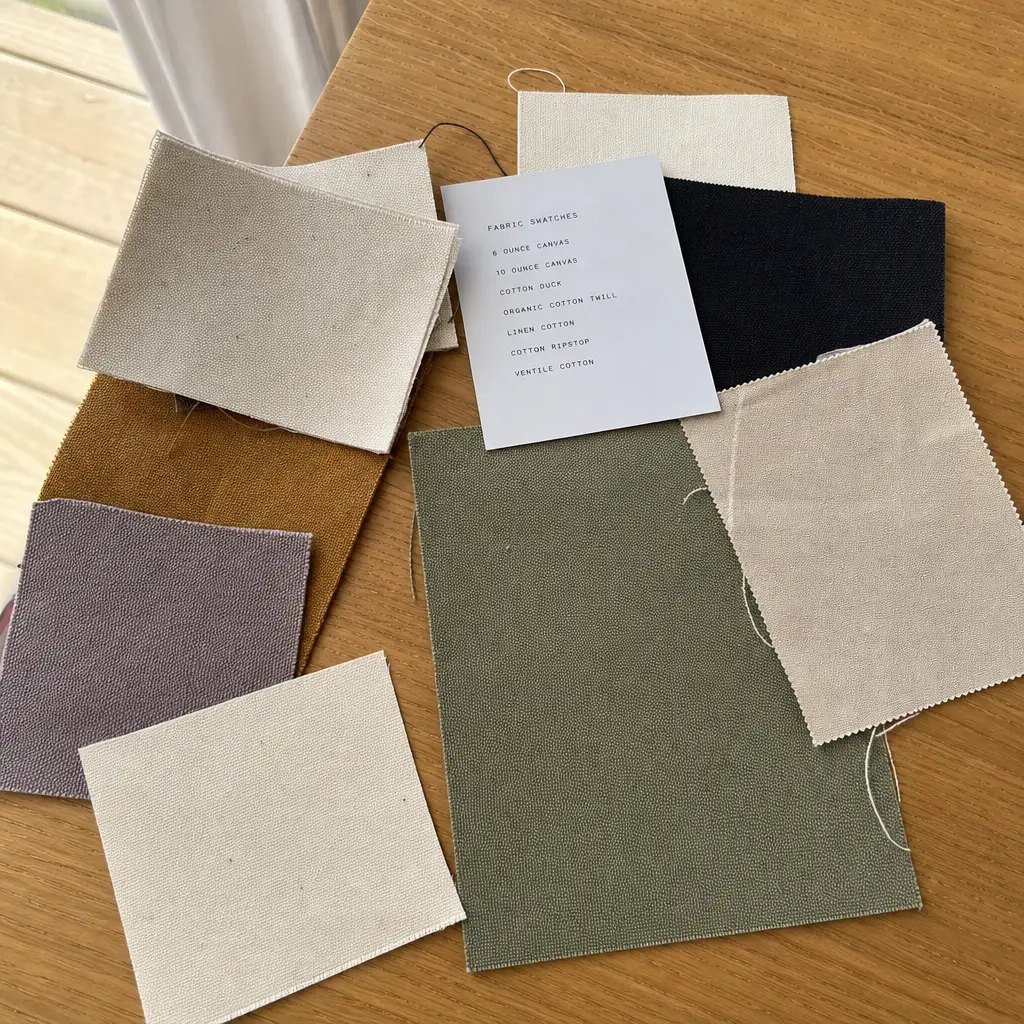
Why subscription box messenger bags fail at the material stage
For subscription boxes, the bag is rarely a standalone retail purchase. It has to fit inside a box, survive a fulfillment line, look good in photos, and still feel worth keeping after the unboxing. That creates a different material problem than a normal wholesale messenger bag order. If the canvas is too light, the bag looks cheap and collapses. If it is too heavy, freight and pack-out costs rise and the bag may crowd the box contents.
The most common sourcing mistake is treating "canvas messenger bag" as a single spec. In practice, the material system includes fabric weight, weave tightness, finish, lining, strap webbing, reinforcement patches, and the print method. A buyer who defines all seven elements usually gets tighter quotes and fewer sample revisions.
- Set the bag's job: insert, gift-with-purchase, or reusable item.
- Define target box dimensions before choosing bag depth and strap style.
- Treat hand feel, print surface, and freight weight as one commercial decision.
Choose the canvas weight around use, not around a headline spec
Most subscription-box messenger bags land in the 10–12 oz range, roughly 340–410 GSM. That weight usually gives enough body for a flat profile, decent print clarity, and manageable freight. It is also easier to sew cleanly when the factory is producing mixed SKUs. For many brand programs, this is the safest starting point because it balances cost and appearance without making the bag feel flimsy.
If the box is premium or the bag will be reused as a day bag, move up to 14–16 oz, about 475–540 GSM. Heavier canvas improves structure and makes the bag feel more substantial in hand. The tradeoff is clear: higher fabric cost, more difficult sewing at thick intersections, and more risk of shrink or uneven finishing if the mill lot is not controlled.
- 10–12 oz: best for most insert programs and mid-tier branded drops.
- 14–16 oz: better for premium merchandising and heavier content loads.
- Ask the factory to quote the same bag in two weights if you are still comparing landed cost.
Compare sourcing routes before you compare price
The supplier route changes the whole buying outcome. A direct factory with messenger bag experience can usually control fabric, sewing, and packing more tightly than a trading company. That matters when the same bag must be repeated across multiple box runs. You get fewer layers in communication, cleaner accountability on sampling, and better visibility into where a quote number actually comes from.
A trading route can still work when you need very fast color matching, a mixed catalog, or a small test order. But for recurring subscription-box supply, buyers often pay for convenience with less control over fabric substitution and less detail on what is included in the quote. If the supplier will not break out material, print, and packing assumptions, it is hard to compare real landed cost.
- Direct factory: stronger for repeat orders and spec control.
- Trading route: faster for mixed sourcing, but harder to audit.
- Hybrid route: useful when you want factory pricing with local coordination support.
Use this comparison to pick the right sourcing route
When buyers compare quotes, they often compare only unit price. That misses the cost of rework, delays, and mispacked cartons. The better approach is to compare the supplier route against the production risk you are willing to carry. The table below is useful when procurement, brand, and operations all need to sign off on the same program.
For subscription boxes, the most expensive mistake is not a slightly higher fabric price. It is a bag that arrives with a wrong fold, weak print, or the wrong carton count and forces manual rework at the fulfillment center. That cost is usually invisible in a simple quote sheet.
- Write decisions in measurable language, not only descriptive wording.
- Ask for sample photos plus one physical approval sample for important orders.
- Keep quotation, sample approval, and inspection notes tied to the same spec version.
Print method should follow the artwork, not the other way around
Canvas has texture, so print choice matters. For one or two solid spot colors, screen print is usually the most stable and cost-efficient route. It holds up well on a coarse surface when the artwork is bold and the placement is simple. If the design uses gradients, small type, or multiple colors, transfer methods may be more practical, especially on moderate MOQs.
Do not approve print based on image proof alone. On canvas, the same artwork can look sharp in a digital file and still fail in production because the weave breaks small details. Ask the supplier to show a physical strike-off or pre-production sample on the exact fabric lot. Rub resistance matters too; a print that looks fine straight out of the box may scuff after folding and shipping.
- Screen print: better for bold logos and simpler brand graphics.
- Heat transfer/digital transfer: better for detailed art, but test for cracking and rub-off.
- Embroidery: looks premium, but can distort lightweight canvas and add cost quickly.
Lining, closures, and reinforcements change the real unit cost
Two bags with the same outer canvas can price very differently once lining and hardware are added. An unlined bag is cheaper and lighter, but the inside seams need to be neat because they remain visible. A lined bag hides construction better and feels more complete, but it adds fabric, labor, and inspection points. For subscription boxes, the right choice depends on what is going inside the bag and how much the bag has to feel like a retail item after unboxing.
Closure style should also fit the delivery risk. Open-top construction is cheapest and easiest to pack, but it is not ideal for smaller accessories that can fall out. Velcro is functional and inexpensive. Magnetic snaps feel better for premium programs, while zippers give the best containment but require tighter sewing tolerance and better puller quality. Strap reinforcement is another area where under-specification hurts; if the strap is only stitched with a single pass instead of reinforced bar-tack or box stitch, the bag may look fine but fail under load.
- Unlined: lower cost, lighter weight, more visible inside finish.
- Light lining: better internal presentation and less seam show-through.
- Reinforced straps: a must if the bag carries books, samples, or tech accessories.
MOQ logic: keep variants low and standardize the base bag
Subscription box buyers often want several seasonal graphics or colorways, but too many material variants make the order expensive and slow. The best MOQ strategy is usually one base bag with the same canvas weight, same strap construction, and same lining status across the program, then vary only the print or a small trim detail. That approach keeps fabric purchasing cleaner and reduces sewing setup changeovers.
If the supplier quotes a low MOQ but the price jumps sharply at each extra color or print version, that is a sign the factory is absorbing setup cost across fewer units. In that case, it may be cheaper to consolidate artwork or to split the program into one neutral body and one limited-edition graphic. Buyers should also watch for hidden MOQ differences between blank bags, printed bags, and bags with custom labels or inner tags.
- Keep one body spec across the run.
- Limit fabric colors if the order is split by box theme.
- Separate MOQ by print version, label version, and packing version in the RFQ.
Sample approval should test the exact risks that matter later
A sample is only useful if it matches the final production route. A blank prototype can help with size and strap comfort, but it cannot approve print clarity, shrink behavior, or the final hand feel. For buyer approval, the most useful sample is a pre-production sample made with the actual canvas, actual print method, actual label, and final fold/pack method. That gives the team a realistic read on what customers will receive.
During approval, focus on a few measurable points instead of vague comments. Compare the bag width and height against spec, check strap drop with the intended content load, and inspect the stitched corners under tension. Fold the sample the way the factory will pack it and make sure the crease pattern does not distort the print. If the bag includes a zipper or snap, cycle it several times. Small defects in sample stage become large claims later when box volume scales.
- Approve final fabric lot, not just a lab swatch.
- Test print after folding and after a light rub pass.
- Measure the packed sample so fulfillment knows carton usage.
Packing and carton design affect damage, labor, and freight
Packing is part of the product for subscription-box programs. If the bags are shipped flat and neatly folded, carton usage improves and fulfillment moves faster. If the supplier over-stuffs each unit, the bag can arrive with hard crease marks, bent corners, or misshapen gussets. That creates extra handling cost and weakens the unboxing experience. For lighter canvas, a simple tissue wrap or inner polybag is often enough. For premium bags, a printed insert card may be better than bulky packaging because it keeps the presentation clean without adding much weight.
Ask for carton detail early: piece count per carton, carton dimensions, gross weight, and whether the bags are nested or individually packed. This is especially important when the bag is going directly into a subscription box line, because the fulfillment team may prefer a specific fold direction or carton count to match their pick-and-pack process.
- Use flat pack geometry that protects the strap and print zone.
- Avoid overstuffed polybags unless the bag must hold shape in transit.
- Make carton count part of the quote, not an afterthought.
Lead time, sample timeline, and the schedule risks buyers underestimate
For canvas messenger bags, realistic lead time depends on fabric availability, print complexity, and whether custom labels or special washing are included. A standard run may move quickly once the sample is approved, but any change in weave, finish, or hardware can add time. Buyers should separate sample lead time from bulk lead time, because a fast quote is not the same thing as a reliable production slot.
The schedule risk usually sits in three places: material sourcing, pre-production sample approval, and final packing. If the factory waits for fabric or webbing to be purchased after PO release, the schedule can slip before sewing even starts. If artwork is still changing during sample stage, approval drifts. If packing instructions are unclear, cartons may be repacked at the end. Put those tasks on the critical path in the RFQ so the supplier can price the real timing, not just the sewing time.
- Separate sample lead time from mass production lead time.
- Freeze artwork before the pre-production sample.
- Treat packing instructions as schedule inputs, not just logistics notes.
Specification comparison for buyers
| Spec decision | Recommended option | When it fits | Buyer risk to check |
|---|---|---|---|
| Canvas body weight | 10–12 oz cotton canvas (about 340–410 GSM) for most subscription-box SKUs | Best balance of hand feel, print clarity, and cost for lightweight lifestyle drops | Too thin will sag and wrinkle; too heavy can push parcel weight and raise freight cost |
| Premium positioning | 14–16 oz canvas (about 475–540 GSM) with reinforced seams | Works for premium boxes, co-branded programs, or bags expected to be reused heavily | Heavier fabric increases sewing difficulty, shrink variability, and price per unit |
| Print method | Screen print for 1–2 spot colors, heat transfer or digital transfer for complex artwork | Best when brand graphics are simple or order volume is medium | Fine details can break up on coarse canvas; transfer durability must be tested after rubbing and folding |
| Fabric finish | Pre-shrunk, bio-washed, or enzyme-washed canvas when color consistency matters | Useful for retail buyers who want softer hand feel and reduced post-sew shrink surprises | Washing can change shade, hand feel, and shrink rate; approve actual production lot, not just lab dip |
| Lining choice | Unlined or light poly-cotton lining depending on contents and price target | Unlined for low-cost inserts; lined for products that carry electronics, books, or cosmetics | Unlined bags may show inner seam quality; lined bags add cost and need tighter sewing control |
| Closure and hardware | Velcro, magnetic snap, or zipper based on box value and spill risk | Zipper for higher-value subscription items; open-top for promotional inserts | Hardware failure and pull strength are common claim points; request cycle and pull tests where relevant |
| Supplier route | Direct factory with bag specialization rather than trading route for repeat programs | Best for controlled specs, lower unit cost, and better process control | Requires stronger RFQ discipline; otherwise spec drift and quote gaps are common |
| MOQ strategy | One shared body spec with variable print or trim, not many fabric variants | Useful when multiple box themes share the same messenger bag silhouette | Too many material options raise MOQ per color and slow approval; keep variant count limited |
| Packing method | Flat-packed with tissue or simple insert card, carton packed by size/color | Best for box fulfillment and freight efficiency | Overstuffed bags deform in carton; poor folding can create crease marks and slower pack-out |
Buyer checklist before sampling
- Confirm target use case first: insert-only giveaway, premium merch item, or reusable retail-style bag.
- Lock fabric weight in GSM or oz, not just 'canvas,' and define acceptable tolerance.
- Specify body fabric, lining, strap webbing, and reinforcement points as separate line items.
- Choose print method based on artwork complexity, not only unit price.
- Request a pre-production sample that matches final fabric lot, print method, hardware, and packing.
- Define carton pack count, folding method, polybag use, and barcode labeling before approval.
- Set acceptance criteria for seam strength, print rub resistance, color shade, and measurements.
- Ask for a real factory quote that separates material, sewing, printing, packing, and freight assumptions.
Factory quote questions to send
- What fabric weight, weave, and finishing do you recommend for this bag at our target unit price, and what is the actual GSM or oz spec?
- Is the quoted price based on unlined or lined construction, and what reinforcement is included at stress points?
- Which print method is included, how many colors are covered, and what setup charges apply per artwork version?
- What is the MOQ by color, by print version, and by carton packing configuration?
- What sample type will you provide before production: stock sample, blank proto, printed proto, or pre-production sample with final materials?
- What is the production lead time after sample approval, and what parts of the schedule usually cause delay?
- How are cartons packed, how many pieces per carton, and what outer carton size and gross weight should we expect?
- Which quality checks are done in-line and at final inspection, and what defect standard do you use for seams, print, and measurements?
Quality-control points to confirm
- Fabric weight tolerance should be controlled within the agreed range; large underweight variance usually means the bag will feel floppy and print less cleanly.
- Stitch density should stay consistent at stress points such as strap ends, gusset corners, and flap attachment areas.
- Print registration must hold on the actual woven texture; edges should not blur, crack, or drift after folding.
- Strap length and drop need to be measured on a finished bag, not only on cut webbing, because sewing allowance changes the final fit.
- Magnetic snaps, zippers, or Velcro should operate smoothly on sample units and repeat through at least basic cycle testing.
- Color shade should be compared against the approved master sample under daylight-equivalent light, not under warm warehouse lamps.
- Carton count, folding method, and polybag protection should preserve shape and prevent corner crushing during ocean freight.