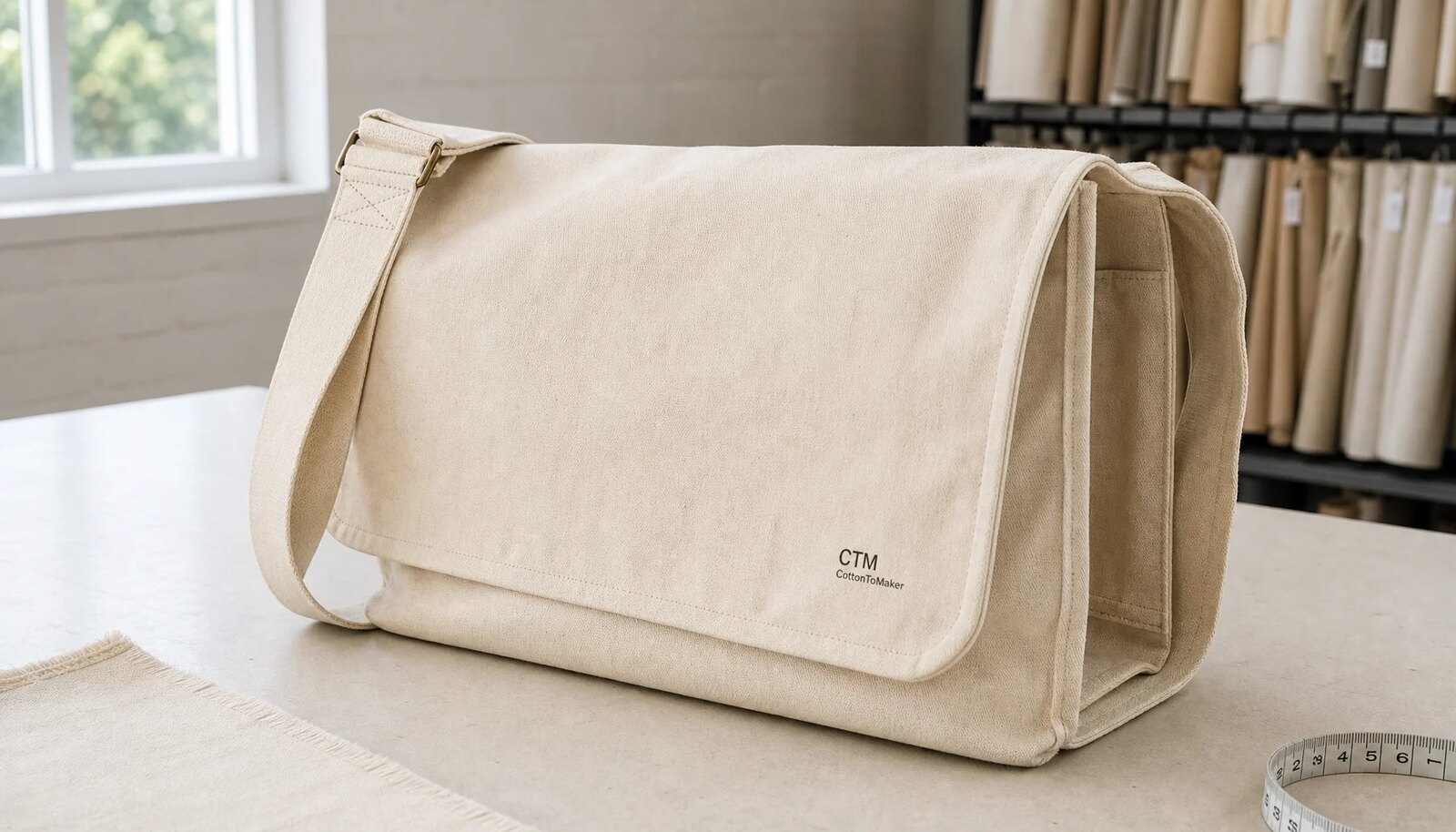
Start with the buying job, not the bag name
A canvas messenger bag can be a retail accessory, a wholesale gift-with-purchase, an employee kit, a showroom sample carrier, or upgraded apparel packaging. Those jobs sound similar until the order reaches costing. A bag that only carries a folded T-shirt and receipt does not need the same canvas, strap, closure, or inspection plan as a bag sold beside jackets and denim.
That is why the first brief should describe the business use before it describes the styling. State the intended contents, target channel, expected retail or promotional value, seasonality, order quantity, and any required material claim. A supplier can quote a low-cost messenger bag quickly, but without this context the quote may hide trade-offs in fabric weight, seam finish, hardware, or print method.
For procurement teams, the useful sequence is material, construction, decoration, packing, then QC. When the order starts with a logo mockup, buyers often discover too late that the artwork sits on a bulky fold, the selected recycled canvas has a rougher surface than expected, or the strap reinforcement is not strong enough for the proposed contents. A cleaner brief reduces those loops.
The phrase canvas messenger bags for eco apparel brands material selection guide should point to a practical sourcing document, not a mood board. Define the bag by measurable choices: canvas oz and GSM, fiber composition, body size, flap length, gusset, strap width, closure, pocketing, seam finish, decoration, packing, and tolerances.
- Describe the use case: packaging, promotion, staff kit, wholesale add-on, or sellable accessory.
- List expected contents and approximate carry weight before asking the factory to recommend reinforcement.
- Keep the first RFQ measurable so suppliers cannot quote different products under the same bag name.
- Treat sustainability language as a documentation requirement, not a styling preference.
Choose canvas weight with cost, structure, and sewing in mind
Canvas weight is often quoted in ounces per square yard, while fabric mills and inspection teams may also use grams per square meter. Use both. As a practical reference, 8 oz is about 271 GSM, 10 oz is about 339 GSM, 12 oz is about 407 GSM, and 14 oz is about 475 GSM. Also ask whether the stated weight is before or after dyeing, washing, softening, coating, or other finishing.
For most eco apparel brands, 10 oz to 12 oz is the balanced range. It feels more substantial than a basic tote, usually gives screen print enough surface stability, and can still be sewn without turning every strap anchor into a bulky production problem. It also packs more efficiently than a heavy structured bag.
The lighter route, 8 oz to 10 oz, can work for event bags, short campaigns, or light retail packaging upgrades. It is not automatically a poor choice. It becomes risky when the brand expects the bag to photograph upright, hold shape on a retail table, or carry heavier catalogues and samples. Lightweight canvas may crease more in cartons and can show a looser weave under ink.
The heavier route, around 14 oz, fits premium merchandise and daily-carry positioning. It gives body and perceived durability, but it also increases material usage, carton gross weight, needle stress, seam puckering risk, and corner bulk. Ask the factory whether it has already sewn that weight in a similar messenger construction, especially if the bag includes lining, pockets, flap layers, or adjustable strap hardware.
The best comparison is two adjacent fabric weights with the same construction. Ask for 10 oz versus 12 oz, or 12 oz versus 14 oz, with identical dimensions, strap, closure, print, and packing. That gives procurement and merchandising a real cost bridge instead of a subjective debate about whether the sample feels premium enough.
- 8 oz to 10 oz: cost-sensitive programs, light contents, compact carton packing.
- 10 oz to 12 oz: common starting point for reusable apparel-brand messenger bags.
- 14 oz: stronger structure and retail feel, with higher sewing and freight impact.
- Require a fabric weight tolerance, commonly around ±5%, and record whether weight is measured before or after finishing.
Specify fiber content before approving eco language
Words such as natural, sustainable, recycled, organic, and eco canvas are not purchase specifications. They are marketing directions. The PO should state the actual fiber composition by percentage: 100% conventional cotton canvas, 100% recycled cotton canvas, 70% recycled cotton and 30% polyester, 100% organic cotton canvas, or another agreed blend.
Recycled cotton canvas can be a strong fit for an eco apparel brand when the documentation and surface character are acceptable. Depending on source and spinning, recycled cotton may show more nep, slub, shade movement, or yarn irregularity. That texture can be attractive on a natural canvas messenger bag, but only when buyers approve it deliberately. Do not let a showroom sample with attractive variation become a production dispute because no one defined acceptable variation.
Ask what documentation supports the recycled claim, what percentage is recycled, and whether the supplier can identify pre-consumer or post-consumer input. If the paperwork does not support the full claim marketing wants to make, narrow the wording before hangtags, product pages, or retailer forms are finalized.
Organic cotton requires the same discipline. Documentation may cover yarn, fabric, or finished bags, and those levels are not interchangeable. Finished-product claim language may need chain-of-custody support. Confirm certification scope, MOQ, lead time, price, and label requirements before the artwork and packaging are locked.
Cotton-rich blends should not be dismissed. A blend may improve dimensional stability, reduce shrinkage, or meet a target price for a volume program. The trade-off is claim language. If the brand needs a pure natural-fiber message, 100% cotton is easier to communicate. If repeatable performance matters more, a documented cotton-rich blend may be the better sourcing decision.
- Write exact fiber percentages into the RFQ, quote, PO, and approval record.
- Request claim documents before using recycled, organic, lower-impact, or plastic-free language.
- Approve natural slub, nep, and shade variation with swatches or clear photo standards.
- Align supplier documents, product labels, website copy, and retailer compliance forms.
Control color, finishing, and shrinkage early
Natural canvas is popular because it looks direct, simple, and compatible with eco apparel. Still, natural is not one color. Greige, ecru, ivory, cream, and natural cotton shades can vary by fiber source, yarn lot, weaving, washing, and finishing. If shade matters, approve a physical standard and decide how much lot-to-lot movement is acceptable.
Stock colors are usually the cleaner first-order route: natural, ecru, black, or a standard mill color. Custom dyed canvas can be worth it for a coordinated retail collection, but it introduces lab dips, revised dips, bulk swatch approval, dye-lot MOQ, and shade-control work. It may also complicate recycled or organic sourcing if the desired base fabric is not available in the right lot size.
Finishing changes how the bag feels and performs. A washed canvas may feel softer and more relaxed, but it can wrinkle more and shrink differently. A stiffer finish can improve structure and print sharpness, yet feel less natural in the hand. Calendering, brushing, softening, enzyme treatment, and sizing can all affect print absorption and carton creasing.
Shrinkage matters even when the bag is not sold as washable. Cotton canvas may be steamed, pressed, stored in humid warehouses, exposed to rain, or spot-cleaned by end users. Cotton webbing, lining, and the main canvas may not behave the same way. If the bag combines several materials, the supplier should check compatibility before the pre-production sample is approved.
- Approve standards for body canvas, lining, strap, print, and hardware colors.
- For custom colors, build lab dip and bulk swatch approval into the sourcing calendar.
- Ask whether the quoted canvas is loomstate, dyed, washed, softened, brushed, calendered, or otherwise finished.
- Request shrinkage and colorfastness checks when size, steaming, rubbing, or spot-cleaning will matter.
Engineer construction around the fabric weight
A messenger bag is not judged only by the front panel. Buyers notice how it hangs on the shoulder, whether the flap covers the opening, how pockets behave when loaded, and whether the strap anchors feel secure. Construction needs to match the selected canvas, not fight it.
Unlined construction is often a smart starting point. It keeps cost and material inputs down, reduces weight, and lets the canvas itself do the work. But unlined should still look intentional. Raw internal seams may fray or appear too basic for retail. Bound seams, folded seams, or clean overlocking can give the interior a more controlled finish without moving to a full lining.
Partial lining can improve a flap, pocket area, or customer-facing interior while controlling cost. Full lining gives the most polished inside finish and hides seam allowances, but it adds cutting, sewing, shade matching, inspection, and possible shrinkage mismatch. If lining is used, specify fabric type, GSM, color, pocket reinforcement, and how the lining is secured inside the bag.
Straps deserve special attention. A messenger bag may fail at the strap even if the body canvas is strong. Common webbing widths include 30 mm, 38 mm, and 40 mm depending on style, expected load, and comfort. Define fixed or adjustable construction, finished length, strap drop, fiber composition, slider hardware, reinforcement patches, bartack count, and stitch pattern. Cotton webbing supports a natural material story but can shrink, twist, and absorb dye differently than the body fabric.
Closure choice should come from the use case. Magnetic snaps feel clean and retail-ready but need alignment checks. Zippers improve security and add functional value, but they bring zipper smoothness and sewing risk. Buckles create a utility look and more adjustment, though they slow opening. Hook-and-loop is practical and inexpensive, yet some brands dislike its texture and sound. An open flap lowers cost and metal use but may feel too simple for a sellable accessory.
- Define body size, gusset, flap length, opening width, pocket count, and seam allowance standard.
- Choose raw, overlocked, bound, folded, partial lining, or full lining deliberately.
- Specify strap width, length, drop, webbing composition, hardware finish, and reinforcement method.
- Test closure access and pocket usability with realistic contents inside the bag.
Match decoration to canvas surface and artwork detail
Screen printing is usually the most practical branding method for canvas messenger bags. It suits one- to three-color logos, bold type, simple icons, and repeat B2B orders. It also looks natural on cotton canvas, which is why many eco apparel brands choose it for wholesale and retail programs.
The limitation is detail. Coarse canvas can swallow fine lines, tight negative spaces, and small type. Ink behavior also depends on fabric texture, color, absorbency, and curing. A clean digital mockup is not enough. Require a strike-off on the actual production canvas whenever a new fabric, color, ink, artwork size, or print location is used.
Heat transfers may help with complex graphics, gradients, short runs, or artwork that screen printing cannot handle efficiently. The risk is that the transfer can feel less integrated with the canvas. Edges can lift if temperature, pressure, dwell time, or film type is wrong. Fold the decorated area as it will be packed, flex it, and rub the edge before approval.
Embroidery, woven patches, and sewn labels can lift the perceived value, but they change the production sequence. Embroidery may pucker lightweight canvas unless backing and tension are controlled. Patches need border stitching and should avoid thick seam areas. Side labels are inserted during sewing and cannot be treated as a late decoration decision. For any patch or label, specify material, size, placement, stitch color, border, and edge finish.
Placement tolerance belongs in the artwork file and inspection plan. A practical range may be ±5 mm for premium placement and ±10 mm for less critical large-logo work, but the right tolerance depends on artwork size, panel shape, and sewing variation. Avoid placing critical artwork across folds, pocket edges, gussets, or high-rub areas unless the design accepts distortion.
- Use screen print for bold logos, simple artwork, and scalable wholesale runs.
- Approve strike-offs on actual production canvas, not only on substitute fabric.
- Check transfer edge lift, embroidery puckering, patch alignment, and label insertion before bulk.
- Record artwork size, color reference, position, and tolerance in the approval file.
Build an RFQ that makes supplier quotes comparable
The RFQ should give every supplier the same product to cost. A clear base spec might read: 12 oz cotton canvas, natural color, body 36 x 28 x 10 cm, flap length 24 cm, unlined body with bound internal seams, fixed 38 mm cotton webbing strap, magnetic snap, one internal pocket, one-color screen print, flat carton packing. From there, ask suppliers to quote optional upgrades separately.
This approach reveals the cost drivers. Recycled cotton, organic cotton, custom dyeing, full lining, adjustable strap hardware, zipper closure, woven patch, individual wrapping, and special carton labeling can each affect MOQ, lead time, and unit price. If all upgrades are blended into one lump quote, procurement cannot tell which decision is moving the cost.
MOQ should be broken down by variable. Ask for MOQ per fabric weight, body color, lining color, strap color, print design, hardware finish, and packing method. A supplier may support a modest order in stock natural canvas but require a higher MOQ for custom dyed recycled fabric. That is not a problem if the buyer knows it before promising multiple colorways to the sales team.
Also ask which production steps are in-house and which are outsourced. Fabric procurement, dyeing, printing, cutting, sewing, hardware attachment, washing or finishing, final QC, and packing may not happen under one roof. Outsourcing is common, but each handoff adds coordination time and approval risk.
Quote validity matters. Cotton, recycled yarn, hardware, and freight-related costs can move. Ask how long the quote is valid, whether it assumes one shipment and one destination, and whether retailer labeling, barcode stickers, carton sequencing, or plastic-free packing are included.
- Request one base quote and separate upgrade lines for material, construction, decoration, and packing.
- Ask for MOQ by color, fabric, lining, strap, hardware, print, and carton variable.
- Require sample cost, sample lead time, bulk lead time, and quote validity in writing.
- Compare prices only after fabric weight, construction, decoration, and packing are normalized.
Approve samples with measurements and real loading
Sample approval should test repeatability, not just appearance. A front-view photo can hide weak strap anchors, rough internal seams, poor flap balance, print cracking, or a pocket that becomes useless when the bag is loaded. For a new canvas messenger bag, a physical sample is strongly preferred before bulk approval, especially with recycled content, custom dyeing, lining, hardware, or a new print method.
Measure the sample at the same points that will be inspected in production: body width, body height, gusset depth, flap length, opening width, pocket size, pocket position, strap length, and strap drop. Record the actual numbers, not only pass or fail. Common soft-bag tolerances may be around ±1 cm for main dimensions and ±0.5 cm for smaller details or print placement, but the final values should fit the bag level and customer expectations.
Load the bag the way it will be used. For apparel packaging, use folded garments. For a sales kit, use catalogues, notebooks, or sample sets. For retail accessory positioning, use daily carry items. Then check whether the strap feels comfortable, the flap still covers the opening, the closure aligns, the bag twists, and the pocket remains accessible.
Decoration should be inspected after handling. Flex the print, fold the flap as it will be packed, and rub the decorated area lightly with a dry cloth. For transfers, look at edge lift. For embroidery, check puckering and backing exposure. For patches, inspect border stitching and placement.
A pre-production sample should use bulk canvas and bulk components whenever possible. If substitute fabric, substitute hardware, or placeholder lining is used, label the sample as development only. Do not let a substitute sample become the bulk production reference unless every difference is documented and reapproved.
- Measure and record all critical sample dimensions before approval.
- Load the bag with realistic contents to test strap, flap, closure, pocket, and balance.
- Flex, fold, and rub decorated areas before approving print, transfer, embroidery, or patch work.
- Write exact approved items and required changes; avoid vague approvals such as “sample OK.”
Set QC standards before fabric is cut
Quality control starts at incoming fabric. Once canvas is cut, the factory cannot easily fix underweight fabric, wrong shade, major slubs, stains, odor, mold marks, oil marks, or shrinkage problems. The purchase order should reference the approved fabric swatch, approved weight, fiber composition, shade standard, and acceptable surface character.
For recycled cotton canvas, define acceptable variation with swatches or photos. Natural texture can be part of the appeal, but major weaving faults, holes, heavy color streaks, excessive nep, and visible panel mismatch within one bag should not pass unless the buyer has approved that look. Inspection teams need a standard they can apply carton after carton.
Dimensional tolerances should be part of the inspection plan. Main body width and height may allow wider tolerance than print placement, pocket position, or flap alignment. Strap length must be controlled because even a small difference can affect wearability. If the bag is sold as a retail accessory, tolerances may need to be tighter than for a promotional program.
Sewing QC should focus on stress points: strap anchors, side seams, pocket mouths, flap corners, closure points, and gusset intersections. Stitch density should match the approved sample; many canvas bag seams use roughly 6 to 8 stitches per inch, but the approved construction is the real standard. Skipped stitches, broken thread, loose bartacks, untrimmed thread nests, and uneven tension should be treated seriously.
A practical load check is worth agreeing before production. The test can be simple: hang a defined static weight for a defined time and inspect for seam tearing, stitch breakage, anchor distortion, or hardware failure. The load should reflect real expected use. A light packaging bag and a daily-carry messenger bag should not be judged by the same standard.
- Check fabric weight, shade, odor, surface faults, and claim documents before cutting.
- Write tolerances for body dimensions, flap, pockets, print placement, and strap length.
- Inspect strap anchors, closures, side seams, pocket mouths, and flap corners more heavily than low-risk seams.
- Agree a realistic load or pull check and record the method in the QC plan.
Plan packing, freight, and receiving before the cartons close
Packing is part of material selection because canvas creases, rubs, and absorbs odor. A soft washed canvas may pack compactly but wrinkle more. A stiff 14 oz canvas may arrive with hard fold lines if compressed into small cartons. A screen print can rub against another bag if the packing method ignores print position.
Specify the packing method: flat, folded once, folded around tissue, individually wrapped, bundled, interleaved, or bulk packed with a carton liner. If the brand avoids virgin polybags, state the accepted alternative, such as paper banding, glassine, recycled polybag, carton liner only, or controlled bulk packing. The factory default may not match the brand’s packaging policy.
Carton quantity should be linked to gross weight and warehouse handling. Heavy canvas messenger bags can make cartons difficult to lift if too many units are packed together. Ask for estimated carton size, units per carton, net weight, and gross weight at quote stage. If the warehouse has a maximum carton weight, pallet height, or label format, include it in the RFQ.
Odor and moisture deserve attention. Cotton canvas can pick up warehouse smell, dye odor, print odor, or moisture during transit. For long ocean shipments or humid seasons, consider carton liners, desiccants where appropriate, and pre-shipment odor checks. Cartons should be clean, dry, correctly marked, and not crushed before loading.
Receiving requirements can be as important as sewing quality. Carton marks, SKU labels, barcode labels, country-of-origin labels if applicable, packing lists, and carton sequencing should be correct before shipment. A well-made bag can still create chargebacks or warehouse delays if labeling is treated as an afterthought.
- Choose flat or controlled-fold packing based on canvas stiffness, print location, and final presentation.
- State whether individual polybags are allowed, prohibited, or replaceable with approved alternatives.
- Confirm carton dimensions, units per carton, net weight, gross weight, and shipping marks before packing.
- Inspect cartons for odor, moisture, crushing, incorrect labels, and print rub risk before shipment.
Specification comparison for buyers
| Spec decision | Recommended option | When it fits | Buyer risk to check |
|---|---|---|---|
| Base canvas weight | 10 oz to 12 oz cotton canvas, approximately 339 to 407 GSM before finishing | Most eco apparel brands needing a reusable bag that prints cleanly, folds for carton packing, and feels more substantial than a basic tote | Confirm whether the quoted weight is before or after washing, dyeing, or finishing; require a fabric weight tolerance, commonly ±5%, and reject substitutions that change hand feel or structure |
| Lightweight cost-control route | 8 oz to 10 oz canvas, approximately 271 to 339 GSM | Low-cost promotional messenger bags, light retail packaging upgrades, event giveaways, or short-term campaigns carrying garments, leaflets, or small accessories | May collapse when photographed, crease heavily in cartons, show looser weave under print, and feel inconsistent with a premium eco apparel brand |
| Premium or heavy-duty route | 14 oz canvas, approximately 475 GSM, with reinforcement patches at strap anchors and high-stress seams | Retail accessory programs, branded sales kits, catalog/notebook carry, or higher perceived-value merchandise where structure matters | Heavier layers increase needle breakage, seam puckering, bulky corners, carton gross weight, and landed cost; confirm the factory has experience sewing the selected weight |
| Recycled material route | Recycled cotton canvas or recycled cotton-rich blend with stated recycled percentage and available documentation | Brands that need a documented material story and can accept natural texture, nep, slub, and shade variation within approved limits | Do not approve broad terms such as eco canvas; verify fiber percentages, pre-consumer or post-consumer source if available, certification or transaction documents, and claim wording allowed by your sales channel |
| Organic cotton route | Organic cotton canvas only when certification scope, MOQ, lead time, and price are confirmed | Brands requiring organic material language in hangtags, product pages, or retail compliance documents | Confirm whether the yarn, fabric, or finished bag is covered; do not assume finished-product certification unless the supplier can provide the relevant documentation |
| Canvas color and dyeing | Natural, ecru, black, or standard stock colors for first orders; custom dyed canvas only when MOQ and lab dip time are accepted | Neutral bags for multi-season apparel collections, lower MOQ trials, and programs where exact apparel color matching is not necessary | Custom dye lots can shift shade between fabric rolls; require lab dip approval, bulk swatch approval, and a shade tolerance reference under D65 or agreed lighting |
| Print method | Screen print for bold one- to three-color logos; transfer, embroidery, woven patch, or label only when artwork and construction justify it | Screen print suits most canvas messenger bags for eco apparel brands because it is direct, scalable, and visually compatible with cotton canvas | Small type may fill in on coarse canvas; require a strike-off on production fabric, print placement tolerance, curing confirmation, and dry/wet rub checks if the bag will be used frequently |
| Closure and hardware | Magnetic snap, zipper, buckle, or hook-and-loop selected by use case; open flap only for lower-cost programs | Magnetic snaps give clean retail value, zippers improve security, buckles create a utility look, and open flaps reduce cost and metal use | Hardware adds inspection risk: check alignment, corrosion, plating scratches, magnet strength, zipper smoothness, sharp edges, and restricted substance requirements if applicable |
| Lining and internal finish | Unlined with bound seams for cost control; partial or full lining for premium retail finish | Unlined construction reduces material inputs and weight; lining improves interior appearance, structure, and pocket durability | Raw internal seams can fray; lining requires shade approval, shrinkage compatibility, pocket reinforcement, and inspection of hidden inside corners |
Buyer checklist before sampling
- State canvas weight in both oz/yd² and GSM; ask whether the number is measured before or after finishing.
- Specify exact fiber composition, such as 100% conventional cotton, 100% recycled cotton, 70/30 recycled cotton/polyester, or certified organic cotton canvas.
- Confirm which sustainability documents are available before approving recycled, organic, lower-impact, or plastic-free marketing language.
- Lock finished bag dimensions: body width, height, gusset depth, flap length, opening width, pocket count, pocket size, and seam allowance standard.
- Define measurement tolerances, for example ±1 cm for main body dimensions and ±0.5 cm for pocket or print placement, unless your program needs tighter control.
- Specify strap width, finished strap length, strap drop, fixed or adjustable construction, webbing fiber, hardware finish, and reinforcement stitch pattern.
- Choose construction clearly: raw edge, overlocked, bound seam, self-fabric facing, partial lining, or full lining with lining fabric GSM.
- Confirm closure type and testing needs: magnetic snap alignment, zipper smoothness, buckle function, hook-and-loop noise/feel, or open flap acceptance.
- Provide vector artwork with Pantone/TCX or ink reference, print size, print location, number of colors, and whether print may cross seams or folds.
- Require a strike-off on actual bulk canvas for screen print, transfer, embroidery, patch, or label placement before bulk decoration.
Factory quote questions to send
- What exact canvas weight do you recommend for this messenger bag, in oz/yd² and GSM, and is the weight measured before or after dyeing/finishing?
- Can you quote the same construction in two weights, for example 10 oz/339 GSM and 12 oz/407 GSM, or 12 oz/407 GSM and 14 oz/475 GSM?
- What is the exact fiber composition by percentage, and is the canvas conventional cotton, recycled cotton, organic cotton, cotton-rich blend, or another blend?
- For recycled or organic materials, what documentation can you provide, and does it cover yarn, fabric, or the finished bag?
- What fabric weight tolerance, shrinkage range, and shade tolerance do you normally control for canvas messenger bag production?
- Is the fabric from a stock lot or custom woven/dyed lot, and will the full order be cut from one mill lot where possible?
- What are the MOQs per fabric weight, body color, lining color, print design, hardware finish, and strap color?
- Which steps are in-house and which are outsourced: fabric procurement, dyeing, printing, cutting, sewing, washing/finishing if any, hardware attachment, final QC, and packing?
- Which print method do you recommend for our artwork, and what ink type, curing process, screen mesh or transfer film, and strike-off approval process will be used?
- What print placement tolerance do you propose, such as ±5 mm or ±10 mm from the approved position, and how will operators control it in bulk?
Quality-control points to confirm
- Fabric weight should be checked against the approved specification in oz/GSM with an agreed tolerance, commonly ±5% unless otherwise stated; underweight fabric that changes structure should not be cut.
- Fiber composition, recycled percentage, organic status, and other material-claim details must match the quote, purchase order, label copy, and available supplier documentation.
- Fabric shade should be checked against approved lab dip, bulk swatch, or standard color reference under agreed lighting; visible panel mismatch within one bag should be treated as a defect unless approved as natural variation.
- Canvas surface should be free from major weaving faults, holes, stains, oil marks, mold marks, unacceptable slubs, excessive nep, color streaks, and strong chemical or musty odor.
- Fabric shrinkage and colorfastness should be checked when the bag may be steamed, washed, spot-cleaned, or exposed to rubbing; cotton canvas and cotton webbing should be evaluated together where possible.
- Cut panels should follow approved grain direction; body panels, flaps, pockets, and linings should not twist, skew, or distort after sewing or pressing.
- Finished dimensions should be measured at defined points, including body width, body height, gusset depth, flap length, opening width, pocket position, and strap drop, with tolerances written in the inspection plan.
- Stitch length should match the approved sample, commonly around 6 to 8 stitches per inch for many canvas bag seams unless the design requires otherwise; skipped stitches, broken threads, and uneven tension should be rejected.
- Strap anchors, side seams, pocket openings, flap corners, and closure points should be reinforced with approved bartacks, box-X stitching, or reinforcement patches; loose bartacks and insecure thread ends are critical defects.
- A practical strap load check should be agreed before production, such as hanging a defined static weight for a defined time and checking for seam tearing, stitch breakage, or anchor distortion.