Start with the coffee roaster use case, not the word “canvas”
For coffee roasters, a canvas messenger bag is rarely just a bag. It may be sold beside retail coffee, issued to wholesale representatives, used by café trainers, packed into distributor welcome kits, or handed out at trade events with sample packs and cupping notes. Those uses do not ask for the same construction. A clean supplier photo can hide a weak flap, a narrow strap, a lining that wrinkles, or a logo that looks sharp in a mockup but loses definition on real canvas.
Procurement teams should treat the product as a connected material system. Shell canvas gives the bag its handfeel and body, yet the lining, reinforcement, webbing, closure, hardware, print method, packing, and tolerances decide whether the order can be repeated without surprises. Two factories may both quote a “14 oz canvas messenger bag.” One quote might include finished-weight cotton canvas, lining, zipper closure, reinforced base, and a metal adjuster. The other may use lighter greige fabric with a stiff finish to make the sample feel heavier. On paper they sound close; in production they are not.
Coffee environments add their own wear pattern. Roast dust, sample-bag corners, hand oils, van floors, café counters, and warehouse shelving all leave marks. Natural canvas can be beautiful for craft positioning, especially with kraft packaging and simple artwork, but it is less forgiving in daily field use. Dark khaki, olive, charcoal, navy, black, and coffee brown usually stay presentable longer. Before sending an RFQ, define the user, the expected contents, and how clean the bag must look after repeated handling.
- Identify the user: customer, wholesale rep, trainer, café staff, event visitor, or distributor team.
- Define the contents: 250 g sample bags, cupping spoons, notebook, sales sheets, tablet, laptop, charger, or retail gift items.
- Decide whether the bag must be durable daily equipment or attractive low-load merchandise.
- Confirm whether visible seed specks, slubs, and natural fabric character support or hurt the brand image.
- Compare supplier offers only after GSM, lining, trim, closure, print, reinforcement, and packing are defined.
Choose a realistic canvas weight and structure
Canvas weight is usually the first specification buyers discuss, but the number needs context. For many functional coffee roaster messenger bags, 12 oz to 14 oz canvas is a practical range. In finished fabric, that is commonly about 400 to 475 GSM, although conversion depends on weave, yarn, finishing, and measurement method. Ask for finished GSM and tolerance. Do not rely only on ounce wording, because some suppliers refer to greige fabric weight before dyeing and finishing.
For lighter promotional messenger bags, 10 oz to 12 oz canvas, approximately 340 to 400 GSM, can work if the contents are brochures, small samples, event inserts, or light retail gifts. The problem starts when a soft promotional construction is described as laptop-ready or field-use. If the bag has no real reinforcement, a lighter shell may sag, strain at the seams, or feel cheap once loaded. Cost can often be managed through simpler pocketing, shared trims, standard packing, and efficient color choices before cutting material below the performance requirement.
Heavier is not automatically safer. Very heavy canvas creates thick seam stacks, bulkier corners, more needle stress, slower sewing, and a higher risk of puckering if the sewing line is not set up for it. Strap anchors, bound edges, flap corners, and zipper ends become especially difficult when several layers meet. The best target is the lightest complete construction that still meets the buyer’s load, appearance, and brand promise.
- Daily-use roaster bag: consider 12 oz to 14 oz canvas with lining and reinforced stress points.
- Light event bag: consider 10 oz to 12 oz canvas with fewer pockets and clear low-load positioning.
- Laptop or tablet promise: add sleeve support, padding or reinforcement, and load testing before approval.
- RFQ wording example: 100% cotton plain-weave canvas, 12 oz nominal, 400 GSM finished, ±5% tolerance, matte handfeel, no excessive resin finish.
- Require the supplier to confirm whether the quoted weight is greige fabric weight or finished fabric weight.
Natural canvas, dyed canvas, blends, and fabric finishing
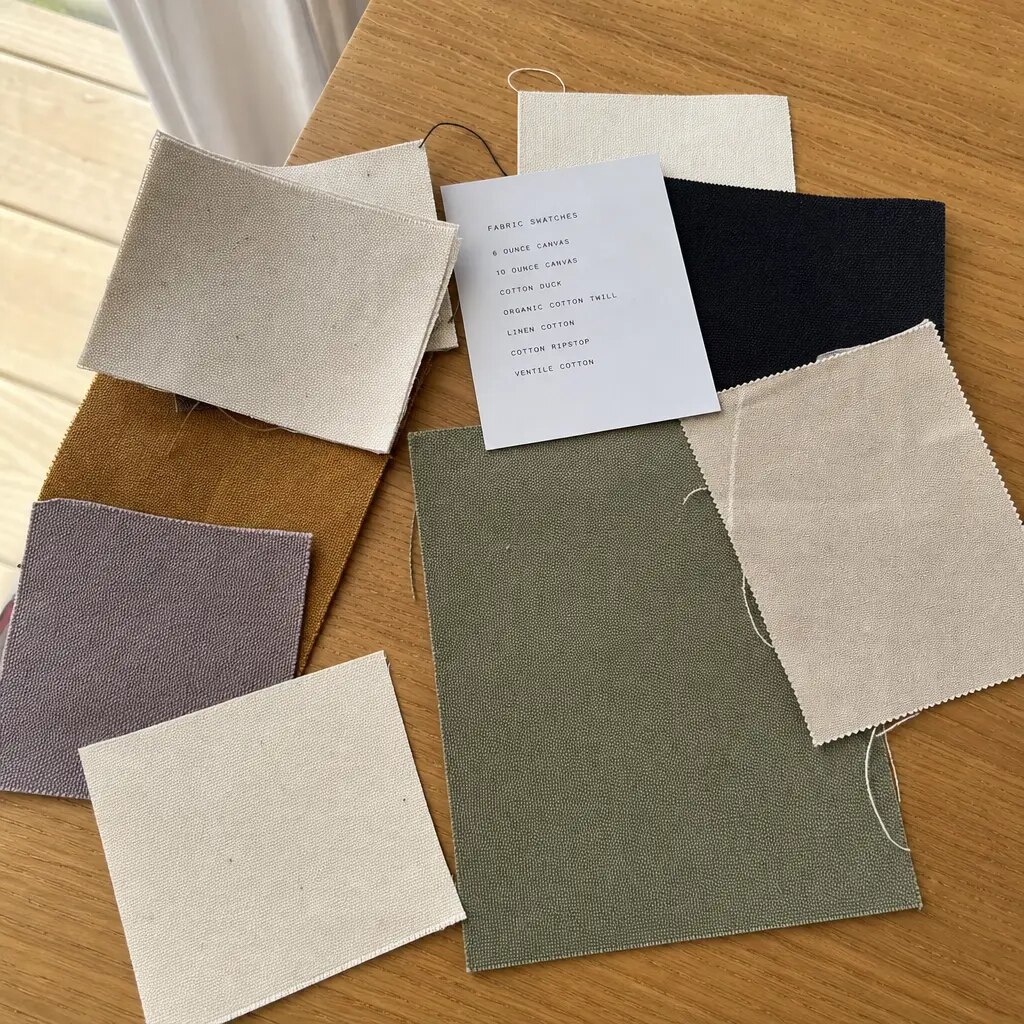
Natural cotton canvas fits coffee branding well. It sits comfortably next to kraft bags, origin cards, roastery illustrations, and one-color logos. It also has a tactile, matte surface that feels more craft than corporate. Still, natural canvas is not a perfect white print base. Seed specks, slubs, small shade shifts, and weave character may appear. Some brands want that. Others reject it. Decide early whether the program needs raw natural, cleaner bleached canvas, or a dyed shell.
Dyed canvas is often the better choice for working bags. Coffee brown, olive, charcoal, navy, black, and dark khaki hide roast dust, scuffs, and hand oils more easily than natural fabric. The tradeoff is color management. Custom dye lots can require lab dips, higher fabric minimums, and bulk shade approval. Stock colors may reduce MOQ, but ask whether the shade is a regular repeat color or only current inventory. If the roaster expects reorders, keep approved swatches from the original production.
Fiber content matters as much as color. Pure cotton supports a traditional canvas story and delivers the expected natural handfeel. Cotton-poly canvas can improve dimensional stability and help reduce shrinkage in some constructions, but it changes dye behavior, print handfeel, colorfastness, messaging, and sometimes cost. Finishing should be named in the RFQ as well. Heavy starch or resin can make a sample feel firm on day one, then soften with handling or crack at folds. Water-repellent or coated finishes may help with stains, but they can also affect ink adhesion and sewing.
- Ask for fiber composition by percentage, not only “cotton canvas” or “eco canvas.”
- For dyed canvas, approve lab dip or stock color standard under consistent lighting.
- For natural canvas, classify acceptable seed specks and slubs separately from stains and contamination.
- Avoid comparing a pure cotton quote with a cotton-poly quote unless the substitution is intentional.
- Request confirmation of finishing: washed, coated, water-repellent, pigment-dyed, piece-dyed, bleached, or heavily sized.
Interior construction: lining, pockets, sleeve, and base support
The inside of the bag is where many price differences hide. A 210D polyester lining is common for commercial canvas messenger bags because it covers seam allowances, gives pockets a cleaner base, and protects contents from the rougher back side of canvas. If the bag will carry sample pouches, cupping spoons, POS cards, notebooks, chargers, a tablet, or a small laptop, lining usually improves both usability and perceived value. Heavier pocket zones can use 300D polyester, binding, or localized reinforcement where abrasion and pulling are expected.
Unlined construction can still be appropriate for simple merchandise or cost-sensitive event programs. It should not mean unfinished. Inside seams need to be bound, overlocked cleanly, or otherwise finished according to the approved sample. Exposed hardware backs, loose threads, raw seam allowances, and distorted pocket panels quickly make a branded roaster bag feel low-grade. If the design includes a front pocket, inner divider, or sleeve, load it during sample review and check whether it pulls the outer panel out of shape.
Base, flap, and closure reinforcement deserve separate attention. A bag that carries coffee samples and notebooks may need self-fabric doubling, foam, nonwoven backing, or board reinforcement depending on how structured it should feel. Self-fabric stays flexible and folds more safely. Foam improves handfeel. Board can sharpen the shape but may warp in humid transit if the material is low quality. Magnetic snaps, zipper ends, sleeve top edges, and strap anchors should not be left unsupported.
- Use lining for retail-grade bags, daily-use staff bags, and any program with inner pockets or electronics.
- Confirm lining denier, color, fiber, pocket count, and pocket dimensions in the RFQ.
- Measure pockets against actual coffee sample pouches, not generic assumptions.
- Specify reinforcement material by location: base, flap, snap, strap anchor, sleeve, and pocket opening.
- Check that reinforcement does not create hard lumps, visible ridges, or uneven flap hanging unless approved.
Straps, closures, and hardware for real carrying comfort
Users judge the strap within minutes. A 38 mm webbing strap is a sensible minimum for messenger bags that carry more than brochures. For heavier daily use, 40 to 50 mm webbing or a shoulder pad can make the bag much more comfortable. Cotton webbing supports a craft roaster look and feels natural, but dark cotton webbing can crock if dye fixation is poor and may absorb moisture. Polyester webbing often gives more consistent color and better resistance to moisture, especially in black or dark brown.
Hardware should be specified, not assumed. “Metal hardware” is too broad for procurement. Iron, zinc alloy, brass, stainless steel, and plastic trims differ in cost, weight, plating quality, rust risk, and feel. Antique brass can pair nicely with coffee-brown canvas, but plating consistency and burr control need inspection. Hardware also affects packing. Sliders, D-rings, rivets, buckles, and snap backs can leave pressure marks on nearby bags when cartons are compressed.
Closures should reflect the way the bag will be used. A simple flap may be enough for retail styling or light gifting. A top zipper under the flap is safer for loose sample packs, chargers, pens, cupping spoons, notebooks, or tablets. Magnetic snaps look clean, but they need backing and accurate placement; otherwise the flap can skew or pull sideways. Hook-and-loop is practical but noisy and collects lint. Buckles support a heritage look, though they slow access unless paired with hidden quick closures.
- Specify strap width, fiber, thickness if known, color, adjustable length range, and shoulder pad requirement.
- Inspect a loaded sample for strap twisting, adjuster slippage, and shoulder pressure.
- Define zipper type, size, tape color, puller style, and end finishing.
- Require reinforcement behind magnetic snaps, rivets, buckles, and strap anchors.
- Check hardware for burrs, rust marks, plating peel, sharp backs, and oil residue.
Logo execution on textured canvas
Coffee roaster artwork tends to be restrained: a one-color bean mark, roastery name, origin-inspired illustration, café slogan, woven tab, or sewn patch. For bulk orders with one to three solid colors, screen printing is often the most practical method. It balances cost, durability, and appearance on flat flap panels. But canvas is not paper. The texture can break fine lines, fill in small text, and make large ink blocks feel stiff if the deposit is too heavy.
Transfers and DTF can help when artwork is detailed or quantities are low, yet they may feel more plastic on natural canvas. Embroidery can work for small marks, but dense stitching may pucker lighter fabric or distort a flap. Woven labels, cotton labels, side tabs, and sewn patches are useful when the buyer wants subtle branding and lower print-cracking risk. The best method depends on order volume, artwork detail, target handfeel, and the exact placement area.
Placement needs a ruler, not a screenshot. The visual center of a flap changes with seam allowance, flap curve, snap position, and the way the bag hangs when loaded. Define the reference point, distance from edge, maximum placement tolerance, and acceptable rotation. For many soft bags, ±5 mm may be realistic for logo placement on a stable panel; washed fabrics or larger panels may need wider tolerances. Always approve a strike-off on the actual canvas color and finish.
- Use screen print for simple 1 to 3 color logos at scale.
- Test fine text, line art, and large ink blocks on the approved canvas before production.
- Confirm whether setup charges are per color, per artwork, per placement, or included in unit cost.
- Keep a sealed print strike-off for bulk inspection and repeat orders.
- For dark canvas, check opacity and contrast under normal retail lighting, not only bright studio light.
MOQ, cost drivers, and quote comparability
MOQ is not just the finished bag quantity. Body fabric, custom dyeing, lining color, webbing color, zipper tape, hardware finish, labels, artwork, and SKU packing can each have their own minimum. A stock natural canvas body with standard black zipper, standard webbing, and one-color screen print is usually easier to manage. A custom coffee-brown shell with matching cotton webbing, custom lining, antique brass hardware, woven label, and multiple artworks will likely carry more upstream constraints.
Separate must-have customization from nice-to-have variation. If the roaster wants several seasonal designs, it may be cleaner to keep one standard bag body and change only the print. If multiple shell colors are important, try to keep lining, webbing, zipper, hardware, and label common across colorways. Shared components reduce approval work, lower sourcing risk, and make repeat production easier.
Quote comparison works only when the assumptions match. Recurring costs include shell fabric, lining, webbing, zipper, hardware, sewing, print, labels, packing, and local handling. Non-recurring costs may include samples, screens, lab dips, label development, artwork preparation, and packing mockups. A first order can look expensive when setup is included; a repeat may improve only if the specification stays stable. Ask each factory to separate unit price, setup charges, sample charges, and costs that change by artwork or colorway.
- Ask MOQ by body color, trim color, hardware finish, label, artwork, and SKU packing.
- Use stock shell colors and standard trims when MOQ or lead time is the priority.
- Change artwork on a shared bag body before changing every material component.
- Confirm whether mixed-print production is allowed and how many pieces are required per design.
- Do not compare quotes unless lining, reinforcement, hardware, print, and packing assumptions are identical.
Sample approval: what to measure before bulk production
Review the messenger bag as a working product, not as a front-view photo. Load the sample with realistic contents: coffee sample pouches, notebook, sales sheets, charger, cupping tools, tablet dummy, or laptop dummy if the product will be sold that way. Then look again. Does the base sag? Does the flap twist? Do the strap anchors pull? Does the zipper wave? Does the front panel distort? Empty samples can be misleading.
Measure the sample and record the numbers. Key points include finished width, height, gusset, flap depth, strap minimum and maximum length, pocket dimensions, zipper length, label position, and logo placement. Soft goods always have variation, so agree tolerances before bulk production. Typical starting points might be ±1 cm for main body dimensions, ±0.5 cm to ±1 cm for pocket or logo location depending on panel size, and ±1.5 cm for strap length, but these need to match the actual construction and factory capability.
Good approval uses several standards together. A sealed pre-production sample captures handfeel, shape, and overall appearance. The specification sheet covers measurable requirements. Swatches lock in material standards. Artwork files define print size and color. Packing samples show how goods should arrive. Photos alone are not enough for dispute control, and measurements alone do not capture handfeel or visual balance. Keep version control on every approved item.
- Approve shell, lining, webbing, zipper tape, hardware, thread, label, and print swatches before bulk production.
- Record sample measurements in an approval sheet and note accepted tolerances.
- Check loaded shape, strap comfort, flap alignment, and zipper function.
- Inspect interior seams, hardware backs, reinforcement, thread trimming, and odor.
- Keep one sealed sample at the buyer side and one sealed sample at the factory side.
Quality control plan for fabric, sewing, printing, and trims
Quality control should begin before cutting. Incoming canvas inspection needs to check GSM, shade, odor, weave defects, holes, oil marks, contamination, dye streaks, and finish consistency. For dyed canvas, compare rolls against the approved lab dip or retained color standard. For natural canvas, separate acceptable seed specks and light slubs from real defects such as stains, oil marks, dark contamination, and holes. Fabric issues found after sewing are much harder to recover from.
During sewing, focus on stress points and symmetry. Messenger bags show alignment problems at the flap, front pocket, gusset, strap anchors, zipper ends, and logo panel. Panels should be cut on grain so the finished bag does not twist when hung empty or lightly loaded. Stitch density should match the approved sample or written standard, such as 7 to 9 stitches per inch if agreed for that construction. Bartacks should be balanced and positioned far enough from weak seam edges. Loose thread nests, skipped stitches, broken seams, and uneven binding need clear defect classification.
Printing and hardware deserve their own checks. Screen print should match the approved color, opacity, handfeel, edge sharpness, curing, and placement. A simple dry rub against white cloth can reveal obvious crocking or under-cured ink risk, although buyers may request formal testing if their internal standards require it. Hardware should be inspected for sharp edges, plating defects, rust marks, weak snap pull, loose rivets, and adjuster slippage. Final inspection should compare packed goods against the sealed sample, measurement sheet, approved artwork, and packing specification.
- Incoming check: GSM, shade, defects, odor, finish, and fabric roll consistency.
- Sewing check: cut direction, seam allowance, stitch density, bartacks, zipper ends, flap symmetry, and strap anchors.
- Print check: color, opacity, placement, edge sharpness, curing, rub resistance, and cracking at fold areas.
- Hardware check: material, plating, burrs, rust, snap strength, rivet security, and adjuster function.
- Final inspection: compare packed goods with sealed sample, measurement sheet, approved artwork, and packing specification.
Packing, carton planning, and clean arrival
Packing influences both presentation and landed cost. Natural canvas can pick up dust and scuffs during transit. Metal sliders, D-rings, rivets, buckles, and snap backs can mark adjacent bags if cartons are compressed. Flaps can crease in the wrong place when every unit is folded differently. For retail merchandise, poor packing can make acceptable goods look used before they reach the roaster’s shelf or event table.
Define the unit pack before production closes. Options include individual polybags, recyclable paper bands, tissue interleaving, hangtags, barcode labels, silica gel, and SKU stickers. Polybags improve cleanliness and barcode control but add plastic. Paper bands reduce plastic use but provide less protection from dust and moisture. If polybags are selected, follow destination-market requirements for warning text, ventilation holes, suffocation warnings, and recycling marks where applicable. Also allow print curing and airing time before tight packing to reduce odor and ink transfer risk.
Carton planning should be approved, not improvised at shipment. Overpacking can lower cube cost but crush flaps, deform bases, and create hardware impressions. Underpacking raises freight cost. For mid-structured messenger bags, 15 to 25 pieces per export carton is often a practical range, although the actual number depends on bag size, reinforcement, folding method, and hardware. Ask for packing photos, carton dimensions, pieces per carton, net weight, gross weight, and carton marks before release. Set a maximum gross weight that fits your warehouse handling rules.
- Standardize folding so flap, zipper, strap, and base do not crease unpredictably.
- Use tissue or interleaving where exposed hardware can mark canvas.
- Define barcode position, hangtag attachment, carton label format, and SKU assortment.
- Set maximum carton gross weight and require approval before changing pieces per carton.
- Request pre-shipment packing photos showing unit pack, folded shape, carton layout, and carton marks.
Specification comparison for buyers
| Spec decision | Recommended option | When it fits | Buyer risk to check |
|---|---|---|---|
| Outer canvas weight | 12 oz to 14 oz cotton canvas, commonly about 400 to 475 GSM finished weight; agree ±5% GSM tolerance or a stated mill tolerance | Daily-use messenger bags carrying roasted coffee samples, cupping notes, tablet, small laptop, invoices, catalogs, or café training materials | Some suppliers quote nominal ounce weight from greige fabric or use heavy sizing to simulate body; confirm finished GSM after dyeing and finishing |
| Lightweight promotional option | 10 oz to 12 oz canvas, approximately 340 to 400 GSM, with simplified pocketing and controlled load claim | Trade shows, retail gift-with-purchase, subscription inserts, or brochure bags where contents are light | If the bag is marketed as laptop-ready or field-use but built like a soft promo bag, flap sag, seam strain, and shape complaints are likely |
| Natural vs dyed canvas | Dyed khaki, olive, charcoal, navy, black, or coffee brown for working bags; natural or bleached canvas for retail merch and craft positioning | Dyed shells hide roast dust, van scuffs, hand oils, and café counter marks better; natural canvas supports earthy roaster branding | Natural canvas may show seed specks and slubs; dyed canvas needs lab dip approval, bulk shade control, and retained swatches for reorders |
| Fiber composition | 100% cotton canvas for matte natural handfeel; cotton-poly canvas when lower shrinkage and dimensional stability matter more | Pure cotton fits craft and sustainability messaging; blends fit repeat-use programs that need cleaner shape retention | Quotes are not comparable if fiber content changes; shrinkage, dye behavior, print handfeel, colorfastness, and cost may differ |
| Lining choice | 210D polyester lining for most commercial bags; 300D polyester or reinforced zones for heavier pocket use; unlined only for simple promo styles | Use lining for inner pockets, hidden seams, clean retail interior, tablet sleeve, and higher perceived value | Unlined bags expose seam allowances unless bound or overlocked; weak pocket construction can distort the outer face |
| Strap specification | 38 mm webbing minimum for most messenger bags; 40 to 50 mm if heavier carry is expected; specify adjustable length range | Wholesale reps, trainers, and café teams carrying samples and documents for several hours | Narrow straps save cost but reduce comfort; cotton webbing can crock or shrink if dye fixation is poor; adjusters can slip if webbing is too smooth |
| Closure system | Top zipper under flap plus magnetic snap or buckle flap closure for secure carry; simple flap only for low-load retail styling | Useful when carrying loose sample packs, cupping spoons, chargers, notebooks, or tablets between accounts | Magnetic snaps need reinforcement and alignment tolerance; hook-and-loop can collect lint; buckles slow access unless decorative or assisted |
| Logo method | Screen print for 1 to 3 solid colors; woven label or sewn patch for subtle branding; transfer/DTF only when artwork detail or low quantity requires it | Screen print is efficient at scale on flat flap panels and supports most coffee roaster logos | Large ink areas may feel stiff or crack at folds; fine text can fill in on coarse canvas; require strike-off on approved fabric |
| Reinforcement method | Self-fabric doubling, nonwoven backing, foam, or PE board depending on area and load target; identify each reinforcement in the spec | Base, strap anchors, magnetic snap points, flap, zipper ends, and laptop sleeve edges | Low-grade board can warp in humid transit; missing reinforcement behind snaps and straps causes pull-out, flap skew, or early returns |
Buyer checklist before sampling
- Define the buying purpose first: retail merchandise, wholesale sales representative bag, café staff issue, trade show giveaway, subscription add-on, training kit, or distributor welcome pack.
- State shell fabric in fiber content, weave, nominal oz, finished GSM, finish type, and tolerance. Avoid only saying heavy canvas, thick cotton, premium canvas, or eco canvas.
- Specify finished bag dimensions: width, height, gusset, flap depth, strap width, adjustable strap range, pocket dimensions, and whether a tablet or laptop size is promised.
- List shell, lining, webbing, zipper, zipper puller, magnetic snaps, buckles, D-rings, rivets, labels, thread color, binding, and reinforcement materials in the RFQ.
- Clarify whether the canvas is natural, bleached, piece-dyed, pigment-dyed, washed, coated, water-repellent, enzyme-washed, or heavily sized.
- For natural canvas, define acceptable seed specks, slubs, shade variation, and minor weave character. For dyed canvas, require lab dip or stock color standard approval.
- Approve artwork by measured placement, Pantone or other color reference, print method, ink type, print size, and maximum placement tolerance before bulk production.
- Define measurable tolerances for body size, flap skew, pocket location, strap length, logo placement, stitch density, and shade variance against the approved standard.
- Request a print strike-off on the actual approved canvas color and finish, not only on a smooth test fabric or digital mockup.
- Require sample photos of interior seams, zipper ends, bartacks, strap anchors, snap backs, pocket openings, bottom reinforcement, and packing method.
Factory quote questions to send
- What is the exact shell fabric composition, weave, yarn count if available, nominal oz, finished GSM, and GSM tolerance after dyeing or finishing?
- Is the canvas greige, natural, bleached, piece-dyed, pigment-dyed, garment-washed, enzyme-washed, coated, water-repellent, or finished with heavy starch or resin?
- Is the quoted shell color a stock shade from regular production, current inventory, or a custom dye lot? What is the MOQ and lab dip lead time for each option?
- Can you provide separate approved swatches for shell fabric, lining, webbing, zipper tape, thread, binding, label, and hardware finish before making the pre-production sample?
- What lining denier and material are included? Is the lining 210D polyester, 300D polyester, cotton, or another material, and is any pocket zone reinforced?
- What webbing material, width, thickness, and adjustable length range are included? Does the quote include a shoulder pad or only bare webbing?
- What are the hardware materials for slider, D-rings, buckles, rivets, magnetic snaps, and zipper pullers: iron, zinc alloy, brass, stainless steel, plastic, or mixed materials?
- Which zipper size and type are included, such as #5 nylon coil zipper, metal zipper, or plastic tooth zipper? Is the zipper under the flap or exposed?
- Does the bag include inner pocket, laptop sleeve, foam padding, bottom reinforcement, flap reinforcement, binding, zipper closure, and snap reinforcement, or only the shell body?
- Which print method is included in the unit price, how many colors are covered, what is the maximum print area, and what setup charge applies per color, artwork, or placement?
Quality-control points to confirm
- Verify finished fabric GSM against the approved standard using the agreed tolerance, such as ±5% unless the buyer and factory approve another range.
- Inspect incoming shell fabric for holes, oil marks, weaving bars, broken yarns, dye streaks, shade bands, contamination, unacceptable odor, and excessive finish before cutting.
- For natural canvas, separate acceptable character from defects: small seed specks and light slubs may be approved, but stains, oil marks, dark contamination, and holes should be rejected.
- Check shade continuity across rolls and confirm the production roll matches the approved lab dip, stock swatch, or retained color standard under consistent lighting.
- Body panels, flap, gusset, and pockets should be cut on grain; the finished bag should not twist when hung empty or when lightly loaded.
- Measure finished width, height, gusset, flap depth, strap length range, pocket opening, zipper length, logo placement, and label placement against the written tolerance table.
- Inspect flap symmetry and closure alignment. Magnetic snaps should meet cleanly without forcing the flap sideways, and reinforcement should not be visible as a hard lump unless approved.
- Screen print should match approved color, opacity, edge sharpness, handfeel, and placement, with no obvious pinholes, smearing, ghosting, under-curing, or cracking at normal flap bends.
- Printed areas and dark webbing should pass agreed dry-rub checks against white cloth so obvious crocking or uncured ink risk is identified before shipment.
- Strap anchor points should have bartacks or reinforced box stitching as approved, with secure backtacking, no skipped stitches, no loose thread nests, and no tearing close to seam edges.