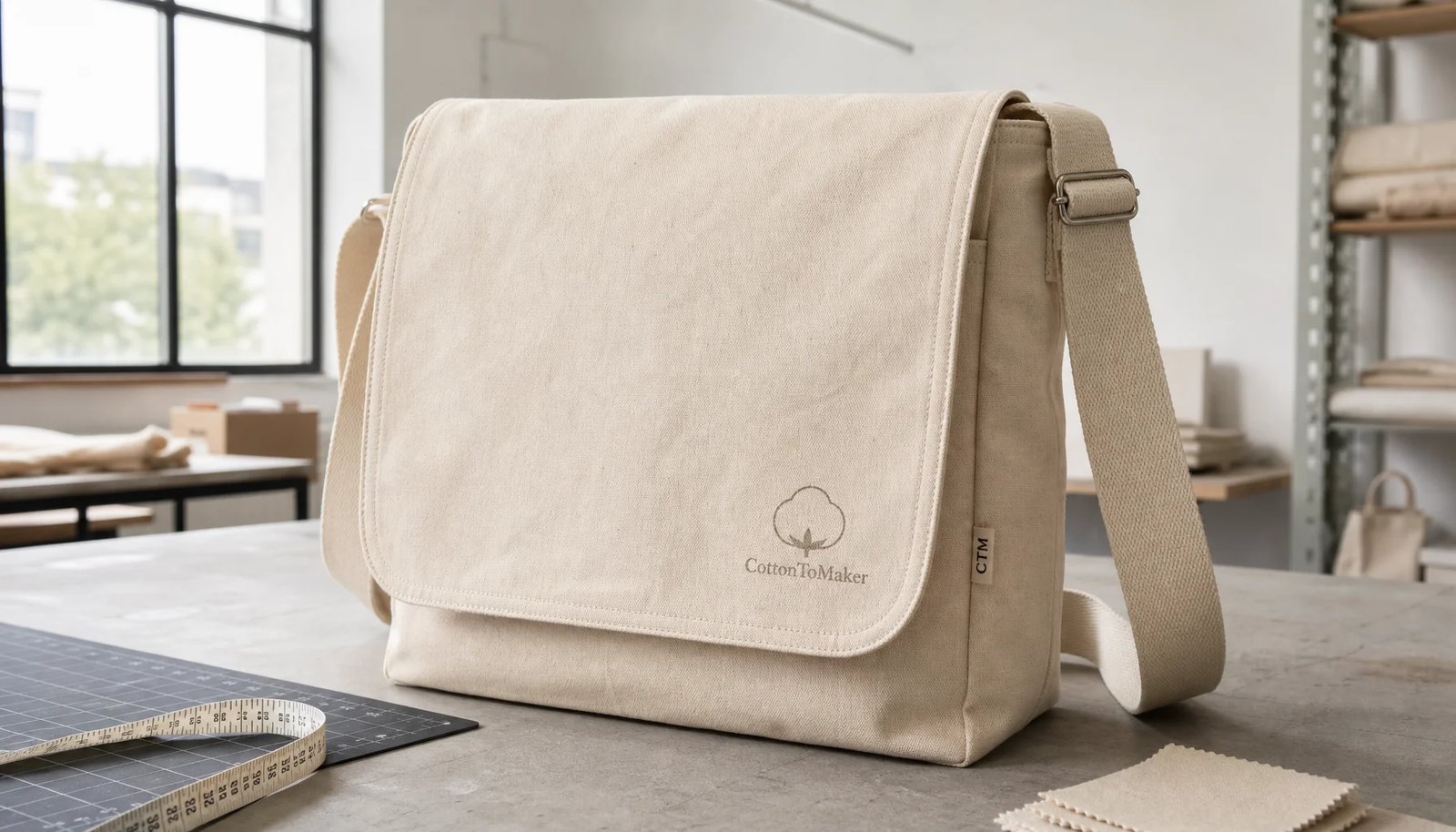
Start With the Bookstore Use Case
A canvas messenger bag for a university bookstore is not the same product as a lightweight promotional tote. Students may carry textbooks, a laptop sleeve, a water bottle, apparel, and small stationery items in one bag. Retail buyers also need the bag to look structured enough on a shelf, accept licensed artwork cleanly, and survive handling before it reaches the customer. Material selection should therefore begin with load, shelf presentation, print quality, and receiving requirements rather than only target unit price.
The first buying decision is the role of the bag. A low-cost orientation giveaway can use lighter canvas if the construction is honest and the stress points are reinforced. A bookstore retail SKU usually needs heavier canvas, better strap hardware, controlled print placement, and cleaner packing. If the RFQ does not identify the use case, suppliers may quote different fabrics, different trims, and different packing assumptions while appearing similar on price.
- Retail SKU: choose 12 oz to 14 oz canvas, clean stitching, retail labels, and stable carton packing.
- Campus event giveaway: choose 10 oz to 12 oz canvas with simplified hardware and fewer print colors.
- Alumni or department merchandise: consider 14 oz to 16 oz canvas, lining, woven label, or premium closure.
- Licensed university mark: treat print approval, logo placement, and color tolerance as critical specifications.
Choose Canvas Weight by Finished Performance
Canvas weight is often quoted in ounces, but international suppliers may also use GSM. For bookstore messenger bags, 12 oz canvas is usually the practical starting point because it has enough body for daily use while staying workable for sewing and packing. In GSM terms, this is commonly around 390 to 420 GSM depending on weave and finishing. A 14 oz canvas, often around 450 to 475 GSM, gives better shelf structure and a more substantial hand feel, but it increases fabric cost, needle wear, carton volume, and sometimes lead time.
Do not treat canvas weight as an isolated number. A dense 12 oz fabric can feel stronger than a loose 14 oz fabric. Dyed canvas may shrink and tighten differently than natural canvas. Washed canvas feels softer but may lose the crisp look that bookstore retail buyers want for displays. The RFQ should state whether the buyer wants natural, dyed, washed, or unwashed canvas and whether the quoted GSM is greige, finished, or tested after production processing.
- 10 oz canvas: acceptable for budget programs when load expectations are modest and reinforcement is added.
- 12 oz canvas: reliable all-purpose choice for most bookstore messenger bag programs.
- 14 oz canvas: stronger retail hand feel for premium campus merchandise and heavier daily use.
- 16 oz canvas: premium but heavier, bulkier, and less forgiving if the pattern is not engineered correctly.
Match Fabric Finish to Print and Shelf Look
Natural canvas is popular for university bookstores because it looks simple, sustainable, and campus-friendly. It also hides minor handling marks better than dark dyed canvas. However, natural cotton can vary in shade from lot to lot, especially if the buyer does not approve a production swatch. Dyed canvas gives stronger brand control, but dark colors may require an underbase for screen printing and can expose lint, crease marks, and shade variation across panels.
A brushed or washed finish feels softer but can reduce print edge sharpness. A tight plain weave normally gives cleaner logo definition than a rough slub fabric. If the artwork includes small type, thin rules, mascot details, or licensing text, the material should be chosen together with the print method. A factory can usually make a good messenger bag from several canvas options, but only one or two will reproduce the artwork cleanly at production speed.
- For one-color bookstore logos, natural 12 oz canvas with screen print is usually efficient and stable.
- For detailed mascot art, request a print test on the selected fabric before approving the order.
- For dark dyed bags, budget for extra print layers or a different ink system if bright colors are required.
- For washed canvas, approve the final hand feel and print effect after the wash, not before.
Specify Construction Before Comparing Prices
Two quotes can both say 'canvas messenger bag' and still describe very different products. One may include bound inside seams, bartack reinforcement, metal adjusters, a lined flap, and individual barcode packing. Another may assume raw inside seams, a plastic adjuster, no lining, and bulk packing. The material guide must therefore include construction details, because heavier fabric alone does not protect the buyer from poor performance.
The highest-risk areas are strap attachments, flap corners, bottom gusset seams, and closure points. Students tend to overload messenger bags unevenly, so the bag must resist tearing where the strap pulls against the side panel. A 38 mm strap is the minimum practical width for most bookstore messenger bags; 50 mm feels better for heavier versions. Cotton webbing looks consistent with canvas, while polyester webbing often has better abrasion resistance and lower stretch.
- Use bartack or reinforced box stitching at strap ends instead of a single straight stitch.
- Define stitch density, commonly around 7-9 stitches per inch depending on fabric thickness and thread.
- Use binding tape on inside seams if the bag is unlined and sold as a retail item.
- Match hardware strength to fabric weight; light hardware on 14 oz canvas looks mismatched and may fail early.
Select Print Method Around Artwork Risk
Screen printing remains the most common method for canvas messenger bags because it is durable, cost-effective, and suitable for university marks with solid colors. It works best when the artwork has clear shapes and limited color count. For bookstore programs, the factory should confirm the printable area on the flap and front panel after accounting for seams, folds, snaps, and flap curvature. A logo that looks centered on a flat artwork file may appear low or tilted after the bag is assembled.
Heat transfer can reproduce more detail, but buyers should be cautious on textured canvas. Transfers can feel like a film, may lift at corners if the pressure is wrong, and may not match the hand feel expected from a campus canvas product. Embroidery works well for small patches or premium labels but can distort lightweight canvas if the backing is poor. For licensed artwork, print approval should include color, placement, ink hand feel, edge sharpness, and packing resistance.
- Screen print: best for solid logos, bookstore names, department marks, and simple mascot graphics.
- Heat transfer: useful for full-color detail but needs peel, rub, and wash-related checks if applicable.
- Embroidery: premium look for small marks, patches, or side labels, not ideal for large flap graphics.
- Woven label: clean for repeat retail programs where logo consistency matters across multiple bag colors.
Understand MOQ and Cost Drivers
MOQ is usually driven less by sewing capacity and more by fabric sourcing, dyeing, printing setup, trim purchasing, and packing materials. A factory may accept a low total quantity if the buyer uses stock natural canvas, standard hardware, and one screen print. The same factory may require a much higher MOQ for custom dyed fabric, custom webbing color, plated hardware, woven labels, or multiple artwork versions. Buyers should separate MOQ by fabric color, print design, and trim color instead of asking only for one total MOQ.
The main cost drivers are fabric weight, cutting consumption, number of compartments, lining, closure system, strap quality, print colors, label type, and packing requirements. A 14 oz bag may cost more not only because the fabric is heavier, but because sewing is slower and cartons hold fewer pieces. Individual polybags, hangtags, UPC stickers, carton labels, and inner packs are not expensive individually, but they affect labor time and receiving accuracy.
- Lowest-cost route: stock natural canvas, unlined body, one-color screen print, standard metal snap, bulk carton packing.
- Balanced retail route: 12 oz to 14 oz canvas, bound seams, adjustable strap, woven side label, individual packing.
- Premium route: heavy canvas, lining, metal buckle or magnetic closure, embroidery or patch, retail hangtag.
- MOQ pressure increases when every department or campus group wants separate artwork under one order.
Approve Samples With Measurable Criteria
A pre-production sample should not be approved only because it looks good in a photo. For canvas messenger bags, the buyer should measure finished dimensions, flap alignment, strap length, hardware placement, print position, and fabric hand feel. The sample should use the real production fabric and real trims. If the sample is made from substitute fabric, the approval should be treated as pattern approval only, not final production approval.
Bookstore buyers should test the sample as a customer would use it. Load it with books or equivalent weight, adjust the strap several times, open and close the flap repeatedly, and check whether the print rubs against the opposite surface when packed. If the bag will be sold folded, leave it packed for several days and inspect crease recovery. Small issues found at sample stage are cheaper than negotiating after a container or air shipment is already produced.
- Measure finished width, height, gusset, flap depth, and strap adjustment range.
- Load test with a realistic campus weight, such as 5-7 kg for a daily-use messenger bag.
- Check print placement against the approved artwork layout with a ruler, not by eye only.
- Review one packed sample to confirm folding method, barcode position, and retail presentation.
Set QC Thresholds Before Production Starts
Canvas messenger bags have predictable defect patterns: shade variation, crooked flaps, uneven straps, skipped stitches, weak bartacks, misaligned snaps, print smudges, and dirty marks on natural fabric. These are not unusual in textile production, so the buyer needs clear acceptance criteria. The purchase order should define critical defects, major defects, minor defects, inspection level, and AQL before cutting begins.
For bookstore retail programs, logo defects should be treated seriously because the product sits under a licensed university brand. A small placement shift may be acceptable on a plain tote, but not on a flap where the school mark is the main selling point. The final inspection should include both functional checks and retail appearance checks. If the order includes several campus logos or departments, inspectors should verify assortment ratio and carton marks against the packing list.
- Critical defects: unsafe sharp hardware, wrong licensed logo, mold, contamination, or structurally failed strap.
- Major defects: crooked flap, obvious print error, broken stitch, wrong size, wrong color, or missing label.
- Minor defects: small thread tails, slight wrinkle, or minor natural cotton speck within approved standard.
- Inspection photos should show front, back, inside, strap joint, hardware, print close-up, packing, and carton marks.
Plan Packing for Bookstore Receiving
Packing is often treated as an afterthought, but it directly affects landed cost and bookstore receiving speed. Messenger bags have flaps, straps, and hardware that can crease, scratch, or press into printed areas if packed too tightly. A simple flat pack with tissue at the flap fold can prevent visible creasing. If the bag has a large screen print, the packing method should prevent ink-to-ink contact or hardware pressure marks during ocean freight.
For university bookstores, carton labeling matters because receiving teams may handle many SKUs during peak season. If each campus, department, or artwork version uses similar natural canvas, carton marks must be clear. Buyers should define whether bags need individual polybags, recyclable paper bands, hangtags, UPC stickers, inner cartons, or mixed-SKU cartons. Mixed cartons may save logistics work for small stores but increase factory packing errors unless the assortment is controlled.
- Request carton size, pieces per carton, gross weight, net weight, and CBM before issuing the PO.
- Keep carton gross weight practical for manual handling, often below 15-18 kg where possible.
- Avoid over-compressed cartons for heavy canvas because flap creases can become permanent.
- Use SKU, artwork code, color, quantity, PO number, and destination on carton marks.
Protect the Schedule Around Campus Peaks
University bookstore demand often clusters around orientation, back-to-school, graduation, alumni events, and sports seasons. Canvas messenger bags require enough time for fabric purchasing, dyeing if needed, sample approval, printing, sewing, inspection, packing, and international transport. A realistic production plan for a custom order often needs several stages rather than one simple lead-time number. The supplier should show which steps run in parallel and which cannot start until approval is complete.
The biggest schedule risks are slow artwork approval, custom fabric dyeing, hardware availability, sample revisions, and late packing data. If licensed artwork must pass a university or agency approval process, that time should be built into the buyer schedule, not blamed on the factory later. For urgent orders, the safest way to reduce lead time is to use stock canvas, standard hardware, fewer print colors, and simple packing rather than pushing a complex custom bag through a compressed calendar.
- Stock natural canvas can shorten material lead time compared with custom dyed canvas.
- Multiple logo versions add screen setup time and increase the risk of mixed packing.
- Late UPC files or hangtag artwork can delay packing even when sewing is finished.
- Air freight may protect an event date but can erase margin on heavy canvas products.
Specification comparison for buyers
| Spec decision | Recommended option | When it fits | Buyer risk to check |
|---|---|---|---|
| Main body canvas weight | 12 oz to 14 oz cotton canvas, roughly 390-475 GSM before washing | Best balance for university bookstore retail bags that must hold books, laptop sleeves, and campus merchandise without feeling too stiff on display | Verify finished fabric weight after dyeing or washing; some suppliers quote greige weight and ship a lighter finished cloth |
| Economy fabric option | 10 oz canvas, roughly 330-360 GSM, with reinforced stress points | Works for promotional bookstore bundles, orientation kits, or price-sensitive seasonal orders where the bag is not positioned as a premium daily carry | Thin fabric can collapse on shelf and show print-through; require a loaded sample test before approving bulk production |
| Premium fabric option | 16 oz canvas, roughly 540 GSM, with heavier needle stitching | Fits higher retail price points, alumni merchandise, limited editions, or licensed bookstore collections where structure matters | Higher fabric cost, slower sewing, more carton volume, and possible flap curling if the pattern is not adjusted |
| Lining choice | Unlined canvas with bound seams for basic orders; cotton or polyester lining for premium retail SKUs | Unlined fits natural campus style and easier inspection; lining fits laptop-friendly or giftable messenger bags | Lining adds labor and can hide loose threads or seam defects; include inside inspection photos in the final QC report |
| Strap construction | 38-50 mm cotton webbing or high-density polyester webbing with metal adjuster | Needed when students may carry books, water bottles, tablets, and apparel in the same bag | Low-density webbing stretches and twists; test adjuster grip and require bartack reinforcement at both strap ends |
| Printing method | Screen print for solid university marks; heat transfer only for detailed art; embroidery for small premium patches | Screen print is most stable for bookstore logos, department marks, and one to three color licensed graphics | Heavy ink on textured canvas can crack if over-cured or under-cured; approve print on the actual production fabric, not paper proof only |
| Closure system | Metal snap, magnetic snap, or buckle depending on retail position and safety requirements | Magnetic snap gives clean bookstore styling; buckle gives outdoor campus look; metal snap keeps cost controlled | Magnets can affect some buyer compliance rules and add alignment risk; request pull-force and placement tolerance in the sample report |
| Packing format | Flat packed with tissue at flap fold, individual polybag or paper band by buyer market, 20-30 pieces per export carton | Protects flap shape, print surface, and barcode labeling for bookstore receiving teams | Over-compression causes crease lines and print sticking; carton drop test and packing photos should be part of pre-shipment approval |
Buyer checklist before sampling
- Define whether the messenger bag is a retail SKU, orientation giveaway, alumni gift, or bundled bookstore promotion before choosing fabric weight.
- Specify finished fabric weight in oz and GSM, not only the fabric name; include tolerance such as plus or minus 5 percent.
- Confirm bag dimensions as finished size after sewing, including flap depth, gusset width, and usable inside opening.
- Require the supplier to print on the actual production fabric and color, not only on a smooth test swatch.
- State strap width, strap length range, adjuster material, and reinforcement method at strap attachment points.
- List every trim: snap, buckle, zipper, lining, binding tape, label, hangtag, barcode sticker, and spare button if needed.
- Approve one physical pre-production sample with final fabric, final color, final logo size, final hardware, and final packing.
- Set AQL level, critical defect definitions, and acceptable tolerances for size, print placement, color, stitch density, and carton weight.
- Request carton dimensions, gross weight, net weight, pieces per carton, and loading quantity before confirming the purchase order.
- Build the bookstore receiving requirements into the RFQ, including UPC labeling, inner pack rules, carton marks, and delivery window.
Factory quote questions to send
- What is the quoted canvas weight in oz and GSM, and is that weight measured before or after dyeing, washing, or finishing?
- Is the canvas made from virgin cotton, recycled cotton, blended yarn, or cotton-poly fabric, and can you provide the composition on the quote sheet?
- What is the MOQ by fabric color, print design, hardware color, and label type?
- Which print method do you recommend for our artwork on this canvas texture, and what is the maximum printable area on the flap and body?
- Can you quote one option at 12 oz canvas and one option at 14 oz canvas with the same dimensions and trims?
- What reinforcement is included at strap joints, flap corners, zipper ends, and bottom gusset seams?
- How many days are needed for material purchasing, sample making, sample revision, bulk cutting, sewing, printing, inspection, and packing?
- What are the export carton dimensions, pieces per carton, gross weight, and estimated CBM for 1,000, 3,000, and 5,000 pieces?
- What defects are normally found during production of this style, and what in-line controls do you use to prevent them?
- Can the final quote separate fabric, printing, hardware, labeling, packing, and inland freight so we can compare suppliers correctly?
Quality-control points to confirm
- Finished bag dimensions should stay within plus or minus 1 cm for width and height, and plus or minus 0.5 cm for flap placement where the logo is centered.
- Fabric weight should match the approved swatch within the agreed tolerance, usually plus or minus 5 percent for cotton canvas.
- Color difference should be controlled against the approved lab dip or fabric swatch under consistent light, with no obvious panel-to-panel shade mismatch.
- Print placement should stay within plus or minus 3 mm for licensed marks on the flap or front panel.
- Screen print should pass a dry rub and light scratch test without powdering, peeling, or ink transfer to tissue after packing.
- Strap attachment points should have bartack or reinforced box stitching with no skipped stitches, broken thread, or loose thread tails.
- Hardware should open and close smoothly, align with the flap, and show no sharp edges, rust marks, plating bubbles, or weak magnet pull.
- Cartons should pass normal export handling expectations with no overstuffing, crushed corners, wet marks, or mixed SKU packing.