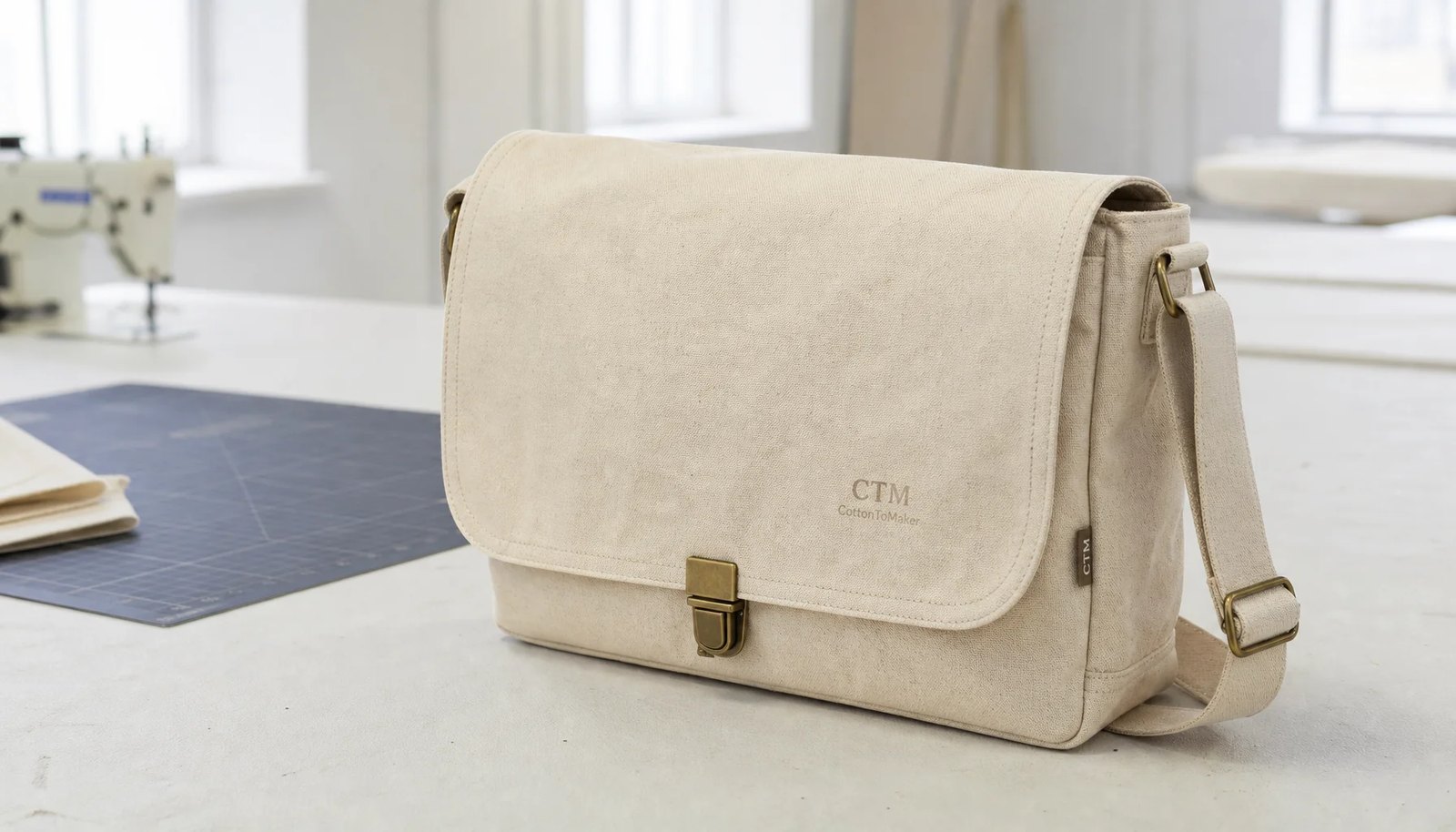
Why logo placement matters on the trade show floor
A canvas messenger bag used at a trade show is not judged while it is flat on a table. It is judged when it is worn across a jacket, stuffed with brochures, moved through a crowded aisle, and dropped onto a booth counter. That makes logo placement a sourcing decision, not a graphic preference. A mark that looks centered on a proof can disappear once the flap folds, the bag fills out, or the strap covers the face.
For trade show exhibitors, the real goal is visibility after handling. If the bag is handed out at registration, the logo needs to read quickly from aisle distance. If the bag carries catalogs or sample kits, the mark should still be visible when the bag hangs cross-body or sits on the floor beside a booth. Anything placed on a seam, under a fold, or behind hardware is likely to become wasted decoration. The buyer should choose placement based on how the packed bag will actually be seen, not on the flat artwork alone.
This is why canvas messenger bags logo placement guide for trade show exhibitors needs to start with use case, not with the artwork file. A bag that is meant to carry a notebook and a few sheets of literature has different visual priorities than a bag that will be filled with heavy literature, a water bottle, and product samples. The more the bag is expected to move, bend, and compress, the more the placement decision needs to respect the construction.
Treat the packed bag shape as the real design surface.
Keep the main logo visible from 2-3 meters, not only at arm's length.
Avoid locations that will be covered by straps, buckles, magnets, or the top fold of the flap.
If the bag will be handed out in a stack, check how the logo looks from the side as well as the front.
Choose the bag structure before you place the logo
The logo position is affected by the bag construction. A 12 oz canvas messenger bag, roughly 340 GSM, is a practical starting point for standard trade show use because it has enough body for print stability without becoming so rigid that folding and packing become difficult. If the bag must carry heavier inserts, a tablet, or a stacked sample kit, 14 oz to 16 oz canvas, roughly 400-450 GSM, usually gives better shape retention and a flatter front panel for decoration. Light 10 oz canvas can work for flat handouts, but it tends to wrinkle more and can make embroidery or large prints look uneven.
Internal build matters just as much as outer fabric. Lining, gusset depth, bottom board, flap padding, interlining, and strap reinforcement all change where a logo can sit cleanly. A stiff front panel gives the factory more room to hold registration. A softer bag may need a smaller logo, a simpler decoration method, or a woven label instead of a large full-front print. For RFQ work, ask the factory to quote the actual canvas weight, the lining material, the closure, and the reinforcement at the strap and flap before you decide on artwork size.
If you are buying for a recurring event, treat bag structure as a platform spec. A supplier who can reproduce the same body and reinforcement from one order to the next will usually hold logo placement more consistently too. A style that changes fabric weight or interfacing between samples and bulk will make the art shift, even if the artwork file itself is unchanged.
Use 12 oz canvas as the default starting point for most trade show messenger bags.
Move to 14 oz or heavier when the bag must be reused after the event.
Ask for a sewn sample with the final lining and reinforcement, not only a flat front panel.
Confirm whether the canvas is pre-shrunk or how the factory controls shrinkage before you approve placement.
Map the logo to the bag, not the mockup
For most buyers, the best primary location is the front flap or the upper front panel. That area gives strong visibility when the bag is worn or placed on a table, and it usually leaves enough uninterrupted fabric for a clean screen print or woven patch. The placement should stay clear of the fold line, buckle, zipper pull, or magnetic closure because those features can distort the artwork once the bag is packed. A common buyer mistake is to approve a logo that looks balanced on a flat dieline but sits too close to the edge once the bag is assembled.
Secondary branding is useful when the main face is crowded or when you want a more restrained look. A small woven side label, a back label, or a discreet label near the pocket can preserve brand presence without consuming the primary print space. This works well on bags that also need room for event inserts, contact cards, or name badges. Do not print across gusset corners, zipper lines, or strap anchors unless the supplier has already proven that the artwork survives sewing, folding, and load stress.
The right placement is usually the one with the fewest conflicts. Look for the largest uninterrupted panel, then test where the seam allowances, folding lines, and hardware path actually land. If the flap has a pronounced curve, the visual center can shift after assembly. If the front pocket is deep, the pocket opening may steal vertical space from the artwork. If the strap crosses the front panel when worn, a centered logo can still disappear in real use. The job is to design around those constraints, not to ignore them.
Use the front flap for the strongest show-floor visibility.
Use the upper front panel when the flap has a buckle, magnet, or visible seam.
Use a side woven label when the main graphic is too detailed for print.
Do not let the logo cross two sewn panels unless the factory has confirmed the construction method.
Ask the supplier for a placement sketch on the actual pattern, not only on a catalog mockup.
Set a placement spec the factory can actually hit
A useful placement spec gives the factory hard dimensions. Do not rely on words like centered, balanced, or visually aligned by themselves. Put the logo in millimeters from the top edge, side seam, and fold line. For example, a front-panel print might sit 20 mm below the flap fold and 15 mm from each side seam, with a width of 100 mm and an overall height that stays within the printable field. The exact numbers should match the bag size and the shape of the panel, but the principle is the same: remove guesswork.
For procurement, tolerance matters as much as nominal position. A practical requirement is often +/-3 mm for smaller marks and +/-5 mm for larger front-panel logos, if the factory can hold that consistently. Do not let the supplier define tolerance after production starts. Decide whether the measurement is taken from the center point, the full printed block, or the outer edge of a woven patch. If the bag has a pocket flap, curved seam, or gusset, ask the factory for a placement drawing that shows the safe zone in relation to those features, not just a floating logo box on a white art sheet.
It also helps to define what is not allowed. State that the artwork must not overlap visible stitching, must not cross a folded edge, and must not land under hardware. If the front panel uses a large decorative seam or topstitch line, include that in the drawing as a no-print boundary. This saves time during sampling because the supplier can reject a bad placement before it becomes a full-line problem.
Write the placement in millimeters, not as a visual impression.
Define tolerance before sample approval.
Confirm the measurement reference points in the tech pack or PO attachment.
If the bag comes in multiple sizes, keep a separate placement spec for each size instead of scaling one position blindly.
Match decoration method to the artwork and fabric
Screen print is usually the most efficient option for simple logos on canvas. It handles one- or two-color artwork well, scales cleanly for repeat orders, and keeps the unit cost predictable when the print size stays stable. The main risks are weak opacity, poor registration, and undercured ink. A print that looks acceptable in a studio mockup can fail in daylight if the ink deposit is too light or the base fabric color is darker than expected. On natural or dyed canvas, always ask for a physical strike-off on the real production fabric.
Embroidery, woven patches, heat transfer, and debossing solve different sourcing problems. Embroidery can give a premium feel on heavier canvas, but dense stitch counts can pucker light fabric and pull the panel out of shape. Woven patches work well for detailed logos and small text because they preserve line work better than stitching or thick print, but they still require attachment rules and a clean edge finish. Heat transfer can handle short-run multicolor artwork, but the buyer should ask about abrasion resistance and wash or rub performance if the bags will be reused. Debossing is usually not a first choice on plain canvas because the fabric does not hold a clean impression the way coated materials do.
The right method is the one that fits both the artwork and the bag life cycle. If the logo is bold and the event order is large, screen print is often the cleanest path. If the design includes fine type, a woven patch may give a more legible result. If the bag will be used by staff after the event, make sure the decoration method can survive repeated handling, friction, and folding. Do not optimize only for the first photo.
Use screen print for bold, flat logos and predictable repeat orders.
Use embroidery only on canvas heavy enough to support the stitch load.
Use woven patches when small text or fine outlines would be lost in print.
Send vector artwork with Pantone targets and a minimum line thickness that survives the chosen method.
Ask the factory to confirm the smallest readable text size before approving any detailed logo.
Build the RFQ around the real cost drivers
A useful RFQ separates the bag build from the decoration. Ask the factory to quote canvas weight, bag dimensions, lining, strap spec, closure, logo placement, decoration method, and packing as separate line items. If those items are bundled into one number, you cannot tell whether one supplier is using heavier canvas, more stitch reinforcement, a larger print area, or a cheaper packaging method. That makes supplier comparison noisy and hides the actual source of cost difference.
MOQ is usually driven by artwork versions, decoration setup, and fabric colorway. A single bag style with one placement is easier to price than a bag with a front print, a side label, and a custom hangtag. For trade show buyers, the issue is not only the minimum quantity. It is whether the factory can keep the setup cost low enough to match event volume without leaving dead stock. Ask for separate pricing on sample fees, screen setup, embroidery digitizing, patch tooling, packing upgrades, and any artwork revision charge so you can compare quotes on a fully loaded basis.
The best RFQs also describe the use case. Tell the supplier whether the bags are for registration handout, VIP attendee kits, sales team travel, or booth staff use. That gives the factory a basis for recommending a closer placement, a different closure, or a stronger reinforcement spec. It also helps them flag a bad idea before it becomes a costed sample. A supplier that asks good questions about load, carry time, and visibility is usually easier to work with than one that only prices the carton.
Request separate lines for sample fee, setup fee, and packaging cost.
Ask whether MOQ changes with a second decoration location or a different logo color count.
Compare offers on a landed basis, not just on the unit price.
If artwork finalization is required before pricing, note that dependency in the schedule.
State the intended bag contents so the factory can judge panel stress and logo distortion risk.
Approve the sample in the right order
A sample process that works has three gates: artwork proof, sewn sample, and pre-production sample. A flat proof helps check logo size and placement on paper, but it cannot show how the bag folds, how a seam interrupts the print, or how the flap behaves once the bag is assembled. The sewn sample must use the actual canvas weight, real strap webbing, real closure hardware, and the same reinforcement method planned for bulk. Otherwise the logo location can shift once the factory changes the pattern to fit the true construction.
When you review the sample, measure against fixed points such as the top edge, side seam, zipper line, pocket opening, and flap fold. Then test the bag with a trade show load, not an empty shell. A bag that looks centered when flat may lean or twist once brochures, notebooks, and sample kits go inside. If the logo drifts outside the agreed tolerance, stop the order and correct the pattern or placement file before bulk cutting starts. That is cheaper than accepting a full lot with a visibly bad logo position.
Use the sample review to close every open question in one round if possible. Confirm print color, placement, stitch quality, hardware, fold line, packing method, and carton mark. If you need to approve a pre-production sample separately, treat it as the final production benchmark. Keep a signed reference sample in procurement and another in production control so there is no dispute over what was approved.
Approve against a packed sample, not only an empty bag.
Keep one signed reference sample in procurement and one in production control.
Record the placement tolerance in millimeters, not just as approved or centered.
Review the sample under the same light used for receiving or booth setup.
Check the sample with the intended inserts inside the bag before signing off.
Set QC checkpoints that catch real defects
The critical control points for canvas messenger bags are logo position, print opacity, stitch quality, and seam alignment. A bag can pass size inspection and still fail commercially if the logo is crooked, too small, or buried under a fold. Agree the acceptable shift before production starts, and make sure the factory knows whether the tolerance applies to the center point, the full printed block, or the edge of the woven label. Many disputes come from vague approval language rather than a bad factory process.
Decoration durability matters because a trade show bag is handled repeatedly, rubbed against clothing, and often reused after the event. That means the print or patch must survive light abrasion, not only a photo check. For embroidery, inspect thread tension, back-side trimming, and any puckering around the logo. For screen print or transfer, check for pinholes, broken edges, color bleed, and weak curing. If the bag will be reused in retail or field sales, treat the logo as a wear point and include it in the QC plan. If your company uses AQL, a common starting point is AQL 2.5 for major defects and 4.0 for minor defects, but the important part is to define the defect list before inspection begins.
The inspection plan should include a first-article check and an in-line check, not only a final carton review. That gives the factory a chance to correct placement drift before the entire run is completed. It also helps catch printing issues caused by canvas variation, humidity, ink viscosity, or operator setup. If one panel on the bag is more structured than another, the logo may move or distort in a way that is only visible once several dozen pieces have been sewn.
Measure logo position from fixed references such as the top edge, side seam, pocket edge, or fold line, not from a loose visual estimate.
Check print opacity, edge sharpness, and color match against the approved sample under the same lighting used for receiving.
Inspect stitch reinforcement at the strap anchors, flap corners, gusset, and pocket openings so the logo area does not distort under load.
Use a placement tolerance target such as +/-3 mm for small marks and +/-5 mm for larger front-panel art if the factory can hold it consistently.
Run a rub or abrasion check on the decorated area if the bag will be reused after the event or carried with rough inserts.
Watch for puckering, thread pull, or panel warp around embroidery, woven patch attachment, or dense printed areas.
Verify that the bag still looks centered and clean when packed with the intended trade show contents, not only when empty.
Audit carton labels, pack count, artwork version, and PO number so the right bag reaches the right event shipment.
Pack for the show, not just the warehouse
Packing has a direct effect on how the logo arrives. Canvas creases easily, and a bad fold can leave a permanent line through the print area. The factory should fold the bag along low-visibility lines and protect the logo face with tissue or a polybag that prevents abrasion without pressing a hard crease into the decoration. If the main art sits near the center of the flap, do not fold directly across it unless the buyer has already accepted that visual risk.
Carton and pack data matter because trade show shipments are time-sensitive and often unpacked by staff who are not production specialists. Carton marks should show style, color, logo version, and pack count so the receiving team can pull the correct bag without opening every box. If the bags include inserts, brochures, or sample gifts, pack those items so they do not rub the print. For humid lanes, desiccant may help. For dusty warehouse handling, a stronger outer polybag or carton liner can be worth the extra cost. Ask the factory for a packed sample photo before bulk cartons leave the plant so you can confirm fold direction and carton labeling.
This part is often overlooked because it is not visible in the design deck. In practice, packing is where good logo placement is either protected or ruined. A clean placement can look bad if the bag is folded too tightly, or if a stack of bags presses a hard crease into the exact area you want attendees to see. Build the pack spec early enough that the factory can apply it during production, not as an afterthought at dispatch.
Specify the fold direction so the logo is not creased across the main face.
Keep the carton count manageable for booth staff who may need to move stock quickly.
Mark each carton with the artwork version if more than one logo layout is in the order.
Request a packed sample photo before bulk cartons leave the factory.
If the bag will be inserted into a welcome kit, verify the insert size so the kit does not deform the front panel.
Plan lead time and landed cost together
Lead time is usually controlled by four steps: artwork confirmation, sample making, bulk production, and shipping. Logo placement decisions can extend the first two steps because the factory may need screen setup, embroidery file conversion, or pattern adjustment. If the event date is fixed, build a buffer for one round of sample correction. The cheapest quote can become the most expensive one if the bags arrive after the show or if the full lot needs rework because the logo sits too low or too close to a seam.
Landed cost should be calculated on the bag that is actually usable at the event, not on the lowest factory price. Include sample fees, decoration setup, export packing, inland freight, and the shipping mode that fits the deadline. For smaller trade show runs, air shipment can make sense even when sea freight looks cheaper on paper, because the cost of missing the event is larger than the freight saving. The right comparison is cost per delivered, saleable bag at the booth, not just price per unit on the pro forma invoice.
It also helps to identify the slowest step before you place the PO. Some orders lose time on artwork approval, while others stall on color matching or sample revisions. If your logo has small text or a detailed outline, assume that one extra correction may be needed. If the bag has a new fabric color or a different closure, allow time for the supplier to rework the pattern and retest the placement. The schedule should reflect the actual risk, not the optimistic one.
Count backward from booth receipt, not from the purchase order date.
Reserve time for artwork revisions if the logo has fine text or multiple brand colors.
Ask the factory which step usually causes delay on this style.
Compare sea and air by total event risk, not by freight rate alone.
Use the delivered, saleable bag count as the cost basis, not the factory quote alone.
Specification comparison for buyers
| Spec decision | Recommended option | When it fits | Buyer risk to check |
|---|---|---|---|
| Canvas weight and body | 12 oz / about 340 GSM with reinforced gusset and strap anchors | Standard trade show bags carrying brochures, catalogs, notebooks, and light sample kits | Too light and the front panel warps; too heavy and you may overpay for structure you do not need |
| Primary logo placement | Centered on the front flap or upper front panel with a safe zone of 10-15 mm from seams and folds | When the bag must be visible while worn, set on a registration table, or stacked at check-in | If the logo crosses a fold line or seam, it can crease or drift off-center after packing |
| Logo size | Typically 80-120 mm wide for a single front mark, adjusted to bag size and viewing distance | When the brand needs to be readable from aisle distance without overwhelming the bag | Oversized art can wrap seams, hit hardware, or look distorted once the bag is filled |
| Decoration method | Screen print for one or two solid colors; embroidery or woven patch for premium or detailed marks | When the artwork is simple and the order volume justifies stable repeat production | Gradients, small text, or thin strokes can fail if the method is not matched to the art |
| Secondary branding | Small woven side label or back label, usually 15-25 mm high for a woven tab | When you want a backup brand cue without crowding the front face | Fine text becomes unreadable if the woven density is too low |
| Closure and hardware | Simple flap, zipper, or magnet with the logo kept clear of the fold and pull path | When the event bag needs security and repeated reuse | Hardware can block the print area or create abrasion on the logo face |
| Strap and reinforcement | Box-X reinforced webbing at stress points with matching bartacks or rivets where needed | When bags will carry catalogs, tablets, or heavier sample kits | Weak reinforcement can pull the panel out of shape and stress the decorated area |
| Packing method | Flat fold with the print face protected by tissue or a polybag that does not press a hard crease | When bags ship long distance before event distribution | Bad folding can leave a permanent line through the logo face |
Buyer checklist before sampling
- Confirm the canvas weight in GSM and oz, plus the lining, interfacing, closure type, and strap reinforcement details.
- Specify the primary logo position, maximum logo width, and any safe-zone distance from seams, folds, zippers, and hardware.
- State the decoration method, Pantone references, minimum stroke width, and acceptable placement tolerance in millimeters.
- Request a sewn sample made from the final fabric, hardware, and strap webbing, not only a flat artwork proof.
- Separate sample fee, setup fee, plate or screen fee, digitizing fee, and packaging cost from the unit price.
- Define fold direction, pack count, carton marks, and whether tissue or polybag protection is required.
- Agree the inspection standard, photo reference, and whether tolerance is measured from the center point or the full printed area.
- Work backward from the trade show receiving date and keep time for one round of sample correction.
Factory quote questions to send
- What canvas weight, lining, interfacing, closure type, and strap construction are included in the quoted price?
- Is the quote for one logo placement only, or does it include a side label, back label, or second decoration area?
- What is the MOQ per artwork version, per colorway, and per decoration method?
- Are screen setup, embroidery digitizing, patch tooling, or artwork file fees separate from the unit price?
- What logo placement tolerance do you hold, and how do you measure it during production and final inspection?
- What minimum stroke width or smallest readable text size do you recommend for the chosen decoration method?
- What packaging is included, and can you confirm carton count, carton size, fold direction, and any polybag spec?
- What are the normal sample lead time and bulk lead time after sample approval, and which step usually causes delay on this style?
Quality-control points to confirm
- Measure logo position from fixed references such as the top edge, side seam, pocket edge, or fold line, not from a loose visual estimate.
- Check print opacity, edge sharpness, and color match against the approved sample under the same lighting used for receiving.
- Inspect stitch reinforcement at the strap anchors, flap corners, gusset, and pocket openings so the logo area does not distort under load.
- Use a placement tolerance target such as +/-3 mm for small marks and +/-5 mm for larger front-panel art if the factory can hold it consistently.
- Run a rub or abrasion check on the decorated area if the bag will be reused after the event or carried with rough inserts.
- Watch for puckering, thread pull, or panel warp around embroidery, woven patch attachment, or dense printed areas.
- Verify that the bag still looks centered and clean when packed with the intended trade show contents, not only when empty.
- Audit carton labels, pack count, artwork version, and PO number so the right bag reaches the right event shipment.