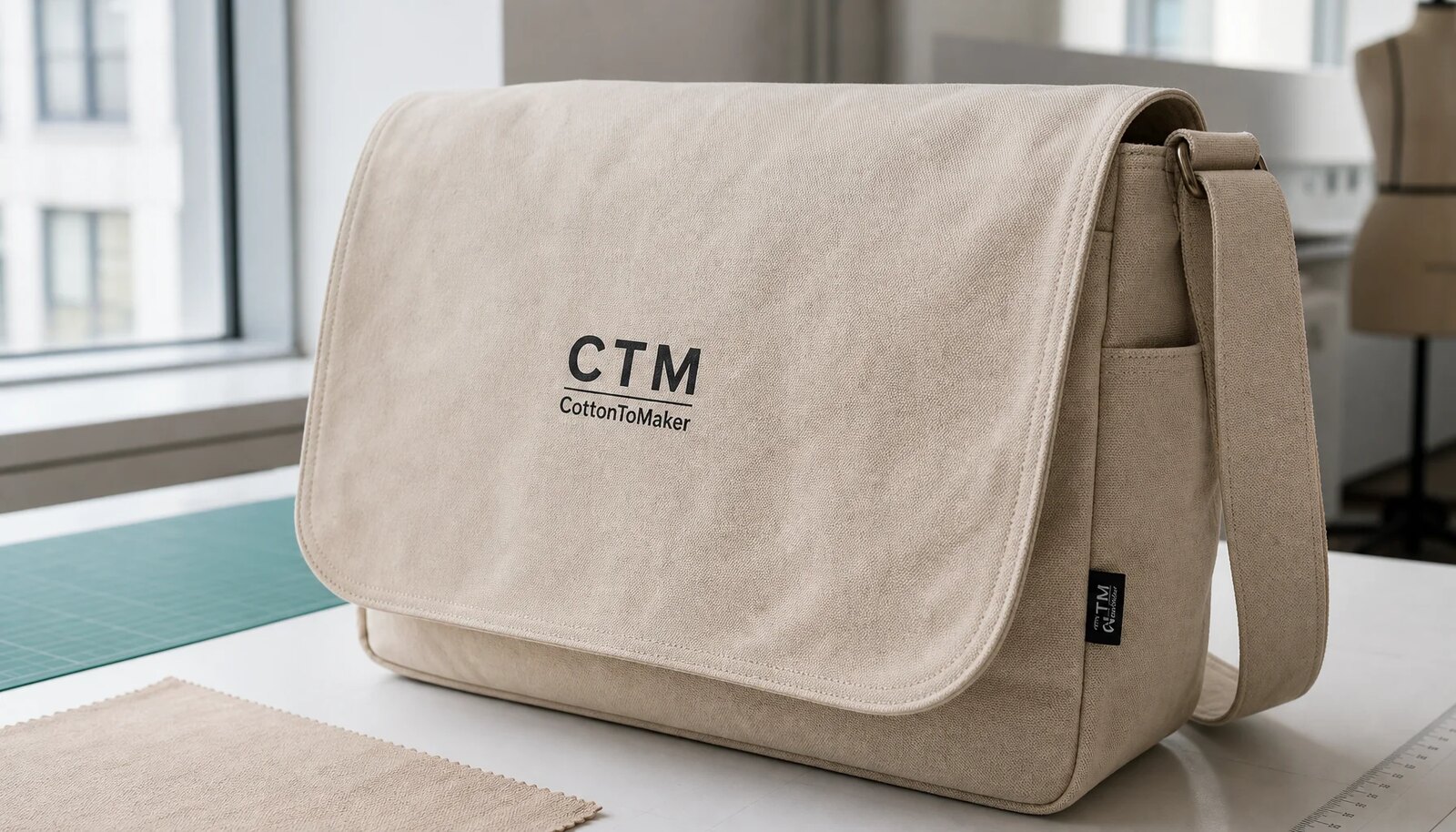
Why Placement Affects Procurement
For event planners, logo placement on a canvas messenger bag is a production specification, not a final artwork note. The selected zone affects the bag pattern, decoration order, tooling, tolerance, packing fold, and inspection method. A front-flap logo may need a flatter reinforced panel. A side label adds trim development and a sewing operation. A pocket print can be affected by zipper placement, pocket height, or contents pressing from behind.
This is also why supplier quotes can vary sharply for what appears to be the same bag. One factory may price a stock messenger bag with a basic one-color print. Another may include custom canvas weight, pre-shrunk fabric, modified flap construction, a strike-off, individual packing, carton labeling, and a pre-production sample. Those are different products with different risk levels.
Event use adds another layer. Messenger bags may be distributed at registration, carried through a venue, placed on chairs, photographed with attendees, or reused after the event. A mark that looks centered in a flat mockup can disappear when the bag is worn cross-body, loaded with brochures, or folded for shipping. The buyer's job is to define the placement in a way the factory can build, price, and inspect.
- Treat logo position as part of the product spec alongside canvas weight, hardware, and packing.
- Compare quotes only after every supplier prices the same logo zone, decoration method, sample scope, and delivery assumptions.
- Prioritize front-facing zones for event visibility, but approve them only on a physical sample.
- Use small labels or patches for premium identity, not as the only branding when distance visibility matters.
Start With Use Case And Bag Structure
A one-day conference giveaway does not need the same construction as a sponsor gift expected to carry tablets, catalogs, chargers, samples, and personal items. Before choosing a logo size, define how the bag will be used, how much weight it should carry, and whether it is meant to be reused after the event. The more load and reuse you expect, the more panel stability matters.
Canvas weight is a practical starting point. A 12 oz canvas, roughly 340 GSM, can suit lighter promotional programs where cost and quantity are the main drivers. It folds easily and works for notebooks, flyers, and simple attendee kits. A 16 oz canvas, roughly 450 GSM, gives better structure and a more substantial hand feel, which is useful for staff kits, sponsor merchandise, VIP programs, and product launches where the bag will be photographed.
Construction details decide the real decoration area. Lining can smooth the front face and reduce show-through from pocket contents. A padded flap can look cleaner but may change the fold and carton packing. Magnetic snaps, buckles, zipper pulls, side rings, webbing tabs, darts, and binding all create no-print zones. Artwork should not be approved until these features are fixed on the sample or technical drawing.
- Specify event role, expected load, and reuse target before finalizing the logo zone.
- Use lighter canvas for short-term handouts and heavier canvas for structured, photo-ready programs.
- Confirm lining, pocket layout, flap curve, closure type, hardware placement, and strap position before artwork approval.
- Ask whether the canvas is raw, dyed, washed, enzyme-washed, pre-shrunk, coated, or water-resistant.
Choose The Right Logo Zone
The front flap is the strongest visibility zone for most event-planner orders. It faces outward when the bag is worn and usually appears in attendee photos. It works best for clean event names, sponsor marks, and organizer logos. The risk is that the flap may bend over the opening, close over a snap, or form a crease if folded incorrectly in packing.
The front pocket panel is a useful alternative when the flap has buckles, curved edges, or a magnetic closure in the print area. It can create a more casual retail look and may remain visible when the flap is open. The buyer should test the pocket with realistic contents because a filled pocket can distort a rectangular logo or make small type look uneven.
Lower front-body placement can support larger graphics, but it may be hidden when the bag sits on a chair, table, or registration counter. Side seam labels, strap tags, and small patches are better for subtle permanent branding. They are especially useful when the same bag body will be reused across multiple events and only the main printed artwork changes.
- Front flap center: best for high-visibility event or sponsor branding.
- Front pocket panel: useful when flap hardware makes printing risky.
- Lower body: suitable for large graphics only if the area remains visible in real use.
- Side seam label: good for permanent brand identity or retail-style detail.
- Strap tag or small patch: refined up close, weak as the only event-floor branding.
Define Placement With Measurements
A digital mockup is not enough for procurement approval. A supplier needs measured instructions tied to fixed physical features of the sewn bag. Instead of writing "logo centered on flap," state the logo width, height, orientation, and measured distance from the flap edge, side binding, top stitch line, snap center, pocket seam, or zipper tape. Use millimeters so overseas and domestic teams interpret the spec consistently.
The placement drawing should also show no-print areas. These include flap fold lines, seam allowances, rounded corners, zipper tape, magnetic snaps, buckles, darts, binding, and any panel that curves when closed. The drawing does not need to be complex, but it should show the artwork box, construction references, hardware, and tolerance. If the supplier wants to shift the artwork for production reasons, that change should come back for written approval before sampling.
A practical placement tolerance for sewn canvas bags is often plus or minus 5 mm from the approved drawing or sample. Tighter control may be possible on a flat panel with a stable jig, while washed canvas or post-sewing decoration may need more allowance. The key is to set the tolerance before bulk production and inspect against that standard, not against a subjective visual judgment.
- State logo size, orientation, and position in millimeters.
- Measure from fixed features, not from a loose mockup centerline.
- Mark no-print zones around folds, seams, zippers, rounded corners, and hardware.
- Use plus or minus 5 mm as a starting tolerance unless the supplier confirms another standard.
- Require written approval before any movement from the agreed placement.
Match Decoration To Artwork And Canvas
Screen printing is the default method for many canvas messenger bag orders because it is efficient, repeatable, and clear for bold artwork. It is a strong fit for one-color or two-color logos, large sponsor marks, and simple event names. On coarse or washed canvas, the supplier may need to adjust mesh, ink deposit, and curing to avoid pinholes, uneven opacity, or fuzzy edges.
Embroidery can make a compact mark feel more premium, but it is not automatically better. Dense stitching can pucker soft canvas, especially near a flap fold or pocket seam. Tiny text, thin lines, and small reverse details may not stitch cleanly. Request a stitched sample on the actual canvas before approving embroidery for sponsor artwork or any logo with fine detail.
Woven labels and sewn patches can handle detail more predictably than direct printing on coarse fabric. They also add a retail-quality finish. The tradeoff is visibility and trim control. A woven side label may look excellent close up but disappear across a busy hall. Heat transfer can work for detailed graphics or short runs, but it needs abrasion and adhesion checks because messenger bags rub against clothing, chairs, tables, and other event materials.
- Use screen print for bold, readable bulk branding.
- Use embroidery for compact marks, not large filled artwork or tiny text.
- Use woven labels or patches when detail, border quality, or a retail look matters.
- Use heat transfer only after testing adhesion, edge lift, abrasion, and hand feel.
- Ask for minimum line thickness, smallest readable text size, and registration tolerance.
Build A Quote Suppliers Can Compare
The RFQ should read like a production brief. Include bag dimensions, canvas weight, color, finish, lining, pocket layout, strap length and width, closure type, hardware finish, thread color, logo zone, artwork size, decoration method, sample sequence, packing format, inspection standard, and delivery deadline. This level of detail protects the event date because it removes guesswork before pricing starts.
Separate the commercial lines. Ask for the blank bag body, decoration, woven label or patch, setup fee, screen fee, embroidery digitizing, sample fee, packing cost, carton marks, inspection cost, and freight assumptions. A low unit price may exclude setup, sample freight, or destination sorting. A higher quote may already include individual polybags, carton labeling, and a full pre-production sample.
MOQ should be clarified by variable. A supplier may have one MOQ for the bag body, another for dyed canvas, another for woven labels, and another for each print color or artwork change. Event programs often include sponsor versions, staff versions, city versions, or VIP versions. Each one can affect setup, production flow, and carton control.
- Send one final artwork file and one measured placement drawing with the RFQ.
- Ask every supplier to quote the same fabric, construction, decoration, sample, packing, and inspection scope.
- Confirm who owns decoration: bag factory, in-house print room, or outside partner.
- Clarify MOQ by colorway, artwork version, logo color count, label type, and packaging format.
- Require written approval for substitutions in material, hardware, trim, placement, or decoration method.
Sample In The Right Sequence
Sample approval should happen in stages. The blank sample confirms bag size, canvas weight, structure, pocket layout, strap feel, hardware, lining, and overall hand feel. The decoration strike-off confirms whether the logo can be produced cleanly on the selected canvas or trim. The pre-production sample confirms the complete product: final fabric, final color, final placement, final decoration, final sewing, final hardware, and final packing.
Skipping the strike-off is risky. A logo can look perfect in a PDF and still fail on canvas because the weave breaks thin lines, the ink sinks into the fabric, or the color looks dull against natural cotton. A woven label may show border distortion. Embroidery may pucker. A patch may sit flat on a table but curl when the flap bends. The strike-off isolates the decoration problem before it becomes a finished-bag problem.
Approval should be objective. Record logo dimensions, placement measurements, color reference, ink or thread details where relevant, and packing fold. A signed physical sample is ideal. When photo approval is necessary, request straight-on views, close-ups, ruler shots, side views showing flap curve, daylight-equivalent color photos, and packing photos. The factory and buyer should be working from the same approval set when bulk starts.
- Approve a blank sample before judging logo placement.
- Review a print strike-off, woven label, patch, or embroidery sample on the actual material.
- Approve a complete pre-production sample before bulk cutting or decoration.
- Keep measurement photos showing distance from seams, edges, snaps, zippers, and fold lines.
- Do not release bulk from a digital mockup alone when placement is sensitive.
Inspect The Whole Branded Bag
A clean logo on a weak bag still creates a poor event experience. Inspect strap anchors, bar-tacks, flap seams, pocket corners, zipper stitching, magnetic snap reinforcement, binding, and lining. Messenger bags are loaded, pulled open, worn across the body, set on floors, and packed into cartons. The decoration and the construction need to survive the same real use.
Print quality should be reviewed under consistent light. Warehouse lighting can hide weak opacity, color shift, and edge feathering. Daylight-equivalent light gives a clearer view of registration, ink coverage, contrast, and pinholes. For embroidery, check loose threads, backing, density, and puckering. For labels, check border centering, fray, angle, and stitch tension. For patches, check edge curl, panel ripple, and stitch consistency.
Define major and minor defects before inspection. Wrong artwork, visibly crooked logo placement, severe color mismatch, decoration cracking, patch detachment, broken strap reinforcement, or missing carton identification should be major defects because they affect brand presentation, usability, or fulfillment. A loose thread away from the logo may be minor if it can be trimmed. If using AQL, state the level and who pays for rework or re-inspection when the shipment fails.
- Measure placement from the approved reference instead of judging by eye.
- Inspect color, opacity, registration, edge quality, and decoration durability under controlled light.
- Check strap anchors, flap hinge, pocket seams, closures, and lining along with decoration.
- Classify wrong artwork, crooked logos, severe color mismatch, and broken reinforcement as major defects.
- Pull samples from different cartons, production times, colors, and artwork versions.
Protect The Logo Through Packing And Delivery
Packing can damage an otherwise approved production run. Canvas messenger bags are often folded to save carton space, but the fold should not run through the main logo unless tested. A front-flap print should be protected from rubbing against buckles, zippers, strap hardware, or the next bag in the carton. Individual polybags, tissue, paper inserts, or simple face protection may be worthwhile when the bags ship directly to an event site with no time for sorting or rework.
Carton packing should match the structure. A soft 12 oz bag may tolerate tighter packing than a structured 16 oz bag with a padded flap, patch, or rigid label. Over-compression can create flap creases, pressure marks, patch curl, or distorted panels. Cotton canvas is also sensitive to moisture, so ask about carton strength, inner bags, desiccant, and warehouse handling when the route involves ocean freight, humid storage, or seasonal weather risk.
Plan lead time by milestones, not by one broad estimate. Track artwork freeze, material booking, blank sample, strike-off, pre-production sample, cutting, decoration, sewing, packing, inspection, shipment booking, freight transit, customs, and local delivery. Some steps can be accelerated; dyed canvas, woven label production, special hardware, and freight often cannot. Fixed event dates reward early artwork approval and a written production calendar.
- Do not fold through the main logo unless the tested sample proves it is acceptable.
- Protect decorated faces from straps, buckles, zippers, and carton abrasion.
- Specify carton count, inner pack count, gross weight, SKU marks, artwork version, and destination labels.
- Use moisture protection when transit or storage conditions create humidity risk.
- Ask for a milestone schedule with last safe approval dates for artwork, sampling, inspection, and dispatch.
Specification comparison for buyers
| Decision area | Best-fit option | Use when | Procurement check |
|---|---|---|---|
| Logo visibility | Front flap center print | Sponsor, organizer, or event branding needs to be seen in registration lines, venue photos, and attendee use | Confirm the closed flap lies flat and the artwork clears snaps, buckles, binding, fold lines, and flap curvature |
| Logo visibility | Front pocket panel print | The flap has hardware, a curved edge, or a fold that interrupts the print area | Test with realistic contents because pocket bulge can distort rectangles, small text, and centered marks |
| Logo visibility | Side label, seam tab, strap tag, or small patch | You need discreet permanent branding, repeat-program identity, or a premium retail-style detail | Do not rely on this as the only event logo if distance visibility matters |
| Decoration method | Screen print | Bold one-color to three-color artwork, medium to large logo areas, and repeat bulk production | Ask for minimum line thickness, ink opacity on the selected canvas, curing method, and strike-off approval |
| Decoration method | Woven label or sewn patch | Fine detail, small text, multi-color marks, or logos that do not print cleanly on coarse canvas | Confirm label size, border tolerance, stitch tension, patch curl risk, and who owns trim development |
| Decoration method | Embroidery | Compact premium marks, initials, venue icons, or small corporate branding | Avoid large filled areas on soft panels unless a stitched sample proves no puckering |
| Canvas and structure | 12 oz canvas, roughly 340 GSM | Lower-cost handouts, light conference materials, or programs where the bag is a short-term promotional item | Check print-through, seam shadowing, panel stability, and whether the logo looks thin on the chosen color |
| Canvas and structure | 16 oz canvas, roughly 450 GSM | Staff kits, sponsor gifts, VIP merchandise, product launches, and bags expected to carry heavier event contents | Confirm shrinkage control, colorfastness, finishing process, and whether GSM is verified before cutting |
| Quality and risk control | Pre-production sample plus measured inspection standard | Any order with sponsor approval, multiple artwork versions, or a fixed event date | Define AQL level, major defects, placement tolerance, approval ownership, and inspection responsibility before bulk production |
Buyer checklist before sampling
- Define the event use case: attendee giveaway, sponsor gift, staff kit, media kit, VIP merchandise, retail resale, or city-specific program.
- Approve one final artwork file, color standard, logo size, and minimum readable text size before requesting production pricing.
- Specify bag dimensions, canvas weight, fabric finish, lining, strap width, pocket layout, closure type, hardware finish, thread color, and logo zone in the same RFQ.
- Measure logo placement in millimeters from fixed points such as flap edge, binding, stitch line, snap center, pocket seam, zipper tape, or side seam.
- Mark no-print zones around folds, rounded corners, seam allowances, snaps, buckles, zipper pulls, magnetic closures, darts, and binding.
- Choose one primary decoration method and one approved fallback if the supplier flags line detail, canvas texture, color opacity, or placement risk.
- Ask whether decoration is handled in-house, by the bag factory, or by an outside print, embroidery, or label partner.
- Request a blank sample, decoration strike-off, and pre-production sample before releasing bulk production.
- Separate quote lines for bag body, decoration, label or patch, setup, sample fee, packing, carton marks, inspection, and freight assumptions.
- Confirm MOQ by bag color, artwork version, logo color count, print location, label type, and packaging format.
Factory quote questions to send
- What canvas weight, GSM, weave type, shrinkage control, and finishing treatment are included in this quote?
- Is the logo applied before sewing, after sewing, or on a separate label or patch, and how does that affect placement tolerance?
- Where exactly will the logo sit, and what are the measured distances from the nearest seam, flap edge, binding, snap, zipper, pocket line, or fold?
- What decoration method do you recommend for this artwork, and what minimum line thickness and smallest readable text size can you hold on this canvas?
- Is decoration completed in your facility, in an in-house print room, or by an outside partner, and who is responsible for rejected color or placement?
- What is the MOQ by bag color, logo color count, artwork version, woven label style, patch style, and packaging format?
- Can you provide a blank sample, decoration strike-off, and pre-production sample, and what is the cost and lead time for each step?
- What is included in the unit price, and what is charged separately for screen setup, embroidery digitizing, woven label development, sample freight, carton marks, or inspection?
- What AQL level or internal inspection standard do you normally use for bags, and how do you classify crooked logos, wrong artwork, loose stitches, and color mismatch?
- How will you pack the printed bags to avoid creasing, rubbing, moisture damage, pressure marks, or patch distortion during transit?
Quality-control points to confirm
- Measure logo placement against the approved drawing or sample and hold tolerance at plus or minus 5 mm unless the artwork guideline or buyer standard requires tighter control.
- Inspect print opacity, edge sharpness, registration, pinholes, and color match under daylight-equivalent light as well as normal warehouse lighting.
- Check that the logo does not break across seams, darts, flap folds, pocket corners, snaps, magnetic closures, zipper tape, buckles, or binding.
- Confirm canvas weight, fabric color, finish, and shrinkage behavior match the approved sample and do not change the decoration appearance.
- Review whether heavy ink, embroidery, or a sewn patch causes panel sag, flap ripple, puckering, patch curl, or closure misalignment.
- Check stitch density, seam straightness, bar-tacks, and reinforcement at strap anchors, flap hinges, pocket corners, zipper ends, and stress points.
- Rub-test the decoration surface lightly for smearing, cracking, lifting, loose threads, label fray, patch edge curl, or ink transfer before approving bulk.
- Pull inspection units from different cartons, colors, artwork versions, and production times rather than only from the top of one carton.
- Verify that folded bags do not leave permanent creases through the logo and that tissue, inserts, or polybags protect the decorated face.
- Match carton marks, SKU code, color code, artwork version, purchase order, packing list, and destination label against the signed approval set.