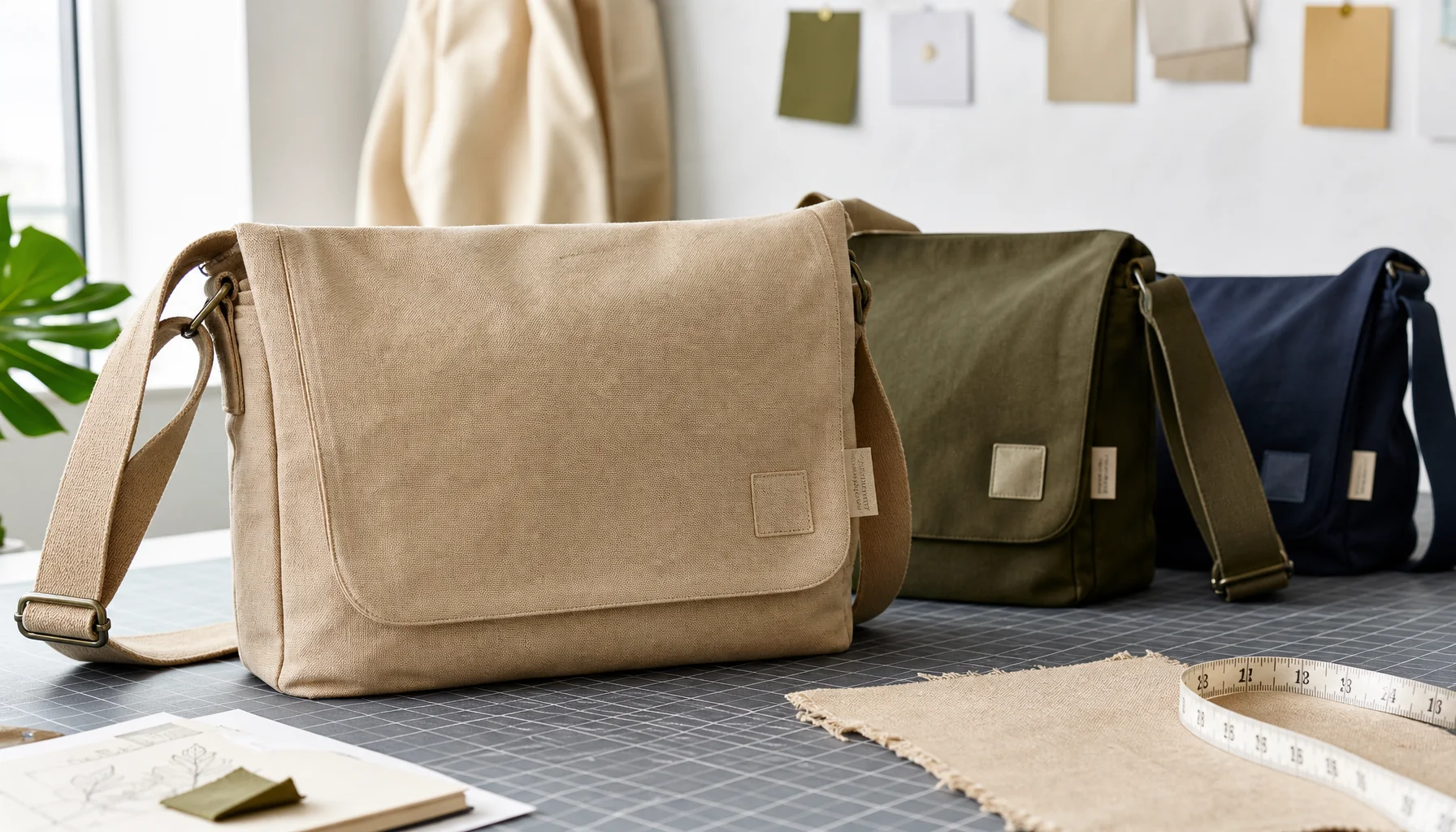
Start With Placement as a Manufacturing Decision
Logo placement on a canvas messenger bag is not a final artwork note. It is part of the production specification. The chosen position can affect the pattern, sewing sequence, decoration fixture, sample route, inspection checklist, packing fold, and final landed cost. That is why procurement teams should lock logo placement before asking for a final bulk price, not after the supplier has already quoted from a loose mockup.
Eco apparel brands often want the bag to feel natural, useful, and understated. A small woven label, a tonal lower-corner print, or a compact flap mark may be the right design choice. Subtle does not mean casual, though. A quiet logo can look premium only when it sits straight, clears the seams, survives packing, and appears where the customer expects to see it.
The risk changes quickly once the logo approaches a flap crease, gusset bend, pocket seam, rivet, magnetic snap, buckle, bar-tack, or shoulder-strap rub point. The same mark may be easy on a flat cut panel and difficult on a finished bag with binding, curves, and hardware. Instead of writing “center logo on front,” use production language: logo width 120 mm; centered on finished front panel; top of logo 70 mm below finished top edge; minimum 20 mm from pocket stitch line and 25 mm from side binding. The exact numbers will change by style. The discipline should not.
- Add logo placement to the tech pack, purchase order, sample approval sheet, and inspection checklist.
- Use finished-bag measurements because sewing, binding, pressing, washing, and gusset formation change the visible area.
- Treat every logo location as its own cost, setup, sample, tolerance, and QC item.
- Balance eco-brand restraint with the visibility needed for ecommerce thumbnails, wholesale catalogs, and retail displays.
- Keep critical text, QR codes, certification marks, and fine lines away from sharp folds and high-abrasion areas.
- Ask whether decoration is applied to roll fabric, cut panels, partially assembled panels, or finished sewn bags.
Confirm the Bag Construction Before Sizing the Logo
A messenger bag is not a flat rectangle once it is sewn. The real decoration area depends on finished width and height, gusset depth, flap length, pocket layout, lining, binding width, seam allowance, bottom curve, bar-tacks, strap attachment points, and hardware. If any of those details change, the safe logo zone can move or shrink. A front mark that looked balanced on the first drawing may crowd the pocket after the pocket is enlarged by 20 mm.
Fabric weight should be stated with the same care. Canvas is often quoted in oz/yd² or GSM. As a rough conversion, 10 oz/yd² is about 339 GSM, 12 oz/yd² is about 407 GSM, and 14 oz/yd² is about 475 GSM. These conversions are useful for discussion, but they do not replace a confirmed fabric standard. Weave, finishing, dyeing, washing, coating, and moisture content can change the hand feel and measured weight.
For sourcing, 10 oz canvas can work for lighter promotional or fashion-led messenger bags with modest decoration. Around 12 oz is a practical middle range for many everyday canvas messenger bags because it supports screen printing without becoming too rigid. Around 14 oz adds structure and can support embroidery or patches better, but it may raise material cost, sewing difficulty, freight weight, and carton volume. Choose the weight for the intended load, brand position, and decoration method, not only for the number on a quote sheet.
- Record finished bag width, height, gusset depth, flap length, strap width, binding width, pocket size, and hardware position in millimeters.
- Ask whether the quoted canvas weight is greige weight, finished fabric weight, or the weight of fabric used in the finished bag.
- Request both oz/yd² and GSM where possible so competing quotes can be compared on the same basis.
- Avoid large solid prints on very loose or highly slubbed canvas unless visible texture through the ink is acceptable.
- For embroidery, review canvas stability, backing, stitch density, and whether the reverse side will be visible.
- For natural or recycled cotton canvas, approve logo color on the actual bulk fabric standard because shade variation can shift the appearance.
- Do not approve the logo zone until the final pocket layout, flap fold line, and hardware centerlines are fixed.
Build a Safe-Zone Map, Not Just a Pretty Mockup
A digital mockup can help the sales team picture the bag. It cannot tell the sewing line where the logo should sit. Buyers need a measured safe-zone map that shows the largest uninterrupted panel, seam allowances, binding, restricted fold areas, pocket stitch lines, gusset bends, bar-tacks, rivets, snaps, buckles, magnetic closures, zipper tape, and retail packing folds.
Ask the factory for a dieline that includes both cut-panel dimensions and finished-bag visible areas. This matters because the logo may be applied before sewing, while the buyer judges the result after sewing. A 10 mm shift on a cut panel can become visually larger once the panel is pulled into a gusset or hidden under binding.
Use practical clearances unless the approved sample proves a tighter design is safe. For many screen prints, labels, and patches, keeping artwork at least 15 mm from seams, binding, pocket stitching, rivets, snaps, and zipper tape reduces defects and visual crowding. Flap fold lines often need more space, commonly 20-30 mm, especially for transfers, dense prints, and small text. Strap branding needs a different map because sliders, shoulder pads, and length adjustment can hide part of the repeat.
- Create separate safe zones for front body, flap, pocket, side seam, strap, and interior branding.
- Mark restricted areas around seams, folds, rivets, buckles, magnets, snaps, zipper tape, bar-tacks, binding, and gusset bends.
- Specify logo width, height if relevant, top distance, side distance, centerline alignment, and minimum clearance in millimeters.
- For flap logos, measure from the visible lower flap edge and the fold line, not only from the cut flap edge.
- For pocket marks, measure from pocket top edge and side stitch lines, then review with the pocket lightly filled.
- For side labels, define exposed label length, inserted fold depth, reading direction, and vertical position.
- For strap logos, define repeat spacing, logo direction when worn, and visibility after strap adjustment.
Use the Front Panel When You Need Visibility and Easier QC
The main front body panel is usually the safest high-visibility zone on a canvas messenger bag. It is easier to fixture, measure, photograph, and inspect than a moving flap, curved side seam, pocket face, or adjustable strap. For B2B programs that need consistent brand presentation, a one-color or two-color screen print centered on the finished front panel is often the cleanest route.
That does not make the front panel risk-free. Messenger bags change shape when they are filled with books, apparel samples, a tablet, or a laptop. A logo that looks perfectly level on an empty flat bag may bow slightly once the gusset expands. For larger artwork, ask for photos of the decorated sample flat, hanging from the strap, lightly stuffed, folded for packing, and reopened. This simple review catches many problems before bulk production begins.
Logo scale should match the bag and the commercial channel. A bold campaign mark may belong in the center of the panel. A premium eco apparel brand may prefer a 45-90 mm lower-corner mark that lets the natural canvas texture lead. If the bag will sell online, review the mark at thumbnail size. If it will sit in wholesale showrooms, view it from 2-3 meters. Design taste and sales visibility are both part of the placement decision.
- Use center-front or upper-center placement when ecommerce, catalog, and retail visibility matter most.
- Use lower-left or lower-right placement for quieter branding and a more material-led product story.
- Align to the finished bag centerline, not the cut-panel centerline.
- Keep text clear of wrinkles created by gussets, pocket seams, bottom folds, and heavy binding.
- For large graphics, approve a decorated sewn sample rather than relying on a flat fabric strike-off alone.
- If several bag sizes share one logo, scale artwork by panel proportion instead of forcing one fixed logo size across all sizes.
- Set a written main-panel tolerance, commonly ±5 mm when the construction and fixture can support it.
Handle Flap, Pocket, Side Label, and Strap Branding as Separate Jobs
Flap branding suits the messenger-bag shape. When the bag is worn cross-body, the flap is often the first visible surface. The tradeoff is movement. A flap bends, opens, closes, rubs against clothing, and may press against snaps, magnets, buckles, or hook-and-loop tape. A compact logo on the stable lower flap area is usually safer than a wide mark crossing the hinge line.
Pocket branding gives a crafted look, especially when the bag has an exterior utility pocket. A woven patch, cotton patch, tonal embroidery, or compact print can work well. But pockets are active surfaces. They distort when filled with a phone, notebook, charger, or small accessories. Inspect the sample empty and lightly filled. Also ask when the decoration is applied. A pocket printed before attachment can shift during sewing; a finished pocket may be harder to fixture cleanly.
Side labels and straps need their own controls. A side seam woven label is durable and understated, but it has limited space and must not rub the wearer, hardware, or binding. Strap branding is visible in real use, especially on cross-body bags, but it may require a separate webbing MOQ, jacquard development, print testing, and abrasion review. These placements are not minor add-ons. Quote, sample, and inspect them separately.
- Flap logo: keep the mark below the main fold path and away from closure hardware by a defined measurement.
- Pocket logo: inspect empty and lightly filled; reject obvious warping, tilting, or tension distortion.
- Side seam label: confirm exposed length, reading direction, seam security, and comfort against the body.
- Strap branding: check logo direction when worn, repeat interval, adjuster coverage, and abrasion resistance.
- Patch branding: specify patch material, backing, edge finish, stitch color, stitch margin, and corner reinforcement.
- Interior branding: use for care instructions, QR codes, brand story, or private-label ID, but do not rely on it for retail visibility unless that is the plan.
- For any second logo location, require separate artwork approval, setup charge, sample review, and QC tolerance.
Match the Decoration Method to Canvas, Placement, and Brand Positioning
Screen printing remains a practical choice for many custom canvas messenger bag programs. It works best on flat panels, bold artwork, and one or two spot colors. Water-based inks can give a softer hand and a lower-plastic feel, which many eco apparel brands prefer. Still, the factory must prove opacity, curing, rub performance, and color on the exact canvas. Natural canvas can warm or mute ink color; dark canvas may need an underbase or a different ink system.
Embroidery adds texture and perceived value for smaller marks, especially on stable 12 oz or 14 oz canvas. It is less suitable for tiny lettering, thin outlines, gradients, or large filled areas. Dense stitching can pucker lighter canvas or distort pockets and flaps. Ask for estimated stitch count, thread colors, backing type, and whether the reverse side will show inside the bag if the style is unlined.
Heat transfers can reproduce complex artwork and gradients, but they need stricter fold and adhesion checks. Transfers placed on flap creases, bottom folds, or high-rub areas are higher risk. Woven labels and sewn patches are strong options for small, durable, multi-color branding across several bag colors, but they bring component MOQ, label lead time, color tolerance, and sewing inspection. For eco-positioned products, confirm the patch substrate, backing, and label material fit the brand’s material policy.
- Screen print: best for flat panels, bold logos, spot colors, and repeatable bulk production.
- Water-based print: good for softer hand; verify opacity, cure, rub, and shade on actual canvas.
- Embroidery: best for small premium marks; control stitch density, backing, puckering, and readability.
- Heat transfer: useful for detailed art; test adhesion, fold cracking, gloss, scorch risk, and edge lifting.
- Woven label: useful for side seams, pockets, interior branding, and subtle exterior ID.
- Sewn patch: good for premium positioning; define substrate, backing, edge finish, stitch margin, and color standard.
- Jacquard or printed strap: highly visible in use, but often tied to separate component MOQ and abrasion approval.
- Do not approve a decoration method from a digital mockup only; require a strike-off or decorated sample on the real material.
Write the RFQ So Every Supplier Prices the Same Scope
A useful RFQ for canvas messenger bags should not ask only for a unit price. It should separate the blank bag cost, fabric basis, decoration cost by placement, setup charges, sample charges, component costs, packing costs, carton data, lead time, and assumptions. Otherwise, one supplier may quote a complete production program while another omits screens, digitizing, woven labels, sample revisions, packing protection, or inspection support.
MOQ can come from several places. The sewing factory may have a bag MOQ. The fabric mill may have a weaving, dyeing, or finishing minimum. The printer may charge by screen and color. Embroidery may price by stitch count. A woven label, patch, or branded strap may require a separate component run. A low bag unit price is hard to evaluate until these conditions are visible.
Artwork quality also affects timing and cost. Vector files are preferred for screen print, embroidery digitizing, woven labels, patches, and branded webbing. Provide final logo size, Pantone references or physical color standards, minimum line-thickness notes, and any critical detail requirements. If the design includes a QR code, small URL, certification icon, or fine eco claim, test it at final production scale. A detail that looks sharp on a PDF may fail on coarse canvas, stitching, or woven yarn.
- Ask for MOQ by bag style, fabric color, decoration method, placement count, print color count, label run, patch run, strap option, and packing option.
- Separate sample fees, setup fees, repeat-order setup policy, and bulk unit decoration charges.
- Confirm whether each print color and each placement requires its own screen, film, or setup.
- For embroidery, ask for digitizing fee, estimated stitch count, thread count, backing, sample revision policy, and production tolerance.
- For labels and patches, ask for component MOQ, lead time, material, color tolerance, edge finish, and sewing cost.
- For strap branding, ask for webbing MOQ, repeat length, yarn or ink specification, abrasion testing, and component lead time.
- Require suppliers to list assumptions so competing quotes can be normalized before selection.
- Do not award bulk production from a quote based only on a low-resolution PNG and approximate bag dimensions.
Use Sampling to Prove the Real Bag, Not the Idea of the Bag
A digital mockup is helpful at the concept stage. It cannot show canvas slubs, ink absorption, print edge definition, embroidery tension, label sewing, flap movement, or packing creases. A practical B2B sampling path is: artwork on measured dieline, blank construction sample, decoration strike-off if needed, decorated pre-production sample, and sealed golden sample.
The blank construction sample confirms the finished bag: dimensions, fabric weight, hand feel, gusset, flap, lining, pocket layout, strap, hardware, stitching, and safe logo zones. The decorated pre-production sample confirms logo size, placement, color, method, and finish on the actual construction. If the supplier later changes canvas, binding, lining, pocket position, hardware, or packing, the earlier placement approval may no longer apply.
The golden sample should be physical, sealed, and documented. Label it with buyer name, style number, date, artwork file name, version number, canvas reference, logo size, placement coordinates, decoration method, color standard, and packing method. Photos help communication, especially across time zones, but the physical golden sample is the stronger standard for line checks and third-party inspection.
- Approve artwork on a measured dieline before making a decorated sample.
- Use a blank construction sample to verify finished dimensions and real safe logo zones.
- Use a decorated pre-production sample to approve placement, color, hand feel, and method.
- Measure sample placement with a ruler and record top, side, fold, pocket, and centerline distances.
- Review the sample flat, hanging, lightly stuffed, folded, packed, and reopened.
- For flap and transfer logos, open and close the flap repeatedly during sample review to check stress points.
- Photograph front, back, side, interior, strap, pocket, flap, close-up logo, and packed presentation.
- Require first-bulk-piece approval when placement is tight, artwork is large, or more than one logo location is used.
Set Bulk Tolerances and Inspect the Logo Like a Product Feature
Logo QC must be measurable. “Looks centered” is not enough for a bulk messenger bag order. The purchase order or inspection checklist should define reference points, logo size, position tolerance, skew tolerance where needed, color standard, defect criteria, and sampling plan. Many stable front-panel prints can be controlled to about ±5 mm if the process is well-fixtured. Flap, pocket, side label, interior label, and strap positions may need wider tolerances, often ±5-10 mm depending on access and construction.
Inspection should cover both placement and decoration quality. For screen print, check coverage, opacity, edge sharpness, registration, pinholes, bleeding, ghosting, lint in the ink, curing, tackiness, rub result, and shade consistency. For embroidery, check thread tension, thread breaks, loose tails, puckering, backing, needle damage, color, and readability. For woven labels and patches, check straightness, stitch security, corner lift, fraying, orientation, fold depth, and comfort. For transfers, check adhesion, bubbling, peeling, scorch marks, gloss variation, and fold cracking.
View the bag the way the customer will use it. A logo may appear straight on a table but tilt when the strap pulls the body into shape. Inspect flat, hanging from the strap, lightly filled, folded according to packing method, and reopened. If the bag is sold in retail packaging, confirm the logo is not hidden, creased, or rubbed in the packed presentation. If the brand uses reduced-plastic packaging, confirm the alternative still protects the decoration during export handling.
- Define measurement references: finished top edge, side binding, pocket stitch line, flap fold line, hardware centerline, and bag centerline.
- Use different tolerances for main panel, flap, pocket, side label, interior label, and strap branding.
- Reject obvious skew or visual imbalance even if one measured point is technically within tolerance.
- Check decoration under consistent lighting against the approved physical sample or color standard.
- Perform agreed rub, fold, adhesion, or handling checks before shipment, especially for transfers and water-based prints.
- Confirm logo readability after folding, packing, hanging, and light stuffing.
- Keep a measurement sheet with the inspection team and attach photos of accepted and rejected examples where possible.
- Ensure bulk uses the same artwork version, scale, fabric, decoration process, and packing method as the golden sample.
Design Packing Around the Logo, Not After It
Packing can protect the logo or damage it. A hard fold through small text may leave a visible stress line. Decorated surfaces pressed face-to-face can block, rub, or transfer under carton pressure, especially during humid storage or long transit. Hardware, buckles, desiccant packets, barcode stickers, hangtags, cardboard inserts, and carton edges can mark prints or transfers if they sit directly against the decoration.
Approve packing during sampling, not after production is finished. Specify fold direction, fold points, individual wrap, tissue or paper separator, belly band, hangtag location, barcode location, carton quantity, carton dimensions, and gross weight. If the brand wants to reduce or eliminate polybags, test the paper wrap or no-polybag method with the decorated sample. Eco packaging supports the brand story only if the bag arrives clean and the logo is undamaged.
Carton compression deserves attention. Overpacked cartons may deform patches, crease transfers, shine a print surface, or press hardware into the front panel. Underpacked cartons can allow movement and abrasion. For logo-critical orders, ask for first-carton photos before shipment. The photo set should show the fold, logo direction, individual protection, carton stack, carton marking, and separators.
- Define fold direction so no critical text, icon, QR code, or transfer edge sits on a hard crease.
- Avoid direct contact between decorated areas and metal hardware, adjusters, buckles, snaps, desiccant packets, labels, or carton edges.
- Use separators, paper wrap, tissue, or an approved alternative if decorated surfaces touch.
- Confirm whether the logo should face outward for retail presentation or inward for protection.
- Set carton quantity and gross weight to avoid over-compression and rubbing.
- Check the decorated sample after being packed and left under light pressure, then reopened.
- If individual polybags are eliminated, confirm the alternative protects against dust, moisture, abrasion, and ink transfer.
- Ask for first-carton packing photos before shipment for logo-critical orders.
Specification comparison for buyers
| Logo placement decision | Typical B2B specification | Best-fit use case | Procurement and QC risk to control |
|---|---|---|---|
| Main front body panel | One-color or two-color screen print centered on the finished flat panel; specify logo width and top/side distances in mm; keep at least 15 mm from seams, binding, pocket stitching, rivets, and gusset bends | Best for retail visibility, employee kits, college programs, trade-show merchandise, and eco apparel brands that need the logo to read clearly in ecommerce thumbnails or from 2-3 meters | Confirm the measurement references are finished-bag references, not cut-panel references; inspect for skew, ink coverage over canvas slubs, and distortion when the bag is lightly filled |
| Lower-corner front logo | Small screen print, tonal embroidery, woven patch, or heat transfer positioned from the finished bottom/side edge; common logo width range is 45-90 mm depending on bag size | Useful for premium or minimalist branding where natural canvas texture, recycled fabric story, or garment-brand identity should not be overpowered | Check that the mark is not hidden by carton folding, front pocket volume, bottom curve, or side gusset pull; require a folded-packing approval photo |
| Flap decoration | Compact logo placed on the stable visible area of the flap; keep 20-30 mm away from the flap fold line and hardware centerline unless the approved sample proves otherwise | Good for classic messenger silhouettes, campus bags, commuter bags, outdoor-inspired lines, and retail programs where the flap is the main visible face | Flap movement causes repeated bending, rubbing, and pressure; avoid fine text or transfers crossing the fold path; inspect after repeated opening and closing |
| Side seam woven label | Folded woven label inserted into side seam or sewn beside seam; define exposed length, fold allowance, logo orientation, and position from top or bottom edge | Fits subtle sustainable branding, private-label collections, natural canvas programs, and SKUs with a clean unprinted front panel | Confirm the label will not rub against clothing, shoulder strap hardware, D-rings, or binding; check label straightness and trapped-seam security |
| Pocket patch or pocket print | Small woven patch, cotton patch, leather-alternative patch, or compact print on pocket face; specify stitch color, stitch margin, and pocket reference points | Works when the bag includes an exterior utility pocket and the brand wants a crafted look without using the full body panel | Pocket tension can warp the mark when filled; inspect empty and lightly filled; verify the pocket is decorated before or after attachment and set tolerance accordingly |
| Shoulder strap branding | Printed webbing, jacquard woven strap, repeated logo tape, or small sewn label; specify repeat length, logo direction when worn, and relation to adjuster hardware | Strong for premium retail programs, subscription kits, travel sets, and bags worn cross-body where the strap is visible during use | Strap branding may need separate webbing MOQ and component lead time; inspect abrasion, repeat consistency, adjuster coverage, and ink or yarn wear |
| Interior branding | Care label, woven label, printed lining mark, QR code label, or inner brand-story patch; define placement on back wall, seam, pocket, or lining panel | Appropriate for low-key exterior branding, retailer compliance, sustainability messaging, care instructions, or private-label identification | Do not rely on interior branding alone if the bag is sold online, on a hanger, or in a wholesale catalog; test QR readability at final scale |
| Dual-location branding | One primary exterior mark plus one secondary side, strap, pocket, or interior mark; quote each placement separately with its own setup and tolerance | Best for premium branded programs where recognition matters in both product photos and real use | Every extra location adds artwork approval, fixture control, sample review, inspection time, and defect exposure; avoid bundled quotes that hide these costs |
| Oversized campaign artwork | Large screen print or transfer kept within one uninterrupted panel; often safer before assembly if construction and factory workflow allow it | Suitable for artist collaborations, limited campaigns, nonprofit merchandise, and retail launches where the bag acts as a large graphic surface | Large art magnifies skew, registration error, lint contamination, folding marks, and ink shade variation; require a decorated pre-production sample and carton-fold test |
Buyer checklist before sampling
- Confirm finished bag width, height, gusset depth, flap length, pocket size, lining, binding width, strap width, hardware position, seam allowance, and finished canvas GSM before approving logo placement.
- Ask whether canvas weight is quoted as finished GSM, finished oz/yd², or greige fabric weight; do not compare suppliers unless the basis is the same.
- Request a measured dieline showing both cut-panel dimensions and finished-bag visible decoration zones after sewing, binding, pressing, washing, or coating.
- Define logo size in millimeters, artwork orientation, placement reference points, color standard, decoration method, and whether the art must remain inside one uninterrupted flat panel.
- Specify clearance from seams, binding, folds, flap crease, pocket stitch lines, zipper tape, rivets, snaps, magnets, buckles, D-rings, adjusters, and bar-tacks.
- Confirm whether decoration is done before cutting, after panel cutting, before final sewing, or after the finished bag is assembled; each route has different placement tolerance and defect risk.
- Provide vector artwork for print, embroidery, woven labels, patches, and webbing; include Pantone references or an approved physical color standard.
- Request a blank construction sample and a decorated pre-production sample; do not release bulk production from a digital mockup alone.
- Approve one sealed golden sample with date, artwork version, fabric reference, placement measurements, color target, decoration method, and packing method.
- Set written bulk tolerances: for example, main front panel ±5 mm, flap or pocket ±5-7 mm, side labels and straps ±8-10 mm unless the factory proves tighter control.
Factory quote questions to send
- What is the finished canvas weight in GSM and oz/yd², and is that measurement before or after dyeing, washing, coating, or finishing?
- What are the finished bag dimensions, seam allowance, binding width, gusset depth, flap fold position, pocket layout, strap width, and hardware centerline measurements?
- Can you mark safe logo zones on the actual messenger bag dieline and identify areas that are unsafe because of folds, curves, seams, bar-tacks, rivets, or hardware?
- Which placements can be decorated without changing the base pattern, and which placements require a sewing sequence change, special fixture, or panel decoration before assembly?
- What is the MOQ by bag style, canvas color, decoration method, ink color count, embroidery stitch count, woven label run, patch run, branded strap run, and packaging option?
- What setup charges apply for screen frames, film/output, embroidery digitizing, woven labels, patches, heat-transfer films, webbing, sewing fixtures, strike-offs, and sample revisions?
- Will the logo be applied to roll fabric, cut panels, partially assembled panels, or the finished sewn bag, and what placement tolerance can you realistically hold for that process?
- Can you supply a blank construction sample, print or embroidery strike-off, decorated pre-production sample, and sealed golden sample before bulk production?
- What tolerance do you hold for the main body logo, flap logo, pocket mark, side seam label, interior label, and strap branding in normal bulk production?
- What ink, thread, transfer film, label yarn, patch material, or webbing material do you recommend for this canvas weight and color?
Quality-control points to confirm
- Main front logo position matches the approved golden sample within ±5 mm unless a different written tolerance is agreed; measure from finished edges, not from cut-panel assumptions.
- Flap and pocket logos match the approved position within ±5-7 mm where practical; side labels, interior labels, and strap branding are commonly controlled within ±8-10 mm depending on construction and fixture access.
- Logo has minimum 15 mm clearance from seams, binding, pocket stitch lines, zipper tape, rivets, snaps, magnets, buckles, D-rings, strap adjusters, and bar-tacks unless the approved design intentionally uses that edge.
- Logo does not cross a sharp fold line, flap hinge, bottom packing crease, gusset bend, or high-rub hardware area unless the decorated sample has passed the agreed fold and rub check.
- Screen print coverage is even over canvas texture, with no unacceptable pinholes, heavy edge build-up, smearing, ghosting, lint in the ink, misregistration, bleeding, or color patchiness.
- Water-based or discharge-style print, if used, is fully cured and not tacky; decorated surfaces do not block, stick, or transfer under normal packing pressure.
- Embroidery has stable thread tension, no looping, loose tails, thread breaks, needle damage, puckering, backing show-through beyond the approved standard, or unreadable fine detail.
- Woven labels and sewn patches are straight, fully secured, evenly stitched, and free from fraying, loose corners, wrong orientation, wrong fold depth, or abrasive placement.
- Heat transfers are fully bonded at all edges, with no bubbling, peeling, scorching, uneven gloss, lifting, or cracking after folding according to the approved packing method.
- Color matches the approved physical standard under the agreed light source; differences caused by natural canvas shade variation are within the signed sample standard.