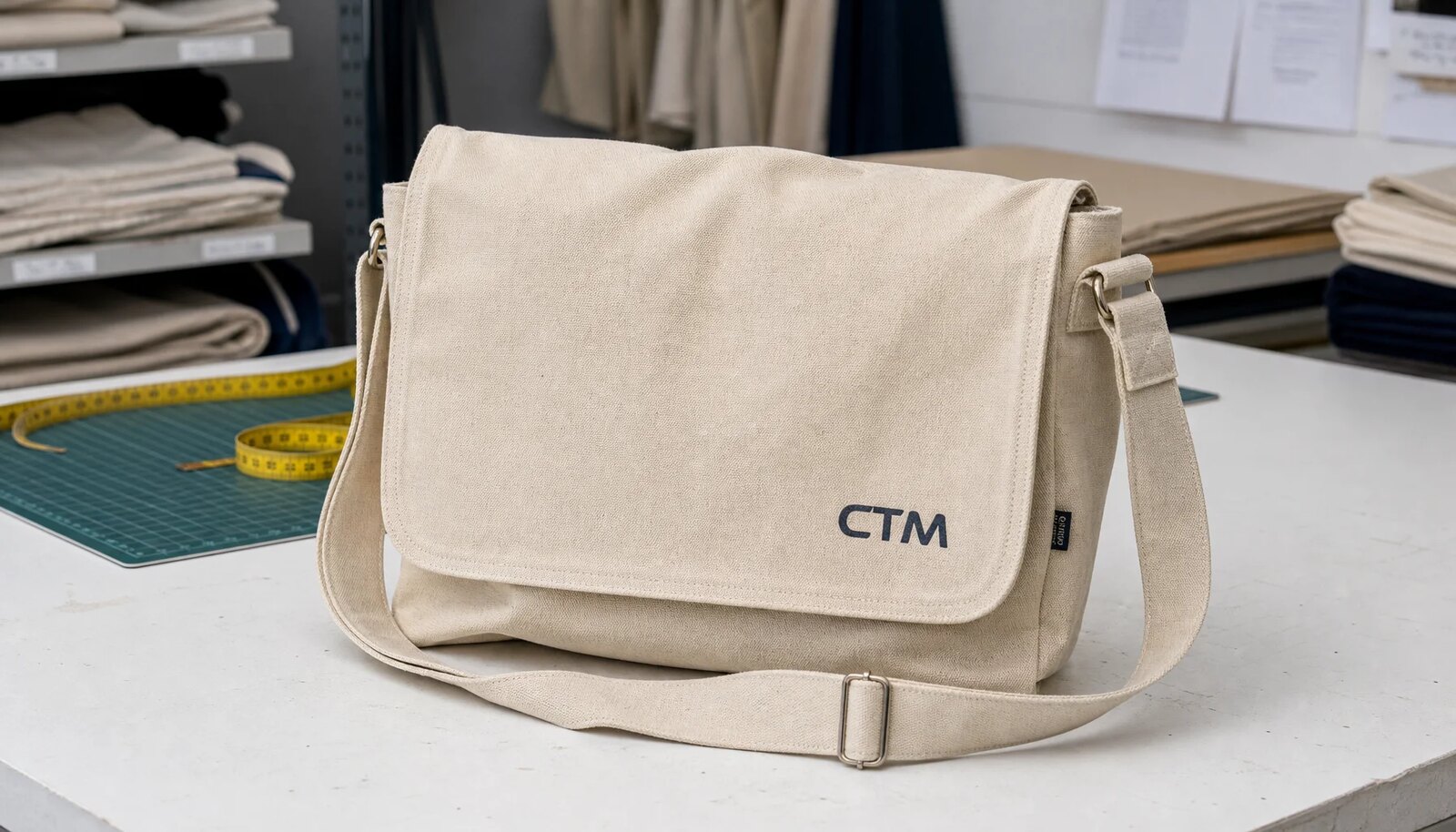
Start With How the Bag Will Be Displayed
Logo placement on canvas messenger bags should begin with the selling environment, not with the artwork file. At craft fairs, bags are rarely viewed flat and perfectly centered. They hang from booth racks, sit in baskets, lean against tables, hang from chairs, or are carried by staff. A logo that looks balanced on a flat mockup can disappear once the flap curves over a filled bag or the shoulder strap falls across the front.
For most craft fair sales, the front flap is the safest primary branding zone because it remains visible while the bag is closed. Lower center, lower right, and lower left placements can all work, but the best choice depends on flap shape, closures, and how the seller displays inventory. If the product is positioned as retail merchandise rather than a giveaway, a modest flap logo plus a small side label often feels cleaner than a large promotional print.
Procurement buyers should describe the display use in the RFQ. Tell the supplier whether the bag will be sold hanging, stacked flat, nested in bins, photographed for a catalog, or worn by booth staff. Ask for sample photos in those positions before approving bulk production. This simple step catches many placement issues before screens, embroidery files, or labels are finalized.
- Best primary zone: front flap, clear of stitched edges, folds, snaps, buckles, pockets, and strap paths.
- Best retail cue: smaller flap mark supported by a side seam label or inside label.
- Weak primary zone: body panel under a closed flap, because it is usually hidden during display.
- Approval photo set: filled front view, hanging view, worn crossbody if relevant, flat table view, and packed view.
- RFQ detail: expected viewing distance, display method, strap position, and whether the logo must be visible from the booth aisle.
Match Placement to Messenger Bag Construction
Messenger bags have more placement restrictions than simple totes. The usable decoration area depends on flap length, flap curve, gusset depth, binding, lining, front pocket layout, closure position, buckle straps, rivets, and the path of the shoulder strap. Two bags with the same outside dimensions can offer very different logo space if one has a plain rectangular flap and the other has decorative webbing, magnetic snaps, or curved bound edges.
Ask the factory for a placement map based on the pattern or a clear sample photo. The map should show seam allowance, center line, flap fold, pocket openings, hardware centers, binding, and recommended print boundary. This becomes a shared reference for the buyer, merchandiser, sample room, print team, sewing line, and inspector. It also prevents the common problem of approving a logo size that cannot be produced cleanly on the final construction.
Decoration timing matters. Printing panels before sewing can be efficient, but sewing variation may shift the final visual position. Decorating after sewing can improve finished-bag alignment, but the assembled bag is harder to handle, especially near pockets and hardware. Neither method is automatically better; the buyer needs to know which process the supplier will use and how placement will be controlled.
- Keep typical flap logos 25-35 mm from stitched or bound edges unless the supplier proves a closer setup.
- Keep artwork away from snaps, rivets, buckles, and adjusters; use a larger no-print zone when hardware creates uneven pressure.
- Avoid placing print across pocket seams, zippers, flap overlaps, or raised webbing because ink coverage can become uneven.
- For curved flaps, measure from the visual center of the finished flap, not only from the rectangular fabric panel.
- For gusseted bags, check the filled side view because the lower flap can rotate downward and reduce visibility.
Choose Canvas Weight Before Decoration
Canvas weight affects cost, hand feel, sewing difficulty, carton weight, and logo quality. A 10 oz canvas, often around 340 GSM depending on mill and finishing, can suit lighter or price-sensitive messenger bags, but it may need extra attention at strap anchors and can show embroidery pucker more easily. A 12 oz canvas, often around 400 GSM, is a practical middle option for many craft fair bags because it has enough body for display while staying manageable for sewing and freight. A 16 oz canvas, often around 540 GSM, gives a stronger premium feel but increases handling, needle wear, folding bulk, and shipping weight.
Buyers should confirm whether the quoted weight is greige fabric weight, finished fabric weight, or an approximate commercial description. Dyeing, washing, coating, softening, and shrinkage can change the final hand feel and surface. A logo approved on natural 12 oz canvas does not automatically prove the same result on washed black 16 oz canvas.
Decoration should be tested on the final fabric whenever the surface changes. Coarse yarns can break fine print edges. Washed canvas may shift size or color after finishing. Dark dyed fabric may require different ink opacity. Coated or water-resistant canvas needs adhesion testing before a large flap print is approved.
- 10 oz canvas: lower weight and easier folding, but check strap reinforcement and embroidery pucker.
- 12 oz canvas: balanced option for screen print, woven labels, and compact embroidery.
- 14-16 oz canvas: stronger hand feel with higher sewing difficulty, carton weight, and fold management.
- Washed canvas: test logo color, shrinkage, and placement after finishing.
- Dyed canvas: confirm colorfastness and ink opacity, especially for light logos on dark fabric.
- Coated canvas: verify ink adhesion and needle marks before approving decoration.
Select the Logo Method by Artwork Risk
Screen printing is usually the most efficient method for solid logos on canvas messenger bags. It works well for one-color and simple multi-color marks, especially on natural or light canvas. Buyers should ask the supplier to separate screen setup, print color count, logo size, placement, and whether printing is done before or after sewing.
Embroidery gives texture and durability, but it is not ideal for every flap logo. Large filled embroidery can pucker medium-weight canvas, add stiffness, and distort the flap. Compact emblems, initials, club marks, and small premium logos are better candidates. The quote should state embroidery size, stitch count, thread reference, backing type, and trimming standard.
Woven labels are useful when the buyer wants a retail look rather than a promotional look. A side seam label, flap seam label, or inside label can add brand recognition without dominating the bag. Heat transfer and DTG can support complex artwork, but they should be tested on the final canvas for bend, rub, edge lift, color density, and surface feel.
- Use screen print for visible one- to three-color logos where cost and repeatability matter.
- Use embroidery for compact durable marks, not large filled art across the flap.
- Use woven labels for minimalist branding, museum shops, artist merchandise, and repeat resale programs.
- Use heat transfer only after testing cracking, adhesion, edge lift, and hand feel on the final canvas.
- Use DTG cautiously on coarse, dark, or washed canvas because detail and color density can vary.
- Ask the supplier to identify the likely defect for each method: bleed, pucker, label twist, cracking, opacity loss, or color shift.
Write an RFQ Suppliers Can Price Accurately
A strong RFQ turns logo placement into measurable instructions. Instead of saying "print on front," specify the logo size in millimeters, reference points, preferred placement, decoration method, artwork colors, and no-print zones. If the buyer wants the supplier's recommendation, ask for it before sampling and require the final placement to be marked on a pattern, sample photo, or tech pack.
Separate fixed requirements from flexible options. A buyer may require front flap visibility, 12 oz natural canvas, and a maximum carton weight, while allowing standard webbing, stock hardware, or a smaller secondary label. This helps factories quote realistic options without silently changing key details. It also makes price comparisons cleaner when multiple suppliers are involved.
The quote should identify what is included and excluded. Screen charges, embroidery digitizing, woven label setup, sample freight, hangtags, barcode labels, export cartons, and special packing may be handled differently by each supplier. Buyers sourcing for resale or distributor programs should collect these items in one quote format to compare landed cost, not just unit price.
- Include bag size, flap size, gusset depth, strap width, lining, pocket layout, closure type, and hardware finish.
- Include canvas weight, fabric color, finish type, and whether stock or custom-dyed fabric is acceptable.
- Include artwork file type, Pantone or thread references, final logo size, preferred placement, and acceptable alternate placement.
- Request quantity breaks on the same specification, then ask for cost-saving alternatives as separate lines.
- Require sample cost, sample lead time, bulk lead time, carton quantity, carton dimensions, gross weight, port, Incoterm, and quote validity.
- Ask whether the sample proves placement only or also proves final color, adhesion, fabric behavior, and construction.
Understand the MOQ Behind the Unit Price
MOQ for canvas messenger bags is rarely driven only by sewing capacity. Minimums may come from fabric rolls, dye lots, cutting efficiency, print setup, woven labels, strap webbing color, lining fabric, hardware finish, and packing format. A supplier may accept a lower quantity for stock natural canvas with black webbing and one-color flap print. The same style may require a higher MOQ with custom dyed canvas, jacquard strap, custom lining, antique metal hardware, and a woven side label.
Craft fair programs often sit between promotional volume and retail volume. A small maker may need a season of inventory, while a distributor may need several artwork versions for regional events. If every logo, fabric color, label design, or strap color creates a separate setup, the real minimum can increase quickly.
A practical quote format starts with one base specification, then lists controlled adders. For example, quote 500, 1,000, and 2,000 pieces in natural 12 oz canvas with one-color flap print, then add separate lines for custom dye, woven label, embroidery, lining, and custom strap. This makes it easier to decide which brand details are worth the MOQ or cost increase.
- Lower-MOQ route: stock natural canvas, stock webbing, standard hardware, simple lining or unlined construction, and one-color screen print.
- Medium-MOQ route: custom fabric color, two- or three-color print, woven side label, standard hardware, and normal export packing.
- Higher-MOQ route: jacquard strap, custom lining, custom hardware finish, multi-position branding, or retail-ready packaging.
- Artwork risk: each logo version, color change, embroidery file, or label design may require a separate setup.
- Fabric risk: custom dye and washed finishes may control schedule more than sewing capacity.
- Quote rule: record which component controls MOQ, not just the finished bag quantity.
Control Cost Without Weakening the Product
The main cost drivers are canvas weight, bag dimensions, pocket structure, lining, decoration method, color count, label type, hardware, strap construction, and packing. Reducing canvas weight can lower unit and freight cost, but it may also make the flap collapse or the bag feel too soft for retail sale. Removing lining saves money, but exposed seams may not match the intended brand position. Cheaper hardware can reduce cost, but weak closures and strap adjusters create complaints that a better logo cannot solve.
Logo placement can also change cost. A large flap print may need a bigger screen, slower handling, longer drying time, and more rejection control. Printing after sewing may improve finished alignment but slows production. A woven label can look premium, but label MOQ and sewing labor may cost more than a simple one-color print.
Cost control should protect the features shoppers notice first: flap shape, strap comfort, closure alignment, print clarity, and clean packing. For many craft fair orders, a strong value specification is 12 oz natural canvas, standard hardware, a clean one-color flap logo, reinforced strap anchors, and packing that prevents logo creasing.
- Best economical visible branding: one-color screen print on the front flap with stock natural canvas.
- Best clean retail branding: modest flap logo, side seam label, or one understated mark instead of oversized promotional art.
- Best premium logo: compact embroidery with approved backing, stitch count, and pucker limit.
- Better cost cut: reduce print size or color count before reducing strap reinforcement or seam quality.
- Hidden cost: rework, repacking, steaming, or discounting if flaps arrive creased or logo areas are scuffed.
- Commercial check: compare landed cost, carton volume, and display quality, not only decoration price.
Approve Samples With Measurable Criteria
Sample approval should not rely on an attractive photo. The approval record should state logo width and height, distance from flap edge or center line, fabric weight, fabric color, strap width, hardware finish, print color, thread color, label size, closure position, and packing method. These details become the standard for bulk inspection.
A clear sample process may include a construction sample, decoration trial, and pre-production sample. The construction sample proves dimensions, pockets, flap shape, strap length, lining, and hardware. The decoration trial proves logo method, color, pucker, adhesion, and surface result. The pre-production sample should combine final bulk materials, final decoration, and final packing. If substitute fabric is used, the sample may prove placement but not final color or durability.
Ask for practical sample photos. A flat image is helpful, but craft fair buyers also need the bag filled, closed, hanging, open, and packed. If sellers hang bags from hooks, judge the logo from that angle. If bags are stacked on tables, confirm the logo remains visible when the strap is tucked or naturally draped.
- Measure placement from fixed sewn points such as flap bottom edge, center line, side seam, pocket edge, or binding line.
- Record whether the approved sample controls construction, decoration, packing, or all production details.
- Keep one sealed approval sample at the factory and one with the buyer, importer, or inspection team.
- Approve written tolerances for placement, color, print quality, pucker, label straightness, and stitching.
- Do not approve bulk production from a digital mockup unless the exact specification is already proven.
- Put sample comments in writing so they carry from merchandiser to sample room, print team, sewing line, and QC.
Set QC Checks Before Bulk Decoration
Logo problems are cheapest to fix before all panels are printed or all assembled bags are decorated. If panels are printed before sewing, check printed panels before assembly and then check finished bags after sewing. If finished bags are printed or embroidered after sewing, the factory should use a jig, template, center mark, or placement guide to prevent drift.
Tolerances should be realistic for canvas. A typical plus or minus 5 mm placement tolerance may be workable for screen print and woven labels away from seams and hardware. Embroidery, curved flaps, thick canvas, or hardware-adjacent placements may need a wider approved tolerance. If the logo must align closely with a pocket, buckle, or edge, build in more clearance before production instead of relying on inspection to sort out a difficult design.
QC should cover decoration and construction together. A printed logo may measure correctly, but a crooked flap, off-center snap, twisted strap, or uneven gusset can make it look wrong. Inspectors should view the bag closed and lightly filled because craft fair display appearance is part of product quality.
- Location: measure from approved reference points and compare with written tolerance.
- Print: check opacity, edge sharpness, registration, ink buildup, pinholes, bleeding, cracking, bend, and dry rub result.
- Embroidery: check pucker, loose threads, missing stitches, backing visibility, trimming, and readability of small letters.
- Labels: check straightness, fold direction, seam catch, frayed edges, loose corners, and pull resistance.
- Construction: inspect strap anchors, flap symmetry, gusset seams, pocket openings, closure alignment, and binding.
- Display check: view the bag filled, closed, hanging, and with the strap in its natural position.
Plan Packing Around Logo Protection
Packing can damage a correctly made bag. If the printed flap is folded sharply through the artwork, the ink may crease during shipment or storage. If metal adjusters, buckles, snaps, or rivets press into the logo, they can leave dents, shine marks, or abrasion. Tight cartons may reduce freight cost but increase rework if the first unpacked bags look crushed.
Specify individual packing, inner packing, carton quantity, carton dimensions, maximum gross weight, carton marks, and whether bags ship folded, flat, or with flap protection. Eco-focused brands may avoid individual polybags, but they still need protection from dust, moisture, carton rub, and hardware transfer. Paper bands, tissue, glassine-style wrap, or grouped inner packs can work if tested on the approved sample.
Craft fair sellers care about unpacking speed. Bags that arrive heavily creased may need steaming before display. Bags with scuffed front logos may be discounted or rejected. Before bulk shipment, review a packing trial or packed carton photo, especially when the logo sits on the flap.
- Avoid any fold line running directly through a printed flap logo.
- Keep metal buckles, snaps, and strap adjusters from pressing into printed or embroidered areas.
- For natural canvas, protect against dust, carton rub, and color transfer from hardware or dark straps.
- For retail orders, confirm barcode, hangtag, country label, care label, and inner carton sorting requirements.
- Set carton gross weight limits that protect warehouse handling and reduce compression damage.
- Test eco packing materials on the approved sample before replacing polybags.
Specification comparison for buyers
| Placement choice | Best decoration method | When it works best | Procurement risk to verify |
|---|---|---|---|
| Front flap center | Screen print for solid logos; compact embroidery for small marks | Best primary logo position when bags hang on craft fair racks, peg walls, chairs, or booth hooks | Confirm the flap curve, snap, buckle strap, binding, and pocket seams do not reduce the real usable area; approve on a filled sample |
| Lower right or lower left flap | Screen print, woven patch, or small embroidery | Good for retail-style craft brands that want visible but not oversized branding | Check that the logo does not rotate downward when the flap bends over a filled gusset |
| Upper flap | Screen print or small woven patch | Works when the lower flap is interrupted by buckles, snaps, or decorative webbing | Make sure the strap does not cover the mark when the bag is hung or worn crossbody |
| Body panel under flap | Inside print, woven label, or small secondary message | Useful as a secondary brand cue visible when the shopper opens the bag | Poor as the only logo placement because it is hidden during normal display |
| Side seam label | Cotton or polyester woven label sewn into side seam, flap seam, or lower gusset seam | Fits minimalist brands, museum shops, artist merchandise, and resale programs | Label may twist, sit crooked, or disappear into the seam; set label position tolerance and pull check |
| Strap branding | Sewn-on keeper label, woven strap tab, or jacquard webbing for higher-MOQ orders | Useful for staff bags, premium merchandise, and bags photographed while worn | Strap MOQ, webbing color, label abrasion, and jacquard setup may exceed the bag MOQ |
| Large illustrated flap artwork | Screen print for flat solid art; transfer or DTG only after final-fabric testing | Works for seasonal craft fair merchandise, school art programs, and limited retail drops | Transfers may crack on coarse canvas; DTG may lose detail on dark or washed fabric |
| Embroidery on flap | Compact embroidery, often under 90 x 60 mm on medium canvas, away from folds and hardware | Good for durable emblems, club logos, initials, and premium corporate gifts | Dense stitch areas can pucker 10 oz or 12 oz canvas; confirm backing, stitch count, thread color, and pucker limit |
| Hardware-adjacent logo | Avoid unless the factory proves the setup with a physical sample | Relevant when the design includes magnetic snaps, buckles, rivets, adjusters, or front pocket hardware | Keep typical no-print zones around hardware; printing or hooping near uneven areas increases rejection risk |
Buyer checklist before sampling
- Define how the bag will be seen: hanging, worn crossbody, laid flat, stacked in a bin, packed on a shelf, or photographed for wholesale catalogs.
- Choose one primary logo position before adding side labels, inside labels, strap branding, or hangtags.
- Specify bag dimensions, flap size, gusset depth, closure type, strap route, pocket layout, lining, and hardware finish because all affect the usable logo area.
- State canvas weight in oz or GSM, such as 10 oz around 340 GSM, 12 oz around 400 GSM, or 16 oz around 540 GSM, and confirm whether this is greige or finished fabric weight.
- Send vector artwork when possible, with logo size in millimeters, Pantone or thread references, placement distances, and no-print zones around seams, folds, pockets, hardware, and strap paths.
- Ask whether decoration is done before sewing or after sewing, because the process changes alignment control, rejection risk, and inspection method.
- Request a pre-production sample using final fabric, final decoration method, final lining if used, final hardware, final strap width, and proposed bulk packing.
- Approve sample photos filled, hanging, closed, open, laid flat, and packed so craft fair visibility is judged in real use positions.
- Confirm MOQ by fabric color, print color count, label type, strap color, lining, hardware finish, and packing format, not only by finished bag style.
- Set written QC tolerances for logo location, print color, adhesion, embroidery pucker, label straightness, seam strength, strap attachment, closure alignment, and carton packing.
Factory quote questions to send
- What is the actual usable logo area on the front flap after seam allowance, flap curve, binding, snap position, buckle position, pocket opening, and fold line are considered?
- Can you mark the maximum print area, recommended logo area, and no-print zones on the pattern or sample photo before sampling?
- Will the logo be decorated before sewing or after sewing, and how will your line control placement accuracy?
- Can you quote the same bag in 10 oz, 12 oz, and 16 oz canvas with expected changes in unit price, carton quantity, carton weight, and lead time?
- Is the canvas weight quoted as greige fabric weight, finished fabric weight, or approximate commercial weight, and what tolerance should we expect in bulk?
- Which decoration method do you recommend for this artwork on the selected canvas color, and what defects are most likely if we choose a lower-cost method?
- What is the MOQ for each fabric color, print color, woven label, strap color, lining material, hardware finish, and packing format?
- Will the production sample use final bulk fabric, final screens or embroidery file, final thread or ink color, and final hardware, or is it only a placement sample?
- What placement tolerance can your line normally control for screen print, embroidery, and sewn labels, and how will QC measure it?
- How many pieces fit per export carton if folded, packed flat, or packed with flap protection?
Quality-control points to confirm
- Logo placement tolerance is typically controlled around plus or minus 5 mm for screen print and woven labels when away from seams; embroidery or difficult constructions may need a wider approved tolerance.
- Screen print should show solid coverage without pinholes, blurred edges, ink bleeding, misregistration, rough buildup, or cracking after basic bend and dry rub checks.
- Embroidery should not cause visible flap puckering beyond the approved sample, especially on 10 oz and 12 oz canvas; trimming should be clean where front or back is visible.
- Woven labels should sit straight, be fully caught in the seam or stitch line, and resist light pulling without loose corners or twisted placement.
- The logo must remain clear when the flap is closed, the bag is lightly filled, and the strap hangs naturally; inspection should not rely only on a flattened empty bag.
- Strap attachment should pass a pull check suitable for the intended load, with reinforcement stitching, cross stitching, or bar tacks where needed.
- Flap corners, binding, gusset seams, front pocket openings, and magnetic snap areas should be inspected because these areas can distort apparent logo alignment.
- Fabric shade, GSM, shrinkage, surface texture, coating, and hand feel should match the approved bulk swatch before printing or embroidery begins.
- Closure alignment should be checked with the flap closed because an off-center snap or buckle can make a correctly printed logo look crooked.
- Cartons should not be overweight, compressed, wet, or packed in a way that creates permanent creases, hardware dents, or abrasion marks across the printed logo.