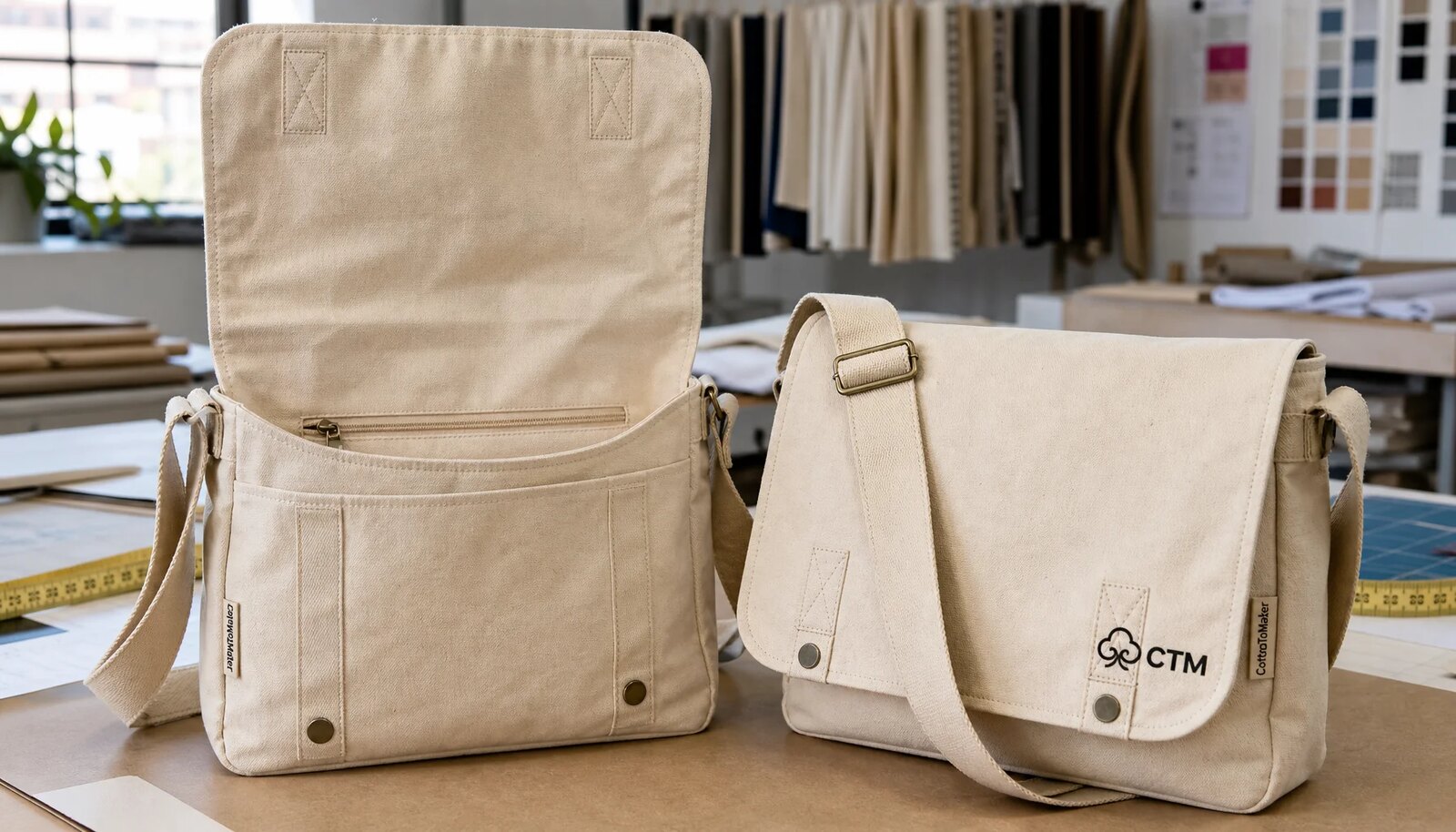
Start the Calendar From Final Approval, Not First Inquiry
For canvas messenger bags lead time planning for craft fairs, the most important calendar rule is simple: a factory does not usually start the real production clock when the buyer sends the first inquiry. Production starts when all commercial and technical release conditions are closed. That normally means an approved quotation, confirmed purchase order, deposit or payment release, final artwork, confirmed fabric, approved sample, and no open trim or packing decisions. If any of those items are still being discussed, the order may be quoted but not fully scheduled.
A realistic imported custom schedule is often 8-12 weeks from final approval when ocean freight is involved. That window includes sample work, fabric booking, printing, sewing, thread trimming, finishing, inspection, packing, export handover, transit, and receiving. Air freight can reduce transit time, but it does not remove the time needed for fabric, artwork preparation, printing, curing, sewing, or quality control. Procurement teams should therefore work backward from the fair setup date, not from the public opening date.
Craft fair programs also need a receiving buffer. Cartons may need to be counted, split by artwork version, ticketed, barcode-labeled, moved to a booth services provider, or distributed to several fair locations. A shipment arriving at a warehouse on Friday for a Monday setup is technically delivered, but it leaves very little recovery time if cartons are damaged, counts are short, labels are wrong, or local delivery is delayed.
- Use the fair setup date as the operational deadline, not only the fair opening date.
- Set a warehouse receiving deadline at least 7-14 days before booth setup.
- Confirm whether the production clock starts after deposit, sample approval, artwork approval, or all approvals together.
- Track sample time, bulk production time, inspection time, export handover, freight transit, customs clearance, and local delivery separately.
- Reserve air freight for shortage recovery or urgent replenishment, not as the default plan for poorly frozen specifications.
- Tell the supplier the real in-hand date and ask them to identify the latest safe approval date.
Translate Craft Fair Use Into Product Specifications
A canvas messenger bag for a craft fair is not always a fashion item, and it is not always a basic giveaway. It may be a sponsor gift, exhibitor kit, artist merchandise product, bookstore item, museum shop SKU, staff bag, or distributor stock item. Each use case affects the size, structure, strap length, pocket layout, branding position, and acceptable cost. Procurement buyers should define the use case before negotiating price because the cheapest construction may not support the way the bag will be handled at the event.
Start with what the bag must carry. A bag meant for brochures and lightweight purchases can use a simpler internal pocket and moderate gusset. A bag meant to hold a tablet, notebook, water bottle, or packaged craft goods needs more attention to gusset depth, strap anchoring, seam strength, and flap coverage. If the buyer has a target item, provide its exact size and weight. A factory can then adjust the pattern instead of guessing from a generic messenger bag reference.
Display performance also matters. Craft fair buyers often need bags to look presentable when stacked on a table, hung from a peg, or shown behind a booth. A bag that collapses completely may save cost but can look low-value in resale. A bag that is too stiff or too heavy may feel premium but raise freight cost and reduce booth handling convenience. The best specification balances display structure, carrying comfort, print visibility, and carton efficiency.
- State whether the bag is for resale, giveaway, exhibitor kit, staff use, sponsor gift, or distributor inventory.
- List the heaviest expected contents and the maximum acceptable sag or distortion.
- Specify finished width, height, gusset, flap length, pocket depth, and strap length range.
- Confirm whether the strap must work for shoulder carry only or adjustable crossbody use.
- Decide whether the flap covers the full front panel, partial front panel, or only the opening.
- Mark required features early, including laptop or tablet fit, pen slots, inner divider, zipper pocket, magnetic snap, buckle, or hook-and-loop closure.
Choose Canvas Weight, Color, and Finish Before Comparing Quotes
Canvas weight is one of the biggest cost and quality drivers in custom messenger bags. A 10 oz canvas may work for budget promotional use, but many B2B craft fair programs benefit from 12 oz canvas, roughly 380-400 GSM depending on weave and finishing. It gives a practical balance of structure, printability, sewing speed, unit cost, and freight weight. A 14-16 oz canvas can feel more premium and durable, but it also increases material consumption, slows sewing, creates thicker seam intersections, and can raise shipping cost.
Buyers should not compare two quotes unless the canvas specification is clear. A supplier quoting natural 12 oz stock canvas is not quoting the same product as another supplier quoting dyed 14 oz canvas with washing or shrinkage control. Ask for both oz and GSM because different suppliers may use different systems. Also ask whether the fabric is greige, natural, bleached, dyed, washed, preshrunk, or treated. These details affect shade, hand feel, shrinkage, price, and production lead time.
Natural cotton canvas usually has a warm tone and visible cotton seed specks. That can be attractive for handmade or craft positioning, but it may not suit buyers who expect a clean white background for sharp sponsor logos. Bleached canvas improves print contrast but can show dirt more easily. Dyed fabric requires lab dip or swatch approval and may add days or weeks if fabric must be dyed for the order. When delivery date is tight, stock natural or stock black canvas is often safer than custom color development.
- Request canvas weight in oz and GSM, plus expected tolerance.
- Ask whether the quoted fabric is stock, made-to-order, dyed after order, washed, or preshrunk.
- Approve a physical fabric swatch before sample making because screen photos are unreliable.
- Use 12 oz canvas for many balanced craft fair merchandise and exhibitor kit programs.
- Use 14-16 oz canvas only when the retail value and freight budget support the upgrade.
- Clarify whether natural cotton specks, shade variation, slubs, and minor weave texture are acceptable.
Freeze Construction Details Before Artwork Exposure
Messenger bag construction has more schedule impact than many buyers expect. A tote bag may be mostly two panels and handles, while a messenger bag includes a flap, gusset, strap, adjuster, closures, pockets, lining or binding in some designs, and multiple reinforcement points. Each added feature creates pattern work, material sourcing, sewing steps, and inspection points. If the buyer changes these details late, the factory may need to remake samples or re-cut parts.
Construction decisions should be locked before the artwork is exposed on the final bag. The flap length affects the print area. The closure position affects where a logo can sit. The gusset depth affects the way the front panel curves when loaded. The strap anchor position affects comfort and seam stress. A pocket behind the flap can change stitch lines visible on the front panel. If artwork is approved before construction is stable, the print may later conflict with stitching, folds, snaps, or buckles.
For B2B procurement, it is useful to classify features as standard, optional, and risk items. Standard features usually include an adjustable cotton webbing strap, flap closure, internal slip pocket, and bartacks at stress points. Optional features may include zipper pockets, woven labels, hangtags, magnetic snaps, metal adjusters, padded sections, or special binding. Risk items include custom hardware, uncommon strap colors, new mold parts, special lining, or construction that the factory has not produced before.
- Freeze bag dimensions, flap shape, gusset, strap width, adjuster, closure, pockets, labels, and reinforcement before final print approval.
- Ask the factory which construction features are standard in their current production line.
- Confirm reinforcement at strap anchors, flap corners, pocket openings, closure points, and side seams.
- Avoid custom hardware unless the schedule allows sourcing, testing, and replacement time.
- Check whether pocket stitch lines or closure parts will be visible on the printed front area.
- Request a revised lead time estimate if any construction detail changes after sample approval.
Select Printing Method Around Artwork, Texture, and Placement
Most craft fair canvas messenger bags use screen printing because event logos, sponsor marks, and simple brand artwork are often solid-color designs. Screen printing is efficient for one to three colors and can perform well on cotton canvas when ink deposit, mesh selection, curing, and fabric texture are controlled. For gradients, full-color artwork, photographic detail, or many small color changes, transfer or digital printing may be considered, but those methods should be sampled for hand feel, edge clarity, and durability.
Messenger bags create more artwork placement challenges than flat totes. The flap may curve, fold, or overlap the front panel. A closure may interrupt the logo area. A seam line can distort a circle or straight rule. A thick gusset can change how the front panel sits when the bag is loaded. Buyers should provide artwork position from edges, print dimensions, Pantone references, color count, and a diagram showing whether the print appears on the flap, lower front panel, pocket, strap, or side label.
Print approval should include more than a digital proof. Canvas texture can create broken edges or pinholes in fine details. Large solid ink areas can feel heavy or crack if not cured correctly. Dark ink on natural canvas may look different after drying than it does wet. If alignment is critical, approve a printed panel or printed pre-production sample before bulk sewing. If the print crosses a fold or sits near a closure, inspect the sample after it is closed, opened, and flat packed.
- Use vector artwork for screen print and confirm minimum line thickness and small text limits.
- Keep critical artwork at least 2-3 cm away from seam lines, flap folds, snaps, and buckle contact points.
- Ask for Pantone targets and define whether approval is by Pantone book, printed strike-off, or physical sample.
- Require a rub test after curing, especially for dark ink, large solid areas, and prints on textured canvas.
- Approve print position tolerance, commonly tighter for centered flap logos than for lower corner marks.
- Ask whether bulk panels are printed before sewing or finished bags are printed after sewing, because placement control differs.
Plan MOQ by Variant, Not Just Total Quantity
MOQ for canvas messenger bags is not only a supplier preference. It is tied to fabric roll usage, cutting efficiency, screen setup, trim purchasing, sewing line setup, packing changeovers, and inspection complexity. A factory may accept 300 pieces for one natural canvas bag with one print, but that does not mean 300 pieces can be split into six fabric colors, three strap colors, and ten sponsor logos without cost or lead time impact.
Craft fair buyers often want localized versions for cities, sponsors, artist collections, or seasonal events. That can be managed, but the RFQ must break down quantity by variant. If the base bag is identical and only the artwork changes, the supplier may permit smaller artwork splits with added screen or setup charges. If body color, canvas weight, strap color, pocket layout, woven label, closure, barcode, or carton mark changes, the variant may become a separate lot for sourcing, cutting, production, and packing.
A practical procurement strategy is to standardize the base bag and vary only what is necessary. One shared natural canvas body with different one-color prints is usually easier to manage than several dyed fabric colors with separate straps and labels. For uncertain event demand, buyers can also plan a common unprinted or lightly branded overrun that can be used across future fairs. Overproduction should be agreed in writing because factories may need allowance for cutting loss or QC rejects.
- Request MOQ by body color, canvas weight, strap color, print design, label, and packing version.
- Ask whether small artwork splits are allowed when the base bag remains identical.
- Bundle city or sponsor versions under one shared construction when possible.
- Avoid splitting low quantities across custom dyed fabric colors unless the budget supports higher setup costs.
- Confirm overproduction or underproduction tolerance before issuing the purchase order.
- Use separate SKU codes for each artwork and packing version to prevent carton mixing.
Use Sampling to Remove Production Ambiguity
For custom canvas messenger bags, a two-step sampling route is usually stronger than approving only one finished sample. The blank structure sample confirms the physical bag: size, gusset, flap proportion, pocket access, strap length, adjuster function, closure position, stitching, and reinforcement. The printed pre-production sample or printed panel confirms artwork scale, ink color, placement, curing, and how the logo looks after the flap is folded and the bag is packed.
Physical sample review matters because canvas is tactile. Buyers need to feel thickness, stiffness, pocket usability, strap comfort, and loaded behavior. Photos help speed communication, but they do not reveal whether a 12 oz canvas feels sturdy enough for resale, whether the strap slips through the adjuster, or whether a pocket is too shallow for the intended item. If time is tight, buyers can approve the structure by courier sample and approve print color from a strike-off or printed panel, but the approval method should be documented.
Sample approval should be written and specific. A note such as 'sample approved' is less useful than an approval record listing accepted dimensions, canvas weight, color, strap range, pocket depth, print size, closure location, and any requested corrections. Keep one approved sample with the buyer or inspector and one at the factory. During final inspection, the approved sample becomes the visual and functional standard.
- Measure sample width, height, gusset, flap length, pocket depth, strap width, and strap length range.
- Load the sample with realistic contents for 30-60 minutes to check sag, strap comfort, and seam stress.
- Open and close the flap repeatedly to check closure alignment and pressure marks.
- Photograph the approved sample with a ruler, front view, side view, inside view, strap detail, pocket detail, and print close-up.
- Keep approval notes clear: approved as is, approved with corrections, or rejected and remake required.
- Ask the factory whether any post-sample change resets pattern, print screen, material sourcing, or bulk production timing.
Build a Quote Sheet That Shows Cost Drivers
A procurement-ready quote for canvas messenger bags should not be a single unit price. Buyers need enough data to compare suppliers fairly, calculate landed cost, and avoid late extras. The RFQ should request fabric specification, finished dimensions, artwork method, print colors, trim details, sample costs, setup charges, packing type, carton dimensions, gross weight, production lead time, and trade term. Without those details, the lowest unit price may become more expensive after freight, inspection, repacking, or labeling is added.
Price breaks are important because messenger bags have setup costs in pattern work, screens, cutting, and line preparation. Ask for clear breaks such as 300, 500, 1,000, and 3,000 pieces using the same spec. If you are considering a premium version, request 12 oz and 16 oz canvas as separate line items, not as vague alternatives. Also ask whether the quote includes individual packing, export carton, carton marks, hangtags, barcode stickers, sample charges, screen charges, and inland freight to port.
The quote should state exclusions and assumptions. If the supplier assumes bulk pack but the buyer later needs individual barcode stickers, carton segregation by event, or paper bands, the cost and packing time can change. If the supplier quotes EXW while another quotes FOB, the landed comparison is incomplete. B2B buyers should create one quote template and require each supplier to answer in the same structure.
- Request unit price at defined quantity breaks using identical construction and packing assumptions.
- Ask for separate lines for each canvas weight, fabric color, artwork version, and packing method.
- Require screen charge, sample charge, custom label setup, hangtag cost, barcode sticker cost, and inspection support terms.
- Collect carton dimensions, units per carton, net weight, gross weight, and carton material for freight comparison.
- Confirm trade term, payment term, production lead time, sample lead time, and export handover time.
- Ask suppliers to list exclusions so late charges do not appear after purchase order approval.
Control Packing So It Protects the Product and Speeds Receiving
Packing affects both product appearance and event execution. Messenger bags are bulkier than flat totes because of gussets, straps, flaps, closures, and pockets. If cartons are too tight, the front flap can crease across the print. If straps are randomly folded, adjusters or buckles can leave pressure marks on light canvas or rub against ink. If artwork versions are mixed without clear carton marks, receiving teams may waste valuable setup time sorting bags at the warehouse or booth.
Flat packing is usually practical for craft fair programs because it saves freight and makes carton counts easier. Individual recycled polybags can keep natural canvas clean during ocean transit and warehouse handling. Paper bands may fit buyers trying to reduce plastic, but they offer less protection from moisture and handling marks. Bulk pack may reduce cost, but it increases the risk of dirt, rubbing, and counting errors unless the receiving process is simple.
Packing requirements should be decided before mass packing begins. Buyers should confirm whether each bag needs a hangtag, barcode sticker, country-of-origin label, retail price sticker, size or color label, care label, or event-specific insert. Carton marks should identify SKU, artwork version, quantity, destination, and purchase order. If cartons are going directly to multiple fair venues, destination labeling becomes a schedule-critical detail, not a warehouse preference.
- Approve packing photos or a packed carton sample before bulk shipment where possible.
- Protect printed flap areas from strap buckles, metal adjusters, snaps, and zipper pullers.
- Use consistent units per carton so event teams can count quickly and identify shortages.
- Specify carton marks by SKU, artwork version, PO number, destination, and quantity.
- Avoid over-compressed cartons because creased flaps and carton bursting can delay receiving.
- Confirm palletization, carton strength, moisture protection, and maximum stacking if goods move through a distributor warehouse.
Set Inspection Standards That Are Measurable
Quality control is strongest when acceptance criteria are defined before production begins. For canvas messenger bags, common defects include fabric stains, strong odor, uneven flap shape, twisted straps, weak strap anchors, skipped stitches, misaligned prints, ink smudges, peeling transfer, crooked pockets, wrong closure placement, incorrect labels, and carton count errors. Many of these problems are preventable when the factory knows the buyer’s inspection standards before cutting and sewing.
Inspection can use random sampling according to an agreed AQL level, but product-specific checkpoints should be listed in the purchase order. Finished size might allow plus or minus 1 cm. Print placement might allow plus or minus 5 mm for normal screen print, or tighter if the logo is centered on a flap. Strap length, pocket depth, flap symmetry, and closure position should have practical tolerances. If tolerances are not written, inspectors may rely on subjective judgment, which creates disputes after shipment.
Functional checks are especially important for messenger bags. A bag can look acceptable on a table but fail during use if strap anchors are weak, the adjuster slips, the closure pulls fabric out of shape, or the pocket is too shallow. Include seam pull checks, strap pull checks, closure function, print rub checks, and loaded fit checks. Final inspection should also verify carton labels and packing counts because craft fair shortages are costly even when the product itself is well made.
- Define critical defects such as wrong artwork, wrong fabric color, unsafe sharp hardware, or missing closure.
- Define major defects such as broken seams, weak strap anchors, peeling print, severe stain, wrong size, or unusable pocket.
- Define minor defects such as light loose threads, small internal marks, or slight shade variation within the approved range.
- Use the approved sample as the visual standard for canvas shade, print color, flap shape, and stitch quality.
- Include seam pull, strap pull, closure function, print rub, measurement, pocket usability, and carton count checks.
- Require inspection photos for front, back, inside, strap anchors, print close-up, closure, carton marks, and packed carton condition.
Specification comparison for buyers
| Planning area | Procurement recommendation | When it fits | Lead time or quality risk to check |
|---|---|---|---|
| Calendar baseline | Count 8-12 weeks from final approved artwork, approved sample, confirmed fabric, and deposit or payment release | Imported custom canvas messenger bags for craft fairs, museum shops, sponsor kits, or distributor stock | Do not count from first inquiry; open artwork, fabric, trim, or packing decisions can keep the order outside the production queue |
| Body fabric weight | Use 12 oz canvas, about 380-400 GSM, for balanced structure and cost | Most craft fair resale, exhibitor kits, bookstore programs, and branded merchandise | Lighter canvas may collapse on display; heavier canvas can slow sewing, raise carton weight, and increase freight cost |
| Premium fabric upgrade | Use 14-16 oz canvas, about 450-540 GSM, only when the retail price supports the upgrade | Artist merchandise, durable daily-use positioning, premium sponsor gifts, and boutique retail programs | Thicker seams need suitable machines, needles, bartacks, and slower line speed; confirm factory experience before promising a launch date |
| Artwork method | Use screen print for 1-3 solid colors; use transfer or digital print for gradients or full-color illustration | Craft fair logos, sponsor names, simple brand marks, and limited-edition event artwork | Require print size limits, Pantone targets, placement tolerance, curing standard, and rub test because flap folds and seams can distort artwork |
| Construction scope | Freeze flap length, gusset depth, strap width, adjuster, pocket layout, closure, labels, and reinforcement before print sampling | Messenger bags that must carry catalogs, tablets, small retail purchases, or exhibitor materials | Changing pocket depth, closure type, or strap anchor after sample approval can require a revised pattern and reset part of the schedule |
| MOQ planning | Ask for MOQ by body color, strap color, print design, label, and packing version | Orders with city-specific artwork, sponsor versions, or multiple retail SKUs | A total MOQ can hide variant minimums; custom dyed fabric, private labels, and barcode versions may require separate setup and higher minimums |
| Sampling route | Approve a blank structure sample first, then a printed pre-production sample or printed panel | New bag dimensions, new flap shape, custom pockets, or artwork placed on the flap | Skipping the structure sample can leave late corrections to fit, sag, strap length, or closure alignment after print screens are made |
| Packing method | Flat pack with controlled strap fold, clean inner protection, 40-60 pcs per export carton depending on size and canvas weight | Craft fair receiving teams that need quick carton counts, clean product, and easy booth replenishment | Over-compression can crease printed flaps; random strap placement can mark light canvas or rub against ink during transit |
| Inspection standard | Write measurable tolerances for size, print position, seam strength, strap function, shade, odor, stains, and carton count | B2B buyers who need consistent SKUs across multiple fair locations or retail accounts | Visual-only inspection misses weak strap anchors, wrong pocket depth, print rub failure, and incorrect carton marks |
Buyer checklist before sampling
- Set the fair opening date, booth setup date, warehouse receiving date, and latest acceptable ship date before requesting any price.
- Define the delivery route: supplier to port, air terminal, forwarder, warehouse, distributor, fair venue, or multiple event destinations.
- Specify finished bag width, height, gusset depth, flap length, strap width, strap length range, adjuster type, pocket layout, closure, and reinforcement.
- State the intended use: giveaway, resale item, exhibitor kit, staff bag, sponsor package, bookstore stock, museum shop product, or artist merchandise.
- Confirm what the bag must carry, including catalogs, packaged goods, tablets, notebooks, water bottles, or event documents, and provide dimensions and expected weight.
- Choose canvas weight in oz and GSM, fabric color, natural or bleached appearance, dye requirement, shrinkage expectation, and acceptable cotton seed specks.
- Provide artwork as vector files with Pantone references, print dimensions, print location from edges, color count, minimum line thickness, and whether the artwork crosses folds or seams.
- Break down order quantity by body color, strap color, artwork version, label version, barcode version, packing method, and delivery destination.
- Request MOQ, price breaks, screen or setup charges, sample charges, carton dimensions, gross weight, units per carton, and trade term in the first quote round.
- Require a blank structure sample, printed pre-production sample or printed panel, and written approval records before bulk fabric cutting or bulk printing.
Factory quote questions to send
- What is your standard MOQ for this canvas messenger bag by body fabric color, strap color, print design, woven label, and packing version?
- Which canvas weights are in regular stock, and which require weaving, dyeing, bleaching, washing, or special procurement?
- Can you quote 10 oz, 12 oz, and 16 oz canvas separately using the same dimensions, closure, artwork, and packing assumptions?
- What is the estimated GSM tolerance for the quoted canvas, and can you provide a physical swatch before sample making?
- How many days do you need for pattern preparation, blank structure sample, printed panel or strike-off, and printed pre-production sample after receiving artwork?
- What print method do you recommend for this artwork, and what are the maximum print areas on the flap, lower front panel, pocket, and strap?
- What placement tolerance do you apply to finished size, flap symmetry, pocket depth, strap length, print position, and closure alignment?
- Which closures, adjusters, webbing widths, zipper types, snaps, labels, and hangtag options are standard in your factory, and which extend lead time?
- What reinforcement is included at strap anchors, flap corners, pocket openings, closure points, and side seams?
- How many sewing lines can you allocate after fabric and printed panels are ready, and what is the realistic daily output for this construction?
Quality-control points to confirm
- Fabric weight should match the approved swatch within the agreed GSM tolerance, with no unacceptable stains, weaving holes, oil marks, excessive slubs, or strong storage odor.
- Fabric shade should be checked against the approved swatch under agreed lighting, especially for natural, bleached, black, navy, and custom dyed canvas.
- Finished bag width, height, gusset, flap length, pocket depth, and strap range should stay within the written tolerance, commonly plus or minus 1 cm unless tighter limits are approved.
- Flap shape should be symmetrical, sit flat when closed, and not twist or pull to one side because of uneven sewing tension or closure placement.
- Strap length and adjuster function should allow the approved shoulder or crossbody use, with no slipping, cracked hardware, sharp edges, or twisted webbing.
- Stress points such as strap anchors, side seams, flap corners, pocket openings, closure positions, and handle joins if used should have bartacks or equivalent reinforcement.
- Seam pull checks should be performed on strap anchors and loaded areas, not only visually reviewed for straight stitching.
- Print color should match approved Pantone or physical printed sample within the agreed tolerance, with no severe bleeding, cracking, peeling, pinholes, ghosting, or uneven curing.
- Print position should stay within the approved alignment tolerance and should not be hidden by flap folds, stitch lines, closure parts, or carton creases.
- Print rub testing should be performed after curing and before final packing, especially for dark ink, large solid artwork, and prints on textured canvas.