Start With the Compliance Problem, Not the Bag Photo
Hotel retail canvas messenger bags sit in a difficult position between souvenir, travel accessory, and branded merchandise. A buyer may show one clean reference photo, but the supplier has to translate that photo into fabric weight, seam structure, logo process, packing format, and export-ready documentation. If those details are left open, two suppliers can quote the same-looking bag with a 20 percent cost gap because one is using lighter canvas, plastic hardware, no lining, and simplified packing.
For procurement teams, supplier compliance is not only about certificates. It is about whether the supplier can repeatedly make the same bag, label it correctly for hotel retail, pack it for receiving, and support inspection before shipment. The RFQ should therefore connect product specification with evidence: material description, production route, sample approval, QC method, carton data, and the exact documents the buyer needs for import or retail compliance.
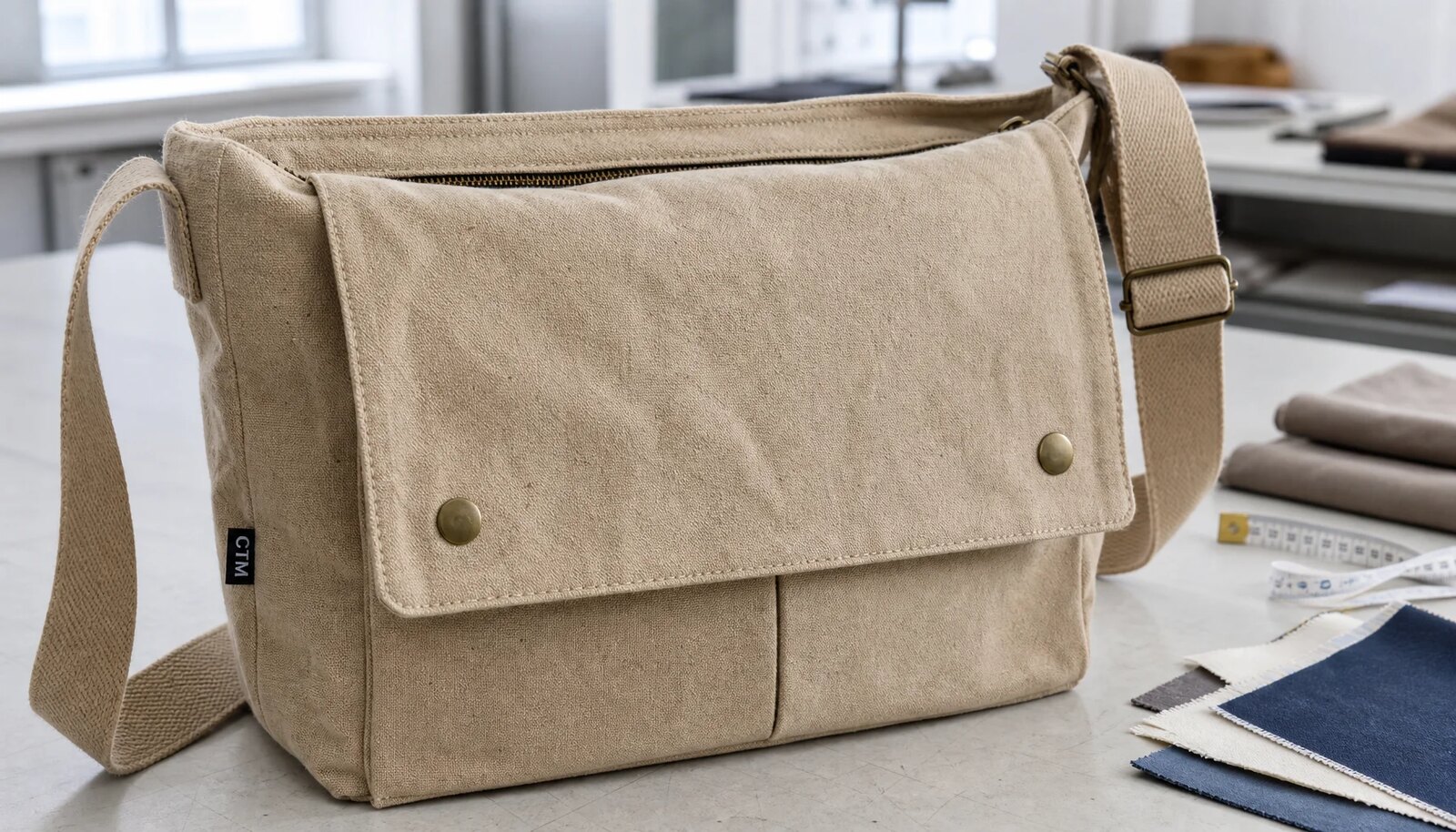
- Treat the reference image as design direction, not a production specification.
- Separate mandatory compliance items from preferences such as washed look or antique hardware.
- Require suppliers to quote against the same construction, otherwise FOB comparison is not meaningful.
- Use a sealed approval sample as the control point for fabric, print, hardware, and workmanship.
Canvas Weight and Construction Choices That Change the Quote
Canvas messenger bags for hotel retail commonly use 10 oz, 12 oz, 14 oz, or 16 oz cotton canvas. In approximate GSM terms, 10 oz is often around 340 gsm, 12 oz around 400 gsm, 14 oz around 475 gsm, and 16 oz around 540 gsm, though the exact number depends on weave and finishing. A light 10 oz canvas may be acceptable for a soft souvenir bag, but a paid retail messenger bag usually needs 12 oz or above, especially when the flap, gusset, and strap carry real use.
Construction also affects cost more than many buyers expect. An unlined messenger bag is faster to sew and shows the natural canvas interior, but seam finishing must be clean. A lined bag looks more retail-ready and hides internal seams, but it adds material, labor, turning difficulty, and inspection points. Reinforcement patches at strap ends, double stitching at stress points, and a structured bottom gusset can add cost, but they reduce after-sales complaints when guests actually use the bag for tablets, books, or travel items.
- Entry retail: 10-12 oz canvas, unlined body, cotton webbing strap, simple inner pocket.
- Mid retail: 12-14 oz canvas, lined body, reinforced strap ends, zipper or snap closure.
- Premium retail: 14-16 oz canvas, lined compartments, metal adjuster, rivets, stronger bottom structure.
- Avoid specifying only “heavy canvas”; use oz, GSM, weave feel, and finished sample weight.
Supplier Routes and What Each One Must Prove
The keyword in this project is supplier compliance, so the sourcing route matters. A direct factory can usually control cutting, sewing, inline inspection, and packing faster because the merchandiser is close to the production floor. A trading company may still be useful when the buyer is consolidating several hotel retail products in one container, but then the trading company must prove how it audits the messenger bag factory and how it prevents unapproved fabric or hardware changes.
For hotel retail, supplier evidence should be practical. A polished company profile is less valuable than production floor photos, similar bag samples, a clear material sourcing plan, and an inspection checklist matching the buyer's product. The supplier should be able to explain MOQ by fabric color, print color, label version, and packing version. If they cannot explain why MOQ changes when the buyer adds three hotel property logos, they may not be managing the real production variables.
- Direct factory evidence: sewing line photos, sample room capability, material swatches, inline QC method.
- Trading company evidence: named production process, supplier audit method, inspection responsibility, consolidation plan.
- Stock supplier evidence: available inventory, batch consistency, decoration limits, replacement policy.
- Decorator route evidence: blank bag consistency, logo testing, reject handling, domestic packing cost.
Print and Branding Methods for Canvas Messenger Bags
The best logo method depends on the canvas surface, artwork style, order quantity, and retail price point. Screen printing is the common choice for simple hotel logos, line art, and one to three solid colors. It gives good coverage on natural or dyed canvas, but fine lines and small reversed text can fill in if the mesh, ink, or pressure is not controlled. Heat transfer can handle more colors and gradients, but buyers should test hand feel, edge durability, and cracking risk on folded flap areas.
Embroidery gives a durable retail look, especially for small crest logos, but it can pucker thinner canvas and becomes costly for large filled artwork. Woven labels or sewn patches are often a good hotel retail solution because the same bag body can be used for several properties while the label changes. For a compliance checklist, the key is to define placement tolerance and test the logo on the actual production canvas. A logo that looks clean on flat white artboard may look weak on slubbed natural cotton.
- Screen print: best for bold logos, limited colors, and medium to large production runs.
- Embroidery: best for compact marks, crests, and premium positioning, not huge filled designs.
- Woven label: useful for multi-property hotel programs and cleaner repeat replenishment.
- Leather or PU patch: retail look, but confirm material compliance, edge finish, and stitching strength.
- Print tolerance: set acceptable position variation, color deviation, ink bleeding, and rub resistance.
MOQ Logic Buyers Should Put in the RFQ
MOQ is not one number. For canvas messenger bags, MOQ can apply to fabric dyeing, canvas color, print screen setup, embroidery thread, hardware finish, label weaving, and carton label versions. A factory may accept a lower total order if the buyer uses natural canvas, standard black or nickel hardware, and one logo color. The same factory may require a higher MOQ if the buyer wants a custom dyed canvas, antique brass hardware, woven label, and individual hotel barcode stickers.
A strong RFQ separates body MOQ from SKU MOQ. For example, the buyer may order 2,000 pieces of the same bag body but split into four hotel logos of 500 pieces each. That is easier than four different fabric colors at 500 pieces each. Procurement teams should also distinguish sample MOQ from production MOQ and re-order MOQ. Repeat orders can sometimes run lower if fabric, labels, and hardware are already approved and the supplier holds the production records.
- Lowest MOQ path: natural canvas, standard strap, screen print, common hardware, simple bulk packing.
- Higher MOQ triggers: custom dyed canvas, special zipper color, custom woven labels, metal logo plate.
- SKU split issue: one body with several logos is easier than several body colors.
- MOQ negotiation lever: accept standard carton packing or combine property logos in one production batch.
Sample Approval Should Simulate Bulk Production
A photo sample is not enough for a hotel retail messenger bag. The approval sample should be made with the quoted canvas weight, same lining if any, same hardware finish, same strap width, same print method, and same label placement. If the sample uses available substitute fabric or temporary hardware, the supplier must label it clearly and state what will change in bulk. Otherwise, the buyer may approve a sample that the factory cannot reproduce at the quoted cost.
The sample review should include measurement, loaded appearance, functional use, and retail presentation. Put a tablet or book inside to see whether the flap closes correctly and whether the strap twists. Open and close snaps or zippers repeatedly. Check if the print sits flat when the flap bends. For hotel retail, also review how the bag looks with hangtag and barcode applied, because poor tag placement can make a good bag look cheap on the shelf.
- Measure width, height, gusset, flap depth, pocket size, strap width, and adjustable strap range.
- Review symmetry: flap angle, pocket alignment, strap attachment, side gusset shape, and bottom corners.
- Test function: closure strength, zipper smoothness, snap retention, strap slider movement, and pocket access.
- Approve with comments in writing; do not rely only on chat photos or verbal agreement.
- Keep one sealed sample with the buyer and one with the factory before mass production.
QC Thresholds That Prevent Retail Complaints
Messenger bags receive more stress than flat totes because the shoulder strap, flap closure, and gusset all work together. QC should therefore focus on stress points and visual shelf appeal. A slightly uneven inner seam may be minor, but a weak strap bar tack is critical. A small shade variation inside the lining may be acceptable, but a crooked front print or tilted flap will be visible immediately in a hotel shop.
Use a defect classification before production starts. Critical defects include broken needles left in the product, sharp hardware, mold, wrong logo, unsafe packaging, and major function failure. Major defects include open seams, loose strap attachment, zipper failure, strong color mismatch, obvious print smearing, wrong label, or incorrect carton marks. Minor defects include small loose threads, slight internal stitch variation, or a small washable mark within the approved limit.
- Stitch density: define target stitches per inch or require approval against sealed sample.
- Seam strength: pull-test strap ends and flap attachments during inline QC, not only final inspection.
- Size tolerance: control finished dimensions so bags fit retail displays and shipping cartons.
- Print quality: reject obvious bleeding, misregistration, peeling, cracking, or wrong Pantone direction.
- Cleanliness: control loose threads, oil stains, chalk marks, odor, and moisture before packing.
Packing and Labeling for Hotel Retail Receiving
Packing is part of supplier compliance because hotel retail orders often ship to distribution centers, property warehouses, or third-party logistics providers. A bag that is well made but packed with wrong barcodes or mixed property labels can create chargebacks, rework, or delayed launch. The RFQ should state whether each bag needs an individual polybag, recycled paper band, hangtag, barcode sticker, care label, silica gel, or retail insert card.
Master carton planning should be confirmed before order approval. Heavy canvas bags can make cartons dense quickly, especially if metal hardware and lining are used. Cartons that are too heavy are difficult for receiving staff and more likely to split during handling. Buyers should request carton dimensions, pieces per carton, gross weight, net weight, and CBM in the quote, then use those numbers for freight comparison and warehouse planning.
- Retail-ready packing: hangtag visible, barcode scannable, bag folded consistently, no crushed flap.
- Eco-lean packing: paper band or kraft sleeve, but confirm fabric stays clean during transit.
- SKU control: separate cartons by hotel property, logo version, color, and barcode where required.
- Carton marks: include PO number, SKU, color, quantity, destination, carton number, and country of origin if needed.
- Moisture control: dry canvas fully before packing and avoid sealing damp washed canvas in polybags.
Lead Time Risks Hidden Behind a Simple Delivery Date
Lead time for custom canvas messenger bags is usually driven by material sourcing, sample approval, printing setup, sewing capacity, and packing complexity. A simple unlined natural canvas bag with screen print may move quickly after approval. A lined bag with custom dyed canvas, antique brass hardware, woven label, and several barcode versions needs more planning. The buyer should not treat the supplier's delivery date as reliable until sample approval and material purchase timing are fixed.
Schedule risk often comes from late artwork changes and unclear property allocation. If a hotel group changes logo size after screens are made, or adds one more property label after woven labels are ordered, the factory may need to restart part of the process. A better workflow locks artwork first, approves the construction sample second, confirms the packing list third, and only then authorizes bulk cutting. This prevents the factory from cutting fabric before the buyer has settled retail packaging and barcode data.
- Typical planning stages: artwork review, material confirmation, sample making, sample approval, bulk material purchase, cutting, printing, sewing, inspection, packing.
- Schedule buffer: allow extra time for custom dyed canvas, metal hardware plating, woven labels, or multi-SKU packing.
- Approval gate: no mass cutting until the buyer approves size, fabric, print, hardware, and packing method.
- Risk control: require weekly production photos during cutting, printing, sewing, and final packing for larger orders.
Quote Data Needed for Real Landed-Cost Comparison
A low FOB price is not useful if the quote omits carton data, packing cost, sample cost, print setup, label charges, or inland handling. For canvas messenger bags, landed cost is affected by product weight and carton volume as much as factory price. A 16 oz lined bag may sell better at retail, but it can increase freight cost and carton weight. Buyers should compare supplier quotes using both unit price and shipment data.
The quote sheet should show fabric specification, lining, hardware, logo method, label type, packing method, MOQ, sample fee, mold or screen charge if any, lead time, payment terms, inspection allowance, and carton details. If one supplier includes hangtag and barcode application while another only quotes bulk packed bags, their prices are not comparable. Procurement teams should normalize the quote before negotiation instead of pushing every supplier for a lower number based on incomplete scope.
- Product cost drivers: canvas GSM, lining, strap density, hardware material, pockets, reinforcement, and sewing time.
- Decoration cost drivers: number of print colors, print size, embroidery stitch count, label type, and setup charges.
- Packing cost drivers: individual bag, hangtag, barcode, tissue, paper band, carton strength, and SKU separation.
- Freight data: carton size, pieces per carton, gross weight, net weight, total CBM, and loading method.
- Commercial terms: incoterm, payment schedule, sample charge, tooling charge, inspection responsibility, and claim handling.
Specification comparison for buyers
| Supplier option | What to verify | Commercial advantage | Buyer risk to control |
|---|---|---|---|
| Direct sewing factory | hardware trim card, strap-load photo, lining close-up, approved flap sample, and first-piece production photos | Better sample-to-bulk control and faster production feedback | May be weaker on export paperwork or branded packing unless checked early |
| Trading company | Factory name, production photos, trim-source proof, and who owns QC decisions | Can coordinate small mixed orders and extra services | Markup can hide real factory capability and slow defect decisions |
| Specialized bag workshop | flap shape, strap webbing, buckle, D-ring, inner pocket, zipper pocket, seam allowance, and load path | More practical for detailed construction, trims, and repeat programs | Capacity may be limited during peak seasons |
| Low-price general supplier | 10-16 oz canvas, washed canvas, rPET canvas, lining fabric, interfacing, and hardware finish | Useful for simple promotional runs with loose specs | Material downgrades, weak packing, and vague inspection scope can erase savings |
| Retail-ready supplier | shape support, strap folding, hardware protection, individual bag, carton drop expectation, and retailer hangtag placement | Can handle labels, SKU separation, carton marks, and receiving rules | Higher unit cost must be compared against reduced warehouse work |
| Compliance-focused supplier | Fabric records, labeling review, test plan, and production traceability | Safer for retail programs and repeat brand orders | Documentation claims need evidence, not only sales language |
| Local sample room plus bulk factory | Signed sample, bulk factory handoff, first-piece photos, and deviation owner | Good for complex branding before large production | Sample room quality may not match bulk line unless handoff is controlled |
Buyer checklist before sampling
- Define finished bag size, flap depth, gusset width, strap width, and pocket layout in centimeters with tolerance bands.
- Specify canvas weight by oz and approximate GSM, not only words such as heavy duty or premium.
- State whether the bag is unlined, cotton lined, polyester lined, or laminated canvas, because this changes cost and sewing method.
- Lock logo method, print size, Pantone references, placement distance from seams, and whether the print must pass rub testing.
- List required hardware material and finish, including snaps, buckles, sliders, zippers, rivets, and magnetic buttons.
- Require one pre-production sample made in bulk fabric with bulk hardware before authorizing mass cutting.
- Set acceptable size tolerance, stitch density, seam strength expectation, color tolerance, print tolerance, and defect classification.
- Define retail packing: hangtag, barcode sticker, silica gel if needed, individual polybag or paper band, master carton marks, and carton weight limit.
- Request quote data by line item: fabric, lining, hardware, printing, labels, packing, sampling, tooling, inland freight, and export carton details.
- Align booking date, sample approval date, material purchase date, production completion date, inspection date, and cargo handover date.
Factory quote questions to send
- What canvas weight are you quoting in oz and GSM, and is it greige, dyed, washed, or enzyme-washed canvas?
- Is the quoted price based on direct factory production or subcontracted sewing, printing, or packing?
- What is the MOQ by body color, logo color, hardware finish, and packing version?
- Which print methods are available for this canvas surface, and what is the minimum line thickness for our logo?
- What are the quoted dimensions, tolerance range, strap length range, and expected finished bag weight?
- Can you provide photos or videos of similar messenger bag production, including cutting, stitching, and inline inspection?
- What sample types are included: blank size sample, printed artwork sample, pre-production sample, and sealed approval sample?
- How many days are needed for material sourcing, sample making, bulk production, inspection, and export packing after deposit?
- What defect standard do you use for open seams, crooked flap, loose threads, print smearing, hardware scratches, and zipper failure?
- What carton size, pieces per carton, gross weight, net weight, and CBM are used for the quoted packing method?
Quality-control points to confirm
- Finished size tolerance should normally be controlled within plus or minus 0.5 cm for body width and height, and plus or minus 1 cm for strap length unless the design requires tighter control.
- Canvas weight must be verified against the approved swatch; a quote for 12 oz canvas should not be accepted if production fabric feels closer to a light tote fabric.
- Critical stress points need reinforcement: strap ends, flap corners, zipper ends, pocket openings, and bottom gusset intersections.
- Print adhesion should be tested by dry rub and light wet rub on the same canvas color used in production.
- Metal hardware should be checked for burrs, plating scratches, inconsistent color, weak snap retention, and sharp edges that can damage fabric.
- Flap alignment should be inspected with the bag filled lightly, not only flattened on the table.
- Labels, barcode stickers, hangtags, and carton marks must match the buyer's SKU list and hotel property allocation.
- Cartons should be drop-resistant for export handling, with carton weight kept practical for warehouse staff and retail receiving teams.