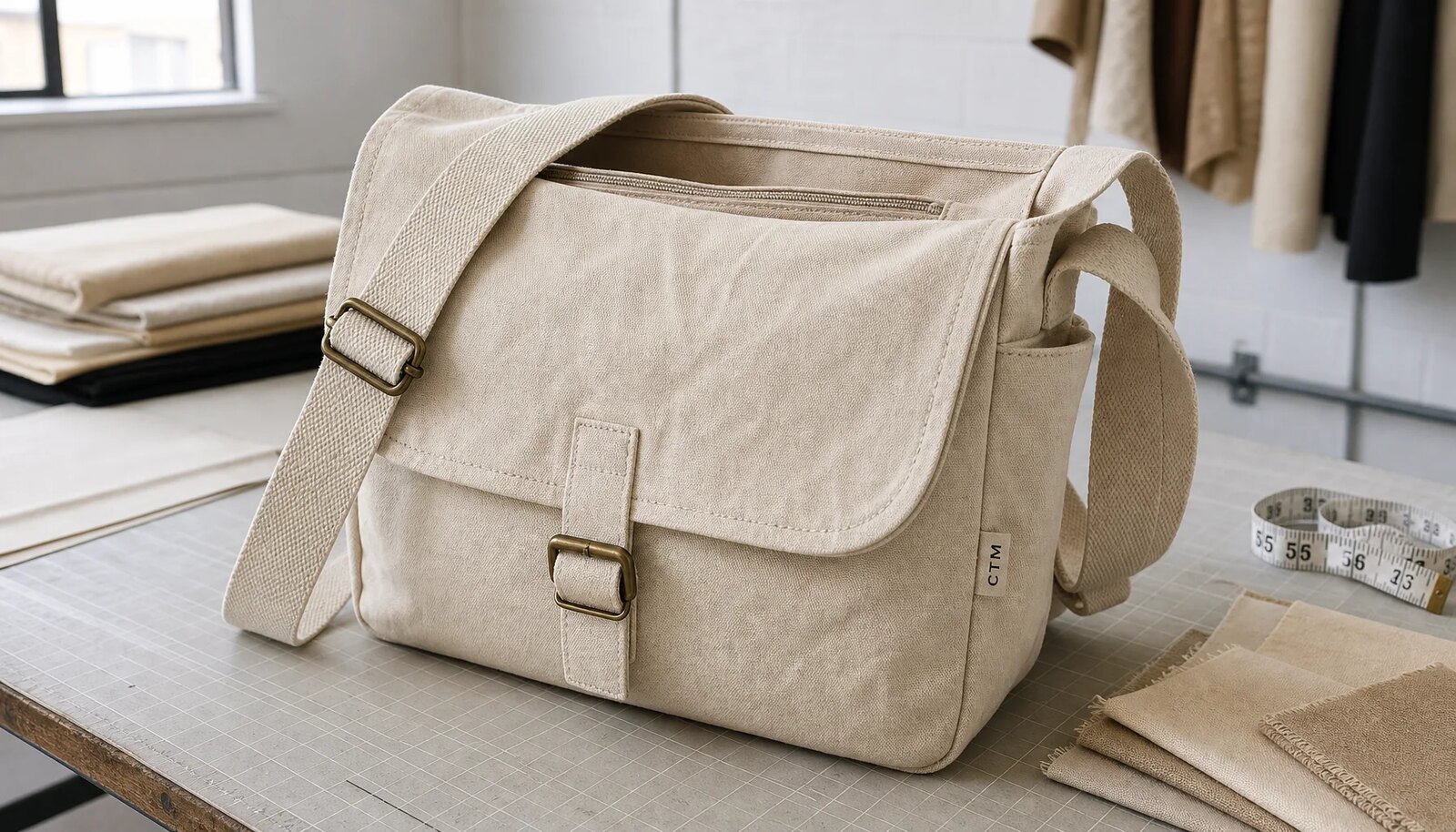
Start With The Retail Job, Not The Bag Sketch
A canvas messenger bag for hotel retail is not the same product as a giveaway tote or a conference handout. It sits in a gift shop, resort boutique, spa store, or destination retail display where guests decide very quickly whether the item feels useful, well made, and worth paying for. The RFQ should begin with the commercial job: premium souvenir, daily travel bag, private-label lifestyle SKU, opening gift, seasonal retail item, or distributor replenishment across several properties.
That retail job changes the specification. A resort boutique may want natural heavy canvas, antique brass hardware, a woven side label, and a softer flap profile. A city hotel may prefer black, navy, or charcoal canvas with a cleaner front logo and a flatter shape for wall display. A distributor serving multiple properties may need one standard body that can accept different logo applications, hangtags, and carton marks without changing the cut-and-sew pattern every time.
Procurement teams should also state the intended retail price band, even if it is only a range. A bag meant to sit in a premium boutique needs different seam finishing, lining, hardware, and packing than a lower-price lobby item. Without that context, suppliers either overbuild the bag and blow the margin, or quote a thin promotional construction that looks cheap next to the rest of the assortment.
The selling environment matters too. A bag displayed on a wall hook needs a strap and hangtag position that looks tidy. A bag stacked on shelves needs flap crease control and a consistent fold. A bag sold through a distributor may need barcode labels, property-specific carton marks, and split packing by hotel. These details affect cost, lead time, and inspection work, so they belong in the RFQ from the start.
- State the channel clearly: hotel gift shop, resort boutique, spa retail, conference shop, opening gift, or distributor replenishment.
- Define the expected user and use case: guest day bag, travel document bag, destination souvenir, or light work bag.
- Share the target retail price band or margin sensitivity so the factory can quote construction options realistically.
- Mention display limits such as wall hooks, shallow shelves, narrow cubbies, counter baskets, or barcode scanning needs.
- Clarify whether the program is a one-time launch, seasonal buy, permanent SKU, multi-property rollout, or reorderable standard item.
Lock The Fabric Spec Before Comparing Prices
The most common quote distortion comes from fabric weight. One supplier may quote 10oz or 12oz canvas to make the price look attractive, while another quotes 14oz or 16oz because the product is positioned as hotel retail. Both offers may describe the item as a canvas messenger bag, but the shelf structure, handfeel, sewing difficulty, and freight weight are not the same. That is why buyers should not compare price before they compare fabric.
For hotel retail, 12oz to 16oz cotton canvas is a practical working range. A 12oz canvas can suit a lighter fashion style, a compact messenger, or a value retail SKU. A 14oz canvas is often the balanced starting point because it feels substantial, prints well, and does not create excessive seam bulk. A 16oz canvas gives a firmer premium impression, but it can increase cutting pressure, needle wear, sewing time, carton weight, and stiffness at the folded flap.
Ask suppliers to state both oz and GSM because canvas naming can vary by market and finishing method. A quoted 14oz fabric may not match another supplier's 14oz fabric if one is measured before washing and the other after finishing. Dyeing, washing, softening, and water-repellent treatment can change handfeel, shrinkage, and surface behavior. Natural canvas also varies in shade, so buyers should not approve a price without seeing a production-equivalent swatch.
Define how the fabric will be controlled in production. Ask for the supplier's tolerance, whether fabric is purchased from stock or woven to order, whether straps use matching cotton webbing, and whether dyed canvas and webbing can be color matched within the same tolerance. This prevents a common retail problem: the body, strap, flap, and label all look acceptable separately but inconsistent as a finished product.
- Request the main fabric as both oz and GSM, such as 14oz cotton canvas at an approximate production GSM range.
- Clarify whether the quoted weight is before washing, after washing, after dyeing, or after coating.
- Ask for fabric swatches, webbing swatches, and lining swatches before locking price and artwork approval.
- Require the same fabric weight and finish when comparing supplier quotes; do not compare stock natural canvas with custom dyed canvas.
- Define color approval under normal store lighting, not only under factory lighting or digital photos.
- Ask whether fabric shrinkage has been allowed for in cutting dimensions and sample measurements.
Specify Construction As A Measurable Product
Messenger bag construction should be written as measurable product requirements, not only as visual descriptions. The body size, gusset, flap overlap, pocket layout, strap width, adjuster type, closure position, seam finish, and reinforcement method all affect cost and user experience. A reference photo can communicate style, but it cannot define whether the bag will carry real guest contents without sagging, twisting, or pulling at the strap seams.
A practical hotel retail size is around 36 x 28 x 10 cm, but the right size depends on the merchandise story. A smaller profile may feel more fashion-oriented, pack efficiently, and suit city hotel retail. A wider or deeper gusset increases perceived value and capacity, but it also changes shelf space, carton volume, and strap loading. If the bag is expected to hold a tablet or slim laptop, state the target device size and whether protection is expected or only casual carrying capacity.
Flap design deserves more attention than it usually gets in RFQs. The flap should cover the opening when the bag is lightly filled, align with the front panel, and sit flat enough for retail presentation. A flap that is too short exposes contents; a flap that is too long can crease, curl, or hide front branding. If the logo sits on the flap, closure hardware must be positioned so it does not interrupt artwork or create pressure marks.
Pockets add retail value, but each pocket also adds labor and quality risk. One inner zipper pocket plus one slip pocket is a common balanced option. Exterior pockets can be useful for maps or room keys, but they should not make the front panel look busy unless the design calls for it. Define pocket size, zipper length, pocket opening reinforcement, and whether the inside seams are bound, overlocked, or hidden by lining.
- Provide a dimension table for width, height, gusset depth, flap overlap, strap length range, and strap width.
- Use a gusset if the bag should hold boxed merchandise, bottles, amenity kits, or folded garments without distorting.
- Require reinforced stitching at strap joints, flap stress points, pocket openings, and bottom corners.
- State whether the strap is fixed, adjustable, removable, cotton webbing, or webbing with shoulder pad.
- Define closure type and position: hidden magnetic snap, visible buckle, buckle with hidden snap, zipper under flap, or hook-and-loop.
- Include seam finishing expectations for unlined bags so inside yarns and raw edges do not reduce retail quality.
Match Branding Method To Canvas And Brand Positioning
Canvas is textured, absorbent, and slightly irregular, so branding has to work with the material rather than fight it. Screen printing is usually the most efficient method for simple hotel logos, destination graphics, one-color icons, and limited-color artwork. It works best when the artwork has enough line thickness and the buyer accepts a small amount of natural canvas texture showing through the ink surface.
Embroidery, woven labels, patches, and heat transfer each create a different cost and quality profile. Embroidery gives a premium textile feel and works well for crests, initials, or small marks, but it can pucker lighter canvas and distort small lettering if stitch density is too high. Woven labels are repeatable and useful for group programs, but they add label MOQ, label lead time, and sewing placement checks. Leather or PU patches can elevate the bag, but they introduce material, color, and compliance questions. Heat transfer can reproduce detailed graphics, yet it may look less natural on rugged canvas unless the design language supports it.
Hotel buyers should give factories production artwork, not only brand guideline screenshots. Vector files, Pantone references, logo scale, print size, location, and approved color tolerance reduce rework. For natural canvas, exact color matching is harder than on white paper because the base fabric color influences the print. For dyed canvas, light ink may require an underbase or multiple passes, which changes cost and handfeel.
The RFQ should also protect the brand from poor placement. Define the logo position with measurements from a seam, flap edge, pocket opening, or centerline. Marked photos are helpful, but measurements are better for inspection. If several hotel logos will run on one body, ask whether the supplier will use separate screens, interchangeable woven labels, or a common body with property-specific hangtags.
- Provide vector artwork, Pantone references, logo size, placement measurements, and approval color tolerance.
- For screen print, confirm ink type, curing method, number of colors, maximum printable area, and dry rub expectation.
- For embroidery, review stitch count, backing, thread colors, minimum readable letter height, and puckering risk.
- For woven labels, confirm size, fold type, edge finish, sewing position, label MOQ, and label lead time.
- For patches, specify material, thickness, debossing or printing method, stitch color, and compliance expectations.
- Ask for a logo strike-off on production-equivalent canvas before approving bulk artwork.
Use MOQ Logic Instead Of Chasing The Lowest Number
MOQ is not just a supplier preference. It comes from material purchasing, dye house minimums, cutting efficiency, print setup, label production, hardware procurement, packing versions, and line changeover. A standard natural canvas messenger bag with one-color screen print may be practical around 500 to 1,000 pieces. A bag with custom dyed canvas, custom webbing, custom lining, custom metal buckle, woven labels, and several logo versions may need a higher MOQ to be efficient and stable.
For hotel groups, procurement teams often get a better result by consolidating the body specification. One shared bag body can be produced in a larger fabric and cutting batch, while hotel-specific logos, hangtags, barcode labels, or carton marks are changed by property. This reduces per-unit cost, simplifies sampling, and improves consistency across a portfolio of hotels. It also gives the buyer clearer inventory control because the body remains the same for future replenishment.
Buyers should ask suppliers to separate MOQ by cost driver. MOQ per fabric color is different from MOQ per logo screen. MOQ per woven label is different from MOQ per carton label. MOQ per custom buckle is different from MOQ per bag body. When these are bundled into one vague MOQ, procurement cannot see which feature is making the order difficult or expensive.
Price breaks should be requested at realistic tiers. Asking only for the minimum quantity encourages a setup-heavy price. Asking for 500, 1,000, 2,000, and 5,000 pieces shows how much cost improves with scale and whether a multi-property buy is worth consolidating. If the program has uncertain demand, ask whether the factory can produce one bulk body run and hold unused labels or repeat the same approved specification for replenishment.
- Separate MOQ per body color, per artwork, per print color, per woven label, per hardware finish, and per packing version.
- Request price breaks at realistic tiers such as 500, 1,000, 2,000, and 5,000 pieces.
- Ask for a consolidated quote if multiple hotels can share one body construction with different logos or hangtags.
- Avoid custom hardware, custom dyed webbing, or printed lining for small runs unless the margin supports setup and leftover materials.
- Clarify whether overage or shortage tolerance applies, especially for custom dyed fabric or printed labels.
- Ask how many finished units can be split by property, SKU, or carton mark without changing the production cost.
Build The Quote Sheet Around Cost Drivers
A useful RFQ should produce more than one final unit price. Procurement teams need to see which specification choices drive cost before they negotiate. Fabric weight, lining, pocket count, closure type, strap construction, printing, labels, hardware, packing, carton volume, and testing can each change the offer. If these costs are hidden, a buyer may pressure the supplier on price and unintentionally cause a downgrade in fabric, stitching, or packing.
The best quote format asks for a base specification plus controlled alternatives. For example, quote the same messenger bag in 12oz, 14oz, and 16oz canvas; quote unlined versus cotton lined; quote screen print versus woven label; quote magnetic snap versus buckle with hidden snap; quote flat bulk packing versus individual retail packing. This gives procurement a decision table rather than a pile of unrelated supplier offers.
Incoterms and logistics data must be part of the quote sheet. A supplier with a slightly higher unit price may have better carton efficiency, lower CBM, or a more complete packing service. Another supplier may quote an attractive EXW price but exclude inland freight, export documents, labels, hangtags, courier charges, or testing. For hotel retail, landed cost and operational readiness matter more than the lowest factory unit price.
Ask suppliers to list assumptions. If the price assumes stock natural canvas, one-color print, no lining, standard antique brass hardware, and bulk packing, that should be visible. If the buyer later requests dyed fabric, a zipper pocket, barcode sticker, individual paper sleeve, and split packing, the quote must be revised before purchase order approval. Written assumptions reduce dispute and protect both sides.
- Request unit price by quantity tier and state currency, Incoterm, port, payment terms, and quotation validity.
- Require a base quote plus optional lines for fabric weight, lining, pocket upgrades, closure changes, branding methods, and packing methods.
- Ask whether the price includes inner label, care label, country-of-origin label, hangtag, barcode sticker, and export carton.
- Require carton dimensions, pieces per carton, gross weight, net weight, and CBM per 1,000 pieces.
- List excluded costs such as courier, testing, mold charge, label setup, inland freight, bank fee, document fee, or palletization.
- Ask suppliers to confirm whether the quoted lead time starts from deposit, artwork approval, material approval, or pre-production sample approval.
Approve Samples In Stages, Not By One Photo
Sampling should reduce uncertainty in controlled stages. A fabric swatch confirms canvas weight, color, surface texture, lining, and webbing match. A hardware card confirms buckle, snap, adjuster, rivet, zipper, and plating finish. A blank structure sample confirms dimensions, strap comfort, pocket layout, flap behavior, and sewing method. A logo strike-off confirms print, embroidery, label, or patch quality. A pre-production sample ties all approved elements together before bulk cutting.
Photo approval is useful for speed, but it cannot replace physical review for a retail canvas messenger bag. Buyers should handle the sample, load it with likely contents, check strap comfort, inspect how the flap sits after bending, and review the logo under normal store lighting. Natural canvas can look different under warm boutique lighting than under factory fluorescent light, so physical approval matters if brand color is important.
The RFQ should define what each sample is meant to prove. A first sample made with substitute fabric may be acceptable for shape review but not for final color or handfeel. A logo strike-off may approve print quality but not bag construction. A pre-production sample should use production-correct fabric, hardware, labels, logo method, and packing. If anything is temporary, the purchase order should say what remains open, when it will be approved, and who accepts the production risk.
Sampling schedules also need stakeholder routing time. Hotel retail programs often require approval from procurement, brand, property operations, retail merchandising, and sometimes the hotel owner or management group. If samples must travel between offices or properties, build that time into the production calendar. Rushing approval is one of the most common ways buyers create preventable production mistakes.
- Request sample stages: fabric swatch, hardware card, blank structure sample, logo strike-off, packing mockup, and pre-production sample.
- Measure finished sample dimensions and record approved tolerance before bulk production.
- Load the sample with realistic contents and review strap comfort, flap alignment, pocket function, and closure strength.
- Approve print or embroidery on production-equivalent canvas, not only on paper, digital mockup, or substitute fabric.
- Keep one signed or sealed pre-production sample at the factory and one with the buyer or inspection team.
- State sample fees, courier fees, revision fees, and whether sample cost is refundable after bulk order.
Set QC Thresholds Before Production Starts
Quality control works best when acceptance points are agreed before production starts. For canvas messenger bags, common risks include uneven dimensions, twisted flaps, weak strap joints, loose threads, poor seam finishing, color variation, print defects, needle damage, rough hardware, zipper failure, and packing creases. These are manageable issues when inspection criteria are written into the RFQ and purchase order.
A hotel boutique product normally needs cleaner sewing and presentation than a basic promotional bag. The buyer does not need a complex factory manual, but the purchase order should define critical, major, and minor defects. Critical defects can include wrong logo, broken strap stitching, severe stains, rusted hardware, sharp metal edges, or incorrect country-of-origin label. Major defects can include visible print smear, twisted flap, poor stitch tension, loose seam, wrong carton mark, or closure failure.
Strap and seam strength should be checked because guests may load the bag beyond the original visual design. A simple load test can be defined: hang a practical load, such as 5 kg, for 30 minutes on one finished sample per lot, then inspect whether strap stitching, webbing, side seams, or fabric tear. The exact load should match the bag's intended use, but the method must be clear enough for factory QC and third-party inspection to repeat.
Logo and color inspection should be tied to the approved pre-production sample. Natural canvas can include small slubs or shade variation, but large stains, oil marks, dye streaks, or obvious panel mismatches should not pass retail inspection. For screen print, look for pinholes, bleeding, cracking, wrong placement, poor registration, and color variation. For embroidery, check puckering, loose threads, backing, skipped stitches, and readability. Packing QC should not be left until shipment day. Retail presentation can be damaged by over-compressed cartons, tight folds, trapped straps, or hangtags bent inside the flap.
- Use the approved pre-production sample as the master reference for fabric, construction, logo, hardware, labels, and packing.
- Define critical defects such as wrong logo, broken strap stitching, severe stain, rusted hardware, sharp edge, or incorrect compliance label.
- Define major defects such as twisted flap, print smear, loose seam, poor stitch tension, wrong carton mark, or closure malfunction.
- Set measurable tolerances for finished dimensions, logo placement, stitch density, fabric weight, and color variation.
- Require strap-load checks, closure function checks, zipper checks, rub checks for print, and visual inspection for stains or needle damage.
- Confirm inspection timing: inline inspection during sewing, final random inspection after packing, and rework rules before shipment release.
Plan Packing For Retail And Freight Together
Packing is part of the product specification, not an afterthought. Flat packing saves carton space and can reduce freight cost, but it may create flap crease lines if the canvas is heavy or the fold is too tight. Lightly shaping the flap with tissue improves shelf presentation but adds labor, material, and carton volume. Individual polybags protect against dust and moisture, but some hotel buyers prefer paper bands, recycled bags, or bulk packing to support plastic-reduction policies.
Retail-ready packing should be defined by the sales channel. A hotel boutique may need hangtags, barcode stickers, care labels, price tickets, and neat strap folding. A distributor may need SKU labels, property-specific carton marks, inner carton sorting, and scan-ready barcodes. A one-time event order may need fewer retail components but more accurate split packing by event location or property. The packing method should follow the channel, not the factory's default habit.
Freight data is essential for landed-cost comparison. Two suppliers can quote the same unit price, but the one with inefficient cartons may cost more after ocean freight, warehousing, domestic delivery, and manual handling. Request carton dimensions, gross weight, net weight, pieces per carton, carton strength, carton marks, and CBM per 1,000 pieces. This information helps procurement compare real landed cost, not just factory price.
Carton weight should also be practical for hotel and distributor operations. If cartons are too heavy, warehouse teams may need extra handling, and damage risk can increase. If cartons are too loosely packed, bags may shift, crease, or arrive with twisted straps. Ask for packing photos at sample stage and confirm final packing through inspection before shipment.
- Specify whether the bag must arrive retail-ready with hangtag, barcode label, care label, price sticker, and country-of-origin label.
- Choose flat packing, folded packing, or lightly shaped packing based on shelf presentation and freight-cost priorities.
- Request carton dimensions, units per carton, gross weight, net weight, carton marks, and CBM per 1,000 pieces.
- Set maximum carton weight if hotel staff, boutique teams, or distributor warehouses handle cartons manually.
- Confirm plastic-free, recycled polybag, paper band, or bulk packing requirements before the supplier quotes.
- Ask for sample-stage packing photos and final inspection checks for flap creasing, strap placement, and label accuracy.
Protect The Schedule From Common Delays
Lead time is often lost before sewing begins. Delays come from late artwork, unclear Pantone references, slow sample approval, custom dyed fabric, unavailable hardware, label MOQ, holiday production peaks, or packing changes after production starts. A realistic RFQ asks the factory to map the schedule from deposit and final approval, not from the first inquiry date.
For hotel retail programs, delivery dates often connect to property openings, seasonal travel periods, conference calendars, resort anniversaries, holiday retail floorsets, or distributor replenishment windows. Missing the date can turn good merchandise into slow-moving stock. Procurement should identify the required delivery date, required ship date, inspection window, and latest approval date before confirming the purchase order.
Custom components need special scheduling attention. Custom dyed canvas may require lab dip approval and dye lot booking. Woven labels may need their own sampling and MOQ. Metal hardware may require plating availability or mold charges. Printed lining can add artwork approval, fabric printing time, and color checks. If the launch window is tight, a standard natural canvas body with stock webbing and standard hardware may be safer than a fully custom build.
The RFQ should ask suppliers what assumptions support the quoted lead time. Does the lead time assume fabric in stock? Does it start after deposit, artwork approval, sample approval, or material arrival? Is inspection included? Is shipment booking included? These questions prevent the common misunderstanding where a buyer treats production completion as delivery readiness.
- Separate fabric lead time, sample lead time, bulk production lead time, inspection time, and shipment booking time.
- Identify long-lead items such as custom dyed canvas, custom webbing, metal hardware, woven labels, printed lining, and special packing.
- Freeze artwork, label content, barcode data, carton marks, and packing method before pre-production sample approval.
- Ask when bulk fabric will be booked and whether the quoted lead time assumes current factory capacity.
- Build approval deadlines for brand, retail, procurement, and property stakeholders into the calendar.
- Add buffer for inspection rework, export document preparation, vessel booking, domestic delivery, and warehouse receiving.
Specification comparison for buyers
| Spec decision | Recommended option | When it fits | Buyer risk to check |
|---|---|---|---|
| Main fabric weight | 12oz to 16oz cotton canvas, roughly 340 to 540 GSM depending on weave, finish, and whether the supplier measures before or after washing | Hotel retail bags that need a premium handfeel without becoming too heavy for guest use or freight budgets | Lower GSM may collapse on shelf; higher GSM can increase freight weight, sewing difficulty, needle marks, and seam bulk |
| Bag size and capacity | About 36 x 28 x 10 cm with a usable opening that stays stable under light load, typically around 8 to 12 liters depending on gusset and lining | Fits travel documents, tablet, amenity kits, resort maps, small purchases, or light daily carry items | Oversized bags can look attractive in renderings but may fail carton weight targets, shelf spacing, and strap comfort checks |
| Closure system | Hidden magnetic snap under flap, metal buckle with hidden snap, or zipper under flap for higher security; hook-and-loop only for value programs | Retail programs needing clean display, easy guest use, and reasonable theft-deterrent closure | Open flap only can look unfinished; exposed magnets can scratch artwork; buckles add labor if guests must use them every time |
| Strap construction | 38 to 50 mm cotton webbing strap with box stitch plus bar tack or reinforced X-stitch at both side seams | Everyday resort, city hotel, and travel retail use where buyers expect comfort and load strength | Thin straps cut into shoulders; weak bar tacks fail when guests carry bottles, tablets, or laptops |
| Branding method | Screen print for simple logos; woven label, embroidery, patch, or debossed PU patch for premium boutique positioning | Hotel logos, resort icons, private-label travel collections, destination merchandise, and group programs | Large prints on uneven canvas can show pinholes; embroidery needs backing and stitch-density review; labels add MOQ |
| Lining choice | Unlined for rustic value; cotton or poly-cotton lining for premium feel; recycled polyester lining if the program wants easier wipe-down and cleaner interior seams | Choose based on retail price point, inside-finish expectations, and whether hidden seams are acceptable | Lining adds labor and inspection points; dark lining can transfer lint onto light canvas if not controlled |
| Pocket layout | One inner zipper pocket plus one slip pocket as a balanced retail option; exterior pocket only if flap coverage is adequate and opening is reinforced | Guests carrying room keys, phones, passports, maps, receipts, tablets, or small travel accessories | Too many pockets increase labor and defect points; poor pocket openings tear or look uneven after loading |
| MOQ structure | 500 to 1,000 pcs for standard natural canvas and simple screen print; higher for custom dyed fabric, custom lining, or custom hardware | Best for hotel groups, distributors, and retail buyers consolidating several properties or logos | Forcing a low MOQ with many custom parts may raise unit cost more than using standard components |
| Packing format | Flat packed with protected flap, hangtag attached, barcode label applied, 20 to 40 pcs per export carton depending on size and folding method | Retail-ready delivery to hotel warehouses, boutiques, and distributor pick-and-pack centers | Over-compressed packing causes flap creases; individual polybags may conflict with hotel sustainability rules |
Buyer checklist before sampling
- Define the retail channel: hotel gift shop, resort boutique, spa retail, conference shop, opening gift, or distributor replenishment.
- State the target retail price band and expected buyer profile so the supplier can balance construction quality, material cost, and perceived value.
- Specify the expected contents: tablet, room documents, water bottle, resort map, amenity products, guidebook, small purchases, or light laptop use.
- Provide target bag size, usable capacity, gusset depth, flap style, strap width, strap adjustability, lining requirement, pocket layout, and closure type instead of only sending a reference photo.
- Specify main canvas weight in oz and GSM and whether the fabric should be natural, bleached, dyed, garment-washed, enzyme-washed, softened, or water-repellent finished.
- Ask whether the quoted fabric weight is before finishing or after finishing, and require the supplier to state acceptable weight tolerance.
- Provide logo artwork in vector format with Pantone references, print size, placement distance from seams, and acceptable color tolerance under normal store lighting.
- Separate must-have features from optional upgrades so factories can quote a base version plus alternatives without guessing or substituting silently.
- Request sample lead time, bulk lead time, MOQ by body color, MOQ by artwork, MOQ by label, and whether fabric or hardware is already available.
- Require carton dimensions, gross weight, net weight, packing method, units per carton, carton marks, and estimated CBM per 1,000 pieces in the quotation.
Factory quote questions to send
- What canvas weights are available from current stock, and what are the actual GSM ranges before and after finishing?
- Is the quoted fabric greige, natural, bleached, dyed, washed, softened, coated, or treated with any water-repellent or stain-resistant finish?
- Can you quote the same bag in 12oz, 14oz, and 16oz canvas with identical construction so we can compare cost, weight, and shelf feel?
- What MOQ applies per bag color, per print color, per label design, per lining color, per hardware finish, and per packing version?
- Which print method is included in the quote, and what is the maximum reliable printable area on the flap, front panel, or strap?
- What reinforcement is included at strap joints, flap stress points, bottom corners, zipper ends, pocket openings, and side gusset seams?
- What sample types are available before production: fabric swatch, hardware card, blank structure sample, logo strike-off, packing mockup, and pre-production sample?
- What are the approval tolerances for finished dimensions, gusset depth, flap overlap, print placement, print color, stitch density, and fabric weight?
- How many pieces per carton, what carton size, what gross weight, what net weight, and what CBM per 1,000 pieces are used in the quote?
- Which costs are not included: inland freight, export documents, testing, barcode labels, hangtags, custom woven labels, mold charges, bank fees, or courier charges?
Quality-control points to confirm
- Main fabric weight should match the approved sample within the agreed tolerance, commonly plus or minus 5 percent unless the purchase order defines another range.
- Finished bag dimensions should stay within agreed tolerance such as plus or minus 1 cm for width and height and plus or minus 0.5 cm for gusset depth when practical.
- Strap joint strength should be tested by hanging a defined load for a defined time without seam cracking, stitch popping, webbing slippage, or fabric tearing.
- Flap alignment should be centered, cover the opening properly, close without strain, and not twist after the bag is filled lightly with typical contents.
- Logo position should match the approved pre-production sample, with defined tolerance from flap edge, side seam, pocket seam, or bottom seam.
- Screen print should pass dry rub checks and show no obvious pinholes, ink bleeding, cracking, shadow marks, registration shift, or unwanted texture buildup.
- Embroidery should have backing trimmed cleanly, no loose threads, no puckering, no skipped stitches, and no distortion of small hotel logo text.
- Metal hardware should be free from sharp edges, plating scratches, weak magnets, loose rivets, rust marks, color mismatch, and rough contact points near fabric.
- Zippers, snaps, buckles, and adjusters should open and close smoothly without catching lining, scratching print areas, or slipping during normal handling.
- Inside seams should be overlocked, bound, or otherwise finished according to the approved sample so loose yarn does not affect retail quality.