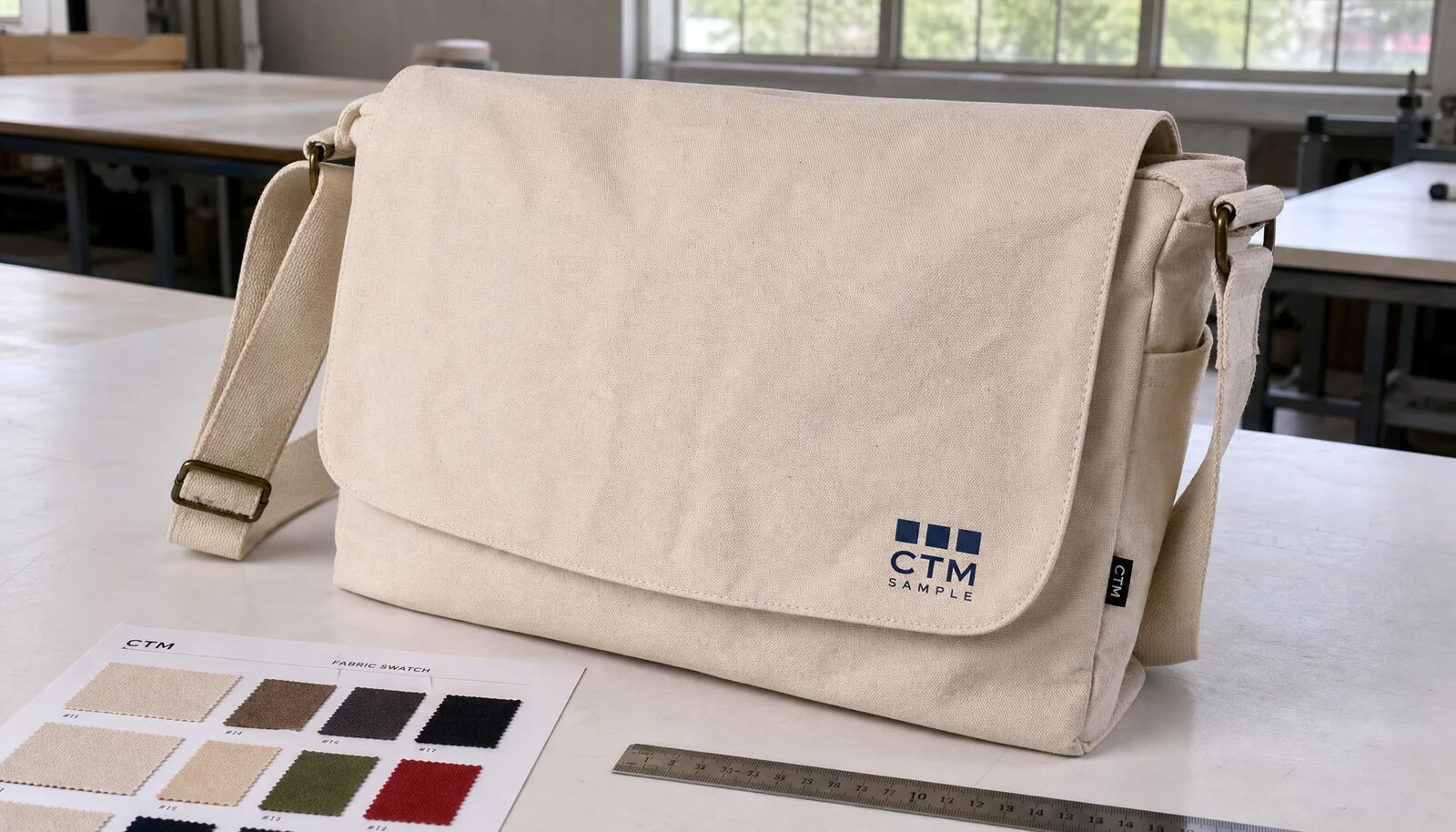
Start With the Hotel Retail Use Case
Canvas messenger bags for hotel retail are not the same product as low-cost event giveaways. A guest buying from a resort boutique, city hotel gift shop, museum hotel, or destination retail corner expects the bag to look intentional on shelf and survive real travel use. The buying problem is usually not whether the factory can make a messenger bag; it is whether the chosen specification supports the selling price, retail display, luggage packing, and brand image.
Before requesting quotes, separate the order into its real use case. Boutique resale needs cleaner stitching, better trim, and controlled packaging. A room amenity can accept simpler construction if the bag is presented well and carries slippers, spa items, or welcome materials. A conference gift may prioritize logo visibility and delivery date. These differences change fabric GSM, print method, lining, pocket count, MOQ, and inspection standard.
- For resort retail, natural or sand-colored 12 oz to 16 oz canvas often fits the relaxed destination look.
- For urban hotel shops, black, navy, or olive canvas with a woven label can feel less promotional.
- For amenity programs, simplify pockets and trims before reducing fabric weight too far.
- For premium resale, invest in strap comfort, flap shape, and logo finish before adding unnecessary compartments.
Specify Canvas Weight Before Comparing Quotes
The word canvas is too broad for a serious RFQ. Two suppliers can both quote a canvas messenger bag while using very different fabric weights, yarn counts, and finishing. For hotel retail, the main fabric usually needs enough body to stand neatly when lightly filled, but not so much stiffness that the flap looks bulky or the bag becomes expensive to ship. A practical range is often 12 oz to 16 oz cotton canvas, roughly 380 to 540 GSM, depending on weave and finishing.
A lower weight such as 10 oz can work for a soft, foldable travel bag, but it may look thin on a retail shelf and may wrinkle heavily in cartons. Heavier 18 oz canvas can look premium but adds cutting difficulty, sewing needle wear, carton weight, and freight cost. If the supplier gives only oz or only GSM, request both. Also ask whether the weight is measured before or after dyeing and finishing, because shrinkage and coating can change the hand feel.
- Natural canvas: confirm whether cotton seed specks are acceptable or should be reduced by fabric selection.
- Dyed canvas: require lab dip approval and colorfastness discussion before bulk dyeing.
- Washed canvas: expect softer hand feel but more size variation and shade variation.
- Coated canvas: improves body but may reduce breathability and affect print adhesion.
Choose Construction That Matches Selling Price
The most visible construction decisions are flap depth, gusset width, strap width, and closure type. A shallow flap may save fabric but can expose the main opening and look unfinished. A deep flap gives a stronger messenger bag profile, but it needs accurate cutting and controlled logo placement. For hotel retail, a medium gusset is usually better than a flat document-bag shape because guests may carry a water bottle, guidebook, tablet, light jacket, or souvenir items.
Closures also signal price level. Hidden magnetic snaps keep the front clean and are easy for guests to use. Metal buckles create a more outdoor or heritage look but slow production and add plating risk. Hook-and-loop is cheap and functional, yet many hotel retail buyers avoid it because the sound and hand feel can reduce perceived value. If the bag includes lining, specify whether seams are bound, overlocked, or hidden inside the lining, because this affects both appearance and inspection time.
- Strap width of 38 mm to 50 mm is more comfortable than narrow promotional webbing.
- Box stitching or reinforced bar tack should be used where the shoulder strap joins the body.
- A tablet pocket should include realistic dimensions and padding expectations, not just the word tablet.
- If the bag must fold flat for shipping, avoid excessive padding and oversized metal buckles.
Match Logo Method to Fabric Texture
Logo execution is one of the most common rejection points for hotel retail canvas messenger bags. Screen printing is usually the most efficient option for clean one-color or simple multi-color artwork on cotton canvas. It gives good cost control at bulk quantities and works well for destination names, hotel marks, and simple line illustrations. The buyer should define print size, Pantone color, location from finished edges, and allowed tolerance before the factory makes screens.
Embroidery can look premium, but dense stitching on a flap may pucker the canvas if the fabric weight, backing, and thread tension are not balanced. Woven labels are useful when the hotel wants a retail product rather than a billboard-style souvenir. Heat transfer is possible for detailed artwork, but it can feel less natural on rough canvas and should be tested for edge lifting. The best RFQ includes the artwork file, expected print area, color count, and whether the logo must survive washing or only normal dry use.
- Screen print: cost-effective for bold artwork, but test ink coverage on textured canvas.
- Embroidery: premium for small marks, but control stitch density and backing.
- Woven label: strong for subtle branding and repeat retail collections.
- Leather or PU patch: check needle holes, edge paint, color migration, and local compliance requirements.
Understand MOQ and Cost Drivers
MOQ is not only a factory sales rule; it is tied to material purchasing, dye lots, printing setup, cutting efficiency, and trim sourcing. Natural canvas in a common weight usually has the lowest MOQ because fabric may be available from stock. Stock dyed colors require enough volume to use available rolls efficiently. Custom dyed canvas needs lab dip, bulk dyeing, and minimum fabric quantity, so the MOQ may rise even if the sewing workshop can handle a smaller order.
Cost differences often come from details that are easy to miss in the first quote. Lining, inner pockets, metal hardware, adjustable strap sliders, reinforced stitching, hangtags, barcodes, and individual packing all add labor or material. A fair quote comparison should show what is included. If one supplier is much cheaper, check whether they removed lining, reduced GSM, used thinner webbing, quoted plastic trims instead of metal, or excluded retail packing.
- Low MOQ route: natural canvas, stock webbing, screen print, unlined body, simple polybag.
- Mid-range route: stock dyed canvas, cotton lining, magnetic snap, woven label, barcode sticker.
- Premium route: custom dyed canvas, upgraded hardware, embroidery or patch, structured packing.
- Hidden cost items: screen charge, sample courier, lab testing, hangtag printing, carton customization, pallet packing.
Build Samples in the Right Sequence
A single sample rarely answers every production question. For hotel retail orders, the sample sequence should control risk before bulk fabric is cut. Start with a material swatch or available fabric reference to approve weight and hand feel. Then approve artwork strike-off on the actual or closest fabric. After that, review a fit sample or pre-production sample with correct dimensions, strap, closures, lining, and logo placement. The packing sample should be reviewed separately if the bag will be sold directly from retail cartons.
The pre-production sample should not be treated as a casual photo approval. Measure finished size, flap alignment, strap length range, pocket size, logo position, stitch density, and opening function. Put typical contents inside the bag and close it. If the flap lifts, the magnets misalign, or the strap twists, the problem will repeat in bulk. Keep one signed or sealed approved sample at the factory and one with the buyer or inspection company.
- Fabric swatch approval controls GSM, color, hand feel, and surface texture.
- Logo strike-off controls ink color, print edge, opacity, and placement method.
- Pre-production sample controls construction, trims, measurements, and workmanship.
- Packing sample controls barcode location, fold method, carton quantity, and shelf presentation.
Set Inspection Criteria Before Production
A quality inspection checklist must be written before production, not after defects appear. For canvas messenger bags, critical defects usually include unsafe sharp trims, broken straps, severe mold or contamination, wrong logo, and unusable closure. Major defects include open seams, obvious print misplacement, wrong fabric color, poor flap alignment, broken zipper, rusted hardware, and size outside tolerance. Minor defects include small loose threads, slight wrinkles, or small marks within agreed limits.
AQL inspection is useful, but hotel retail buyers should add product-specific acceptance criteria. For example, logo placement might need plus or minus 3 mm to 5 mm tolerance depending on artwork and flap size. Finished bag dimensions may allow plus or minus 5 mm to 10 mm, but pocket openings and strap length should be practical, not just technically close. Pull testing at strap joints is important because guests often overload bags during travel.
- Check fabric weight against approved swatch and purchase specification.
- Measure body width, height, gusset, flap depth, strap width, and strap length range.
- Inspect print adhesion, color, registration, opacity, and distance from seams.
- Test closures repeatedly for alignment, holding strength, and ease of use.
- Review inside seams, lining attachment, pocket opening, and thread trimming.
- Open cartons during inspection to verify packing quantity, carton marks, and barcode accuracy.
Plan Packing for Retail Handling
Packing is not only an export requirement. Hotel retail teams may receive cartons in small storerooms, move stock by hand, and place bags directly on shelves. If the messenger bags arrive crushed, dusty, or with twisted straps, store staff must spend time fixing them. A simple individual polybag protects against dirt and humidity, while paper sleeves or belly bands may improve presentation if plastic reduction is part of the hotel policy.
The fold method should not create permanent creases across the printed flap. Strap placement inside the bag or along the back panel should be consistent. If a barcode is required, confirm whether it goes on the polybag, hangtag, sewn label, or carton. For humid sea routes, silica gel may be appropriate, but it must be packed safely and comply with the buyer's market rules. Carton strength matters because canvas bags are heavy compared with thin nonwoven bags.
- Use a packing trial to confirm bags per carton, carton size, gross weight, and cubic meter.
- Keep printed flaps separated if ink surface may rub during transit.
- Avoid over-compressing heavy canvas because flap edges and straps can deform.
- Put SKU, color, quantity, and carton number on export marks for easier hotel receiving.
- Confirm whether retail hangtags are attached by string, safety pin, plastic loop, or not attached.
Control Lead Time and Schedule Risk
Lead time for canvas messenger bags depends on more than sewing capacity. The critical path often includes fabric availability, dyeing, lab dip approval, print screen preparation, trim purchasing, sample revisions, bulk cutting, sewing, thread trimming, packing, inspection, and vessel or air booking. If custom dyed canvas or special hardware is involved, the schedule can change quickly. A buyer working toward a hotel opening, seasonal retail launch, or conference date should not treat production time as one single number.
A practical schedule separates approval time from factory production time. If the buyer takes one week to approve a lab dip and another week to approve a revised sample, that time should be visible. For repeat orders, lead time can shorten when fabric, trims, screens, and approved patterns are already fixed. For first orders, build a buffer for one sample correction. The most expensive schedule mistake is approving incomplete details just to start production, then discovering the packing or logo is wrong at final inspection.
- Material booking can start only after fabric weight, color, and quantity are confirmed.
- Printing cannot be locked until artwork size, color, and placement are approved.
- Custom trims can delay sewing even when fabric is ready.
- Final inspection should happen after at least 80 percent packed, preferably 100 percent packed for retail orders.
- Shipping mode should be compared using carton CBM and gross weight, not unit price alone.
Compare Quotes by Landed Retail Value
The cheapest unit price may not be the lowest landed cost. A lighter canvas bag may save money at the factory but create higher defect rates, weaker shelf presentation, or more customer returns. A bag with poor packing may require hotel staff to steam, clean, re-tag, or sort stock before sale. A quote with no barcode, no hangtag, and no inspection support may look attractive until the distributor adds those costs later.
For a clear comparison, request quotes in a format that separates product cost, logo cost, packing cost, sample cost, tooling or screen cost, carton details, and lead time. Then add freight estimate based on carton CBM and gross weight. If two suppliers quote different specifications, normalize them before deciding. A 14 oz lined messenger bag with metal snaps cannot be fairly compared with a 10 oz unlined bag with hook-and-loop closure.
- Compare fabric GSM, not only bag size.
- Compare included trims by material, finish, and function.
- Compare print method, print size, and number of colors.
- Compare packing method and carton data for freight calculation.
- Compare inspection readiness, sample process, and willingness to define defect classes.
Specification comparison for buyers
| Spec decision | Recommended option | When it fits | Buyer risk to check |
|---|---|---|---|
| Main fabric weight | 12 oz to 16 oz cotton canvas, roughly 380 to 540 GSM depending on weave | Hotel boutiques and resort shops that need a structured retail feel without making the bag too heavy for tourists | Low GSM can collapse on shelf; very heavy canvas increases freight and may feel stiff before washing or use |
| Flap and closure construction | Full flap with magnetic snap, metal buckle, or hidden hook-and-loop depending on brand positioning | Magnetic snap suits premium retail; buckle suits outdoor styling; hook-and-loop suits lower-cost amenity packs | Magnets must align cleanly; hook-and-loop can sound cheap; buckles add labor and must pass pull testing |
| Shoulder strap | 38 mm to 50 mm cotton webbing with reinforced box stitching and adjustable slider | Best for tourist use, conference add-ons, and hotel gift shops where buyers expect practical carry comfort | Thin strap cuts into shoulder; weak slider plating can scratch or rust during sea shipment |
| Logo method | Screen print for clean one- to three-color artwork; embroidery or woven label for premium small marks | Screen print works for hotel names and destination artwork; woven label works when the bag must look less promotional | Large prints may crack on heavy texture; embroidery can pucker flap fabric if backing and density are wrong |
| Lining and pockets | Unlined for rustic retail; cotton lining with one inner pocket for higher average selling price | Unlined fits beach resorts and casual shops; lined versions fit city hotels and corporate gifting | Lining adds cost and inspection points; pocket opening, seam allowance, and loose threads need tighter QC |
| Color route | Natural, black, navy, olive, or custom dyed canvas with approved lab dip | Stock colors suit small MOQs and faster lead time; custom dye suits brand collections and multi-SKU retail | Custom dye needs shade tolerance and crocking tests; natural canvas can show cotton seed specks by default |
| Retail packing | Individual polybag or paper sleeve, barcode sticker, silica gel when required, and export carton with inner divider if needed | Useful for hotel retail receiving teams that sell directly from cartons or replenish shelf stock in small batches | Over-packing raises cost; under-packing creates strap deformation, dirty bags, and barcode scanning problems |
| Inspection level | Final random inspection using agreed AQL plus 100 percent check for logo position on premium orders | Appropriate when the bag is sold as branded merchandise rather than a disposable event giveaway | If logo alignment is not separately controlled, a technically functional bag can still be rejected by hotel retail |
Buyer checklist before sampling
- Define the retail use case: boutique resale, room amenity, conference gift, loyalty member gift, or staff accessory.
- State target fabric weight in oz and GSM, not only the word canvas.
- Provide finished bag size, flap depth, gusset width, strap width, strap length range, and pocket layout.
- Send vector artwork with Pantone references and specify print size, placement tolerance, and logo method.
- Approve fabric swatch, strike-off, pre-production sample, and packing sample before bulk cutting.
- Set measurable QC thresholds for stitching, print adhesion, shade variation, metal trim function, and carton condition.
- Confirm barcode, hangtag, country-of-origin label, warning text, and retail packaging requirements before mass production.
- Request quote data by line item: fabric, printing, trims, packing, sample charge, mold or screen charge, and inland freight.
- Build lead time around lab dip, material booking, sample approval, production, inspection, and export cut-off dates.
- Keep a sealed approved sample at the factory and one with the buyer for inspection comparison.
Factory quote questions to send
- What exact canvas weight can you supply for this bag, shown in both oz and GSM, and is it stock fabric or custom woven or dyed?
- What is the MOQ for natural canvas, stock dyed canvas, and custom dyed canvas, and does the MOQ change by logo method?
- Which print method do you recommend for our artwork size and color count, and what tests do you run for rubbing, washing, or cracking?
- Can you quote the same bag with unlined construction and with cotton lining plus one inner pocket so we can compare retail positioning?
- What metal or plastic trim grades are included in the quote, and can you provide photos or samples of sliders, snaps, buckles, and zipper pulls?
- What is your standard seam allowance, stitches per inch, and reinforcement method at strap connection points?
- How many days are needed for artwork strike-off, pre-production sample, bulk production, packing, and final inspection after approval?
- What packing method is included, and what is the estimated carton size, quantity per carton, gross weight, and cubic meter per carton?
- Which defects are treated as critical, major, and minor during final inspection, and what AQL level do you normally support?
- What quote items are excluded, such as barcode stickers, hangtags, lab testing, courier sample freight, export documents, or palletization?
Quality-control points to confirm
- Fabric weight must match approved swatch within agreed tolerance, commonly plus or minus 5 percent unless otherwise specified.
- Finished size should follow the approved sample, with practical tolerance such as plus or minus 5 mm for key dimensions and tighter tolerance for logo placement.
- Logo print should pass dry rub and tape pull checks suitable for the chosen ink and fabric surface.
- Stitching should be even, with no skipped stitches, broken thread, open seams, needle holes outside the seam line, or loose back-tacking.
- Strap attachment should use reinforcement stitching and withstand agreed pull force without seam tearing or webbing slippage.
- Metal snaps, buckles, sliders, and zippers should operate smoothly, align correctly, and show no rust, sharp edges, plating peel, or oil marks.
- Interior pockets and lining, if used, should be cleanly sewn with no trapped fabric, twisted seams, or excessive loose threads.
- Color should match approved lab dip or production swatch under standard light, and dark fabrics should be checked for dry and wet crocking risk.
- Packing should keep the bag clean and flat, with correct barcode, SKU, carton mark, quantity, and export carton strength.
- Final cartons should be dry, undamaged, accurately counted, and suitable for the agreed transport route.