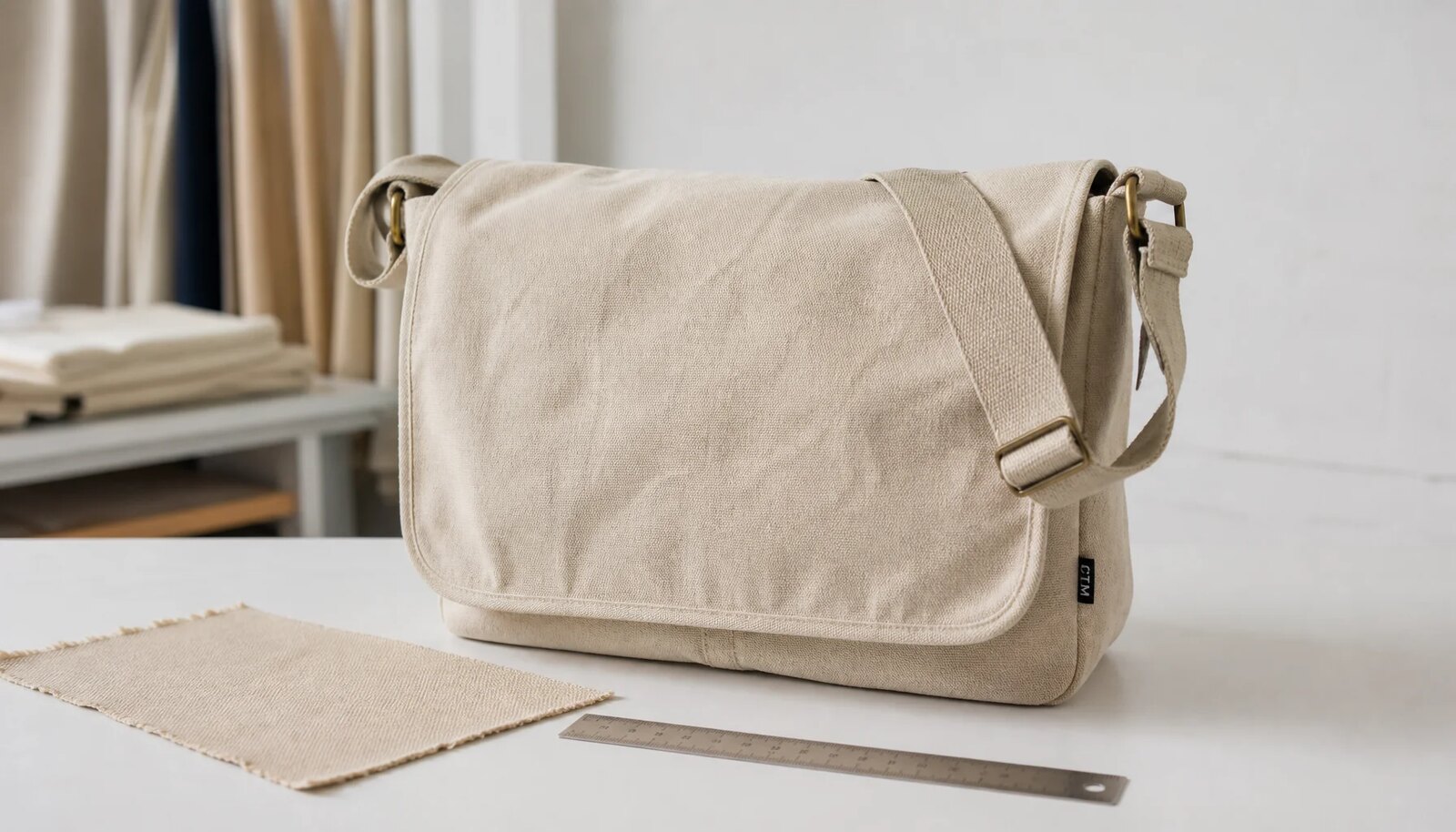
Start With the Retail Job
A canvas messenger bag for hotel retail is not just a promotional shoulder bag with a nicer logo. It has to look believable on a boutique shelf, carry the property’s story, and survive normal guest use after checkout. Material selection should begin with the buying situation: where the bag will be sold, who will buy it, what they will carry, and what shelf price the hotel expects.
A resort shop may want a relaxed natural canvas bag displayed near towels, sandals, and local gifts. A city hotel boutique may need a cleaner lined messenger bag for a tablet, passport pouch, guidebook, and small purchases. A conference hotel store may care more about document size, zipper security, barcode labels, and fast replenishment. Those are different jobs, even if the reference photo looks similar.
The sourcing mistake is asking several suppliers to quote one image. One factory may price 10 oz unlined cotton canvas with plastic adjusters. Another may include 14 oz canvas, 210D lining, metal sliders, and a zipper top. A third may use a cotton-poly blend, stock webbing, and a woven label. The bags may all be called canvas messenger bags, but the cost base is not the same.
For hotel groups, decide early whether the program needs one shared base pattern or multiple property-specific versions. A beach resort, mountain lodge, urban boutique hotel, and airport hotel can often share the same construction while changing the woven label, hangtag, colorway, or barcode data. That keeps MOQ and reorders easier to manage.
- For resort souvenir retail, prioritize natural texture, clean seam finishing, corrosion-aware hardware, and relaxed branding.
- For premium boutique retail, prioritize lining, stable color, refined hardware, accurate logo placement, and controlled shelf presentation.
- For conference hotel shops, prioritize document size, tablet protection, zipper security, barcode labels, and replenishment consistency.
- For spa and wellness retail, prioritize soft handfeel, neutral palettes, understated labels, low odor, and clean internal seams.
- For multi-property hotel groups, consider one shared base bag with property-specific woven labels, hangtags, or small print changes.
Turn Shelf Price Into a Spec Budget
The target shelf price should guide the material budget. An entry souvenir bag cannot carry the same construction cost as a premium city-boutique accessory. Outer canvas, lining, pockets, zippers, metal hardware, woven labels, hangtags, barcode stickers, individual bags, and carton count all affect the unit cost. The goal is not to strip the bag down. The goal is to pay for features guests will notice and use.
Build a feature hierarchy before you ask for quotes. Mark each detail as required, preferred, or optional. If pricing comes back too high, the supplier can remove the right items instead of quietly downgrading hidden materials such as lining, webbing thickness, zipper quality, or strap reinforcement.
For example, ask for a base price using 12 oz natural canvas, unlined construction, 38 mm cotton webbing, one-color screen print, and paper belly band packing. Then ask for an upgrade price using 14 oz canvas, 210D lining, one zipper pocket, 50 mm strap, woven label, and retail-ready barcode label. Now the price difference is useful. You can see what the upgrade actually buys.
The acceptance standard should match the retail position. A lower-cost souvenir item can still be well made, but it should stay simple. A premium hotel boutique item needs tighter control of stitching, shade, hardware finish, logo placement, and packing condition. Do not approve an overbuilt development sample if the final retail price cannot support it.
- Classify features as required, preferred, or optional before comparing suppliers.
- Ask for a base specification and one or two upgrade prices instead of vague price alternatives.
- Protect visible brand elements first: canvas texture, flap alignment, logo quality, strap appearance, and packing presentation.
- Use the target shelf price to decide whether lining, zipper top, tablet sleeve, and premium hardware are commercially realistic.
- Ask suppliers to itemize cost drivers such as custom dyeing, lining, zipper top, woven label, retail packing, and barcode application.
Choose Canvas Weight Carefully
Canvas weight is one of the first details buyers ask about, and it is also one of the easiest details to misunderstand. Weight may be quoted in ounces per square yard, GSM, greige weight, finished weight, or commercial shorthand. One ounce per square yard equals approximately 33.9 GSM, so 12 oz is about 407 GSM, 14 oz is about 475 GSM, and 16 oz is about 542 GSM.
Those conversions help when comparing quotes, but they do not tell the whole story. A washed 14 oz canvas may feel softer than an unwashed fabric at the same weight. A coated canvas may feel stiffer and may affect print adhesion. The yarn, weave, finishing, and moisture content all change the final handfeel.
For most canvas messenger bags for hotel retail, 12 oz to 16 oz is the practical range. A 12 oz canvas can work for medium-size unlined or lightly lined bags with modest internal organization. A 14 oz canvas is often a balanced choice for a lined messenger bag with a flap, adjustable strap, and one or two pockets. A 16 oz canvas gives stronger shelf shape and a more premium feel, but it can create bulk at seams and corners.
Heavier fabric is not automatically better. At 18 oz or 20 oz, sewing becomes harder, flap folding can look bulky, magnetic snaps may feel weaker through the layers, and freight weight rises. Use heavier canvas only when the brand wants a rugged look and the retail price supports the added material and production time.
- 10 oz canvas: suitable for simple unlined budget styles, but usually too soft for structured hotel retail messenger bags.
- 12 oz canvas: good entry retail option for medium-size bags with limited internal organization and moderate load expectations.
- 14 oz canvas: balanced all-round choice for lined messenger bags with a flap, strap anchors, and one or two pockets.
- 16 oz canvas: better for premium handfeel and shelf shape, but check sewing bulk, closure strength, and carton weight.
- 18 oz and above: use only for intentionally rugged designs where price, production, and freight budgets support the extra material.
- Always approve a finished production-intended swatch, not only a weight number in the supplier’s quotation.
Match Composition and Finish to the Brand
Natural cotton canvas remains popular in hotel retail because it feels tactile, relaxed, and easy to connect with travel, resort, spa, and boutique settings. It also brings a real sourcing issue: shade variation. Unbleached or lightly processed natural canvas can vary from lot to lot. If a reorder must match the first delivery closely, keep approved swatches and define the acceptable shade range before bulk production.
Cotton-poly canvas can be a practical alternative when dimensional stability, wrinkle control, or cost consistency matters more than a pure cotton story. If the hangtag, product page, or shelf card mentions fiber content, ask for a composition declaration. Avoid sustainability or material claims that the supplier cannot document.
Dyed canvas gives stronger brand control and supports property-specific colors, but it adds work. Dark navy, black, olive, burgundy, and chocolate canvas can rub onto light clothing if dyeing or finishing is weak. Hotel guests may wear white shirts, resort linens, or light uniforms, so dry and wet rubbing risk deserves attention. Custom dyeing can also increase MOQ because the fabric mill has its own minimum dye lot.
Washed canvas creates a softer, lived-in look. It can also change dimensions, shade, print behavior, label appearance, and flap shape. Light water-resistant finishing can help with daily travel use, but do not call a bag waterproof unless the whole construction supports that claim. Coatings may change odor, handfeel, breathability, and logo adhesion.
- Use natural canvas when the brand accepts controlled shade variation and wants an organic hotel retail look.
- Use custom dyed canvas when brand color matters and the quantity supports fabric MOQ, lab dips, and colorfastness checks.
- Use washed canvas when the bag should feel soft and casual, but review shrinkage, shade unevenness, and flap shape.
- Use cotton-poly canvas when the buyer accepts a blend and wants improved dimensional stability, wrinkle control, or cost consistency.
- Use light water-resistant finishing only after confirming handfeel, odor, print adhesion, and care-label wording.
- Avoid waterproof claims unless the full bag construction is built and tested for that performance.
Specify Lining and Pockets Without Guesswork
Lining changes the way the bag feels, sells, and fails. An unlined canvas messenger bag is lighter, lower cost, and easier to inspect. It can be right for resort souvenirs or casual retail, provided the inside is still clean. Bound seams, overlocked edges, or neatly finished seam allowance matter because guests see the interior every time they use the bag.
A lined bag looks more retail-ready and protects contents better. Common options include 210D polyester, 300D polyester, cotton sheeting around 120-160 GSM, and blended lining fabrics. Polyester lining is practical and easier to wipe. Cotton lining feels softer and more premium, but it may wrinkle and absorb stains more readily. The buyer should specify lining color, denier or GSM, pocket layout, seam allowance, and whether the lining is loose, tacked, or fixed.
Internal organization should be useful, not impressive on paper. One zipper pocket adds value for room keys, cards, passports, and small travel items. One slip pocket can help with a phone or map. A padded tablet sleeve makes sense for city hotels and conference properties, but only if the device size, padding thickness, and target retail price are clear.
Every pocket adds labor and another inspection point. Pocket corners, zipper ends, and sleeve openings take repeated stress. Add reinforcement where the bag will be pulled, filled, or stretched. Put pocket measurements in the spec sheet; do not rely on the approved sample being interpreted correctly by the sewing line.
- For entry retail, use unlined canvas with bound seams or neatly finished internal seam allowance.
- For mid-range retail, use 210D or 300D polyester lining with one zipper pocket and one simple slip pocket.
- For premium retail, add a padded sleeve only when target device size, padding thickness, and shelf price are defined.
- Specify pocket height, width, zipper length, sleeve opening, padding thickness, and corner reinforcement method.
- Check that lining does not twist, sag, fray, or catch in the zipper when the bag is filled.
- Avoid internal organization that the target retail price and inspection budget cannot support.
Treat the Strap as a Load System
Many messenger bag problems start at the strap anchor, slider, snap, or zipper rather than in the middle of the canvas panel. Guests may carry a water bottle, tablet, guidebook, purchases, and personal items while walking through a city or resort. The shoulder strap is not a decorative detail. It is the load system.
Cotton or cotton-blend webbing from 38 mm to 50 mm is common. A 38 mm strap can suit smaller bags and value programs. A 50 mm strap is more comfortable for heavier or premium styles, though it costs more and needs properly sized sliders and adjusters. Webbing thickness, edge feel, colorfastness, and stretch should be reviewed on the physical sample.
The adjuster must grip the strap without slipping. Hardware with burrs can cut webbing or feel sharp against clothing. Anchor points should use box-X stitching, bar tacks, reinforced tabs, or another approved construction. Rivets can add visual appeal, but they should not replace proper stitching unless the full construction has been tested.
If the bag is lined, reinforcement may need to sit between the outer shell and lining. Approve that construction on the pre-production sample and record it in the tech pack. Otherwise, a good-looking outside sample can hide weak internal reinforcement that fails later.
- Specify strap width, webbing composition, thickness, color, adjustability, and finished strap length range.
- Match buckle and slider size to the webbing so the strap does not twist, slip, or jam.
- Use box-X stitching, bar tacks, or reinforced tabs at strap anchors, then define the stitch pattern in the spec.
- Check hardware by hand for burrs, sharp plating, weak springs, rust marks, oil stains, and inconsistent finish color.
- Test a filled sample by hanging it from the strap and checking anchor distortion after load exposure.
- For coastal or humid environments, ask how the selected hardware finish is protected against corrosion.
Select Hardware and Closures for Real Use
Hardware should support both the hotel’s visual language and the bag’s daily use. Antique brass works well with natural canvas and heritage styling. Matte black suits modern urban branding. Nickel and gunmetal can look clean and commercial. Coastal resorts should pay closer attention to corrosion risk, especially if bags may be exposed to humidity, salt air, or wet swimwear.
Approve a trim card before bulk production. It should show the actual buckles, sliders, snaps, rivets, zipper pulls, zipper tape, and finish colors. Small differences matter. A slider that looks acceptable in a photo may have poor grip. A snap may be difficult to open. A zipper pull may feel too light for a premium retail item.
Closure choice affects appearance, usability, cost, and inspection. A hidden magnetic snap gives a clean retail look and is easy for guests to open. Check it through the real canvas thickness, lining, reinforcement, and flap construction. A magnet that works on an empty flat sample may release when the bag is filled.
A zipper top beneath the flap adds security for city hotels, airport hotels, conference hotels, and travel-focused retail. It also adds material cost and defect risk. Define zipper size, tape color, puller style, pull direction, end reinforcement, and usable opening width. Then test the sample while wearing it, not only while it lies flat on a table.
- Use hidden magnetic snaps for clean display when the bag is not positioned as high-security travel storage.
- Use zipper top plus flap when guests are likely to carry valuables, devices, passports, or conference documents.
- Use buckle-look magnetic tabs when the brand wants heritage styling without slow manual buckling.
- Define zipper size, tape color, puller style, pull direction, end reinforcement, and opening width in the specification.
- Test closures on a filled sample, not only on an empty sample lying flat.
- Reject closures with weak magnets, sharp edges, uneven placement, or visible distortion around reinforcement.
Choose Logo Methods That Respect Canvas Texture
Logo quality is one of the first things a hotel buyer, retail manager, or guest will notice. A logo that looks sharp on a digital mockup may lose detail on coarse canvas. The right method depends on the artwork, canvas finish, color, placement, and shelf-price position.
Screen printing is practical for solid logos, resort marks, and simple artwork on the flap or front body. It works best with clean shapes and limited colors. Define ink color, print size, placement, registration tolerance, and acceptable edge sharpness. Always approve the strike-off on the actual finished production canvas, not on a smooth test cloth.
Heat transfer can reproduce gradients and fine artwork, but it may look less natural on cotton canvas. It can feel plasticky, crack, or lift at the edges if adhesion is weak. Embroidery can add premium value for small marks, but it may pucker lighter canvas and does not suit tiny detailed lettering unless the artwork is simplified.
Woven labels are often a safe option for hotel retail. They provide consistent branding, avoid large ink coverage, and make multi-property programs easier. A side seam label, front patch label, or flap label can change by property while the base bag remains the same. Ask about label MOQ and reorder timing before approving the branding plan.
- Use screen print for one to three solid logo colors and medium or large placement on the flap or front panel.
- Use woven labels for understated premium branding, consistent reorders, and multi-property hotel programs.
- Use embroidery for small marks after checking backing, puckering, stitch density, and thread color.
- Use heat transfer only after testing adhesion, edge lifting, cracking, and surface feel on the selected canvas finish.
- Approve artwork scale on a physical sample because flap seams and folds can change visual balance.
- Record logo placement tolerance so final inspection can measure alignment objectively.
Plan MOQ, Reorders, and Packing Early
MOQ is rarely only the finished bag quantity. The real minimum may come from fabric color, dye lot, webbing color, lining color, zipper tape, hardware finish, woven label, hangtag, barcode sticker, or packing material. A factory may accept a lower order if the buyer chooses stock natural canvas, stock webbing, standard hardware, and one-color print. A custom-dyed hotel brand color with matching lining and custom webbing is a different conversation.
Separate product MOQ from material MOQ in the RFQ. A supplier may say the bag MOQ is 500 pieces, while the custom dyed fabric mill requires enough fabric for 1,000 pieces. The factory may charge the extra fabric into the first order or hold it for later use only if the buyer agrees. Similar issues can appear with woven labels, special zipper tape colors, and nonstandard metal finishes.
Retail packing should not be left until the end. A paper belly band may suit a natural resort look. Individual polybags can protect light canvas during export, but they may conflict with a plastic-reduction retail story. Hangtags and barcode stickers should sit where they will not damage the logo, crease the flap, or confuse store scanning.
Ask for carton dimensions, units per carton, gross weight, and packing fold method. Canvas can pick up dust, pressure marks, and moisture. Review the packing sample with the product sample so the bag arrives in sellable condition, not just technically correct.
- Lowest MOQ route: stock natural canvas, stock webbing, standard hardware, one-color screen print, and simple packing.
- Moderate MOQ route: stock canvas color, standard hardware, custom woven label, hangtag, barcode sticker, and lining.
- Higher MOQ route: custom dyed canvas, matching webbing, custom lining, special zipper color, and premium hardware finish.
- Highest complexity route: multiple property-specific versions with different fabrics, trims, artwork, and packing labels.
- Ask each supplier to list separate MOQs for fabric, lining, webbing, hardware, labels, hangtags, and retail packing.
- Approve packing fold, hangtag position, barcode location, carton marks, and moisture protection before production starts.
Lock Samples Before Bulk Cutting
Sample approval should lock the production standard, not simply confirm that the bag looks nice. The approved sample should represent final outer canvas, color, finish, lining, pocket layout, strap width, hardware finish, closure system, logo method, stitch density, seam allowance, packing fold, hangtag position, and barcode placement.
If the first sample uses substitute fabric or available hardware, label it as a fit sample or development sample. Do not let it become the production standard unless those substitute materials are approved in writing. This is especially important when the factory uses stock trim for speed during sampling.
The pre-production sample is the key control point. Measure it, fill it, wear it, open and close it, rub the logo, check pocket access, hang it by the strap, and pack it the way the bulk order will ship. Add written tolerances to the PO or spec sheet. Useful starting points are ±1 cm for body width and height, ±0.5 cm for gusset, ±2 cm for strap length, and ±3-5 mm for logo placement, adjusted for the design.
Keep one approved sample sealed or clearly marked for final inspection and reorder reference. A retained swatch from the production fabric lot also helps with shade and handfeel disputes. Without physical references, inspection becomes a debate about photos and memory.
- Approve fabric swatch, lab dip or shade band if dyed, trim card, logo strike-off, PP sample, and packing sample in sequence.
- Measure body width, height, gusset, flap length, strap length, strap drop, pocket dimensions, and logo placement.
- Test the sample with realistic contents such as tablet, bottle, guidebook, wallet, and small purchases.
- Rub print or dyed areas with dry and slightly damp cloth to identify weak curing or dye transfer risk.
- Fold the sample into proposed retail packing and check for flap creases, logo damage, strap deformation, and barcode visibility.
- Keep one approved sample sealed or clearly marked for final inspection and reorder reference.
Specification comparison for buyers
| Spec decision | Recommended option | When it fits | Buyer risk to check |
|---|---|---|---|
| Outer canvas weight | 12 oz to 16 oz cotton canvas, approximately 407-542 GSM when converted from oz/yd²; confirm whether the supplier reports greige, finished, or nominal commercial weight | Hotel boutiques, resort shops, conference hotel stores, welcome retail, and reusable travel bags that need structure without a heavy industrial feel | Quotes may use different weight definitions; require finished fabric weight, tolerance such as ±5%, shrinkage result, and a retained swatch from the production lot |
| Canvas composition | 100% cotton canvas for natural handfeel and hospitality storytelling, or cotton-poly canvas when dimensional stability, wrinkle control, and cost consistency matter more | Cotton suits premium resort, spa, and boutique retail; cotton-poly can fit value programs, repeat replenishment, or darker dyed colors where stability is important | Blends can look similar to cotton; require composition declaration, care-label wording, and fiber-content confirmation if the claim appears on hangtags or retail copy |
| Canvas finish | Natural, dyed, washed, enzyme-washed, pigment-washed, or light water-resistant finish; approve final finished fabric, not only a greige swatch | Natural and washed finishes fit relaxed resort concepts; dyed canvas fits brand-color programs; light repellency fits city travel and outdoor-adjacent retail | Finishing changes shrinkage, shade, odor, print adhesion, and seam bulk; require lab dip or shade band, handfeel approval, and print strike-off on finished canvas |
| Lining material | 210D or 300D polyester lining for easy cleaning, 120-160 GSM cotton sheeting for a softer premium feel, or unlined canvas with bound seams for lower cost | Lined bags suit higher shelf prices, tablet use, zipper pockets, and city hotels; unlined bags suit casual resort, beach, and simple souvenir programs | Thin lining tears at zipper pockets and sleeve corners; specify denier or GSM, color, pocket reinforcement, seam allowance, and acceptable defects for open seams or fraying |
| Shoulder strap | 38 mm to 50 mm cotton or cotton-blend webbing, commonly 1.5-2.5 mm thick, with box-X stitching or bar tacks at both anchor points | Crossbody guest use where bags carry maps, tablets, water bottles, purchases, and personal items; 50 mm improves comfort on heavier or premium styles | Cheap webbing may stretch, twist, bleed, or feel sharp; specify width, thickness, adjuster fit, strap length range, colorfastness, and pull or static load requirement |
| Hardware finish | Antique brass, matte black, gunmetal, or nickel hardware matched to brand style; approve zipper pullers, snaps, sliders, rivets, and adjusters on a trim card | Antique brass pairs with natural canvas; matte black suits modern properties; nickel or gunmetal can fit urban hotel retail; corrosion-aware trims suit coastal resorts | Inconsistent plating, burrs, weak sliders, and rust cause returns; require finish code, burr-free edges, smooth operation, no plating flakes, and corrosion review for humid locations |
| Closure system | Hidden magnetic snap for clean display, zipper top plus flap for travel security, or buckle-look magnetic closure for heritage styling without slow manual buckling | Magnetic snap fits boutique and resort display; zipper top fits city hotels, airport hotels, conference shops, and guests carrying passports or devices | Magnets may be weak through thick canvas and zippers add defect points; test closure on a filled sample and define zipper size, tape color, pull direction, and opening width |
| Logo method | Screen print for solid artwork, woven label for premium low-risk branding, embroidery for small marks, or heat transfer for complex artwork only after adhesion testing | Screen print fits most hotel marks; woven labels support multi-property programs; embroidery suits small premium logos; heat transfer suits gradients only when handfeel is accepted | Ink cracking, dye migration, puckering, and poor registration hurt retail perception; approve strike-offs on actual finished canvas with placement tolerance and color standard |
| Internal organization | One zipper pocket plus one slip pocket for most mid-range styles; padded tablet sleeve only when device size, padding, and target shelf price justify it | Useful for city hotels, conference properties, airport hotels, and corporate gift shops where guests carry devices, documents, keys, and travel accessories | Too many pockets increase labor and defects; define pocket dimensions, zipper length, padding thickness, corner reinforcement, and inspection points for loose lining or skipped stitches |
Buyer checklist before sampling
- Define the selling scenario first: resort souvenir, city hotel boutique, spa retail, conference merchandise, welcome-shop item, or premium guest purchase.
- Set the target shelf price, expected landed cost range, launch quantity, reorder expectation, and whether the program needs one shared base bag or property-specific versions.
- Specify outer fabric by composition, weave if known, canvas oz, approximate GSM, finish, color, and whether the quoted weight is greige, finished, or nominal.
- State practical tolerances in the PO: finished fabric weight commonly ±5%, key body dimensions commonly ±1 cm, and strap length commonly ±2 cm unless tighter limits are agreed.
- Request production-intended swatches for natural, dyed, washed, or coated canvas and review handfeel, stiffness, odor, shade range, shrinkage, and print compatibility.
- State whether the bag is unlined, fully lined, or partially lined, then define lining denier or GSM, color, pocket layout, sleeve size, seam finishing, and reinforcement.
- Fix shoulder strap width, webbing material, thickness, adjustability, finished length range, buckle and slider finish, anchor position, and reinforcement stitch pattern.
- Define hardware quality for snaps, zippers, buckles, sliders, rivets, pullers, and decorative trim, including finish color, burr-free edges, and smooth operation.
- Choose the logo method based on canvas texture and artwork complexity; require a print, embroidery, heat-transfer, or woven-label strike-off on actual finished production material.
- Set sample checkpoints: fabric swatch, lab dip or shade band if dyed, trim card, branding strike-off, fit sample if needed, pre-production sample, and packing sample.
Factory quote questions to send
- What exact outer canvas are you quoting, including composition, oz/yd², GSM, weave if known, finish, color process, and finished-fabric tolerance?
- Is the canvas stock fabric, custom dyed, washed to order, pigment finished, or coated to order, and what MOQ applies per fabric color and finish?
- Can you provide swatches from the intended production mill and confirm shrinkage after the selected finish, dry/wet rubbing risk, and any odor-control process?
- Is the quoted fabric weight measured before finishing, after finishing, or listed as a commercial nominal weight, and what variation should we expect between lots?
- What lining, pocket fabric, padding, zipper size, zipper tape, magnetic snap, buckle, slider, rivet, thread, and reinforcement grades are included in the quoted price?
- What shoulder strap width, webbing thickness, finished adjustable length range, adjuster type, anchor construction, and reinforcement stitch pattern are included?
- Which logo method is included, how many colors are included, what is the maximum logo area, what placement tolerance do you use, and what is charged separately?
- Can you provide a logo strike-off on the actual finished canvas before bulk production, and is it included in the sample fee or billed separately?
- What reinforcement is used at strap anchors, flap corners, zipper ends, magnetic snaps, inside pocket corners, and tablet sleeve openings?
- What are the fit sample lead time, pre-production sample lead time, bulk production lead time after PP approval, and final cut-off date for fabric, trim, and artwork approval?
Quality-control points to confirm
- Fabric composition, weight, color, and finish should match the approved swatch within written tolerance; a common finished weight tolerance is ±5% unless a tighter limit is agreed.
- Finished dimensions should be measured consistently after pressing and normal packing, including body width, body height, gusset, flap length, strap length, strap drop, and pocket dimensions.
- Use written dimensional tolerances: body width/height often ±1 cm, gusset ±0.5 cm, logo placement ±3-5 mm, and strap length ±2 cm unless the product design requires tighter control.
- Flap alignment should be centered and symmetrical; skewed flaps, wavy edges, uneven topstitching, and distorted corners are highly visible on hotel retail shelves.
- Stitching should be checked for density and consistency; many canvas bags use approximately 7-10 stitches per inch, but the buyer should approve the actual standard on the PP sample.
- Color should be checked under the agreed light source, especially for natural canvas lots, washed finishes, dark dyed canvas, dark webbing, and contrast lining.
- Colorfastness risk should be reviewed for dark canvas, dark webbing, and dyed lining because crocking can transfer onto guest clothing, light upholstery, or hotel linens.
- Print adhesion should pass an agreed tape, rub, or light abrasion check suitable for the selected ink, transfer film, embroidery backing, or woven-label attachment.
- Logo placement should match the approved artwork sheet, with acceptable tolerance for vertical position, horizontal position, rotation, color registration, and label orientation.
- Strap anchor stitching should be symmetrical, fully locked, and tested under a defined static load without seam tearing, skipped stitches, broken thread, or visible distortion.