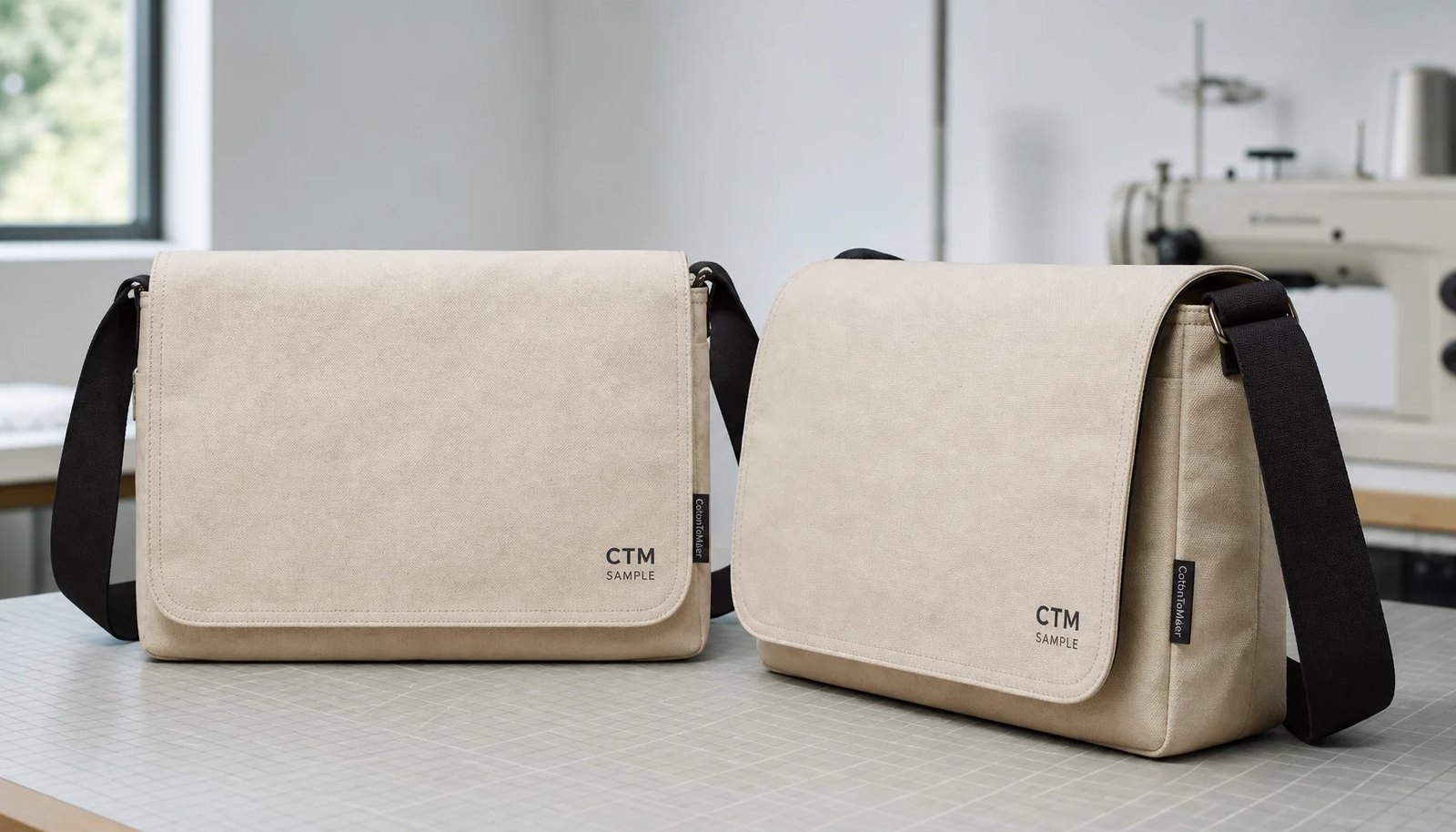
Why print proofing fails on trade show orders
Trade show buyers do not have the luxury of a soft failure. A canvas messenger bag is not just a tote with a strap. It carries a brand mark through a noisy hall, gets packed by different people, and often survives for weeks after the event. A logo that looks acceptable on a screen mockup can still fail on production canvas because the texture pulls the ink, the stitch line shifts the artwork, or the final fold lands across the print.
Most bad outcomes come from spec drift rather than from bad artwork. The bag was changed from one fabric weight to another, the print method changed to protect MOQ, or the supplier moved the logo to avoid a seam. Proofing exists to freeze those details before bulk. If the proof is weak, the first visible defect will show up at the show, not in the factory.
- Treat the proof as a production control, not a graphic exercise.
- Do not approve a layout that ignores seam lines, folds, or strap interference.
- Use the proof to lock the bag face that the exhibitor will actually hand out.
Lock the bag spec before you talk artwork
For wholesale canvas messenger bags, a practical starting point is 12 oz or about 340 gsm canvas. That weight gives enough body for a clean print, keeps the bag from collapsing in transit, and still folds for carton packing. If the bag will hold catalogs, samples, or heavier event materials, move up to 16 oz or about 450 gsm. Thinner canvas lowers cost, but it can curl, show through, and make even a good print look less controlled.
Do not approve artwork until the structural spec is fixed. The bag width, gusset depth, flap style, closure type, strap webbing, and any inner pocket all affect the available print area and the way the bag folds. A logo that sits perfectly on a flat panel can become unreadable once the flap is stitched or the bag is turned for packing. Ask the factory for a dimensioned drawing with the print zone marked in millimeters.
- Use 12 oz or 340 gsm as a common starting spec for exhibitor use.
- Move to heavier canvas when the bag will carry catalogs or reused samples.
- Lock closure type, pocket layout, and strap width before approving placement.
Choose the print method around the artwork
Screen print is still the default choice when the logo is simple, flat, and limited to one to three spot colors. It gives strong edges, a consistent feel, and usually the best unit cost at scale. If the logo uses gradients, small type, or several colors that do not separate cleanly, ask whether a transfer method or a hybrid decoration route is better. Do not let the supplier pick the method only because a machine is already available.
The proof standard should match the method. A screen-printed bag needs a strike-off or pre-production sample on the same canvas, with the same ink and cure cycle. A transfer print needs proof of adhesion, hand feel, and rub resistance on the real panel. In both cases, the supplier should state the intended color target, the exact print size, and whether the reverse side remains blank or receives a second mark.
- Simple flat logos usually belong on screen print.
- Detailed artwork needs a method that can hold small features without filling in.
- Require proof on production canvas, not on paper or a random substitute fabric.
Compare sourcing routes before comparing price
A direct factory with in-house printing gives the cleanest control over fabric, print, and packing, but only when the factory truly owns each step. A trading company can simplify communication and consolidate suppliers, yet the buyer still needs to know who signs off the sample and where defect responsibility sits. A local decorator using imported blanks is useful for urgent replenishment, but the blank bag and the final decoration may not match the original spec if the source bag changes.
The right comparison is route plus quote structure, not just the lowest unit price. One supplier may include screens, ink, cartons, and inner packs while another leaves those items off the quote. A low-looking number can turn into a higher landed cost once setup, packaging, and freight are added back in. Use the table to separate repeat-order routes from first-run development and urgent event supply.
- Compare bag cost, print setup, and packing as separate line items.
- Identify whether any subcontractor is involved in printing or finishing.
- Treat stock blanks as a different product, not as a like-for-like custom quote.
Build a proof package that people can actually use
A usable proof package is not a single PDF layout. It should include vector artwork, the exact print size, a placement map measured from fixed points, the fabric color reference, and the intended ink system. The best suppliers also add a production note that states which panel is printed, whether the logo crosses a gusset, and how the bag is folded for packing. If any of that is missing, the factory will fill in the gaps with its own assumptions.
If the logo carries small type or a detailed icon, include a magnified callout so the print team knows what cannot be simplified. Buyers often receive a visually similar bag that still fails because the logo moved a little, the line weight filled in, or the final canvas batch shifted in shade. The proof should remove judgment calls, not create more of them.
- Send a vector file, not a screenshot or a flattened mockup.
- Measure placement from seams and edges, not from the center of an imagined panel.
- State whether the back side is blank, printed, or carries a secondary mark.
Sample approval should use pass-fail rules
Approve the sample on the same fabric and same print method that will be used in bulk. A sample made on a nicer blank bag is not a reliable approval. Set clear pass-fail rules before sign-off: if the logo drifts outside the agreed tolerance, if the strap blocks the print when the bag is folded, or if the ink rubs onto white paper during handling, the sample is not ready for production.
Use the sample to test real behavior, not just appearance. Fold it the way the exhibitor will pack it. Put inserts inside. Open and close the flap or zipper several times. View the logo in daylight and under indoor venue lighting. Photograph the sample next to a ruler or scale so there is no argument later about size or placement.
- Inspect the proof under daylight and under indoor light.
- Run a dry rub test, then a fold test, then a repeat handling test.
- Record approval photos with a ruler so the placement is measurable later.
Packing for booth use and distributor storage
Packing matters because a trade show bag is usually handed out flat and then refolded by the buyer or exhibitor later. If the print sits across a hard fold line, the logo can crack before the event even opens. Ask the factory to define the fold direction, whether an insert board is needed, and whether each unit goes into a polybag. For heavier canvas, a paper or tissue insert can protect shape without adding much cost.
Carton planning depends on where the bags are going. Exhibitors need easy-count cartons with clear size marks so receiving staff can move quickly. Distributors usually want pallet-ready cases with stable master pack counts for warehouse handling. If the shipment is going straight to a venue, the carton label should make SKU, quantity, and order identification easy to read without opening every case.
- Do not fold the bag through the printed logo unless the buyer accepts that risk.
- Set an inner pack count and outer carton count before production starts.
- Match carton marks to the purchase order and the packing list exactly.
Lead time risk sits in the proof stage
The schedule usually breaks into artwork approval, sample production, sample review, bulk production, quality inspection, packing, and freight. The risky part is rarely the sewing line itself. It is the approval loop. A late change to font size, print placement, or logo color can force new screens, new setup, or a new sample. That is how a cheap quote becomes an expensive one.
Build buffer around fabric confirmation, print setup, and carton availability. If the event date is fixed, ask the supplier to show the longest realistic path instead of the best-case path. A good production plan leaves enough room to absorb one correction without missing the ship date. If the supplier cannot explain where the buffer lives, the buffer probably does not exist.
- Lock artwork before screens, plates, or transfer tools are made.
- Allow time for a second sample if the first proof exposes a defect.
- Treat freight cutoff dates and holiday shutdowns as hard schedule inputs.
Compare landed cost, then decide whether to rebid
For a first order, the best quote is often the one with the strongest proof control and the lowest risk of rework, not the lowest unit price. Compare unit price, setup charges, packing, cartons, inland freight, and any exposure to reprint or replacement. If a supplier hides print setup inside the unit price, ask for the breakdown anyway so the next quote can be compared on the same basis.
Once the first production spec is locked, future orders become easier to price and rebid because the cost drivers are visible. That is how buyers stop paying for vague development. The objective is not to buy the cheapest messenger bag on paper. It is to buy a bag that prints cleanly, survives the event, and arrives in the carton count and condition that the warehouse or venue team can receive without surprise.
- Compare quotes on the same fabric weight, same print method, and same pack rule.
- Separate one-time setup from recurring cost before approving the order.
- Keep a record of every change between the sample and the bulk quote.
Specification comparison for buyers
| Spec decision | Recommended option | When it fits | Buyer risk to check |
|---|---|---|---|
| Direct factory with in-house screen print | Best for repeated runs with one to three spot colors and a fixed bag spec | When the buyer wants one owner for fabric, print, and packing | Verify that the factory, not a subcontractor, approves the strike-off and controls defect handling |
| Bag factory plus vetted outside printer | Useful when the sewing factory is stronger than the print line | When the artwork needs special inks or the bag maker lacks printing capacity | Confirm who owns color approval, who stores the screens or plates, and who pays for rework |
| Trading company bundling several factories | Good for buyers who want one commercial contact and flexible routing | When procurement values communication speed more than direct factory control | Watch for hidden markups and make sure sample responsibility is written clearly |
| Stock blank bag with local decorator | Good for urgent event replenishment or small test orders | When ship date matters more than custom construction optimization | Check that the blank shade, handle spec, and final decoration match the original product |
| High-volume OEM with screen setup | Best for larger repeat orders with fixed artwork and fixed packing rules | When the buyer can spread setup cost across volume | Ask how plate cost, spoilage, and change fees affect the real unit price |
| Digital transfer or hybrid print route | Best for gradients, photo-style graphics, or very small type | When the logo has detail that will not print cleanly as a standard screen print | Test rub resistance, heat impact, and hand feel on the actual canvas weight |
| Sample-room development run first | Best for a first order or a new supplier qualification | When the buyer needs to lock dimensions and print placement before bulk | Do not let bulk switch fabric lot, print method, or pack method without written approval |
| Regional distributor with decorated inventory | Good for fast domestic delivery and repeat replenishment | When the buyer needs near-term stock and can accept less customization | Less control over fabric weight, interior build, and branding consistency |
Buyer checklist before sampling
- Final bag size, fabric weight, color, and closure are locked before artwork approval.
- Artwork is supplied as vector files with Pantone or CMYK callouts and a minimum line thickness note.
- Print area is measured from fixed seams and edges on a factory drawing, not guessed from a mockup.
- The proof is on production fabric and matches the intended print method.
- Sample approval includes daylight viewing, fold testing, and dry rub testing.
- Packing count, fold direction, inner pack rule, and carton marks are confirmed in writing.
- MOQ, setup charges, packaging, and freight are separated in the quote so the unit price is comparable.
- Lead time includes artwork sign-off, sample approval, bulk production, inspection, and ship date buffer.
Factory quote questions to send
- Is the print done in-house, outsourced, or split across more than one site?
- What exact canvas weight or GSM is quoted, and is that the same fabric used for the sample?
- What is the usable print area in millimeters, and where are the reference points measured from?
- Which print method, ink system, and curing process are included in the quote?
- Will I receive a digital proof, strike-off, or pre-production sample before bulk?
- What is the MOQ by color, by logo version, and by print setup?
- What is included in the unit price, and what is extra for setup, packing, cartons, or inner bags?
- What defect standard applies to print alignment, stitch quality, and carton damage?
- Are sample and bulk production using the same fabric lot, trim, and closure components?
- What is the full production calendar, including approval cutoffs and ship-date milestones?
Quality-control points to confirm
- Fabric weight matches the agreed GSM and does not drift into a lighter lot without notice.
- Stitching is straight, reinforced, and secure at handles, gusset corners, flap points, and strap joins.
- Print placement matches the approved artwork map and stays clear of seams, folds, and stress points.
- Color is evaluated under daylight and indoor light against the approved proof or swatch target.
- Fine text, small icons, and thin strokes stay readable after the bag is folded for packing.
- Ink does not bleed, crack, smear, or transfer to the reverse side after handling and stacking.
- Folded units do not create a hard crease through the logo unless that has been explicitly accepted.
- Carton count, outer marks, and pack method match the purchase order and packing list.