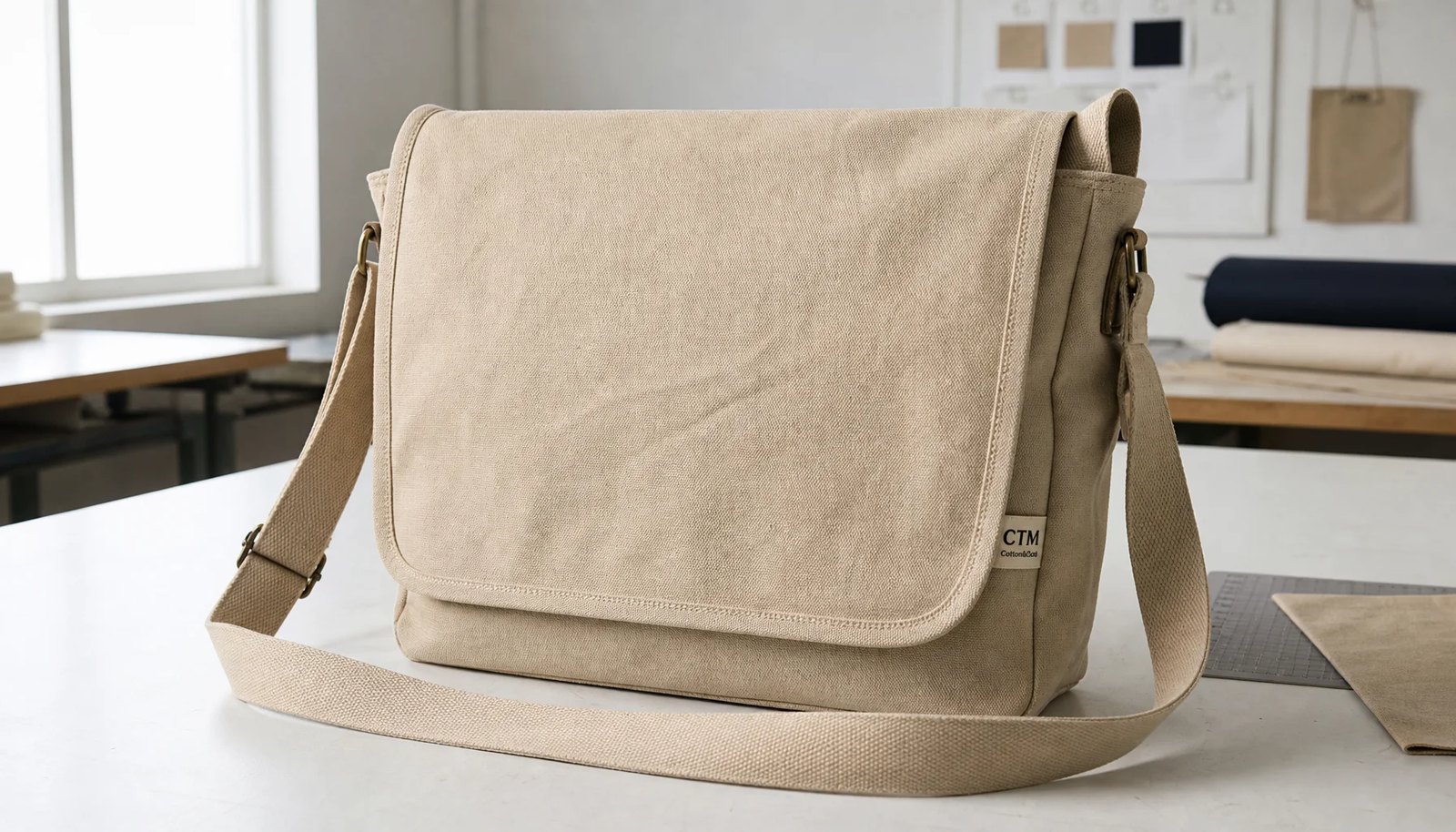
Why material choice matters more than the bag sketch
For subscription box programs, the canvas messenger bag is judged before anyone has a chance to use it. The first impression comes from fabric handfeel, print clarity, edge finishing, and whether the bag lands in the carton with a crisp fold or a crushed, underbuilt profile. A bag can look completely right in a concept deck and still miss the mark in production if the canvas is too limp, the strap is too narrow, the print sits on a fold line, or the closure pushes the packed size beyond the box plan.
Procurement teams need to treat material selection as a cost-and-performance decision, not just a visual one. The right build depends on what the bag will carry, whether customers are expected to reuse it, how much branding it needs to hold, and how much freight the finished item can add to the program. The goal is not simply to make a good-looking sample. The goal is to land on a spec that fits the box, survives shipping, stays within the landed-cost ceiling, and feels intentional when the customer opens it.
This is where sourcing errors become expensive. If the buyer approves artwork first and thinks about fabric later, the factory may quote a bag that looks similar but behaves very differently in bulk. One version may be fine in a photo sample but too soft to hold a messenger shape, while another may be durable yet too bulky to pack efficiently. Material selection should be settled before the purchase order is locked and before fulfillment has committed to carton logic.
The best procurement result is a bag family that fits the subscription system, not just the brand story. That means aligning body fabric, strap construction, closure, decoration method, and packing format with the real shipping environment. If the bag is going into monthly boxes, the spec should account for repeated handling, compression from adjacent items, and the possibility that customers will keep and reuse it rather than discard it.
- Use the intended contents to define fabric weight, not the artwork alone.
- Match the bag’s structural build to the box’s freight and dimensional limits.
- Avoid over-specifying premium trims when the product is meant for short-term use.
- Treat pack-out and shipping behavior as part of the product spec, not an afterthought.
Start with box constraints, not bag aesthetics
The carton usually decides more than the design team expects. Before a supplier quotes the bag, the buyer should know the maximum folded thickness, target insert count per box, and whether the messenger bag has to lie flat under other items. A gusset, a stiff closure, or a long strap can change carton volume fast, and once that happens the fulfillment team may lose the ability to pack the box cleanly without crushing the product.
A practical way to start is to work backward from the box dimensions and the expected insert set. Ask what must fit beside the bag, how much compression it can tolerate, and whether the customer will see the bag first or last when opening the subscription box. If the bag is supposed to act as the hero item, the folded orientation and outer protection matter more than if it is a supporting insert. That choice should happen before the fabric is chosen.
Shipping route matters too. A bag packed by hand for direct-to-consumer orders may need a different spec from one that is first mass-packed into retail distribution cartons. In the first case, the focus is often a neat fold and low complaint rate. In the second, the bag may need tighter dimensional control and stronger packaging because it will be handled more times before the customer sees it.
For procurement, the useful question is not only, “Does the bag look good?” It is, “What will this bag do to the box once it is folded, stacked, and shipped?” That question forces measurable decisions: folded size, tolerance band, packing method, and whether the bag can recover shape after compression. If the supplier cannot answer those questions, the quote is not ready for production review.
- Confirm the target folded size before you ask for pricing.
- Define the bag’s position in the box sequence: hero item or supporting insert.
- Check carton volume impact as part of landed cost.
- Require the supplier to show how the bag will be folded and recovered after pack-out.
Choose the right canvas weight and finish
Most subscription-box messenger bags sit in the 10 oz to 14 oz range, with 12 oz to 14 oz the most practical band for a bag that needs a durable feel without becoming heavy or hard to fold. Below that, the body can collapse, especially if the bag is unlined, the contents are soft, or the print area is wide and needs a smooth face. Above that, the bag starts to behave like a more rigid carry item. That can work for premium gifting, but it also raises freight and makes packing harder.
Buyers should specify finished weight, not just raw or greige fabric weight. Washing, dyeing, coatings, and enzyme or garment finishes can change the final result. That matters because a supplier can quote a fabric that looks right in a lab sample but finishes lighter, softer, or more absorbent after production. If the program depends on a crisp profile, ask for the finished gsm rather than the theoretical fabric spec alone.
Canvas construction matters just as much as the number on the sheet. A tight plain weave usually gives better print edges and more predictable seam behavior than a looser weave. If the supplier offers washed canvas or peached canvas, ask whether the finish softens the body too much for the intended use. A softer finish can look premium in hand, but it may reduce the bag’s ability to hold a clean shape inside the box.
For multi-tier subscription programs, one fabric weight can sometimes serve more than one SKU if the trim set stays stable. That usually improves sourcing consistency and lowers the risk of a mismatch between samples and bulk. If the premium tier is expected to feel more substantial, a heavier body, denser weave, or partial lining may be worth the added cost. The decision should be based on packability, reuse value, and freight, not a vague idea of “better quality.”
- 10 oz to 11 oz: lower cost and lighter box load, but less structure and more collapse risk.
- 12 oz to 14 oz: common for balanced handfeel, print stability, and repeat use.
- Finished gsm matters more than greige weight when dyeing or washing is involved.
- Ask whether finishing changes shrinkage, opacity, or fold recovery.
Specify dimensions, seam construction, and tolerances
A canvas messenger bag is only useful to procurement if the dimensions are controlled. The body width, height, gusset depth, flap length, strap drop, and pocket size should all be written into the tech pack with an acceptable tolerance range. Without those details, the factory can deliver a visually similar bag that still fails to fit the box or the intended insert. For B2B buyers, a clear tolerance sheet is more useful than a vague approval note like “looks good.”
Seam construction is a major source of failure in this category. Stress points at the strap join, side seams, and flap connection need reinforcement, usually through bartacks, boxed reinforcement, or another documented method. A supplier should be able to explain stitch count, seam allowance, and the exact reinforcement method for every high-load area. If the bag is expected to be reused, those details matter more than decorative finishing.
Dimensions also need to be tied to packaging behavior. A bag can measure correctly on the table and still misbehave once folded if the gusset springs back or the strap creates a bulge. Ask the sample room to fold the bag using the agreed pack method and to measure the final packed thickness. That final packed size should be part of approval, because it directly affects carton loading and warehouse speed.
Tolerances should be realistic and specific. Buyers do not need a generic promise that the bag will be “close” to the sample. They need a measurable band for critical dimensions, a separate band for noncritical dimensions, and a clear rule for hidden versus visible seams. The supplier should know which measurements are critical to function and which are only important for appearance. That distinction reduces disputes later and gives QC a defensible standard.
- Write body dimensions, gusset depth, flap length, and strap drop into the spec sheet.
- Use separate tolerances for critical and noncritical measurements.
- Require reinforcement details for strap joins and other high-load points.
- Approve the packed thickness, not only the open bag dimensions.
Match decoration method to artwork and handling
The decoration method should come from the art file and the use case, not from what is cheapest on paper. Simple logos with solid fills usually work best with screen print because the process is predictable, repeatable, and cost-efficient at scale. It is also easier to approve because the buyer can judge ink coverage, placement, and edge sharpness without having to decode a more complex decorative process.
If the bag needs a premium feel, a woven label, sewn patch, or small embroidery can be a better choice than a large printed graphic. But each option affects lead time and risk differently. Embroidery adds density and can distort thin canvas if the backing is not balanced. Heat transfer can suit short runs or complex art, but it is more sensitive to repeated folding, moisture, and abrasion. Woven labels are stable and clean, yet they can feel too understated if the brand wants the bag itself to carry the visual message.
The artwork should drive the process. Large lettering, bold brand marks, and simple icons are usually print-friendly. Fine gradients, tiny text, and photographic or tonal art need more careful review because canvas is textured and the folded bag interrupts the image. Before approving a decoration method, ask for the minimum line thickness, smallest readable text size, and number of setup colors. Those questions quickly reveal whether the supplier is quoting the same process you actually want.
For subscription-box programs, decoration must also survive handling inside the carton. Ask for a light rub test, a folded abrasion check, and a cure confirmation, especially for large printed areas. If the bag is meant to be reused, a decoration that looks crisp on day one but cracks after a few folds creates avoidable complaints. The buyer should test the product as a packaged item, not only as a flat decoration panel.
- Use screen print for bold, low-detail branding with stable unit cost.
- Use woven labels or embroidery when the artwork is small and premium positioning matters.
- Avoid tiny multi-color art unless the value of the detail justifies the setup cost.
- Ask for minimum line thickness and smallest text size before approving the method.
Decide on lining, closure, and hardware
Lining, closure, and hardware are often where the quote starts to drift. A plain unlined bag may be enough for a soft-goods insert, but the buyer should check whether raw seam allowances will show through the canvas or whether the contents could press through the body. Partial lining can improve presentation and reduce visible seam exposure without turning the product into a full retail briefcase. Full lining can be justified for premium gifting, but it adds sewing time, cost, and more chances for misalignment.
The closure decision should be tied to what the bag is supposed to protect. Open-top messenger bags are easier to pack and cheaper to produce, but they offer less security in transit and less perceived value. Magnetic snaps are clean and quick, but the magnet strength needs to be strong enough to close reliably without making the flap difficult to use. Zippers offer better retention, yet they add seam complexity, extra labor, and a higher risk of hardware failure if the zipper source is weak.
Hardware needs the same scrutiny as fabric. Buyers should specify whether metal parts must be nickel-free, matte, antique, painted, or fully color-matched to the trim palette. If the bag uses rivets, snaps, or zippers, ask about the source and the inspection process for sharp edges, loose parts, and finish wear. For a subscription-box program, a failed snap or a sharp edge is not a small issue; it becomes a customer complaint the moment the box is opened.
The practical rule is simple: add hardware only when it supports the use case or the brand tier. If the product is a low-cost insert, every added part should earn its place. If it is a higher-value reusable bag, a stronger closure or cleaner finish may justify the cost. The buyer should make that choice in the RFQ, not after the factory has already started sourcing parts.
- Use unlined or partial lining when the contents are soft and cost control matters.
- Use magnetic snap or zipper only when closure value outweighs added complexity.
- Specify hardware finish and defect expectations, not just the hardware type.
- Ask whether hardware is sourced in-house or purchased from a third party.
Build an RFQ that exposes real cost drivers
A useful RFQ compares like with like. If two factories receive different assumptions, the quotes are not comparable even if the unit price looks close. The RFQ should lock the exact size, canvas weight, construction method, decoration method, lining status, closure type, and packing spec. That gives the buyer a real basis for comparison and prevents hidden substitutions that only appear after approval.
The quote should be broken into line items wherever possible. Ask the supplier to separate base sewing cost, decoration cost, hardware cost, label or patch cost, packaging cost, and any special pack-out cost. That structure shows where the money is going and makes it easier to remove or simplify components without restarting the sourcing process. It also helps when the brand needs a version for a lower price tier or a different distribution channel.
The quote needs to include the full operational assumptions, not just EXW pricing. Ask for carton size, gross weight, pieces per carton, and whether the pack-out is optimized for freight or for shelf presentation. A bag that ships flat and packs efficiently can often beat a lower-priced bag that consumes more cubic space. For subscription work, freight and packing often matter as much as sewing cost, because the bag is part of a larger monthly box network rather than a standalone wholesale item.
The buyer should also compare sourcing routes before judging price. A direct factory usually offers better traceability and more reliable revision control. A trading company may be useful for mixed baskets, but the buyer needs to know who owns each step: fabric purchase, sample making, decoration, sewing, packing, and QC sign-off. If the quote does not make responsibility clear, then the price is carrying hidden risk that will show up later as delay or defect ownership disputes.
- Use the same size, same fabric, same decoration, and same packing logic across all quotes.
- Ask for line-item pricing instead of a single bundled number.
- Compare carton dimensions and gross weight across suppliers.
- Confirm who owns each production step before comparing price.
Approve samples like a production buyer, not a designer
A sample should prove manufacturability, not only visual appeal. The pre-production sample needs to use the actual fabric lot, thread color, decoration method, hardware, and packing approach that will be used in bulk. If the factory swaps materials for the sample, the buyer loses the chance to test the exact friction, fold behavior, and seam response that will reach the customer. That creates a false sense of confidence and is one of the most common causes of avoidable launch problems.
The approval process should include measured checks, not just comments about appearance. Measure body width, height, depth, strap drop, print placement, and label position against the tech pack. Inspect the inside seams, bartacks, corner tension, and any hardware attachment points. If the bag is intended for subscription boxes, fold it using the agreed method and confirm it fits the carton without forcing the fabric or deforming the print. The sample should also be weighed so the buyer can validate freight assumptions.
For launch programs with several stakeholders, use at least two sample stages when possible. A prototype or sales sample helps the team agree on direction. A pre-production sample confirms the exact materials and construction that will go to bulk. If the program will be reordered later, keep one sealed golden sample and one working reference sample for QC. That gives the buyer a physical standard for future production instead of relying on memory or photos.
The sample should also be version-controlled. Label it with date, revision number, and the exact configuration it represents. Store it under conditions that limit unnecessary fade, dust, or handling wear. If the supplier changes stitch pattern, thread source, or hardware vendor later, the approved sample should still be usable as a clear reference. That is especially important for reorders, where small changes can be missed if the buyer assumes the next run will match the first one automatically.
- Keep one sealed golden sample for bulk reference.
- Approve dimensions, not just artwork placement.
- Test fold memory and crease recovery before production release.
- Verify that sample materials and components match bulk plans.
Specify packing for carton efficiency and fulfillment
Packing decisions can affect the program cost as much as fabric choice. Canvas messenger bags for subscription boxes are often packed flat, then stacked with a polybag or tissue sheet to reduce scuffing. If the item is meant to feel premium, a simple belly band, care card, or side label may be justified, but every extra piece should have a clear purpose. Packaging should improve customer experience, protect the bag, or make fulfillment easier. If it does none of those, it is likely just added cost.
The carton plan should protect the product without inflating dimensional weight. A clean flat pack is usually best unless the closure or hardware creates pressure marks. Ask the factory to propose two or three carton-count options and show the freight impact of each. If the bag is pre-packed for retail, insist on a drop-safe pack test and clear outer carton marks. The goal is to prevent creases, print rub, and compression dents that make the bag look used before it ever reaches the customer.
Fulfillment teams also need to know whether the bag opens into shape easily. Some closure styles, lining choices, or tightly stitched edges make the bag hard to flatten and then recover. In subscription programs, that matters because the pack-out line needs speed and consistency. If a bag has to be manually shaped before packing, the labor cost may outweigh the savings from a lighter fabric or simpler decoration. Buyers should ask for an actual pack-out demo, not just a photographed sample on a worktable.
Standardize carton marks and pack instructions before production starts. Master carton labels should show size, color, quantity, PO number, and version code when relevant. If more than one distribution center will receive the order, the carton-marking logic should be agreed during sample approval. Good packing specifications reduce dock errors, speed up receiving, and make claim handling easier if a problem appears later.
- Use flat pack unless hardware or closure type creates damage risk.
- Compare carton count options against freight and warehouse labor.
- Require carton labels, pack instructions, and version codes before bulk.
- Treat pack-out demos as part of approval, not as an optional extra.
Set QC thresholds that match the bag’s actual job
The QC standard should reflect how the bag will be used after unboxing. A giveaway-style subscription insert can tolerate some cosmetic variation, but a resale-grade messenger bag needs tighter alignment on seam straightness, print position, and hardware finish. The buyer should define acceptable tolerance ranges before sewing starts, because post-production correction is much more expensive than a clear pre-production standard. QC is most effective when the supplier knows which dimensions are critical and which can vary slightly.
Inspection should focus on the failure modes that actually show up in this category: seam slippage at strap joins, print cracking at fold lines, color inconsistency across panels, and dimension drift from unbalanced sewing. If the bag has a zipper or magnetic snap, test repeated opening and closing on a sample set. If the bag is intended to be reused, review abrasion on the strap and corners after light load testing. These are the points most likely to become customer complaints after the box is opened.
The inspection plan should also define sample size and reject criteria. If the buyer expects a tight visual standard, the AQL target or internal acceptance level should be communicated early. The factory should know whether small shade shifts are acceptable, whether minor thread ends can be trimmed, and whether stitching defects on hidden seams are allowed. That removes ambiguity from the final inspection and makes the supplier accountable to the same standard used during sampling.
For messenger bags inside subscription boxes, compression and presentation matter as much as durability. The QC checklist should include folded shape recovery, surface wrinkling, label placement, and whether the bag still looks retail-ready after carton pressure. If the bag will be photographed for marketing or unboxed on camera, it should pass a visual standard in both the opened and folded states. That is more realistic than inspecting only a flat, untouched sample in the factory room.
- Set dimensional tolerance by critical measurement, not by visual judgment alone.
- Test print rub resistance on fold zones and strap-adjacent areas.
- Include pull checks on strap attachments and top corners.
- Inspect both folded presentation and opened shape recovery.
Specification comparison for buyers
| Spec decision | Recommended option | When it fits | Buyer risk to check |
|---|---|---|---|
| Base fabric weight | 12 oz to 14 oz finished canvas | Most subscription box programs that need a durable but still packable bag | Too-light fabric can collapse and show print-through; too-heavy fabric can increase freight, carton size, and folding difficulty |
| Canvas construction | Tight plain weave with consistent yarn count | When the bag needs clean print edges and stable seam behavior | Loose weave can distort logos, telegraph seam allowances, and vary from sample to bulk |
| Handle and strap build | Cotton webbing strap with reinforcement at all load points | Reused bags that customers will carry beyond the unboxing | Weak bartacks, short stitch length, or thin webbing can fail under repeated loading |
| Decoration method | Screen print for simple art; woven label or embroidery for premium small-brand marks | One-color logos, short messages, or simple icons | Fine gradients and tiny text often need another process and can change handfeel or abrasion performance |
| Lining strategy | Unlined or partial lining unless the contents are sharp, oily, or premium | Cost-sensitive subscriptions with soft inserts | Unlined bags can show raw seams or allow impression marks from enclosed items |
| Closure choice | Open top, magnetic snap, or zipper based on contents and target price | Higher-value boxes or bags meant for repeat use | Hardware adds cost, assembly time, and failure points if magnet pull or zipper quality is weak |
| Supplier route | Direct factory with sample room and in-house sewing | Buyers who need spec control, MOQ clarity, and accountable revisions | Trading layers can hide fabric source, blur defect ownership, and slow approvals |
| MOQ structure | One base body with shared fabric and trim, then vary only art or label | Multiple box tiers using one bag platform | Color splits and custom hardware can multiply MOQ if the factory cannot consolidate material buys |
| Packing format | Flat packed with agreed polybag, carton count, and mark labels | High-volume fulfillment and dimensional weight control | Overstuffed packing increases carton size, scuff risk, and warehouse handling time |
Buyer checklist before sampling
- Confirm target fabric weight in both oz and gsm, plus an acceptable tolerance band for bulk production.
- Lock finished bag dimensions, strap drop, seam allowance, and any closure placement before the first sample is approved.
- Specify print method, Pantone references, minimum line thickness, and minimum text size for the artwork.
- Request a pre-production sample made with the actual fabric lot, thread color, decoration method, and hardware.
- Ask for carton count, folded size, master carton dimensions, and gross weight before purchase order release.
- Confirm whether shrinkage, washing, or dyeing changes the finished size, fabric handfeel, or print opacity.
- Ask the supplier to show the pack-out sequence and warehouse handling assumptions, not just a product photo.
- Define acceptable visible defects, stitch defects, and shade variation in writing so the inspector is not guessing.
- Request separate pricing for the base bag, each trim or hardware option, and any alternate packing method.
- Confirm the lead-time split across material booking, sampling, bulk sewing, finishing, inspection, and dispatch.
Factory quote questions to send
- What exact canvas construction, finished weight, weave density, and measured shrinkage are you quoting?
- Is the quoted price based on finished fabric weight or greige fabric weight, and what finishing steps are included?
- Which decoration method is included, and what changes in cost if we switch from one-color screen print to embroidery, woven label, or heat transfer?
- What MOQ applies to each size, color, and hardware combination, and what is the lower-MOQ price break?
- What sample stages do you provide, and does the pre-production sample use the same fabric lot, thread, label, and closure parts as bulk?
- How are the bags packed per carton, what are the carton dimensions and gross weight, and can you propose a more freight-efficient pack-out?
- What QC standard do you use for stitch density, seam slippage, print alignment, bartack strength, and dimensional tolerance?
- What is the realistic production lead time after sample approval, and which components are the most likely to delay it?
- Can you quote the base bag and each optional trim or hardware variant as separate line items?
- What test data can you share for colorfastness, seam strength, abrasion resistance, or print rub performance, if available?
Quality-control points to confirm
- Fabric weight matches the agreed gsm/oz target within the approved tolerance and is consistent across panels and lots.
- Canvas surface is free from visible weaving defects, oil stains, major slubs, or uneven dyeing outside the approved range.
- Stitch density is even, bartacks are secure, and load points do not pucker when the bag is filled to the expected use weight.
- Seams lie flat, seam allowances are controlled, and corner finishing does not twist the body after folding or stuffing.
- Print registration, ink opacity, and cure performance hold up after light rubbing, fold testing, and carton compression simulation.
- Strap length, strap drop, symmetry, and reinforcement points match the approved sample and do not shift after sewing.
- Hardware functions smoothly, stays aligned, and has no sharp edges, loose rivets, weak snaps, or damaged zipper teeth.
- Folded size, carton count, inner packing, and outer carton strength protect the product during transit and warehouse handling.
- Label placement, care instructions, barcode labels, and carton marks remain readable and correctly positioned after pack-out.
- Critical dimensions are checked against a written tolerance sheet, not judged only by eye against a reference sample.