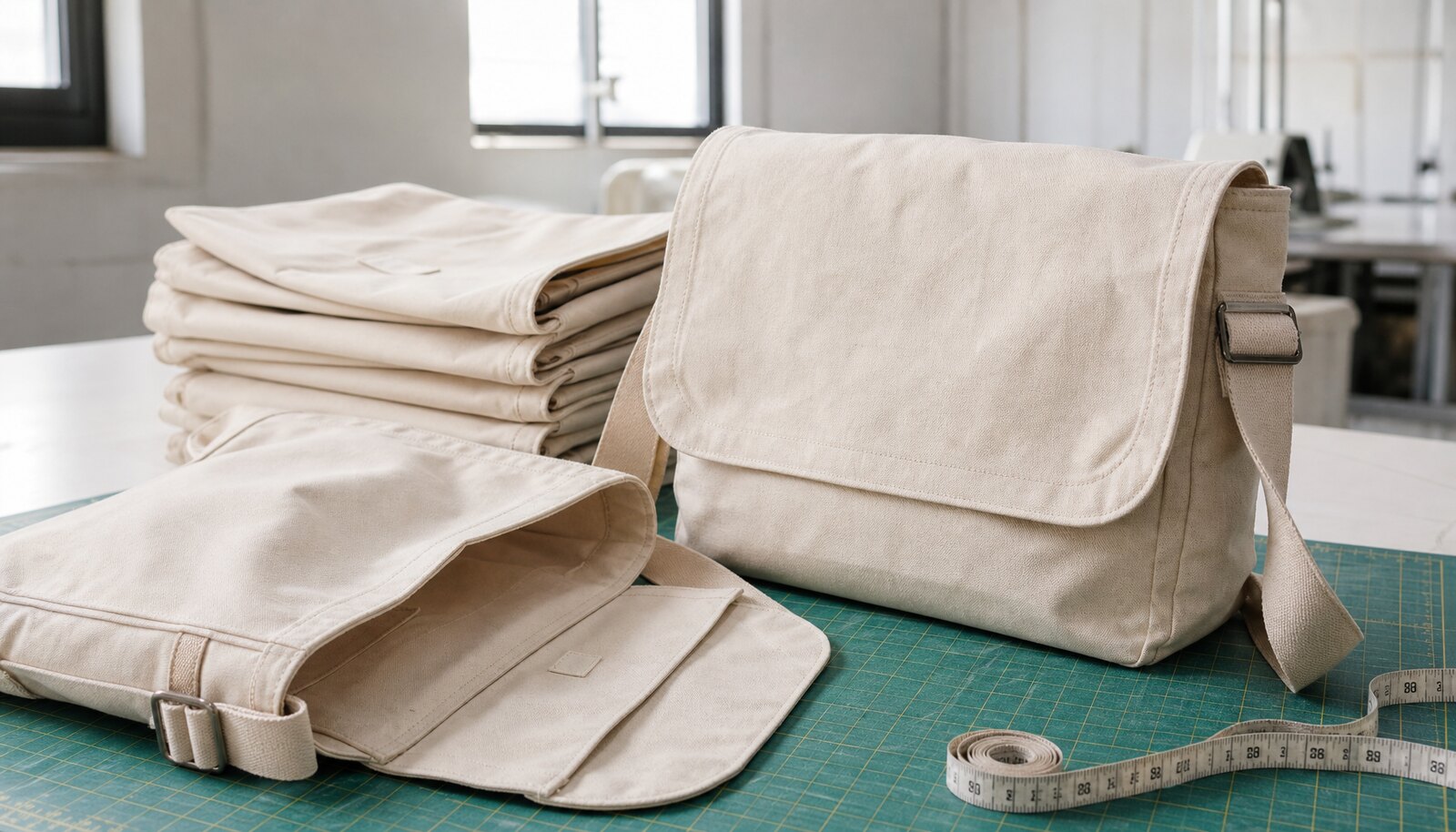
Why carton planning belongs in the product spec
For canvas messenger bags sold through gift shops, the carton is not a warehouse detail. It affects the unit landed cost, the shelf condition of the bag, and the amount of freight you pay for air. Buyers often compare bag quotes without checking whether one supplier packed 20 pieces per carton in a tight, retail-friendly fold while another packed 24 pieces with more compression and a larger outer box. The unit price can look better on paper while the freight and damage exposure are worse.
The commercial spec should therefore describe both the bag and the packed carton. That means final size, fold method, inner wrap, outer carton dimensions, gross weight target, and whether the bag must arrive retail-ready or can be unwrapped on receipt. If you do not specify those items, the supplier will fill in the blanks using its own standard method, which may not match your retail display or margin target.
- Treat carton dimensions as a sourcing input, not a post-production outcome.
- Use pack count and gross weight targets to compare quotes on a like-for-like basis.
- Approve the packed unit, not only the loose sample, before releasing bulk.
Start with the retail use case, then choose fabric and size
The right bag spec depends on how the gift shop will sell it. A souvenir-style program needs a bag that looks structured on a shelf and stays presentable after repeated handling. A daily-carry program needs a strap and seam build that can tolerate books, catalogs, or a water bottle. Those two use cases can both use canvas messenger bags, but they should not be bought with the same tolerance for fabric weight, closure, or carton compression.
A practical default for standard gift-shop retail is 12 oz canvas with a simple one-color logo. Move to 14 oz when the bag needs a more premium hand, better body, or heavier perceived value. Larger gussets and zipper tops improve utility, but they also increase sewing labor and cube. For carton planning, the important point is not just the flat pattern. It is the folded thickness after stitching, pressing, and any inner wrap that stays in the box.
- 12 oz is usually the commercial starting point for standard retail value.
- 14 oz is better when shelf structure matters more than minimum weight.
- If the bag is pre-washed or enzyme-washed, confirm whether the process changes size and hand feel.
Worked carton math: from bag dimensions to pallet load
A quote becomes useful only when the carton math is visible. Use a worked example with the supplier before you order. Suppose the finished bag folds to 12.5 x 10 x 0.6 in. If you plan 20 bags per carton, the pure product volume is 12.5 x 10 x 0.6 x 20 = 1,500 cubic inches. That is only the bag volume; it does not include void space, polybags, tissue, carton wall thickness, or the fact that folded bags do not nest perfectly.
If you add a realistic packing factor, say 1.25 to 1.35, the carton needs roughly 1,875 to 2,025 cubic inches of usable interior volume. A practical outer carton might be about 20 x 15 x 7 in. That equals 2,100 cubic inches, or about 0.034 cubic meters. If the gross weight lands around 11 to 12 lb, you can then compare air and ocean options using the same carton basis. At 20 cartons per pallet, a 48 x 40 in pallet with a 2 x 2 carton pattern and five layers gives 20 cartons per pallet, which is a useful starting pattern for warehouse handling and freight planning.
- Calculate both product volume and packed carton volume; they are not the same.
- Use a packing factor to account for voids and packing material.
- Track gross weight per carton and pallet count together, since freight and handling both depend on them.
How spec choices change cost, cube, and defect risk
Many bag quotes are driven by a small set of decisions. Fabric weight changes raw material cost and finished weight. Closure style changes components and sewing time. Print complexity changes setup time and reject risk. Packing method changes cube, carton count, and how the bag looks when it reaches retail. The buyer should ask the supplier to show which choice moved the price instead of accepting one blended number with no explanation.
A useful way to read a quote is to ask, for each option, what it does to the carton and what it does to the sample. For example, a zipper top increases perceived value, but it also adds a component that can fail or be stitched off-center. A woven label may be cheaper than a complex print, but it also changes the brand presentation and may need its own approval. A slightly smaller carton can cut freight materially, but if it requires compressing the bag harder, the shelf appearance may suffer. The best option is usually the one that balances value, not the one with the lowest unit price line.
- If a change reduces cube, check whether it also increases compression marks or wrinkling.
- If a change lowers material cost, check whether it adds sewing steps or defect points.
- If a change simplifies printing, check whether it hurts the shelf presentation you need.
Write the RFQ so suppliers quote the same thing
A weak RFQ creates false comparisons. One supplier prices raw canvas, another prices washed canvas, and a third quietly changes the strap width or carton pack. The numbers will not be comparable, and the cheapest quote may only be cheapest because it assumes a different product. For canvas messenger bags, the RFQ should lock down the fabric spec, size, closure, strap, print method, inner packing, carton count, and carton target. If any of those variables are open, the supplier can reasonably answer with its own default.
The carton section of the RFQ should be specific enough that freight estimates can be built from it. Ask for carton dimensions, gross weight, inner packing material, carton marks, and whether the bag is polybagged. If you need the quote to support landed-cost comparison, ask for FOB or ex-works pricing, carton count per shipment, and any surcharge for custom cartons or special labels. The point is not to burden suppliers with paperwork. The point is to remove hidden assumptions that distort the final buy decision.
- State dimensions in both finished form and folded form.
- List the artwork version and the acceptable print tolerance.
- Ask suppliers to price the same bag in at least two packing formats if carton efficiency matters.
Choose the sourcing route based on control, not habit
Direct factories usually give the best visibility into the things that matter most on this product: fabric availability, sewing quality, carton pack logic, and lead-time risk. If your order is repeatable and the spec is stable, direct sourcing makes it easier to compare cost against the actual factory capability. Trading companies can still be useful when the order is mixed, when the buyer needs a lower MOQ, or when the team wants one point of contact across multiple accessory items. The tradeoff is transparency. If the quote does not identify the real factory or does not separate service fees from production cost, it is harder to know where the margin sits.
The right choice depends on how much operational control the program needs. A gift-shop buyer with seasonal replenishment may prefer a factory that can hold the same carton spec across repeat orders. A distributor building mixed promo assortments may prefer a service layer that can coordinate labels, packing inserts, and consolidated freight. The decision should be driven by how much variability the program can tolerate, not by a generic preference for one sourcing model over another.
- Use a direct factory when repeatability and clear production control matter most.
- Use a trading company when the order needs coordination across several small components or SKUs.
- Ask for factory identity, production site, and service fee disclosure before comparing quotes.
Samples, approvals, and the paperwork that prevents disputes
The sample should answer more than appearance questions. For this product, the sample must show stitch quality, print position, strap reinforcement, folded shape, and how the bag looks in packed condition. Keep one sealed reference sample on the buyer side and one on the factory side. If the order has multiple colors or logo placements, label each reference clearly. That avoids the common dispute where both sides remember the approval differently after bulk production has already started.
The approval file should also include a simple spec sheet, a carton spec sheet, the packing sequence, and a signed sample approval note. If the buyer needs strict retail control, add a photographed first-article approval step before the factory runs the full batch. A good sample process does not need to be elaborate, but it does need version control. A different zipper pull, different stitch count, or different fold method should trigger a new approval, not a verbal exception.
- Approve the exact packed version that will ship, not a display-only sample.
- Keep photo records of front, back, side, inside, and packed views.
- Do not let carton changes happen after sample approval without a fresh sign-off.
QC that fits a retail bag program
Inspection for canvas messenger bags should focus on defects that affect retail value or use. A slightly uneven seam is less serious than a weak strap attachment, a misaligned logo, a stain, or a bag that will not sit flat on a shelf. For gift shop programs, visual consistency matters because the buyer often places several units side by side. One bad color lot or one off-center logo can make the whole display look uncontrolled.
Set the inspection plan before production starts. A common starting point for a retail accessory program is AQL 2.5 for major defects and 4.0 for minor defects, unless your customer or retailer has a stricter rule. Define what counts as critical, major, and minor. Add an inline check for the first pieces off the line, a pre-shipment inspection on packed goods, and a carton-level check for count, marks, and damage. If the bags will ship through more than one handling step, ask for a simple drop or handling test on packed cartons. The test does not need to be overengineered. It just needs to match the real transit risk.
- Check print placement and color consistency on the first and last cartons from the run.
- Measure strap length, seam reinforcement, and pocket symmetry on random samples.
- Reject repeated issues, not one-off noise, and document the defect pattern by carton.
Packing, labeling, and freight decisions that change landed cost
Packing can change freight cost without changing the bag itself. A tight fold with minimal void space may improve cube, but it can also increase wrinkle risk. A softer wrap protects the product more carefully, but it may add labor and slightly enlarge the carton. The buyer should compare at least two packing methods before freezing the order. If the product is retail-ready, include the hangtag, barcode, and any care label in the same approval step so the factory does not have to reopen the packing plan later.
Freight comparison should be made using carton volume and gross weight, not unit price alone. For example, if a carton is 20 x 15 x 7 in, its volume is 2,100 cubic inches. If a revision increases that to 21 x 16 x 8 in, the volume rises to 2,688 cubic inches, which is about 28% more space per carton. That kind of change can outweigh a small unit-price concession. For air freight, compare billed weight using the carrier's dimensional formula. For ocean freight, compare total CBM and the number of cartons that fit on a pallet or in a consolidated shipment. The goal is to know which packing plan actually produces the better landed cost, not just the prettier quote.
- Use carton marks that match the packing list exactly.
- Keep carton labels durable enough for humidity and warehouse handling.
- If you use mixed colors, make sure the carton marks and inner pack counts support fast receiving.
A buying workflow that keeps the order on track
Procurement teams do better when they treat the bag program as a sequence of locked decisions. First, confirm the retail use case and target price band. Second, freeze the fabric, size, closure, and logo method. Third, request quotes on the same carton format and the same inspection basis. Fourth, approve the sample in packed condition. Fifth, release production only after carton size, gross weight, and packing list format are finalized. That sequence prevents the common late-stage changes that push orders past the ship window.
For seasonal gift-shop buying, this matters more than it does in a routine replenishment order. A small delay in artwork approval or carton sign-off can move the shipment into a higher-cost freight period or miss the retail season entirely. Use the production calendar backward from the store receipt date, not forward from the PO date. If the supplier cannot commit to the carton plan or inspection method before production starts, the quote is not yet ready for a purchase order.
- Freeze the spec before negotiating the final price.
- Work backward from the in-store date, not the factory start date.
- Treat carton approval and inspection as milestones, not optional steps.
Specification comparison for buyers
| Spec decision | Practical starting point | Tradeoff data for procurement | Buyer risk to check |
|---|---|---|---|
| Fabric weight | 12 oz canvas for standard gift-shop retail | Usually the best balance of body, printability, and sewing speed. Moving to 14 oz often improves shelf structure but increases finished weight and can slow stitching on dense seams. | Ask for actual oz and GSM, plus finish method and pre-shrink status. Thin spots near seams are more important than the nominal fabric spec. |
| Finished bag size | About 12 x 14 x 3 in. with a usable gusset | A larger face gives better retail presence but expands carton cube quickly. Even 1 in. added to each carton side can raise volume by more than 10% once packing inefficiency is included. | Confirm folded size, gusset depth, and tolerance after pressing. Quote based on flat pattern only is not enough. |
| Closure style | Open top for simple gift-shop merchandising; zipper top for premium positioning | Open top is cheaper and lighter. A zipper adds perceived value and product control but adds components, sewing time, and defect points. | Verify zipper type, pull durability, and whether the supplier already sources the specified zipper size and finish. |
| Strap spec | 38 mm webbing strap with reinforced attachment points | Wider webbing improves carry comfort and reduces shoulder complaints, but it can add cost and make folding less compact in carton pack. | Request strap length range, seam reinforcement detail, and a simple pull test on a production-like sample. |
| Print method | 1-color screen print for simple logos; woven label or hangtag for restrained branding | Screen print is usually the lowest-cost repeatable option for one-color art. Complex artwork, small text, or gradients increase reject risk and sample iterations. | Ask for Pantone references, print placement drawing, and acceptable variance on first-piece approval. |
| Inner packing | Polybag only for low-cost bulk; tissue or insert for retail-ready presentation | Polybag protects from dust with minimal cost. Tissue or inserts reduce crease risk but add labor and may slightly increase carton cube or pack time. | Confirm whether the buyer or factory supplies the inserts and whether packing labor is included in the quote. |
| Carton pack | 20-24 pcs/carton, finalized with a pilot pack | Higher counts reduce carton count and often improve freight efficiency, but gross weight and compression risk rise. Lower counts protect shape but can increase freight per unit. | Check gross weight, outer carton dimensions, and handling limits before locking the pack count. |
| Carton format | Optimized carton size for the exact fold method | Custom carton sizing can reduce cube meaningfully, but it may require a carton MOQ, longer lead time, or a new die line. | Ask whether the carton is stock or custom, what burst strength is used, and how much empty headspace is in the pilot carton. |
| Sourcing route | Direct factory for stable volume; trading company for mixed or low-MOQ programs | Direct sourcing gives better visibility into sewing, fabric, and carton details. A trading company can add coordination value but may obscure where the real constraint sits. | Request the actual factory name, production location, and any service fee or markup hidden in the quote. |
Buyer checklist before sampling
- Final finished size, folded size, and tolerance for width, height, and gusset depth
- Canvas weight in oz and GSM, plus whether the fabric is pre-shrunk, enzyme-washed, or raw
- Print method, artwork file version, Pantone references, and acceptable color variance
- Closure type, strap width, strap length range, and reinforcement method at stress points
- Carton pack count, inner packing method, outer carton size, gross weight target, and pallet pattern
- Inspection standard, AQL target, sample count, drop test method, and defect definitions
- Production calendar with sample approval date, PO release date, production start, and ship window
Factory quote questions to send
- What exact canvas spec is included in your base price, including oz/GSM, yarn count, weave, and finishing process?
- Is the MOQ driven by fabric, print setup, carton size, or accessory sourcing? Please separate those constraints.
- What folded bag dimensions and carton dimensions did you use to calculate cube and freight volume?
- Please quote the same bag with open top and zipper top so we can compare the cost impact of the closure choice.
- What inspection standard, AQL level, and carton drop or handling test are included in your production plan?
- Can you show a pilot packing photo with gross weight, carton marks, and the exact pack sequence used?
- Please identify the actual factory, the service fees or markups if any, and the lead time that depends on artwork or accessory approval?
Quality-control points to confirm
- Approve the pre-production sample in both loose and packed form, not just as a display sample
- Check stitching density, seam reinforcement, strap attachment, and pocket alignment on first article and random bulk units
- Set a clear defect taxonomy for critical, major, and minor issues so both sides use the same language
- Inspect print registration, opacity, and cure quality on the first and last cartons from the run
- Define acceptable variance for finished dimensions after pressing and packing
- Use a common starting point such as AQL 2.5 for major defects and 4.0 for minor defects unless the retailer specifies stricter rules
- Require carton photos, carton count verification, and a weighted gross-check from the packed line
- Use a simple handling test or an ISTA-style package test profile if the order will ship through multiple handoffs
- Verify that carton tape, carton burst strength, and corner condition survive normal transit handling