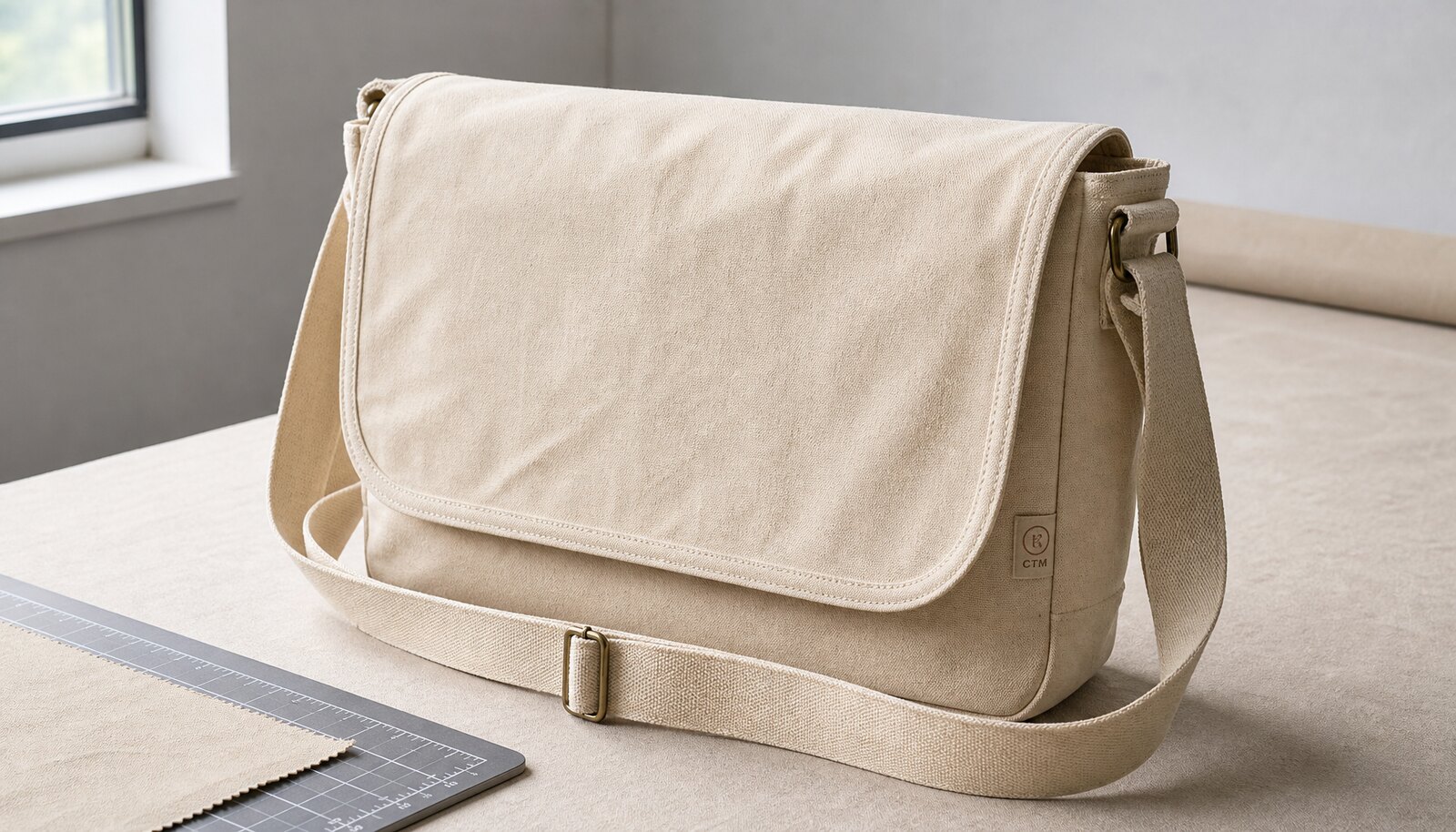
Start With The Selling Job
A canvas messenger bag for a gift shop is not just a bag. It is a retail object that has to sell quickly, survive casual carry, and look right next to postcards, mugs, books, or local artwork. If you start the RFQ with only a picture and the phrase custom canvas messenger bag, the factory has to guess the price basis. That is where quote spread, sample confusion, and later claim disputes begin. The RFQ should say what the bag is meant to do on the shelf and what it needs to carry in the customer's hand.
For gift shop buyers, the business question is usually not only the design but the retail job. Is this an impulse add-on, a premium souvenir, or a practical daily bag? Each one pushes the spec in a different direction. If the bag is meant to fit brochures, a notebook, or a tablet, say that early. If the bag is mainly for branding and visual impact, say that too. The factory can then quote the right fabric weight, print method, and packing style instead of building a generic messenger shape that looks acceptable but misses the channel.
- State the selling channel: museum shop, tourist store, attraction retail, or brand pop-up.
- Define the target retail role: entry price, mid-tier souvenir, or premium keepsake.
- List the carry requirement: brochure, notebook, tablet, or light daily use.
- Give the target order cadence so the supplier knows if this is a one-time buy or a repeat program.
Lock The Base Spec Before Pricing
Most price errors come from an underspecified base bag. Canvas weight, fabric finish, gusset size, and strap construction affect cost more than minor trim details. For this category, 12oz canvas is roughly 400gsm and is usually enough for a lighter gift shop item with a softer hand. 16oz canvas is roughly 540gsm and gives more structure, a fuller appearance, and a higher perceived value. If the bag will carry books or needs to hold its shape on a shelf, that heavier range is often the safer choice. If the price point is tight, 12oz or 14oz can work, but only if the print and stitching are still clean.
The RFQ should also lock dimensions with tolerance. A messenger bag can vary a lot between 28 x 30 x 8 cm and 34 x 28 x 10 cm, and those differences change material usage and carton packing. Ask for finished measurements, not just pattern size, and specify whether the bag is unlined, partially lined, or fully lined. The same goes for strap drop and closure type. If the flap needs to overlap a logo area or cover a pocket opening, that geometry should be on the drawing, not left for the sample room to interpret.
- Specify fabric weight in oz and gsm, plus natural, bleached, dyed, or washed finish.
- Write finished size, gusset, and strap drop with a tolerance band.
- State whether the bag is unlined, partly lined, or fully lined.
- Show any reinforcement points, especially strap ends, base corners, and flap stress points.
Choose The Logo Method By Shelf Impact
For canvas messenger bags, the decoration method is often the biggest driver of quote spread after fabric weight. A simple 1- or 2-color screen print is still the most practical choice when the art is bold, the logo is flat, and you want clean repeatability. That method usually gives the best mix of cost, clarity, and production speed. It also behaves better on textured canvas than highly detailed transfer art. Fine gradients, tiny text, and photographic images often look weak once they hit the weave, especially if the bag will be handled frequently in store.
A woven patch or embroidery can make sense when the buyer wants a more finished retail object. That is common for branded gift shop programs, premium museum stores, or city souvenir lines that need a more upscale feel. The tradeoff is cost and panel distortion. A thick patch can pull the canvas, and embroidery can show puckering if the fabric is too light. The RFQ should name the print size, location, number of colors, and whether the supplier is expected to color match to Pantone or to a physical swatch. Without that detail, every supplier will quote a different level of risk.
- List logo size and placement in centimeters, not only by artwork file.
- State the number of print colors and whether gradients are allowed.
- Require placement away from seams, pockets, and fold lines.
- If using embroidery or a patch, define thread color, patch size, and edge finish.
Write MOQ Logic Into The RFQ
Factories do not price canvas messenger bags only by fabric area. They price sewing time, setup labor, print screens, hardware, folding, and packing. That is why MOQ logic matters. A small order with a complex flap, lining, multiple pockets, or two decoration positions can cost disproportionately more than a larger order with a simple build. Buyers often ask for the lowest MOQ first and then compare prices without realizing that the setup burden is being spread over too few units. A cleaner approach is to tell the supplier the launch quantity and the likely reorder quantity so they can quote both.
Gift shop programs also benefit from a pilot-run mindset. If the design is new, ask for a small production lot or pilot batch with a higher unit price and a clear repeat-run price after the first order is approved. That gives you a practical way to test sell-through without locking the program into a permanent expensive spec. The RFQ should show whether color splitting is allowed, whether mixed artwork can share the same body, and whether the factory can hold fabric and hardware for a second order. If the quote ignores replenishment logic, it is not truly useful for a retail buyer.
- State the first order quantity and the expected repeat quantity separately.
- Ask for price breaks at realistic volume points, not only at one ideal MOQ.
- Clarify whether color splits or mixed art files count as separate SKUs.
- Ask whether setup costs are one-time or repeated on every batch.
Compare Sourcing Routes On One Baseline
The best sourcing route depends on how stable the spec is and how much control the buyer needs. A direct factory is the cleanest route when the design is locked, the artwork is simple, and the order will repeat. You usually get better visibility on fabric, stitch detail, and process control, but you also need a stronger RFQ because the factory will not fill in the gaps for you. A trading company can be useful when the buyer needs help coordinating art, packing, and multiple SKUs in one shipment. That can reduce internal workload, but you must understand whether the quote includes margin layering or subcontracted production.
A local assembler or domestic converter is mainly a speed route. It can help when a gift shop needs a fast seasonal refill, a smaller domestic launch, or a short-run customization job that cannot wait for sea freight. The tradeoff is usually higher unit cost and fewer material options. Whatever route you choose, compare quotes only after the same assumptions are fixed: the same fabric weight, the same logo method, the same packing count, and the same sample stage. Otherwise you are not comparing suppliers. You are comparing different products that happen to share a name.
- Direct factory: best for repeat orders and tighter process control.
- Trading company: best for mixed programs or buyers who need coordination help.
- Local assembler: best for urgent replenishment and short lead-time needs.
- Require each source to list excluded items so the quote can be normalized.
Approve The Sample Against Measurable Points
The sample is not just a visual check. It is the first real proof of whether the factory understands the bag. Measure finished size, strap length, flap overlap, and print position against the drawing. Inspect how the gusset folds, how the seam bulk sits at the corners, and whether the bag looks balanced from the front and side. On canvas, a bag can look fine when flat on the table and still feel awkward once it is worn. If the strap drop is wrong or the flap sits too high, the retail product will feel cheap even if the quote looks good.
For new art, new hardware, or a new fabric shade, ask for a production-intent sample rather than a loose sales sample. The approval note should read like a small technical spec: accepted size, accepted color reference, accepted stitch line, and accepted hardware finish. If the supplier wants approval by photo only, push back unless the program is extremely simple. A photo cannot show seam density, print curing, or whether the magnet actually closes cleanly. If the sample is not measurable, it is not ready to be frozen for bulk production.
- Check size, strap drop, flap overlap, and print placement against the approved drawing.
- Inspect stitch density, seam straightness, and reinforcement at all load points.
- Confirm color against a physical swatch or Pantone under daylight, not only on screen.
- Write pass/fail language for hardware function, shape, and visual alignment.
Set QC Thresholds That Match The Channel
Gift shop buyers usually need a higher visual standard than a bulk promo program because the bag sits on a shelf and often becomes part of a display story. The defects that matter most are the ones a customer sees immediately: crooked print, uneven flap edges, loose threads, mismatched fabric shade, and hardware that looks cheap or tarnished. Load-bearing defects matter too, but the first sales problem is usually visual. If the product looks tired before it leaves the carton, the channel will discount it quickly or stop reordering.
Use measurable acceptance criteria instead of vague language like good quality or best workmanship. A practical QC file can define the maximum allowed print shift, the minimum stitch density, the acceptable variance in size, and the condition of the bag after folding. If you use an AQL-style inspection, pair it with a plain-language defect list that names the reject conditions. A common example is to reject any broken strap bartack, any rust on hardware, any visible ink cracking on the approved print area, and any odor or stain that would be unacceptable in retail packaging.
- Define exact reject conditions for print shift, strap reinforcement, and hardware finish.
- Set visual standards for symmetry, color consistency, and fold presentation.
- Require carton-level checks for count accuracy and packaging damage.
- If the program is premium, ask for pull or closure testing on a sample basis.
Specify Packing For Retail Handling
Packing is often the step that decides whether the bag arrives ready to sell or ready to rework. A gift shop may want each messenger bag individually folded, inserted into a polybag, and labeled with a barcode or SKU sticker. Another buyer may prefer bulk packing to reduce plastic and warehouse handling. The right answer depends on the channel and the store staff. The important point is to put the packing logic into the RFQ. If you leave it out, the factory will choose the simplest method for production, not necessarily the best one for retail receiving.
Carton count and gross weight matter as much as the bag itself. A carton that is too heavy is hard to move and more likely to be damaged in transit. A carton that is too light may waste freight volume. Ask for master pack count, inner pack count if used, carton size, gross weight, and ship mark format. If the bags are sold with hangtags, barcode stickers, or inserts, define that now. Packing changes are easy to miss in email threads and expensive to correct after production starts.
- State whether each bag needs a polybag, insert card, hangtag, or dust protection.
- Ask for carton count, carton dimensions, and gross weight by SKU.
- Specify barcode placement and whether retail labels are pre-applied or loose.
- Confirm folding method so the bag opens cleanly when displayed.
Compare Landed Cost, Not Unit Price
The cheapest ex-factory quote is not always the best buy. For canvas messenger bags, landed cost is shaped by freight, duty, inland transport, packaging, testing, artwork setup, and the cost of rework if the sample is not right the first time. A supplier with a slightly higher ex-factory price can still be the better choice if the print is cleaner, the packing is retail-ready, and the lead time is more reliable. That matters in gift shops because sell-through is often seasonal. Missing the window costs more than a small unit-price difference.
Ask every supplier to quote on the same baseline and to separate the lines that usually get hidden. Those lines include sample charge, screen setup, plate or patch charge, individual packing, barcode work, and any special carton marking. If one quote includes testing and another does not, normalize the numbers before comparing. The simplest RFQ decision rule is this: award the quote that gives you the best combination of spec accuracy, packing readiness, and schedule confidence, not only the lowest number at the bottom of the page.
- Compare product cost, packing cost, testing cost, and freight on the same sheet.
- Ask for separate line items for sample, setup, and repeat-run pricing.
- Include inward freight, duty, and local delivery if you need true landed cost.
- Treat rework risk as a cost factor, especially for seasonal gift shop launches.
Plan The Schedule Around Peak Gift-Shop Demand
Lead time is not just a factory promise. It is a chain of approvals, material booking, print setup, sample sign-off, production, packing, and shipment. A new canvas messenger bag with custom art usually needs more time than a re-order of a locked spec. If the schedule is tied to a museum exhibit, holiday period, travel season, or store launch, tell the supplier the hard date and the soft date. The factory should quote against the real window, not the ideal one. Many delays come from waiting too long to approve art or changing the artwork after the screens are already made.
A useful RFQ also asks what happens if one part is late. Can the factory start on blanks before print approval? Can they hold a material lot for a repeat order? Can they partial-ship if your receiving window is tight? Those questions matter more than a vague lead-time number because gift shop buyers often need flexibility around seasonal cash flow and store opening dates. The best supplier is not just fast. It is the one that can absorb small changes without turning the whole order into a reset.
- Give the supplier the target delivery date, not only the order date.
- Allow time for artwork approval, sample review, and material booking.
- Ask whether partial shipment or split packing is possible if needed.
- Build buffer time for peak season, holiday congestion, and correction rounds.
Specification comparison for buyers
| Spec decision | Recommended option | When it fits | Buyer risk to check |
|---|---|---|---|
| Fabric weight | 12oz canvas, about 400gsm | Mid-priced gift shop bags where you want a softer drape and easier sewing | Can look thin after washing or heavy printing; confirm finished weight after shrinkage |
| Fabric weight | 16oz canvas, about 540gsm | Premium souvenir programs, heavier books, or a bag that needs stronger shelf presence | Higher sewing load, slower production, and more needle wear if the factory is not set up for heavy fabric |
| Logo method | 1-2 color screen print | Bold artwork, city icons, museum logos, and repeat orders with stable art | Registration drift, ink cracking, or poor curing on textured canvas |
| Logo method | Woven patch or embroidery | Premium retail positioning, smaller emblems, or brands that want a more finished look | Patch placement can pull the panel out of shape and raise setup cost |
| Closure and hardware | Magnetic snap under flap | Gift shop bags that need quick use and a cleaner retail appearance | Magnet position, plating finish, and flap alignment must be controlled |
| Sourcing route | Direct factory | Repeat programs, stable spec, and buyers who want tighter cost control | Requires a complete RFQ and clear sample approval to avoid spec drift |
| Sourcing route | Trading company | Small launches, mixed SKUs, or buyers who need help coordinating details | Margin layering and hidden subcontracting can blur what is actually included |
| Sourcing route | Local assembler | Urgent replenishment or domestic fulfillment where speed matters more than lowest cost | Higher unit price and fewer fabric or hardware options |
Buyer checklist before sampling
- Define the finished size, gusset, and strap drop with tolerance limits.
- State the canvas weight in oz and gsm, plus whether the fabric is bleached, natural, dyed, or washed.
- Lock the logo method, print size, color count, and placement before asking for price.
- Specify lining, pocket count, closure type, and any reinforcement at the strap points or base.
- Set the target MOQ, acceptable color split, and expected reorder plan.
- Ask for a pre-production sample and a clear sign-off rule for dimensions, print, and hardware.
- Confirm folding method, individual polybag use, barcode label placement, and master carton count.
- Request the quote in separate lines for product, print setup, sample charge, packing, and excluded costs.
- State the target ship window and any seasonal deadline that cannot slip.
Factory quote questions to send
- What exact fabric weight, weave, and shrink allowance are you quoting?
- Which decoration method is included, and what setup or screen charges apply?
- What is the MOQ, and how does the unit price change at 500, 1,000, and 3,000 pieces?
- What is included in the sample stage, and is the sample charge refundable against the order?
- Can you state carton count, carton dimensions, gross weight, and the folding method?
- Which operations are done in-house, and which parts are outsourced to another shop?
- What are your tolerances for finished size, print placement, and strap length?
- What lead time do you need after artwork approval and deposit?
- Which QC tests can you provide for stitching, strap strength, color, or hardware finish?
- What costs are excluded from your quote so I can compare suppliers on the same basis?
Quality-control points to confirm
- Finished dimensions stay within the agreed tolerance on width, height, and gusset.
- Fabric weight matches the approved spec and does not feel underweight after finishing.
- Print color, position, opacity, and edge sharpness match the approved sample.
- Stitching is straight, with no skipped stitches, loose thread chains, or broken seams.
- Bar-tacks or reinforcement stitches at the strap ends are symmetric and secure.
- Magnet, snap, zipper, or buckle works smoothly and sits aligned on the flap or body.
- Hardware finish is clean, with no rust, sharp edges, or visible plating defects.
- Lining and interior pockets are clean, with no oil marks, odor, or exposed rough edges.
- Folding and packing protect the print and keep the bag shape from collapsing in carton.
- Carton labels, barcode stickers, and shipping marks match the order data and carton count.