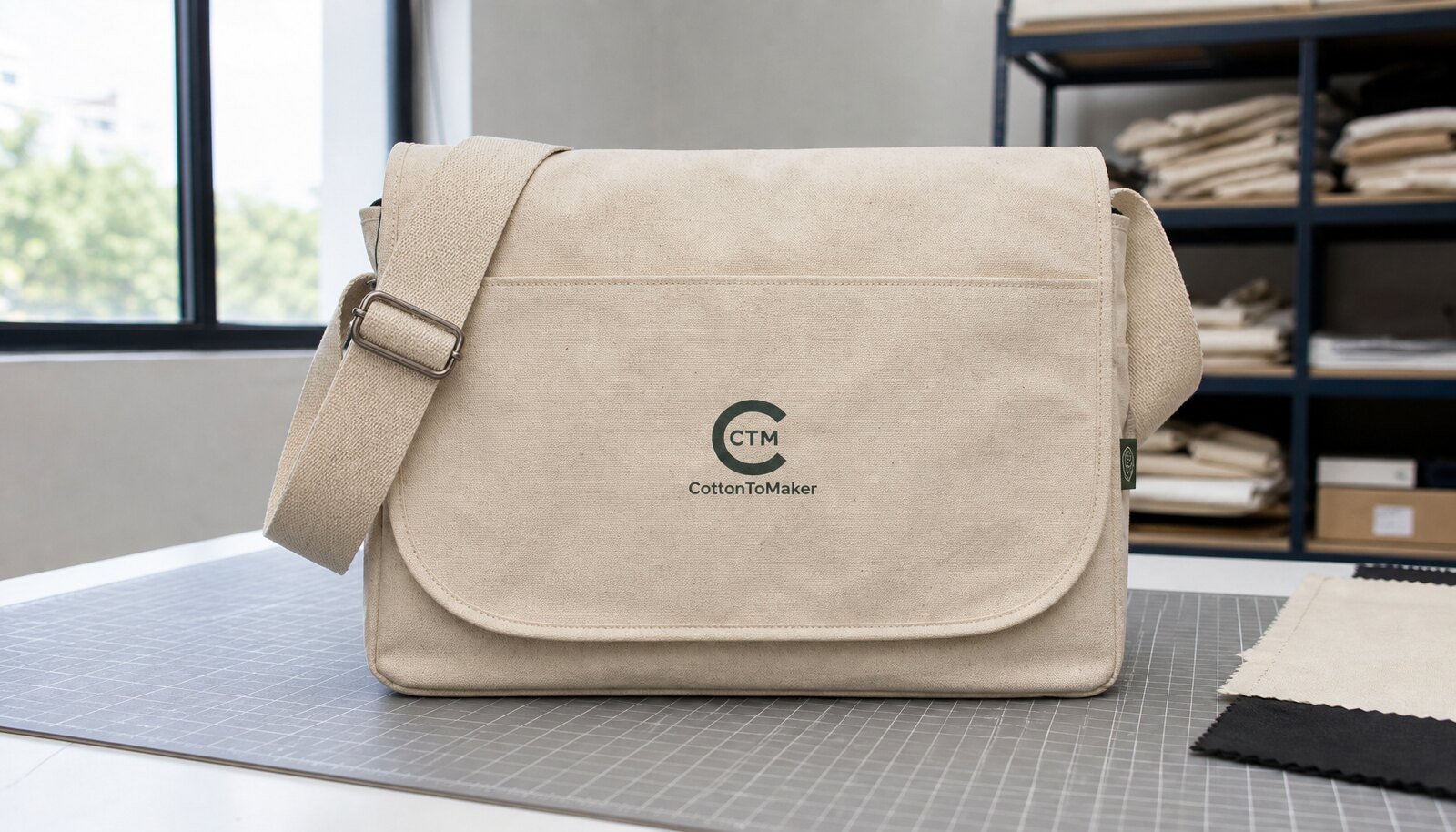
Why logo placement matters more on canvas messenger bags than on totes
Gift shop buyers sometimes treat messenger bags like a tote with a flap, but the manufacturing risk is different. A canvas messenger bag has more construction features than a flat tote: flap folds, front pockets, zippers, gussets, strap anchors, lining tension, rivets, and seam intersections. Those details can interfere with logo placement and change how the mark reads once the bag is sewn, folded, packed, and hung on display. A design that looks clean in artwork software can become difficult to print on a real panel with curves, seams, and hardware. For gift shops, the commercial goal is usually simple: make the bag recognizable without making it look like a giveaway item. Shoppers want something useful and giftable, but they also want a bag that feels retail-ready. That means the logo must sit where customers can see it immediately, yet still survive handling, stacking, and freight compression. If the logo is too close to a flap edge, pocket seam, or fold line, the print may pass a flat sample review and then distort in bulk. Procurement teams should therefore think in measurable placement zones, not just “front logo” or “small mark on the side.” The most common sourcing mistake is to approve artwork before defining the panel. On messenger bags, the panel controls the outcome. A centered front print on a stable panel is often the safest commercial choice, but the exact location depends on pocket height, flap shape, and how the bag is sewn. A buyer who asks for a dimensioned placement drawing early will usually get more reliable quotes, fewer sample revisions, and a lower chance of late-stage rejection. That is especially important when the bag is being bought for gift shops, where shelf appearance and consistent branding affect sell-through as much as cost does.
- Treat logo placement as part of the bag construction spec, not as a decorative afterthought.
- Ask for measured placement from fixed points such as top edge, side seam, pocket edge, and fold line.
- Use the approved sample as a production control piece, not as a display sample only.
Start with the retail use case: shelf display, counter sale, or e-commerce photo
The best logo zone depends on how the bag will be seen in the market. In a gift shop, some messenger bags are displayed on hooks or shelves where the front panel faces outward all day. Others are sold online first and need to look clean in product photography. If the bag is meant for shelf display, the most valuable placement is usually a centered front print or a centered pocket print that reads clearly at a distance. If the bag is mainly for e-commerce, the logo must also photograph cleanly from a slight angle, which makes seam interference and strap overlap more important. A bag sold near other gifts often has to communicate fast. That favors a simple, stable logo position with enough open canvas around it to separate the mark from pockets or decorative stitching. If the product is seasonal or part of a limited collection, buyers sometimes want a less obvious placement so the same base bag can be reused across multiple assortments. In that case, a side label, gusset mark, or back-panel logo can work, but the buyer should accept that the brand will be less visible in a crowded retail display. From a procurement standpoint, the use case affects more than presentation. Shelf-facing logos tend to require tighter placement control because even a small shift is visible in store. Online-only or low-visibility placements can tolerate slightly more variability, but they also reduce brand recall. That tradeoff should be spelled out in the RFQ. If the bag is meant to help the gift shop build a recognizable private-label line, visible front-panel branding is usually worth the extra control cost.
- Shelf display: prioritize front-panel visibility and clean alignment.
- E-commerce photos: check logo visibility from a slight angle, not only straight-on studio shots.
- Seasonal retail: consider a removable label or understated side branding if the same base bag will be reused.
Choose the logo zone before you choose the decoration method
On canvas messenger bags, the usable logo zones are limited by construction. The front panel is usually the most valuable area because it is the first surface shoppers see. If there is a front pocket, the buyer must decide whether the logo belongs above the pocket, on the pocket itself, or below it. Above the pocket usually gives the cleanest result because it avoids seam interruption and is easiest to measure. On-pocket placement can work if the pocket panel is flat and well supported, but the bag should be tested loaded and unloaded because the print can appear to shift when the pocket expands. The back panel is the next option. It is useful when the front face must stay clean or when a seasonal graphic is already taking the front face. The downside is visibility. Back-panel logos often sell well in product listings but can disappear in store unless the bag is hanging at the right angle. Side gusset branding is subtle and can feel premium, especially when done as a woven label or a small embroidered mark. However, it is usually not the best choice for brands that need quick retail recognition. The side is also higher risk if the gusset is narrow or the bag will be packed tightly in cartons. A buyer should ask suppliers to mark the proposed zone on a blank sample or a dimensioned mockup. Do not accept a vague answer such as “front center” if the front face is broken by a pocket flap or decorative topstitch. The supplier should be able to show the visible print area, the no-print zone around seams, and the location of the logo relative to the flap fold. If the factory cannot draw that accurately, the order is not ready for bulk production.
- Front panel: best visibility, but only if the panel is stable and flat enough for the chosen method.
- Front pocket: useful only when the pocket stays flat and does not bulge under normal use.
- Back panel: good for cleaner fronts, but weaker shelf recognition.
- Gusset or side label: subtle branding, but ask whether it remains readable from normal retail distance.
Fabric weight, weave, and finish: how they change print quality and bag feel
Most buyers comparing canvas messenger bags for gift shops will see quotes in the 12 oz to 16 oz range, and the right choice is not only about price. Twelve-ounce canvas is flexible and lighter, which helps freight cost and can make the bag feel less bulky. It also tends to drape more, so large logos may show slight waviness if the panel is not well supported. Fourteen-ounce canvas is often the best commercial middle ground because it gives enough body for a messenger bag silhouette while still allowing efficient sewing and packing. Sixteen-ounce canvas creates a more premium hand feel and holds its shape better, but it increases sewing load and usually raises both material and freight cost. Weave density matters as much as nominal weight. A tighter weave gives the printer a cleaner surface and reduces the chance of ink bleeding into open gaps between yarns. That matters for small text, thin outlines, and logos with fine detail. Washed or garment-dyed canvas can look more retail-friendly, but it adds another variable: shade variation. That is not always a problem, but it makes color inspection and logo consistency harder. If the bag is meant for gift shop shelves, buyers should decide whether the visual softness of a washed finish is worth the added QC attention. One practical way to negotiate is to ask the factory for the same artwork on two fabric options: the quoted production fabric and one step up in weight. Comparing the sample by hand often reveals whether the logo sits flat, whether the bag stands up properly, and whether the print edges look crisp enough for your sales channel. If the brand mark is small and text-heavy, a tighter weave or heavier canvas is usually safer. If the logo is bold and graphic, a lighter canvas can still perform well and reduce landed cost.
- 12 oz canvas: useful when price sensitivity and freight weight matter more than structure.
- 14 oz canvas: usually the most balanced option for retail-ready messenger bags.
- 16 oz canvas: better when the bag needs a premium look and firmer body.
- Ask for the same finish on sample and bulk; washed, dyed, or enzyme-treated fabric can change print behavior.
Logo method comparison: what each decoration route really delivers
The best decoration method depends on artwork complexity, order size, and how much control the buyer wants after reorder. Screen printing is usually the lowest-cost choice for simple logos, especially on medium runs. It produces strong color density and works well on canvas when the ink, mesh, and curing process are controlled. For a clean front-panel logo on a gift shop messenger bag, screen print is often the most efficient option if the logo uses one or two spot colors. The risk is that it becomes less attractive when the artwork is highly detailed or when the supplier’s registration control is weak. Heat transfer is useful when the artwork has more detail, gradients, or a short development window. It can also make sense for a pilot order if the buyer wants to test a design before committing to a full screen setup. But transfer quality varies widely. A film that looks fine on day one can show edge lift or cracking after fold testing if the application temperature or pressure is inconsistent. Embroidery gives a strong premium signal, but it is not the default choice for every messenger bag. It works best on heavier canvas and for small logos. Large embroidered areas can distort the panel and increase production time. Woven labels and patches are often overlooked, but they can be the best commercial answer when the logo is small or the fabric texture is uneven. A woven label can be placed on the pocket, flap, or side seam with less risk than printing directly onto a textured panel. Patches are also useful when the buyer wants a more crafted look. The key commercial issue is not whether the label is attractive in isolation, but whether it survives sewing, folding, and carton compression without curling or sitting crooked. For procurement teams, the method choice should always be tied back to run size, artwork detail, and the number of times the same bag will be reordered.
- Screen print: best for simple logos and repeat runs with controlled artwork.
- Heat transfer: useful for short runs or detailed art, but test for edge lift and cracking.
- Embroidery: premium look on smaller marks and heavier canvas, but slower and more expensive.
- Woven label or patch: useful when the fabric is textured or the logo should feel less promotional.
Use a real cost comparison: method price, setup, and reorder economics
Procurement teams often focus on the bag unit price and miss the real cost drivers. For custom canvas messenger bags, the landed cost includes the base bag price, decoration setup, print or embroidery charges, packaging, carton loading efficiency, inspection time, sampling, and freight. A supplier who looks expensive at first glance may actually be cheaper once setup, rework, and shipping are included. The most common hidden cost is the decoration setup fee, especially when the buyer changes logo placement after the first sample or adds a second branding location later in the process. Logo placement can also influence freight cost. A bag with a more structured panel and heavier canvas may cost more per piece but pack more predictably, which can reduce crushed cartons and awkward void space. A lighter bag may reduce unit price but raise risk if the logo sits on a flexible panel that wrinkles in transit. Buyers should compare carton dimensions, gross weight, and pieces per carton alongside the product price. If two suppliers quote the same bag but one packs 20 pieces per carton and the other packs 30, the freight outcome may be different enough to change the decision. A simple landed-cost model should capture at least four lines: ex-works bag price, decoration/setup cost, packing cost, and freight estimate. For first orders, add sample and revision cost. For reorder planning, amortize setup over expected volume. That gives the buyer a better answer than asking “What is your best price?” because it shows whether the supplier can actually support the product through repeat business. If the gift shop program is seasonal, the ability to reuse the same setup on reorders may matter more than a small one-time unit discount.
- Request all-in costing for bag body, decoration, packing, and export carton.
- Compare gross weight, carton size, and pieces per carton before judging supplier price.
- Amortize setup and sample cost across the expected order volume, especially for first runs.
- Ask whether reorder pricing keeps the same screen, label, or tooling or triggers a new setup fee.
Supplier route comparison: direct factory, trading company, or decorator
There is no single supplier route that fits every gift shop program. A direct factory is usually the best fit when logo placement must be controlled tightly, the buyer wants repeat orders, and the artwork will stay stable across seasons. The factory can manage the sample, production, and packing spec in one chain, which lowers the risk that the sample and the bulk order diverge. The drawback is that factories may be less flexible on very small orders or mixed product requests. A trading company can be useful when the buyer wants one contact for multiple items or needs support with smaller, less predictable orders. However, the buyer should verify where decoration actually happens. If the print or embroidery is outsourced, the quote may look simple while the real control point is elsewhere. That matters when logo placement must stay exact across reorder cycles. Domestic decorators or resellers are useful when speed is the main concern, but they often sit higher in the cost chain and may not offer the same control on fabric origin, trim consistency, or carton efficiency. The right route depends on the role of the bag in the assortment. If the messenger bag is a core private-label item, direct factory sourcing usually gives the best repeatability. If it is a seasonal add-on with a short sales window, a trading company or decorator may be acceptable, provided the buyer still gets a measured sample and written production control points. For any route, the supplier should be able to show actual photos of the production line or sample room, not only a catalog image.
- Direct factory: best when repeatability and measured placement matter most.
- Trading company: useful for consolidated buying, but verify the true production site and decoration source.
- Decorator or reseller: fast for urgent programs, but usually weaker on unit economics and reorder control.
- Ask for line photos, sample room capability, and proof of how the logo is controlled in bulk production.
Sampling workflow: how to avoid approving the wrong placement
A pre-production sample is the control document for the whole order. It should not be approved only because the logo looks good in a photo. On a canvas messenger bag, the sample must show the exact logo position, artwork size, fabric weight, seam behavior, strap attachment, and final packing method. If the supplier sends a hand-made sample that is not built on the same line or with the same fabric batch as production, the buyer should treat it as a development sample only, not as bulk approval. The approved sample must be made as close to production as possible. The best workflow is usually three steps. First, review a dimensioned artwork sheet or digital mockup that shows the logo safe area. Second, approve a physical sample with written measurements on the bag or on a control sheet. Third, lock the sample by having both sides keep the same signed reference, especially if the supplier will produce multiple colorways. If the order includes a pocket logo or back-panel logo, ask for open and closed photos so you can see whether the mark remains visible when the bag is used as a retail display piece. During sample review, buyers should also test the bag in realistic ways: fold it into the carton shape, put a small weight into the pocket, rub the logo lightly, and check whether the print sits flat after packing. It is much easier to correct a 5 mm placement issue at sample stage than to discover after production that the screen was aligned from a soft fold rather than from the top edge. If the supplier resists measured approval, that is usually a sign that the bulk process is not yet under control.
- Approve a dimensioned mockup before making the physical sample.
- Use a signed or marked control sample for bulk comparison.
- Check the bag open, closed, folded, and packed, not only flat on the table.
- Test pocket-loaded appearance if the logo sits near a front pocket or flap edge.
QC thresholds, defect categories, and packing tests buyers can actually use
For buyer-side quality control, logo placement should be inspected as a measurable feature, not an impression. A practical target for a simple front-panel mark is ±5 mm placement tolerance on the first production run, with tighter control for repeat orders once the process is stable. If the logo is small, text-heavy, or placed near a seam, the acceptable tolerance may need to be even tighter. The point is not to apply one universal number, but to define the allowable drift before bulk starts. That allows the factory to set the print jig and sewing line with the same reference point the buyer will use in inspection. An inspection plan should cover both appearance and function. Appearance checks include print clarity, registration, color density, edge finish, and alignment relative to the pocket or flap. Functional checks include strap strength, zipper travel, flap closure, and whether the logo area puckers when the bag is opened. For a branded gift shop product, the bag must remain sellable after it has been folded, packed, and handled. A print that looks perfect before packing but transfers in the carton is not acceptable. Buyers should ask how the print is cured and how long the factory waits before folding and bagging. Packaging tests are often overlooked. A practical QC check is to confirm that the printed area does not stick to the polybag or to another bag during compression. It is also worth checking carton stack pressure, because bags with a fresh print or low-cure transfer can mark each other when packed tightly. For export shipments, ask for a first-carton review: one or two cartons opened after the first run to confirm the packaging spec, count, and rub resistance before the whole lot is released. If the order is large, many buyers also set a simple AQL-style sample plan for visual and functional defects so the supplier knows the rejection threshold before packing begins. For operational clarity, reject or hold the lot if you see repeated defects in the same category, not just one isolated cosmetic issue. Common defect buckets should include print placement, print quality, seam damage, fabric shading, hardware function, packing errors, and carton damage. That makes it easier to escalate a bulk issue quickly: the factory knows whether it needs to adjust print registration, rework the sewing line, or repack cartons. It also prevents the buyer from accepting a bag that looks fine in a single unit but fails in shipment because the defect is systematic rather than random.
- Set a measurable logo-placement tolerance before bulk: typically ±5 mm for simple marks.
- Inspect first-off pieces during production, not only final packed cartons.
- Check for rub-off, print transfer, and pack compression damage.
- Use a carton-opening review on the first cartons to verify count, packing, and print stability.
- Require the factory to separate defects into clear categories: placement, print, sewing, hardware, fabric, packing, and carton damage.
Quote comparison: the documents and details that separate a real supplier from a generic offer
A useful quote is more than a unit price. It should show the bag body specification, decoration method, placement dimensions, setup charges, sample fees, packing details, carton quantity, and lead time. If any of those elements are missing, the buyer cannot compare offers on equal terms. A low price without a measured placement drawing is not a strong commercial offer; it is an incomplete one. Buyers should request the same quote format from every supplier so the comparison is clean. Ask for the exact logo width in millimeters or inches, the print location from fixed edges, the fabric weight and finish, the number of colors, the packing method, and the estimated gross weight per carton. If the supplier is offering embroidery, ask for stitch count and whether the backing is cut-away, tear-away, or another type. If the supplier is offering heat transfer, ask for film type, press temperature, and wash or rub test results. These details matter because they explain the unit price, the setup cost, and the risk of variation. The most useful sourcing discipline is to force the supplier to quote against the same assumptions. If one quote assumes 12 oz washed canvas and another assumes 14 oz plain canvas, the numbers are not directly comparable. If one supplier is quoting a logo above the pocket and another is quoting on-pocket placement, the price difference may reflect risk, not efficiency. Procurement teams get better results when they compare quote against quote only after they have normalized the spec.
- Ask every supplier for the same quote template and the same measured placement reference.
- Separate base bag price, setup charge, sample cost, packing cost, and freight estimate.
- Do not compare quotes until fabric weight, finish, logo size, and logo position are normalized.
- Request documentation for whichever decoration method is proposed: print, embroidery, patch, or label.
Specification comparison for buyers
| Logo method / placement | Typical use case | Commercial tradeoff | Buyer risk checks | What to ask for in quote |
|---|---|---|---|---|
| Front-panel screen print | Best for simple, high-visibility branding on stable front panels | Lowest unit cost at medium and higher runs; strong shelf visibility; easiest to repeat on reorder | Confirm safe distance from top fold, pocket edge, and strap anchor; ask for measured artwork width and first-off approval | Setup fee, cost at 300/1,000/3,000 pcs, ink count, cure method, and whether screen is retained for reorder |
| Front-pocket print | Useful when the pocket is flat, wide, and part of the retail design | Looks integrated and retail-friendly, but pocket volume can distort the print when loaded | Check pocket height, pocket stitch line, and whether the logo shifts when the pocket is filled | Ask for print position from pocket top and side seams, plus a loaded-pocket sample photo |
| Back-panel print | Good when the front face must stay clean or seasonal | Keeps the front uncluttered, but reduces front-facing recognition in store | Verify the back panel is not pulled by lining, strap hardware, or a center seam | Request a full-size placement drawing and open/closed bag images |
| Gusset or side label | Subtle branding for premium or minimalist retail lines | Low visual impact from the front; better for brand marks than sales messaging | Check whether the label twists, curls, or disappears in tight carton packing | Ask for label size, stitch method, edge sealing, and sewing allowance |
| Embroidery on front panel | Premium look for small logos on heavier canvas | Higher cost, slower stitching, and less suitable for fine text or large marks | Confirm stitch density, backing, and whether hooping distorts the panel | Ask for stitch count, thread colors, backing type, and price breaks by quantity |
| Woven patch or sewn label | Useful when fabric texture is rough or logo is small | Can be easier to control than direct print, but requires extra sewing and edge control | Inspect edge sealing, color accuracy, and panel flatness after sewing | Request patch size, weave detail, sewing position, and MOQ per color |
| Heat transfer | Short runs, pilots, or detail-heavy art | Fast setup and flexible for complex artwork, but greater risk of cracking or edge lift | Require fold and rub testing; check gloss shift and film feel | Ask for transfer type, press temperature, press time, and adhesion test results |
| 12 oz canvas body | Value-led gift shop assortment or lower freight target | Lower cost and lighter pack-out, but softer panel structure and more visible waviness under print | Confirm weave density, shrinkage, and whether the print sits flat after folding | Ask for actual fabric weight, finish, and the same fabric in sample and bulk |
| 14 oz canvas body | Common balance point for retail-ready messenger bags | Good structure without becoming too heavy; often the safest commercial middle ground | Check that the sample and bulk fabric are the same finish and dye process | Request fabric spec sheet, GSM or oz basis, and packing weight per carton |
Buyer checklist before sampling
- Final artwork in vector format with exact logo width, PMS/CMYK reference, minimum line thickness, and defined no-print margins around seams, zipper tape, flaps, and hardware.
- A dimensioned placement drawing showing logo distance from the top edge, side seam, pocket edge, fold line, and strap anchor, with the reference point clearly marked.
- Confirmed fabric weight, weave, and finish, such as 12 oz washed canvas, 14 oz plain canvas, or 16 oz heavyweight canvas, matched to the approved sample.
- Chosen logo method tied to artwork complexity and run size: screen print, heat transfer, embroidery, woven label, or sewn patch.
- MOQs by color, artwork version, and decoration location, plus any extra charge for a second print location, special thread, or custom trim.
- Pre-production sample with measured logo position, open and closed photos, and a signed control reference kept by both buyer and supplier.
- Packing specification covering polybag size, suffocation warning if required, insert card size, carton count, carton marks, and barcode location.
- Lead time broken into sample development, material booking, production, first-off inspection, packing, and freight buffer, each with a written target date.
- Reorder plan stating whether future orders reuse the same screen, embroidery file, label die, thread shade, and carton format or require new approval.
- Inspection plan with defect categories, sampling method, acceptance thresholds, and escalation steps if print position, color, or packing fall outside tolerance.
Factory quote questions to send
- Where exactly will the logo sit on the bag, measured from the top edge and side seam, and does it cross any stitch line, zipper tape, fold line, or pocket edge?
- What fabric weight, weave density, and finishing process are you quoting, and how will that affect print sharpness, bag structure, and retail presentation?
- Which decoration method are you proposing for this artwork, what is the setup charge, and how does the price change at 300, 1,000, and 3,000 pieces?
- Is the MOQ per color, per artwork, per fabric batch, or per trim combination, and what extra cost applies if we change logo size or add a second print location?
- Can you provide a pre-production sample with measured logo placement, then a signed or sealed control sample before bulk cutting begins?
- What is the first-off inspection process during production, and who approves logo placement before the factory continues mass printing or embroidery?
- How do you pack each bag, what carton quantity do you recommend, and what is the gross and net weight per carton for freight comparison?
- What is your standard production lead time after sample approval, and what delays should we expect for custom fabric, special trim, color matching, or label sourcing?
- What tests do you run for print adhesion, fold resistance, rub-off, and packaging compression before shipment?
- If we reorder this style, what parts of the spec are guaranteed to stay the same and what parts may require a new sample or setup charge?
Quality-control points to confirm
- Logo position tolerance: ±5 mm is a practical starting point for a simple front-panel mark on the first production run; tighten the tolerance on repeats once the placement is locked.
- Print quality: no visible pinholes, misregistration, smearing, cracking, haloing, soft edges, or washed-out areas under normal retail lighting.
- Defect categories to watch: seam puckering around the decorated area, crooked label sewing, thread breaks, fabric shade banding, contamination marks, and crooked carton packing.
- High-risk rejection trigger: any logo that overlaps a seam, fold line, zipper tape, pocket edge, or strap anchor in a way that changes readability or durability should be treated as a fail, not a cosmetic deviation.
- Stitching around the logo area: no needle damage, skipped stitches, loose thread tails, or panel distortion near corners, pockets, and strap anchors.
- Fabric surface: no oil marks, yarn slubs, coating patchiness, broken yarns, or rough fibers that cause uneven ink absorption or print shading.
- Color match: logo color and fabric tone should match the approved sample or written standard, with no obvious batch drift across cartons.
- Functional test: strap attachment, zipper movement, flap closure, and pocket use must remain smooth after decoration and final pressing.
- Rub and fold test: print should not transfer when folded, stacked, or rubbed against adjacent bags, tissue, or polybag film.
- Packaging integrity: bag should not pick up print transfer, moisture odor, compression marks, or fold creases after polybagging and carton storage.