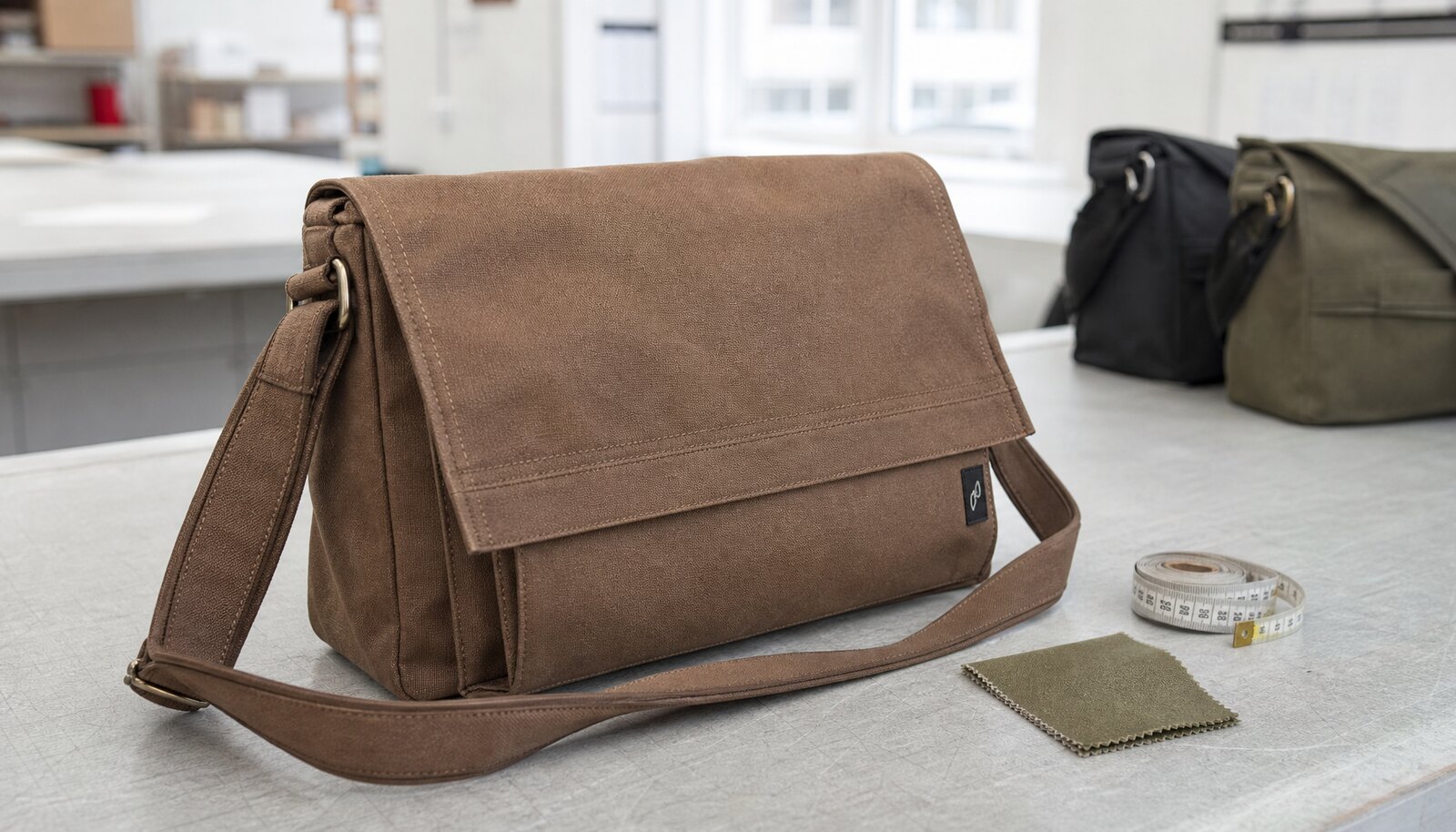
1. What gift shop buyers should expect from a canvas messenger bag
A canvas messenger bag for a gift shop is not the same as a rugged outdoor satchel or a general-purpose school bag. The commercial job is different. It needs to look clean on shelf, carry a believable retail load, survive repeated handling by shoppers and staff, and still arrive looking neat enough to merchandize immediately. That means procurement has to think about appearance, construction, and packaging at the same time, not as separate decisions.
The most common failure pattern is simple: the sample looks attractive, but the bulk order arrives with a softer body, weaker stitching, inconsistent print placement, or packaging that causes creasing before the bags even reach the store. Buyers often underestimate how much abuse a retail bag sees before the end customer buys it. It is lifted, stacked, re-bagged, opened, re-closed, and sometimes overfilled by the shopper trying to fit a souvenir, book, or bottle.
For that reason, durability testing for this category should be based on use, not only materials. You want a bag that preserves shape, keeps the logo legible, and holds together through repeated carry. The most useful test plan will reflect the exact retail application: lightweight souvenir use, everyday carry, tourist gift spend, or branded resale. The more clearly you define the use case, the easier it becomes to choose the right canvas weight, lining, closure, and reinforcement.
There is also a sourcing angle. A procurement buyer should not accept broad claims such as “thick canvas” or “strong sewing” without measurable proof. Those phrases are too loose to compare across suppliers. Instead, ask for finished fabric weight, stitch type, reinforcement details, and load test results. In the canvas messenger bag category, vague wording is usually where quality risk hides.
2. Build the spec first: fabric, lining, hardware, and reinforcement
Durability testing only works when the test target is clear. Before you compare suppliers, lock the bag specification into measurable items. That means body fabric weight, weave style, lining material, strap webbing width, closure type, hardware finish, and reinforcement method. If any of those are left open, the factory can quote a lower price using lighter or weaker components and still argue that the sample was “within range.”
For many gift-shop programs, a body fabric around 14 oz / 400 GSM can be a workable entry point if the bag is meant to hold a modest retail load and keep a casual look. A more structured shelf presentation often points buyers toward 16 oz / 470 GSM or a verified equivalent, especially if the product needs to stand upright or visually read as premium. Those numbers should be treated as buyer targets, not universal truths. The right spec depends on pattern shape, lining support, and intended load.
Lining deserves the same attention as the outer canvas. A 200D to 210D polyester lining is often enough for small retail items, but only if seams are clean and corners are not under tension. Thin lining can split first at the seam allowance or around the zipper tape. If the bag has an internal pocket, ask the factory to show how the pocket mouth is reinforced. The pocket is a common tear point because customers pull on it with one hand while looking at the bag with the other.
Hardware is another area where cheap substitutions can erode the whole order. A slider that drags, a ring that bends, or a low-cost adjuster that slips can make a bag feel defective even when the fabric is fine. Use one hardware standard across the order unless there is a clear reason to mix options. Mixed hardware batches create visual inconsistency and replacement headaches later.
Reinforcement matters more than buyers sometimes expect. On a messenger bag, the strap anchor, bottom corners, and zipper ends absorb repeated stress. Box-X stitching or bar-tack reinforcement is usually more informative than a supplier saying the bag is “reinforced.” Ask where the reinforcements are placed, how many stitches are used, and whether the stitch pattern is standard on all units or only on photo samples.
3. Durability testing checklist with concrete methods and pass/fail criteria
A useful durability test is practical, repeatable, and specific enough that a merchandiser or QA lead can run it without interpretation gaps. The goal is not lab-grade certification for every order. The goal is to screen out weak construction before bulk approval. For canvas messenger bags for gift shops, three test groups matter most: load carry, closure performance, and abrasion/appearance retention.
Start with a realistic load carry test. Fill the bag with weighted contents that simulate retail use, such as books, a bottle-shaped object, or weighted pouches. For a small souvenir-style messenger bag, 3 kg may be enough to expose weak seam construction; for a fuller-use retail carry bag, 4–5 kg is a more meaningful target if the design is intended to support that load. Carry the bag for 10 cycles of 30 seconds each, with set-down and pick-up between cycles. Acceptable results: no seam opening, no strap anchor deformation visible to the naked eye, no slider failure, and no major shape collapse. Reject if the strap anchor lifts, stitching pops, or the bag body twists so severely that the closure misaligns.
Next, test zipper or flap function. Run the zipper open and closed 20–30 times on the sample, checking for snagging at the top corners and the transition points where the zipper tape meets the fabric. The slider should travel smoothly without requiring extra force. A flap with magnetic closure should close consistently without misalignment or weak pull strength. Acceptance standard: closure works repeatedly, does not catch lining, and does not create visible puckering around the opening. Reject if the zipper jams, the teeth separate, the magnetic closure shifts out of position, or the top edge warps during use.
Then check abrasion and logo durability. Rub the logo area and exposed canvas surface with a dry white cloth for 20 strokes, then repeat with moderate hand pressure for another 20 strokes. If the order includes a print method that is known to be more vulnerable, ask the factory for a simple abrasion test reference sample before bulk. Acceptance standard: no obvious cracking, smearing, transfer, or loss of legibility. The purpose here is not to simulate years of wear; it is to catch weak print curing or poor ink bond before shipment.
A fourth check is dimensional and shape stability. Measure the bag against the approved sample and verify the opening width, body height, strap length range, and pocket placement. If the canvas is supposed to stand with structure, place it on a flat table with a normal load and check for panel collapse or uneven lean. If the bag sags excessively in the sample room, it will usually look worse on a retail shelf. The shape should remain presentable when lightly loaded, not only when empty and carefully posed.
Finally, do a touch-and-sight inspection under consistent lighting. Look for loose threads, raw seam edges, uneven topstitching, color variation between panels, and visible scratches on hardware. Retail buyers frequently underestimate how much these small flaws matter to shoppers. A bag can pass a carry test and still become a slow seller if it looks untidy. That is why durability and appearance should be inspected together.
4. Comparison matrix: which supplier route gives the best control
Procurement teams often compare only unit price, but sourcing route affects failure risk as much as the bill of materials. A factory-direct supplier, a trading company, a domestic workshop, and a private-label agent can all quote the same bag, yet each one carries different levels of visibility over materials and inspection. The right choice depends on order size, how important repeatability is, and whether the buyer can manage the spec tightly.
Use the matrix below as a practical procurement screen. It is not about choosing the cheapest route by default. It is about matching your control needs to the supplier structure. If you need repeat orders and consistent handling quality, direct factory visibility usually matters more than saving a small amount per unit. If you need a short-run seasonal item, speed and flexibility may matter more than deep production documentation.
5. How to compare quotes without getting misled by a low unit price
A quote for canvas messenger bags can look comparable on the surface and still conceal major differences underneath. One supplier may include the logo application, packing inserts, and carton labels. Another may quote only the blank bag. One factory may use a heavier canvas but a simpler lining. Another may use a thinner outer fabric with better trim. That is why quote review has to follow the same logic as engineering review: the same spec, the same quantity, the same packing, and the same test expectations.
A good comparison starts with quantity breaks. Ask each supplier to quote at 500, 1,000, and 3,000 pieces if those volumes reflect your likely buying pattern. Then separate the major cost drivers: body fabric, lining, strap webbing, hardware, print method, packaging, and testing. If the supplier refuses to itemize, the buyer loses control over the numbers. That does not mean the supplier is dishonest, but it does mean the quote is hard to audit.
Negotiation should focus on what can be standardized. If you can accept one logo location, one hardware finish, and one carton configuration, you often reduce waste and improve repeatability. If you need multiple colors or artwork variants, ask where the supplier’s cost jumps begin. Sometimes the best commercial move is not to push the lowest possible price, but to simplify the spec enough to get a cleaner production process. Lower complexity often protects quality better than aggressive price pressure.
You should also ask about the cost of change. If a factory quotes a low base price and then charges separately for every small revision, the final landed cost can climb quickly. Clarify whether sample revisions, screen charges, labels, barcode stickers, and carton art are included. The quote should tell you where the risk sits. If the pricing logic is opaque, the order is likely to become opaque later too.
6. Sample approval should prove the final build, not a showroom version
A sample is not meaningful unless it mirrors the bulk build. Gift-shop buyers sometimes approve a clean presentation sample that was made with more manual attention than the production line will ever give. That creates a false sense of security. The sample you approve should use the final canvas, lining, strap, hardware, logo method, and packaging structure. If the factory can only produce the sample with special handling, the sample is not a reliable production reference.
Use a short but disciplined sample approval sequence. First, verify the spec sheet revision and the approved artwork file. Second, compare the sample against the written requirements for fabric weight, size, strap width, closure type, and placement of the logo. Third, inspect the stress points: strap anchors, side seams, zipper ends, and pocket openings. Fourth, place the bag in a simple retail display condition to judge shelf appearance. A bag that looks fine on a workbench may read very differently on a shelf or counter.
Keep one sealed golden sample and one photo set with dated annotations. That makes later disputes much easier to resolve. If the factory proposes a substitution later, you can compare the bulk output to the approved reference instead of arguing from memory. For high-intent branded orders, the golden sample should include the exact thread color, print position, label placement, and packing format. Even small deviations should be recorded as accepted or rejected so the factory knows what is and is not allowed.
An effective approval note is specific, not emotional. Instead of writing “looks good,” record the measurable choices: fabric shade accepted, strap anchor construction accepted, zipper finish accepted, and packaging accepted. If you want a revision, state exactly what changes. That protects the buyer, the supplier, and the schedule.
7. QC protocol for factory management: defect severity, AQL reference, and shipment release
QC has to do more than say pass or fail. Factory teams need a practical inspection framework that tells them which defects are minor, major, or critical, and what to do when issues appear. AQL is still useful as a reference point for many procurement teams, but it should be paired with defect severity definitions so everyone knows what counts as a shipment stopper. For canvas messenger bags, the critical path is usually functional failure, severe appearance defects, and packaging nonconformance.
A workable reference for finished goods inspection is to use a normal visual inspection plan such as AQL 2.5 for major defects and a tighter reference such as AQL 1.0 for critical defects if your program is brand-sensitive. The exact sampling plan should be agreed with your QC partner or factory team before the order starts. What matters most is consistency. If one order is checked to one standard and the next order is checked to another, the data loses value.
Defect severity should be written clearly. Critical defects include strap anchor failure, missing or broken hardware, wrong logo placement that violates brand rules, or packaging that makes the bag unusable on arrival. Major defects include zipper snagging, crooked logo placement outside tolerance, broken stitches at non-critical seams, and visible shade mismatch between panels. Minor defects include small loose threads, tiny label misalignment within tolerance, or very slight packaging wrinkles that do not affect function. The factory should know which category triggers rework, which triggers sorting, and which can be accepted only if the total rate stays within the agreed limit.
Before shipment release, the buyer or QC team should confirm a release checklist. The carton count should match the packing list. The artwork should match the approved revision. The polybags and barcodes should match the PO. The defect report should show no unresolved critical issues. The random sample should meet the agreed visual and functional criteria. Only then should the shipment move. If the release signoff happens before these checks, the buyer is simply hoping the order is right.
For factory management, the most useful checklist item is traceability. Record fabric lot, print batch, sewing line, inspection date, and inspector name. If a problem appears after arrival, traceability helps you identify whether the issue came from a material batch, a machine setup, or a packaging mistake. That is especially important for repeat gift-shop programs where the buyer may reorder the same bag multiple times across a season.
8. Packaging, cartoning, and shelf-readiness are part of durability
Packaging is not only a logistics issue. For gift shop bags, it is part of the product experience. A canvas messenger bag can arrive technically intact but still look damaged if the polybag is too tight, the carton is overfilled, or the bag is folded in a way that leaves permanent creases. Buyers should treat packaging as part of the durability outcome because packaging determines how the bag appears when the store opens the case.
The default approach is usually one bag per clean polybag with a size sticker or barcode label, then carton packing by SKU and color. If hardware can scratch the canvas or print, use tissue, a light insert, or a protective sheet to reduce rubbing. The goal is not luxury packaging; it is damage prevention and receiving efficiency. A store team should be able to open cartons quickly, count accurately, and move the bags to shelf or stock without rework.
Carton specifications should be written into the purchase order. Confirm pack count, carton dimensions, gross weight, master carton markings, and whether inner bags or dividers are required. If the cartons are too heavy, they become vulnerable to edge crush and hand damage during handling. If they are too loose, the bags can shift and crease. Ask the factory what they use as the target compression resistance for their normal export carton if the route is long or involves transfers. Even a strong bag can be made to look cheap by poor packing.
If the gift shop program needs shelf-ready presentation, the bag should retain shape after unpacking. That may require a simple insert or a careful folding method. Ask for a packing sample photo before bulk approval. The time spent here is usually cheaper than correcting a shipment that arrived with wrinkled fronts, bent flaps, or dirty marks caused by carton abrasion.
9. Lead time, order planning, and the commercial levers that actually move the schedule
Lead time risk usually starts before sewing begins. The biggest delays often come from sample revisions, fabric reservation, print approvals, and hardware sourcing. If your order uses custom-dyed canvas, special labels, or a new logo application method, the schedule can slip before the cutting table even starts. That is why procurement should divide the timeline into sample approval, material booking, production, final inspection, and dispatch instead of accepting one undifferentiated lead-time number.
For seasonal gift-shop buying, it helps to identify the schedule bottleneck in the quote stage. Ask the factory whether the constraint is canvas availability, printing capacity, sewing capacity, or packing labor. That question is more useful than asking for the shortest possible delivery date. A supplier that can produce quickly but cannot book the right fabric is still a risk. Likewise, a factory that can print fast but has weak final packing control may miss the ship date through rework.
Negotiation levers should be practical. If you want a better price or a shorter lead time, the most effective levers are usually simplification and consistency: one logo location, one hardware finish, one carton format, and one approved spec revision. Ask whether the supplier can reserve materials after sample approval and whether any of those materials are shared across other orders. If they are, your order should have explicit reservation language so it does not get delayed by someone else’s production priority.
You should also separate product lead time from administrative lead time. Artwork signoff, PO confirmation, and deposit timing all affect when production starts. Many gift shop programs lose days simply because approvals are scattered across teams. The cleanest way to reduce delay is to decide in advance who approves the sample, who signs off the artwork, and who releases the order to bulk. A good product can still arrive late if the decision chain is unclear.
10. Procurement FAQ: the buyer questions that add real value
Below are the questions that matter most when sourcing canvas messenger bags for gift shops. They are meant to reduce ambiguity, not to repeat the same RFQ language in another form. Use them in supplier calls, sample reviews, and final quote comparisons.
Before shipment, collect the final inspection result, carton photos, packing list, label photos, and any deviation approvals. If a claim appears later, the buyer needs evidence that connects the defect to the approved spec and shipped cartons.
- Write decisions in measurable language, not only descriptive wording.
- Ask for sample photos plus one physical approval sample for important orders.
- Keep quotation, sample approval, and inspection notes tied to the same spec version.
Specification comparison for buyers
| Sourcing route | Typical fit | Durability control | Buyer risk to verify | Best procurement use case |
|---|---|---|---|---|
| Factory-direct with in-line QC | 500–5,000 pcs, repeat programs, brand-controlled specs | Highest: can lock fabric, hardware, stitch pattern, and pre-shipment checks | Confirm they can show fabric lot records, sealed sample, and in-line photo reports | Best when you need stable repeat orders and tighter spec discipline |
| Trading company with factory backing | Lower-complexity orders, mixed item baskets, or buyers who need consolidation | Medium: depends on whether the trader controls the factory spec and inspection | Ask who owns the sample, who buys materials, and who signs off final QC | Useful when you need several SKUs or one shipping point |
| Domestic decorator / small workshop | Short runs, local events, very low MOQ, or rush orders | Variable: workmanship may be good, but repeatability can be inconsistent | Check whether they can document stitch standards, hardware source, and load test method | Best for small custom runs where lead time matters more than unit cost |
| Private-label import agent | Early-stage programs where the buyer wants help with sourcing and compliance paperwork | Medium to high if the agent manages approved suppliers well | Demand full cost breakdown, test responsibilities, and production accountability | Good for teams that need sourcing support but still want procurement visibility |
| Material | 10-16 oz canvas, washed canvas, rPET canvas, lining fabric, interfacing, and hardware finish | Before price comparison | Different cloth weights, backing, or certification claims make quotes hard to compare | |
| Construction | flap shape, strap webbing, buckle, D-ring, inner pocket, zipper pocket, seam allowance, and load path | Before sampling | Weak stress points create returns and failed inspections | |
| Decoration | embroidery, woven patch, leather patch, metal label, or print placed away from flap folds and hardware pressure | Before artwork approval | The wrong method can crack, bleed, pucker, or fail on the chosen fabric | |
| MOQ | Base MOQ plus change drivers | During quote review | Custom colors, trims, and packing can change minimums |
Buyer checklist before sampling
- Write the spec in measurable terms: finished fabric weight, lining weight, strap width, zipper size, hardware type, and reinforcement method.
- Set a realistic functional load target for the bag and state the test method used to verify it.
- Approve only one logo application method per PO unless the variations are intentional and priced separately.
- Ask for a pre-production sample that reflects final materials, not a hand-built presentation sample.
- Require fabric shade, print placement, strap attachment, and zipper alignment to match the approved sample within defined tolerances.
- Build the carton and polybag requirements into the PO so packaging is not treated as an afterthought.
- Request a defect summary with severity levels before shipment release.
- Compare suppliers on the same line items: materials, workmanship, testing, packing, lead time, and payment terms.
- Ask for photo evidence from cutting, sewing, and final packing if the order is time-sensitive or highly branded.
- Keep a sealed golden sample and a dated spec sheet tied to the same revision number.
Factory quote questions to send
- What is the finished body fabric weight in GSM or oz, and what tolerance do you hold during production?
- Is the quoted canvas washed, dyed, or raw, and does the finishing change the final handfeel or shrinkage?
- What stitch construction do you use at strap anchors, bottom corners, and zipper ends, and what is the stitch density?
- Which load test do you perform on the finished bag, for how many cycles, and what is the pass/fail criterion?
- Which zipper size, slider type, and tape specification are included in the quote?
- What is the MOQ by color and by logo version, and how does pricing change at 500, 1,000, and 3,000 pieces?
- Which packaging items are included per unit and per carton, and are barcode or size labels included?
- Can you share your in-line QC checkpoints and final inspection standard before shipment?
- What is the sample lead time, how many revisions are included, and what triggers extra sample charges?
- What are the top three cost drivers in this quote, and what would change the price up or down the most?
Quality-control points to confirm
- Fabric roll inspection: check shade consistency, weave uniformity, and visible thin spots before cutting starts.
- Stitch inspection: verify the strap anchors, zipper ends, and seam intersections for skipped stitches, broken thread, or distortion.
- Hardware inspection: confirm sliders, rings, and adjusters move smoothly and match the approved finish.
- Logo inspection: verify size, placement, color match, edge sharpness, and rub resistance against the approved sample.
- Functional check: test zipper travel, strap adjustment, and flap closure on every inspected piece or sample unit.
- Packed-goods inspection: check polybag count, barcode accuracy, carton marking, carton strength, and moisture protection.
- Release rule: do not authorize shipment if critical defects appear above the agreed limit or if the sealed sample is not matched.
- Documentation rule: every PO should have a revision-controlled spec sheet, signed approval sample photo set, and inspection record.