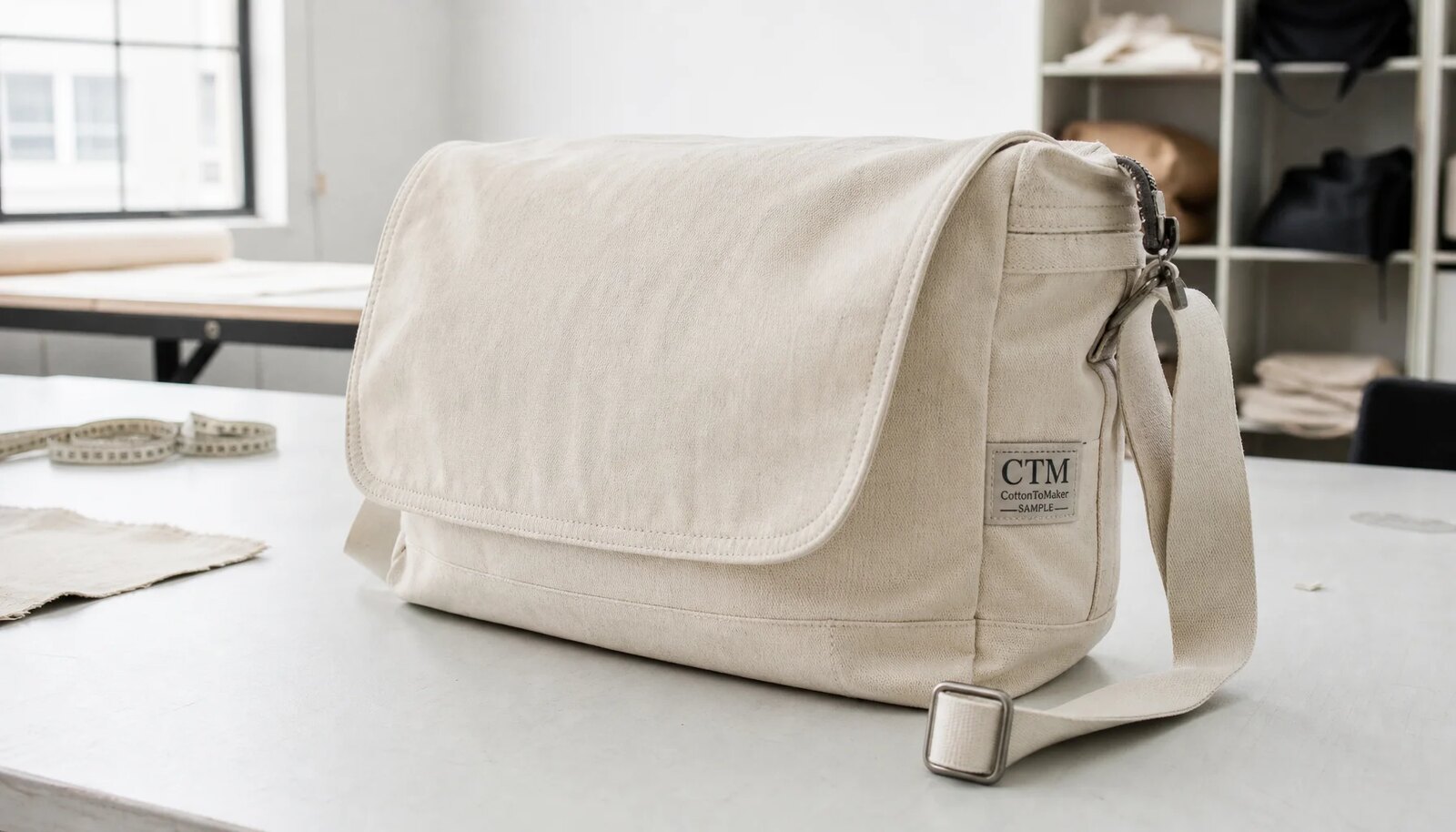
Start With the Job the Bag Has To Do
Canvas messenger bags for farmers market vendors are not fashion carryalls. They are working bags for people who move fast, handle cash or cards, keep pens and receipts within reach, and may also carry small tools, order slips, gloves, a compact device, or a bottle. The buyer is not sourcing a lifestyle accessory. The buyer is sourcing a utility item that will be opened, dropped, slung over a shoulder, and loaded again all day.
That use case changes the procurement logic. A simple canvas tote can tolerate a vague brief and still function. A messenger bag cannot. Once you add a flap, a zipper, a front pocket, a strap mount, or internal organization, the product becomes a cut-and-sew program with real setup cost and real quality risk. If the request goes out as "make it sturdy" or "add a few pockets," every factory will fill in the blanks differently and the quotes will not be comparable.
The cleanest starting point is a controlled base model. One body size. One closure type. One strap spec. One hardware package. One logo location. That sounds restrictive, but it is what gives procurement leverage. After the first production run is stable, the supplier can vary artwork, trim color, or carton marking without having to recalculate the whole manufacturing path. That is how you protect both MOQ and reorder continuity.
For B2B buyers, the goal is not to specify the most features. It is to specify the fewest features that still solve the vendor's daily workflow. Anything beyond that should be justified with a cost or usability reason, not because the drawing has room for it.
- Treat the bag as an operational tool, not a promo item.
- Start with one base model so quotes stay comparable.
- Add features only when they solve a documented use case or a retail requirement.
Lock the Base Spec Before You Ask for Pricing
The spec drives the price more than the logo does. For these canvas messenger bags, the first material decision is canvas weight. A 12 oz canvas, roughly 407 GSM, is a practical starting point for light-to-medium daily carry. A 14 oz canvas, roughly 475 GSM, is the safer commercial choice when the bag needs a firmer hand, better abrasion resistance, or a shape that does not collapse when empty. A 16 oz canvas can be appropriate for heavier loads or a more structured look, but it increases sewing effort and freight weight, so the value needs to be clear.
Then define the body construction in measurable terms. Decide whether the main compartment is open, flap-closed, or zippered. Specify whether the front pocket is decorative or functional. A functional pocket needs enough opening width, seam allowance, and depth to actually hold the intended item. Do not leave the supplier to infer that from a sketch. The same applies to the strap. Buyers should define strap width, webbing type, buckle style, attachment method, and reinforcements at the anchor points. If the strap spec is vague, the sample may look fine but fail in daily use.
Branding should be as simple as the program allows on the first order. One-color screen print is usually the easiest route because it is straightforward to quote, repeat, and inspect. Woven labels, embroidered patches, stitched patches, and debossed details can improve perceived value, but each option adds setup, alignment, and approval steps. For a first bulk order, simplicity usually improves MOQ leverage and reduces dispute risk during inspection.
If the bag must be branded for multiple farmers market vendors, use the same body and vary only the artwork or label. That keeps the construction stable while still allowing a vendor-specific SKU strategy.
- Use 12 oz as a practical floor for lighter utility use.
- Move to 14 oz when structure, durability, or bag shape matters.
- Freeze closure, strap, pocket layout, and branding method before quoting.
Know What Actually Drives MOQ
Factories do not choose MOQ at random. Minimums are usually driven by fabric purchasing, cutting efficiency, trim sourcing, setup waste, and the labor required to change over a line. If the factory already has the canvas weight in stock, uses standard webbing, and can run a familiar print method, the MOQ can stay relatively low. If the order needs fresh fabric booking, custom dyeing, uncommon hardware, or special labeling, the minimum rises because the supplier has to protect margin on a smaller run.
The most common MOQ drivers are color count, artwork complexity, and trim variation. One shell color with one print location is much easier to produce than a custom-dyed body with contrast binding, a specialty zipper pull, and multiple label placements. Each extra element can create another purchase action, another inspection step, or another delay if one component misses the schedule. A quote that looks friendly at first can become expensive once the buyer adds "just one more" change.
The right negotiation question is not "Can you lower MOQ?" It is "Which three parts of this spec are pushing MOQ up the most?" In practice, the answer is usually stock fabric availability, print setup, and trim standardization. Once procurement knows that, the team can negotiate where the friction actually is rather than arguing over a number in the abstract.
That is also why a low MOQ quote is not automatically the best quote. If the supplier gets there by swapping to a thinner canvas, simplifying the reinforcement, or changing the trim package without saying so, the buyer is not comparing like for like.
- Ask whether the canvas is stock-supported or sourced specifically for your order.
- Ask how many print screens, embroidery steps, or setup passes the artwork requires.
- Ask which trims are standard catalog items and which trigger a supplier minimum.
Match the Sourcing Route to the Order Size
Different sourcing routes solve different problems. A direct cut-and-sew factory is usually the strongest option when the specification is stable and the buyer expects reorders. The factory can own fabric, sewing, packing, and corrective action instead of passing the responsibility around. A trading company or sourcing office can be useful when the program includes multiple materials, multiple SKUs, or the buyer needs one commercial contact across several factories. A domestic decorator on imported blanks can work when the launch is small, urgent, and the buyer can accept less construction control.
The tradeoff is control versus convenience. A lower MOQ from a middle layer is only useful if the buyer can still identify who owns cutting, print, sewing, and packing. If nobody can explain process ownership clearly, the low minimum may simply be a sign that the program is being handled loosely. That is a hidden risk, not a sourcing benefit.
For canvas messenger bags for farmers market vendors, the practical route depends on the program stage. A stock-blank plus local branding route is often enough for a pilot. A direct factory is better once the buyer has a stable spec and wants a repeatable reorder path. A small workshop may be fine for samples or niche retail, but it is usually not the right base for a scalable procurement program unless the volume will stay low.
The supplier type should match the buyer's objective. If the objective is speed, use the route that already has inventory or a close-to-stock body. If the objective is repeatability, use the route that can control the full build. If the objective is market testing, do not over-engineer the first run.
- Use direct factory sourcing when reorders and spec repeatability matter most.
- Use a sourcing office only if they can explain process ownership and quality control clearly.
- Use blanks or domestic decoration when speed matters more than custom construction.
Negotiate MOQ by Removing Setup Friction
The strongest MOQ negotiation usually comes from reducing complexity, not arguing over the number itself. If you want a lower minimum, start by removing the steps that make the order expensive to start. Standard canvas color, standard webbing, one print position, one label location, and standard carton packing all help. A buyer who keeps the product simple has more leverage than a buyer who asks for a custom body, a custom lining, and a custom closure and then asks why the minimum moved up.
One effective tactic is to ask the supplier to quote the same design at 300, 500, and 1,000 pieces. That exposes the price curve. If the unit price drops sharply at 500 or 1,000, procurement can decide whether the extra inventory risk is worth the savings. If the price barely moves, the program may already be near the supplier's efficient minimum and the conversation should shift to lead time, deposit, or packing terms rather than quantity.
Another practical lever is to trade commercial terms instead of product quality. A higher deposit, a slightly longer lead time, or acceptance of standard labels can sometimes reduce MOQ without changing the bag itself. What should not be accepted is a lower minimum achieved by quietly downgrading the canvas weight, reducing reinforcement, or swapping hardware. That is not a valid concession because it creates a different product under the same name.
If the buyer needs multiple vendor designs, the best structure is often one body with different artwork or label versions. That keeps the manufacturing path stable while giving the commercial team multiple SKUs to offer to individual vendors or programs.
- Ask for tiered pricing at 300, 500, and 1,000 pcs on the same spec.
- Trade deposit, lead time, or label standardization before accepting a weaker material spec.
- Keep one body and vary artwork or label instead of changing construction.
Write an RFQ the Factory Can Price Consistently
A strong RFQ removes ambiguity. Include finished dimensions, canvas weight, closure type, strap width, logo file, logo placement measurements, label type, packing method, carton marks, target quantity, destination, and whether the order is for sellable retail stock or for vendor use. If any of those items are missing, each supplier will fill the gaps differently and the price comparison will not be reliable.
It helps to include two versions of the spec in the same RFQ. The base version should be the simplest version that still satisfies the use case. The alternate version can add a lining, heavier canvas, upgraded branding, or a different closure. That gives procurement a direct read on which features drive cost and MOQ. It also protects the buying team from over-specifying the first run before demand is proven.
If you are comparing suppliers across regions, make the assumptions identical. Do not compare one quote built on a 12 oz stock canvas with another quote built on a 14 oz dyed-to-order fabric and call the lower quote the better value. The specs are not equal, so the quotes are not equal. The RFQ should force alignment before price discussion starts.
A good RFQ also tells the supplier what will happen next. State whether the order needs a sample sequence, a production-ready file review, or a final carton approval. Suppliers price more accurately when they know the approval path up front.
- Attach vector artwork and exact logo placement dimensions.
- Request separate line items for sample fee, print setup, and packaging.
- Ask for all quantities quoted on the same spec so the MOQ curve is clear.
- State whether the order is for retail shelf use, vendor carry, or internal distribution.
Use Samples to Prove the Quote Is Real
A sample is not a courtesy item. It is a proof of manufacturability. For a canvas messenger bag, the buyer should inspect the bag empty and loaded. Check how it sits on the shoulder, whether the flap closes cleanly, whether the pocket opening is usable, whether the seam structure stays flat, and whether the bag twists or sags when weight is added. A sample that looks acceptable on a table but fails when loaded is not ready for bulk approval.
The sample process should be staged. Start with a blank fabric or construction sample if the canvas weight is new to the program. Then review a print strike-off or decoration sample so artwork quality and placement can be judged separately. After that, approve a sewn pre-production sample that includes the final strap length, label position, closure, and packing method. Skipping directly to bulk from a rendering is a common source of disputes later.
Ask whether the sample fee, strike-off fee, and pre-production sample fee are deductible from bulk. Also confirm that the approved sample becomes the production standard. That matters if there is later disagreement about print alignment, seam placement, or hardware position. The approved sample should be the reference point for inspection, not a casual approval email.
If the supplier will not send photos of the actual sample in hand, or only sends polished product shots, that is a warning sign. Procurement should ask for unedited photos on a flat surface and close-up shots of the stitching, strap anchor, print, and inside finish before moving forward.
- Measure the sample, do not judge only from the drawing.
- Load-test the bag with a realistic working weight.
- Approve material, print, and sewing as separate checkpoints if the program has any complexity.
- Make the approved sample the reference standard for bulk inspection.
Set QC Limits Buyers Can Enforce
Quality control for canvas messenger bags should focus on defects that matter in use or will be visible to the customer. The recurring issues are fabric weight drift, crooked print placement, weak bar tacks, loose thread tails, uneven stitch length, and hardware that pulls away from the seam. If the bag is sold as branded retail, small cosmetic problems matter more. If it is a field-use or utility bag, structural reliability matters more.
The buyer should set acceptance criteria before production starts. Define tolerance bands on body width, body height, gusset depth, and strap length. A practical tolerance on sewn canvas products is often plus or minus 0.25 in to 0.5 in on critical dimensions, but the exact range should be tied to the function and appearance of the bag. For print, define acceptable shift in millimeters or as a percentage of the logo area. For hardware, define a simple pass-fail standard such as no visible seam failure or attachment failure after repeated opening, closing, and carrying.
Keep the QC language concrete. Do not say only that the strap should be strong. Say what the strap width is, how it is attached, and which points must be bar-tacked. Do not say only that the print must be centered. Say the placement tolerance and the approved viewing standard. The more measurable the spec, the less room there is for post-production argument.
For a first order, buyers should also decide what defects are critical, major, and minor. That lets the factory know where the line is before the lot ships. Without that split, every inspection conversation turns into a negotiation after the fact.
- Set tolerances for body width, height, gusset depth, and strap length.
- Define acceptable print shift and reject obvious registration defects.
- Require reinforced stress points and secure hardware attachment on every lot.
- Classify defects as critical, major, or minor before production starts.
Plan Packing and Cartons Before You Compare Prices
Packing affects both unit cost and transit risk. A canvas messenger bag can be shipped flat or partially formed. Flat packing usually improves carton density and lowers freight cost. Partial forming can improve presentation and reduce wrinkling, but it uses more carton volume and may increase handling cost at receipt. The right choice depends on whether the bag has a rigid insert, a structured base, metal hardware, or a shaped flap.
The packing spec should be part of the quote. Ask how many units fit per master carton, what the gross weight is, whether the factory includes carton marks, and whether they will add a polybag, insert card, silica packet, or protective sheet. Without carton dimensions and gross weight, landed cost comparison is incomplete. Two quotes with the same ex-factory unit price can produce very different freight outcomes if one supplier packs more efficiently than the other.
If the bags are going into a warehouse or fulfillment center, ask for receiving-friendly carton marks and SKU separation. For small MOQ orders, packing mistakes often cost more per unit than sewing defects because the team spends time relabeling and sorting. A good packing spec removes that hidden labor from the buyer's side.
If the bag is going straight to multiple vendors, use carton labels that separate by SKU, color, and artwork version. That reduces receiving errors and helps the buyer prove what was shipped if there is a later shortage claim.
- Specify polybag thickness if the bag needs individual protection.
- Request carton size, gross weight, and units per carton in the quote.
- Use flat packing unless product shape or presentation requires partial forming.
- Separate SKUs clearly on carton marks and outer labels.
Judge the Order on Landed Cost and Reorder Value
A low ex-factory price is not automatically the best deal. The order should be judged on landed cost: unit price, sample fees, print setup, packing, internal freight, export cartons, duty, brokerage, and delivery to the destination warehouse. If the quote omits one-time charges or uses loose packing assumptions, it can look cheaper on paper while costing more in practice.
Lead time matters for the same reason. A faster quote is not better if it exists only because the supplier simplified the product or assumed stock material that is not actually available. Ask for lead time from sample approval, not from first contact. Then ask what events would extend the schedule: fabric sourcing, strike-off approval, trim procurement, sewing congestion, or carton reprint. That makes schedule risk visible before the order is placed.
For repeat programs, the real value is not just the first shipment. It is the reorder path. If the approved spec can be run again without remaking the whole setup, procurement gets consistency and lower future friction. That is often worth more than a small first-order discount. A stable reorder path also makes it easier to compare future suppliers, because the benchmark remains the same.
This is where procurement should think beyond the quote and look at the operating cost of the relationship. A supplier that documents the spec, keeps the sample, and can repeat the approved build accurately may be more valuable than a cheaper one-time source that forces the buyer to revalidate every order.
- Compare total landed cost, not just factory price.
- Ask for lead time from sample approval and list the schedule risks explicitly.
- Protect reorder continuity by keeping the approved spec stable.
- Value repeatability as part of procurement cost, not just the first invoice.
Specification comparison for buyers
| Spec decision | Recommended option | When it fits | Buyer risk to check |
|---|---|---|---|
| Direct cut-and-sew factory | Best when the same factory controls cutting, sewing, labeling, packing, and final carton build | Repeat programs, stable artwork, and target MOQs around 500 to 1,000 pcs | MOQ can still rise if canvas, lining, hardware, or print setup must be sourced specially |
| Trading company or sourcing office | Useful when you need one commercial contact across multiple factories or mixed materials | Programs with multiple SKUs, bundled buys, or teams that need sourcing support | Markup opacity, weaker process control, and unclear responsibility for defects or delays |
| Domestic decorator on imported blanks | Best for small runs with a short launch window | Sub-300 pc tests, pop-up programs, or seasonal pilots | Limited size control, fewer trim options, and less leverage on long-term pricing |
| Stock blank plus local branding | Lowest setup burden for a first market test | Pilot orders, quick-turn promotions, and buyers validating sell-through | You may inherit off-color stock, weak canvas weight, or a body shape that does not fit the brand |
| Small workshop or artisan maker | Good for premium prototypes and very low volume | Sample development, display pieces, or niche retail with low repeat demand | Uneven stitch consistency, slower output, and limited scale for reorders |
| Factory with in-house print | Strong when one body style repeats with multiple artwork versions | Single-body programs where print placement and repeatability matter | Artwork changes can trigger screens, strike-offs, or setup cost that pushes MOQ upward |
| Multi-SKU order on one base bag | Use one body, one strap, and one hardware set, then vary only artwork or label | Three or more vendor-specific designs that share one construction spec | Inventory mix-ups if labels, carton marks, or print versions are not separated clearly |
| Tiered MOQ quote | Ask for 300 / 500 / 1,000 pcs pricing on the same spec | When you want a realistic negotiation instead of a one-number quote | A lower MOQ may hide fabric substitution, weaker trim, or longer lead time |
Buyer checklist before sampling
- Lock one body size, one canvas weight, one strap spec, and one closure type before asking for quotes.
- Decide whether the first order needs one print color, multiple print colors, or a woven or embroidered brand mark.
- Ask suppliers to quote 300, 500, and 1,000 pcs on the same spec so the MOQ curve is visible.
- Request a blank fabric sample, a print strike-off, and a sewn pre-production sample before bulk approval.
- Confirm packing details up front: polybag type, carton count, carton size, gross weight, and carton marks.
- Compare FOB, DDP, and warehouse-delivered cost, not just the ex-factory unit price.
- Set acceptance limits for dimensions, print alignment, stitch quality, and hardware attachment before production starts.
- Ask who owns fabric booking, print setup, sewing, packing, and corrective action if a defect appears.
Factory quote questions to send
- What is your MOQ by color, by artwork version, and by canvas weight for this messenger bag?
- Can you quote the same design at 300, 500, and 1,000 pcs and show exactly what changes at each tier?
- Is the canvas stock-supported or dyed to order, and what GSM tolerance do you hold on incoming fabric?
- What is included in the unit price: print setup, lining, strap, labels, inner bag, and export carton?
- What are the sample fee, strike-off fee, and pre-production sample fee, and are any deductible from bulk?
- What is the lead time from sample approval to bulk shipment, and what events extend it?
- Can you share recent unedited photos of similar bags in production, plus the packing method and carton specification?
- How do you handle rework if the print shifts, the strap stitch fails, or the hardware is not aligned to spec?
- Which parts of the bag are standard components and which parts require special sourcing?
- What inspection standard do you use for stitching, print registration, dimensions, and carton count?
Quality-control points to confirm
- Canvas weight matches the approved spec within the factory tolerance, with no unexplained fabric substitution.
- Finished dimensions stay within the agreed tolerance on body width, height, gusset, and strap length.
- Print registration is clean, with no major ghosting, pinholes, or visible misalignment at the approved viewing distance.
- Stitching is even and secure, with reinforced bar tacks at stress points and no loose thread tails on visible seams.
- Hardware, snaps, buckles, and zipper pulls are firmly attached and function smoothly across a basic cycle test.
- Color tone is consistent across panels, labels, and trim, with no obvious shade banding between lots.
- Packing matches the approved spec for polybag, insert, carton count, carton mark, and master carton dimensions.
- Random samples from the lot show no contamination, oil marks, broken stitches, or damaged corners from packing.
- Strap attachment points show no puckering, seam pull, or uneven reinforcement.
- Approved sample and production lot match on label placement, print scale, and closure alignment.