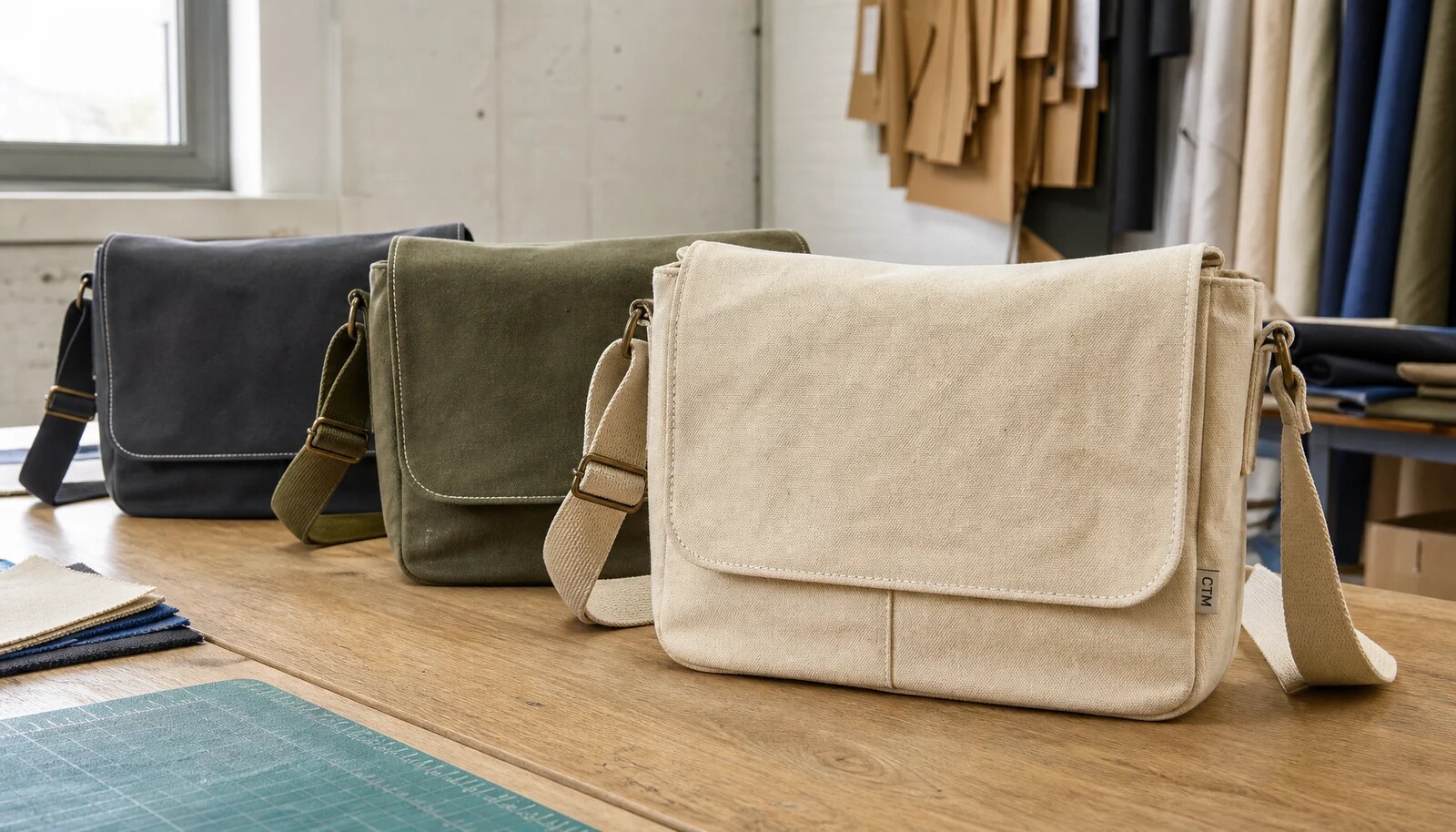
Begin With the Market-Day Job
A strong canvas messenger bags for farmers market vendors bulk pricing plan starts with the job the bag has to do. The name of the product is not enough. A farmers market vendor may be moving between a truck, stall table, cooler, cash box, product display, and customer line all morning. The bag may hold a phone, card reader, receipt book, cash pouch, pens, small labels, keys, sample jars, seed packets, folded order forms, or a compact water bottle. That is a different use pattern from a laptop messenger bag and also different from a basic promotional tote.
For procurement teams, the first useful question is commercial: who is the bag for, and how will success be measured? A staff utility bag should favor quick access, secure pockets, strap comfort, and reinforced stress points. A farm shop resale bag needs a cleaner finish because customers will touch the lining, inspect the label, and compare it with other merchandise. A CSA membership gift or event bag may need simpler construction so the unit cost stays controlled across hundreds or thousands of pieces.
This is where many bulk orders drift. Buyers start by asking for heavy canvas, metal hardware, multiple pockets, embroidery, and hangtags before the actual use case is settled. Sometimes that premium build is right. Other times it creates a slow, expensive product that does not match the selling window or retail price. The better move is to write down load weight, access needs, security expectations, useful life, and target landed cost before asking suppliers to price the bag.
- Classify the order as staff utility, retail resale, membership gift, event merchandise, or distributor bundle.
- Estimate normal carry weight; many vendor kits stay under 2 kg, but dense items such as jars, tools, or coins change the reinforcement requirement.
- Decide whether quick access or security matters more, because flap depth, zipper use, and closure hardware affect both function and sewing cost.
- Set the acceptable interior appearance level: raw seams, bound seams, or fully lined construction.
Turn the Idea Into a Priceable Spec
The phrase canvas messenger bag leaves too much room for interpretation. One supplier may quote a 10 oz unlined cotton canvas bag with a simple flap. Another may assume 12 oz washed canvas, cotton lining, a zipper pocket, and metal hardware. A third may price a stock pattern with limited strap adjustment. All three quotes might look comparable in a spreadsheet, but they are not pricing the same item.
A practical farmers market messenger often works best in a compact size rather than a full laptop format. A useful starting range is 10 to 13 inches wide, 8 to 10 inches high, and 2 to 4 inches deep. If the bag must hold a tablet, folded forms, a notebook, or small packaged samples, test those items before locking the pattern. If it mainly carries a phone, card reader, cash pouch, keys, pens, and receipts, a smaller bag can reduce fabric consumption, carton volume, and wearer fatigue.
Write dimensions as finished measurements. State whether the inspector should measure the bag empty, flat, lightly filled, or under another agreed condition. Soft canvas changes shape with handling, lining, washing, and seam thickness, so the tolerance sheet matters. For many soft canvas bags, a starting tolerance of about plus or minus 0.5 inch on main body dimensions and about plus or minus 0.25 inch on pocket or label placement is commercially realistic. Tighter tolerances may be possible, but they should be agreed before production and reflected in the inspection standard.
Pockets deserve the same discipline. A front slip pocket under the flap is economical, though it may be slower to reach during checkout. A back slip pocket can help with receipts or a phone. An internal zipper pocket protects cash or keys, but it adds zipper quality, lining alignment, and sewing checks. Pen slots are useful only when sized properly. If they are too narrow, they are ignored. If they are too wide, pens fall out when the vendor bends or reaches.
- Write dimensions as finished width x height x gusset, with measurement condition and tolerance.
- Specify flap depth, flap corner shape, closure placement, and whether the flap must cover the front pocket completely.
- Define each pocket by location, size, opening width, closure, and intended contents.
- Include strap width, webbing type, adjuster type, ring type, anchor position, and adjustable length range.
- Attach artwork placement measurements from seams or flap edges, not only a visual mockup.
Name the Canvas Clearly
Canvas weight should be stated in both ounces and GSM whenever possible. Ounce terminology can be slippery in bag sourcing because suppliers may refer to weight per square yard, finished weight after treatment, or a familiar commercial name rather than a tested value. GSM gives buyers another reference point. As a rough guide, 10 oz canvas is often near 340 GSM, 12 oz near 400 GSM, and 14 oz near 475 GSM, although actual values vary by mill, weave, and finishing.
For farmers market vendor bags, 10 oz canvas can work for price-sensitive promotional programs and lighter carry. A 12 oz canvas is often the balanced starting point for daily use because it gives better body without making folded seams too bulky. A 14 oz canvas can feel more substantial and premium, but it increases material cost, sewing effort, carton weight, and freight cost. On a small bag with layered seams, heavy canvas can also feel stiff if the pattern has tight curves or a thick flap.
Fiber content should be written plainly. Ask whether the material is 100% cotton, cotton/poly blend, recycled cotton blend, organic cotton, duck canvas, plain weave canvas, or another construction. Natural-looking canvas should not be treated as organic unless documentation supports the claim. Recycled cotton can have more variation in yarn consistency and surface character, so buyers should review swatches for slubs, tensile feel, color variation, and print appearance.
Finishing changes both appearance and performance. Washed canvas feels softer and can look more retail-ready, but shade variation and shrinkage control become important. Dyed canvas helps match brand programs, yet dye lot minimums and lab dip approval add time. Coated canvas can improve light moisture resistance compared with untreated cotton, but it may change hand feel, print behavior, and odor. Do not stop at color names such as natural, olive, or black. Ask what fabric source, finish, and shade approval process are included in the quote.
- Request oz, GSM, fiber content, weave, finish, and color source in every supplier quote.
- Ask whether fabric weight is greige, finished, washed, coated, or production-ready weight.
- Approve swatches from the intended production fabric lot or the closest available bulk source.
- For dyed canvas, approve lab dips or shade bands and define acceptable shade variation before fabric is purchased.
- For organic, recycled, or other sustainability claims, request documentation instead of relying on color or product description.
Design Around Stress Points
Messenger bags rarely fail in the middle of a flat fabric panel. They fail where load and motion concentrate: strap anchors, side seams, flap corners, pocket openings, zipper ends, closure points, and the top edge of the body. Farmers market vendors may not carry extreme weight, but they do handle the bag repeatedly while standing, bending, taking payments, restocking, and packing up. That repeated motion is why reinforcement belongs in the spec, not as a vague note.
Strap design is a good place to be precise. A 1 inch strap can be enough for a light promotional bag. For regular crossbody use, 1.25 inch or 1.5 inch cotton or poly-cotton webbing usually feels better. The webbing should be checked for rough edges, twisting, colorfastness, and slippage through the slider. Length matters too. Vendors may wear the bag over an apron, sweater, rain jacket, or coat. A strap that looks right in a product photo may feel short during a cold outdoor market.
Hardware choices affect cost, perceived value, and QC workload. Metal sliders and rings can look stronger, but they need inspection for burrs, plating defects, rust marks, and finish consistency. Plastic side-release buckles can reduce weight and suit utility programs, though buyers should confirm strength and low-temperature behavior if relevant. Magnetic snaps are convenient, but the surrounding fabric needs reinforcement so the snap does not pull through. A zipper under the flap improves security, but it adds tape alignment, puller quality, end stop, and smooth-run checks.
Ask the supplier to show the reinforcement on the sample. A line in a quote that says reinforced does not tell you whether the strap anchor uses a bartack, box-X stitch, doubled fabric, wider seam allowance, or a hidden patch. Close photos of the approved sample should become part of the production record, especially for repeat orders.
- Use bartacks or box-X stitching at strap anchors where the construction allows.
- Add reinforcement patches or doubled fabric at ring attachments and magnetic snap locations.
- Check metal hardware for burrs, plating defects, rust marks, and correct finish color.
- Confirm the strap does not twist easily through the slider and does not slip under normal load.
- Test closure alignment with the bag both empty and lightly filled.
Choose Branding That Can Be Repeated
Branding has to work on textured fabric, through production, and after repeated market-day handling. For many bulk canvas messenger bag programs, one-color screen printing is the most practical starting point. It suits farm names, farmers market logos, CSA programs, distributor marks, and simple private-label artwork. It also keeps the cost structure easier to read after the first screen setup. Bold artwork tends to perform better than fine distressed textures, thin lines, gradients, or tiny reversed text.
A print strike-off is more useful than a digital mockup. The mockup shows placement, but it cannot show ink absorption, opacity, edge sharpness, rub resistance, or how a PMS target looks on natural or dyed cotton. Print placement should be measured from seams, flap edges, pocket edges, or another fixed reference point. A practical placement tolerance on soft sewn bags may be plus or minus 0.25 to 0.5 inch, depending on the panel size and method. Agree on that before production starts.
Embroidery can be the right choice for a small premium mark, but it is not automatically better. Dense embroidery on lighter canvas can pucker the panel. Embroidery on the flap may need to happen before assembly, which affects the sewing flow. Pricing depends on stitch count, thread colors, backing, embroidery area, and speed. It is best used when the brand mark is compact and the product can support the extra cost.
Woven labels, side tabs, and sewn patches are often strong options for repeat B2B programs. They can be used across totes, aprons, pouches, and messenger bags, which helps a buyer build a consistent product family. They also avoid some large-front-panel print risks. Still, labels bring their own MOQ, setup, lead time, fold accuracy, stitch placement, and color matching requirements. Approve the label itself and its placement on the actual bag, not as a separate trim only.
- Use screen print for bold, cost-controlled logos and market program artwork.
- Use embroidery for small premium marks after checking puckering and backing removal.
- Use woven labels or side tabs for repeat product families and cross-SKU branding.
- Avoid fine distressed textures, gradients, tiny serif text, and narrow reversed type unless the supplier confirms feasibility.
- Approve strike-offs, label samples, and placement measurements before bulk production.
Build Price Tiers That Explain the Cost
A useful bulk pricing plan does more than collect one unit price. It shows how cost changes as quantity rises. For canvas messenger bags for farmers market vendors, ask suppliers to quote the same locked specification at 300, 500, 1,000, and 3,000 pieces. These tiers are large enough to reveal fabric purchasing, cutting, screen setup, sewing-line efficiency, and packing differences while still matching common seasonal B2B order sizes.
Separate one-time costs from per-unit costs. First-order costs may include pattern development, sample making, screen charges, embroidery digitizing, woven label setup, artwork separation, lab dips, print strike-offs, and sample freight. Per-unit costs include canvas, lining, webbing, hardware, thread, sewing labor, decoration, labels, hangtags, polybags, cartons, and factory margin. If everything is folded into one number, buyers can misread the reorder cost and make poor margin decisions.
MOQ is usually tied to more than sewing capacity. Fabric roll length, dye lot minimums, label MOQ, screen setup, hardware purchasing, and line scheduling all influence the lowest efficient quantity. A factory may be willing to make 300 pieces, but the 500-piece or 1,000-piece price may be much stronger because fixed work is spread across more units. At the other end, 3,000 pieces only makes sense if demand, storage, cash flow, and seasonality support the buy.
Compare landed cost, not just ex-factory price. Add inland transport, export charges if applicable, international freight, duty, customs brokerage, insurance if used, inspection cost, receiving, storage, and outbound handling. Cotton canvas bags can be bulky relative to their unit price, so folding method and carton density matter. A slightly higher unit price can still win if the supplier gives cleaner QC, better carton efficiency, clearer documentation, and fewer short or unsellable units.
- Request tiered pricing at 300, 500, 1,000, and 3,000 pieces using the same spec and Incoterm.
- Ask for one-time charges and per-unit charges in separate lines.
- Compare first-order cost and reorder cost separately.
- Use the same carton count, freight mode, and delivery term for supplier comparisons.
- Calculate landed cost per sellable unit, including expected inspection and defect allowance.
Sample Like You Mean to Inspect
Sample approval should be measured, photographed, and documented. A messenger bag can look fine in a supplier photo and still fail the buyer's use case. The strap may be too short over a jacket. The flap may pull to one side. The pocket may become hard to reach when the main compartment is filled. The print may sit too close to a seam. The pre-production sample should become the master reference for inspection, not a casual visual guide.
Start with materials. Review canvas swatches for weight, hand feel, weave, color, odor, slubs, and print behavior. For dyed canvas, approve lab dips or a defined shade band before bulk dyeing. For washed canvas, ask whether shrinkage is completed before cutting and whether final dimensions are based on the washed material. For new artwork, approve a strike-off on the same canvas or the closest production-equivalent material.
Then test the full bag with real vendor contents. Load it with a phone, card reader, receipt book, cash pouch, pens, keys, labels, sample packets, and any small tools or packaged goods expected in daily use. Wear it crossbody. Stand, bend, reach, and open the closure with one hand. Check whether the bag tips forward, whether the strap slider holds, whether the pocket sequence feels natural during checkout, and whether the closure still lines up when the bag is lightly filled.
Record every approved feature: finished dimensions, product weight, canvas type, lining, pocket sizes, strap range, hardware finish, thread color, stitch density, print position, label placement, fold method, carton pack-out, and any allowed variation. If the buyer changes strap width, hardware, canvas weight, pocket layout, or artwork after sampling, the supplier should confirm price and lead-time impact before bulk cutting begins.
- Approve fabric swatch, lab dip if needed, print strike-off, label sample, hardware sample, and full pre-production sample.
- Measure body, gusset, flap, pocket, strap, label, and print placement with agreed tolerances.
- Photograph front, back, side, bottom, inside, stress points, branding, and packed form.
- Load-test the sample with real vendor contents before approval.
- Keep a dated master sample and written approval sheet for inspection and repeat orders.
Write QC Rules Before Cartons Close
Quality control is easiest to enforce when it is written before production. Canvas messenger bags have predictable risk areas: fabric shade variation, stains, odor, crooked flaps, twisted bodies, weak strap anchors, skipped stitches, print defects, hardware scratches, zipper failures, label errors, and packing mistakes. If the purchase order only says good quality, the buyer and supplier may disagree after the cartons are finished.
Many buyers use an AQL-based inspection plan for bulk soft goods. Common references include ANSI/ASQ Z1.4 or ISO 2859-1 sampling, often with General Inspection Level II and agreed AQL values such as 0 for critical defects, 2.5 for major defects, and 4.0 for minor defects. The exact plan should be agreed with the supplier or third-party inspector. Critical defects may include unsafe sharp hardware, broken strap anchors, wrong artwork, severe mold or odor, or a materially wrong product. Major defects may include zipper failure, dimensions outside tolerance, crooked flap, visible shade mismatch, print misregistration, or missing pocket. Minor defects may include loose threads, small removable marks, or slight stitch waviness within the approved standard.
Use realistic measurement tolerances for soft cotton products. A starting point may be plus or minus 0.5 inch for main body width and height, plus or minus 0.25 inch for pocket placement, label position, and print placement, and plus or minus 1 inch for strap adjustment range. A simple, stable pattern can sometimes hold tighter limits. Washed canvas, heavy seams, and soft construction usually need more practical tolerance planning.
QC should happen in stages. Incoming fabric inspection catches weight, shade, odor, moisture, and stain issues before cutting. In-line sewing checks catch strap anchor, seam allowance, stitch tension, and pocket alignment problems before the whole lot is complete. Final inspection verifies appearance, measurements, function, branding, and packing. Packed-carton review confirms case pack, barcode labels, carton marks, gross weight, and moisture condition.
- Set critical, major, and minor defect definitions before production starts.
- Agree on AQL level, sample size method, inspection stage, and who pays for reinspection after failure.
- Use measured tolerances for size, print, label, pocket, flap, and strap range.
- Inspect stress points with practical pull checks, not visual review only.
- Check packed cartons as well as loose product samples.
Control Packing and Receiving Details
Packing is not an afterthought; it is part of the cost and the customer experience. Canvas messenger bags may be packed flat, folded, lightly stuffed, individually polybagged, grouped in inner cartons, or bulk packed into master cartons. Flat packing can improve freight efficiency, but it may leave flap creases or compressed straps. Stuffing helps the bag hold shape, but it increases carton volume. Individual polybags protect against dirt and moisture and allow barcode labels, but they add cost, labor, and packaging waste.
The right pack-out depends on where the bags go next. Warehouse receiving may require SKU labels, barcode stickers, purchase order numbers, carton marks, and consistent case packs. Retail resale may need hangtags, country-of-origin labels, suffocation warnings on polybags, and clean individual presentation. Event distribution may work better with simple bulk cartons that can be counted quickly by staff. These requirements should be part of the quote because they affect labor, materials, and carton purchasing.
Ask for carton data before awarding the order. Units per carton, carton dimensions, net weight, gross weight, and estimated carton count should be quoted at each quantity tier. Freight providers need this information to estimate chargeable weight and shipping cost. A low unit price can lose its advantage if cartons are inefficient, poorly sized, or too weak for stacking.
Moisture control deserves attention with cotton canvas. Goods should be packed dry and stored away from damp floors. Depending on route, season, and storage plan, the buyer may specify master carton liners, silica gel, or other moisture precautions. At receiving, teams should check carton condition, odor, water marks, crushed corners, count accuracy, barcode readability, and visible creasing before the shipment is accepted into inventory.
- Approve fold method and check whether the bag recovers after unpacking.
- Request carton dimensions, net weight, gross weight, case pack, and total carton count in the quote.
- Define barcode, hangtag, polybag, country-of-origin label, and carton mark requirements before production.
- Match case pack to warehouse handling, such as 20, 25, or 50 units per carton.
- Inspect arrival condition for moisture, odor, compression, labeling accuracy, and short packs.
Plan Around the Selling Season
Farmers market programs often have a narrow window. Bags needed for spring openings, CSA sign-ups, harvest weekends, or holiday local-food campaigns must arrive before the demand period, not just before a theoretical ship date. A real timeline includes RFQ clarification, swatch review, lab dips if needed, artwork preparation, strike-off approval, sample making, sample freight, revision time, deposit, material booking, cutting, printing or embroidery, sewing, finishing, QC, packing, freight, customs, receiving, and internal distribution.
First orders usually take longer than reorders because every decision is still being validated. Fabric, dimensions, branding, hardware, pocket layout, and packing all need approval. Even a responsive supplier cannot recover much time if the buyer is still revising logo size, changing the canvas color, or adding pockets after sample review. Repeat orders can move faster when the approved sample remains valid and materials are available, but buyers should still confirm fabric stock, label stock, hardware availability, and factory capacity before promising delivery.
Freight planning belongs in the bulk pricing plan. Air freight can rescue a late launch, but canvas bags are bulky enough that air cost may erase offshore savings. Ocean freight is usually more economical for larger volumes, but it requires earlier commitment. Nearshore production, domestic decoration, or stock blanks may be useful when the calendar is tight, even if the unit price is higher.
A disciplined B2B plan also sets a reorder trigger. If bags are sold or distributed weekly, review sell-through early enough to reorder before the season peaks. Keep the master sample, fabric swatch, lab dip, print strike-off, label reference, hardware reference, carton label, and final spec sheet from the first order. Those references reduce drift and make the next quote faster, cleaner, and easier to inspect.
- Work backward from the required in-hand date, not the factory ship date.
- Separate deadlines for artwork approval, material approval, pre-production sample approval, bulk production, inspection, freight, and receiving.
- Decide in advance whether schedule recovery will use air freight, split shipment, stock blanks, or nearshore replenishment.
- Set a reorder review date based on seasonal sell-through or distribution pace.
- Keep production references so repeat orders match the approved bulk run.
Specification comparison for buyers
| Sourcing or spec decision | B2B recommendation | Best-fit order profile | Risk to verify before PO |
|---|---|---|---|
| Direct OEM canvas bag factory | Use when the buyer has a locked tech pack, repeatable artwork, and enough quantity for efficient cutting, printing, and sewing | 500 to 3,000+ units, one to three colorways, planned replenishment, private-label program | Confirm fabric source, sample-to-bulk matching, in-line QC ownership, and whether final inspection is internal or third party |
| Trading company with factory network | Use when coordination across fabric, trim, labeling, printing, export documentation, and mixed production steps matters more than direct factory contact | Mixed bag programs, multi-SKU seasonal buys, buyers without a local sourcing office | Ask which factory is sewing the bags, which steps are outsourced, and who pays for rework if inspection fails |
| Stock blank plus local decoration | Use for pilot demand tests, urgent market events, or low-MOQ resale trials where speed beats full customization | 50 to 300 units, fast launch, limited customization, simple logo placement | Blank canvas weight, pocket layout, strap length, and color may not match the final custom product |
| Nearshore or domestic maker | Use when delivery timing, communication speed, and smaller replenishment runs are more important than the lowest ex-factory price | Seasonal reorders, late calendar recovery, premium small batches | Unit cost may be higher and available canvas weights, dye lots, and hardware choices may be narrower |
| Unlined 10 oz canvas shell | Lowest-complexity build for light promotional use, simple event merchandise, or low retail price targets | Giveaways, event kits, light carry under about 2 kg, cost-controlled market promotions | Raw seam appearance, lower body structure, seam fray control, and interior abrasion must be checked |
| Lined 12 oz canvas shell | Balanced construction for staff utility and resale because it gives better body without making sewing overly heavy | Vendor staff bags, farm shop resale, CSA membership merchandise, weekly market carry | More sewing operations mean more inspection points: lining caught in seams, pocket alignment, and zipper function |
| 14 oz structured canvas build | Use for premium feel or firmer shape when the retail price and freight budget can support the heavier construction | Higher retail price, heavier daily carry, longer expected service life | Bulkier seams may require stronger needles, higher sewing time, larger cartons, and higher freight weight |
| One-color screen print | Best first-choice branding method for bold logos and cost-controlled runs on a flat flap or front panel | 500+ units, simple farmers market or farm brand logo, distributor program, CSA campaign | Check PMS tolerance, ink cure, rub resistance, print placement tolerance, and artwork line weight |
| Woven label or side tab | Strong repeat-program option when the same brand mark is used across multiple canvas products | Private label, distributor programs, tote/apron/bag family branding | Label MOQ, label lead time, stitch placement, fold accuracy, and color matching can affect schedule |
Buyer checklist before sampling
- Define the commercial use first: staff utility bag, farm shop resale item, CSA or market membership gift, distributor bundle, or event merchandise.
- List the real carry contents: phone, card reader, cash pouch, receipt book, pens, keys, labels, small tools, seed packets, sample jars, compact water bottle, or folded order forms.
- Set finished dimensions as width x height x gusset, and state whether measurements are taken empty, flat, lightly filled, or at inspection with a tolerance.
- Specify canvas by oz and GSM, fiber content, weave, finish, and color source: natural greige, dyed, washed, coated, organic cotton, recycled cotton blend, or conventional cotton.
- Choose construction before quoting: unlined, bound seams, cotton lining, polyester lining, internal zip pocket, slip pocket, bottom reinforcement, and stress-point bartacks.
- Lock strap details: width, webbing composition, slider material, D-ring or rectangular ring material, anchor reinforcement, and minimum-to-maximum adjustable length.
- Define closure hardware: magnetic snap, metal snap, zipper under flap, side-release buckle, hook-and-loop, or no closure, including finish color and corrosion expectations.
- Limit the first production run to one primary branding method unless the margin supports added complexity such as print plus woven label plus hangtag.
- Request bulk pricing at 300, 500, 1,000, and 3,000 pieces with one-time charges separated from per-unit charges, including screens, digitizing, labels, samples, and carton labeling.
- Ask the supplier to quote using the same Incoterm, pack count, carton assumptions, and artwork placement so pricing can be compared fairly.
Factory quote questions to send
- What exact canvas weight is quoted in oz and GSM, and is that weight measured before washing, coating, dyeing, or other finishing?
- What is the fabric composition and weave: 100% cotton canvas, cotton/poly blend, recycled cotton blend, duck canvas, plain weave canvas, or another construction?
- Is the quoted fabric from existing stock, fresh bulk purchase, or custom dyeing, and what fabric MOQ or dye lot minimum applies?
- What finished dimensions, gusset depth, flap depth, pocket layout, lining, seam finish, closure type, and strap length range are included in this price?
- What measurement tolerances do you recommend for body dimensions, gusset, flap placement, print position, and strap length on bulk inspection?
- Can you quote the same confirmed spec at 300, 500, 1,000, and 3,000 pieces, and show which costs change at each tier?
- Which costs are one-time charges and which are per-unit charges: sample fee, pattern fee, screen charge, embroidery digitizing, woven label setup, hangtag, barcode, polybag, and export carton?
- What reinforcement is included at strap anchors, flap corners, side seams, pocket openings, zipper ends, and closure points, and will these use bartacks or box-X stitching?
- What branding limitations apply to our artwork: minimum line weight, smallest readable text, maximum print area, PMS tolerance, ink type, curing method, and rub-test expectation?
- If embroidery is quoted, what stitch count, backing, thread count, embroidery area, and puckering control are included?
Quality-control points to confirm
- Check incoming fabric weight by agreed method, including oz/GSM, weave, fiber composition claim, width, shade lot, hand feel, odor, stains, slubs, and moisture condition before cutting.
- Confirm shrinkage or dimensional stability if washed canvas, dyed canvas, or coated canvas is used, especially when tight finished tolerances are required.
- Measure finished width, height, gusset, flap depth, strap width, strap adjustment range, pocket opening, pocket depth, label position, and print position against the approved tolerance sheet.
- Inspect cutting accuracy so front and back panels align, flap edges sit square, side seams do not twist, and the bag hangs straight when lightly loaded.
- Check stitch density, seam allowance, backstitching, thread tension, skipped stitches, loose threads, needle holes, seam puckering, and color matching of thread.
- Verify reinforcement at strap anchors, D-rings, sliders, closure points, pocket openings, and flap corners, using the approved stitch type such as bartack or box-X.
- Perform practical load and pull checks on strap anchors, rings, sliders, snaps, zippers, and magnetic closures using the agreed test load and dwell time.
- Review print quality for registration, opacity, cure, cracking after flexing, rub resistance, edge sharpness, placement, color consistency, and contamination.
- Review embroidery for puckering, thread breaks, loose tails, backing removal, skipped areas, alignment, and stitch density if embroidery is used.
- Inspect woven labels and patches for correct artwork, color, orientation, fold, stitch security, placement tolerance, and whether label edges scratch or curl.