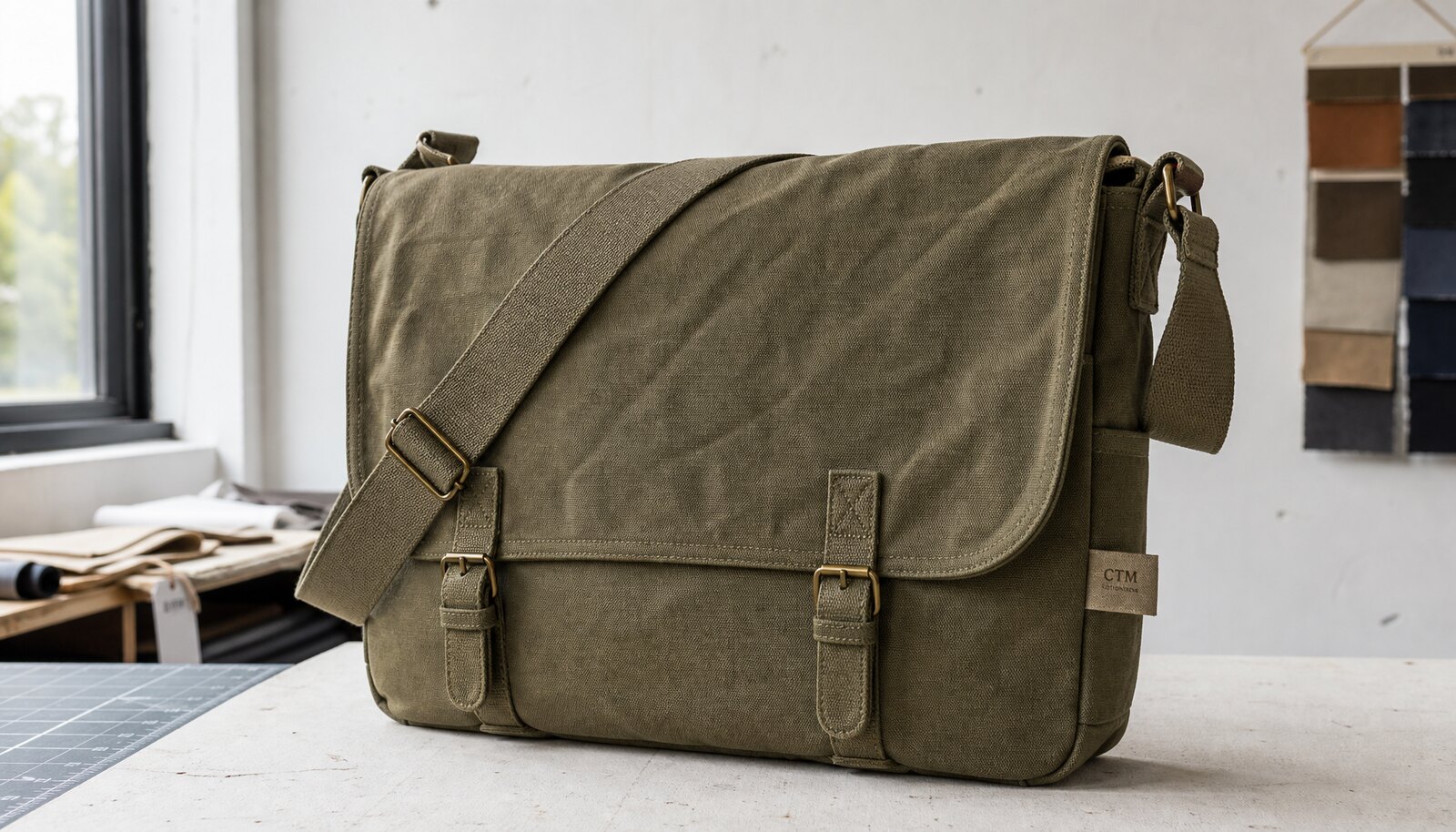
Why event buyers need a different messenger bag spec
Canvas messenger bags for events are not the same as a commuter bag bought off the shelf. Event buyers usually need a bag that is easy to pack, easy to brand, and strong enough to survive a full day of handling by staff, visitors, or retail customers. The bag may carry brochures, notebooks, a sample product, a bottle, or a tablet, but it usually does not need the pocket complexity, padded laptop build, or premium hardware of a fashion messenger bag. If you start with the wrong use case, you overbuild the bag and lose margin, or you underbuild it and create complaints at the event.
The right brief starts with the event journey. Will the bag be handed out empty at registration, pre-packed into a sponsor kit, or sold as a merch item? Does the buyer care more about a large logo area, a neat retail look, or the ability to pack flat in a carton? Those answers determine the real spec. For event programs, the smartest bag is often the simplest one that holds its shape, takes print cleanly, and keeps labor and freight under control.
- Use case first: handout, sponsor kit, or retail-style event merch.
- Load expectation first: brochures only, mixed event materials, or light device carry.
- Brand requirement first: large logo area, premium handfeel, or low-cost volume packaging.
Fabric weight and structure decide most of the cost
Canvas weight is the first decision that shapes both look and unit price. For a standard event messenger bag, 10 to 12 oz canvas is usually the workable middle ground. It gives enough body for a flap bag, prints well, and does not create a heavy carton or a steep freight bill. If the bag only needs to carry printed collateral, 8 to 10 oz may be acceptable, but the handfeel gets softer and the bag can look too casual unless it is cut with a good gusset and reinforced seams. For a more premium event or a retail program, 14 to 16 oz gives stronger structure and a better shelf impression, but it adds cost in fabric, sewing time, and carton weight.
Structure matters as much as the fabric number. A bag can be made from a good canvas and still feel cheap if the flap collapses, the sides twist, or the strap pull point is weak. Lining, interfacing, and reinforcement change that outcome. A simple unlined body is fine for a low-cost handout bag. If the buyer wants a cleaner inside finish, better shape retention, or less show-through after printing, a light lining or selective interfacing on the flap and front panel is worth the extra cost. Ask the factory to quote the same style both unlined and lined so the comparison is real, not theoretical.
- 8 to 10 oz: lowest-cost event handout bag, softer body, less structure.
- 10 to 12 oz: standard choice for most conference and sponsor programs.
- 14 to 16 oz: premium feel, stronger shape, higher freight and sewing cost.
- Reinforce strap anchors and the bottom seam even on light bags.
Branding methods should match the event timeline
Decoration is where many canvas messenger bag quotes drift apart. Screen print is usually the best option when the artwork is simple, the logo uses one to three solid colors, and the buyer wants a clear price break at volume. It is repeatable, fast, and easy to compare across suppliers. The catch is that canvas texture can affect ink coverage, so you need to review the strike-off on the same fabric weight that will be used in bulk. If the logo has thin lines, gradients, or small text, screen print may still work, but it must be tested at actual size, not reduced on a sales sheet.
Embroidery, woven patches, and sewn labels are useful when the event bag needs a more premium finish or when the logo should survive abrasion better than a printed mark. Embroidery adds texture but can distort a light canvas panel if the stitch density is too high. A woven label on the flap or side seam is often a safer way to add brand presence without affecting the print area. For many event orders, the cleanest approach is one main print on the flap or body plus a small woven side label. That gives the buyer strong branding, lower risk, and a quote that is easier to control.
- Use screen print for simple logos and clearer unit-price control.
- Use embroidery or woven labels for premium event programs or abrasion-prone use.
- Approve decoration on bulk-intended fabric, not only on a smooth sample stock.
- Avoid placing the key logo across seams, folds, snaps, or strap anchor points.
Supplier route and MOQ logic should be chosen together
The supplier route changes everything. A direct cut-and-sew bag factory is usually the best fit when you need a custom messenger shape, a specific canvas weight, and the print applied in the same production flow. That route gives the cleanest control over dimensions, reinforcement, and packing, and it removes one handoff. A trading company can be useful when the order combines multiple promotional items or when the buyer values a single export contact more than factory-level detail. A local decorator plus overseas blank importer can work for very small runs, but the coordination burden rises quickly and the finished bag often looks less consistent from batch to batch.
MOQ is not only a number; it is a build strategy. The more variables you add, the faster the minimum order climbs. One body color, one print position, one strap construction, and one carton format keep the order accessible. A second fabric color, a padded strap, an inner pocket, or a special buckle usually pushes the factory into a higher fabric cut plan or a separate component order. When buyers want a lower MOQ, the best leverage is to keep the core bag simple and move brand differentiation into print, label, or packaging rather than into custom structural parts.
- Direct factory is best for custom body shape, build control, and cleaner quote ownership.
- Trading company is best when the buyer wants one contact for multiple SKUs.
- Local decoration plus imported blanks only makes sense when speed beats unit cost.
- Keep the first order to one body color, one strap style, and one print position if MOQ matters.
Read the quote as a build sheet, not as a single price
A useful quote for canvas messenger bags should read like a build sheet. It should tell you the finished size, fabric weight, lining or no lining, print method, color count, strap type, hardware, packing method, and the incoterm being used. If those items are missing, the quote is not comparable and the buyer is likely to get a price surprise later. The first thing to compare is scope, not unit price. A lower quote may simply exclude lining, extra reinforcement, sample approval, or carton labeling that another factory already included.
For planning, it helps to think in quote bands rather than exact promises. As an example, a simple unlined 10 to 12 oz messenger bag with one-color screen print and bulk packing can sit in a much lower cost band than a lined 14 to 16 oz bag with a padded strap and a zipper pocket. A modest order can also move sharply with quantity: a factory may spread setup cost over 500 pieces very differently than over 5,000 pieces. Ask for a price ladder at two or three quantities so you can see whether the factory is really offering scale or just quoting a single convenient number.
- Treat the quote like a specification document.
- Compare the same build across suppliers before comparing price.
- Request example pricing at 500, 1,000, and 5,000 pieces.
- Separate sample fee, tooling, packaging, and freight assumptions in the quote.
Sample approval should be based on bulk-intended materials
A sales sample is useful for shape and branding discussion, but it is not enough for approval. The correct approval step is a pre-production sample made from the actual bulk fabric, print method, and hardware. That sample should reflect the real seam build, the real strap, and the real packing method. If the factory sends a sample that is cleaner, heavier, or more carefully finished than the planned bulk run, the buyer is approving a product that cannot be repeated economically. That is a common reason event buyers receive a first shipment that looks different from the sample they signed off.
The sample review should be practical and fast. Measure the body, check the strap drop, inspect print density, and open and close the flap repeatedly. Put something of the intended weight inside the bag and see how the seams pull, how the flap sits, and whether the bag still hangs flat. If the bag is for a conference kit, load it with brochure-sized material. If it is for a premium event, test the feel with a notebook or tablet-sized dummy. The sample should be signed off only when it reflects the actual user load, not just when it looks good on a tabletop.
- Approve a pre-production sample, not only a sales sample.
- Measure finished size and strap drop on the same sample you inspect visually.
- Load the bag with the intended contents before accepting the build.
- Keep annotated photos of the approved sample for production reference.
Packing choices affect freight, damage, and receiving time
Packing is often treated as an afterthought, but it changes both landed cost and receiving speed. Event bags are frequently bulk packed to keep price low and carton volume under control. That works well when the bag is a giveaway, a conference insert, or a sponsor kit component. If the buyer needs retail presentation, each bag may need an individual polybag, a barcode sticker, a hangtag, or a belly band. Those small choices add labor and material cost, but they also reduce handling damage and make store receipt easier. The right answer depends on whether the bag is being opened once at an event or sold through a retail channel.
Ask the factory to define the fold method and carton count. A messenger bag that is folded the wrong way can crease the print, distort the flap, or create a distorted carton stack that ships poorly. Carton marking should match the purchase order, and the master carton count should be easy to verify at receiving. For sea freight, a simple moisture barrier or clean inner polybag can be worthwhile if the route is long or the destination is humid. The goal is not fancy packaging; it is to preserve the product condition at the lowest total cost.
- Bulk pack is usually best for event handouts and sponsor kits.
- Individual polybagging makes sense when the bag is retail-facing or resale-ready.
- Agree on fold direction so the print and flap shape are not damaged in transit.
- Make carton count, outer marks, and pack method part of the PO.
QC thresholds should focus on the points buyers actually see
The most expensive QC mistake is to inspect the wrong things. For canvas messenger bags for events, the buyer sees size, print quality, seam finish, strap feel, and carton count. That means the inspection plan should focus on those items first. Dimension tolerance needs to be realistic but controlled, especially on bag width, gusset depth, and strap length. Print placement should be measured from the same seam reference every time. If the logo sits too high, too low, or too close to the edge, the bag looks off even when the material itself is fine.
The factory should also define major and minor defects before production starts. Broken stitches at strap anchors, serious print smearing, missing hardware, or wrong color are major defects. Small thread ends, slight fold marks, or very minor shade variation may be minor if they stay within the agreed limit. This is where AQL terms help, but only if the buyer also defines the visible issues that matter for the event. A low-cost giveaway bag and a premium retail messenger should not use the same tolerance mindset. The inspection standard must match the commercial use of the bag.
- Set visible tolerances for print placement, size, and strap length.
- Separate major defects from minor finish issues before mass production starts.
- Check strap anchors, flap alignment, and carton count on every lot.
- Use the approved sample as the visual reference for acceptable shade and print density.
Lead time and landed cost need one shared plan
Lead time for canvas messenger bags is usually a chain of smaller steps: fabric sourcing, cutting, printing, sewing, finishing, packing, and booking freight. For a simple order using standard canvas and one-color print, a factory may quote a production window that looks short on paper. The real schedule is only safe if the buyer has already approved the sample and the artwork files are final. If the order needs custom-dyed fabric, multiple print colors, or a special strap component, the timeline should stretch accordingly. Buyers often lose time not in sewing, but in waiting for artwork approval or a late decision on packaging.
Landed cost is where sourcing discipline pays off. A lower ex-works unit price can disappear once freight, duties, inland delivery, and receiving labor are added. That is why the cheapest quote is not always the lowest-cost option for an event program. A factory that can combine cutting, printing, sewing, and packing with fewer handoffs may price slightly higher but still produce a better total landed cost because the shipment is cleaner and less delayed. The best buyer decision is usually the one that balances unit price, schedule reliability, and the cost of a failed event date.
- Plan production only after artwork and sample approval are stable.
- Build buffer time for fabric delays, print rework, and shipment booking.
- Compare ex-works, FOB, and CIF quotes on the same basis.
- Include freight, duty, local delivery, and receiving labor in landed cost.
Specification comparison for buyers
| Spec decision | Recommended option | When it fits | Buyer risk to check |
|---|---|---|---|
| Sourcing route | Direct cut-and-sew bag factory | You need custom dimensions, flap shape, strap build, and print managed in one place | Verify the factory actually cuts and sews the bag body instead of outsourcing the core work |
| Sourcing route | Trading company with bag factory network | You are buying several SKUs, need one export contact, or want a faster quote cycle | Confirm who owns the pattern, who approves samples, and where QC happens before shipment |
| Decoration route | Bag factory screen print | The logo is simple, the color count is low, and you want fewer handoffs | Check print registration, ink opacity on canvas, and whether the factory has its own print line |
| Decoration route | Separate print vendor plus bag factory | You need specialty decoration, oversized artwork, or mixed materials that a bag line cannot handle well | Watch for delays between vendors, shade variation, and damage during rehandling |
| MOQ strategy | One body color, one print position, one strap spec | You want the lowest workable MOQ for an event program or first launch | Do not add multiple colors, lining options, or hardware finishes before the base style is approved |
| Fabric spec | 10 to 12 oz canvas for standard event use | The bag carries brochures, notebooks, and light gifts without feeling flimsy | Ask for finished GSM after dyeing and printing, not only a nominal fabric number |
| Fabric spec | 14 to 16 oz canvas with lining or interfacing | You need a premium handfeel, better structure, or light laptop carry | Check weight, stiffness, seam bulk, and carton efficiency because freight cost rises quickly |
| Packing route | Flat bulk pack with size label and carton count | The order is for events, not retail shelf display, and unit cost matters more than presentation | Confirm fold direction, carton master count, moisture protection, and barcode or label placement |
Buyer checklist before sampling
- Define the event use case: handout bag, sponsor kit, conference bag, or retail-style carry bag.
- Lock finished size, gusset depth, flap style, and strap length before requesting quotes.
- Choose one primary fabric weight and one decoration method for the first quote round.
- Request a sample made from bulk-intended fabric, not only a sales sample.
- Ask for thread count, seam reinforcement, and strap anchor details in writing.
- Specify artwork format, print placement, color count, and acceptable color tolerance.
- Confirm packing method, carton size, carton count, and whether each bag is individually bagged.
- Request a quote that separates sample fee, unit price, packing, tooling, and freight assumptions.
- Set defect thresholds for dimensions, print clarity, stitch quality, and hardware function.
- Build the schedule from sample approval backward and leave time for rework or delayed raw material arrival.
Factory quote questions to send
- What exact fabric weight, weave type, and finish will be used for the bulk order?
- Is the bag body, print, and packing all done in-house or split across suppliers?
- What is the unit price at 500, 1,000, and 5,000 pieces, and what changes at each tier?
- What is included in the sample fee, and is it refundable against a bulk order?
- What are the dimensions and acceptable tolerances for body size, strap length, and print placement?
- Which decoration method is quoted, and what is the maximum color count before the price changes?
- What is the standard lead time after sample approval, and what raw-material items could extend it?
- What packaging options are included, and how do they change carton volume and freight cost?
Quality-control points to confirm
- Finished bag size matches the approved spec within the agreed tolerance for width, height, and gusset depth.
- Strap anchors are reinforced consistently with no loose stitches, skipped stitches, or uneven bar-tacks.
- Print position, color density, and registration match the approved strike-off or pre-production sample.
- Main seams, flap edges, and pocket openings are straight, clean, and free from puckering or frayed thread.
- Hardware such as buckles, snaps, zippers, and adjusters functions smoothly and is installed in the correct orientation.
- Canvas shade is consistent across the lot and does not drift from the approved bulk fabric swatch.
- Carton count, outer marks, and packing configuration match the purchase order and shipping instructions.
- No bag shows contamination, odor, broken needle damage, or visible damage from folding and packing.