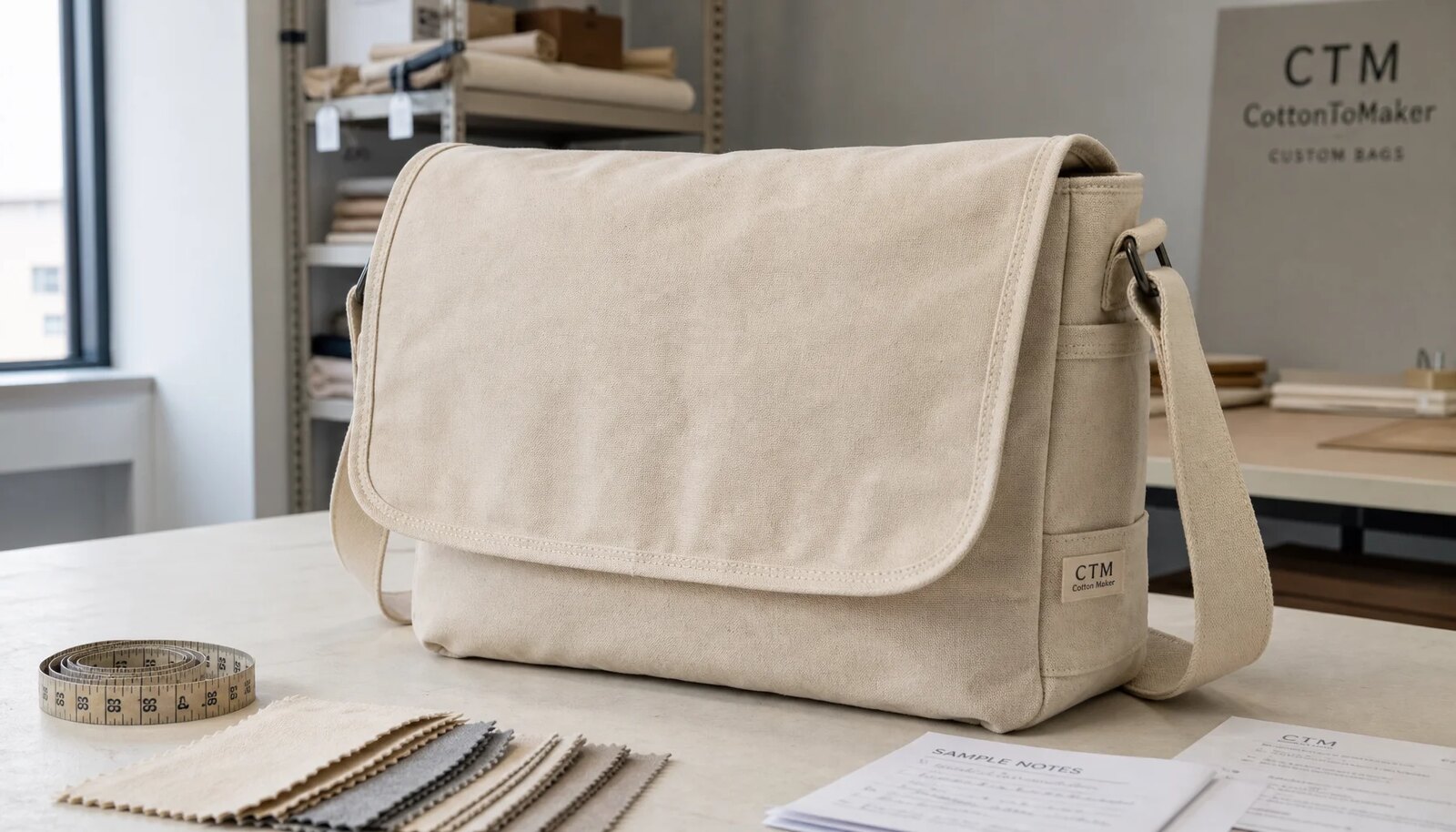
Begin with the event job
Canvas messenger bags for event planners are not one product. A registration giveaway, a speaker welcome bag, a sponsor kit, and a staff operations bag may all use canvas and a shoulder strap, but they carry different loads and face different handling conditions. Procurement gets better pricing and fewer surprises when the RFQ starts with the job the bag must perform, not with a generic name copied from a catalog.
Spell out how the bags will move through the event. Will they be handed out empty at badge pickup, pre-packed by a fulfillment team, mailed to attendees, placed on chairs, sorted by sponsor, or shipped to regional offices? That one detail changes the body size, gusset depth, flap coverage, closure type, strap strength, folding method, carton marks, and even the best decoration position. A bag can look tidy in a digital mockup and still fail when the flap will not close over a notebook and boxed sponsor gift.
The buying question is therefore not simply whether 10 oz or 12 oz canvas is better. The better question is whether the finished bag, including strap, stitching, closure, pockets, decoration, and packing, supports the planned event contents at the target budget and arrival date. A one-day attendee bag may need low carton volume and fast unpacking. A staff bag needs reinforced anchors and comfortable carry. A VIP gift may justify a better label, cleaner lining, or heavier hand feel.
- Define the role first: attendee handout, registration kit, VIP gift, speaker pack, sponsor kit, staff operations bag, resale item, or regional rollout.
- List every insert with size and approximate weight, including notebook, tablet, charger, bottle, apparel, brochure stack, badge holder, boxed item, and sponsor flyer.
- State whether the bag ships empty, pre-filled, individually packed, bulk packed, mailed, placed on seats, or sorted by destination.
- Choose the main priority before quoting: lowest landed cost, reuse value, premium feel, fast delivery, repeatability, or durability under staff use.
- Tell the supplier whether bags must stack neatly on tables, fit kit-assembly lines, or mainly perform after attendees leave the venue.
Convert fabric weight carefully
Canvas weight is usually quoted in ounces per square yard or GSM. For sourcing discussions, 8 oz is about 271 GSM, 10 oz about 339 GSM, 12 oz about 407 GSM, 14 oz about 475 GSM, and 16 oz about 542 GSM. These conversions are useful, but they are not a substitute for a clear measurement basis. A supplier may quote greige cloth, finished cloth, coated cloth, washed cloth, or the finished bag. Those numbers should not be compared as if they are identical.
For most canvas messenger bags for event planners, 10-12 oz is the practical starting range. It gives enough structure for notebooks, programs, brochures, badge materials, and light sponsor inserts while keeping sewing time, carton weight, and freight more manageable. Lighter 8-10 oz canvas can work for short-use programs when the bag is compact and the contents are light. Heavier 14-16 oz canvas can make sense for staff kits, VIP bags, speaker gifts, tablets, chargers, and higher reuse expectations.
Fabric weight still cannot carry the whole specification. A well-built 10 oz messenger bag with reinforced strap anchors, bound seams, and the right gusset may outperform a heavier bag with weak webbing and loose stitches. Likewise, a fully lined 12 oz bag with several pockets and metal hardware may cost more and pack bulkier than a simpler 14 oz unlined version. Use the fabric weight as one decision inside a complete build, not as a quality claim by itself.
- 8-10 oz canvas, about 271-339 GSM: suitable for light attendee kits, short-use giveaways, and budget-sensitive programs.
- 10-12 oz canvas, about 339-407 GSM: the safest starting point for reusable event messenger bags with moderate contents.
- 12-14 oz canvas, about 407-475 GSM: useful when the buyer wants more structure, stronger hand feel, or better reuse value.
- 14-16 oz canvas, about 475-542 GSM: better for staff operations bags, VIP gifts, tablets, chargers, and heavier event contents.
- Require every quote to state whether the fabric weight is measured before finishing, after dyeing or washing, after coating, or on the complete bag.
Match build to carry load
Messenger bags fail at predictable places. The strap anchors pull first. Side seams open under repeated load. Flap corners distort. Closure areas shift when the bag is filled. Pockets sag if they are stitched for appearance rather than use. Event handling is not gentle either: bags are stacked in cartons, moved through warehouses, opened quickly at venues, repacked by staff, and carried across long halls.
The body shape should follow the contents. A flat body is fine for slim notebooks, folders, badges, and papers. Add a gusset when the kit includes a bottle, charger, rolled shirt, boxed gift, or thick booklet. Full lining can improve presentation and hide raw seams, but it also adds labor, inspection points, cost, weight, and carton volume. Bound inner seams are often a smart middle ground for event programs that need durability without retail-level complexity.
Straps need actual numbers in the RFQ. Ask for webbing width, material, slider material, length range, and reinforcement pattern. For many event messenger bags, 30-38 mm webbing is a practical range; heavier staff kits may need a wider strap or shoulder pad. Cotton webbing gives a consistent canvas look. Polyester webbing often offers stable strength, less stretch, and dependable dye consistency. Either can work when the anchor construction matches the load.
- Use a flat body for documents, programs, brochures, folders, badges, and slim notebooks.
- Use a gusset when contents are thick, boxed, rounded, or likely to push against the flap.
- Specify strap width, webbing material, slider material, adjustment range, and reinforcement instead of accepting generic strap wording.
- Require box-X stitching, dense bar tacks, reinforcement patches, folded webbing insertion, or another defined method at load-bearing points.
- Define pockets by use, such as A4 document pocket, 10-inch tablet sleeve, zipper pocket for staff supplies, or front pocket for badge materials.
Write dimensions with tolerances
Loose dimension language creates avoidable problems. A supplier may read a 15 x 11 inch messenger bag as the outside finished body, the usable interior space, or the approximate panel size before sewing. A 2 inch gusset may mean the cut depth, the finished side depth, or the bottom width after pressing. Those differences look minor in a quote table. They matter a lot when an event kit will not fit.
Write the finished dimensions and, where contents are critical, the usable interior dimensions. Include body width, body height, gusset depth, flap depth, pocket openings, strap width, strap adjustment range, and decoration placement. Tolerances belong in the same document. For many sewn canvas bags, plus or minus 5-10 mm on the finished body may be realistic, depending on construction. Small patches, labels, or logo placements may need tighter visual control, such as plus or minus 3-5 mm where the factory can reasonably hold it.
A fit test beats a flat measurement. Load the approved sample with the actual notebook, tablet, brochure stack, bottle, or boxed insert. Close the flap. Adjust the strap. Check whether the bag sits naturally or bulges in a way that makes the closure unreliable. If A4 or letter documents must fit flat, say so. If a tablet must fit, name the model or sleeve dimension.
- State whether each dimension is outside finished size, inside usable size, or pattern size before sewing.
- Specify width, height, gusset, flap depth, pocket openings, strap width, strap length range, and logo placement in one unit system.
- Agree realistic tolerances before sampling and confirm them on the pre-production sample.
- Fit-test the sample with actual or equivalent event contents before approving bulk production.
- Check closure performance during the size review because a bag can measure correctly and still fail when filled.
Make quotes comparable
Two suppliers can quote a 12 oz canvas messenger bag and mean very different products. One price may include full lining, metal sliders, a hidden magnet, a woven patch, individual polybags, and export cartons. Another may include an unlined body, plastic hardware, one-color print, and bulk packing. The fabric weight is the same on the surface, but the labor, material, inspection, and packing assumptions are not.
A useful RFQ separates the variables that move cost. Ask for the base unit price and visible adders for lining, extra pockets, upgraded hardware, embroidery, woven patch, sewn label, heat transfer, extra print colors, individual polybag, hangtag, insert card, barcode label, special carton sorting, rush production, and freight basis. Not every supplier will break out everything, but the request pushes the conversation toward comparable terms. It also shows where the budget is actually going. Sometimes removing pocket complexity saves more than dropping from 12 oz to 10 oz canvas.
Ask for quantity breaks that match real buying scenarios. For event programs, 300, 500, 1,000, 2,000, and 3,000 pieces are often more useful than one optimistic high-volume quote. Ask for both the technical MOQ and the economic MOQ. The technical MOQ is what can be produced. The economic MOQ is where material booking, setup, and QC make commercial sense. Finally, define the trade term. EXW, FOB, CIF, DDP, and delivered-to-warehouse quotes are different prices with different risk.
- Separate unit price from sample fee, print setup, artwork work, patch charge, packing, export carton cost, and freight basis.
- Request standard and premium versions when the budget is not fully locked.
- Compare suppliers on the same dimensions, fabric basis, construction, decoration, packing, quantity, lead time, and trade term.
- Ask for price breaks at realistic event volumes instead of relying on a single MOQ.
- Make the required warehouse arrival date part of the quote so the supplier prices the real schedule.
Choose the sourcing route
The right supplier route depends on control, timing, and how customized the bag must be. A direct factory is usually the strongest route when the buyer needs custom dimensions, controlled fabric weight, reinforced construction, repeatable branding, specific packing, and consistent reorders. The tradeoff is time. Custom production needs a clear specification, sample review, material booking, bulk sewing, decoration, inspection, and freight.
A trading company can help when the event program includes several categories: messenger bags, tote bags, lanyards, apparel, notebooks, pouches, and packaging. The buyer gets one coordination point. The risk is that cutting, sewing, printing, inspection, and packing may happen at different facilities. Ask what is subcontracted, where inspection occurs, and who owns corrections if decoration or sewing does not match the approved sample.
Stock wholesalers and local decorators are faster when the event date is close and the buyer can accept an existing blank. This route can work for small quantities or rush programs, but it is weaker when the bag must fit a known kit, match a brand color, or be reordered later with the same hand feel. Even stock bags need checks. Confirm inventory, strap length, closure alignment, print-safe area, carton condition, and the true available quantity before approval.
- Use direct factory sourcing for custom dimensions, controlled canvas weight, repeat programs, and stronger bulk consistency.
- Use a trading company when multiple event products need bundled sourcing and the buyer accepts an added coordination layer.
- Use stock wholesalers when speed matters more than custom shape, fabric feel, pocket layout, or exact canvas weight.
- Use local decorators when blank bags are acceptable and the main need is quick logo application.
- Ask where sewing, decoration, inspection, and packing physically happen before the order is placed.
Select branding for canvas
Decoration should match the fabric texture, artwork, folding method, and expected reuse. Screen printing is usually the practical choice for bold one-color or two-color logos on medium-weight canvas. It is efficient at scale and can look clean when the artwork is not too fine. Ask the supplier to confirm ink type, curing method, print area, and expected edge clarity on the chosen weave. Small sponsor marks, thin lines, and reversed type may fill in or break up on coarse canvas.
Heat transfer can handle gradients, small details, and multi-color artwork, especially at lower quantities. It still needs testing. Messenger bags bend at the flap and printed panel during packing and use, so a transfer can crack, lift at the edge, show a glossy film outline, or feel stiff compared with the surrounding fabric. Request a transfer sample on the actual canvas and fold it using the final packing method before approval.
Woven patches, sewn labels, and embroidery can make the bag feel more reusable. A woven patch can carry detailed branding and holds up well when sewn correctly. Embroidery can look substantial, but lighter canvas may pucker if backing and stitch density are not controlled. A small sewn label can be a good choice for corporate programs that want a bag people will reuse without a large front logo. Whatever method you choose, approve it on the sewn bag, not only on a digital proof or flat strike-off.
- Choose screen print for bold artwork, fewer colors, repeat volume, and a strong cost-to-visibility balance.
- Use heat transfer only after checking fold durability, edge adhesion, gloss level, cracking, adhesive residue, and stiffness on the actual canvas.
- Choose woven patches or sewn labels when reuse value and long-term appearance matter more than maximum logo size.
- Use embroidery carefully; review backing, stitch density, thread color, and puckering on the selected canvas weight.
- Define logo placement tolerance and approve branding on the sewn sample because flaps, seams, pockets, and folds affect visual centering.
Approve samples like users will handle them
A photo is not a sample approval. Event bags are filled, stacked, carried, opened, closed, sorted, and sometimes repacked by people moving quickly. Put the real or equivalent contents into the sample. Close the flap. Adjust the strap at short, middle, and long settings. Carry it for several minutes. Place it on a table. Look for twisting, sagging, closure shift, strap discomfort, blocked pockets, and flap lift.
Sample approval should lock measurable details. Record fabric weight, GSM basis, canvas color, finish, dimensions, pocket layout, strap width, strap length range, hardware material, closure type, thread color, stitch density, decoration method, logo placement, and packing method. If one of those details changes after approval, treat it as a written revision. That protects the buyer from silent substitutions in fabric lots, webbing, hardware, lining, or decoration settings.
For larger programs, use staged approvals. A material swatch confirms hand feel and base color early. A lab dip may be needed for dyed canvas. A printed strike-off confirms ink coverage or transfer behavior. A patch or label sample confirms brand detail before sewing. The pre-production sample should be a complete bag. The packed sample should show the final fold, individual packing if any, carton count assumptions, and whether the logo will be creased under compression.
- Fill the sample with the real event kit before approving body size, gusset, flap depth, closure type, and strap length.
- Check shoulder and crossbody carry at short, middle, and long strap settings.
- Measure the sample against the written tolerance instead of relying on a mockup or approximate dimension.
- Approve decoration on the sewn bag after the final folding method has been tested.
- Keep one approved sample for buyer reference and one labeled production sample for the factory line when possible.
Set measurable QC rules
Quality control works best when the standard is agreed before production starts. The purchase order should define tolerances for finished dimensions, strap length, logo placement, pocket position, flap alignment, stitch quality, closure function, fabric appearance, and carton packing. It should also classify defects by severity. A broken strap anchor, missing closure, sharp hardware edge, unusable zipper, severe stain, or wrong logo is usually critical or major. A small loose thread inside the bag may be minor if it does not affect function or appearance.
Inspection should include both appearance and use. A bag can look acceptable at a glance and still have weak strap stitching or a closure that fails when the bag is filled. For staff bags, heavier kits, or premium programs, ask for a sampled loaded hang or pull check using a load that reflects intended use. The check should confirm that anchors do not tear, seams do not open, the flap still closes, and the body does not distort beyond the approved standard.
Shade and print consistency deserve attention. Natural canvas, dyed canvas, washed canvas, and recycled blends can vary by lot. Ask whether the bulk order will be cut from one fabric lot and how shade variation across cartons will be controlled. Decoration color should be checked against the approved sample under consistent lighting. Sponsor logo placement and color can trigger more internal concern than a minor sewing variation, so write the standard clearly.
- Set tolerances for width, height, gusset, flap depth, strap length, strap width, pocket position, closure placement, and logo placement.
- Require secure seams with no skipped stitches, broken threads, open seams, loose anchors, seam slippage, or visible needle damage.
- Check closure function on filled samples, especially magnets, snaps, hook-and-loop strips, buckles, and zipper-under-flap designs.
- Inspect outer panels for oil stains, dye stains, holes, scorch marks, puckering, shade mismatch, dirty handling marks, and excessive slubs.
- Request inspection photos, measurement records, defect counts, loaded-check notes, and carton weight checks before shipment for higher-risk orders.
Plan packing and carton math
Packing is part of the product specification. It affects presentation, freight, warehouse intake, unpacking labor, and damage risk. Bulk packing is efficient when bags will be opened at an event warehouse or registration area. Individual polybags can protect the bag and improve presentation, but they add cost, labor, material use, carton volume, and disposal work at the venue. Belly bands, hangtags, insert cards, and barcode labels should serve the distribution workflow, not appear by habit.
The folding method matters because messenger bag flaps and logos are visible. A sharp fold through a printed panel can create creases, ink stress, or transfer edge problems before the event starts. Ask the supplier to show the final fold during sample approval. The fold should protect the decoration, keep the flap aligned, prevent strap tangles, and let event staff unpack quickly. Sometimes a slightly larger carton is cheaper than venue rework caused by crushed logos or tangled straps.
Get carton data before confirming the PO. Request units per carton, carton dimensions, gross weight, net weight, total carton count, and estimated CBM. For air freight, volumetric weight can make a bulky low-cost bag expensive. For ocean freight or palletized delivery, carton strength and labeling matter more. Specify carton marks, destination labels, event codes, sponsor codes, regional sorting, and whether cartons need to support a kit-assembly sequence.
- Choose bulk packing, individual polybags, belly bands, insert cards, hangtags, or barcode labels based on the actual distribution workflow.
- Approve the folding method during sampling so the logo, flap, strap, and closure are not damaged or distorted in transit.
- Request carton dimensions, units per carton, gross weight, net weight, total carton count, and estimated CBM before order release.
- Specify carton marks, event codes, destination labels, sponsor identifiers, and regional sorting rules before packing begins.
- Check that pack count supports warehouse intake, kit assembly speed, and venue distribution without extra repacking.
Specification comparison for buyers
| Spec decision | Recommended option | When it fits | Buyer risk to check |
|---|---|---|---|
| Base fabric weight | 10-12 oz canvas, approximately 339-407 GSM if converted from oz per square yard | Most conference handouts, registration kits, notebooks, brochures, light sponsor inserts, and reusable attendee bags | Confirm whether the supplier is quoting greige fabric, finished fabric, coated fabric, washed fabric, or finished bag weight; these are not interchangeable |
| Budget event build | 8-10 oz canvas, approximately 271-339 GSM, with simple pocketing and one-color decoration | Short-use giveaways, lightweight badge-pickup kits, and programs where freight volume matters as much as unit cost | Oversized panels may collapse, wrinkle around print, or feel disposable; test with the actual kit before approving |
| Balanced reusable build | 10-12 oz canvas with reinforced strap anchors, bound inner seams, and an adjustable 30-38 mm shoulder strap | General event planner programs where the bag should work during the event and remain useful afterward | If pockets, lining, or hardware are added without a load review, cost and carton volume can rise faster than durability |
| Heavier-duty build | 14-16 oz canvas, approximately 475-542 GSM, with box-X or bar-tack reinforcement and stronger thread | Staff operations bags, VIP gifts, speaker kits, field teams, tablets, chargers, and heavier contents | Heavier canvas increases needle marks, sewing time, carton weight, and freight cost; it can be overbuilt for a one-day attendee item |
| Finished dimensions | Body, gusset, flap depth, strap range, and pocket size specified in millimeters or inches with tolerances | Any program where contents, venue packing, or sponsor inserts are known before production | Generic dimensions can produce a bag that fits on paper but will not close when filled |
| Construction level | Single-layer canvas with bound seams or partial lining, unless a full lining has a clear function | Event kits needing durability and clean presentation without retail-level complexity | Full lining, dividers, interlining, and multiple pockets add labor and inspection points; compare them against a heavier unlined option |
| Decoration method | Screen print for simple logos; woven patch, sewn label, or embroidery for premium reuse; heat transfer only after fold testing | Clear brand marks, sponsor logos, staff bags, and moderate to high order volumes | Print approval on flat fabric is insufficient; approve decoration on the sewn bag and after folding in the final pack method |
| Closure type | Flap with hook-and-loop, snap, hidden magnet, buckle, or zipper-under-flap selected by load and access needs | Quick-access attendee bags, staff kits, premium gifts, and bags that will be carried while moving through venues | Check closure alignment on a filled sample; magnets may be weak through thick canvas, hook-and-loop can be noisy, and buckles slow access |
| Strap specification | Adjustable cotton or polyester webbing, typically 30-38 mm for normal event bags and wider for heavier staff kits | Any messenger bag expected to be worn crossbody, carried during setup, or reused after the event | Weak anchors, narrow webbing, low stitch density, plastic sliders, and poor bar tacks often fail before the canvas body |
Buyer checklist before sampling
- Define the exact event role: attendee handout, registration kit, VIP gift, staff operations bag, sponsor kit, speaker welcome pack, resale item, or regional rollout item.
- List planned contents with size and approximate weight: notebook format, brochure stack, tablet model, charger, badge holder, water bottle, apparel item, boxed gift, or sponsor insert.
- Lock finished dimensions: body width, body height, gusset depth, flap depth, front pocket, inner pocket, zipper pocket, strap width, and strap adjustment range.
- Specify fabric weight in both oz per square yard and GSM, and state whether the quote must refer to greige cloth, finished cloth, coated cloth, washed cloth, or the complete finished bag.
- State the canvas type and finish: natural unbleached, dyed, washed, brushed, duck canvas, organic cotton if required, recycled blend if required, or coated water-resistant finish.
- Choose the construction level: unlined, bound inner seams, partial lining, full lining, interlining, padded tablet sleeve, inner divider, zip pocket, pen slot, or document pocket.
- Define load-bearing details: thread type, stitch density target, seam allowance, strap anchor reinforcement, bar tack or box-X pattern, stress-point reinforcement, and acceptable hardware material.
- Specify closure type and performance expectation: hook-and-loop, hidden magnet, snap, buckle, zipper-under-flap, open-top with flap cover, or dual closure for heavier kits.
- Specify decoration method, artwork dimensions, color count, Pantone or brand color references, print placement tolerance, and whether approval must happen on the actual sewn bag.
- Request sample stages: fabric swatch, lab dip if dyed, printed strike-off or patch sample, fit sample, pre-production sample, and approved packed sample for larger programs.
Factory quote questions to send
- Is the quoted fabric weight based on greige cloth, dyed or washed finished cloth, coated cloth, or the complete finished bag, and what is the GSM equivalent?
- What canvas construction is included: plain-weave canvas, duck canvas, brushed canvas, washed canvas, natural unbleached canvas, dyed canvas, organic cotton canvas, or blended canvas?
- What is the yarn composition and finish: 100% cotton, cotton-poly blend, recycled cotton blend, water-resistant coating, enzyme wash, soft wash, or preshrunk finish?
- What are the exact finished dimensions for width, height, gusset, flap depth, pocket openings, strap width, and adjustable strap length range?
- What production tolerances do you hold for finished size, flap alignment, pocket position, strap length, strap width, and logo placement?
- Is the bag unlined, bound-seam, partially lined, fully lined, or interlined, and which panels or stress points receive reinforcement?
- Which thread type and approximate stitch density are used on main seams, flap seams, pocket seams, and strap anchors?
- What reinforcement method is used at load-bearing points: box-X stitching, bar tack, rivet plus stitching, reinforcement patch, or folded webbing insertion?
- Which decoration method is included in the unit price, and is the quote based on one-color screen print, multi-color screen print, heat transfer, embroidery, woven patch, sewn label, or leather-look patch?
- Can you provide a printed strike-off, embroidery sample, label sample, or patch sample on the actual canvas before the full pre-production sample is approved?
Quality-control points to confirm
- Finished dimensions match the approved pre-production sample and stay within agreed tolerance for body width, height, gusset, flap depth, pocket placement, strap width, and strap length.
- Canvas weight, weave density, hand feel, color shade, shrinkage behavior, and finish are consistent across the bulk order, with no mixed lots unless approved.
- Fabric panels are free of holes, cuts, stains, severe slubs, streaking, shade mismatch, excessive creasing, oil marks, adhesive residue, scorch marks, and dirty handling marks.
- Main seams are straight, secure, and free of skipped stitches, broken stitches, loose thread tails, open seams, seam slippage, puckering, and visible needle damage.
- Strap anchors use the approved reinforcement pattern, such as box-X stitching, dense bar tacks, or reinforcement patches, and do not tear, shift, or distort after a loaded pull check.
- Flap alignment is centered, closure placement is consistent, and magnets, snaps, buckles, zippers, or hook-and-loop strips function correctly when the bag is filled to the agreed test load.
- Print position, print color, ink coverage, edge clarity, transfer adhesion, embroidery registration, patch placement, and label sewing match the approved sample on the actual sewn bag.
- Pockets and compartments remain usable after the bag is filled, with no blocked openings, twisted lining, loose inner seams, sharp hardware edges, or rough zipper ends.
- Bulk packing matches the approved folding method, pack count, individual packing requirement, carton labeling, carton dimensions, gross weight, and any required barcode, event code, or destination mark.
- Randomly selected cartons are checked against the approved sample and inspection report before shipment, with defects separated into critical, major, and minor categories.