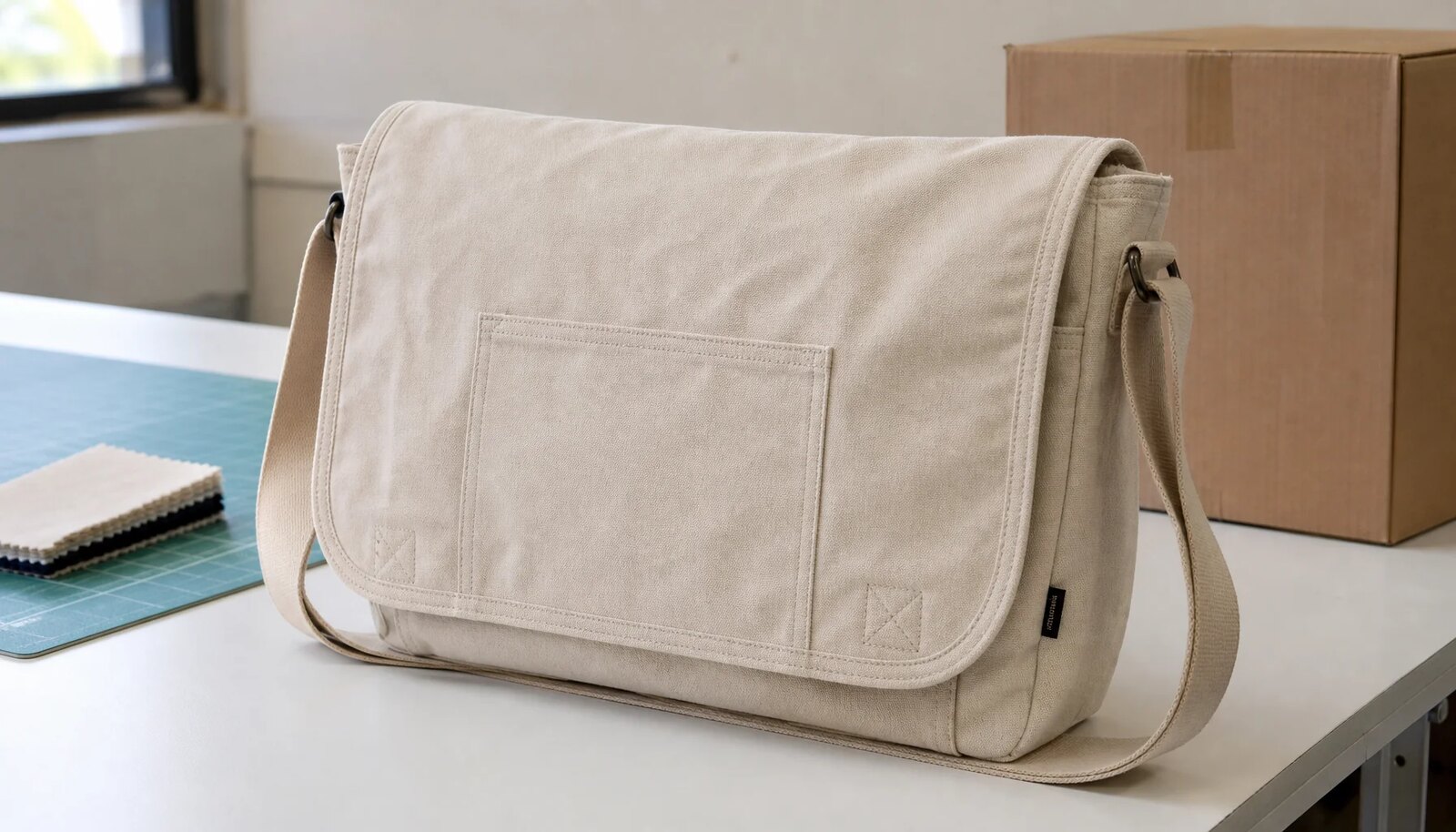
Why carton packing belongs in the product spec
For canvas messenger bags for event planners, carton packing is not a warehouse afterthought. It affects landed cost, receiving speed, damage rate, count accuracy, and the amount of repacking your team may need to do before an event. A bag can look acceptable in a sample room and still arrive with crushed flap corners, rubbed logos, bent pocket edges, or tangled straps if the carton plan is loose. Event buyers often work against fixed dates, venue receiving windows, and sponsor deadlines, so a packing issue is not just cosmetic. It can become a labor problem at the worst possible time.
The carton plan should follow the order's real handling route. If the bags are going directly into attendee kits, flat pack density and clean counting may matter more than retail presentation. If they are handed over individually to VIP guests, speakers, or client teams, tissue, individual polybags, hangtags, or a light insert may be worth the added labor and carton volume. If the bags are being warehoused for repeat events, carton marks and barcode labels may be just as important as the bag itself.
Procurement teams should request the packing plan before final price comparison, not after the purchase order is placed. A supplier quoting 30 pieces per carton with minimal protection is not quoting the same operational product as a supplier quoting 20 pieces per carton with tissue separation and a stronger master carton. Both may be valid. The risk is comparing them as if they are identical. For a proper canvas messenger bags for event planners carton packing plan, the buyer should define pack count, fold method, protection, carton grade, gross weight, and carton marks in the RFQ.
- Treat packing as part of the product specification, because it changes freight, damage control, and receiving labor.
- Ask for carton dimensions, pack count, net weight, gross weight, and carton grade before approving the final quote.
- Confirm whether the bags are flat packed, folded, nested, stuffed, individually protected, or retail packed.
- Use carton marks that match the warehouse receiving process: style number, color, artwork version, quantity, carton number, gross weight, and destination reference.
Start with event use, contents, and carry load
Event planners rarely source messenger bags as pure fashion items. The bag is usually expected to carry printed agendas, lanyards, badge packs, sponsor inserts, pens, a charger, a tablet, a small notebook, or staff documents. That means the first sourcing decision should be the intended contents, not the logo. A clean design that cannot hold the real event kit will create complaints, repacking, or awkward last-minute substitutions.
A practical RFQ should describe the load in plain terms. State whether the bag must fit A4 or letter-size documents without curling. Note whether a tablet sleeve is needed, whether the bag must close over a filled kit, and whether staff will carry the bag all day. A thin document carrier can work for a one-day conference handout, but it may feel weak for multi-day staff operations. A deeper gusset gives more capacity, but it also increases folded thickness and may reduce carton count.
Canvas weight should be chosen around use and packing. A 10 oz canvas, roughly around 340 GSM depending on weave and finish, can work for light paper kits and cost-sensitive giveaways. A 12 oz canvas, often around 410 GSM, gives more structure and a more durable handfeel for reusable attendee or staff bags. Above that range, buyers should check whether the added fabric weight improves the user experience enough to justify higher sewing difficulty, heavier cartons, and freight impact.
The bag shape should also be checked with the real kit contents. A messenger bag that photographs well when empty can distort when loaded if the base is weak, the strap points are underbuilt, or the flap is too short. Ask the factory to test the sample with a light fill similar to the intended contents. The goal is not a heavy-duty luggage test unless that is the use case. The goal is to avoid a bag that collapses, twists, or refuses to close under normal event conditions.
- List the real contents before choosing body size, gusset, pocket layout, and closure.
- Use 10 oz canvas for lighter paper-based kits where cost and carton efficiency matter.
- Use 12 oz canvas for better structure, heavier kits, longer reuse, or more premium handfeel.
- Check the sample loaded lightly, not only flat on a table.
Build a spec that factories can price accurately
A strong spec sheet reduces the supplier's room for assumptions. For canvas messenger bags, the RFQ should include finished dimensions, fabric weight, color, lining status, pocket layout, closure, strap construction, artwork method, packing method, and carton requirements. If the buyer sends only a photo and a target price, each supplier will fill in missing details differently. One may quote lighter fabric, one may remove reinforcement, one may use a cheaper strap, and one may change the carton count to make freight look better.
Finished dimensions should be written in centimeters with tolerances. Include body width, body height, gusset depth, flap length, front pocket size, internal pocket size if any, strap width, and adjustable strap length range. If the bag needs to hold A4 or letter documents, say whether the documents must fit flat, fit inside a sleeve, or fit with additional items. These details help the factory build a pattern that serves the event use rather than simply copying a generic messenger style.
Construction details deserve equal attention. Buyers should state whether the bag is unlined, bound at internal seams, partially lined, or fully lined. Unlined canvas is cheaper and packs thinner, but raw edges can look unfinished if the bag is opened in a corporate setting. Binding internal seams improves appearance without the full cost of lining. Full lining improves perceived value but adds material, labor, thickness, and potential inspection points. There is no universal best choice. The right choice is the one that matches budget, reuse expectation, and carton density.
Hardware and reinforcement should also be specified, because they are common places for cost variation. Strap width, buckle material, slider type, D-ring or anchor construction, zipper quality, snap type, and hook-and-loop size can all change the quote. If the bag will be used by staff for several days, bartacked strap anchors are not a decorative extra. They are a primary durability feature. If the bag is mainly a lightweight giveaway, the buyer can still ask for reinforcement at pocket corners and flap stress points to prevent early failure.
- Include a dimensioned sketch or tech pack, even if it is simple.
- State canvas weight in oz and GSM, and ask the factory to confirm the quoted material.
- Define lining and internal seam finish before price comparison.
- Specify strap width, hardware, closure, and bartack positions instead of accepting generic descriptions.
Choose decoration around logo risk and event context
Decoration should be selected around artwork, order size, and the way the bag will be used after the event. For many B2B programs, 1 or 2 color screen print is the most practical option. It is cost-efficient at volume, easy to repeat, and visible on natural or dyed canvas. Screen print works best when the logo has solid shapes, limited colors, and enough line weight to sit clearly on textured fabric. It is less forgiving with gradients, tiny sponsor text, and fine outlines.
Embroidery, woven patches, and sewn labels can raise perceived value, but they change both cost and production logic. Embroidery works well for bold marks but can pucker canvas if the stitch area is dense or if the backing is poorly controlled. Woven patches are useful when buyers want a premium, reusable look or when multiple artwork versions can be managed as separate labels. A small side label may make the bag more likely to be reused after the event, while a large front print maximizes brand visibility during the event. That is a business decision, not just a design preference.
For sponsor-heavy events, buyers should be careful with artwork complexity. A panel crowded with multiple small logos may look acceptable on a digital mockup and disappointing on rough canvas. Procurement should ask the marketing team for simplified art where possible and should confirm minimum line thickness and minimum text size with the supplier. If brand color is strict, include Pantone references or another agreed standard, but remember that natural canvas, dyed canvas, and ink absorption can shift the visual result.
A physical print proof is especially important when artwork has multiple colors, small text, or a placement that crosses a flap, pocket, or seam. The proof should show the actual canvas, actual ink or thread, actual placement, and acceptable tolerance. Position tolerance should be written in the order, for example plus or minus a defined number of millimeters from the approved location. Without this, buyers may find themselves arguing over whether a shifted logo is a defect or normal production variation.
- Use screen print for simple logos, repeat orders, and strong cost-to-impact performance.
- Use embroidery for bold artwork where premium texture matters more than fine detail.
- Use woven patches or sewn labels for reusable, retail-leaning, or multi-artwork programs.
- Request a print strike-off when the logo includes small text, thin lines, multiple colors, or strict brand color.
Compare supplier routes before comparing unit price
The lowest unit price is not always the lowest total risk. For a product where sewing, printing, and packing all affect the final result, buyers should understand the supplier route before making a decision. A direct factory with in-house or tightly controlled sewing, decoration, and packing is usually stronger for repeat orders and carton-level consistency. A trading company can be useful when it adds real coordination, consolidation, or supplier management. A stock-and-custom route can be fast, but it often limits fabric, construction, logo placement, and carton packing options.
The key question is not simply whether the supplier says they are a factory. The key question is who controls each step. Who buys the canvas? Who cuts and sews the panels? Who prints the artwork? Who applies labels? Who packs the cartons? Who signs the inspection report? If these steps are split across several parties, the buyer needs clear accountability. Outsourcing is not automatically bad, but unclear outsourcing makes inspection disputes harder to resolve.
Quote comparison should also separate cost lines. Ask for the unit price, sample charge, print setup charge, label or patch cost, special packing cost, carton cost if nonstandard, inland handling, and incoterm. This helps identify what is actually included. A quote that looks low may exclude individual polybags, desiccant, barcode labels, or stronger export cartons. A quote that looks higher may include a more realistic pack-out and fewer shipment surprises.
For event buyers, responsiveness matters because approval windows are often tight. A supplier should be able to answer carton count, sample timing, artwork proof timing, and bulk lead time with specifics. Vague answers such as 'standard packing' or 'normal carton' are warning signs. The buyer does not need a complicated sourcing ritual. They need written details that can be checked at sample stage, production stage, and final inspection.
- Ask which production steps are in-house and which are subcontracted.
- Compare quotes only after fabric, construction, decoration, packing, and incoterm are aligned.
- Request separate cost lines for sample, artwork setup, special packing, carton labels, and logistics extras.
- Favor suppliers who can document the carton plan before the purchase order is finalized.
Use the comparison table to lock the buying decision
The comparison table in this guide is designed to make quote conversations more precise. It is not a request to overbuild every bag. Some event programs need a simple canvas messenger bag with clean printing and efficient flat packing. Others need a more structured reusable bag with better internal finish, stronger strap anchors, and a premium patch or label. The buyer's job is to choose the right level of specification and then require every supplier to quote that same level.
A common procurement mistake is mixing specifications during comparison. One supplier quotes 10 oz canvas with no lining and 30 pieces per carton. Another quotes 12 oz canvas with bound seams and 20 pieces per carton. A third includes individual polybags, while another packs loose. These are not comparable offers. They may all be reasonable, but the buyer cannot judge value until the product, packing, and delivery terms are standardized.
Use the table as a pre-RFQ decision map. Start with the event use, then choose fabric weight, bag structure, print route, closure, strap specification, and carton packing density. Once those items are chosen, send the same spec to each supplier. This keeps the conversation focused on execution, price, lead time, and risk rather than hidden assumptions.
The table is also useful during sample review. If the approved option is 12 oz canvas, partial lining, 38 mm adjustable strap, screen print, and 24 pieces per carton, then the sample and packing mock-up should reflect that. A sample made from stock fabric or packed casually is not enough to approve bulk production. The decision points must remain connected from quote to sample to inspection.
- Use the table before RFQ, not only after quotes arrive.
- Eliminate quote gaps by fixing fabric, construction, decoration, packing, and incoterm.
- Reject vague substitutions unless the supplier explains the cost, timing, and QC impact.
- Keep the selected table decisions attached to the purchase order and inspection checklist.
Approve samples as production controls
A sample is not only a presentation item. It is a production control tool. The approved sample should prove that the chosen canvas, thread, strap, hardware, closure, artwork, lining, and packing can be made together. If the supplier sends a generic stock bag with a similar logo, it may help with early discussion, but it should not be used as the final approval reference. Bulk production should be based on a pre-production sample made from the final material set.
Sample review should be measured, not only visual. Check the finished dimensions flat, then check the bag with a light load similar to the event kit. Confirm body width, height, gusset, flap coverage, pocket opening, strap range, and closure alignment. Test whether the bag closes easily when filled with the expected documents or accessories. If the strap twists, the flap pulls, or the pocket becomes unusable, the issue should be corrected before bulk cutting.
Decoration needs its own approval. The buyer should review print size, print placement, ink coverage, color, edge sharpness, and any cracking or rub risk where the bag folds. For embroidery or patches, inspect puckering, stitch density, patch alignment, thread tails, and backing. If the event includes multiple artwork versions, the buyer should approve a proof for each design or define which shared elements are already approved and which elements still need checking.
The sample should also be packed the way the factory plans to pack bulk. Fold it, protect it, and place it in the intended carton arrangement. This shows whether the logo rubs against hardware, whether the flap creases in a visible area, whether straps tangle, and whether the carton count is realistic. Many problems appear only after compression. A strong carton packing plan is easier to approve when at least one packed sample or packing mock-up is reviewed before production.
- Approve a pre-production sample made with final fabric, final artwork, final strap, and final packing method.
- Measure the sample flat and lightly filled with realistic event contents.
- Check print proof, placement tolerance, seam quality, closure function, and strap adjustment.
- Photograph and document the approved sample so production and inspection have the same reference.
Design the carton packing plan around freight and receiving
A good carton packing plan protects the bags while keeping freight and receiving practical. For canvas messenger bags, flat packing is often the best export approach because it reduces void space and keeps the shipment compact. A common starting point is 20 to 30 pieces per master carton, but the final count depends on bag size, canvas weight, lining, hardware, folded thickness, and individual protection. The best carton count is the one that protects the bag and keeps handling manageable, not simply the highest number the factory can force into a box.
Gross weight should be controlled. Many buyers prefer master cartons under about 15 to 18 kg gross weight for practical manual handling, though the exact limit depends on the warehouse and destination rules. Overweight cartons are harder to move, more likely to split, and less friendly to event teams receiving product at venues. Underfilled cartons waste freight and create internal movement that can scuff prints or bend corners. The carton should be full enough to stay stable but not compressed enough to deform the bags.
Protection should match the decoration and finish. Natural canvas with a simple print may only need clean folding and tissue separation. A darker dyed canvas, heavy hardware, embroidery, or large printed area may need individual polybags or additional tissue to prevent rubbing. If the shipment faces humidity risk, desiccant can be added, but it should be placed so it does not stain or dent the product. Buyers with sustainability requirements should specify acceptable polybag thickness, recyclable material, paper wrapping, or reduced-plastic alternatives early, because these choices affect both cost and packing labor.
Carton markings should be detailed enough for receiving under time pressure. Each carton should show style number, color, artwork version, quantity, carton number, gross weight, net weight, and destination or PO reference. If the buyer's warehouse uses barcode receiving, barcode labels should be included in the RFQ and verified during inspection. Mixed-color or mixed-artwork cartons should be avoided unless the buyer specifically wants them and the packing list is clear. For event operations, clean count accuracy is often more valuable than a small packing convenience at origin.
- Start with 20 to 30 pieces per carton, then adjust after measuring folded thickness and gross weight.
- Keep master cartons within the buyer's manual handling and warehouse requirements.
- Use tissue, polybag, or other protection based on print rub risk, hardware contact, and presentation needs.
- Specify carton marks and barcode labels before bulk packing begins.
Set QC standards before bulk fabric is cut
Quality control should be written before production starts. Canvas messenger bags have several defect areas that can become subjective if they are not defined: fabric shade, slubs, stitching, seam alignment, strap strength, closure function, print placement, and packing accuracy. AQL inspection can work well, but only when defect definitions are clear. A loose thread is not the same as an open seam. A slight print shift is not the same as a double image. A small canvas slub may be acceptable on natural fabric, while an oil stain should not be.
The inspection checklist should include measurements and functional checks. Measure body dimensions, gusset, flap, pocket, strap width, and strap length range. Check whether the bag sits square when empty and when lightly filled. Pull gently at strap anchors, test buckle adjustment, open and close zippers or snaps, and check pocket access. Inspect bartacks at high-stress points. If the bag has lining, confirm that lining is not twisted, caught in the zipper, or loose at corners.
Print and decoration inspection should be specific. Check placement against the approved sample, confirm color and coverage, and inspect for pinholes, smearing, ink buildup, cracking, or poor registration. For embroidery, review thread tension, backing, puckering, loose threads, and color. For patches or labels, check position, stitching, edge finish, and whether the label remains flat after packing. Decoration defects are often highly visible on event products because bags may be distributed in a branded setting.
Packing inspection should not be skipped. Inspect loose pieces from production, but also open at least one packed carton. Confirm inner count, master count, carton marks, carton strength, barcode labels, fold method, individual protection, and gross weight. Check whether bags at the top, bottom, and corners of the carton show compression damage. If the shipment includes several colors or artwork versions, sample cartons across those variants so defects are not hidden in one part of the run.
- Write critical, major, and minor defect definitions before inspection.
- Inspect measurements, stitching, strap anchors, closures, decoration, and carton packing.
- Open packed cartons during QC, not only loose production units.
- Tie inspection standards to the approved sample, purchase order, and packing plan.
Plan lead time around approvals, not just production days
Lead time for canvas messenger bags is often controlled by approvals as much as factory sewing capacity. A simple order may need several working days for artwork confirmation, material arrangement, and sampling, then additional time for bulk after sample approval. A practical planning window is often around 7 to 10 working days for a pre-production sample and 25 to 35 days for bulk production after approval, but buyers should confirm current timing with the supplier. Peak seasons, dyeing, complex decoration, hardware shortages, or repeated artwork changes can extend the schedule.
Event deadlines make late changes expensive. If the marketing team is still adjusting sponsor logos while the factory is preparing screens or ordering labels, the clock is already at risk. Procurement should assign one decision owner for sample approval and define what must be signed off: bag construction, artwork, color, strap, closure, carton packing, and carton marks. Multiple reviewers can be useful early, but late-stage review loops often add days without improving the finished product.
Shipping mode should be considered before finalizing carton dimensions. Air freight is sensitive to volumetric weight, so inefficient cartons can increase cost quickly. Sea freight may lower the per-unit freight cost, but it needs more planning time and stronger carton discipline. If event dates are fixed, buyers should build a timeline backward from the required in-hand date, including factory production, inspection, rework buffer, export handling, transit, customs, delivery appointment, and internal kit assembly.
Landed cost comparison should include all these timing and packing variables. Unit price alone does not show sample fees, setup charges, special packing, carton labels, inspection, inland freight, volumetric weight, or rework risk. A slightly higher ex-factory price can be the better buy if the bag packs efficiently, passes inspection cleanly, and arrives countable. A low unit price can become expensive if cartons are damaged, packing is inconsistent, or the order requires urgent repacking before the event.
- Build the schedule backward from the event in-hand date, not from the factory's ideal production date.
- Freeze artwork, bag construction, and carton packing before bulk approval.
- Include inspection, rework buffer, export handling, transit, customs, and final delivery in the timeline.
- Compare landed cost by carton and by usable delivered unit, not only by ex-factory piece price.
Specification comparison for buyers
| Spec decision | Recommended option | When it fits | Buyer risk to check |
|---|---|---|---|
| Fabric weight | 10 oz to 12 oz canvas, approximately 340 to 410 GSM, confirmed by weight test or mill sheet | Conference kits, document carry, light tablet accessories, staff bags, and branded giveaways that need visible structure | Too light can wrinkle, distort at seams, and feel disposable; too heavy increases sewing difficulty, carton volume, and freight cost |
| Fabric finish | Natural or dyed cotton canvas with agreed shrinkage, color tolerance, and surface cleanliness standard | Programs where logo clarity and repeat-order consistency matter more than fashion variation | Uncontrolled dye lots, slubs, shade bands, or oil marks can create visible differences across cartons |
| Bag dimensions | Define finished size, gusset depth, flap length, and pocket dimensions in centimeters with tolerance | Event folders, badges, A4 or letter documents, chargers, pens, tablets, and light staff equipment | A good-looking sample may still be too shallow, too narrow, or too soft once the event kit is loaded |
| Print method | 1 to 2 color screen print for volume; embroidery, woven patch, or sewn label for premium reuse | Simple corporate marks, sponsor logos, repeat programs, and bags intended for post-event use | Fine lines, gradients, and small text can fill in, misregister, or crack on textured canvas |
| Bag structure | Partial lining or bound internal seams with reinforced base and bartacked stress points | Buyers needing a clean interior without paying for a full fashion-grade bag | Unlined interiors may show raw edges; full lining raises cost, thickness, and packing volume |
| Closure | Zip top under flap for better security, or flap with hook-and-loop or snap for faster access | Event teams carrying schedules, badges, small electronics, chargers, and attendee materials | Weak closure choice leads to complaints about lost contents, noisy operation, poor access, or cheap handfeel |
| Strap spec | 38 mm to 50 mm cotton or polyester webbing with adjustable buckle and bartacked anchors | Frequent carry, heavier contents, and staff or attendee use across multi-day events | Thin straps cut into shoulders; weak anchors can fail during handling or after the event |
| Carton pack density | Flat pack 20 to 30 pcs per master carton, tissue or polybag protection, desiccant if needed, gross weight under 15 to 18 kg | Export orders where damage control, count accuracy, and warehouse handling matter more than retail display | Overpacked cartons crush corners and bend flaps; underpacked cartons waste freight and inflate landed cost |
| Master carton spec | Export-grade 5-ply for normal loads, 7-ply when hardware, long transit, or stacking risk is higher | Sea freight, mixed warehouse handling, event deadlines, and shipments that may be moved several times | Weak cartons split, deform, or lose count integrity; unclear carton marks slow receiving |
Buyer checklist before sampling
- Define the event use case first: document carrier, attendee kit, staff operations bag, tablet carrier, sponsor merchandise, or retail-style giveaway.
- List the intended contents and confirm whether the bag must fit A4, letter-size folders, a tablet, badge packs, chargers, water bottle, or printed agenda.
- Lock the canvas weight in both oz and GSM, and require confirmation of weave, finishing, shrinkage control, and color tolerance.
- Specify finished dimensions in centimeters, including main body, gusset, flap, pocket size, strap length range, and measurement tolerance.
- Confirm whether the bag is unlined, bound-seam, partially lined, or fully lined, and identify exposed internal edges that must be clean.
- State print method, number of colors, artwork size, placement, Pantone or other color reference, and placement tolerance.
- Require a print strike-off or physical proof when artwork has small text, thin lines, multiple colors, or sponsor marks with strict color standards.
- Define strap width, strap material, buckle type, adjustment range, anchor construction, and bartack requirement at stress points.
- Confirm closure type and test expectation: zipper, flap, hook-and-loop, snap, magnetic button, or combined closure.
- Give the target carton pack count, maximum carton size if the warehouse has limits, and maximum gross weight per carton.
Factory quote questions to send
- What canvas weight, GSM, weave, finishing, and color tolerance are you quoting, and can you confirm whether the base price is for 10 oz, 12 oz, or another fabric?
- Is the quoted price for a direct factory build, or are sewing, printing, washing, labeling, or carton packing handled by subcontractors?
- What finished bag dimensions are included in the quote, and what measurement tolerance will you use for body, gusset, flap, pocket, and strap length?
- What is the exact print method, number of colors included, artwork size in centimeters, placement tolerance, and setup charge for each design?
- Can you provide a print strike-off on the final canvas before making the full pre-production sample?
- What strap width, webbing material, buckle type, hardware finish, bartack placement, and closure construction are included?
- Is the bag unlined, bound at internal seams, partially lined, or fully lined, and what fabric is used for lining if included?
- What carton pack count, carton dimensions, net weight, gross weight, and carton grade have you planned for this bag size?
- How will each bag be protected inside the carton: flat packed loose, tissue separated, individually polybagged, desiccant added, or retail packed?
- Can you provide one pre-production sample with final fabric, thread, print, strap, hardware, label, and packing method before bulk approval?
Quality-control points to confirm
- Canvas weight matches the approved spec within the agreed tolerance, and hand feel, weave, shade, and surface cleanliness are consistent across cartons.
- Finished dimensions match the approved sample and tolerance for body width, body height, gusset, flap coverage, pocket size, and strap length.
- Stitch density is even, seams are straight, and bartacks are secure at strap anchors, pocket corners, flap corners, zipper ends, and closure stress zones.
- Thread color, binding, label position, lining fabric, and internal seam finish match the approved pre-production sample.
- Print placement stays within the approved position tolerance, with no visible misregistration, pinholes, ink smearing, weak coverage, or cracking on bend points.
- Embroidery, woven patches, or sewn labels are centered, securely attached, and free from loose threads, puckering, skipped stitches, or backing residue.
- Zippers, hook-and-loop, snaps, magnetic buttons, or flap closures operate smoothly and align across the production run.
- Strap width, strap length range, buckle function, webbing tension, and anchor reinforcement match the approved sample, with no twisting or uneven adjustment.
- Bag dimensions are checked both flat and lightly filled so the buyer can see whether the pattern distorts under realistic event-kit contents.
- Internal pockets, pen loops, document sleeves, or organizer panels are checked for usable opening size, seam security, and alignment.