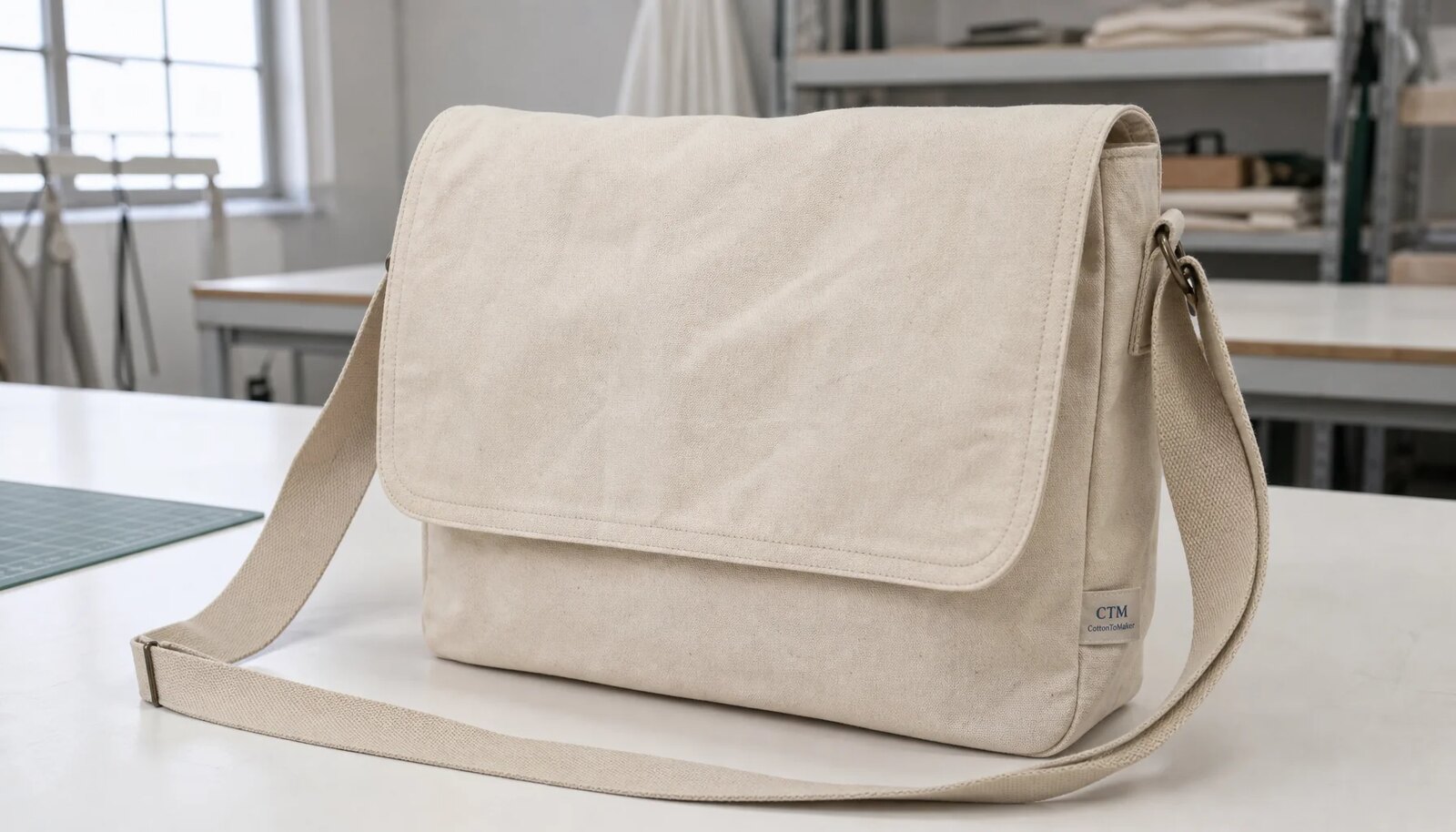
Start with the event job and packed load
A messenger bag for an event program should be specified around how it will be used, not around a generic catalog photo. The same silhouette can serve as a low-cost attendee handout, a staff operations bag, a speaker gift, or a retail merchandise item. Each use case has a different tolerance for weight, closure quality, interior finish, logo risk, and delivery timing.
Begin with a one-page usage brief. Identify who carries the bag, how it is distributed, whether it is handed out empty or pre-packed, how long it must remain useful, and what brand impression it must support. A registration giveaway may only carry paper, a pen, and a badge. A staff bag may carry a radio, charger, tablet, tape, water bottle, and printed schedules for several days. Treat those as different products.
Packed weight is especially important because messenger bags concentrate stress at strap anchors, side seams, flap corners, hardware points, and pocket mouths. If the bag must carry two to three kilograms, ask for reinforced anchors and a written load check. If the bag holds a tablet or catalog, confirm usable internal size rather than only outside dimensions.
- Attendee welcome bag: prioritize logo visibility, flat packing, efficient unit cost, and fast handout.
- Staff operations bag: prioritize strap strength, pockets, closure reliability, and repeated daily handling.
- Sponsor gift: prioritize print accuracy, color consistency, and a finish that respects brand standards.
- Speaker or VIP bag: prioritize structure, lining, hardware, interior organization, and presentation.
- Resale merchandise: prioritize repeatable dimensions, barcode labeling, retail pack options, and reorder consistency.
Convert the concept into a production spec
A clean RFQ should read like a production instruction. Suppliers need finished width, height, gusset, flap height, strap width, adjustable strap range, fabric weight, lining, closure, pocket layout, reinforcement, branding method, packing format, and delivery destination. When these fields are missing, each supplier makes its own assumptions, and the lowest price may simply reflect a smaller or weaker bag.
Canvas weight should be written in ounces and GSM when possible. As a practical sourcing reference, 8 oz canvas is often quoted near 270 gsm, 10 oz near 340 gsm, and 12 oz near 400 gsm, but these are estimates that vary by weave, finish, and mill tolerance. Avoid vague terms such as heavy canvas or premium canvas unless the supplier also confirms the measurable weight.
Dimensions should be finished measurements. If the bag must hold A4 documents, letter folders, a tablet, or a pre-built welcome kit, provide those item dimensions and approximate thickness. A deeper gusset increases capacity but also raises fabric consumption, carton volume, and freight cost. Flap coverage should be checked with the bag packed, because an empty sample can hide gapping.
- Budget build: 8 oz canvas, unlined body, simple flap, one-color screen print, fixed or basic adjustable strap.
- Balanced build: 10 oz canvas, reinforced strap anchors, adjustable webbing strap, flap closure, and optional inner pocket.
- Premium build: 12 oz canvas or lined 10 oz canvas, zipper under flap, internal pockets, upgraded hardware, label, or patch branding.
- Measurement fields: finished width, height, gusset, flap height, strap width, strap range, and pocket position.
- Approval rule: define whether measurements are taken flat, empty, seam to seam, or by usable internal capacity.
Use a real bulk pricing plan, not a single unit quote
For event planners, a useful bulk pricing plan shows how the price changes as quantity and specification change. The exact price depends on fabric market, factory, season, decoration, packing, and freight route, but procurement can still request structured tiers. Ask every supplier to quote the same bag at the same quantity breaks, with the same packing and Incoterm, so the comparison is meaningful.
A practical tier request is 300, 500, 1,000, 2,000, and 5,000 pieces. At low quantities, setup, sampling, cutting, screen preparation, and line changeover carry more weight. At higher quantities, fabric buying, cutting yield, decoration setup, and labor balancing usually improve. The price benefit is not automatic if the order is split across many colors, logos, labels, or packing versions.
Use a base-plus-options format. Ask for one base bag price, then add or deduct each feature. This prevents a supplier from winning by excluding lining, using a narrower strap, reducing canvas weight, or quoting bulk pack when the event actually needs individual barcode labels.
- Tier 1, 300 pcs: use for pilot events, VIP groups, or urgent runs; expect higher setup impact per unit.
- Tier 2, 500 pcs: common starting point for custom event programs where factory setup is more efficient.
- Tier 3, 1,000 pcs: useful for conferences and sponsor campaigns; ask whether one base bag can support several logo versions.
- Tier 4, 2,000 pcs: request sharper pricing on fabric, cutting, print setup, and carton planning.
- Tier 5, 5,000 pcs: suitable for multi-event or national programs; confirm capacity, inspection plan, and version control before chasing the lowest unit price.
Model landed cost before approving the cheapest option
Unit price is only one part of a canvas messenger bag budget. Landed cost includes sample fees, artwork setup, label tooling, inspection, export cartons, freight, duty, customs clearance, destination handling, domestic delivery, and sometimes fulfillment-center labeling. A low FOB unit price can lose its advantage once carton volume and freight are included.
Build a simple landed-cost comparison. For example, compare a 1,000-piece 8 oz unlined bag with one-color print against a 1,000-piece 10 oz reinforced bag with zipper under flap and inner pocket. The second option may have a higher factory price and heavier cartons, but it may reduce event risk if the contents are valuable or the bag will be reused by staff. The right decision is not always the lowest unit price; it is the lowest acceptable risk for the event job.
Ask suppliers to estimate carton size, pieces per carton, gross weight, total cartons, and shipment volume before final award. Messenger bags with thicker canvas, lining, metal hardware, and deep gussets can shift freight cost materially. If budget is tight, compare specification changes that reduce both manufacturing and freight impact.
- Likely price increasers: heavier canvas, lining, zipper, metal hardware, wider strap, extra pockets, second logo, individual bagging, barcode labels, and retail hangtags.
- Likely price reducers: stock natural canvas, one-color logo, flap-only closure, unlined body, standard webbing, bulk flat pack, and fewer artwork versions.
- Ask for add/deduct pricing for zipper, lining, inner pocket, tablet sleeve, second print, woven label, individual bag, and upgraded carton labeling.
- Compare EXW, FOB, CIF, DAP, or DDP only when the physical spec and carton plan are identical.
- Keep separate budget lines for samples, rush freight, inspection, rework, late artwork changes, and fulfillment requirements.
Choose the sourcing route by schedule and control
The right supplier route depends on how locked the specification is and how much timeline risk the event can tolerate. A direct cut-and-sew factory is usually best when the buyer needs control over fabric weight, pattern, reinforcement, logo placement, packing, and repeatability. It also requires clearer technical communication from procurement.
A trading company can be useful while comparing build levels, fabric options, and factories. The risk is visibility. Ask whether the same production site will make the sample and bulk order. Confirm where cutting, sewing, decoration, inspection, and packing happen. If those steps are split between suppliers, quality control must follow the bag through each stage.
Stock-program suppliers protect urgent event dates. The buyer accepts standard dimensions, colors, strap style, and logo positions, but gains speed. Still confirm that inventory and decoration capacity are reserved in writing. For domestic emergency top-ups, local decorators or resellers may be worth the premium even if the base bag is less customized.
- Use a direct factory for locked specs, meaningful quantity, and repeat programs.
- Use a trading company when you need fast comparison, but require final production-site transparency.
- Use a stock supplier when the event date is close and customization can be limited.
- Use a local reseller for small replenishment, domestic handling, or timing recovery.
- Ask all suppliers to state where fabric sourcing, cutting, sewing, decoration, inspection, and packing will occur.
Write an RFQ suppliers can price cleanly
A strong RFQ removes interpretation. Include product construction, branding, commercial terms, packing, quality expectations, and deadline milestones in one document. If the bag must fit a specific tablet, catalog, bottle, or welcome kit, include dimensions, weight, and photos if available.
Commercial terms matter. Suppliers may quote EXW, FOB, CIF, DAP, or DDP, and those prices are not interchangeable. For fair comparison, request the same Incoterm and destination from each supplier, or ask each supplier to show separate factory price, freight assumptions, and destination charges.
Artwork instructions should be measurable. Provide vector files, Pantone references, logo size, and logo placement from fixed bag edges. A useful instruction is specific, such as a logo centered on the flap, 9 inches wide, with the top of print 2 inches below the flap seam, and placement tolerance of plus or minus 0.25 inch if the panel allows it.
State the quality process before pricing is finalized. If you need a production-material sample, approval sheet, in-line photos, final random inspection, carton photos, packing list, or corrective-action process, include it in the RFQ. Suppliers price and schedule more accurately when operational requirements are visible early.
- Product line: size, gusset, canvas weight, finish, lining, closure, strap, pockets, reinforcement, hardware, and thread.
- Branding line: artwork file, method, color count, print size, position, Pantone target, label, patch, or hangtag.
- Commercial line: quantity by color and artwork, tier breaks, Incoterm, destination, event date, payment term, and sample fee.
- Packing line: flat or folded pack, individual bag or bulk pack, inner bundle, carton quantity, carton marks, barcode labels, and pallet rules.
- Quality line: sample type, tolerances, inspection standard, defect classification, photo reporting, and rework responsibility.
Approve branding for speed, accuracy, and durability
Branding is often the approval bottleneck. Screen printing is efficient for simple event logos, sponsor marks, and solid-color artwork. It performs best when ink opacity, registration, drying, and curing are controlled on the actual canvas, not only on a smooth test sheet. Natural canvas texture can soften edges and alter perceived color.
Transfers and digital print help with gradients, small details, or multi-color sponsor artwork, but they need testing on the real fabric finish. Washed, coated, or textured canvas can affect adhesion. Check cracking, edge lifting, abrasion, and appearance after the flap is folded and the bag is packed.
Embroidery can look premium, but dense stitching may pucker lighter canvas. Woven labels offer repeatable subtle branding for repeat programs, while patches create a stronger design feature. Each method adds its own control points: tooling, placement, stitch quality, backing, edge finish, colorfastness, and compliance concerns where relevant.
For multi-sponsor events, simplify when time is short. A one-color sponsor system, woven side label, or printed insert can be safer than a large multi-color panel requiring repeated approvals. Maintain an artwork placement sheet for repeat events so the next order starts from an approved standard.
- Screen print: strong for simple logos, solid colors, large runs, and repeat event programs.
- Transfer or digital print: useful for detailed artwork; test adhesion, cracking, abrasion, and edge lifting.
- Embroidery: premium feel; check puckering, backing, loose threads, and machine time.
- Woven label: tidy repeat branding; control label tooling, color, seam placement, and orientation.
- Patch: high visual impact; verify material, edge finish, stitching, durability, and colorfastness.
Treat samples as production controls
A sample is the control item for bulk production. Request a pre-production sample made with production canvas, webbing, thread, hardware, lining, closure, and decoration method. If substitutes are used, the supplier should identify them in writing and state what will change in bulk.
Review the sample with a tape measure and the actual event contents. Measure width, height, gusset, flap length, strap width, strap adjustment range, pocket size, and logo placement. Pack the real kit and check whether the flap closes, the strap sits correctly, the base holds shape, and pockets remain usable. Test zippers, snaps, magnets, buckles, or Velcro repeatedly.
Decoration review should happen in normal light as well as close-up photos. Check logo color, opacity, registration, edge sharpness, placement, and whether the print lands on a fold or stress area. For transfers, flex the area and inspect the edge. For embroidery, check puckering and backing visibility.
Document approval in a sample sheet. Record sample version, date, material references, measurements, hardware, logo method, approved deviations, and required corrections. If approval includes comments, either make a revised sample or issue a written correction list that becomes part of the production file.
- Approve a production-material sample whenever the schedule allows.
- Test the sample with real event-kit contents and approximate packed weight.
- Keep one signed sample with the buyer and one with the factory when possible.
- Do not release bulk production until fabric, artwork, construction, hardware, and packing are approved.
- Photograph approved details: front, back, flap, strap anchors, interior, logo, label, hardware, and carton pack.
Set measurable QC standards before cutting
Quality standards should be fixed before fabric is cut. Canvas messenger bags have predictable risks: wrong fabric weight, shade variation, size drift, crooked flaps, weak strap anchors, sparse stitching, misaligned logos, zipper failures, stains, loose threads, and packing errors. Written tolerances make inspection less subjective.
For many medium messenger bags, plus or minus 0.5 inch on body width, height, or gusset is a workable commercial tolerance, but tighter control should be agreed before pricing. Logo placement may need tighter control, such as plus or minus 0.25 inch from approved position, depending on artwork size and panel shape. Strap length, flap coverage, pocket placement, and gusset depth should also be listed when fit matters.
Defect classification helps avoid arguments. Critical defects may include wrong artwork, wrong color, broken strap anchor, unsafe sharp hardware, missing cartons, or unusable closures. Major defects may include open seams, obvious stains, zipper snagging, heavy print shift, crooked flap, severe shade mismatch, or wrong label placement. Minor defects may include small removable thread ends or slight natural canvas flecks within the approved character.
Inspection should include shipment accuracy, not only bag appearance. Event orders can fail when carton marks are wrong, versions are mixed, or pack counts are inconsistent. Require final photos and a packing list before shipment, especially when goods go directly to a venue or fulfillment center.
- Set tolerances for body size, gusset, flap length, strap width, strap range, pocket position, and logo placement.
- Check strap anchors, D-rings, adjusters, box stitches, bartacks, zippers, snaps, and flap alignment.
- Inspect print size, color, opacity, registration, edge sharpness, adhesion, cracking, and scuffing risk.
- Verify carton count, carton marks, artwork version, color, quantity, PO number, destination, and barcode labels.
- Use in-line inspection for larger or deadline-sensitive orders so rework is possible before final packing.
Plan packing and lead time around event operations
Packing affects freight, warehouse handling, registration setup, and distribution accuracy. Flat packing is usually efficient for event programs because cartons stack well and bags can be staged quickly. Individual bags, tissue, or interleaf paper may be justified for retail, VIP presentation, or scuff-sensitive prints, but they should be planned rather than added late.
Carton quantity should match handling conditions. A 25-piece carton may be easier for venue teams to lift and count. A 50-piece carton may reduce total carton count but can become heavy with 12 oz canvas, lining, and metal hardware. Request carton dimensions, gross weight, net weight, total cartons, and pallet details before approving shipment.
Lead time should be built backward from the on-site need date, not the event opening day. Goods often need time for receiving, counting, kitting, venue transfer, sponsor sorting, and problem correction. For standard custom bags with clear approvals, sampling may take about 7 to 14 days and bulk production about 25 to 40 days after approval, but custom dyeing, washed finishes, premium hardware, complex decoration, peak-season capacity, or freight constraints can extend the schedule.
Create a backup specification before the calendar becomes urgent. If a milestone slips, the buyer may switch to stock natural canvas, one-color print, standard hardware, flap-only closure, or bulk flat pack. Decide which compromises are acceptable early so the team is not forced into rushed approvals near the event date.
- Use carton marks showing item, color, artwork code, quantity, PO number, event name, destination, carton number, and total cartons.
- Avoid overpacking that creases the flap, distorts the print, bends hardware, or creates pressure marks.
- Request milestone dates for artwork, sample, material booking, cutting, sewing, decoration, inspection, export packing, shipment, and delivery.
- Allow time for receiving, counting, kitting, sponsor sorting, and venue transfer before the event.
- Do not remove final inspection from the calendar unless the buyer accepts the operational risk in writing.
Specification comparison for buyers
| Decision area | Budget option | Balanced event option | Premium or risk-control option |
|---|---|---|---|
| Canvas body | 8 oz cotton canvas, often quoted near 270 gsm depending on mill tolerance; best for light handouts | 10 oz cotton canvas, often quoted near 340 gsm; good default for conference kits and sponsor bags | 12 oz canvas or lined 10 oz canvas; better for VIP, speaker, resale, or staff-use bags |
| Closure | Flap only; lowest sewing complexity and fast packing | Flap with Velcro, snap, or magnetic closure; better content control | Zipper under flap, buckle, or tuck lock; higher material and QC attention required |
| Strap system | Fixed cotton webbing strap with simple seam attachment | Adjustable 1.25 to 1.5 inch webbing strap with reinforced anchors | Heavier webbing, metal adjuster, D-rings, box stitches, bartacks, and load-check requirement |
| Branding | One-color screen print in one position | One or two-color screen print, woven label, or simple patch | Multi-color print, transfer, embroidery, leather/cotton patch, hangtag, and tighter placement tolerance |
| Interior | Unlined, no internal pocket | Unlined or light lining with one slip pocket | Full lining, zipper pocket, tablet sleeve, pen loop, or key loop |
| Packing | Bulk flat pack by carton | Flat pack with inner bundles and carton marks by event, color, or logo code | Individual bag, barcode label, retail hangtag, carton sequencing, pallet labels, and fulfillment-center rules |
| Sourcing route | Stock-program supplier when schedule is urgent and customization is limited | Direct cut-and-sew factory for controlled specs and repeat orders | Factory plus third-party inspection when order value, brand risk, or deadline exposure is high |
| Main buyer risk | Quote may hide thinner fabric, smaller dimensions, or reduced reinforcement | Spec drift between sample and bulk if tolerances are not written | Higher unit cost, longer lead time, more approvals, and heavier freight cartons |
Buyer checklist before sampling
- Define the event use case: attendee giveaway, registration kit, staff operations bag, sponsor gift, speaker bag, VIP room-drop, resale merchandise, or post-event store item.
- List actual contents, including notebook, agenda, folders, tablet, bottle, catalog, charger, badge, inserts, staff tools, or merchandise, plus approximate packed weight.
- Set finished width, height, gusset depth, flap height, strap width, adjustable strap range, pocket layout, closure, and target load before requesting quotes.
- Specify canvas weight in ounces and GSM when possible; frame common 8 oz, 10 oz, and 12 oz references as estimates subject to fabric construction and mill tolerance.
- State whether fabric is natural, bleached, dyed, washed, coated, laminated, waxed, or water-resistant, because each affects price, feel, testing, and lead time.
- Define color as stock, lab-dip dyed, or Pantone-referenced, and require an approved swatch before custom fabric booking.
- Separate quote lines for lining, zipper, inner pocket, tablet sleeve, second print location, woven label, hangtag, individual bag, barcode label, and upgraded hardware.
- Define logo method, color count, print size, position from fixed edges, Pantone target, artwork file format, and placement tolerance.
- State MOQ by total quantity, fabric color, artwork version, label version, packing version, and destination split.
- Confirm whether multiple sponsor or event logos can share one base bag production run to improve pricing without losing version control.
Factory quote questions to send
- What exact canvas weight are you quoting in oz and gsm, what weave is used, and what tolerance applies to fabric weight?
- Is the canvas stock fabric, greige fabric to be dyed, or custom dyed, and when does material booking begin?
- Are sample fabric, webbing, thread, lining, closure, hardware, and decoration the same as bulk production, or are any substitutes being used?
- Which decoration method is included in the unit price, how many colors and locations are included, and what setup or tooling charges apply?
- What is the MOQ by fabric color, artwork version, label version, and packing version?
- What is included in the quoted unit price: strap, adjuster, D-rings, zipper, lining, pocket, label, hangtag, barcode, individual bag, silica gel if required, and export carton?
- What thread type, stitch density, seam allowance, bartack locations, and reinforcement method are used at strap anchors, side seams, flap corners, and pocket openings?
- What finished-size tolerances apply to width, height, gusset, flap, strap width, and strap length, and will they be written into the approval sheet?
- What logo placement tolerance applies from fixed edges, and how is print position controlled on flaps, pockets, seams, or curved panels?
- Can you quote price breaks at 300, 500, 1,000, 2,000, and 5,000 pieces using the same specification, packing plan, and Incoterm?
Quality-control points to confirm
- Fabric weight should remain within the agreed written tolerance, with no holes, thin panels, oil marks, heavy streaks, weaving faults, or unacceptable slubs beyond the approved canvas character.
- Fabric color should match the approved swatch or lab dip within the agreed tolerance, including body panels, flap, gusset, strap, lining, and replacement lots where relevant.
- Dyed or dark canvas should be checked for dry and wet rubbing risk, especially where bags may contact light clothing, printed inserts, badges, or hotel linens.
- Finished size should stay within the agreed tolerance; many medium canvas messenger bag programs use about plus or minus 0.5 inch for body dimensions unless tighter control is specified and priced.
- Gusset depth, flap coverage, opening width, pocket placement, and strap length should match the approved sample so the intended event kit fits without gapping or twisting.
- Stitching should be straight, secure, and even, with no skipped stitches, open seams, broken needle marks, loose thread chains, puckering, or messy visible backstitching.
- Stitch density should be checked against the approved standard, such as a defined stitches-per-inch range, because sparse stitching weakens stress areas even when seams look tidy in photos.
- Strap anchors, D-rings, adjusters, box stitches, and bartacks should withstand agreed load checks without tearing, slipping, twisting, or creating stress holes in the canvas.
- Print position, logo size, registration, edge sharpness, ink opacity, and color should match the signed artwork sheet and approved sample.
- Packing inspection should verify carton count, piece count, artwork version, carton marks, barcode labels, PO references, destination splits, and protection against flap creasing or print scuffing.