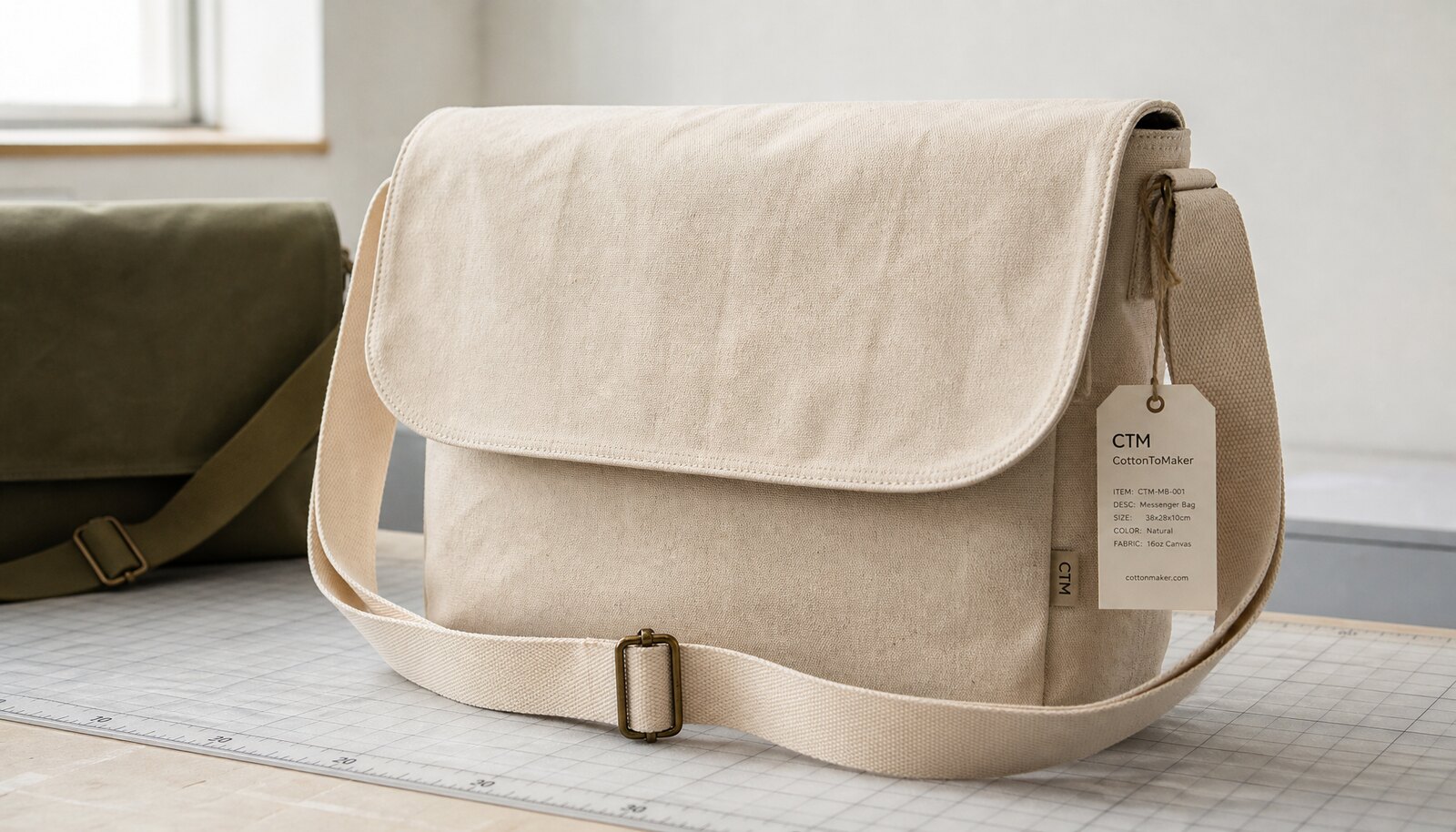
Why corporate gifts need a different bag spec
A canvas messenger bag for corporate gifts is judged as much by presentation as by function. The buyer is not only paying for a carrier; they are paying for how the recipient reads the brand when the flap opens, how the bag sits on the shoulder, and whether it feels like a deliberate gift or a cheap promotion. That is why a plain canvas shell is usually not enough. The bag needs enough structure to hold shape, a closure that looks intentional, and branding that survives handling without looking inflated or fragile.
The first mistake is buying to price before you buy to use case. A conference handout bag, a client welcome gift, and an internal recognition gift all need different specs. If the bag will carry documents only, a lighter canvas and simpler build may be fine. If it must carry a laptop, catalogs, or a mixed gift set, the wall weight, lining, strap reinforcement, and internal pocketing matter much more. Good sourcing starts with the end use and the perceived value target, then works backward into the spec sheet.
- Decide whether the bag is meant to look utilitarian, premium, or retail-ready.
- Separate the carry requirement from the gift presentation requirement.
- Do not let a low unit price hide a thin build that feels underwhelming in hand.
Set the size, fabric weight, and structure first
For most corporate gift programs, canvas weight is the first commercial decision that changes both feel and cost. A common starting point is 10 to 12 oz canvas, roughly 340 to 410 GSM, when the bag needs to stay light and cost-controlled. Move up to 12 to 16 oz, roughly 410 to 540 GSM, when the bag should hold shape better and feel more substantial. Heavier canvas also hides print distortion better, but it can make folding and sewing slower, which raises labor cost. If the buyer wants a more premium presentation, the right answer is often not simply thicker fabric. A well-balanced 12 oz canvas with a lining or bottom insert can outclass a heavy unstructured shell.
Messenger bags also need a clear decision on internal format. A business gift bag often benefits from a simple lining, one slip pocket, and a reinforced base so brochures and tech items sit flat. If you need a 13-inch or 15-inch laptop fit, state the actual device dimensions, not just the bag name. Ask the factory to confirm the usable width, height, and depth after seams are sewn. A bag can look large on a drawing and still fail in use if the gusset is narrow, the flap steals too much opening space, or the internal pocket reduces the main compartment by more than expected.
- Use 10 to 12 oz canvas for lighter gift programs and 12 to 16 oz for a more substantial feel.
- Ask for finished dimensions, not cut size, and confirm the usable opening with the flap closed.
- If the bag carries laptops, add structure before you add decorative trim.
Choose branding that fits the fabric and the audience
Canvas is forgiving, but it is not a blank sheet in the way coated polyester is. Fine text, gradients, and thin lines can disappear into the weave unless the print method matches the artwork. For corporate gifts, screen print is usually the best value when the logo is simple and the brand color count is low. It keeps the image crisp, cost stable, and production repeatable across larger runs. Embroidery works well when the logo is compact and the buyer wants a more tactile, premium impression. Woven patches are often the safest option when the logo is detailed, small, or needs a polished retail look without relying on direct print coverage.
The wrong move is choosing a decoration method because it is expensive rather than because it suits the bag. A large embroidered logo on a soft flap can pucker the fabric. A multi-color print on rough canvas can look dirty if the underbase is weak. Heat transfer can work for short runs or complex art, but it can become the weak link if the bag is heavily folded or exposed to friction. Ask for the decoration method, the exact placement, and the pass/fail standard before you approve artwork. If the logo sits near a seam, rivet, or edge fold, make the factory show the clearance on the template, not only on a flat proof.
- Use screen print for simple logos and repeatable medium-to-large quantities.
- Use embroidery or a woven patch when the logo should feel premium and durable.
- Keep small text and fine details out of rough canvas unless the factory proves legibility on a sample.
What drives the quote and why the cheapest line is rarely the full story
A usable supplier quote should break the bag into its real cost drivers. Fabric weight, lining, closure type, strap webbing, buckle or snap hardware, decoration method, and packing method all change the price. The problem is not that factories quote differently; it is that many quotes leave out the part that later becomes a change order. A buyer cannot compare two offers if one includes only a body shell and a one-color print while the other includes lining, a reinforced shoulder pad, an insert card, and polybag packing. Ask for the quote to separate material, labor, decoration, packing, tooling, sample cost, and freight term so you can see where the difference comes from.
MOQ logic also follows the same pattern. A basic blank bag may allow a lower minimum because the factory can cut and sew from existing fabric stock. Once the order adds custom lining, custom webbing color, a nonstandard buckle, or a stitched patch, the MOQ usually climbs because the factory has to reserve more material and setup time. For corporate gifts, buyers often underestimate how much packaging affects the real unit cost. A gift-ready fold, tissue wrap, barcode label, and master carton mark can add more operational work than the print itself. If the quote is suspiciously low, it often means one of these elements has been omitted rather than discounted.
- Request separate lines for fabric, sewing, print or patch, lining, hardware, packing, and tooling.
- Ask what triggers MOQ increases: custom color, custom zipper pull, new artwork, or special insert.
- Treat packaging as part of the product, not as an optional extra.
How to compare supplier routes without mixing apples and oranges
Different sourcing routes solve different business problems, and procurement teams need to name the route before they compare the quote. A direct cut-and-sew factory with in-house printing is usually the cleanest route when you want full control over the bag build and decoration. A trading company can make sense when your program spans multiple product types or when you need one commercial contact to coordinate several factories. A blank-stock route with local branding works when the event date is fixed and you need speed more than full customization. Each route has a cost profile, but the real difference is risk ownership.
The route also affects your ability to recover if the first sample is weak. A factory that makes the body, the lining, and the print in one place can fix a defect faster than a broker who has to chase multiple subcontractors. On the other hand, a trading company may secure a better blend of capabilities if your program needs not only bags but also inserts, sleeves, or mixed packaging. The point is not to declare one route superior. The point is to make sure the buyer knows what kind of supplier they are evaluating and what tradeoff is being accepted in exchange for the quoted number.
- Match the sourcing route to the program goal: speed, control, customization, or convenience.
- Do not compare a blank-stock quote with a fully custom build unless the spec is identical.
- Ask who owns defect correction if the sample passes but the bulk run drifts.
Sample approval should test use, not just appearance
A good sample process for canvas messenger bags should include at least two checkpoints: a visual approval sample and a pre-production sample. The visual sample confirms the look, logo placement, and general feel. The pre-production sample confirms the actual bulk fabric, trims, print setup, and packing method. If the item will be used as a gift, the sample should be reviewed fully packed, not only as an empty bag. A bag that looks sharp on the table may still disappoint if the closure sits crooked when loaded, the strap twists under weight, or the flap opens too far and reveals unfinished lining edges.
The sample should be measured and handled like a real production unit. Confirm finished dimensions, strap length, pocket depth, stitch quality, and print registration. Load the bag with the intended contents or a weighted substitute and see whether the shoulder drop remains comfortable and the bottom sags. If the logo is printed, fold the bag along its natural travel points and check whether the print cracks on the crease. If you are buying a premium corporate gift, that kind of test matters more than a perfect front-facing photo. Approval should be based on how the bag behaves in use and during packing, not only on how it looks in a sample room.
- Approve both appearance and function before bulk starts.
- Measure the actual sample against the agreed finished spec sheet.
- Test the bag loaded, folded, and packed the way the final customer will receive it.
Packing and presentation can raise or destroy the gift value
For corporate gifts, packing is part of the product story. A canvas messenger bag shipped loose in a carton may arrive technically correct but still feel unfinished. A controlled fold, a clean polybag, a small insert card, and a consistent carton mark can turn the same bag into a gift-ready item. The buyer should decide whether the bag is intended to be handed out directly, placed inside a larger gift box, or sold as retail stock. Each path needs different packing logic. If the bag is going into a gift box, overpacking the bag itself can make it bulky and hard to place. If it is going directly to recipients, the inner presentation matters more.
Packing also affects defect risk. Canvas absorbs handling marks, and a poorly folded flap can develop hard creases that never fully recover. If the item ships in humid conditions, use moisture protection appropriate to the route and storage time. Ask for the folding method, polybag thickness or alternative wrap, carton quantity, and carton size before approving bulk. If there is a logo patch, side label, or woven tag, confirm that the fold will not crush it. A bag that arrives with the label hidden or distorted may still pass dimensional QC but fail brand presentation.
- Define whether the bag is gift-ready on arrival or only a component inside a larger kit.
- Confirm fold direction and packaging so the logo is visible and not crushed.
- Use carton labels and SKU marks that match the retail or distribution plan.
Lead time risk is usually a sample problem first
A realistic schedule for custom canvas messenger bags often runs through several gates: artwork confirmation, sample development, sample revision if needed, bulk material booking, production, packing, and shipment. In many programs, the sample stage is where the timeline gets damaged, not the sewing line. If the buyer changes logo placement after seeing a sample, or if the factory has to rework the flap shape because the artwork was not sized correctly, the bulk start moves back immediately. That is why the RFQ should require complete artwork files, a final size target, and a clear approval path before the factory quotes lead time.
For planning purposes, many buyers treat one sample cycle plus bulk production as the normal path, not the optimistic one. A simpler blank-stock program may move faster, while a fully custom build with special webbing, lining, or packaging usually needs more time. Peak seasons, holidays, and shipping congestion can add more risk than the bag itself. Protect the schedule by asking the factory when raw materials are actually reserved, whether print plates or labels have been ordered, and what happens if the pre-production sample is delayed by a week. Those are the questions that separate a credible plan from a sales promise.
- Build schedule buffer for sample revision, not only for bulk sewing.
- Reserve more time when custom packaging, special hardware, or multiple logo placements are involved.
- Avoid committing a delivery date until the approval sample is signed off.
Compare landed cost, not just ex-factory price
The correct buying comparison for canvas messenger bags is landed cost by route, not the smallest ex-factory quote. Landed cost should include the bag unit price, sample and tooling fees, packing spec, inland handling, freight mode, duty or tax exposure, and any domestic decoration if the bag is only delivered blank. A lower factory quote can become the highest total spend if it requires a second print step, extra rework, or a more expensive shipping carton because the bag is packed inefficiently. Procurement should ask every supplier to quote the same terms and show which items are included versus optional.
When you compare quotes, look for hidden specification drift. One supplier may quote a 12 oz canvas bag with a simple lining and unprinted interior, while another quietly uses 10 oz fabric, no reinforcement, and a lighter zipper pull. That is not a cheaper product; it is a different product. The safest method is to create a one-page spec summary with dimensions, fabric weight, decoration method, packing method, and approval sample requirements, then require every supplier to respond line by line. That removes the easy excuse that one quote was based on assumptions the others did not share.
- Compare on the same spec, the same pack-out, and the same shipment term.
- Treat sample, tooling, and domestic rebranding costs as part of the total buy.
- If two quotes differ sharply, check for missing lining, thinner fabric, or lighter packing rather than assuming margin differences.
Specification comparison for buyers
| Spec decision | Recommended option | When it fits | Buyer risk to check |
|---|---|---|---|
| Direct cut-and-sew factory with in-house screen print | Best default for custom corporate gifts | You need one supplier to control sewing, branding, packing, and final inspection | Confirm the print step is truly in-house and not quietly subcontracted |
| Trading company sourcing from multiple factories | Useful when you need flexibility across sizes, trims, or regions | You want one contact point and can accept an extra layer between you and production | Clarify who owns sample approval, defect correction, and schedule recovery |
| Blank stock bag imported, logo added locally | Fastest route for urgent events or short campaigns | You value speed and lower development work more than deep customization | Check blank stock consistency, logo adhesion, and whether the base bag looks premium enough |
| Factory with a dedicated sample room and pre-production review | Best for first-time programs or strict brand approvals | Artwork, trim placement, and presentation need several sign-offs before bulk | Make sure sample speed does not hide weak bulk capacity or missed details |
| Supplier with in-house embroidery or woven patch capability | Good for premium positioning with a simpler logo | Your mark works well as a patch, stitched logo, or small emblem | Check stitch density, edge finish, thread color stability, and logo legibility at distance |
| Supplier that can add lining, board, or internal pocketing | Best for laptop use, sales kits, or heavier carry loads | The bag must feel more like a business accessory than a giveaway | Verify structure does not make the flap awkward or reduce usable volume |
| Lowest-price workshop with no documented QC process | Only for very basic giveaways where failure risk is acceptable | The bag is decorative and there is little brand risk if variation appears | Expect wider spread in dimensions, print quality, seam finish, and packing consistency |
| Export factory with carton spec and transit-ready packing control | Best for sea freight, retail distribution, or warehouse handling | The goods will travel far and be handled multiple times after packing | Check carton strength, inner protection, and whether labels match the shipment plan |
Buyer checklist before sampling
- Define the actual use case: client gift, employee reward, event giveaway, or retail resale.
- Lock the finished size, usable internal space, and whether the bag must fit a 13-inch or 15-inch laptop.
- Specify canvas weight in GSM or oz, plus whether you want washed, dyed, or natural canvas.
- State the closure type, strap construction, and whether you need a lining, pocket, or base board.
- Provide vector artwork, Pantone references, and the exact logo placement on the bag body, flap, or patch.
- Ask for a pre-production sample, not only a sales sample, before bulk approval.
- Confirm packing method, carton count, polybag use, barcode labels, and any insert card or gift sleeve.
- Match every quote line item: fabric, print, trim, packaging, tooling, sample cost, lead time, and shipment term.
Factory quote questions to send
- What exact canvas weight, weave, and finishing are you quoting?
- Is the logo decoration screen print, embroidery, woven patch, heat transfer, or a mixed method?
- What is the MOQ per color, per artwork version, and per packing format?
- Are lining, pocketing, zipper, magnetic closure, or metal trims included in the quoted price?
- Can you provide finished dimensions, tolerance limits, and the expected bag weight per piece?
- What is the sample cost, sample lead time, and what changes trigger a new sample charge?
- Are screens, plates, embroidery files, labels, or packaging dies one-time charges or reusable?
- What packing method is included: fold method, polybag, tissue, desiccant, insert card, and master carton spec?
- What is the bulk lead time after sample approval and deposit, and what can delay it?
- Which QC standard do you follow for dimensions, stitching, print quality, and carton packing?
Quality-control points to confirm
- Fabric weight matches the approved spec and the lot does not mix visibly lighter or rougher canvas without approval.
- Finished dimensions stay within a tight tolerance, usually about plus or minus 0.5 cm for small bags and plus or minus 1 cm for larger bags.
- Load-bearing seams use consistent stitching with reinforcement at strap ends, corners, and flap attachment points.
- Print placement is centered or positioned within the approved tolerance, with clean edges and no color bleed into the weave.
- The logo finish passes a simple flex check without cracking, flaking, or obvious distortion on the fold line.
- Hardware such as snaps, zippers, buckles, and rivets operates smoothly and has no sharp edges or loose fixation.
- Interior seams, lining edges, and pocket openings are neat, with no raw thread tails that could snag documents or clothing.
- Packing count, fold direction, carton labels, and outer carton marks all match the purchase order and shipping plan.