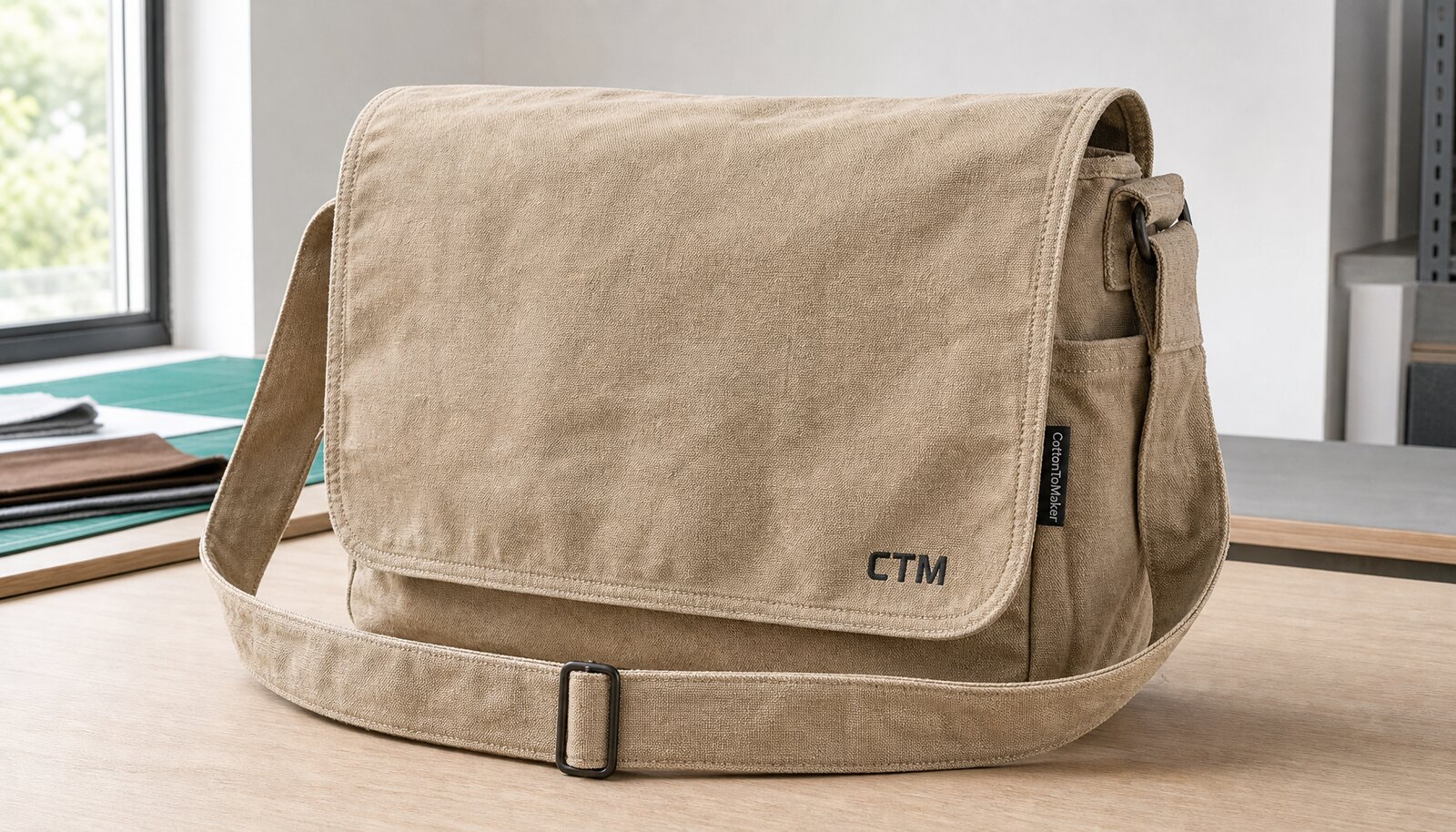
Start With the Launch Job, Not the Bag
A canvas messenger bag for a brand launch is not just a carry item. It is often the first physical object a buyer, influencer, distributor, or store team touches, so the bag has to do three jobs at once: carry the right load, present the brand cleanly, and survive handling before it reaches the end user. If the bag is too light, it feels cheap. If it is too heavy or overbuilt, it costs more than the campaign can justify and slows production. The right spec sits between those extremes.
The common mistake is to write the RFQ around a generic bag and then add logo requests later. That usually leads to a quote that cannot be compared, because one supplier priced a promo build and another priced a retail-ready build. For a launch program, define the actual use case first: is it a press-kit bag, a retail gift-with-purchase, a trade-show handout, or a store display carrier? Once that use case is clear, the rest of the spec becomes easier to defend.
- Use case should define size, load, closure, and brand presentation.
- A launch bag that carries paper, samples, or a light laptop needs a different strap and seam spec than a flat promo bag.
- The bag should look finished on arrival, not like a blank that still needs work.
- Do not mix launch quality with lowest-price promo logic if the bag will sit in a retail environment.
Choose the Fabric Weight and Build That Match the Product
Canvas weight drives most of the feel and much of the cost. In practice, 10 oz canvas is around the light promo end, 12 oz to 14 oz is the most balanced launch range, and 16 oz starts moving toward a firmer premium build. In GSM terms, those weights are often roughly 340 gsm, 407 gsm, 475 gsm, and 540 gsm, but mills and finishes vary, so do not rely on the label alone. A buyer should ask for the actual fabric swatch and the mill spec, not just a generic canvas description.
The shell weight is only one part of the build. A messenger bag that will be handled by brand teams or retail staff usually needs at least a lined interior, reinforced strap anchors, and enough seam allowance to hold shape at the flap and side gussets. If the bag is meant for documents or a small laptop, structure matters more than pure fabric thickness. A lighter shell with poor reinforcement will fail faster than a slightly heavier shell with proper bar-tacks and a sensible panel layout.
- 10 oz is acceptable for lightweight promo use, but it tends to sag with books or devices.
- 12 oz to 14 oz is the most practical range for launch programs that need a premium but controlled cost.
- 16 oz is better when the bag must feel substantial or carry heavier contents.
- Ask for shrinkage data if the bag will be washed or if the brand is sensitive to post-production distortion.
- If the bag uses contrasting lining, confirm colorfastness so the lining does not bleed onto the shell.
Branding Choices: Print, Embroidery, or a Woven Patch
The branding method should follow the logo, not the other way around. A simple block logo with two spot colors usually works best as screen print because the setup cost is sensible at launch quantities and the result stays clean on large flat areas. If the mark is tiny, detailed, or meant to feel more premium, a woven patch or embroidery can be better, but only if the canvas is heavy enough and the stitch count will not pucker the fabric. Thin scripts and fine lines are the first elements to fail when a logo is forced into the wrong decoration method.
Print placement matters almost as much as method. A logo that sits too low can disappear when the bag is worn. A logo that sits too high can clash with the flap fold or pocket line. For launch bags, keep the artwork simple, lock the Pantone reference, and approve the actual print size on a sample before bulk. Ask the supplier how the art will be applied, where the logo lands on the panel, and what tolerance they will use for placement and registration.
- Screen print fits simple artwork, flat graphics, and repeatable bulk runs.
- Embroidery works for a premium look, but it can distort light canvas if the stitch density is too high.
- Woven patches are useful when the logo needs edge definition and the fabric itself should stay clean.
- Heat transfer can handle more complex art, but it needs wash and rub testing before approval.
- If the launch bag will ship through fulfillment, make sure the decoration can survive folding, packing, and carton compression.
Supplier Route and Cost Tradeoffs
There are several valid sourcing routes for canvas messenger bags, and each one fits a different launch problem. A direct cut-and-sew factory is usually the best option when the bag needs custom panel shapes, custom lining, or a repeatable bulk program. A trading company or sourcing office can be useful when the launch includes multiple components or when the buyer wants one contact to manage coordination. A regional decorator with imported blanks works when speed matters more than structural customization and the logo is simple enough for a ready-made base bag.
The key is to compare the route, not just the unit price. A lower ex-works number can hide higher setup charges, a longer sample cycle, or unclear subcontracting. For brand launches, buyers should ask who owns cutting, who prints, who packs, and who signs off the final inspection. If one party is only coordinating and another party is actually making the bag, the commercial quote needs to show that structure clearly or the buyer cannot compare risk properly.
- Direct factory usually wins on control and repeatability.
- Trading company usually wins on coordination, but margin and subcontract risk need to be visible.
- Decorator with blanks usually wins on speed, but the base bag may not match retail expectations.
- Small launch quantities often need higher setup cost per unit, so compare total order cost, not only unit price.
- If multiple colors are planned, ask whether the MOQ applies per color or per combined style.
Write the RFQ So Quotes Can Be Compared
A usable RFQ for canvas messenger bags should let the factory price the same bag three times without guessing. That means the finished size, shell fabric weight, lining, strap width, pocket layout, closure type, logo method, carton pack, and shipping window all have to be visible in the request. If any of those items are vague, the supplier will fill the gap with its own standard and the quote will look cheaper than it really is. That is how launch orders go wrong before a sample is even made.
The most practical RFQ format is a one-page spec summary plus artwork and a small set of target quantities. Include the first quantity you want to test, the expected repeat quantity if the launch works, and the delivery date that matters to your channel. Then ask the supplier to break the quote into shell fabric, trim, print or embroidery, sample fee, packing, and ex-works price. When those lines are separate, procurement can see where the cost is coming from and which lever to pull if the target margin is tight.
- List finished dimensions, not just a general size description.
- State the exact canvas weight and whether the fabric is raw, dyed, or washed.
- Add the artwork placement, decoration size, and color references.
- Ask for pricing at multiple quantities so MOQ effects are visible.
- Require quote assumptions to be written out, including packing and lead time.
Sample Approval and QC Thresholds
A launch bag should move through at least one formal sample approval stage before bulk production starts. In most programs, the first sample is only a construction check. The pre-production sample is the more important milestone because it shows the final fabric, decoration, packing, and sizing together. Once that sample is signed off, it becomes the reference point for mass production. Without a golden sample, every later dispute becomes subjective, especially on color, logo placement, and edge finishing.
The acceptance criteria should be practical, not theatrical. Buyers do not need lab language for every point, but they do need clear thresholds for the parts that affect retail quality. Focus on dimensions, seam strength, print registration, strap symmetry, closure function, and carton accuracy. If a sample fails on something the user will notice in the first five seconds, it is not ready for bulk. If the supplier cannot reproduce the sample twice in a row, the bulk run is still at risk.
- Approve one golden sample and keep it tied to the PO.
- Measure body size, strap length, pocket depth, and flap alignment.
- Rub-test printed areas and open-close closures repeatedly before sign-off.
- Look at inside seams and pocket corners, not only the outside face.
- Require a first-article or pilot-run review if the launch date is fixed.
Packing, Cartons, and Shelf Readiness
Packing decisions affect both brand perception and landed cost. A messenger bag folded too tightly can hold creases that make the product look cheap at first opening. A bag packed too loosely can shift inside the carton and damage the print or wrinkle the lining. For launch programs, a simple controlled fold, tissue or insert board, a clear polybag if needed, and a retail barcode label are usually enough. If the bag is going directly to stores or fulfillment, the pack method should support quick scanning and fast unpacking.
Master carton sizing matters more than many buyers expect. A carton that is too large adds freight cost, while a carton that is too tight crushes the shape and leaves the bag looking distorted on arrival. Ask the supplier to show the folded dimensions, the inner pack count, and the outer carton size before the order is released. If the launch uses a premium logo print, make sure the polybag and carton do not mark the print surface during transit.
- Use a fold method that protects the logo and keeps the flap shape clean.
- Confirm whether each unit needs a polybag, hang tag, or barcode sticker.
- Set the carton count to balance handling efficiency and shape retention.
- Check that master carton marks match the PO and the channel receiving the goods.
- If the item ships to retail, require a pack test before the bulk run.
Lead Time Risk and Schedule Control
Launch timing is usually tighter than the bag itself. A realistic schedule needs time for artwork approval, sample making, sample revision, fabric booking, bulk production, packing, and freight. If the bag uses a custom dye lot, a woven patch, or special hardware, the timeline gets longer very quickly. The risk is not only factory sewing time. Most delays happen before sewing starts, when fabric, trim, or artwork is still being revised.
The safest way to protect the launch date is to lock the high-risk items first. Decide the fabric, logo method, and pack format before arguing about minor cosmetic details. A buyer who approves a sample too late, or sends corrected artwork after material booking, usually pays for the delay through air freight or missed launch windows. That is why the PO should include the latest acceptable approval date and the fallback shipping mode if the production schedule slips.
- Plan sample time, production time, and freight time separately.
- Keep a buffer between sample approval and the final ship date.
- Avoid changing artwork after screens, patches, or trims are already booked.
- If the launch date is fixed, build in a backup freight option.
- Ask the factory to flag any process that is on the critical path.
Landed-Cost Comparison Before You Place the Order
For procurement, the real decision is not the ex-works unit price. It is the total landed cost per sellable bag. That number includes the bag, setup charges, sample fees, packaging, inland handling, freight, duty, brokerage, and the cost of any defects or rework. A quote that is 8 percent lower on paper can become more expensive if the carton pack is inefficient, the print rejects are high, or the freight density is poor. That is why launch bags should be quoted as complete landed programs rather than as a single factory number.
A useful comparison method is to look at the bag in three layers. First, the production layer: shell, trim, print, and packing. Second, the logistics layer: carton size, carton count, and shipping mode. Third, the commercial layer: payment terms, overrun tolerance, and replacement policy. If the supplier can show all three layers, procurement can compare offers with much less guesswork. If the supplier only sends a round unit price, assume there are hidden assumptions that will appear later as extra charges.
- Compare ex-works, not just delivered, when the supplier routes differ.
- Include setup, sample, and packaging in the first cost review.
- Watch carton dimensions because volumetric freight can change the landed result.
- Treat defect allowance and replacement terms as cost items, not afterthoughts.
- Use the same spec across all quotes or the comparison is not valid.
Specification comparison for buyers
| Spec decision | Recommended option | When it fits | Buyer risk to check |
|---|---|---|---|
| Supplier route | Direct cut-and-sew factory | You need custom panel shapes, lining, trim, and repeat SKUs after launch | Verify the factory owns sewing, cutting, and final inspection instead of passing work to unknown subcontractors |
| Supplier route | Trading company or sourcing office | You need one contact for mixed components, multiple colors, or small launch programs | Ask who actually makes the bag and where each process happens so margin and delays are visible |
| Supplier route | Regional decorator with imported blanks | You need a fast regional drop for a simple logo on a standard messenger bag | Check whether the blank bag is retail-grade or only promo grade before you approve the artwork |
| Fabric weight | 12 oz to 14 oz canvas | Most launch bags need a balance of structure, hand feel, and price | Ask for the actual GSM and a swatch because nominal ounce ratings vary by mill and finish |
| Fabric weight | 16 oz canvas | You want a firmer premium feel or expect heavier contents | Confirm strap stitching and seam allowance are upgraded, or the heavier shell will still fail at the stress points |
| Print method | 1 to 2 color screen print | The logo is bold, flat, and order volume is high enough to spread screen setup cost | Get ink type, cure method, and rub resistance in writing so the mark does not crack in transit |
| Print method | Embroidery or woven patch | The launch position is premium and the logo is simple enough to stitch cleanly | Check puckering, backing, and stitch density because lighter canvas can distort under dense embroidery |
| MOQ strategy | One shell spec with multiple logo variants | You are testing several brand markets or event uses at once | Separate setup fees from unit price so a low MOQ does not hide expensive changeovers |
| Packing route | Retail fold with insert and barcode label | The bags will ship into stores, fulfillment centers, or kitting operations | Confirm carton count, fold method, and label placement so the bag opens cleanly and scans correctly |
Buyer checklist before sampling
- State the finished size, usable depth, and any laptop or document fit requirement.
- Lock the shell fabric weight in oz and GSM, not just the word canvas.
- Define strap width, strap length, and whether the strap needs padding or a sliding shoulder pad.
- Specify lining, pocket count, closure type, and whether the bag must stand upright when packed.
- Provide logo artwork in vector format, plus Pantone references and exact print placement.
- Set the acceptable sample type: sales sample, pre-production sample, or golden sample.
- Ask for unit pricing at at least three quantities so MOQ effects are visible.
- Require carton size, pack count, and master carton mark details before approval.
- State the target ship window and the latest acceptable approval date for art and samples.
- Define overrun or underrun tolerance, defect allowance, and replacement terms in the PO.
Factory quote questions to send
- What is the ex-works price at 300, 500, and 1,000 pieces per color, and what changes in the cost structure at each step?
- Is the quote based on 12 oz, 14 oz, or 16 oz canvas, and is the fabric raw, dyed, washed, or pre-shrunk?
- Which processes are in-house, including cutting, sewing, printing, embroidery, packing, and final inspection?
- What are the setup charges for screens, embroidery files, woven labels, or custom hardware, and are those charges one-time or per color?
- What is the sample fee, what sample stage is included, and can any of that cost be credited against the bulk order?
- What carton pack count, carton dimensions, inner packing, and label format are included in the quote?
- What is the production lead time after artwork approval, sample approval, and deposit receipt?
- What overrun or underrun tolerance do you allow, and how are extra or short units handled on the invoice?
- What quality standard or inspection report do you follow, and can you share photos from a previous production run?
- What shipment term and payment term does the quote assume, and what costs are excluded from the unit price?
Quality-control points to confirm
- Finished dimensions should stay within the approved tolerance, typically plus or minus 1 cm on the body and plus or minus 2 cm on strap length unless the spec says tighter.
- Fabric weight and hand feel should match the approved swatch, with no obvious shade banding between panels or between front and back pieces.
- Main seams, strap ends, and stress points should have even stitch density, clean back-tacks, and no skipped stitches or loose thread tails.
- Bar-tack reinforcement at strap anchors and pocket openings should be centered and secure, with no lifted edges or broken threads.
- Print placement should match the artwork proof, with clear edges, correct color, and no cracking, smearing, or offset after rubbing.
- Zippers, snaps, magnetic closures, or hook-and-loop parts should run smoothly through repeated open-close cycles without snagging.
- The bag should pass a realistic load test for its intended use, such as a filled sample that sits and carries without seam opening or strap distortion.
- Carton labels, barcode labels, and inner pack counts should match the purchase order, and the outer carton should not crush the bag shape in transit.
- There should be no oil marks, needle damage, mold smell, fabric holes, or contamination from cutting dust inside the lining or pocket corners.