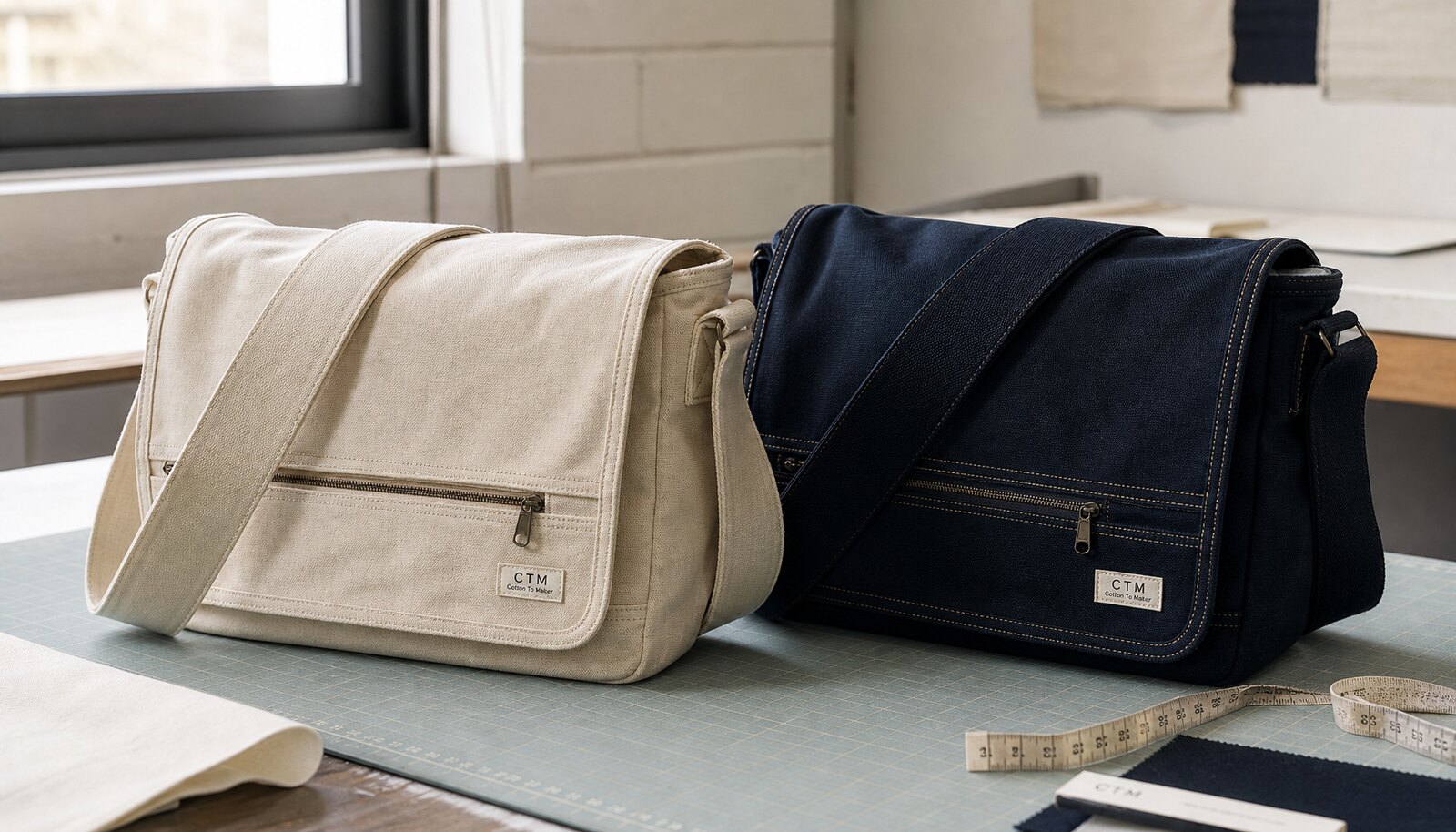
Start With The Winery Use Case
A canvas messenger bag for a boutique winery is not just a tote with a flap. In practice, it may be sold in a tasting room, used as a club-member gift, bundled with wine accessories, or offered as a premium retail item that needs to look structured on a shelf and still carry bottles, catalogs, or event materials. That use case decides whether you need an open top, a zipper, a flap with snap, or a more finished interior. If the buyer skips that step and only asks for a generic messenger bag, the factory will usually quote the cheapest workable construction, not the bag that fits the retail channel.
The right spec starts with what the end customer will actually carry. If the bag is mainly for lightweight merch and paper collateral, a simple unlined build may be enough. If it is meant to support daily shoulder use, repeated resale, or premium gifting, the strap, handle drop, closure, and shape retention matter much more than a decorative print. Boutique winery buyers often pay extra for a bag that feels intentional and durable, then lose the margin because the spec never defined the load, the opening style, or the amount of structure needed.
- Define the primary use: retail sale, tasting room giveaway, club kit, or event pack.
- Set the likely load before you price the bag: papers only, mixed merch, or heavier carry.
- Decide whether the bag should read as premium retail or practical promotional stock.
Set Fabric And Structure First
Fabric weight drives both the feel and the quote. For canvas messenger bags, buyers usually compare 12 oz, 14 oz, and 16 oz construction, but mills and factories may convert that differently into gsm depending on weave density and finishing. As a working rule, 12 oz suits lighter retail use, 14 oz is a balanced middle point, and 16 oz is better when the bag needs a firmer body or better resistance to sagging. Ask the factory to state both gsm and finished fabric treatment, because raw canvas, washed canvas, and dyed canvas behave differently in sewing and in final shape.
Structure is the second decision that changes how the bag performs. A soft unlined body keeps the cost down, but a lightly lined or partially reinforced bag holds the shape better and presents better in a tasting room. If the bag will carry heavier items or needs to stand upright on a shelf, specify base reinforcement, seam allowance, and strap attachment details early. Otherwise the production sample may look acceptable flat on the table and still fail once the buyer loads it with real product.
- Use 12 oz for lighter, price-sensitive programs that do not need much body.
- Use 14 to 16 oz when the bag must feel premium, structured, or reusable.
- Ask for reinforcement at stress points rather than adding unnecessary layers everywhere.
Compare Sourcing Routes Before You Lock The Spec
The supplier route matters as much as the spec. A direct factory with a real canvas bag line gives better control over pattern, stitching, and packing, but only if they actually produce the bag rather than buying and relabeling it. A trading company or sourcing agent can be useful when the buyer needs one point of contact across multiple categories, but the quote often hides the real production source and reduces transparency on lead time, QC, and issue handling. For a buyer who needs repeatable canvas messenger bags, the cleanest path is usually a direct factory with documented bag experience.
Short-run programs work differently. If the winery is testing a new retail item or needs a fast seasonal drop, a stock blank bag plus local decoration may be the fastest route. That route lowers the upfront commitment, but it also creates more variation between the blank bag, the print partner, and the final packed unit. Use it when speed matters more than exact construction control. Use a direct factory when the buyer cares about repeating the same bag over multiple seasons, colorways, or reorders.
- Direct factory: best for control, repeat orders, and custom construction.
- Trading company: useful when consolidating many SKUs, but verify production ownership.
- Stock blank plus local decoration: suitable for short runs and concept testing.
Choose The Branding Method That Fits The Order Size
Branding should match both the logo and the order size. For boutique wineries, one-color screen print is often the cleanest choice because it is durable, legible, and easy to repeat across reorders. A woven side label can also work well when the buyer wants a quieter brand mark, especially on natural canvas. Embroidery and patches create a more premium look, but they add labor and can be expensive if the logo is small, detailed, or placed on a thick area of the bag. Heat transfer can help with complex artwork, but it is usually not the first choice for a bag that should feel like a lasting retail item.
The practical issue is not just appearance. The logo placement affects sewing, registration, and waste. A large print across the front panel can hide stain marks and make the product look more retail ready, but it also raises the risk of misalignment. A small chest logo or corner mark is cheaper and easier to keep consistent, yet it may not read well from a display shelf. Buyers should send vector artwork, specify Pantone references if color matters, and request a print proof on the actual fabric before bulk approval.
- Use screen print for simple logos, strong contrast, and predictable repeat orders.
- Use woven labels or small patches when the brand needs a quieter, premium look.
- Avoid fine text or thin lines unless the printer has already proven that detail on the exact canvas.
Read The MOQ And Quote Like A Factory Does
MOQ is not just a number; it is a reflection of setup time, fabric consumption, and labor efficiency. A bag with one panel print, no lining, and a simple strap may support a lower MOQ than a bag with multiple pockets, a zipper closure, and several branding steps. Buyers often compare two quotes that look close on paper, then discover that one includes the print setup, while the other splits it into separate charges. To get a usable comparison, ask every supplier to quote the same artwork, dimensions, fabric weight, closure, and packing method, then show the price break by quantity tier.
Good quote data should tell you where the cost changes. If the factory adds a second color print, a zipper, or an interior pocket, the unit price may step into a different labor bucket rather than moving in a smooth line. The buyer should ask for the cost of each upgrade, not only the final unit price. That lets procurement decide whether to simplify the spec, increase the order size, or keep the extra feature because it improves retail value enough to justify the margin hit.
- Request tiered pricing at multiple quantities using the same exact spec.
- Separate base bag cost from print, tooling, labels, packing, and carton charges.
- Treat low MOQ pricing carefully because setup and waste can hide the real unit economics.
Use A Sample Approval Process That Catches Real Problems
A pre-production sample should answer practical questions, not just look close enough. Measure the finished dimensions, confirm the fabric handfeel, test the closure, and load the bag with real items that reflect the winery use case. The sample should also confirm logo placement, strap length, and whether the bag hangs correctly on the shoulder. If the buyer only approves a flat sample, the factory can still ship a bag that twists, sags, or feels too shallow once it is sewn at scale. The approved sample should become the reference for bulk production, with clear tolerances written into the order.
For quality control, focus on the failure points that tend to appear in canvas messenger bags. Watch for skewed panels, weak bartacks, uneven topstitching, and print drift near seam lines. Check zipper action if the bag includes a closure, and open and close it several times rather than once. If the bag uses a lining, inspect the inside for puckering, loose threads, or damage from the needle. A production sample is not a formality; it is the cheapest place to find a mistake that would be expensive to correct after cutting begins.
- Approve against a physical reference sample, not only a PDF or render.
- Measure size, strap length, logo position, and closure alignment.
- Load the sample with real contents and carry it before signing off.
Pack The Bag For Wholesale, Not Just For Photos
Packing changes both damage risk and receiving speed. A wholesale order of canvas messenger bags usually ships in bulk with clear carton marks, count per carton, and a packing list that matches the actual bundle. If the bags are going into a tasting room or retail shelf, the buyer may want individual polybags or tissue to protect the print and keep the bag presentable. If the bags are going straight into distribution, bulk pack may be the better choice because it reduces material cost and carton volume. The right answer depends on how much handling the bags will go through before they reach the end buyer.
Packing also affects the first impression when the carton is opened. Abraded prints, dust, and crushed corners are often packing problems, not sewing problems. Ask the factory how they prevent scuffing, whether they use desiccant in humid lanes, and how they protect straps and metal hardware from rubbing against the canvas. If the buyer needs retail readiness, specify barcode placement, polybag warning text, and whether the carton should be packed by SKU or by mixed assortment. Mixed cartons can save time in some distribution channels, but they make receiving more fragile if the count is not exact.
- Choose bulk packing for distributor flow and retail-ready packing for shelf presentation.
- Lock carton count, carton marks, and SKU separation before mass production.
- Protect printed faces and hardware so the bag arrives ready to sell, not just ready to ship.
Build Lead Time Around The Real Risk Points
Lead time is often sold too casually. For canvas messenger bags, the clock can move on fabric purchase, print setup, sample signoff, and carton preparation, not only on sewing time. If the design uses custom fabric weight, special dyeing, or multiple print positions, the schedule may slip long before the sewing line starts. Buyers should ask the factory what starts the lead time and what approvals must happen first. A good answer is specific: deposit received, artwork approved, sample signed, and fabric in house. A vague answer usually means the schedule is not being managed tightly.
Seasonal winery demand makes the buffer even more important. If the bags are tied to harvest events, holiday gifting, or club shipments, the buyer should not plan to receive them at the edge of the need date. Build in time for sample review, small corrections, and shipping delays. When comparing suppliers, a slightly longer but credible schedule is often safer than a short promise without detail. Late bags are expensive because they miss the sales window, not because the unit cost changed.
- Define the start of lead time in writing.
- Leave room for sample correction and artwork approval.
- Treat seasonal retail dates as hard deadlines, not target dates.
Compare Landed Cost, Not Just Unit Price
A good buyer does not stop at the unit quote. The actual decision is landed cost, which includes freight, duties, inland delivery, packaging upgrades, and any local decoration if the bag is only partially finished at origin. Two quotes can look close until one includes individual packing, carton marks, or a specific shipping term and the other does not. For canvas messenger bags, this matters because structural details like lining, zipper, and hardware can change both carton volume and weight. The cheapest factory quote is not always the cheapest delivered program.
The cleanest way to compare suppliers is to force the same quote frame. Ask each source to quote the same bag size, the same fabric weight, the same decoration method, and the same packing format, then identify what is included and what is excluded. If one supplier offers a lower unit price but pushes print setup, sample fees, or freight to separate lines, the buyer can still compare fairly. That gives procurement a real basis for choosing between a direct factory, a trader, or a short-run domestic route without being misled by a low headline number.
- Compare quotes on the same spec, not on similar-looking samples.
- Ask for exclusions in writing so hidden costs do not appear after PO release.
- Use landed cost to decide whether to simplify the bag or increase the order size.
Common Mistakes That Turn A Simple Bag Into A Problem
The most common mistake is over-specifying the bag in ways that do not help the sale. Buyers add lining, extra pockets, special hardware, and multiple decoration methods, then wonder why the quote becomes uncompetitive. Another common error is treating the sample as a decorative approval rather than a production control sample. The factory can copy the look while changing stitch density, seam allowance, or material weight, and the buyer may not notice until the carton arrives. Good sourcing prevents that by narrowing the spec to what the end customer actually values.
A second mistake is missing the relationship between construction and packing. A well-made bag can still arrive damaged if the print rubs, the straps fold sharply, or the carton is overfilled. The most reliable programs are the ones where the buyer, the factory, and the packer all use the same reference for size, placement, and carton logic. If the winery plans to reorder, keep the approved sample, carton drawing, and quote sheet together as the production record. That file becomes the fastest way to avoid re-quoting the same mistakes on the next order.
- Do not add features unless they improve sales, margin, or durability.
- Keep the approved sample, artwork, and carton spec together as one record.
- Reorder from the last approved production file, not from memory.
Specification comparison for buyers
| Spec decision | Recommended option | When it fits | Buyer risk to check |
|---|---|---|---|
| Core sourcing route | Direct factory with a real messenger-bag production line | Best for custom dimensions, repeat orders, and buyers who need control over stitching, packing, and carton spec | Confirm floor photos, line capacity, and whether the factory actually sews the bag or only trades it |
| Short-run sourcing route | Stock blank bag plus local decoration partner | Useful for a launch test, seasonal winery merch, or low-volume orders under a tighter budget | Blank stock may not match your target size, and print or embroidery quality can drift between vendors |
| Fabric weight | 12 oz for lighter retail use, 14 to 16 oz for premium or heavier carry | Fits tasting room retail, membership kits, and orders that need a sturdier drape and better shape retention | Too light makes the bag limp; too heavy increases sewing labor and can distort the sample if the pattern was not adjusted |
| Branding method | One-color screen print or woven side label for simple winery branding | Works well when the logo is bold, the order is medium to large, and you want clean repeatability | Fine text can fill in, and each extra color or placement adds setup, alignment, and rejection risk |
| Closure | Zipper or flap with snap for retail and travel use | Fits bags that carry papers, tablets, tasting kits, or premium purchase bundles | Hardware changes lead time and needs pull testing; weak alignment causes returns and complaints |
| Strap build | 38 to 50 mm webbing with box-X reinforcement at the stress points | Appropriate for shoulder carry, repeated use, and bags expected to hold more than light promotional items | Narrow straps dig into the shoulder and weak bartacks fail once the bag is loaded |
| Interior layout | Unlined or lightly lined with one pocket | Best when the bag is meant to stay simple, cost-controlled, and easy to produce at scale | Extra pockets and lining add labor, slow the line, and can reduce usable interior volume |
| Packing route | Bulk pack with carton labels for wholesale; retail-ready polybag only if the buyer needs shelf presentation | Bulk packing suits distributors and winery warehouses; retail-ready packing suits tasting room sales | Wrong carton count, missing polybag protection, or unclear carton marks create receiving delays and abrasion damage |
Buyer checklist before sampling
- Final bag size with finished width, height, and gusset depth
- Fabric weight stated in gsm and, if needed, oz equivalent
- Canvas finish requirement such as washed, bleached, dyed, or raw natural
- Logo file in vector format plus Pantone references or approved color samples
- Print method, print placement, and maximum ink coverage
- Strap length, strap width, and reinforcement method
- Closure type, zipper grade, snap type, or flap construction
- Lining, pocket count, and any internal divider requirements
- Packing spec, individual polybag requirement, carton count, and carton mark text
- Target MOQ, reorder expectation, shipping term, and required lead-time buffer
Factory quote questions to send
- What exact fabric weight and weave do you propose, and can you state the gsm and finished shrinkage?
- Is the quoted price based on direct factory production, or does it pass through a trading company or agent?
- What is included in the unit price: base bag, print, label, zipper, lining, inner pocket, polybag, and carton?
- What is the MOQ at this exact specification, and what price breaks apply at higher quantities?
- Are screen charges, plate charges, embroidery digitizing, or sample charges separate from the unit price?
- What pre-production sample will you provide for approval before bulk cutting starts?
- What carton size, carton quantity, and gross weight do you recommend for this order?
- What lead time starts the clock: deposit, artwork approval, sample approval, or fabric receipt?
- Which Incoterm are you quoting, and what freight, duty, or inland charges are excluded?
- What QC checks do you run in-line and at final inspection, and what AQL or defect standard do you use?
Quality-control points to confirm
- Fabric weight matches the approved range and is consistent across the roll lot
- Finished bag dimensions stay within the agreed tolerance after sewing and pressing
- Logo placement, color, and sharpness match the signed sample
- Topstitching is straight, even, and free of skipped stitches or loose thread tails
- Strap reinforcement uses the agreed bartack or box-X pattern and does not twist
- Zipper runs smoothly, sits level, and does not snag the lining or seam edge
- Flap, snap, or magnetic closure aligns correctly and survives repeated opening
- Interior pocket size and position match the sample and do not reduce usable volume
- Carton count, packing method, and carton marks match the shipping instruction
- Random bags from the lot show no musty odor, stain, oil mark, or fabric shade mismatch